Bowery Bank (New York, NY)

Episode Information

Episode UID
1007070921
Episode Type
Run โ†’ Suspension โ†’ Closure
Bank Type
state
Bank ID
100707 routing
Routing Number
1-0070
Start Date
September 30, 1876
Location
New York, New York (40.714, -74.006)

Metadata

Model
gpt-5-mini (chosen from majority vote of a three-model LLM ensemble)
Short Digest
dfd5fcb17113547a

Response Measures

None

Description

A heavy withdrawal/run in Septโ€“Oct 1876 is followed by references to a receiver in early 1877, indicating ultimate closure.

Events (2)

1. September 30, 1876 Run
Cause
Local Banks
Cause Details
Panic triggered by the suspension/closure of New Amsterdam and Bond Street savings banks, spreading to Bowery Bank.
Measures
Officers waived the 60 days' notice and paid depositors as fast as clerks could settle accounts; officials publicly assured solvency.
Newspaper Excerpt
The excitement also extended somewhat to the Bowery, Bleecker Street, and Metropolitan Banks...large numbers of men and women called for their deposits.
Source
newspapers
2. February 18, 1877 Receivership
Newspaper Excerpt
RECEIVER STEWART, of the Bowery Bank, should remember that we have no postal money order arrangements with the other world, and that more than half the creditors of his defunct institution have already left our own globe.
Source
newspapers

Newspaper Articles (4)

Article from New-York Tribune, September 30, 1876

Click image to open full size in new tab

Article Text

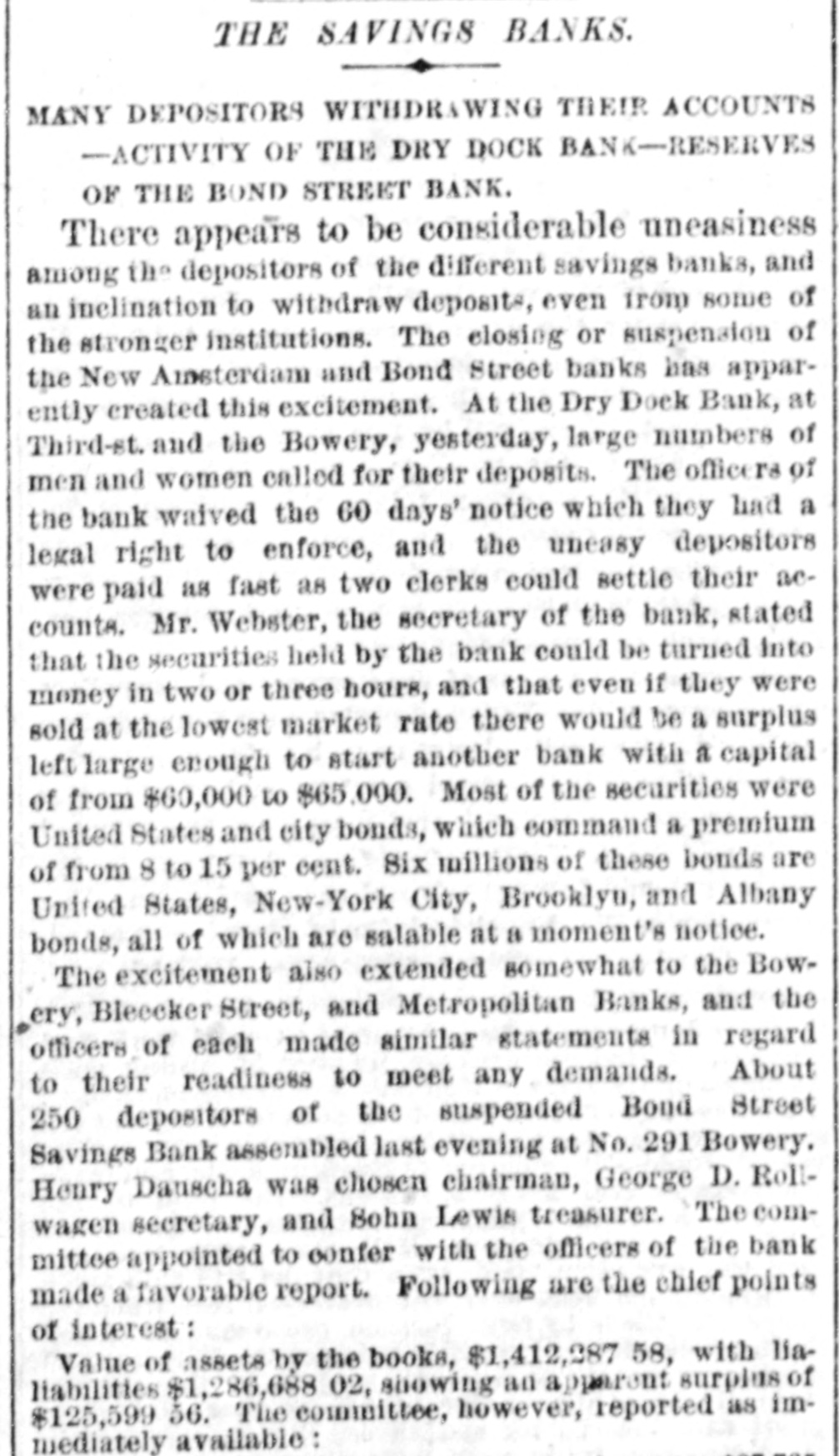
THE SAVINGS BANKS. MANY DEPOSITORS WITHDRAWING THEIR ACCOUNTS -ACTIVITY OF THE DRY DOCK BANK-RESERVES OF THE BOND STREET BANK. There appears to be considerable uneasiness among the depositors of the different savings banks, and an inclination to withdraw deposits, even from some of the stronger institutions. The closing or suspension of the New Ainsterdam and Bond Street banks has apparently created this excitement. At the Dry Dock Bank, at Third-st. and the Bowery, yesterday, large numbers of men and women called for their deposits. The officers of the bank waived the 60 days' notice which they had a legal right to enforce, and the uneasy depositors were paid as fast as two clerks could settle their accounts. Mr. Webster, the secretary of the bank, stated that the securities held by the bank could be turned Into money in two or three hours, and that even if they were sold at the lowest market rate there would be a surplus left large enough to start another bank with a capital of from $60,000 to $65.000. Most of the securities were United States and city bonds, which command a premium of from 8 to 15 per cent. Six millions of these bonds are United States, New-York City, Brooklyn, and Albany bonds, all of which are salable at a moment's notice. The excitement also extended somewhat to the Bowery, Bleeeker Street, and Metropolitan Banks, and the officers of each made similar statements in regard to their readiness to meet any demands. About 250 depositors of the suspended Bond Street Savings Bank assembled last evening at No. 291 Bowery. Henry Dauscha was chosen chairman, George D. Rollwagen secretary, and Sohn Lewis treasurer. The committee appointed to confer with the officers of the bank made a favorable report. Following are the chief points of interest: Value of assets by the books, $1,412,287 58, with lialiabilities $1,286,688 02, showing an apparent surplus of $125,599 56. The committee, however, reported as immediately available:
Article from The New York Herald, October 1, 1876

Click image to open full size in new tab

Article Text

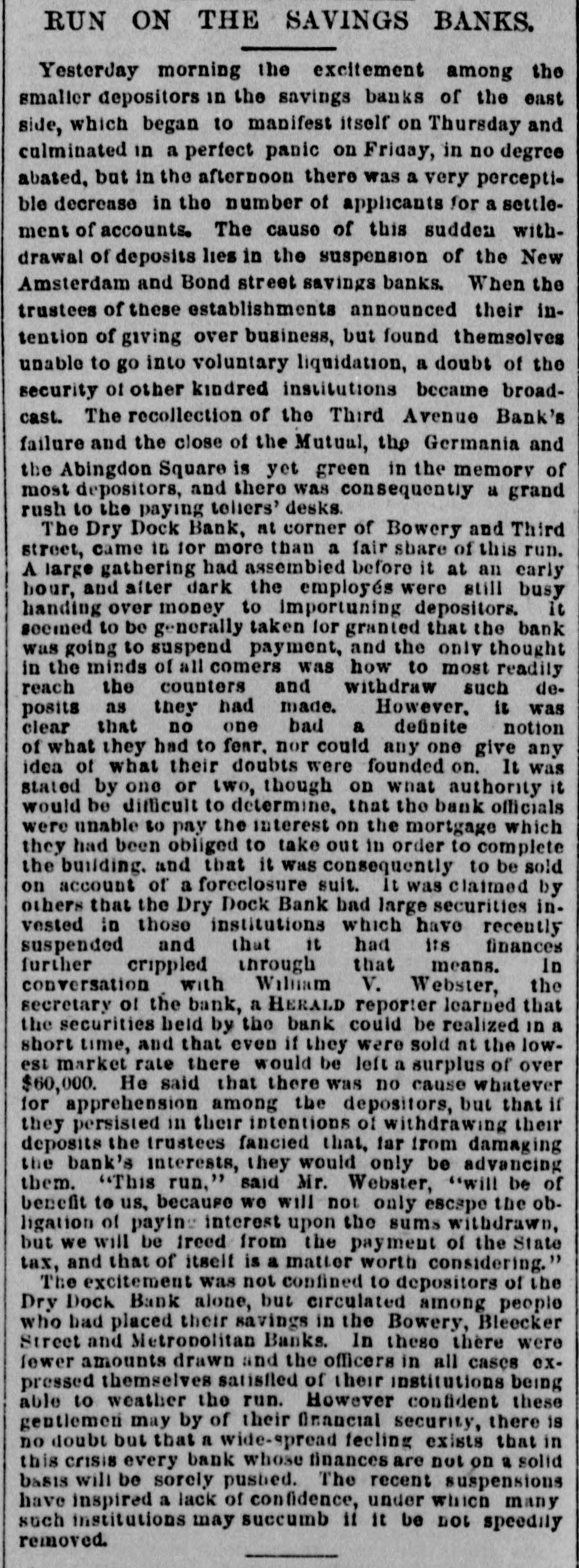
RUN ON THE SAVINGS BANKS. Yesterday morning the excitement among the smaller depositors in the savings banks of the east side, which began to manifest itself on Thursday and culminated in a perfect panic on Friday, in no degree abated, but in the afternoon there was a very perceptible decrease in the number of applicants for a settlement of accounts. The cause of this sudden withdrawal of deposits lies in the suspension of the New Amsterdam and Bond street savings banks. When the trustees of these establishments announced their intention of giving over business, but found themsolves unable to go into voluntary liquidation, a doubt of the security of other kindred institutions became broadcast. The recollection of the Third Avenue Bank's failure and the close of the Mutual, the Germania and the Abingdon Square is yet green in the memory of most depositors, and there was consequently a grand rush to the paying telsers' desks. The Dry Dock Bank, at corner of Bowery and Third street, came in for more than a fair sbare of this run. A large gathering had assembied before it at an early hour, and after dark the employรฉs were still busy handing over money to importuning depositors. it seemed to be generally taken for granted that the bank was going to suspend payment, and the only thought in the minds of all comers was how to most readily reach the counters and withdraw such deposits as they had made. However, it was clear that no one bad a definite notion of what they had to fear. nor could any one give any idea of what their doubts were founded on. It was stated by one or two, though on what authority it would be difficult to determine, that the bank officials were unable to pay the interest on the mortgage which they had been obliged to take out in order to complete the building. and that it was consequently to be sold on account of a foreclosure suit. It was claimed by others that the Dry Dock Bank bad large securities invested in those institutions which have recently suspended and that it had its finances further crippled through that means. In conversation with William V. Webster, the secretary of the bank, a HERALD reporter learned that the securities held by the bank could be realized in a short time, and that even if they were sold at the lowest market rate there would be left a surplus of over $60,000. He said that there was no cause whatever for apprehension among the depositors, but that if they persisted in their intentions of withdrawing their deposits the trustees fancied that, far from damaging the bank's interests, they would only be advancing them. "This run," said Mr. Webster, "will be of benefit to us, because we will not only escspe the ob. ligation of paying interest upon the sums withdrawn, but we will be freed from the payment of the State tax, and that of itself is a matter worth considering." The excitement was not confined to depositors of the Dry Dock Bank alone, but circulated among people who had placed their savings in the Bowery, Bleecker Street and Metronolitan Banks. In these there were fewer amounts drawn and the officers in all cases expressed themselves satisfied of their institutions being able to weather the run. However confident these gentlemen may by of their financial security, there is no doubt but that a wide-spread feeling exists that in this crisis every bank whose finances are not on a solid basis will be sorely pushed. The recent suspensions have inspired a lack of confidence, under which many such institutions may succumb if it be not speedily removed.


Article from The New York Herald, February 18, 1877

Click image to open full size in new tab

Article Text

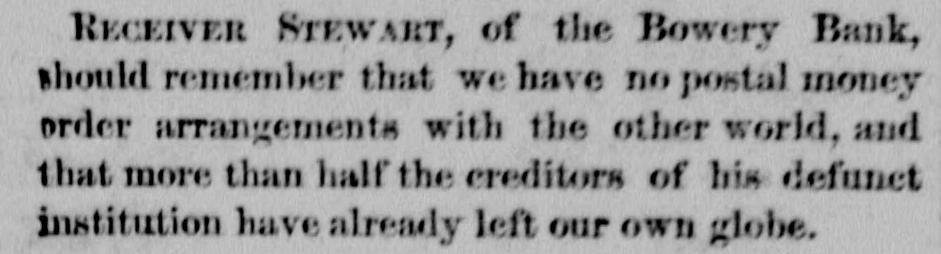
RECEIVER STEWART, of the Bowery Bank, should remember that we have no postal money order arrangements with the other world, and that more than half the creditors of his defunet institution have already left our own globe.


Article from The New York Herald, June 24, 1877

Click image to open full size in new tab

Article Text

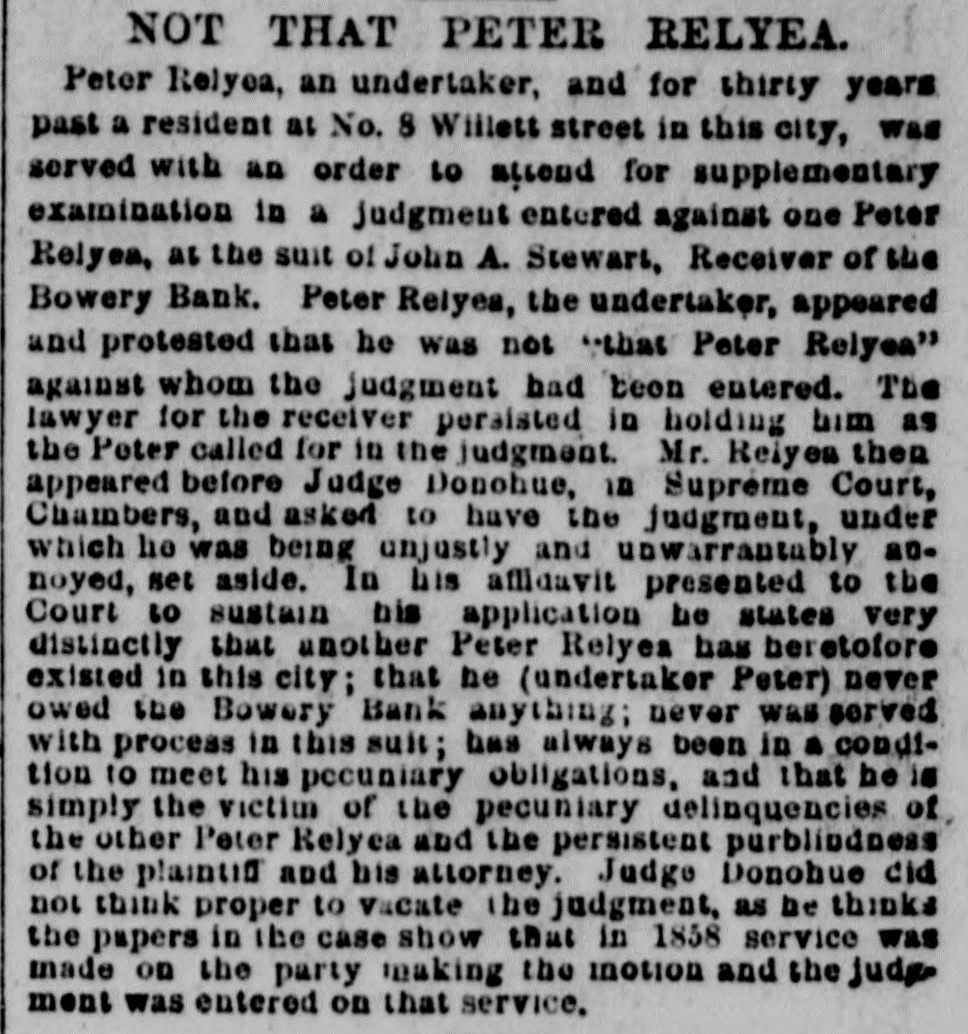
# NOT THAT PETER RELYEA. Peter Relyea, an undertaker, and for thirty years past a resident at No. 8 Willett street in this city, was served with an order to attend for supplementary examination in a judgment entered against one Peter Relyea, at the suit of John A. Stewart, Receiver of the Bowery Bank. Peter Relyea, the undertaker, appeared and protested that he was not "that Peter Relyea" against whom the judgment had been entered. The lawyer for the receiver persisted in holding him as the Peter called for in the judgment. Mr. Relyea then appeared before Judge Donohue, in Supreme Court, Chambers, and asked to have the judgment, under which he was being unjustly and unwarrantably annoyed, set aside. In his affidavit presented to the Court to sustain his application he states very distinctly that another Peter Relyea has heretofore existed in this city; that he (undertaker Peter) never owed the Bowery Bank anything; never was served with process in this suit; has always been in a condition to meet his pecuniary obligations, and that he is simply the victim of the pecuniary delinquencies of the other Peter Relyea and the persistent purblindness of the plaintiff and his attorney. Judge Donohue did not think proper to vacate the judgment, as he thinks the papers in the case show that in 1858 service was made on the party making the motion and the judgment was entered on that service.