Lincoln Trust Company (New York, NY)

Episode Information

Episode UID
1011671594
Episode Type
Run Only
Bank Type
trust
Bank ID
101167 routing
Routing Number
1-0116
Start Date
October 25, 1932
Location
New York, New York (40.714, -74.006)

Metadata

Model
gpt-5-mini (chosen from majority vote of a three-model LLM ensemble)
Short Digest
4948477767ab3e09

Response Measures

None

Events (2)

1. October 25, 1932 Run
Cause
Local Banks
Cause Details
Runs began after suspensions of nearby banks (Twelfth Ward Bank and Hamilton Bank) triggered depositor withdrawal from Lincoln Trust Company.
Newspaper Excerpt
A run was started on the Lincoln Trust Company and at 9:30 a crowd of depositors gathered in front of the doors and were forced to form a line. At 10 o'clock the doors opened and a run began.
Source
newspapers
2. March 10, 1933 Run
Cause
Macro News
Cause Details
Wider banking panic following major bank closures/suspensions (Knickerbocker, National Bank of America) precipitated runs on Lincoln Trust Company.
Newspaper Excerpt
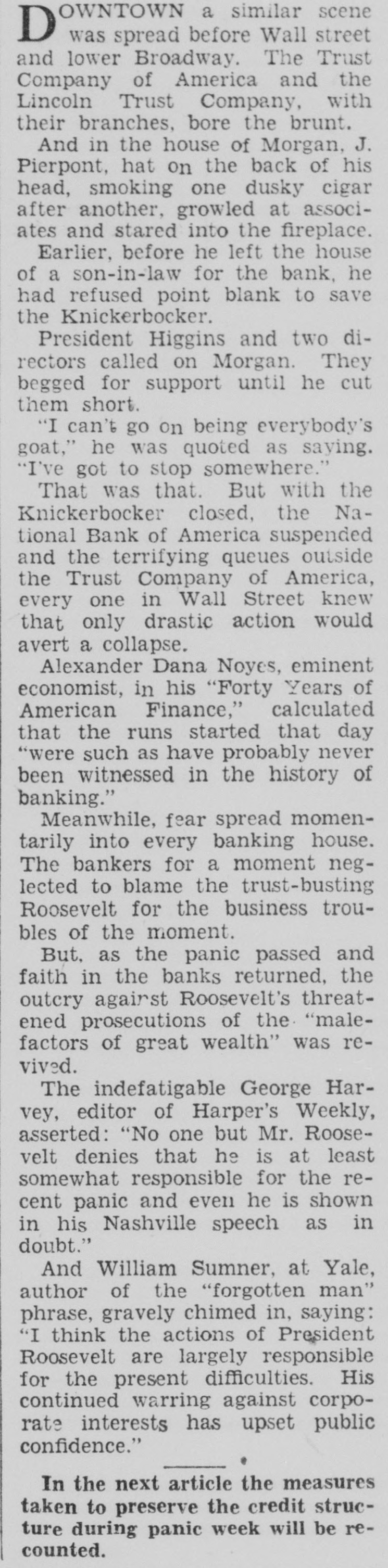
The Trust Company of America and the Lincoln Trust Company, with their branches, bore the brunt... the Knickerbocker closed, the National Bank of America suspended and the terrifying queues outside the Trust Company of America
Source
newspapers

Newspaper Articles (2)

Article Text

50 AND 25 YEARS AGO at the doors of the Trust Company of America at 3 o'clock this morning, and, as the day dawned, the number in line increased. With the London market strong and a general advance from one to three points in the entire list, the New York market took hope. However, the Twelfth Ward Bank and the Hamilton Bank suspended this morning. A run was started on the Lincoln Trust Company and at 9:30 a crowd of depositors gathered in front of the doors and were forced to form a line. At 10 o'clock the doors opened and a run began. The contract for the construction of an eight-room school house, to be erected in DeSoto, has been awarded to Contractor Hager, of this city. The price is $15,000. The building will be one of the consolidated schools and well constructed of brick and stone.


Article from The Indianapolis Times, March 10, 1933

Click image to open full size in new tab

Article Text

OWNTOWN a similar scene D was spread before Wall street and lower Broadway. The Trust Company of America and the Lincoln Trust Company, with their branches, bore the brunt. And in the house of Morgan, J. Pierpont, hat on the back of his head, smoking one dusky cigar after another, growled at associates and stared into the fireplace. Earlier, before he left the house of a son-in-law for the bank, he had refused point blank to save the Knickerbocker. President Higgins and two directors called on Morgan. They begged for support until he cut them short. "I can't go on being everybody's goat," he was quoted as saying. "I've got to stop somewhere." That was that. But with the Knickerbocker closed, the National Bank of America suspended and the terrifying queues outside the Trust Company of America, every one in Wall Street knew that only drastic action would avert a collapse. Alexander Dana Noyes, eminent economist, in his "Forty Years of American Finance," calculated that the runs started that day "were such as have probably never been witnessed in the history of banking." Meanwhile, fear spread momentarily into every banking house. The bankers for a moment neglected to blame the trust-busting Roosevelt for the business troubles of the moment. But, as the panic passed and faith in the banks returned, the outcry agairst Roosevelt's threatened prosecutions of the "malefactors of great wealth" was revived. The indefatigable George Harvey, editor of Harper's Weekly, asserted: "No one but Mr. Roosevelt denies that he is at least somewhat responsible for the recent panic and even he is shown in his Nashville speech as in doubt." And William Sumner, at Yale, author of the "forgotten man" phrase, gravely chimed in, saying: "I think the actions of President Roosevelt are largely responsible for the present difficulties. His continued warring against corporate interests has upset public confidence." . In the next article the measures taken to preserve the credit structure during panic week will be recounted.