
New York Clearing House (New York, NY)

Episode Information

Episode UID
1020071294
Episode Type
Suspension โ†’ Reopening
Bank Type
trust
Bank ID
102007 routing
Routing Number
1-0200
Start Date
October 26, 1907
Location
New York, New York (40.714, -74.006)

Metadata

Model
gpt-5-mini (chosen from majority vote of a three-model LLM ensemble)
Short Digest
08aca585d3d04e2a

Response Measures

None

Events (1)

1. October 26, 1907 Suspension
Cause
Macro News
Cause Details
Clearing house suspended specie payments and authorized loan/clearing-house certificates during the 1907 financial panic to stem nationwide bank failures and liquidity crisis.
Newspaper Excerpt
Oct. 26 New York Clearing House authorized use of loan certificates.
Source
newspapers

Newspaper Articles (4)

Article from The Montgomery Advertiser, December 29, 1907

Click image to open full size in new tab

Article Text

July 18-The Korean ministry re. signed July 19-The Emperor of Kotea abdicated July 20 The Hague Conference approved the proposal to adopt the Red Cross conv ention to naval warfare July 23- The new port of Zeebruggo opened by King Leopold of Belgium. July 24- Cabinet crisis in Newfound!and. July 25-Japan and Korea agreed on Japanese control over Korean affairs arbiJuly -Venezuela refused to trate the American claims. July William D Haywood acquitted of the murder of ex-Governor of Steunenberg Idaho. July First election held for the Philippine Assembly Aug. -Alabama revoked the license of the Southern Rallway to do business in the State. Aug Judge, Landis fined the Standard Oil Company $29,240,000 for accepting freight rebates. Aug. Gocernor Smith of Georgia signed the State prohibition bill Aug. The Southern Railway conceded the demands of Alabama regarding passenger rates. Aug 9-A strike of telegraph operators spread through many American cities. Aug. 10 Wisconsin Central Railway Company fined $17,000 for rebating Aug. 11-The Eighth International Zionist Congress opened at The Hague Aug. 15 King Edward and Emperor Francis Joseph met near Ischl Aug. 18-The International Socialist Congress opened at Stuttgart Aug. 19 -The Transvaal Parliament voted to buy the Culinan diamond and present it to King iward. Aug. 20 President Roosevelt spoke at the corperstone-laying for the PIIgrim monumentatProvincetown Mass. Aug. 23-Announcement made that sixteen American battleships would sail from the Atlantic to the Pacific coast Aug. 24 Secretary Taft, speaking in Oklahoma, attacked the proposed State Constitution Aug. 26-m House of Lords passed the deceased wife's sister marriage bill. Aug. 28-Prince Wilheim of Sweden visited President Roosevelt at Oyster Bay Aug. 31 Mirza All Asghan, Premier of Persia, killed. Sept. Fifteenth National Irrigation Congress opened in Sacramento, Cal. Sept. McKinley monument at Buf. falo dedicated. Sept. 7-A modus vivendi signed to cover the Newfoundland fisheries for the season Sept. 9- Anti-Japanese riots in Vancouver. B. Sept. 10 -Annual national encampment of Grand Army of the Republic opened at Saratoga Sept. 12 Franco-Spanish army routed the Moors at Taddert. Sept. 13 The Cunard liner Lusitania completed her maiden voyage from Queenstown to Sandy Hook in five days and minutes. Sept. 17 State Constitution adopted at a special election in Oklahoma Sept. 19-New Franco Canadian commercial treaty signed at Paris. Sept. The Hague Conference adopted the proposed convention for the institution of an international prize court Sept. 23 Trial of United States Sena. tor Borah of Idaho on charges of land frauds begun at Boise Sept. Receivers appointed for the New York City Railway Company Sept. 25- Secretary of State Root left Washington for Mexico. Sept. 28-Sir John Charles Bell elect. ed Lord Mayor of London. Sept. -President Roosevelt spoke at the dedication of the McKiniey mon. ument at Canton. Oct. President Roosevelt started on trip down the Mississippi River. Oct. Emperor of Japan received Secretary Taft in private audience at Tokio. Oct. Deep Waterways Convention held at Memphis Oct. Rodolphe Lemieux appointed Canada's envoy to Japan to take up the immigration problem. Oct. 12-Secretary Taft welcomed in Hong Kong Oct 16 Secretary Taft opened the Filipino Assembly at Manila Oct. 20-Nine balloonists started in second international aeronautic contest at St Louis. Oct.21-President Roosevelt made a speech at Vicksburg Miss Oct. 22 -Knickerbocker Trust Com. pany of New York suspended. Oct -Secretary Cortelyou took steps to relieve the financial situation. Oct. 24 -Call money at 100 per cent on New York Stock Exchange Oct. 25-Several banks in New York and Brooklyn suspended Oct. 26 New York Clearing House authorized use of loan certificates. Oct. 29 -King Alfonso and Queen Victoria arrived in London. Nov. 2 -Russia Germany, Great Brit. ain and France signed a treaty guaranteeing the integrity of Norway Nov -Nearly 77.000 British railway employes voted in favor of a strike Nov. -Elections held in thirteen States, Nov 8 German Emperor and Empress left Berlin for London Nov Crown Princess of Germany gave birth to a son. Nov William J Bryan published a statement that he would accept the Democratic Presidential nomination next year. Nov. 14 Oklahoma admitted to the Union as the forty-sixth State Nov. 17 President Roosevelt an. nounced an issue of Panama bonds and interest-bearing certificates of indebtedness for financial relief. Nov. 19 Alabama Legislature voted in favor of State rohibition. Nov. 26- Ioward Maxwell deposed President of the Borough Bank of Brooklyn, committed suicide Nov. -Jamestown Tercentenary Exposition closed. Dec. Sixtieth Congress opened Dec. 8 Mrs. Annie M Bradley acquitted at Washington of the murder of former Senator Arthur Brown of Utah. Dec. National Bank of Commerce of Kansas City suspended Dec. President Roosevelt issued a statement reiterating his decision not to acceut a third term nomination Dec. 16- Fleet of sixteen American battleships left Hampton Roads for the Pacfic. Dec. -Secretary Cortelyou issued a statement denying he was a candidate for the Republican Presidential nomination Dec. 19. Personal encounter between Representative Williams of Mississippi and DeArmond of Missouri on the floor of the House of Representatives.


Article from Bryan Morning Eagle, January 19, 1908

Click image to open full size in new tab

Article Text

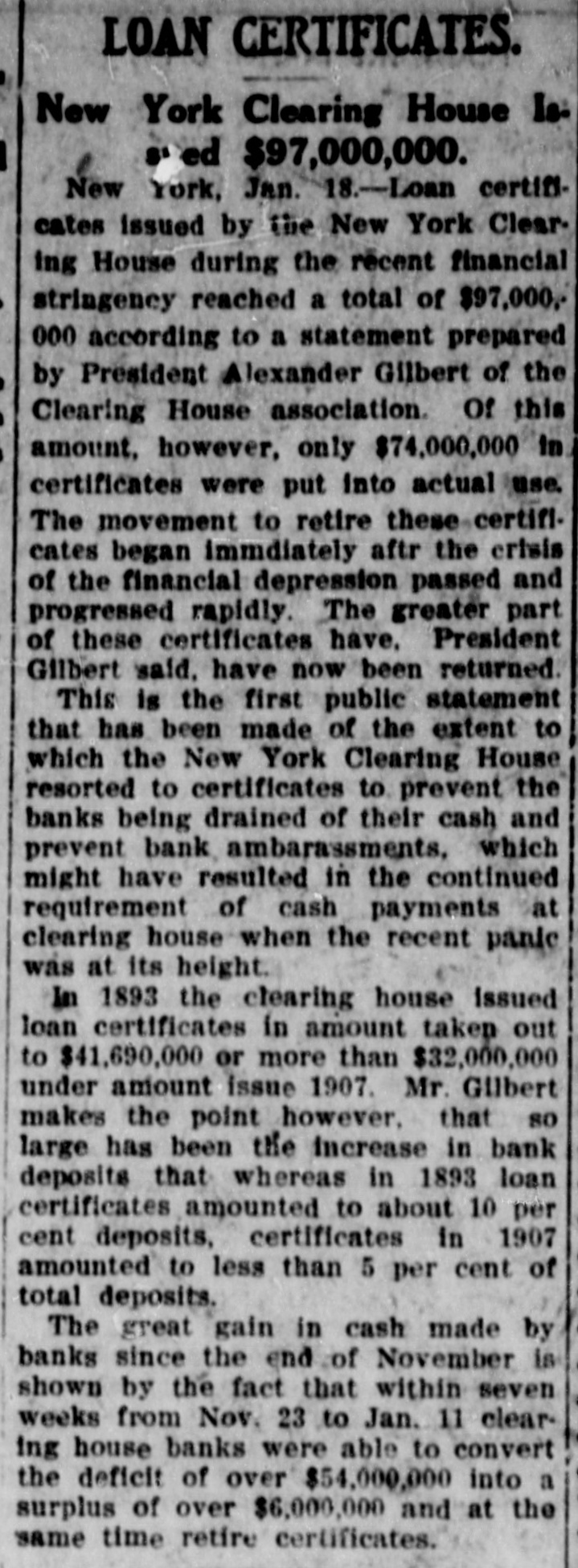
LOAN CERTIFICATES. New York Clearing House Is. ed $97,000,000. New York, Jan. 18.-Loan certificates issued by the New York Clearing House during the recent financial stringency reached a total of $97,000.000 according to a statement prepared by President Alexander Gilbert of the Clearing House association. Of this amount, however, only $74,000,000 in certificates were put into actual use. The movement to retire these certificates began immdiately aftr the crisis of the financial depression passed and progressed rapidly. The greater part of these certificates have, President Gilbert said. have now been returned. This is the first public statement that has been made of the extent to which the New York Clearing House resorted to certificates to prevent the banks being drained of their cash and prevent bank ambarassments, which might have resulted in the continued requirement of cash payments at clearing house when the recent panic was at its height. In 1893 the clearing house issued loan certificates in amount taken out to $41,690,000 or more than $32,000,000 under amount issue 1907. Mr. Gllbert makes the point however, that so large has been the increase in bank deposits that whereas in 1893 loan certificates amounted to about 10 per cent deposits, certificates in 1907 amounted to less than 5 per cent of total deposits. The great gain in cash made by banks since the end of November is shown by the fact that within seven weeks from Nov. 23 to Jan. 11 clearing house banks were able to convert the deficit of over $54,000,000 into a surplus of over $6,000,000 and at the same time retire certificates.


Article from Willmar Tribune, September 9, 1908

Click image to open full size in new tab

Article Text

Discusses National Issues. Editor Willmar Tribune: IS THE CAMPAIGN TO BE FOUGHT ON THE MONEY QUESTION? It seems SO now. In 1896 the question was how to relieve the money famine, how to supply a sufficient volume of real money, how to stop the then worldwide scramble for gold. The increased production of gold in Alaska and South Africa beginning in 1897 and continuing to the present day has for the time being supplied sufficient volume of money. But while this enormous increase in the world's supply of basic money has revived business here and elsewhere in the world, raised prices on commodities and labor, yet the experience of last fall reminded us that we may have money famines of more or less severity just the same. A year ago, about, there were several heavy bank failures in New York. The depositors of these banks or trust companies got scared and started a run. Matters became so serious that the New York clearing house suspended specie or money payment and simply issued a "I owe you.' Well, this was of course an illegal and unheard of procedure on the part of the New York clearing house. Here were hundreds and thousands of banks all over the country having deposits in the great New York banks, and these country banks in need of the money. but they could not get it; only a slip of "I owe you, which was not money-not a legal tender for debt. The situation was serious for a while. Here was a large precentage of the money of the country locked up in the banks of New York, and the banks refused to pay it out. In the mean time there were throughout the country, especially the West, hundreds of thousands of families who had mortgages on their farm and homes who, if this thing had continued for any length of time, would have lost the savings of a lifetime for want of real legal tender money to redeem it with. The clearing house certificates no doubt stayed the run and the panic, illegal as they were, but it is one of those kill or cure financial remedies that this country never wants to try again, if avoidable. The question now is, who can these bank runs be prevented? The answer is simple, provide some absolute guaranty against loss to bank depositors. But how? Well, that is the question. State and federal government inspection of banks is not sufficient. We now have that, and still bank failures and loss to depositors right along. No, the government itself must step in and guarantee the prompt payment of every depositor. Nothing else will answer to stop runs on banks in times of bank failures. Two methods are proposed by the two great parties. The Republican party proposes postal savings banks as the remedy. The post office will, of course, deposit the money in the banks to get it into circulation. But as the government steps in between the depositor and the bank, it is directly repsonsible to the depositors. The Democrats propose a deposit insurance scheme operated by the


Article from Evening Star, March 9, 1933

Click image to open full size in new tab

Article Text

SCHP ISSUES USED BEiORE IN AMERICA Clearig House Certificates Prited in 1873, 1884, 1893 and 1907. By the Asociated Press. NEW ORK. March 9.-For the second tim during the span of a lifetime, a Rooseelt is forced to grapple with the intracies of an emergency currency. Durin the panic of 1907, while nearing the nd of his term of office, President Teodore Roosevelt, Republican, saw the ountry forced to adopt the use of scrip. And nw, some 25 years later, at the very beinning of his administration, Presiden Franklin D. Roosevelt, Dempcrat, is aking a similar drastic action As a neessary step toward breaking the tanged credit situation in which the counry finds itself. Fifth Script Issue. Five dferent times in its history has lhe Ame.can Republic resorted to the expedient of issuing clearing-house certificats, or scrip. Previous to 1907. they wer put out in 1893, 1884 and 1873. Curren conditions have been cause for Wall Street veterans to recall the developmnts, similar in character. that caused baks in 1907 to supplement currency in circulation by the issuance of clearing-buse certificates. Then, S now, the country was faced by the hrrowing spectacle of the closing of on bank after another. But the situation n 1907 became acute largely as the reult of a practice followed at that time by trust companies in New York. of accepting demand deposits without te provision of regular banking safegards as to reserves. The climax cane when the Knickerbocker Trust Co. closed its doors, along with three othr trust companies and six banks. But unke the present situation. 1907 saw a stck market panic marked by several sectacular phenomena, chief of which was a demand rate for loans running u to 125 per cent. The release of $25,00(000 through the intervention of J. P. Morgan and the Exchange authorites relieved this situation, but the New York Clearing House was forced to ake additional action shortly thereafter. Suspended Cash Payments. The edior of the Commercial and Financial Chronicle. writing in 1907 about the plan of the clearing house, described : as follows: "Any bank which has a debit balance against it. instead of being obliged to settle the balance in cash, may deposit with the dearing House Committee any securities t has in its vaults, and obtain certficates representing 75 per cent of their value. With these certificates its debit balance at the clearing house can be settled. The certificates bear interst at 6 per cent." Thus, the general intent in 1907, as now, was to bring about general suspension 0 cash payments in the clearing house The loan certificates issued in 1907 renained in use for 22 weeks. New Yok's lead on October 26, 1907, in the isuance of scrip was rapidly followed with similar action by practically every clearing house in the country. The result was the issuance throughou the entire United States of $238,000,00 of scrip, as against $69,000,000 in 1893. While 10 uniform rule was followed, the certiicates were widely issued in denominaions of from $1 up, so as to facilitate usage.