Lawndale National Bank (Chicago, IL)

Episode Information

Episode UID
1024701578
Episode Type
Run → Suspension → Reopening
Bank Type
national
Bank ID
102470 national
Charter Number
10247
Start Date
June 11, 1931
Location
Chicago, Illinois

Metadata

Model
gpt-5-mini (chosen from majority vote of a three-model LLM ensemble)
Short Digest
40d3f7d2788728c6

Response Measures

Public signal of financial health

Description

1931 run was a local Chicago panic; the 1933 suspension was a statewide/federal banking holiday (not caused by the 1931 run).

Events (4)

1. August 26, 1912 Chartered
Source
historical_nic
2. June 11, 1931 Run
Cause
Macro News
Cause Details
Part of a broader Chicago banking panic/nervousness in June 1931 prompting hurried withdrawals.
Measures
Mayor Anton Cermak rushed to the bank and spoke to depositors to reassure them and halt the run.
Newspaper Excerpt
Depositors...were withdrawing their accounts from the Lawndale National bank...The mayor rushed the bank to reassure depositors and halt the run.
Source
newspapers
3. March 4, 1933 Suspension
Cause
Government Action
Cause Details
Governor Henry Horner proclaimed a mandatory three-day bank holiday for Illinois (part of national banking moratoria).
Newspaper Excerpt
A general three-day bank holiday affecting all Illinois banks was ordered...The Federal Reserve bank of Chicago joined the holiday.
Source
newspapers
4. March 8, 1933 Reopening
Newspaper Excerpt
The proclamation said that the banks must reopen Wednesday, March 8, but that withdrawals may be limited to 5 per cent during the following eight days.
Source
newspapers

Newspaper Articles (18)

Article Text

(Continued on Page HALTS RUN ON BANK CHICAGO. June The banking situation made the mayor pointment Chicago break an with the ambassador Great Britain today. Anton Cermak awaited Mayor in office visit from Ambassador Charles Dawes, former vice president. The telephone rang. Depositors, the message said, withdrawing their counts from the Lawndale Na. tional bank, in which the director. The mayor ried the bank, reassured positors halted


Article Text

DATE WITH DAWES; CHICAGO, June ated Press) The banking situation made the mayor of Chicago break an appointment with the ambassador to England today. Mayor Anton J. Cermak awaited his office visit from Gen. Charles G. Dawes, former vice president. The telephone rang. Depositors, the message said, were withdrawtheir the Lawndale National bank, in which the mayor is director. A hurry-up run to the bank and the mayor's talk to the depositors halted the returned to his office to find Dawes had gone. "I'll come again," Dawes told the mayor's secretary. came only to pay my respects." The State Bank of Beverly Hills Bank, on the south side of the city was closed today by the state auditor, at the request of the board directors. Deposits amounted $900,000. The closing brought 26 the number of banks whose doors were locked during the past week.


Article Text

by Chicago Mayor Chicago, Associated banking situamade the mayor of Chicago break with the England Mayor Anton Cermak awaited his office visit from General Charles former vice president. The telephone Depositors, message said, their from the LawnNational bank, in which the director. run the bank and mayor's talk the depositors halted the he his office to find Dawes had gone. come Dawes told the came only The State Bank of Beverly Hills, on the south side of the city closed today by the state auditor the request the board of directors. Deposits amounted to $900,000. the Garfield State bank, west side bank that had deposits at the last call, was closed request of its board directors. 27th outlying bank close this Several of the institutions closed earlier the started plans for today and offihoped to have them reopened soon.


Article Text

RUN ON BANK MAKES MAYOR DODGE DAWES June banking situation made the mayor Chicago break an appointment with the from Great Britain Mayor Anton Cermak awaited in his office Ambassador Charles Dawes, former vice president. The rang. Depositors, the message said, withdrawfrom the Lawndale National Bank which the mayor director. The mayor rushed the bank to reassure depositors and halt the run. But he returnDawes come and gone. "I'll come again,' the bassador said. came only pay my respects."


Article Text

RUN ON BANK MAKES MAYOR DODGE DAWES CHICAGO, June 11 banking situation made the mayor Chicago break an appointment with the from Great Britain today. Mayor Anton Cermak awaited in his office from Ambassador Charles Dawes, former vice president. The telephone rang. Depositors, the message said, withdrawaccounts from the Lawndale National Bank which the mayor director. The mayor rushed the bank to reassure depositors and halt the run. But he returnto find Dawes had come and come again," the bassador said. came only to pay my respects."


Article Text

APPOINTMENT IS BROKEN Banking Situation Prevents Meeting of Dawes and Mayor Cermak. CHICAGO. (A). The banking situation made the mayor of Chicago break an appointment with the ambassador to England. Mayor J. Cermak awaited in his office a visit from General Dawes. The telephone rang. Depositors, the message said, were withdrawing their accounts from the Lawndale National bank, in which the mayor is director. A hurryup run to the bank and the mayor's talk to the depositors halted the run-but he returned to his office to find Dawes had come and gone. "T'll come again," Dawes told the mayor's secretary. came only to pay my respects."


Article Text

CO-OP UNITS IN THIS BUILDING 100% OCCUPIED South Shore Club Flats Have Cash Balance. If you have a defaulted real estate bond and haven't been able to get the desired information regarding it from the bondholders' committee or from other sources, The Tribune may be of assistance to you. Write to "The Tribune Real Estate Bond Service, Chicago Tribune." Don't ask for informa. tion regarding more than one issue at a time. Give name of underwriter and full title of the bond. Inquiries must be by stamped, self. addressed envelope for personal reply. BY AL CHASE. One hundred per cent occupancy is for the thirty one apartments in the on of the South Shore club nts at 7000 South Shore drive, in statement issued yesterday by the Bondholders' Protective committee. The one store in the building also is rented. There are two of and one of them is occupied. Of the 148 suites in the hotel B. M. WINSTON. about 60 cent Photo.] per are rented. This building was financed through a Greenebaum Sons Investment company $1,350,000 first mortgage bond issue, at 6½ per cent. since reduced to $1,323,000. The Chicago Title and Trust company, receiver. yesterday made the following statement of cash receipts and disbursements from May 1, 1931. to Dec. 31, 1932: RECEIPTSGross $147,472 Operating expenses 760 Other disbursements... 50,892 Excess of over receipts.$ Cash balance. beginning of period. Cash balance. December 31, 1931.. 37,523 The committee is made up of B. M. Winston, Eugene V. R. Thayer, Howard Loeb, John P. Olsen, Murray Wolbach, and M. E. Greenebaum. Abel Davis is chairman and C. J. is secretary. Foreclosure proceedings have been instituted by the committee, but a decree of sale has not yet been entered. Medway Apartments. The Lawndale National bank, receiver of the Medway 6820 South Michigan reports cash on hand March 31, 1932, as $2,051 On that same date It is stated that fourteen of the nineteen suites in the building were occupied. Following is the of receipts and from July 6, 1931, to March 31, 1932: RECEIPTSrentals Operating $2,343 Receiver's fees Attorney's fees Insurance 2,908 Cash balance as of March 31. 1932. 2,052 The Medway apartments were financed through a $75,000 first mortgage bond issue, at 6½ per cent, un derwritten by the Capital Mortgage corporation. No principal payments have been made on the loan. Bonds were called for deposit last August. Lincoln Wilson Building. In statement issued yesterday by Walter C. Palmer, secretary of the Bondholders' committee, it was stated that the occupancy the first of this month in the Lincoln Wilson building. at 4600 Lincoln ave. nue, was 75 per cent for the apartments and 80 per cent for the stores. Howard Hurwith, appointed receiver on March 3. 1932, makes the following statement of disbursements from March 3, 1932 to April 30, 1932: Gross 1,359 Operating expenses .......3 556 Payments refrigerators. 105 746 Cash receiver's hands: April 1932 613 The Lincoln- building was financed by means of Lackner, Butz & Co. $150,000 first mortgage bond issue at 6½ per cent. This has since been to Bonds were called for deposit on Feb. 2, 1932.


Article Text

FOSTER DENIES REDS BACKING BANK ATTACK CHICAGO, July 28.-(P)-Authors of communistic propaganda found in a Pontiac, Mich., hotel were sought today by the secret service and detectives everywhere as the directors of a nationwide campaign against the confidence of bank depositors. Chicago bankers, government officials and Michigan police unhesttatingly blamed the communist party for systematized attack on the Integrity of financial institutions in many large cities, particularly the runs which threatened every bank in Chicago last month. It was said by C. L. Smith, prosecuting attorney at Pontiac, to have been backed by sovlet Russia. William Z. Foster. communist candidate for president, denied his organization had sponsored whispering campaign against the First National bank of Pontiac. or that man known as George Rowland. in whose room seditious letters found. was member of the party. Illinois' drastic sedition law. providing 20 years' imprisonment and directed against "anyone who advocates reformation of the government by violence or any other unlawful means," was eyed as the handlest weapon should any radicals be caught (Continued on Page Two)


Article Text

BLAMED CAMPAIGN Melvin Head, Believes Plot found were sought today by the everywhere directors against the confidence Chicago officials Michigan police blamed the Communist party for attack the integrity financial institutions in many large cities, particularly the runs which every bank Chicago last month It said by prosecuting attorney Pontiac, have been backed by Soviet Russia William Foster. Communist candidate for president, denied organization had sponsored whisagainst the First pering campaign National bank Pontiac, that man known George ist whose room seditious was member of the party. 'Rowland,' believed today to be really George E. once candidate for president Queens Borough New York City and with record for criminal Michigan since last in August. Illinois' drastic sedition law. 20 years imprisonment and directed against "anyone who advocates the violence or any other ernment by unlawful means, was eyed as the should any radihandiest weapon caught and connected be the Pontiac more than the caused ing two in citadels soundest store upwards of order to meet cash on hand in mands of longer The situation definitely acute, appeared the Pontiac let references from Chicago, advising sent "much that there and progress on jugs in president of Melvin National bank and the First American Bankers head of the association, er blamed the 'radicals, "plot to be he believed the he said that he had and cities that ports from many used in frightenilar system was teledepositors by anonymous ing messages. bankers told how Other Chicago 300 400 bank radicals opened withdrew them accounts and en spreading news simultaneously, the


Article Text

BANK PLOTTERS SOUGHT. Widespread Search Made for Men Traced to Pontiac, Mich. CHICAGO. July of Communistic propaganda found in Pontiac, Mich., hotel were sought today by the secret service and everywhere as the directors of against the confidence of bank depositors. Chicago bankers, government officials and Michigan police unhesitatingly blamed the Communist party for systematized attack on the integrity of financial institutions in many large cities, particularly the runs which every bank in Chicago last month. It was said by prosecuting attorney at Pontac, to have been backed by soviet William Z. Foster, Communist candidate for president, denied his organization had sponsored pering against the First National Bank of Pontiac, or that man known as George Rowland, in whose room seditious letters were found, was a. member of the party.


Article Text

NET SPREAD RED BANK PLOT CHICAGO July 28 Authors of Communistic propaganda found sought today by the secret service and detactives everywhere as directors nationwide campaign against the confidence of bank depositors. Chicago bankers government of ficials and Michigan police unhesitatingly blamed the Communist party for systematized attack on the integrity of financial institutions many large cities. particularly the runs which threatened every bank in Chicago last month. It was said by C. L. Smith, pros ecuting attorney at Pontiac to have been backed by Soviet Rus William Z. Foster Communist candidate for President, denied that his organization had sponsored whispering campaign against the First National Bank of Pontiac, or that man known as George Row ters were found. was member of the party Illinois' drastic sedition law provides 20 years imprisonment for "anyone who advocates reformation of the government by violence or any other unlawful means." Chicago's June bank rons closed more than 40 institutions and caused the city's soundest financial citadels to store upwards of $100.000,000 in cash on hand in order to meet demands of depositors. The situation here. no longer acute, appeared definitely linked with references in the Pontiac let ters sent from Chicago, advising 'Rowland' that there was "much progress here" and runs on jugs in loop."


Article from Evening Star, March 4, 1933

Click image to open full size in new tab

Article Text

EARLY U. S. ACTION PLANNED ON BANKS New York and Illinois Declare Holidays—Only Four States Unrestricted. Connecticut took similar action, bringing to 43 the list of States in which restrictions on withdrawals are operative in some form or another. Only Montana, Colorado, North Dakota and South Carolina remained without restrictions at noon today. Delaware's banks were open, but the State Legislature has already taken emergency action. These developments had brought from Representative Rainey, the next Speaker of the House, the prediction that "an extra session of Congress will be called at the earliest possible time." He said he felt that early next week, possibly Tuesday, would not be too soon. Previously Rainey had told House members-elect to remain in Washington. Others at the Capitol said the session probably would begin Wednesday. The Federal Reserve Bank of New York was closed with all other banking institutions of that State. The Federal Reserve Bank at Philadelphia also closed, under a holiday declared throughout Pennsylvania by Gov. Pinchot. Later in the day the Minneapolis Federal Reserve Bank suspended business. The closing of the New York Federal Reserve Bank meant the tying up of its huge gold reserve for the period of the holiday against withdrawal by either domestic or foreign agencies. In discussing the banking relief program, Senator Robinson said: "We do not know just when it will be completed, but it will be expedited all possible. The details can not be announced right now but you may be assured there will be no delay." Wagner Plans Action. Previously Senator Wagner, Democrat, of New York, had told newspaper men he would carry immediately to Democratic leaders an appeal for immediate emergency banking moves. Informed at his hotel here of banking moratoria in New York and Illinois, Wagner said he would appeal this morning to Democratic leaders to begin working out a program and some time this afternoon would call on Mr. Roosevelt with the same objective. A bank holiday, he said, "is the only thing to do" to meet the emergency of the banks themselves, but he added quick steps are necessary to enable them to reopen and continue operations. Harvey Couch, Democratic member of the Reconstruction Finance Corporation, was the first White House caller this morning. He said after a brief conference with President Hoover he had discussed "matters incident to the banking situation," but declined to give details. Couch conferred last night with President-elect Roosevelt. Officials in Conferences. High officials both of the outgoing Republican and incoming Democratic administrations were in conference most of the night. Secretary of the Treasury Mills said afterward the Hoover administration would have no statement, but that governors of the Federal Reserve banks in Chicago and New York would have announcements. Demands Impossible. The hours between midnight and dawn saw banking officials in many States struggling with the problem, made acute by the flurrying of nervousness on the part of depositors. As a statement by the New York Clearing House Committee put it: "The unthinking attempt of the public to convert over $40,000,000,000 of deposits into currency at one time is, on its face, impossible." The statement added that the condition clearing house banks is such that "they could, through the facilities of the Federal Reserve Bank, pay on demand every dollar of their deposits," but that withdrawals throughout the country as a whole have increased so that a "halt" is necessary "to enable the proper authorities to consider and adopt remedies to meet this situation, not for New York primarily, but for the Nation as a whole." Only a few States remained today in which restrictions on withdrawals had not been invoked. No Holiday in Virginia. In Virginia, Gov. Pollard said no general banking holidays would be declared because the State's laws already protect the banks and their depositors. In Maryland, the General Assembly early today approved the emergency banking legislation without a dissenting vote in either House. Gov. Ritchie signed it this morning, but said that the banking institutions of the State will not reopen Monday. The resources of the Reconstruction Finance Corporation earlier had been made available to hard-pressed, but solvent banks in States that have imposed moratoria on withdrawals. This was one of a number of developments yesterday that included introduction of legislation to allow postal savings checking accounts and to confer upon the incoming administration sweeping authority to maintain the security of deposits. Reconstruction Corporation officials said their policy called for lending institutions—if the loans were well secured—enough money to pay the percentage of deposits that could be withdrawn, provided the banks did not have the funds immediately available. It was emphasized this was not a new departure, but was simply the application of regulations decided upon for individual instances in the past to a situation spread into a number of States. Pinchot's Statement. Gov. Pinchot of Pennsylvania here for the inauguration issued the following statement: "Because of the declaration of a bank holiday in New York, Illinois and most of the other States, similar action in Pennsylvania has become unavoidable. "Were our banks to remain open, the demands upon them would impose an impossible burden. "Therefore, upon specific recommendation of Gov. Norris of the Philadelphia Federal Reserve Bank, I hereby declare a bank holiday throughout Pennsylvania on Saturday, March 4, 1933, and Monday, March 6, 1933." Exchange Statement. A statement issued by the Governing Committee of the New York Stock Exchange said: "The Governing Committee at a meeting held this morning in order to give full effect to the banking holiday declared by the Governor of the State of New York directed: "First, that the exchange be closed during such holiday; "Second, that members and firms registered on the exchange be prohibited from making any contracts for the purchase or sale or the borrowing or lending of any securities, and also from permitting their offices or facilities to be used for the purpose of making or carrying out any such contracts; "Third, that all deliveries be suspended on all member contracts, except on such contracts as may be cleared by or settled through the Stock Clearing Corporation, and that in such cases deliveries shall be made as the Stock Clearing Corporation shall direct."


Article Text

ILLINOIS BANKS ORDERED TO CLOSE FOR THREE DAYS CHICAGO, March 4 (AP).—A general three-day bank holiday affecting all Illinois banks was ordered early Saturday after an extended conference between leading Chicago financiers and Gov. Henry Horner. Melvin A. Traylor, president of the First National bank, made the announcement. The order will be in effect Saturday, Monday and Tuesday. Traylor said that the three-day closing order is mandatory upon all banks in Illinois by virtue of a proclamation signed by Gov. Horner. The proclamation said that the banks must reopen Wednesday, March 8, but that withdrawals may be limited to 5 per cent. during the following eight days. A statement by Gov. Horner said: "For the past several days I have been in constant conference and communication with representatives of the banks of Illinois in an effort to determine upon the best course of action in the present emergency. It has been hoped and believed that, in spite of bank holidays in states surrounding Illinois and throughout the country, the banks of this state would be able to withstand the strain that has been placed upon them. This was my viewpoint until this hour. "Friday I issued a statement to the effect that a bank holiday did not seem to be necessary in Illinois at that time. The greatest effort has been made to avoid such a necessity. The banks in Chicago alone have paid out more than $350,000,000 in the past two weeks in an effort to stem the tide. It has also been expected that the national government might take some general action, but no word in that regard has been received by me. The picture has materially changed since Friday. "Finally, after a day of unprecedented withdrawals from the banks of this state, and at the request of the Chicago Clearing House banks and the Illinois Bankers' association and with the approval of the Federal Reserve Bank of Chicago, I now deem it essential to the welfare of our citizens, and necessary for the protection of depositors who have not withdrawn their funds, to declare the bank holiday referred to in my proclamation this day issued." The Federal Reserve bank of Chicago joined the holiday and no gold was exchanged Saturday. It was said it would not reopen "until conditions warrant."


Article Text

ALL U. S. JOINS BANK HOLIDAY Nation's Leaders Lay Plans to Restore Financial Normalcy. (Continued From Page 1.) orders and gave checks for the balances. Railroad companies took emergency action, announcing broadened credit and stating that travelers would not be left stranded anywhere because of banking difficulties. FINANCIAL MECHANISM OF U. S. STANDS STILL By Claude A. Jagger. Associated Press Financial Editor. New York, March 4.—(AP)—The great financial mechanism of the United States stood still Saturday. While a new president took office promising drastic and courageous emergency action, the banks of New York and Chicago, as well as the New York stock exchange, the Chicago board of trade and other security and commodity exchanges of the nation, were closed. Financial and government officials in New York, Washington and other cities bent their efforts towards development of procedure to permit resumption of financial transactions and business settlements next week. The banking holiday movement which started in Michigan February 14 finally embraced the big financial institutions of Wall Street and La Salle street early Saturday. End Tuesday in N. Y. The holiday period was scheduled to end on Tuesday in New York, on Wednesday in Chicago, and to terminate on either Tuesday or Wednesday in most other large states. Reports from over the country depicted a nation accepting with fortitude and good cheer an unparalleled experience in the modern industrial era in the United States. In the meantime, shortages of cash to meet ordinary living expenses failed to develop to any extent, and banks in a number of localities provided cash to meet payrolls. Business and commerce functioned with little interference, with the practice of extending credit or accepting checks widespread. The New York clearing house and associations of banks in other cities met to develop methods of resuming banking operations next week. Affects World. The effect of the virtual standstill in banking in the United States, world's richest nation with more than a third of the world's supply of monetary gold, brought international financial transactions to a standstill over much of the world. In London, long the world center of international finance, quotations on American dollars and all other foreign exchanges were suspended, as well as quotations on gold. As a result, foreign exchange transactions were at a standstill in Paris and many other capitals. It was the first time the dollar had not been quoted in a number of leading capitals since the Civil war. The New York and Chicago federal reserve banks, as well as most of the other 10 reserve institutions, closed, owing to general bank holidays, although no formal order was issued from the federal reserve board at Washington. The reserve banks of Cleveland, San Francisco and Richmond were open, however, and the Kansas City reserve institution transacted business for banks in its territory that were open. The closing of the New York reserve bank checked the large withdrawals of gold for hoarding and export which had developed. The sub-treasury in New York was open and redeemed treasury certificates for gold as usual, although it paid out metal only in $5,000 bars, doing no business in coin. Bankers Hold Meetings. Leading New York bankers held meetings at the New York clearing house and elsewhere Saturday after seasons through Friday night and early Saturday morning, resulting in Governor Lehman's proclamation ordering a two-day legal holiday, which came at 4 a. m. The net demand deposits of the 27 clearing house banks were reduced by $409,944,000 in the week ended Saturday the weekly clearing house statement showed, still leaving the huge total of $5,463,124,000. Bankers explained that the rush to convert bank deposits into currency had reached a point which taxed physical facilities to meet it, although the resources of the large banks and the federal reserve system remained enormous. A statement by the clearing house declared that the New York banks were in such condition that they "could, through facilities of the federal reserve bank, pay on demand every dollar of their deposits," but that it had been decided to call a temporary halt for the benefit "not of New York primarily, but of the nation as a whole." No Lack of Currency. Banking authorities said there was no lack of currency issuing facilities, or of actual currency, but that it had become imperative to check the rush for cash, to preserve the long established and efficient practice of doing business through bank checks clearances, and prevent an excess of currency which would not be needed when hysteria had subsided. The people received the news of the holiday calmly, realizing that the steps taken were in the interest of the general welfare and that the big banks here are actually in strong condition. One bank honored blanket payroll checks until the noon closing hour; and persons who sought access to safety deposit boxes, which had swallowed up large amounts of currency this week, encountered no difficulties. Financial authorities explained that 90 per cent of the nation's business was normally transacted through the medium of bank checks and pointed out that total currency in circulation, even at the record figure of $6,720,000,000 shown in this week's report, was only a fraction of the total of more than $40,000,000,000 in bank deposits in the country, so that it was apparent the hysterical movement to convert deposits into cash had to be checked unless currency were to be extended to ridiculous levels. Suggestions for resuming banking business dealt chiefly with methods of increasing check circulation, and the records of 1907, when a real shortage of money necessitated various expedients were closely scrutinized. At that time, clearing house associations in New York and other leading cities issued clearing house certificates, which were used to settle transactions and to some extent circulated as currency. The present problem was seen as reflecting chiefly a lack of confidence, rather than a lack of currency, or a lack of banking facilities. If currency were brought out of hoarding, it was explained, there would be more than enough, for the amount issued is now far above that outstanding in the halcyon days of 1928 and 1929. A statement was issued by the federal reserve bank, supplementing yesterday's statement, which resulted in a sharp reduction of the gold decrease reported Friday. Friday's report, showing transactions up to 3 p. m., had indicated a loss of $116,439,600, through earmarkings for foreign account and exports, the largest reduction ever reported for a single day. It was revealed Saturday, however, that after 3 p. m., there had been a decrease in gold held for foreign account of $39,754,500, resulting in the addition of that amount to American stocks of metal. This left the nation's gold stock at the end of the week at about $4,245,000,000, more than a third of all the monetary gold in the world, and about $336,000,000 above the level reached last June 15, as a result of the large loss of metal during the spring of 1932. Saturday's holiday was the first emergency action which stopped gold transactions since exports of the metal were restricted in the war years, from October, 1917, to June, 1919. The closing of the stock exchange was the first time trading has been halted in this market by economic circumstances since 1914, when the war scare forced suspension, although the bull market of 1928 and the selling panic late in 1929 forced restriction of trading hours to permit clerical forces to catch up with the work. Extended week-ends were also taken in November of 1929 to give rest to clerks who had been working night and day. After the closing of the exchange at the end of July, 1914, no trading was permitted until November 28, when restricted dealings in bonds were resumed, and December 12, when trading was again started in stocks. TERMS OF ILLINOIS HOLIDAY LISTED Chicago, March 4.—(AP)—Illinois dug down in its jeans for cash Saturday to pay its way while banks shut down for a three-day holiday decreed by Governor Henry Horner. The drastic order outlawed all checks and drafts made before Saturday unless already cleared and shut down effectively all banking in Chicago, second financial center of the country. Downstate, here and there, bankers defied the decree and opened for business as usual, declaring themselves ready to pay the full demands of depositors. But these were exceptions. Governor Horner remained in close touch with leading bankers. Terms of the holiday proclamation, briefly, were: All banks in Illinois directed to close Saturday, Monday and Tuesday. Upon reopening Wednesday for a seven-day period the banks must set aside 5 per cent of deposits as of the close of business March 3 to be paid depositors on demand. During the period March 8 to 15 any deposits made shall be segregated and held as in trust, subject to withdrawal in full if demanded. Any checks, drafts, etc., dated prior to March 4 shall not be honored. Unless the holiday is extended, all restrictions cease at midnight March 15. In the last fortnight $350,000,000 had been drained from Chicago banks alone, while the federal reserve bank's weekly report showed withdrawals of $846,515,000 by 141 banks in 36 leading cities of the seventh reserve district for the week ended March 1. The board of trade closed along with the Chicago stock and curb exchanges, stopping trading in grain and cotton futures. Immediate steps were taken, however, to maintain a cash market for grain. At the world's greatest packing center, the farmer still was able to sell his livestock for cash. Shipments Monday and Tuesday to the Chicago stockyards will be paid for by checks on the packers. Banks will be reopened in time to redeem the checks. After an extended conference at the Chicago livestock exchange, another conference on future plans was called for Tuesday. The Mercantile exchange, mammoth market for futures trading in butter and egg futures, also closed its doors, but wholesale dealers were ready to transact business with the sources of supply for fresh produce. Arrangements were made to extend personal credit. LONDON PRAISES U. S. BANK MOVE By Associated Press. Dollar transactions were suspended in the European capitals as a result of the American bank holidays. Tourists unable to cash checks were accommodated by hotels, travel agencies and some banks. London — All foreign exchange quotations were suspended and there was no quotation on gold. Currency rates in Europe are based on the dollar and there was some talk of the possibility of adopting the French franc or some other currency backed by gold as basis for exchange rates. The foreign exchange policy for Monday was not certain. American branch banks were open; the bankers praised the declaration of bank holidays in the states as a move in the right direction. The stock market closed dull after a quiet session. N. Y. CLEARING HOUSE TO ISSUE CERTIFICATES New York, March 4.—(AP)—Plans for issuing clearing house certificates as a medium for the conduct of trade at the expiration of the state banking holiday on Tuesday were worked out Saturday by the New York Clearing House association. At a meeting that lasted throughout the afternoon the large New York city commercial banks decided on this temporary arrangement as a means of facilitating commerce and providing a currency medium. Mortimer N. Buckner, president of the association, said the certificates would be printed over the week end and would be ready for distribution on Monday. The only previous occasion on which these certificates have been employed here was in the panic of 1907 when about $500,000,000 of such paper was in circulation. Clearing house certificates are paper based on bank deposits and in effect constitute currency jointly issued by a group of banks. They can be issued in small amounts. In the present situation it was pointed out workers may find it possible to have small checks honored in trade provided those checks bear a clearing house endorsement. Adoption of this plan, it was explained, would avoid issuance of an excessive amount of currency. RICH EXPLORER WEDS. London, March 4.—(AP)—Philip M. Chancellor, 25-year-old millionaire explorer, was married today to Frau l

Article Text

ILLINOIS BANKS ORDERED TO CLOSE FOR THREE DAYS CHICAGO, March 5 (AP).—A general three-day bank holiday affecting all Illinois banks was ordered early Saturday after an extended conference between leading Chicago financiers and Gov. Henry Horner. Melvin A. Traylor, president of the First National bank, made the announcement. The order will be in effect Saturday, Monday and Tuesday. Traylor said that the three-day closing order is mandatory upon all banks in Illinois by virtue of a proclamation signed by Gov. Horner. The proclamation said that the banks must reopen Wednesday, March 8, but that withdrawals may be limited to 5 per cent. during the following eight days. A statement by Gov. Horner said: "For the past several days I have been in constant conference and communication with representatives of the banks of Illinois in an effort to determine upon the best course of action in the present emergency. It has been hoped and believed that, in spite of bank holidays in states surrounding Illinois and throughout the country, the banks of this state would be able to withstand the strain that has been placed upon them. This was my viewpoint until this hour. "Friday I issued a statement to the effect that a bank holiday did not seem to be necessary in Illinois at that time. The greatest effort has been made to avoid such a necessity. The banks in Chicago alone have paid out more than $350,000,000 in the past two weeks in an effort to stem the tide. It has also been expected that the national government might take some general action, but no word in that regard has been received by me. The picture has materially changed since Friday. "Finally, after a day of unprecedented withdrawals from the banks of this state, and at the request of the Chicago Clearing House banks and the Illinois Bankers' association and with the approval of the Federal Reserve Bank of Chicago, I now deem it essential to the welfare of our citizens, and necessary for the protection of depositors who have not withdrawn their funds, to declare the bank holiday referred to in my proclamation this day issued." The Federal Reserve bank of Chicago joined the holiday and no gold was exchanged Saturday. It was said it would not reopen "until conditions warrant."


Article Text

BANKS WAIT FOR OFFICIAL NOTE To Remain Closed Until Gov. Horner Instructs Officials To Obey Woodin. CHICAGO, March 7—(AP)— Uncertain over what action to take, officials of Illinois banks kept in constant touch with Washington today, seeking an interpretation of Secretary of the Treasury Woodin's new regulations. The Continental Illinois National Bank and Trust company in Chicago, largest bank west of New York, opened and accepted new deposits for a time but ceased doing so after conferences between bank officials and communications with Washington. In addition to declining to accept new deposits, most of the banks did not meet drafts for food shipments, payrolls, or other purposes described as necessary by Secretary Woodin. There was a clearing house association meeting, however, and the outcome of it was expected to provide banks with a definite program to follow. Most of the bank officials said variations between Secretary Woodin's lightened restrictions and a bank holiday declared for Illinois last week by Gov. Henry Horner made them hesitate to open on a modified basis. Governor Horner, however, planned to issue a new proclamation later today authorizing Illinois banks to follow the regulations made by the treasury secretary. The national banks were informed by A. P. Layburn, national bank examiner, that they should obey Secretary Woodin's regulations and disregard the provisions of the state holiday. Under Horner's proclamation of last week, banks would reopen tomorrow with a 5 per cent restriction on withdrawals for the next 10 days. Several Illinois cities solved the problem of a medium of exchange by issuing scrip backed by currency. Springfield, Urbana, and Peru were among the towns taking such action. The Federal reserve bank at Chicago was understood to be ready to issue millions of dollars in certificates if authorization were received from Washington. ZION DEMOCRAT SLATE REJECTED Town Board Votes To Throw Out Democratic Ticket On Legal Technicality. The Zion township Democratic ticket today was ordered off of the ballot by the town election board in a hearing held in the sheriff's office, and at the same time a similar action was started against Independent candidates in Cuba township to keep them from the ballot. The Zion board voted two to one to reject the Democratic ticket. Supervisor B. C. Thompson and Town Clerk A. E. Hueneryager voted for rejection and Justice of the Peace Thomas McEwen for acceptance of the slate. This leaves only the Voliva ticket in the field. No Sworn Statements Attorney Joseph Bishop, of the firm of Bishop, Carey & LaRose, argued that the petitions were insufficient because there was no sworn statements attached to the petition. Attorney Earl K. Cook, counsel for the Democrats, argued that the petitions were in substantial conformity with the requirements prescribed by law. The objection to the Independent candidates in Cuba township was filed by Bishop also. Besides the alleged deficiency of sworn statements of candidacy there are numerous other defects in these petitions, he declared. May Be Unopposed If he is successful in this action it will leave candidates on the Citizen's ticket unopposed at election. This ticket is headed by Supervisor Harold D. Kelsey, of Barrington. As Kelsey and Town Clerk A. F. Grom, of Barrington, are members of the Cuba board of elections, and also candidates for re-election on the Citizen's ticket, Bishop asked County Judge P. L. Persons to appoint two other members in their place who could be considered unprejudiced. He appointed Joseph Woller and Cornelius Snyder, Republican and Democratic precinct committeemen in Cuba township. This hearing was set for Saturday morning at 9 o'clock, and will be held in the county building in a room designated by the sheriff.


Article Text

CHICAGO'S BANKS READY TO REOPEN Await Decision of Congress and State Is Withheld March ing of banks awaited the of national and state holidays and action of conBank employes were working on plans to open whatever may be forthfrom Ed banking business today was still the basis dictated by the He Scrip certificates had been prepared for the ciation, but under the new plan expanding the currency they probwill not be used. The banks handled transactions for produce, livestock, and other foodstuffs only in cash. The Chicago livestock exchange basis of holding drafts and checks pending reopenof the banks Many produce houses doing likewise The banks handled no drafts or checks.


Article from The Waterbury Democrat, March 14, 1933

Click image to open full size in new tab

Article Text

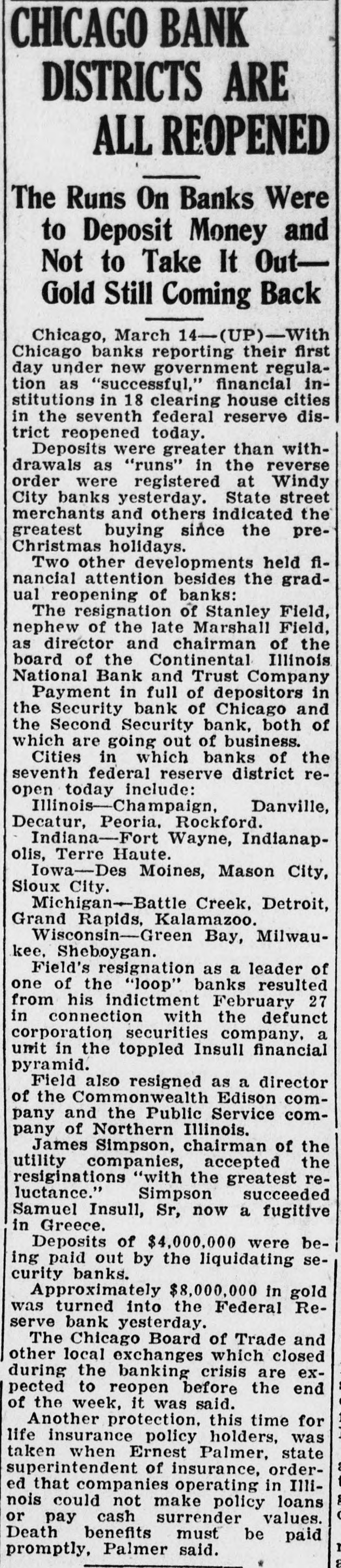
CHICAGO BANK DISTRICTS ARE ALL REOPENED The Runs On Banks Were to Deposit Money and Not to Take It OutGold Still Coming Back Chicago, March 14-(UP)-With Chicago banks reporting their first day under new government regulation as "successful," financial institutions in 18 clearing house cities in the seventh federal reserve district reopened today. Deposits were greater than withdrawals as "runs" in the reverse order were registered at Windy City banks yesterday. State street merchants and others indicated the greatest buying since the preChristmas holidays. Two other developments held financial attention besides the gradual reopening of banks: The resignation of Stanley Field, nephew of the late Marshall Field, as director and chairman of the board of the Continental Illinois National Bank and Trust Company Payment in full of depositors in the Security bank of Chicago and the Second Security bank, both of which are going out of business. Cities in which banks of the seventh federal reserve district reopen today include: Illinois-Champaign, Danville, Decatur, Peoria. Rockford. Indiana-Fort Wayne, Indianapolis, Terre Haute. Iowa-Des Moines, Mason City, Sioux City. Michigan-Battle Creek, Detroit, Grand Rapids, Kalamazoo. Wisconsin-Green Bay, Milwaukee, Sheboygan. Field's resignation as a leader of one of the "loop" banks resulted from his indictment February 27 in connection with the defunct corporation securities company, a unit in the toppled Insull financial pyramid. Field also resigned as a director of the Commonwealth Edison company and the Public Service company of Northern Illinois. James Simpson, chairman of the utility companies, accepted the resiginations "with the greatest reluctance." Simpson succeeded Samuel Insull, Sr, now a fugitive in Greece. Deposits of $4,000,000 were being paid out by the liquidating security banks. Approximately $8,000,000 in gold was turned into the Federal Reserve bank yesterday. The Chicago Board of Trade and other local exchanges which closed during the banking crisis are expected to reopen before the end of the week, it was said. Another protection, this time for life insurance policy holders, was taken when Ernest Palmer, state superintendent of insurance, ordered that companies operating in Illinois could not make policy loans or pay cash surrender values. Death benefits must be paid promptly, Palmer said.