City Trust Company (New York, NY)

Episode Information

Episode UID
1075571550
Episode Type
Suspension โ†’ Closure
Bank Type
trust
Bank ID
107557 routing
Routing Number
1-0755
Start Date
February 11, 1929
Location
New York, New York (40.714, -74.006)

Metadata

Model
gpt-5-mini (chosen from majority vote of a three-model LLM ensemble)
Short Digest
ca3539e9801c74eb

Response Measures

None

Description

Closure followed discovery of massive irregularities/forgeries and insolvency; later assets were turned over to another trust.

Events (2)

1. February 11, 1929 Suspension
Cause
Bank Specific Adverse Info
Cause Details
Closed by state superintendent after discovery of extensive fraud/forged notes, impaired capital and irregularities following death of president F. M. Ferrari.
Newspaper Excerpt
The City Trust company ... closed today by Frank H. Warder, superintendent of the state department of banking.
Source
newspapers
2. August 1, 1929 Receivership
Newspaper Excerpt
An order authorizing Joseph Broderick, State banks, turn over the assets the defunct City Trust Company to International Germanic Trust Company, thus full payment to City Trust depositors was signed today by Justice Philip McCook Supreme Court.
Source
newspapers

Newspaper Articles (22)

Article from The Times, February 11, 1929

Click image to open full size in new tab

Article Text

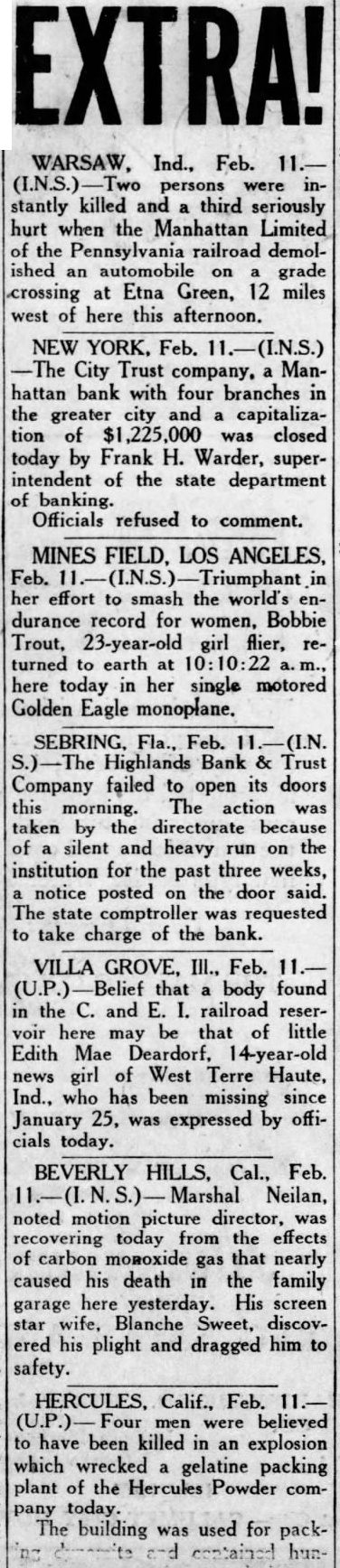
EXTRA! Ind., Feb. (I.N.S.) were inpersons stantly killed and a third seriously hurt when the Manhattan Limited of the Pennsylvania railroad demolished an automobile on grade crossing at Etna Green, 12 miles west of here this afternoon. NEW YORK, Feb. City Trust company. Manhattan bank with four branches in the greater city and capitalization of $1,225,000 closed today by Frank H. Warder, superintendent of the state department of banking. Officials refused to comment. MINES FIELD, LOS ANGELES, Feb. in her effort to smash the world's endurance record for women, Bobbie Trout, 23-year-old girl flier, returned to earth at 10:10:22 here today in her single motored Golden Eagle monoplane. SEBRING, Fla., Feb. Highlands Bank & Trust Company failed to open its doors this morning. The action was taken by directorate because of silent and heavy run on the institution for the past three weeks, notice posted on the door said. The state comptroller was requested to take charge of the bank. VILLA GROVE, III., Feb. (U.P.) Belief that body found in the C. and E. I. railroad reservoir here may be that of little Edith Mae Deardorf, 14-year-old news girl of West Terre Haute, Ind., who has been missing since January 25, was expressed by officials today. BEVERLY HILLS. Cal., Feb. Marshal Neilan, noted motion picture director, was recovering today from the effects of carbon monoxide gas that nearly caused his death in the family garage here yesterday. His screen star wife, Blanche Sweet, discovered his plight and dragged him to safety. HERCULES, Calif., Feb. Four men were believed to have been killed in an explosion which wrecked gelatine packing plant of the Hercules Powder company today. The building was used for packhun-


Article from The Times, February 11, 1929

Click image to open full size in new tab

Article Text

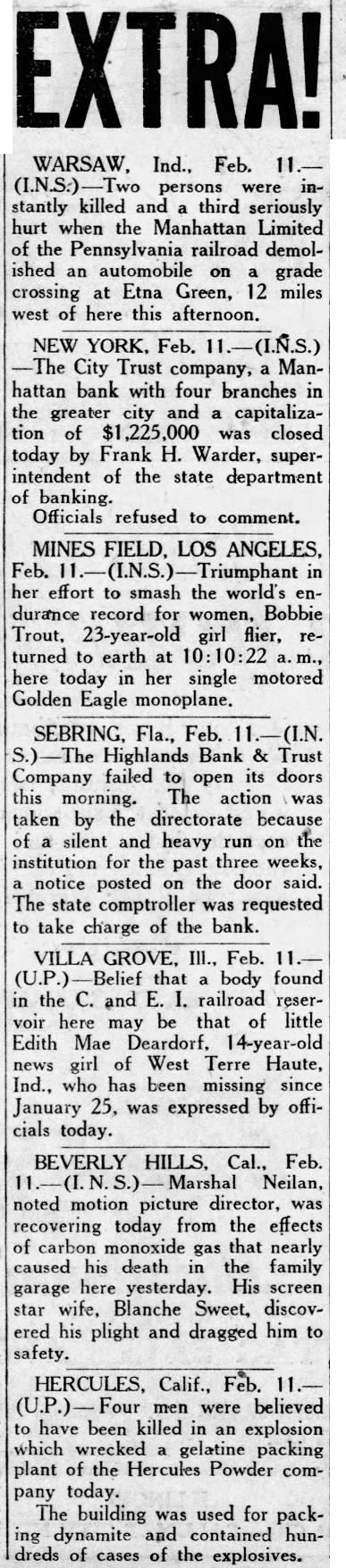
EXTRA! Ind., Feb. (I.N.S:) were inpersons stantly killed and third seriously hurt when the Manhattan Limited of the Pennsylvania railroad demolished an automobile on grade crossing at Etna Green, 12 miles west of here this afternoon. NEW YORK. Feb. (I.N.S.) The City Trust company, Manhattan bank with four branches in the greater city and capitalization of $1,225,000 was closed today by Frank H. Warder, superintendent of the state department of banking. Officials refused to comment. MINES FIELD. LOS ANGELES, Feb. (I.N.S.) Triumphant in her effort to smash the world's endurance record women, Bobbie Trout, 23-year-old girl flier, returned to earth at here today in her single motored Golden Eagle monoplane. SEBRING, Fla., Feb. Highlands Bank & Trust Company failed to open its doors this morning. The action was taken by the directorate because of a silent and heavy run on the institution for the past three weeks, notice posted on the door said. The state comptroller was requested to take charge of the bank. VILLA GROVE, III., Feb. (U.P.) Belief that body found in the C. and E. I. railroad reservoir here may be that of little Edith Mae Deardorf, 14-year-old news girl of West Terre Haute, Ind., who has been missing since January 25, was expressed by officials today. BEVERLY HILLS, Cal., Feb. Marshal Neilan, noted motion picture director, recovering today from the effects of carbon monoxide gas that nearly caused his death in the family garage yesterday. His screen star wife, Blanche Sweet, discovered his plight and dragged him to safety. HERCULES, Calif., Feb. Four were believed to have been killed in an explosion which wrecked gelatine packing plant of the Hercules Powder company today. The building was used for packing dynamite and hundreds of cases of the explosives.


Article from Wilkes-Barre Times Leader, the Evening News, February 11, 1929

Click image to open full size in new tab

Article Text

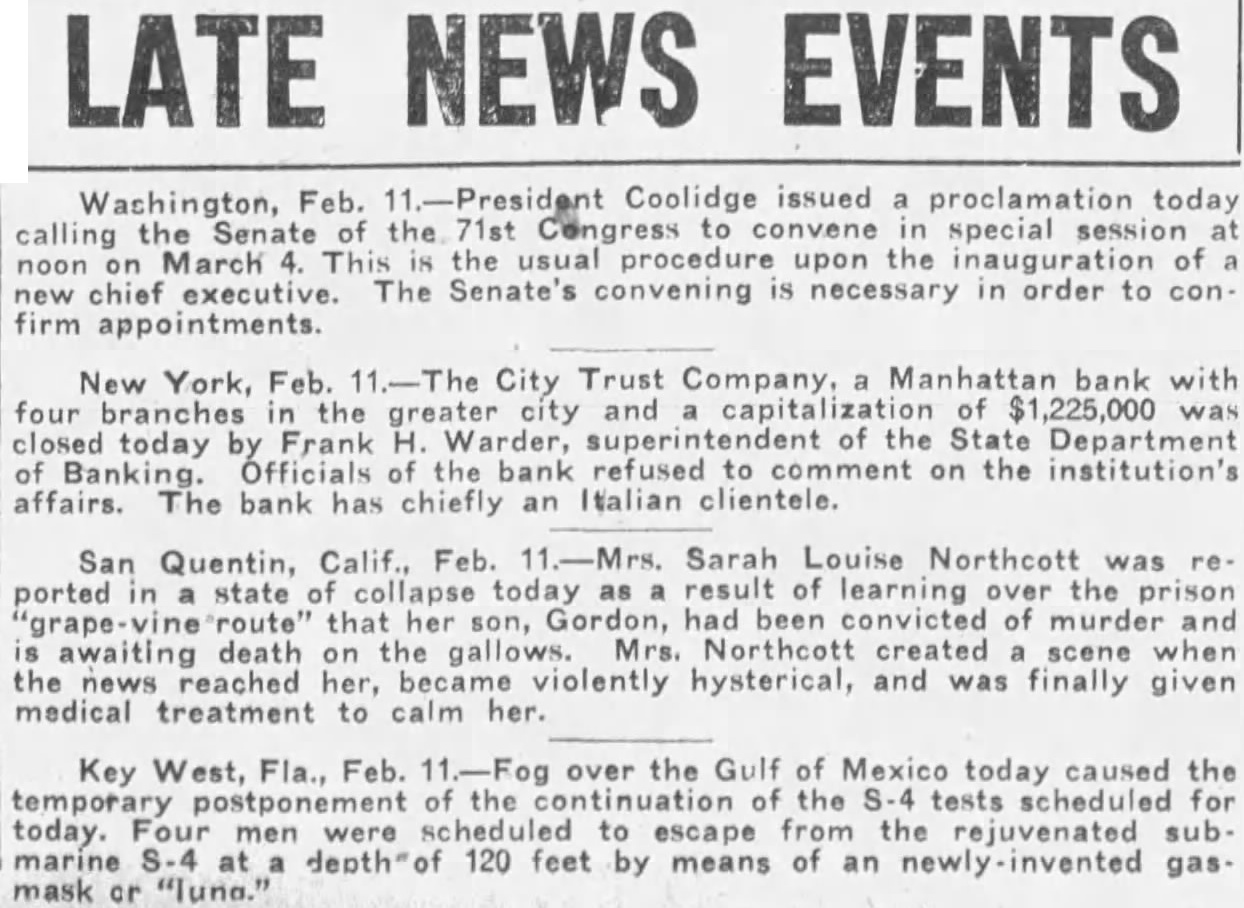
LATE NEWS EVENTS Coolidge issued proclamation today calling the the 71st This the upon the of executive. The Senate's convening is necessary in order to con New York, Feb. City Trust Company, Manhattan bank with four branches the greater and capitalization $1,225,000 closed today Warder, superintendent Department Officials the on the institution's affairs. The bank has chiefly an Italian clientele. San Quentin, Calif., Feb. 11.-Mrs. Sarah Louise Northcott was ported state today result learning the prison that Gordon, been of murder and awaiting death the gallows. Northcott created scene when the reached her, violently hysterical, and finally given medical treatment to calm Key West, Feb. over the Gulf of Mexico today caused the the the for today. scheduled escape marine 120 feet means of an mask or


Article from Brooklyn Eagle, February 11, 1929

Click image to open full size in new tab

Article Text

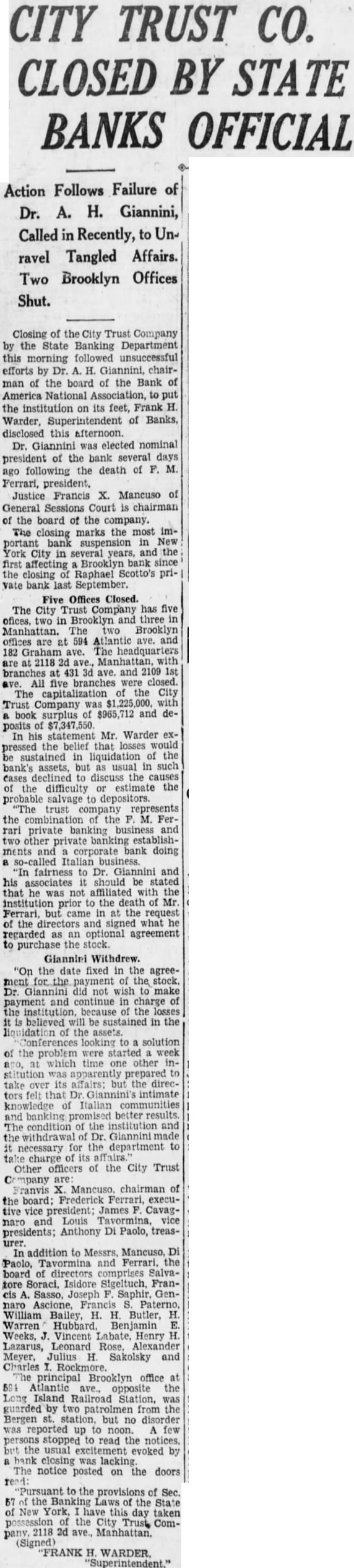
CITY TRUST CO. CLOSED BY STATE BANKS OFFICIAL Action Follows Failure of Dr. A. H. Giannini, Called in Recently, to Unravel Tangled Affairs. Two Brooklyn Offices Shut. Closing City Trust Company by the State Banking Department this followed efforts by Dr. H. chairman of the board of the Bank of America National put the institution on its feet, Frank H. Warder, Superintendent of Banks, disclosed this afternoon. Giannini was elected nominal president of the bank several ago following the death of F. M. Ferrari, president. Justice Francis X. Mancuso of General Sessions Court chairman of the board of the company. The closing marks the most imbank suspension New portant York City several years, and the affecting Brooklyn bank the closing Raphael Scotto's private bank last September. Five Offices Closed. The City Trust Company has five ofices, in Brooklyn three The two Brooklyn offices are 594 Atlantic ave. The headquarters ave., Manhattan, with branches 431 ave. and 2109 five branches were closed. The capitalization the Trust Company $965,712 and de$7,347,550. In his statement Mr. Warder exthe belief that would sustained in liquidation the assets, but usual in such cases declined discuss the difficulty estimate the probable trust the of Ferrari private other establishments and corporate doing Italian business. "In fairness to Dr. his associates should be stated not with institution the Mr Ferrari, and signed what regarded as optional agreement to purchase the stock. Gianniri Withdrew. "On the date fixed in the agreement payment the stock, Giannini not wish make payment and in charge the balieved be in the assets. looking solution of the problem week which one other apparently prepared take its but direcintimate Italian banking condition the and withdrawal Giannini for the department to necessary charge Other officers of the City Trust Mancuso. chairman of board; Frederick execuvice James Cavagnaro and Louis presidents; Anthony Di Paolo, treasaddition to Messrs, Mancuso, Paolo, directors Isidore Sigeltuch, FranSasso, Saphir, GenWilliam Bailey, H. Butler, Warren Hubbard. Benjamin Vincent Henry Lazarus, Leonard Julius Sakolsky and Charles office 591 Atlantic opposite the Island Railroad Station, guarded by two from the Bergen station. but no disorder reported up read the the usual evoked by closing was notice posted on the doors "Pursuant provisions of Sec. the State New this day the City Com(Signed) "FRANK H.


Article from Brooklyn Eagle, April 21, 1929

Click image to open full size in new tab

Article Text

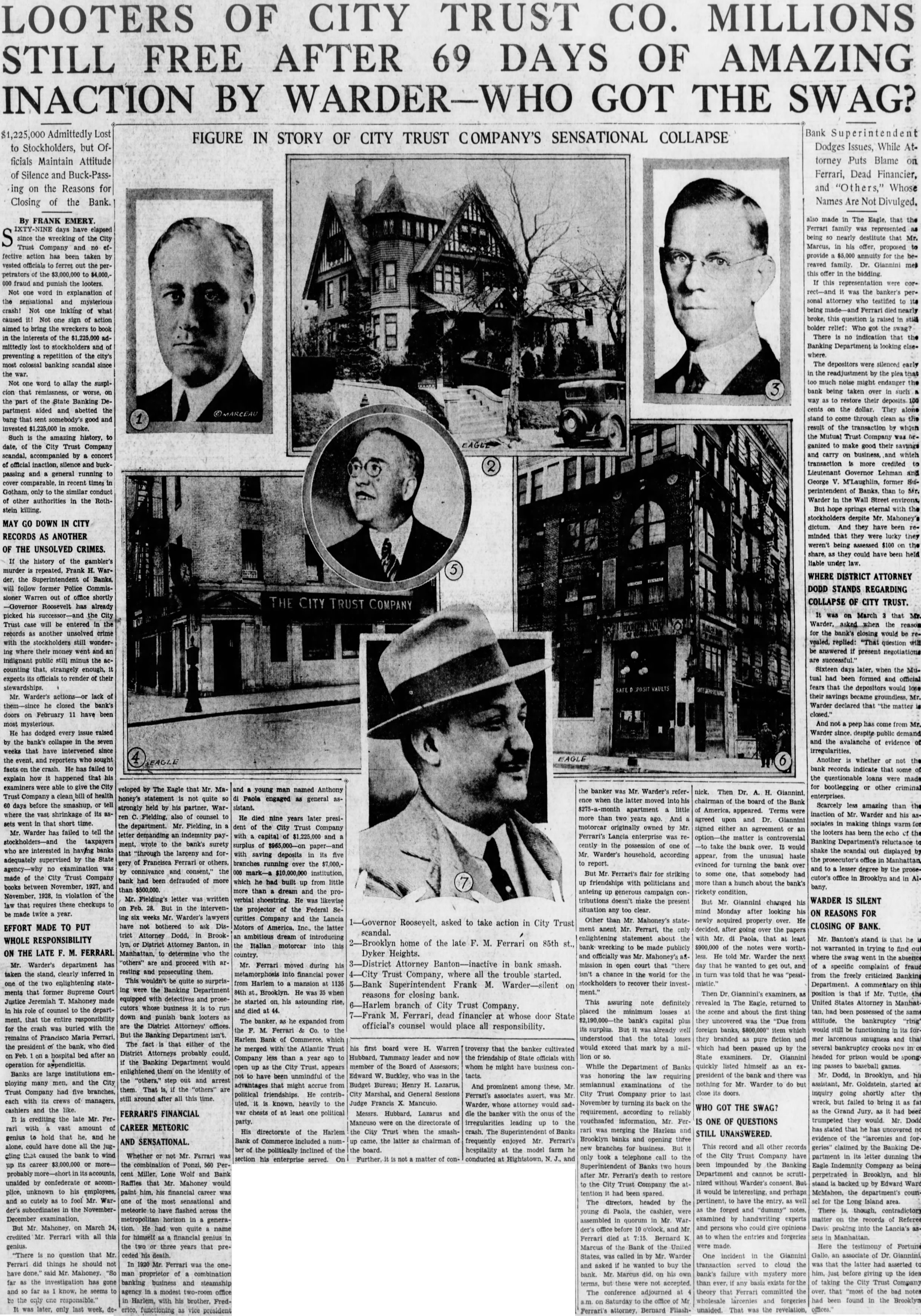
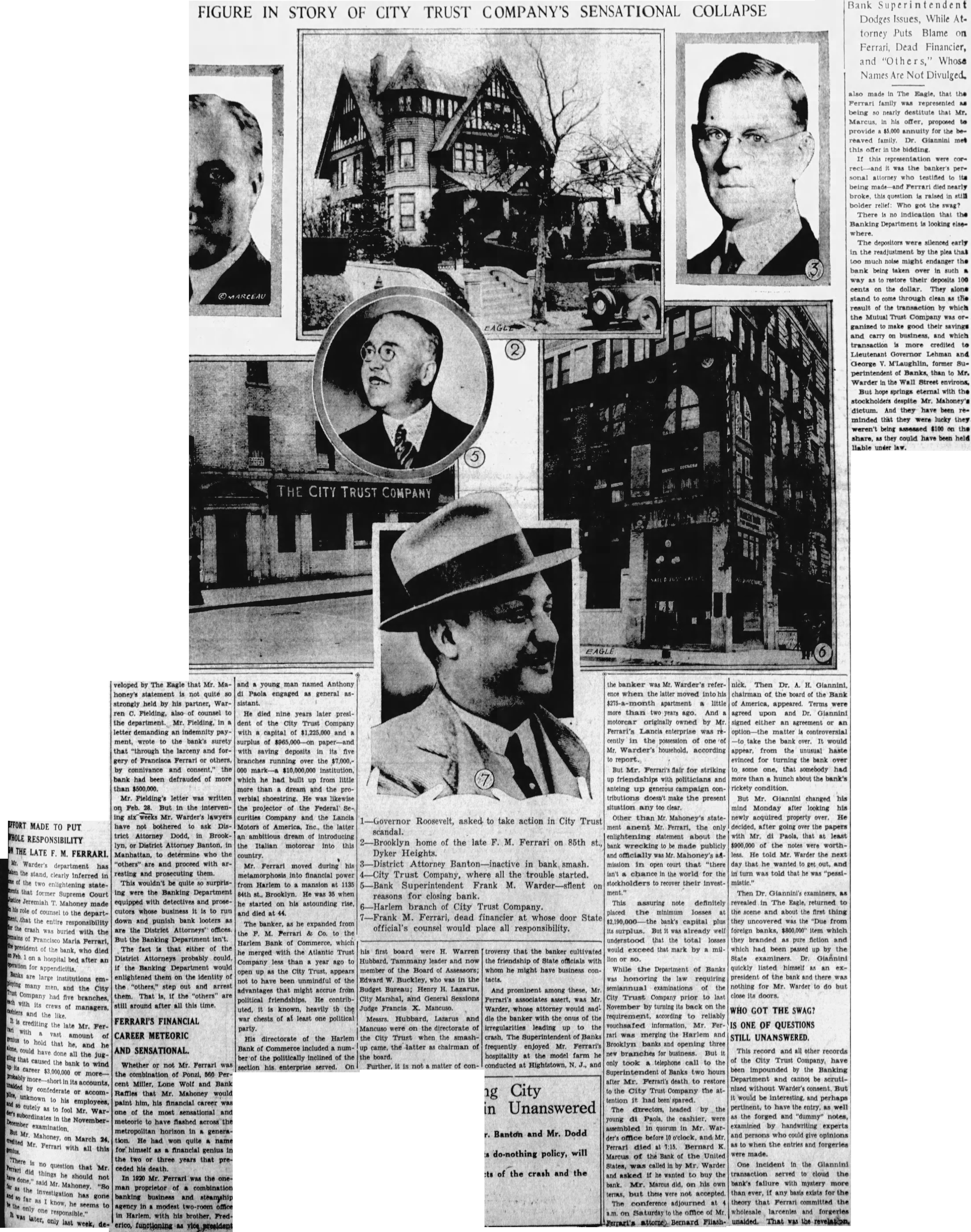
LOOTERS OF CITY TRUST CO. MILLIONS STILL FREE AFTER 69 DAYS OF AMAZING INACTION BY WARDER-WHO GOT THE SWAG? $1,225,000 Admittedly Lost to Stockholders, but Officials Maintain Attitude of Silence and Buck-Passing on the Reasons for Closing of the Bank. By FRANK EMERY. IXTY-NINE days have elapsed S since the wrecking of the City Trust Company and no effective action has been taken by vested officials to ferret out the perpetrators of the $3,000,000 to $4,000,000 fraud and punish the looters. Not one word in explanation of the sensational and mysterious crash! Not one inkling of what caused it! Not one sign of action aimed to bring the wreckers to book in the interests of the $1,225,000 admittedly lost to stockholders and of preventing repetition of the city's most colossal banking scandal since the war. Not one word to allay the suspicion that remissness, or worse, on the part of the State Banking Department aided and abetted the bang that sent somebody's good and invested $1,225,000 in smoke. Such is the amazing history, to date, of the City Trust Company scandal, accompanied by a concert of official inaction, silence and buckpassing and a general running to cover comparable, in recent times in Gotham, only to the similar conduct of other authorities in the Rothstein killing. MAY GO DOWN IN CITY RECORDS AS ANOTHER OF THE UNSOLVED CRIMES. If the history of the gambler's murder is repeated, Frank H. Warder, the Superintendent of Banks. will follow former Police Commissioner Warren out of office shortly -Governor Roosevelt has already picked his successor-and the City Trust case will be entered in the records as another unsolved crime with the stockholders still wondering where their money went and an indignant public still minus the accounting that, strangely enough, it expects its officials to render of their stewardships. Mr. Warder's actions-or lack of them-since he closed the bank's doors on February 11 have been most mysterious. He has dodged every issue raised by the bank's collapse in the seven weeks that have intervened since the event, and reporters who sought facts on the crash. He has failed to explain how it happened that his examiners were able to give the City Trust Company clean bill of health 60 days before the smashup, or tell where the vast shrinkage of its assets went in that short time. Mr. Warder has failed to tell the stockholders-and the taxpayers who are interested in having banks adequately supervised by the State agency-why no examination was made of the City Trust Company books between November, 1927, and November, 1928, in violation of the law that requires these checkups to be made twice year. EFFORT MADE TO PUT WHOLE RESPONSIBILITY ON THE LATE F. M. FERRARI. Mr. Warder's department has taken the stand, clearly inferred in one of the two enlightening statements that former Supreme Court Justice Jeremiah T. Mahoney made in his role of counsel to the department, that the entire responsibility for the crash was buried with the remains of Francisco Maria Ferrari, the president or the bank, who died on Feb. on hospital bed after an operation for appendicitis. Banks are large institutions employing many men, and the City Trust Company had five branches, each with its crews of managers, cashiers and the like. It is crediting the late Mr. Ferrari with a vast amount of genius to hold that he, and he alone, could have done all the juggling that caused the bank to wind up its career $3,000,000 or moreprobably more-short in its accounts, unaided by confederate or accomplice, unknown to his employees, and so cutely as to fool Mr. Warder's subordinates in the NovemberDecember examination, But Mr. Mahoney, on March 24. credited Mr. Ferrari with all this genius. "There is no question that Mr. Ferrari did things he should not have done," said Mr. Mahoney. "So far as the investigation has gone and so far as know. he seems to be the only one responsible." It was later, only last week, de- FIGURE IN STORY OF CITY TRUST COMPANY'S SENSATIONAL COLLAPSE veloped by The Eagle that Mr. Mahoney's statement is not quite so strongly held by his partner, Warren Fielding, also of counsel to the department. Mr. Fielding, in a letter demanding an indemnity payment, wrote to the bank's surety that "through the larceny and forgery of Francisca Ferrari or others, by connivance and consent," the bank had been defrauded of more than $500,000. Mr. Fielding's letter was written on Feb. 28. But in the intervening six weeks Mr. Warder's lawyers have not bothered to ask District Attorney Dodd, in Brooklyn, or District Attorney Banton, in Manhattan, to determine who the "others" are and proceed with arresting and prosecuting them. This wouldn't be quite so surprising were the Banking Department equipped with detectives and prosecutors whose business it is to run down and punish bank looters as are the District Attorneys' offices. But the Banking Department isn't. The fact is that either of the District Attorneys probably could, if the Banking Department would enlightened them on the identity of the "others," step out and arrest them. That is, if the "others" are still around after all this time. FERRARI'S FINANCIAL CAREER METEORIC AND SENSATIONAL. Whether or not Mr. Ferrari was the combination of Ponzi, 560 Percent Miller, Lone Wolf and Bank Raffles that Mr. Mahoney would paint him. his financial career was one of the most sensational and meteoric to have flashed across the metropolitan horizon in a generation. He had won quite a name for himself as a financial genius in the two or three years that preceded his death. In 1920 Mr. Ferrari was the oneman proprietor of a combination banking business and steamship agency in a modest two-room office in Harlem, with his brother, Frederico, functioning as vice president and a young man named Anthony di Paola engaged as general assistant. He died nine years later president of the City Trust Company with a capital of $1,225,000 and a surplus of $965,000-on paper-and with saving deposits in its five branches running over the $7,000,000 mark-a $10,000,000 institution, which he had built up from little more than a dream and the proverbial shoestring. He was likewise the projector of the Federal Securities Company and the Lancia Motors of America, Inc., the latter an ambitious dream of introducing the Italian motorcar into this country. Mr. Ferrari moved during his metamorphosis into financial power from Harlem to a mansion at 1135 84th st., Brooklyn. He was 35 when he started on his astounding rise, and died at 44. The banker. as he expanded from the F. M. Ferrari & Co. to the Harlem Bank of Commerce. which he merged with the Atlantic Trust Company less than a year ago to open up as the City Trust, appears not to have been unmindful of the advantages that might accrue from political friendships. He contributed. it is known, heavily to the war chests of at least one political party. His directorate of the Harlem Bank of Commerce included number of the politically inclined of the section his enterprise served. On 1-Governor Rooseyelt, asked to take action in City Trust scandal. 2-Brooklyn home of the late F. M. Ferrari on 85th st., Dyker Heights. 3-District Attorney Banton-inactive in bank smash. 4-City Trust Company, where all the trouble started. 5-Bank Superintendent Frank M. Warder-silent on reasons for closing bank. 6-Harlem branch of City Trust Company. 7-Frank M. Ferrari, dead financier at whose door State official's counsel would place all responsibility. his first board were H. Warren Hubbard, Tammany leader and now member of the Board of Assessors; Edward W. Buckley, who was in the Budget Bureau: Henry H. Lazarus, City Marshal, and General Sessions Judge Francis X. Mancuso. Messrs. Hubbard. Lazarus and Mancuso were on the directorate of the City Trust when the smashup came, the latter as chairman of the board. Further, it is not a matter of con- troversy that the banker cultivated the friendship of State officials with whom he might have business contacts. And prominent among these, Mr. Ferrari's associates assert, was Mr. Warder, whose attorney would saddle the banker with the onus of the irregularities leading up to the crash. The Superintendent of Banks frequently enjoyed Mr. Ferrari's hospitality at the model farm he conducted at Hightstown, N. J., and the banker was Mr. Warder's reference when the latter moved Into his $275-a-month apartment a little more than two years ago. And a motorcar originally owned by Mr. Ferrari's Lancia enterprise was recently in the possession of one of Mr. Warder's household, according to report. But Mr. Ferrari's flair for striking up friendships with politicians and anteing up generous campaign contributions doesn't make the present situation any too clear. Other than Mr. Mahoney's statement anent Mr. Ferrari, the only enlightening statement about the bank wrecking to be made publicly and officially was Mr. Mahoney's asmission in open court that "there isn't a chance in the world for the stockholders to recover their investment." This assuring note definitely placed the minimum losses at $2,190,000-the bank's capital plus its surplus. But it was already well understood that the total losses would exceed that mark by a million or so. While the Department of Banks was honoring the law requiring semiannual examinations of the City Trust Company prior to last November by turning its back on the requirement, according to reliably vouchsafed information, Mr. Ferrari was merging the Harlem and Brooklyn banks and opening three new branches for business. But it only took a telephone call to the Superintendent of Banks two hours after Mr. Ferrari's death to restore to the City Trust Company the attention it had been spared. The directors, headed by the young di Paola, the cashier, were assembled in quorum in Mr. Warder's office before 10 o'clock, and Mr. Ferrari died at 7:15. Bernard K. Marcus of the Bank of the United States, was called in by Mr. Warder and asked if he wanted to buy the bank. Mr. Marcus did. on his own terms. but these were not accepted. The conference adjourned at 4 a.m. on Saturday to the office of Mr Ferrari's attorney, Bernard Fliash- nick. Then Dr. A. H. Giannini. chairman of the board of the Bank of America, appeared. Terms were agreed upon and Dr. Giannini signed either an agreement or an option-the matter is controversial -to take the bank over. It would appear, from the unusual haste evinced for turning the bank over to some one, that somebody had more than hunch about the bank's rickety condition. But Mr. Giannini changed his mind Monday after looking his newly acquired property over. He decided. after going over the papers with Mr. di Paola, that at least $900,000 of the notes were worthless. He told Mr. Warder the next day that he wanted to get out, and in turn was told that he was "pessimistic." Then Dr. Giannini's examiners, as revealed in The Eagle, returned to the scene and about the first thing they uncovered was the "Due from foreign banks, $800,000" item which they branded as pure fiction and which had been passed up by the State examiners. Dr. Giannini quickly listed himself as an expresident of the bank and there was nothing for Mr. Warder to do but close its doors. WHO GOT THE SWAG? IS ONE OF QUESTIONS STILL UNANSWERED. This record and all other records of the City Trust Company have been impounded by the Banking Department and cannot be scrutinized without Warder's consent. But it would be interesting, and perhaps pertinent, to have the entry. as well as the forged and "dummy" notes, examined by handwriting experts and persons who could give opinions as to when the entries and forgeries were made. One incident in the Giannini transaction served to cloud the bank's failure with mystery more than ever. if any basis exists for the theory that Ferrari committed the wholesale larcenies and forgeries unaided. That was the revelation, Bank Superintendent Dodges Issues, While Attorney Puts Blame on Ferrari, Dead Financier, and "Others," Whose Names Are Not Divulged, also made in The Eagle, that the Ferrari family was represented as being so nearly destitute that Mr. Marcus, in his offer, proposed to provide $5,000 annuity for the bereaved family. Dr. Giannini mes this offer in the bidding. If this representation were correct-and it was the banker's personal attorney who testified to its being made-and Ferrari died nearly broke, this question is raised in still bolder relief: Who got the swag? There is no indication that the Banking Department is looking elsewhere. The depositors were silenced early in the readjustment by the plea that too much noise might endanger the bank being taken over in such & way as to restore their deposits. 100 cents on the dollar. They alone stand to come through clean as the result of the transaction by which the Mutual Trust Company was are ganized to make good their savings and carry on business, and which transaction is more credited to Lieutenant Governor Lehman and George V. M'Laughlin, former Sifperintendent of Banks. than to Mr. Warder in the Wall Street environs, But hope springs eternal with the stockholders despite Mr. Mahoney's dictum. And they have been reminded that they were lucky they weren't being assessed $100 on the share, as they could have been held liable under law. WHERE DISTRICT ATTORNEY DODD STANDS REGARDING COLLAPSE OF CITY TRUST. It was on March 3 that Mr. Warder, asked when the reason for the bank's closing would be revealed, replied: "That question will be answered if present negotiations are successful." Sixteen days later, when the Mutual had been formed and official fears that the depositors would lose their savings became groundless, Mr. Warder declared that "the matter is closed." And not peep has come from Mr. Warder since. despite public demand and the avalanche of evidence of irregularities. Another is whether or not the bank records indicate that some of the questionable loans were made for bootlegging or other criminal enterprises. Scarcely less amazing than the inaction of Mr. Warder and his associates in making things warm for the looters has been the echo of the Banking Department's reluctance to shake the scandal out displayed by the prosecutor's office in Manhattan, and to lesser degree by the prosecutor's office in Brooklyn and in Albany. WARDER IS SILENT ON REASONS FOR CLOSING OF BANK. Mr. Banton's stand is that he is not warranted in trying to find out where the swag went in the absence of a specific complaint of fraud from the freely criticized Banking Department. A commentary on this position is that if Mr. Tuttle, the United States Attorney in Manhattan. had been possessed of the same attitude. the bankruptcy "ring" would still be functioning in its former larcenous smugness and that several bankruptcy crooks now in or headed for prison would be sponging passes to baseball games. Mr. Dodd, in Brooklyn, and his assistant, Mr. Goldstein. started an inquiry going shortly after the wreck, but failed to bring it as far as the Grand Jury, as it had been trumpeted they would. Mr. Dodd has stated that he has uncovered no evidence of the "larcenies and forgeries" claimed by the Banking Department in its letter dunning the Eagle Indemnity Company as being perpetrated in Brooklyn, and his stand is backed up by Edward Ward McMahon. the department's counsel for the Long Island area. There is, though, contradictory matter on the records of Referee Davis probing into the Lancia's assets in Manhattan. Here the testimony of Fortune Gallo, an associate of Dr. Giannini, was that the latter had asserted to him, just before giving up the idea of taking the City Trust Company over. that "most of the bad notes had been found in the Brooklyn
Article from Brooklyn Eagle, April 21, 1929

Click image to open full size in new tab

Article Text

LOOTERS OF CITY TRUST CO. MILLIONS STILL FREE AFTER 69 DAYS OF AMAZING INACTION BY WARDER-WHO GOT THE SWAG? Lost Admittedly $1,225,000 to Stockholders, but Officials Maintain Attitude Silence and Buck-Passing on the Reasons for Closing of the Bank. By FRANK EMERY. IXTY-NINE days have elapsed since the wrecking of the City Trust Company and no effective action has been taken by rested officials to ferret out the perpetrators of the $3,000,000 to $4,000,fraud and punish the looters. Not one word in explanation of the sensational and mysterious crash! Not one inkling of what caused it! Not one sign of action aimed to bring the wreckers to book interests of the $1,225,000 admittedly lost to stockholders and of preventing repetition of the city's most colossal banking scandal since Not one word to allay the suspicion that remissness, or worse, on the part of the State Banking Department aided and abetted the bang that sent somebody's good and invested $1,225,000 in smoke. Such is the amazing history. to date, of the City Trust Company scandal, accompanied by a concert of official inaction. silence and buckpassing and general running to cover comparable, in recent times in Gotham. only to the similar conduct of other authorities in the Rothstein killing. MAY GO DOWN IN CITY RECORDS AS ANOTHER OF THE UNSOLVED CRIMES. If the history of the gambler's murder repeated, Frank H. Warder, the Superintendent of Banks, will follow former Police Commis-Governor Roosevelt has already picked his successor-and the City Trust case will be entered in the records as another unsolved crime with the stockholders still wondering where their money went and an indignant public still minus the accounting that, strangely enough, it expects its officials to render of their Mr. Warder's actions-or lack of them-since he closed the bank's doors on February 11 have been most mysterious. He has dodged every issue raised the bank's collapse in the seven weeks that have intervened since the event. and reporters who sought facts on the crash. He has failed to explain how it happened that his examiners were able to give the City Trust Company clean bill of health days before the smashup, or tell where the vast shrinkage of its assets went in that short time. Mr. Warder has failed to tell the Bockholders-and the taxpayers who are interested in having banks adequately supervised by the State agency-why no examination was made of the City Trust Company (books between November, 1927. and November. 1928, in violation of the law that requires these checkups to be made twice year.


Article from Brooklyn Eagle, April 21, 1929

Click image to open full size in new tab

Article Text

LOOTERS OF CITY TRUST CO. MILLIONS STILL FREE AFTER 69 DAYS OF AMAZING NACTION BY WARDER-WHO GOT THE SWAG? 1,225,000 Admittedly Lost Stockholders, but Officials Maintain Attitude f Silence and Buck-Passon the Reasons for Closing of the Bank. By FRANK EMERY. have elapsed days IXTY-NINE since the wrecking of the City Trust Company and no efaction has been taken by to ferret out the perto of the punish the and Not word in explanation of sensational mysterious one of what sign of action Not one bring the wreckers to book interests of the $1,225,000 adlost to stockholders and of repetition of the city's banking scandal since word to allay the suspithat remissness. or worse, on of the State Banking Deaided and abetted the somebody's good and in the amazing history, to the City Trust Company accompanied by a concert official inaction, silence and buckand general running to comparable in recent times in only to the similar conduct other authorities in the Rothkilling. DOWN IN CITY AS ANOTHER THE UNSOLVED CRIMES. history of the gambler's repeated. Frank H. WarSuperintendent of Banks, former Police CommisWarren out of office shortly Roosevelt has already his successor-and the City will be entered in the as another unsolved crime stockholders still wonderwhere their money went and an public still minus the acthat, strangely enough, it its officials to render of their Warder's actions-or lack of he closed the bank's on February 11 have been mysterious. has dodged every issue raised bank's collapse in the seven that have intervened since event. and reporters who sought the crash He has failed to how it happened that his miners were able to give the City Company clean bill of health days before the smashup, or tell the vast shrinkage of its aswent in that short time. Warder has failed to tell the teckholders-and the taxpayers are interested in having banks dequately supervised by the State gency-why no examination was of the City Trust Company between November, 1927, and November, 1928, in violation of the that requires these checkups to made twice year.


Article from Brooklyn Eagle, April 21, 1929

Click image to open full size in new tab

Article Text

MADE TO PUT RESPONSIBILITY LATE F. M. FERRARI. Warder's department has the stand, clearly inferred in the two enlightening statethat former Supreme Court Jeremiah T. Mahoney made role of counsel to the departthat the entire responsibility crash was buried with the of Francisco Maria Ferrari, president of the bank, who died on hospital bed after an operation for appendicitis. Banks are large institutions emmany men, and the City Company had five branches, with its crews of managers, cashiers and the like crediting the late Mr. Ferwith vast amount of genius to hold that he, and he could have done all the jugthat caused the bank to wind career $3,000,000 or moreprobably in its accounts, unalded by confederate or accomAlice, unknown to his employees, so cutely as to fool Mr. WarDecember subordinates in the NovemberBut Mr examination. Mahoney, on March 24. genius. credited Mr. Ferrari with all this "There is no question that Mr. have Perrari did things he should not done,' said Mr. Mahoney. "So the investigation has gone to far as know, he seems to the was only later, one responsible." only last week, de- FIGURE IN STORY OF CITY TRUST COMPANY'S SENSATIONAL COLLAPSE and a young man named Anthony di Paola engaged as general assistant. veloped by The Eagle that Mr. Mahoney's statement is not quite so strongly held by his partner, Warren C. Fielding, also of counsel to the department. Mr. Fielding, in a letter demanding an indemnity payment, wrote to the bank's surety that "through the larceny and forgery of Francisca Ferrari or others, by connivance and consent," the bank had been defrauded of more than $500,000. Mr. Fielding's letter was written on Feb. 28. But in the intervening weeks Mr. Warder's lawyers have not bothered to ask District Attorney Dodd, in Brooklyn, or District Attorney Banton, in Manhattan, to determine who the "others" are and proceed with arresting and prosecuting them. This wouldn't be quite so surprising were the Banking Department equipped with detectives and prosecutors whose business it is to run down and punish bank looters as are the District Attorneys' offices But the Banking Department isn't. The fact is that either of the District Attorneys probably could, if the Banking Department would enlightened them on the identity of the "others," step out and arrest them. That is, if the "others" are still around after all this time. FERRARI'S FINANCIAL CAREER METEORIC AND SENSATIONAL. Whether or not Mr. Ferrari was the combination of Ponzi, 560 Percent Miller, Lone Wolf and Bank Raffles that Mr. Mahoney would paint him, his financial career was one of the most sensational and meteoric to have flashed across the metropoiltan horizon in a generation. He had won quite a name for himself as a financial genius in the two or three years that preceded his death. In 1920 Mr. Ferrari was the oneman proprietor of a combination banking business and steamship agency in a modest two-room office in Harlem. with his brother. Frederico, functioning as vice president He died nine years later president of the City Trust Company with a capital of $1,225,000 and a surplus of $965,000-on paper-and with saving deposits in its five branches running over the $7,000,000 mark-a $10,000,000 institution, which he had built up from little more than a dream and the proverbial shoestring. He was likewise the projector of the Federal Securities Company and the Lancia Motors of America, Inc., the latter an ambitious dream of introducing the Italian motorcar into this country. Mr. Ferrari moved during his metamorphosis into financial power from Harlem to a mansion at 1135 84th st., Brooklyn. He was 35 when he started on his astounding rise, and died at 44. The banker, as he expanded from the F. M. Ferrari & Co. to the Harlem Bank of Commerce, which he merged with the Atlantic Trust Company less than year ago to open up as the City Trust, appears not to have been unmindful of the advantages that might accrue from political friendships. He contributed, it is known, heavily to the war chests of at least one political party. His directorate of the Harlem Bank of Commerce included number of the politically inclined of the section his enterprise served. On 1-Governor Roosevelt, asked to take action in City Trust scandal. 2-Brooklyn home of the late F. M. Ferrari on 85th st., Dyker Heights. 3-District Attorney Banton-inactive in bank, smash. 4-City Trust Company, where all the trouble started. 5-Bank Superintendent Frank M. Warder-sflent on reasons for closing bank. 6-Harlem branch of City Trust Company. 7-Frank M. Ferrari, dead financier at whose door State official's counsel would place all responsibility. his first board were H. Warren Hubbard, Tammany leader and now member of the Board of Assessors; Edward W. Buckley, who was in the Budget Bureau; Henry H. Lazarus, City Marshal, and General Sessions Judge Francis X. Mancuso. Messrs. Hubbard, Lazarus and Mancuso were on the directorate of the City Trust when the smashup came, the latter as chairman of the board. Further, it is not a matter of con- troversy that the banker cultivated the friendship of State officials with whom he might have business contacts. And prominent among these, Mr. Ferrari's associates assert. was Mr. Warder, whose attorney would saddle the banker with the onus of the irregularities leading up to the crash. The Superintendent of Banks frequently enjoyed Mr. Ferrari's hospitality at the model farm he conducted at Hightstown, N. J., and the banker was Mr. Warder's reference when the latter moved into his $275-a-month apartment a little more than two years ago. And motorcar originally owned by Mr. Ferrari's Lancia enterprise was recently in the possession of one of Mr. Warder's household. according to report. But Mr. Ferrari's flair for striking up friendships with politicians and anteing up generous campaign contributions doesn't make the present situation any too clear. Other than Mr. Mahoney's statement anent Mr. Ferrari, the only enlightening statement about the bank wrecking to be made publicly and officially was Mr. Mahoney's admission in open court that "there isn't a chance in the world for the stockholders to recover their investment." This assuring note definitely placed the minimum losses at $2,190,000-the bank's capital plus its surplus. But It was already well understood that the total losses would exceed that mark by a million or so. While the Department of Banks was honoring the law requiring semiannual examinations of the City Trust Company prior to last November by turning its back on the requirement, according to reliably vouchsafed information. Mr. Ferrari was merging the Harlem and Brooklyn banks and opening three new branches for business. But it only took a telephone call to the Superintendent of Banks two hours after Mr. Ferrari's death to restore to the City Trust Company the attention it had been spared. The directors, headed by the young di Paola, the cashier, were assembled in quorum in Mr. Warder's office before 10 o'clock. and Mr. Ferrari died at 7:15. Bernard K. Marcus of the Bank of the United States, was called in by Mr. Warder and asked if he wanted to buy the bank. Mr. Marcus did. on his own terms, but these were not accepted. The conference adjourned at 4 a.m. on Saturday to the office of Mr. Ferrari's attorne.) Bernard Fliash- But Mr. Giannini changed his mind Monday after looking his newly acquired property over. He decided. after going over the papers with Mr. di Paola, that at least $900,000 of the notes were worthless. He told Mr. Warder the next day that he wanted to get out, and in turn was told that he was "pessimistic." nick. Then Dr. A. H. Giannini, chairman of the board of the Bank of America, appeared. Terms were agreed upon and Dr. Giannini signed either an agreement or an option-the matter is controversial -to take the bank over. It would appear, from the unusual haste evinced for turning the bank over to some one, that somebody had more than hunch about the bank's rickety condition. Bank Superintendent Dodges Issues, While Attorney Puts Blame on Ferrari, Dead Financier, and "Others," Whose Names Are Not Divulged. Then Dr. Giannini's examiners, as revealed in The Eagle, returned to the scene and about the first thing they uncovered was the "Due from foreign banks, $800,000" item which they branded as pure fiction and which had been passed up by the State examiners. Dr. Giannini quickly listed himself as an expresident of the bank and there was nothing for Mr. Warder to do but close its doors. WHO GOT THE SWAG? IS ONE OF QUESTIONS STILL UNANSWERED. This record and all other records of the City Trust Company, have been impounded by the Banking Department and cannot be scrutinized without Warder's consent. But it would be interesting, and perhaps pertinent, to have the entry, as well as the forged and "dummy" notes, examined by handwriting experts and persons who could give opinions as to when the entries and forgeries were made. One incident in the Giannini transaction served to cloud the bank's failure with mystery more than ever, if any basis exists for the theory that Ferrari committed the wholesale larcenies and forgeries unalded. That was the revelation. also made in The Eagle, that the Ferrari family was represented as being so nearly destitute that Mr. Marcus, in his offer, proposed to provide $5,000 annuity for the bereaved family. Dr. Giannini met this offer in the bidding. If this representation were correct-and it was the banker's personal attorney who testified to its being made-and Ferrari died nearly broke, this question is raised in still bolder relief: Who got the swag? There is no indication that the Banking Department is looking elsewhere. The depositors were silenced early in the readjustment by the plea that too much noise might endanger the bank being taken over in such a way as to restore their deposits 100 cents on the dollar. They alone stand to come through clean as the result of the transaction by which the Mutual Trust Company was organized to make good their savings and carry on business, and which transaction is more credited to Lieutenant Governor Lehman and George V. M'Laughlin, former Superintendent of Banks, than to Mr. Warder in the Wall Street environs, But hope springs eternal with the stockholders despite Mr. Mahoney's dictum. And they have been reminded that they were lucky they weren't being assessed $100 on the share, as they could have been held liable under law.


Article from The Brooklyn Daily Times, May 23, 1929

Click image to open full size in new tab

Article Text

REVEALED pique Hubbard said. and the directors then went the office of Dr. Giannini, from whom they believed they could more money. Giannini's best offer. Hubbard said, for full value of the stock to stockholders and 4ยฝ cent. of deposits. This meeting also broke off in some manner Hubbard did not explain. The directors met in Warder's office, where the books the City Trust Company were be gone over. Hubbard quoted Warder as saying at this "There no need the Murray Hill branch. know there nothing wrong there." Had City, State Funds Hubbard also testified that Ferrari had him use his political influence get bank accounts of the city for Ferrari banks totaling $75,000. He also State account for and State count for These negotiations he through Morris Tremaine. Controller. and James Beha, State Insurance tendent. Commissioner Moses again caused friction State bodies vestigating the bank's today, when he Assistant Attorney General Robert Conklin from the counsel table his hearing and prohibited this State law from participating questioning Moses' came the result of Attorney General Hamilton Ward's remarks night Manhattan political meeting, he charged Moses was shunting the accusations in the City Trust failure rest upon Frank Warder, resigned Banking Ward Criticizes Moses Ward objects to Moses tion being entirely "too limited and laying door one Another critic the course of the Inquiry. Leon Leighton, an torney for asked for session of the Supreme Court investigate criminalthe City Trust case, told bide his time by Lehman. The Governor told Leighadditional could time Jury have Moreland expected the formed assets and liabilities Trust and pay despositors full. open for group. that completed Mutual Trust will sign the tract the State Banking perintendent the throw open public be settled Notebook Re-enters Hearing The little red notebook in which there of paying $30.000 cash to one plained Warder' spelled backcame play again today. Warren Fielding. of the law firm Justic took the stand and told of seeing the notebook the bank. but could not tell Fred Piderit, bank examiner found the book. recalled the stand and told being sent the City Trust bank while Dr. Giannini's auditors were checking the books preparatory to taking the defunct institution. Piderit swore he went there February without examination sheets. without Instructions make port State Bank Examiner, but merely to "stay with Giannini's auditors." Warder Censured Him He said he did not know he there, that once when Warder visited the and Piderit did be within elbowthe


Article from The Brooklyn Daily Times, May 23, 1929

Click image to open full size in new tab

Article Text

Planes on Daily Trips Now to Atlantic City Atlantic City, May 23.-Daily airplane service between York Atlantic City inaugurated by the Curtiss Flying Service, Inc., with the arrival the municipal airport here yesterday of Sikorsky amphibian plane carrying passengers and pilot and pilot. It that two round trips will be made daily, excepting effective June The New York North Beach, Queens. The trip today took minutes. with them.' he said. But he did not explain why.' Federal hearing beHenry had believed Warder had sent men the bank "hinder on the Piderit concluded his testimony by had made report and auditors, merely without why he was followwell known HarCity Trust stockholder. said bought Ferrari stock the word Judge Francis upon whom operchase City Trust Saphir knew nothing Barker. $61.in loans made Mary not know that Mary Barker Mrs. Ferrari, listed under maiden loan Theresa Ferrari's listed under her maiden also physician further testified that he bought from agency Lancia holding volved the tangle. That July Ferrari urged him to 1928, Bank stock. Upon that the City Ferrari's statement Trust probably check for gave 570 for Says They Were Illegal. Pollak interposed the that the here: voting trust Judge sell illegal? Did not you you would not entered the deal had known Dr. Saphir said he experienced his stock. great He Judge "after much pushing and ferred DI Paolo, treasCity Trust Co. around," Dr. "pushing Saphir given shares in the City for Prudential took in the deal came light, he swore, when cancelled check without eH asked Paolo told Judge Mancuso Stand took the stand Judge agitadeath and conferthe sale of the City Trust through said he was called DI Paolo went Warder's apartment. Warder me only 'We must act Warder then called Judge Mancuso Warder rushing. "things are not you they Mancuso the Paolo, did Mancuso reiterated everything would Warder people. directors meeting Italian president after funeral. Feared "Run" on Bank Warder also emphasized his But on the bank the After veered from the posal Marcus merely cash check run, and terms. said that while DI urged for Paola held until office talk directors. despite Warder's ground broke up, said.


Article from News and Record, June 14, 1929

Click image to open full size in new tab

Article Text

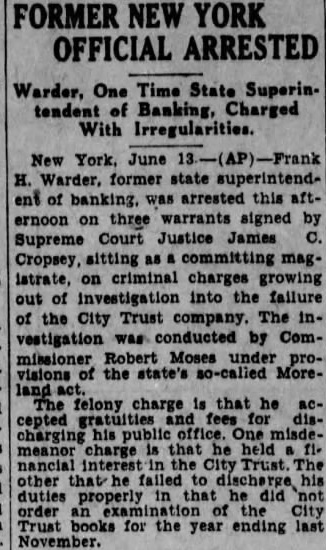
FORMER NEW YORK OFFICIAL ARRESTED Warder, One Time State Superintendent of Banking, Charged With Irregularities. New York, June H. Warder, former state superintendent of banking. was arrested this afternoon on three warrants signed by Supreme Court Justice James Cropsey, sitting as committing mag. istrate, on criminal charges growing out of investigation into the failure of the City Trust company. The investigation was conducted by Commissioner Robert Moses under visions the state's so-called MoreThe felony charge that he cepted charging his meanor charge that he held nancial interest other failed discharge duties properly in that did order the Trust for the year ending last


Article from Springfield Leader and Press, June 28, 1929

Click image to open full size in new tab

Article Text

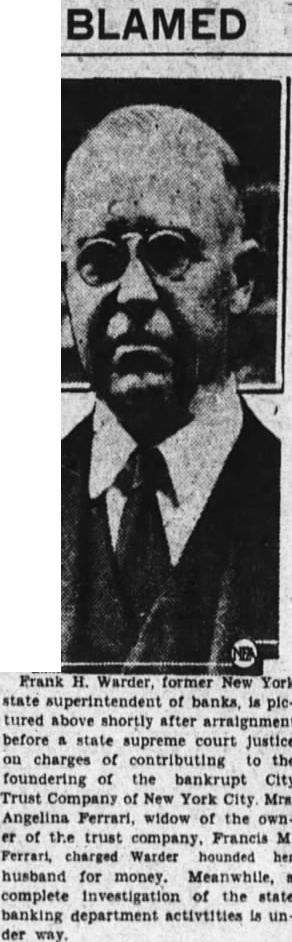
BLAMED Frank H. Warder, former New York state superintendent of banks, is pictured above shortly after arraignment before a state supreme court justice on charges of contributing to the foundering of the bankrupt City Trust Company of New York City Mrs. Angelina Ferrari, widow of the owner of the trust company. Francis M. Ferrari, charged Warder hounded her husband for money. Meanwhile, complete investigation of the state banking department activities is un der way.


Article from Passaic Daily Herald, August 1, 1929

Click image to open full size in new tab

Article Text

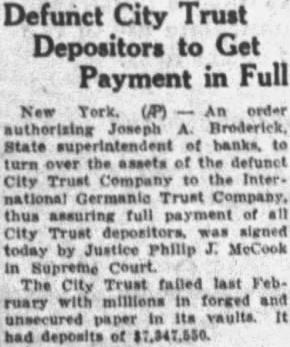
Defunct City Trust Depositors to Get Payment in Full New York. (AP) An order authorizing Joseph Broderick, State banks, turn over the assets the defunct City Trust Company Inter. national Germanic Trust Company, thus full payment City Trust signed today by Justice Philip McCook Supreme Court. The Trust failed last City ruary millions in forged unsecured its had deposits of $7,347,550.


Article from The Buffalo News, August 7, 1929

Click image to open full size in new tab

Article Text

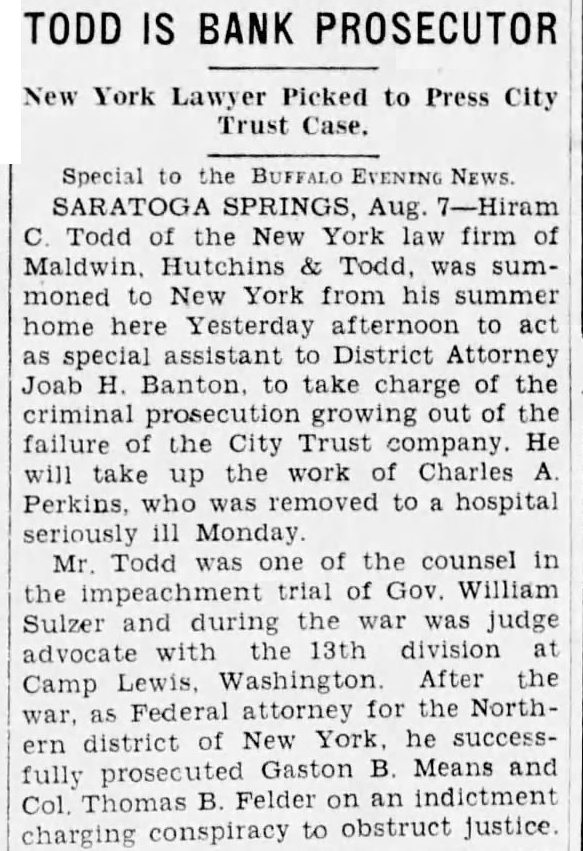
TODD IS BANK PROSECUTOR New York Lawyer Picked to Press City Trust Special to the BUFFALO EVENING NEWS Todd of the New York law firm of Maldwin Hutchins Todd, was summoned to New York from his summer home here Yesterday afternoon to act as special assistant to District Attorney Joab H. Banton. to take charge of the criminal prosecution growing out of the failure of the City Trust company. He will take up the work of Charles A Perkins, was removed to hospital seriously ill Monday Mr. Todd was one of the counsel in the impeachment trial of Gov. William Sulzer and during the war was judge advocate the 13th division at Camp Lewis, Washington After the war, as Federal attorney for the Northern district of New York, he successfully prosecuted Gaston B. Means and Col. Thomas B. Felder on an indictment charging conspiracy to obstruct justice


Article from Brooklyn Eagle, October 19, 1929

Click image to open full size in new tab

Article Text

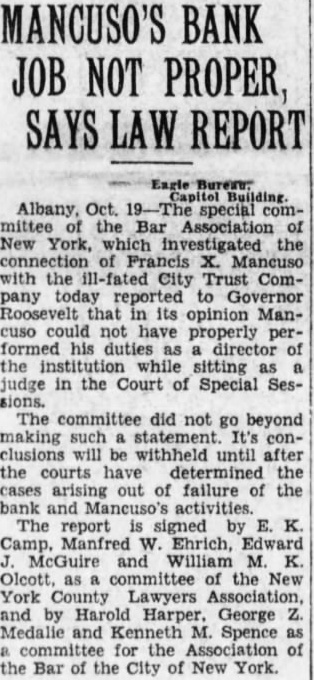
MANCUSO'S BANK JOB NOT PROPER, REPORT Albany, Oct. mittee the Association New York, which investigated the connection Francis Mancuso the City Trust Company today Governor its opinion Mancuso have properly his duties the while sitting judge in the Court of Special SesThe did not go beyond making such statement. It's conclusions be withheld until after courts have determined the cases arising out of failure the bank and activities. report signed Camp. Manfred W. Ehrich, McGuire William M. committee of the New York Lawyers by Harold Harper. George Medalie and Spence the the Bar the City of New York.


Article from The Times-Tribune, October 23, 1929

Click image to open full size in new tab

Article Text

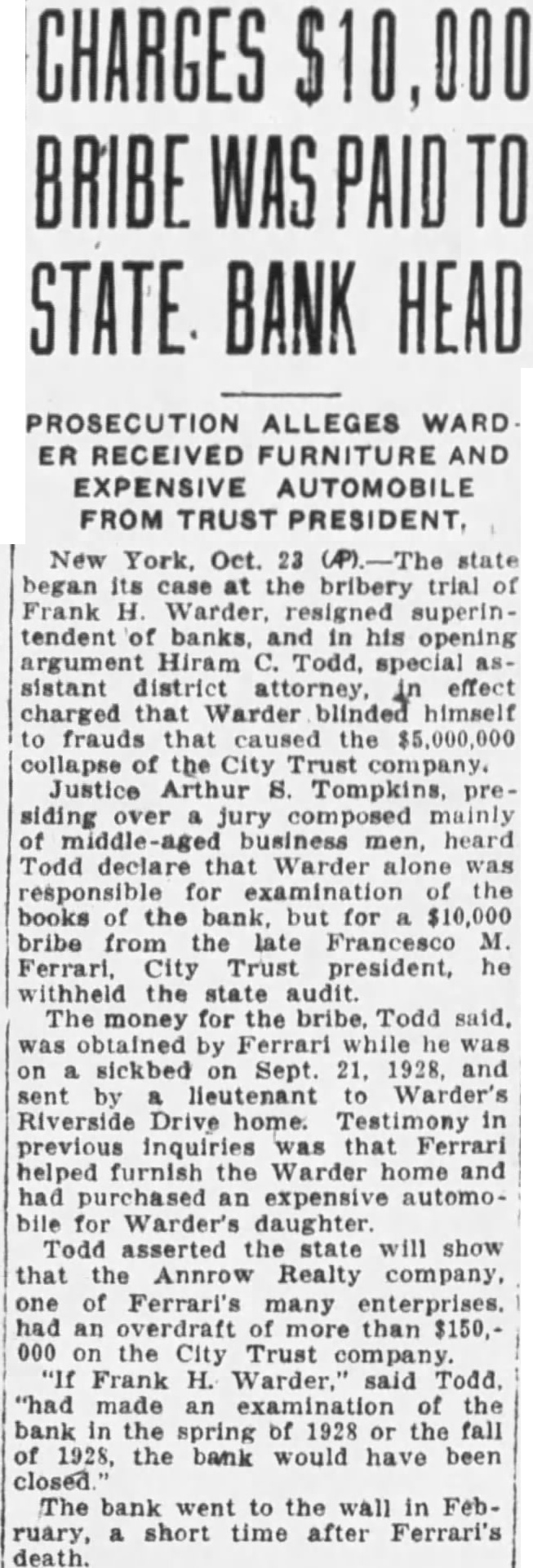
CHARGES BRIBE WAS PAID TO STATE BANK HEAD PROSECUTION ALLEGES WARD ER RECEIVED FURNITURE AND EXPENSIVE AUTOMOBILE FROM TRUST PRESIDENT. New York, Oct. 23 state began its at the bribery trial Frank superintendent banks, and his opening argument Hiram Todd, sistant district attorney effect charged that Warder blinded himself to frauds that caused the collapse of the City Trust company. Justice Arthur Tompkins, presiding over jury composed mainly aged heard Todd declare Warder was the books of the $10,000 bribe from the late Francesco M Ferrari, City Trust president, withheld the state audit. The money for the bribe, Todd said, obtained by Ferrari while on sickbed on Sept. and Warder's Riverside Drive home. in previous Ferrari helped furnish the Warder and had purchased expensive automobile for Warder's daughter Todd asserted the state will show that the Annrow Realty company, one of Ferrari's many enterprises. an more than $150,000 the Trust company. Frank H. said "had made the bank the spring of 1928 the fall of 1928, the bank would have been The bank went the wall in February, short time after Ferrari's death.


Article from Brooklyn Eagle, October 24, 1929

Click image to open full size in new tab

Article Text

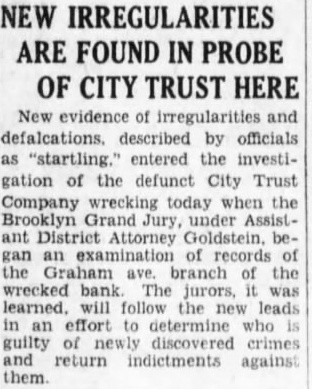
NEW IRREGULARITIES ARE FOUND IN PROBE OF TRUST HERE New evidence irregularities and defalcations. described by officials as "startling." entered the investigation of the defunct City Trust Company wrecking today when Brooklyn under Assistant District Attorney Goldstein. gan an of records the branch the wrecked jurors, learned. will follow the new leads effort determine who guilty discovered crimes and return indictments against them


Article from New Britain Herald, November 11, 1929

Click image to open full size in new tab

Article Text

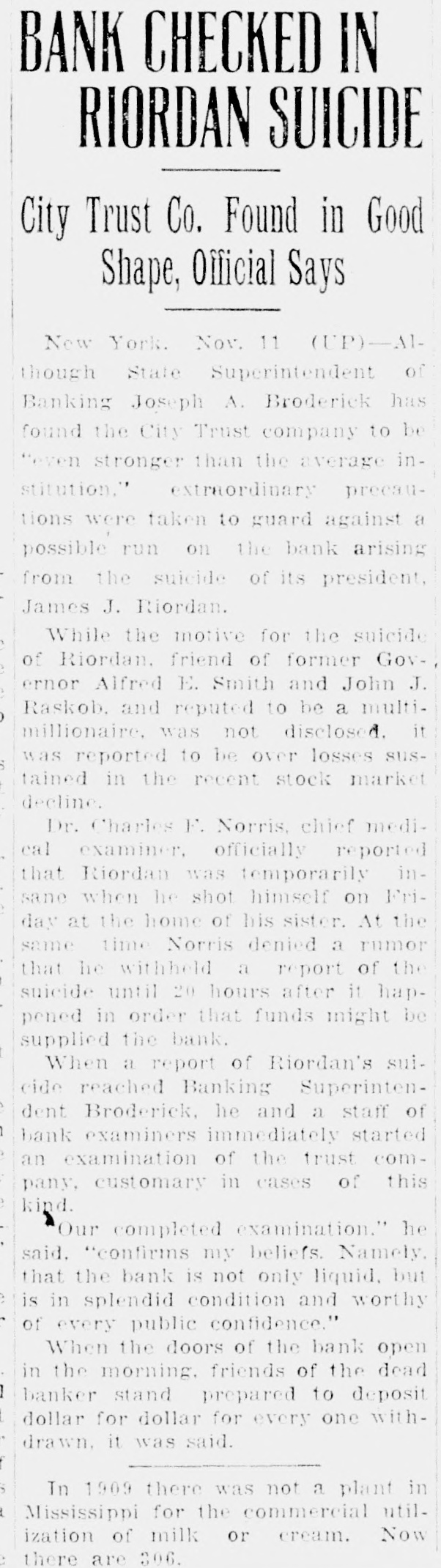
BANK CHECKED IN RIORDAN SUICIDE City Trust Co. Found in Good Shape, Official Says New York. Nov. 11 (UP)-Although State Superintendent of Banking Joseph A. Broderick has found the City Trust company to be "even stronger than the average institution.'' extraordinary precautions were taken to guard against a possible run on the bank arising from the suicide of its president, James J. Riordan. While the motive for the suicide of Riordan. friend of former Governor Alfred E. Smith and John J. Raskob. and reputed to be a multimillionaire. was not disclosed. it was reported to be over losses sustained in the recent stock market decline Dr. Charles F. Norris, chief medical examiner, officially reported that Riordan was temporarily insane when he shot himself on Friday at the home of his sister. At the same time Norris denied a rumor that he withheld a report of the suicide until 20 hours after it happened in order that funds might be supplied the bank. When a report of Riordan's suicide reached Banking Superintendent Broderick, he and a staff of bank examiners immediately started an examination of the trust company, customary in cases of this kind. Our completed examination." he said. "confirms my beliefs. Namely that the bank is not only liquid. but is in splendid condition and worthy of every public confidence." When the doors of the bank open in the morning, friends of the dead banker stand prepared to deposit dollar for dollar for every one withdrawn. it was said. In 1909 there was not a plant in Mississippi for the commercial utilization of milk or cream. Now there are 306.


Article from The Times, December 18, 1929

Click image to open full size in new tab

Article Text

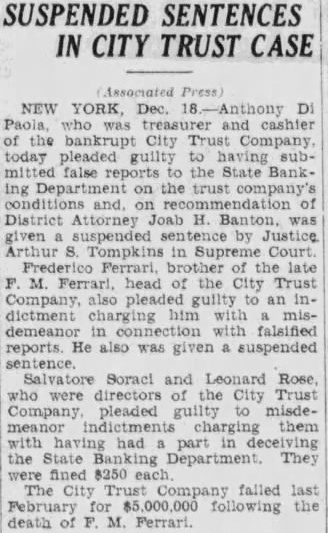
SUSPENDED SENTENCES IN CITY TRUST CASE NEW YORK, Dec. Anthony DI Paola, who was treasurer and cashier of the bankrupt City Trust Company today pleaded guilty to having submitted false reports to the State Banking Depart on the trust company's conditions and, on of District Attorney Joab H. Banton, was suspended by Justice Arthur S. Tompkins in Supreme Court Frederico Perrari, brother of the late F. M. Ferrarl. head of the City Trust Company also pleaded guilty to an indictment charging him with misdemeanor in with falsified reports He also was given a suspended sentence. Salvatore Soraci and Leonard Rose, who were directors of the City Trust Company pleaded guilty to misdemeanor them with had part in the State ing They were fined $250 each The City Trust Company falled last February for following the death of F. M. Ferrari.


Article from Times Union, December 26, 1930

Click image to open full size in new tab

Article Text

The News WILLIAM THE BEST POLICY the closing the doors the in New York our curious Communist movement began entirely new activity. reported that Communist orators have stationed themselves in front of the branches depositors in long lines reclaim they could of their deposits, and harangued crowds on the evil deeds of the bankers. What possible connection there between the troubles of the bank in question and the Soviet Union that the orators call upon their hearers to not quite clear. What on earth the local Communist party knows about banking any form has developed. But the peculiar incident veloped something new in plain and fancy tating." appear that Communists are deliberately working certain banks to attack. There would point naming them here, but fact that they have mentioned several by name and have caused them acute People have been called the telephone by strangers and told that the and Shore Dinner National Bank about to close its doors. Stories have been deliberately spread that the Corn, Rye and Scotch Trust Company is in difficulties. EVIL RUMORS Rumors of that kind spread with incredible rapidity. People have no time, and do not care investigate the rumors. No one would tell them the truth, anyway, if the bank actually were in danger. Each one thinks (quite properly) of his own bitterly hard-earned money, the few hundreds or thousands he has accumulated by self denial in order to have money for emergencies like illness, for son's education, for needed vacation. And each goes down quietly to withdraw his money thinking, also quite properly, of his own interests before the general interest of the bank the public. so easy to start rumor of that kind; easy to start run on In piping times of prosperity when banks like the City Trust Company of odoriferous memory fail enough demonstrate that it is because of the raseality of faithless men. But when bank fails in the midst of period of depression is easier to believe the worst than not to. Many will recall the curious rumors that swept the community in the first months of the war, when everybody was told that there hospital full wounded sailors in the Brooklyn Navy Yard. No one could be found who had actually seen the wounded sailors, but everybody knew somebody who had. It was always just one person removed from the teller of the tale. It was impossible to deny the story because there was nothing inherently improbable in it; the only thing the matter with the story was that it was not true. But the story, accompanied by detailed descriptions of defeats at sea, of mutinies warships and troopships, of mutinies of whole regiments, created among the people and did great harm to the national morale. Just that thing is being deliberately aimed at the Communists. few rumors, few crazy speeches on street corners, an appeal to frantic people who see their life's savings swept away, and mischief done. And this leads directly to consideration of of the most interesting facts in modern life. every depositor in every bank simultaneously demanded his money back there would be complete collapse. There would be disaster. The fact that there is no such disaster is due to the existence of credit. The banks receive money for deposit in checking and savings accounts and they promise their clients that the money is always at their disposal. Then they money and employ it in ways that bring returns to their of course themselves. That the business of banking. FAITH AND CONFIDENCE Every business man and private citizen has faith and confidence in his bank because he believes that whenever he wants his money he can get it. And because he believes he can get it he doesn't ask for And because he doesn't ask for it the bank has to employ in ways that are deemed proper. When City Trust Company collapses business men what is the result of and they act accordingly. But when sudden panics seize numbers of people misled by lying rumors, it cult situation to handle. For even if possible to get the person who starts such rumors, and even if he admits that he had nothing to base his rumors upon, he might very well say, believed it." And then what can you Punish person for circulating false information? Then, as Hamlet said, who of us would 'scape whipping? Banks sound largely because we believe them to be sound. We know that there are laws protecting our interests and that, generally speaking, the laws are honestly administered. We have many laws protecting depositors, policyholders in insurance companies, stockholders in utility companies. We have had evil experiences in the past, and our laws are result of the scandals disclosed in 1905 and thereabouts. Even with the laws they are there can be grave abuses; dishonest bankers can tamper with corruptible officials, has happened at least once in recent years. There are laws that protect people engaged in foreign exchange, but it is significant that the business generally goes without the need of the protection of laws. There are always and petty men ready to and go court on the est technicality, but generally speaking, men of large affairs know that when they agree to something over cup coffee in friendly office chat their word good. They may afterward put into writing, but pledged word enough. Householders call up dealers the telephone and order goods. Legally, no contract has been made. Actually, both parties trust each other and the through. goes The business world built upon faith, for there after all no substitute for faith in one's pledged word. Without faith the whole structure would collapse. With faith men trust each other. There are, of many things in our banks that should be looked into soberly. There should be no lying on the part of those on one side. The people are entitled the truth. But those who deliberately destroy the faith of by doing actually create the distress out of nothing about as low as human beings fall.


Article Text

State Bank Head Bribe Guilty Taking New York, Jan. Warder, former state superintendent banks, must five 10 years in Sing Sing prison for cepting bribe, the appellate vision the court today in affirming his conviction. More than year ago Warder convicted of accepting $10,000 keep bank from over the books of the City Trust Company, which failed in February, 1929, for more than All the appellate justices concurred opinion today. for the would carried to the court appeals. Warder had held various public offices for more than 30 years when City Trust Company collapse loosed cloud of scandal that volved number public figures, including General Judge Francis Mancuso, who resigned during the ensuing The revealed that Warder allegedly been $136,000 for "favors" to the bank.


Article Text

Warder Was Wrong by Nearly Two Years On Closing of City Trust Co. 'Incident' Boasted That Case Was 'Over' and it Will be 'Over' for Him Next Tuesday When He By FRANK G. HOLMES When former Banking Superintendent Frank H. Warder. swaggering and confident, announced with smile of smug satisfaction on March 19. 1929, that the $5,000,000 collapse of the City Trust Company was "closed incident" so far as he was concerned he guessed wrong by one year and ten months. The "incident" will not be closed for Warder until next Tuesday, when he scheduled to begin serving five to ten-year term in Sing Sing for accepting $10,000 bribe from the late M Ferrari. president of the looted bank. Made Fatal Mistake The cocksure Warder made tal mistake when made his "closed incident' The Eagle at once accepted the implied challenge and for 36 consecutive days waged vigorous campaign pry off the lid of secrecy with which Warder had veiled the bank looting and to bring the guilty justice While hammering away for offiaction which one. here or Albany. seemed disposed to take. the Eagle revealed day by day the hidden. sinister secrets of the plunOn April 1929. the Eagle published exclusively that Warder had failed to examine the bank for more than year violation of the banking law which requires two examinations each year. This the the examinations in consideration of $10,000 which he was tried and convicted although nine other indictments were returned against him. Other Indictments Follow Thus the March 19. 1929. marked beginning instead of an as Warder had fatuously believed. From that beginning came indictments against score of persons connected in one way or the other with the bank. the resignation Francis Mancuso. the bank's chairman, from the General Sessions Bench: his indictment. subsequently quashed as which has been appealed by the office District Attorney in and half dozen trials But of all those indicted. Warder the only one who has been convicted the only one who has been brought justice to the end the trail which leads to Sing Sing. Long. Painful Trail It was long. painful trail. with Warder's counsel. James Cuff. battling every inch of the way Cuff and the astute Max D. Steuer exhausted every legal resource at their command to stave off the day of Through the delays incident to appeals and failure of District Attorney Crain's office prepare their appeal brief until months after was due, Warder has managed to stay of prison for more than year and three months after his conviction. But Judge Benjamin Cardozo ended this period of grace last Friday when he refused Warder the privilege carrying his case to the Court of Appeals Becomes Tragedy The dark City Trust drama which Ferrari played the role of financial Machiavelli and Warder that of his highly paid servitor came tragic end when Ferrari died suddenly Warder and his associates in the bank were After an conference at which futile attempts were made to have some other institution take over the bank. Warder closed on 1929. with the brief statement that its capital and surplus had been impaired But Warder remained mum clam when persistent inquiry was made to the bank failed. for much failed, and who was responsible Rumors afloat bad loans loans to directors violation of law politicians. nothing falsification records All while Warder was working frantically get some banking group to take over the stitution and thus put an end to further inquiry Then came his nouncement that banking group been formed for this purpose which would be knowl. as the Mutual Trust Company. was in connection with this announcement that he mentioned the crash as "closed incident.' Stockholders and depositors protective committees had been formed and under the constantly increasing pressure of the newspaper campaign Warder resigned on April 22. 1929 But even then failed read gright the handwriting on the wall Confident that resignation coming on top of the formation Mutual Trust group. would end further inquiry, he boasted There has been some clamor in one newspapers. The articles published may been tional. but they did not help the unfortunate depositors, who were my concern am gratified that, notwithstanding the culties of the situation, have to render real service unfortunate matter and take this opportunity thank the construcpress of this city for its operation. Lehman Acts Two days later came the news that Warder preparing for Europe Governor Roosevelt had consistently refused demands to appoint Moreland Commissioner, was in Warm Springs,