National Hudson River Bank (Hudson, NY)

Episode Information

Episode UID
109100807
Episode Type
Suspension β†’ Reopening
Bank Type
national
Bank ID
10910 national
Charter Number
1091
Start Date
March 2, 1867
Location
Hudson, New York (42.253, -73.791)

Metadata

Model
gpt-5-mini (chosen from majority vote of a three-model LLM ensemble)
Short Digest
eb210edb805e18a6

Response Measures

None

Events (4)

1. April 29, 1865 Chartered
Source
historical_nic
2. March 2, 1867 Suspension
Cause
Bank Specific Adverse Info
Cause Details
Discovery of a $50,000 embezzlement by the cashier triggered suspension.
Newspaper Excerpt
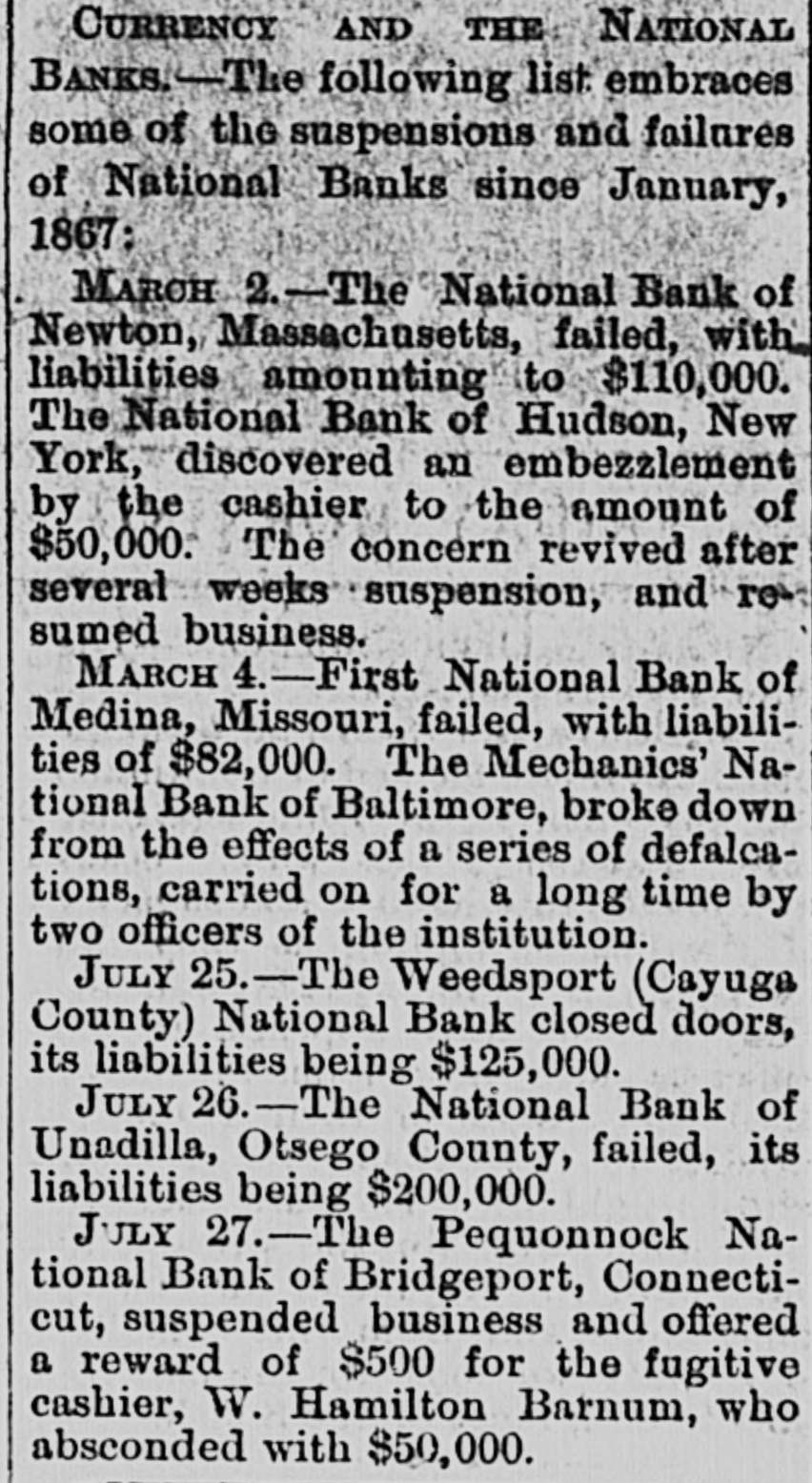
The National Bank of Hudson, N. Y., discovered an embezzlement by the cashier to the amount of $50,000. The concern revived after several weeks' suspension, and resumed business.
Source
newspapers
3. April 24, 1912 Voluntary Liquidation
Source
historical_nic
4. * Reopening
Newspaper Excerpt
The concern revived after several weeks' suspension, and resumed business.
Source
newspapers

Newspaper Articles (5)

Article from The Charleston Daily News, March 8, 1867

Click image to open full size in new tab

Article Text

NEWS SUMMARY. Cotton closed in Liverpool on the 6th at 131d. The New York market was dull at 30c. for Middling Uplands. Gold closed at 34). The Senate of the Virginia Legislature have passed Bill by vote of twenty-five to four to call Convention of the State on the second Monday in May next. The New Hampshire election takes place March 12th. Miss BRADDON'S new magazine, Belgravia, is advertised for sale. Fires are prevalent in the woods in various parts of the State, destroying much property. Gen. JOSEPH E. JOHNSTON, last week, was invited to take seat on the floor of the Louisiana House of Representatives. The tax on cotton, under the new law cnacted last week, is 2 cents a pound, instead of 8 cents as heretofore BROWNLOW threatens to return to private life, and the Boston Post offers its condolence to private life. The Hudson. N. Y. and Newtown, Mace I National Banks have been taken in charge of by the Comptroller of the Currency. Canadian eggs, under the new tariff, will have to pay duty of one cent per dozen. Our national debt will be paid. There are about forty candidates for Governor of Iowa. Gen. BAKER, Congressman GRINNELL and Col. MERRILL are the leading competitors. Gen. GLEESON: who is now military director of the Fenian Brotherhood, has given a contract for two thousand uniforms to a large clothing firm in New York. It is said that Prince SALM SALM, a German offi cer, who served in the United States army during the recent war.isnow in command of MAXIMILIAN'S forces garrisoned in the city of Orizaba. Statistics show that the Northwest contains onesixth of the improved land of the country, and produce one-half of the entire bulk of the products of the United States. The Scandinavians of Chicago recently gave a grand ball. in which numbers of Danish, Norwegian, and Swedish men and women appeared in their old national costumes, Some ex-Fredericksburg darkies voted at the election in Georgetown. One old fellow. however, declined, saying, "They jist put the names down, and the next thing is tax: on every nigger that voted. The British steamship Mexican, dispatched from Baltimore to Liverpool by the Baltimore and Ohio Bailroad Company, and which left Cape Henry on the 1st ultimo, arrived off Queenstown on the 16th, all well. The Chinese have nutaerous diseases of the eyes; every fifth man having some ocular defect, and every fifteenth losing his sight altogether. They attribute it to the excessive use of rice and constant shaving The Gainesville (Fla. New Era says that. with a favorable season, the cotton crop of Alachua County will far exceed that of 1866, as a much greater.area of land will be planted with the staple. Better raise less cotton and more corn. In the Maryland Legislature, the other day, Mr. APPLEMAN (Republican) offered resolutions condemning the election of the notorious rebel and traitor General CUSTIS LEE, to the Presidency of the State Agricultural College. Rejected It is stated in the New York Tribune that under the provisions of the Naval Appropriation Bill. passed at the late session of Congress, at least 10,000 employees in the Government Navy Yards are will be discharged during that there 2,200,000 proprietors of vineyards in France, 1000 varieties of vine cultivated. 5,435,000 acres of land devoted to vineyards, and in 1864 the crop was 1,820,000,000 gallons of wine, worth $100,000,000. Two large floating cisterns constructed at Cherbourg, have arrived at Havre, on their way to Paris. They are intended to supply the aquariums of the Exhibition with a water, and during its continuance will make constant trips between the sea and Paris. Senator WADE, of Ohio, who has been elected President of the Senate, was born at West Springfield, Massachusetts. and is sixty-six years of age. He went to Ohio when about twenty-one years old, after receiving a common school education. Heis an extreme Radical We learn that the Right Rev. Bishop QUINLAN, of the Catholic Diocese of Mobile, which includes, we believe, the States of Alabama and Florida, has been commissioned by Governor PATTON as one of the representatives of Alabama at the Paris Exposition. HARPER & BROTHERS will publish immediately the new Bankrupt Bill, with notes, forms of procedure, and a collection of all the American and English decisions upen the law of bankruptcy, adapted to the use of the lawyer and merchant, by EDWIN JAMES. The New York correspondent of the Philadelphia Ledger Bays "Tradeof all kinde remains ruinously dull. Go where you will the complaint is uniform Many dry goods and grocery firms are behind with their notes, and nots few suspensions are reported among the smaller houses.' The St. Paul Pioneer says: "Some people are verdant enough to ask, 'Can Congress do so and so? Why certainly they can. A railroad conducfor once accosted LOLA MONTEZ thus, (Madam, you cannot smoke in the car.' But you see can. replied LOLA, for I am doing it. This is Congressional logic.' A cotemporary, alluding to the numerous cases of suicide, and murdering of children by mothers in the Northwest, says: 'When the fathers in that country determine to tar and feather every fanatical lecturer they catch in the act of haranguing silly people on the subject of spiritualism, freelovism and damphoolism generally, the throats of their children will be safe." The New York Assembly on Wednesday voted down a proposition to let negroes in that State for delegates to the constitutional convention. Yet a majority of this same New York Legislature are in favor of thrusting negro suffrage upon their countrymen in the South and not only that, but in favor also of keeping them out of the Union until they consent to it. Through the courtesy of Mr. ROBERT ROWELL, of this city, we have been permitted, says the Louisville Journal, to examine copy of the Australa sian, published at Melbourne, Australia, the largest paper in the world. It contains thirtv-two pages of five columns each, and if printed on a single sheet would be nine feet long by three A meerschanm pipe manufactured in this country, and designed for the Paris Exhibition, is now to be seen in New York. The pipe itself is eleven inches in length, and the amber mouth-piece eight inches long and two inchea thick. The carving on the trunk of the pipe represents the meeting of Macbeth and Banquo with the witches, on their way to the battle-field. Surmounting the bowl SHAKEPEARE is represented seated on a chair, looking down upon the scene. The Rabbis of Europe are to assemble in council in Paris next year, in order that the great Sanhedrim may take place in conjunction with the Universal Exhibition. The Central Jewish Committee of Paris has taken the initiative of the meeting, which will especially called on to decide the following questions The abolition of the probled

Article from The Evening Telegraph, August 1, 1867

Click image to open full size in new tab

Article Text

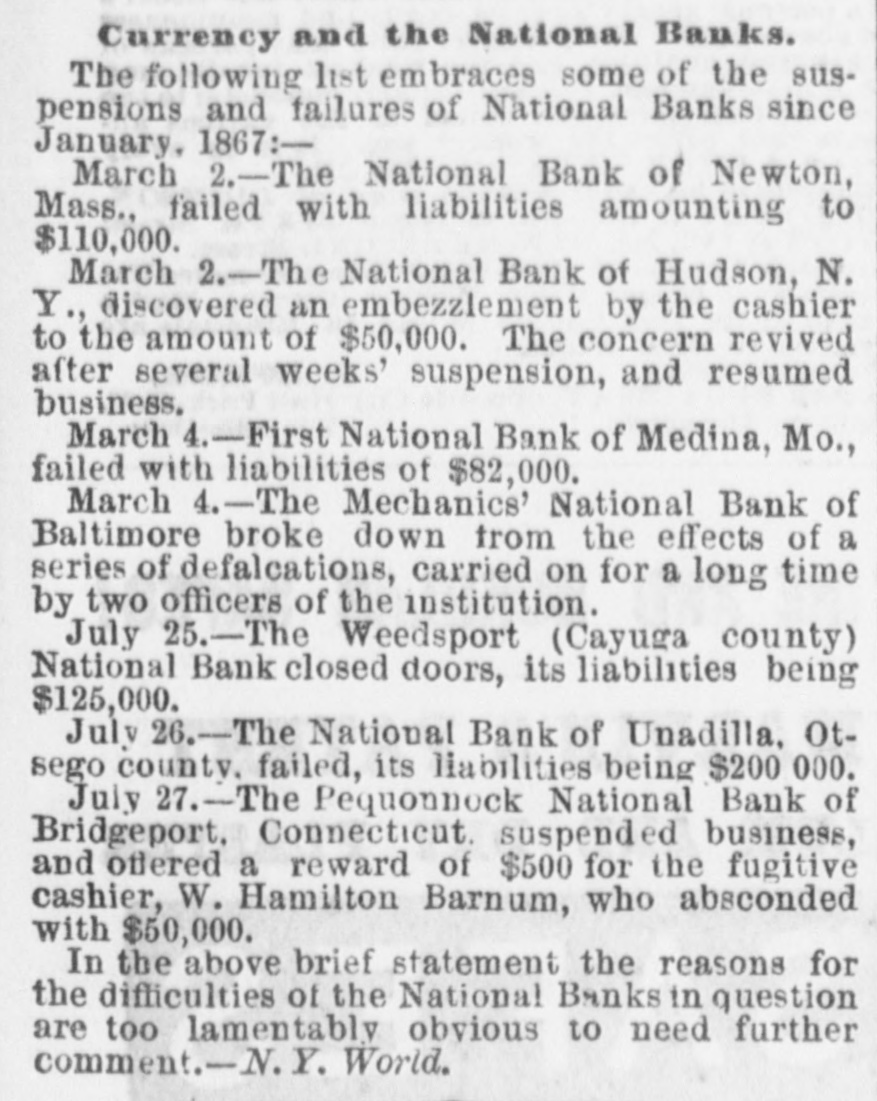
Currency and the National Banks. The following list embraces some of the suspensions and failures of National Banks since January, 1867:March 2.-The National Bank of Newton, Mass., failed with liabilities amounting to $110,000. March 2.-The National Bank of Hudson, N. Y., discovered an embezzlement by the cashier to the amount of $50,000. The concern revived after several weeks' suspension, and resumed business. March 4.-First National Bank of Medina, Mo., failed with liabilities of $82,000. March 4.-The Mechanics' National Bank of Baltimore broke down from the effects of a series of defalcations, carried on for a long time by two officers of the institution. July 25.-The Weedsport (Cayuga county) National Bank closed doors, its liabilities being $125,000. July 26.-The National Bank of Unadilla, Otsego county. failed, its liabilities being $200 000. July -The Pequonnock National Bank of Bridgeport, Connecticut. suspended business, and offered a reward of $500 for the fugitive cashier, W. Hamilton Barnum, who absconded with $50,000. In the above brief statement the reasons for the difficulties of the National Banks in question are too lamentably obvious to need further comment.-N. Y. World.


Article from The Wheeling Daily Register, August 2, 1867

Click image to open full size in new tab

Article Text

FINANCE AND TRADE. Commercial and Financial. The following list embraces some of the suspensions and failures of National Banks since January, 1865: March 2.β€”The National Bank of Newton, Mass., failed with liabilities amounting to $110,000. March 2.β€”The National Bank of Hudson, N. Y., discovered an embezzlement by the cashier to the amount of $50,000. The concern revived after several weeks suspension, and resumed business. March 4.β€”First National Bank of Medina, Mo., failed with liabilities of $82,000. March 4.β€”The Mechanics' National Bank of Baltimore, broke down from the effects of a series of defalcations, carried on for a long time by two officers of the institution. July 25.β€”The Weedsport (Cayuga County) National Bank closed doors, its liabilities being $125,000. July 26.β€”The National Bank of Unadilla, Otsego County, failed, its liabilities being $125,000. July 27.β€”The Pequonnock National Bank of Bridgeport, Conn., suspended business and offered a reward of $500 for the fugitive cashier, W. Hamilton Barnum, who absconded with $50,000. The New York Journal of Commerce says: The possibility of domestic troubles during the elections soon to occur, has deterred many operators from commencing fresh engagements, and is having a material effect upon the demand for goods to distribute through the West. After the election, if political affairs are more settled, we may hope for some revival of business. The wheat and rye harvested, and the corn not yet matured, alike rejoice in the dryer atmosphere beneath the sunny sky. Even potatoes have been small and hard, owing to the great prevalence of wet weather. A few such summer's suns will work wonders for all the crops, and good crops are as essential to financial and commercial prosperity as a good government. The Milwaukee Journal of Commerce, in a late article upon the legal tender question, said: We do not know that the constitutionality of the legal tender act, as it is called, will ever be brought fairly and squarely before the Supreme Court. We have no wish to see it done at present, so as to unsettle all the relations of debtors and creditors as now adjusted to the paper currency; but, for the sake of its importance as a precedent, we do hope that at some time, perhaps after specie payments have been resumed, it will be brought before that august tribunal for its solemn decision. We believe that if this is done after popular passion has subsided, the Court will pronounce a verdict against the act, and that this will give general satisfaction to the people. We have never insisted that Congress cannot order money to be coined or stamped of paper, leather, or any other substance of its choice, and declare the same a legal tender. Webster always insisted that under the Constitution nothing could be made a legal tender for debt but coins of gold or silver, but we waive that question now. The point we established, and which has never been assailed by either reason or argument, is that the present paper issues were not stamped or coined as money; are merely promises to pay money; and therefore show upon their face their want of conformity to the constitutional requirement. When this is fairly considered by the Supreme Court, free from the pressure of financial excitement, we have little doubt in regard to the decision. The following extract is from the money article of the Age of Wednesday: The demand for money from speculative borrowers continues moderately active, but there is comparative little inquiry for purposes of legitimate business. Call loans are made on stock collaterals at 4a5 per cent., and there are exceptional transactions in large sums upon government securities at 3 per cent. The best commercial paper is readily placed at 6a7 per cent. per annum discount. The dry goods market during the past week, although by no means active, has shown a material improvement from the previous dullness and unsettled feeling. Considerable preparation is being made for an early opening of business. The extremely low point to which prices have been forced has brought in a number of buyers, who intend holding for an advance. Trade has been stimulated by orders from the interior to supply demands for consumption. Prices are still unchanged, ruling very low, but an early improvement is confidently looked forward to by many. The statement of our Philadelphia banks for the present week clearly indicates the dullness in business prevalent at this season. All the leading items, except legal tenders, are lower than in the preceding report. Loans fell off $36,091; specie, $8,626; deposits $830,769, and circulation $3,892. Legal tenders


Article from Daily Ohio Statesman, August 5, 1867

Click image to open full size in new tab

Article Text

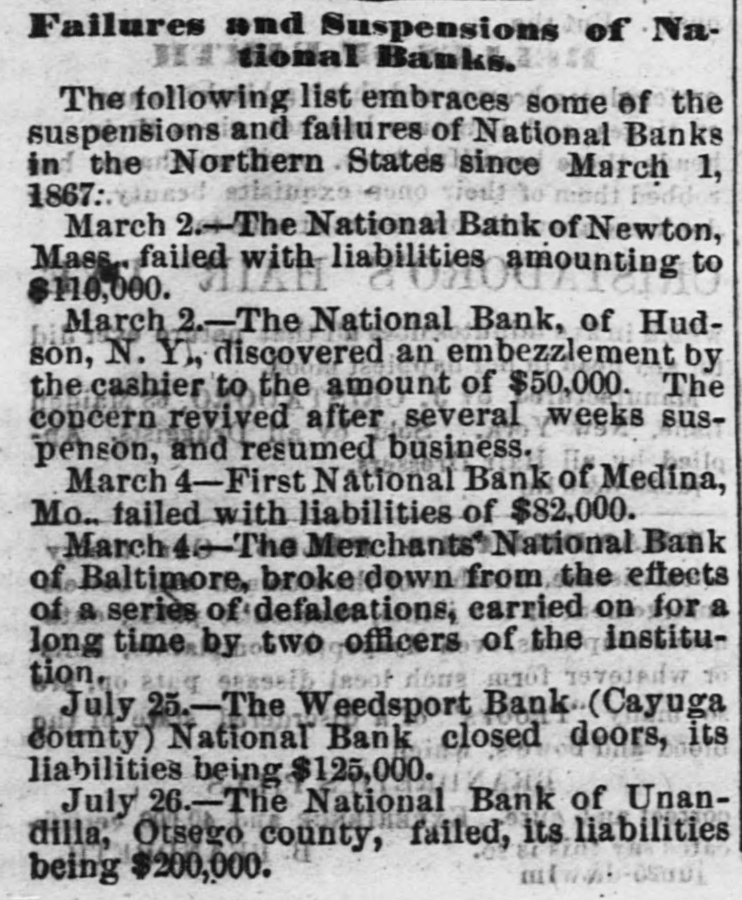
Failures and Suspensions of National Banks. The following list embraces some of the suspensions and failures of National Banks in the Northern States since March 1, 1867: March 2.-The National Bank of Newton, Mass failed with liabilities amounting to $110,000. March 2.-The National Bank, of Hudson, N. Y), discovered an embezzlement by the cashier to the amount of $50,000. The concern revived after several weeks suspenson, and resumed business. March 4-First National Bank of Medina, Mo.. failed with liabilities of $82,000. March 40-The Merchants National Bank of Baltimore, broke down from the effects of a series of defalcations, carried on for a long time by two officers of the institution. July 25.-The Weedsport Bank (Cayuga county) National Bank closed doors, its liabilities being $125,000. July 26.-The National Bank of Unandilla, Otsego county, failed, its liabilities being $200,000.


Article from The Daily Phoenix, August 9, 1867

Click image to open full size in new tab

Article Text

CURRENCY AND THE NATIONAL BANKS.-The following list embraces some of the suspensions and failures of National Banks since January, 1867: MARCH 2.-The National Bank of Newton, Massachusetts, failed, with liabilities amounting to $110,000. The National Bank of Hudson, New York, discovered an embezzlement by the cashier to the amount of $50,000. The concern revived after several weeks suspension, and resumed business. MARCH 4.-First National Bank of Medina, Missouri, failed, with liabilities of $82,000. The Mechanics' National Bank of Baltimore, broke down from the effects of a series of defalcations, carried on for a long time by two officers of the institution. JULY 25.-The Weedsport (Cayuga County) National Bank closed doors, its liabilities being $125,000. JULY 26.-The National Bank of Unadilla, Otsego County, failed, its liabilities being $200,000. JULY 27.-The Pequonnock National Bank of Bridgeport, Connecticut, suspended business and offered a reward of $500 for the fugitive cashier, W. Hamilton Barnum, who absconded with $50,000.