First National Bank & Trust Company (Flint, MI)

Episode Information

Episode UID
1099701598
Episode Type
Suspension β†’ Closure
Bank Type
national
Bank ID
109970 national
Charter Number
10997
Start Date
February 14, 1933
Location
Flint, Michigan

Metadata

Model
gpt-5-mini (chosen from majority vote of a three-model LLM ensemble)
Short Digest
8a3892088f665abc

Response Measures

None

Receivership Details

Depositor recovery rate
95.6%
Date receivership started
1934-02-27
Date receivership terminated
1941-06-12
Share of assets assessed as good
31.4%
Share of assets assessed as doubtful
68.2%
Share of assets assessed as worthless
0.3%

Description

Statewide eight-day moratorium (Feb 14, 1933) led to prolonged closing; conservator then receiver appointed.

Events (6)

1. May 18, 1917 Chartered
Source
historical_nic
2. February 14, 1933 Suspension
Cause
Government Action
Cause Details
Governor Comstock issued a statewide eight-day banking moratorium closing all Michigan banks to halt runs and stabilize the system.
Newspaper Excerpt
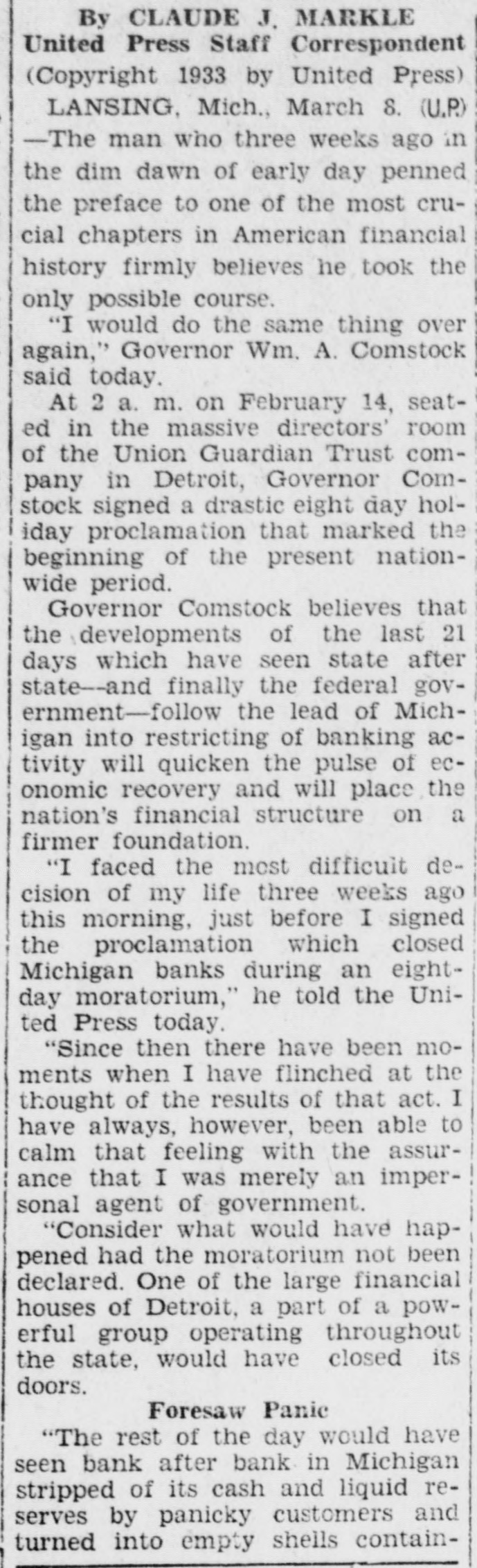
Every bank and financial institution in Michigan was closed today under a sweeping, eight-day suspension order issued ... by Governor William A. Comstock.
Source
newspapers
3. March 25, 1933 Other
Newspaper Excerpt
SPAETH CONSERVATOR FOR FIRST NATIONAL ... notified ... Washington this morning granted for the appointment of conservator ... no withdrawals no safety deposit closed ... conservator charged with full conduct of affairs under emergency provisions act.
Source
newspapers
4. March 27, 1933 Other
Newspaper Excerpt
CONSERVATOR IS NAMED FOR TWO FLINT BANKS ... Carl F. Spaeth this authority appointment conservator ... First National and Genesee County which have interlocking directorates.
Source
newspapers
5. February 27, 1934 Receivership
Source
historical_nic
6. February 27, 1934 Receivership
Newspaper Excerpt
John S. Smith ... assumed his duties yesterday as receiver of the First National Bank & Trust company, succeeding Carl F. Spaeth.
Source
newspapers

Newspaper Articles (23)

Article from The Indianapolis Times, February 14, 1933

Click image to open full size in new tab

Article Text

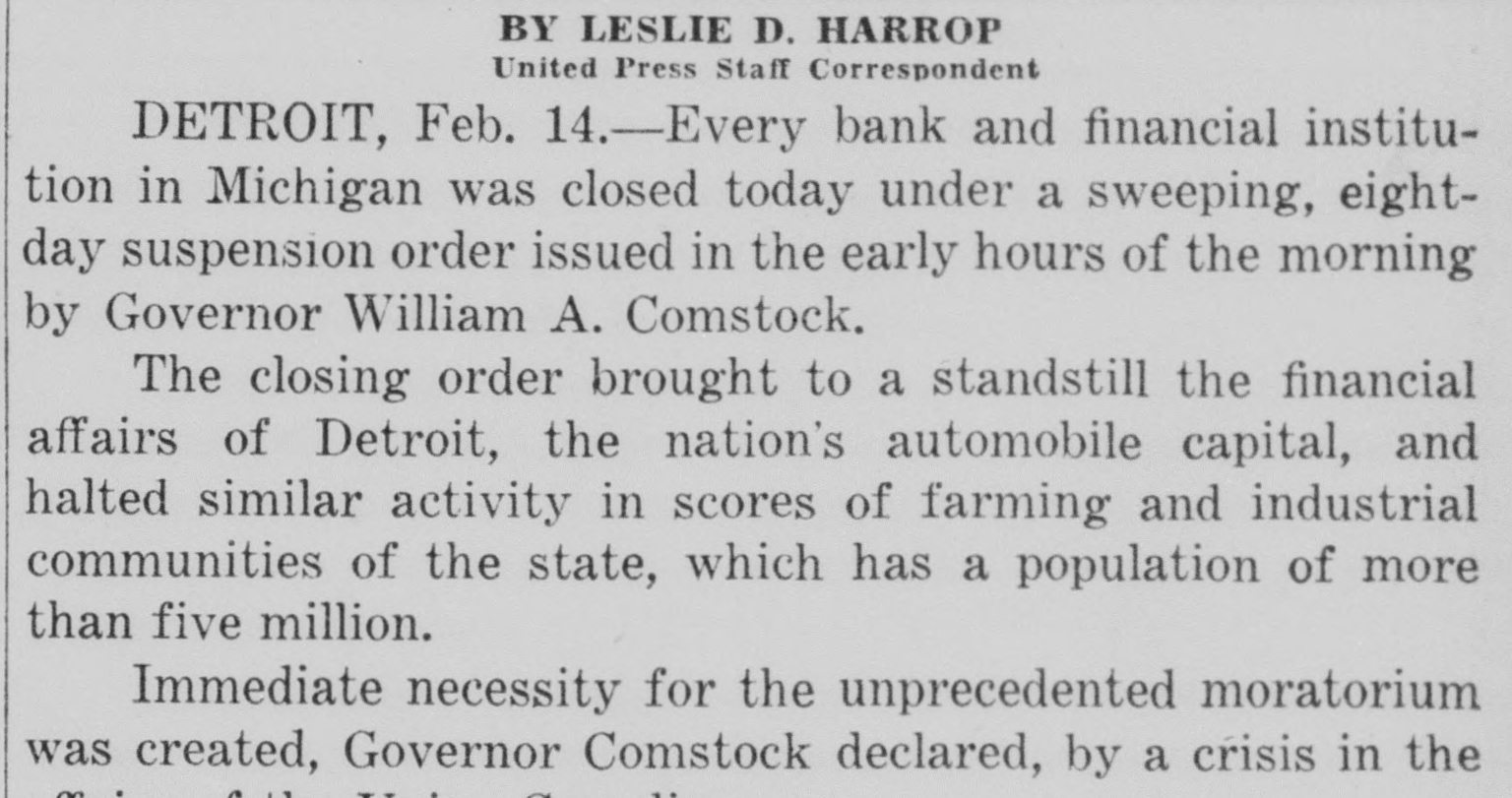
BY LESLIE D. HARROP United Press Staff Correspondent DETROIT, Feb. 14.β€”Every bank and financial institu- tion in Michigan was closed today under a sweeping, eight- day suspension order issued in the early hours of the morning by Governor William A. Comstock. The closing order brought to a standstill the financial affairs of Detroit, the nation's automobile capital, and halted similar activity in scores of farming and industrial communities of the state, which has a population of more than five million. Immediate necessity for the unprecedented moratorium was created, Governor Comstock declared, by a crisis in the


Article from Imperial Valley Press, February 14, 1933

Click image to open full size in new tab

Article Text

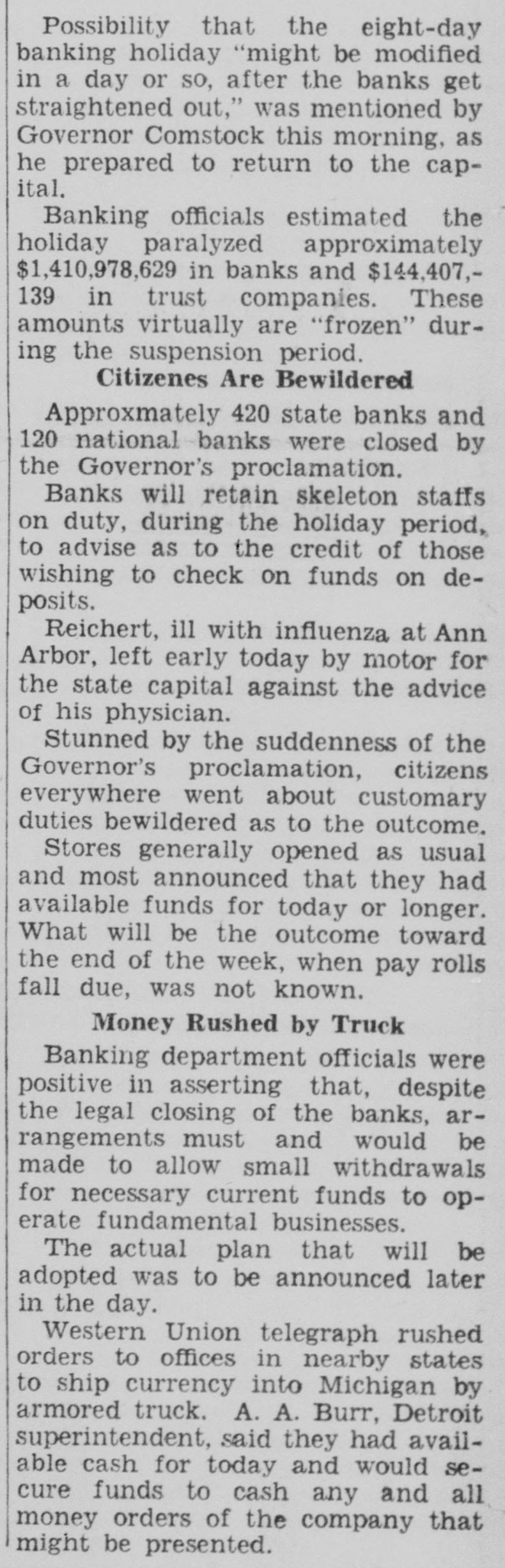
By LESLIE D. HARROP United Press Staff Correspondent DETROIT, Feb. 14.-Every bank and financial institution in the state of Michigan was closed today under a sweeping, eight day suspension order issued in the early hours of the morning by Gov. William A. Comstock. The closing order brought to a standstill the financial affairs of Detroit, the nation's automobile capital, and halted similar activity in scores of farming and industrial communities of the state, which has a population of more than five million. Immediate necessity for the unprecedented moratorium was crelated, Comstock declared, by a crisis in the affairs of the Union Guardian Trust company of Detroit. He said he understood the trust company would have had to close its doors. Emergency measures were started by Michigan banking department officials to provide the necessary cash to tide the state over the holiday. Plans, under which small and necessary bank withdrawals could be made were considered by R. E. Reichert, state banking commissioner. A possibility that the eight day banking holiday "might be modified in a day or so after the (Continued On Page 6)


Article Text

EIGHT DAYS Governor Takes Dictator's Powers to Prevent Financial, Chaos in State DETROIT, 14. William Comstock today, formal an ruling soften the effects ruling the the trust for today, order. Banks reopen his taking small and checks day with this ruling the banks state. Virtually peninsula mained the Michigan officials with Union and the state's banking strueture." By PAUL WEBER ISTAFF CORRESPONDENT SERVICE] DETROIT. Feb. ing the power of a dictator to save the state from financial chaos, William A. Comstock today closed every bank and trust m Michigan for an period. The state legislature was to be asked later today to approve his action. tied up in posits and trust funds. Five hundred banks trust companies affected. governors of the Detroit would closed for duration the OF EDICT The edict with dramatic while the state's millions, in their cities, lages and farms, slept of the danger threatened. Only of financial and political leaders remained In sleepless conferences behind doors of the dilemma. statement financial situation which made the "holiday" necessary, centered in Detroit's gigantic Union Trust of which (Continued on Page Three)


Article Text

THE MICHIGAN MORATORIUM The Governor of Michigan has closed all the banks and trust companies in his State for eight days. It is the same thing, on a larger scale, as has happened in many small towns in the Middle West and West during Shutdowns the course of this depression. It has happened all over Michigan for the same reason, Vs. Runs which appears to us to be a good reason. This reason simply is that the gold standard dollar has been growing more and more un-get-atable. It is better to freeze money in the banks and go on a scrip basis temporarily than to permit bank runs, which might produce bank failures. We think Gov. Comstock of Michigan has acted wisely and with true prudence. As we see it, the Michigan moratorium is another argument for cheapening the dollar so that people can get it more easily to buy goods, pay debts and keep business in motion. President Hoover told us Monday night in solemn tones that if we go off the gold standard we shall have economic disaster. What does he think we're having now, while we still cling to the gold standard?


Article Text

THE MICHIGAN MORATORIUM The Governor of Michigan has closed all the banks and trust companies in his State for eight days. It is the same thing, on a larger scale, as has happened in many small towns in the Middle West and West during Shutdowns the course of this depression. It has happened all over Michigan for the same reason, Vs. Runs which appears to us to be a good reason. This reason simply is that the gold standard dollar has been growing more and more un-get-atable. It is better to freeze money in the banks and go on a scrip basis temporarily than to permit bank runs, which might produce bank failures. We think Gov. Comstock of Michigan has acted wisely and with true prudence. As we see it, the Michigan moratorium is another argument for cheapening the dollar so that people can get it more easily to buy goods, pay debts and keep business in motion. President Hoover told us Monday night in solemn tones that if we go off the gold standard we shall have economic disaster. What does he think we're having now?


Article Text

THE MICHIGAN MORATORIUM The Governor of Michigan has closed all the banks and trust companies in his State for eight days. It is the same thing, on a larger scale, as has happened in many small towns in the Middle West and West during Shutdowns the course of this depression. It has happened all over Michigan for the same reason, Vs. Runs which appears to us to be a good reason. This reason simply is that the gold standard dollar has been growing more and more un-get-atable. It is better to freeze money in the banks and go on a serip basis temporarily than to permit bank runs, which might produce bank failures. We think Gov. Comstock of Michigan has acted wisely and with true prudence. As we see it, the Michigan moratorium is another argument for cheapening the dollar so that people can get it more easily to buy goods, pay debts and keep business in motion. President Hoover told us Monday night in solemn tones that if we go off the gold standard we shall have economic disaster. What does he think we're having now, while we still cling to the gold standard?


Article Text

THE MICHIGAN MORATORIUM Vs. Runs The Governor of Michigan has closed all the banks and trust companies in his State for eight days. It is the same thing, on a larger scale, as has happened in many small towns in the Middle West and West during Shutdowns the course of this depression. It has happened all over Michigan for the same reason, which appears to us to be a good reason. This reason simply is that the gold standard dollar has been growing more and more un-get-atable. It is better to freeze money in the banks and go on a scrip basis temporarily than to permit bank runs, which might produce bank failures. We think Gov. Comstock of Michigan has acted wisely and with true prudence. As we see it, the Michigan moratorium is another argument for cheapening the dollar SO that people can get it more easily to buy goods, pay debts and keep business in motion. President Hoover told us Monday night in solemn tones that if we go off the gold standard we shall have economic disaster. What does he think we're having now, while we still cling to the gold standard?


Article Text

THE MICHIGAN MORATORIUM The Governor of Michigan has closed all the banks and trust companies in his State for eight days. It is the same thing. on a larger scale, as has happened in many small towns in the Middle West and West during Shutdowns the course of this depression. It has happened all over Michigan for the same reason, Vs. Runs which appears to us to be a good reason. This reason simply is that the gold standard dollar has been growing more and more un-get-atable. It is better to freeze money in the banks and go on a scrip basis temporarily than to permit bank runs. which might produce bank failures. We think Gov. Comstock of Michigan has acted wisely and with true prudence. As we see it. the Michigan moratorium is another argument for cheapening the dollar so that people can get it more easily to buy goods, pay debts and keep business in motion. President Hoover told us Monday night in solemn tones that if we go off the gold standard we shall have economic disaster. What does he think we're having now


Article Text

THE MICHIGAN MORATORIUM Shutdowns Vs. Runs The Governor of Michigan has closed all the banks and trust companies in his State for eight days. It is the same thing. on a larger scale, as has happened in many small towns in the Middle West and West during the course of this depression. It has happened all over Michigan for the same reason, which appears to us to be a good reason. This reason simply is that the gold standard dollar has been growing more and more un-get-atable. It is better to freeze money in the banks and go on a scrip basis temporarily than to permit bank runs, which might produce bank failures. We think Gov. Comstock of Michigan has acted wisely and with true prudence. As we see it, the Michigan moratorium is another argument for cheapening the dollar so that people can get it more easily to buy goods, pay debts and keep business in motion President Hoover told us Monday night in solemn tones that if we go off the gold standard we shall have economic disaster. What does he think we're having now ?


Article from The Bismarck Tribune, February 16, 1933

Click image to open full size in new tab

Article Text

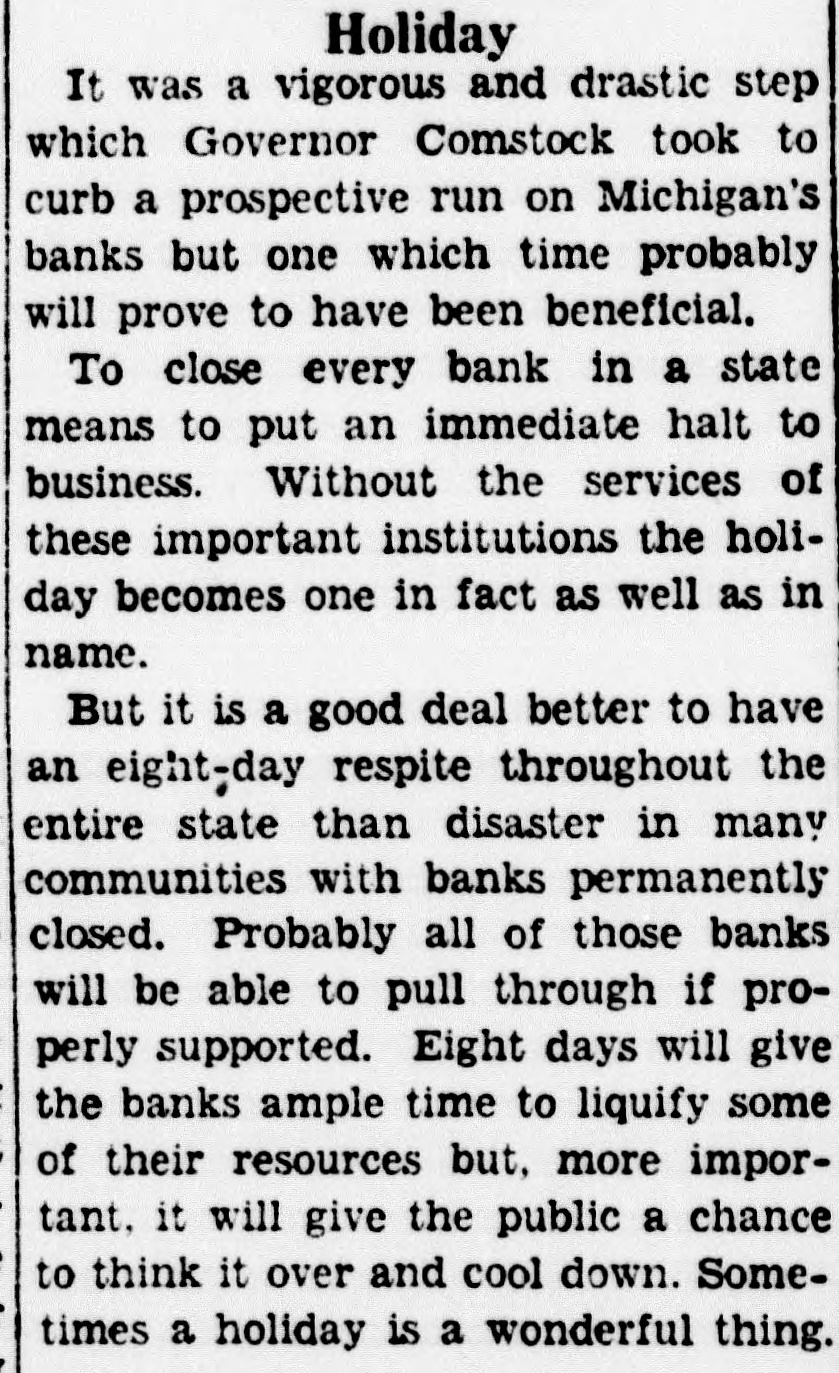
# Holiday It was a vigorous and drastic step which Governor Comstock took to curb a prospective run on Michigan's banks but one which time probably will prove to have been beneficial. To close every bank in a state means to put an immediate halt to business. Without the services of these important institutions the holiday becomes one in fact as well as in name. But it is a good deal better to have an eight-day respite throughout the entire state than disaster in many communities with banks permanently closed. Probably all of those banks will be able to pull through if properly supported. Eight days will give the banks ample time to liquify some of their resources but, more important, it will give the public a chance to think it over and cool down. Sometimes a holiday is a wonderful thing.


Article Text

MICHIGAN'S BANKS OPENED TODAY FOR LIMITED BUSINESS gan's banks opened for restricted business today. some of them for the first time since Governor William A. Comstock's emergency closing order ten days ago. Rudolph E. Reichert state banking said that most banks were "doing business in the best possible way," and congratulated the state's bankers on their cooperation during the emergency. He said that most banks were cashing checks that had not already been cleared, on the depository percentage basis laid down in the governor's second proclamation issued Tuesday. Generally, the banks were following the plan under operation for the past week in Detroit, allowing depositors to withdraw 5 per cent of their deposits. In Detroit at the opening hour there were no lineups outside the banks and few instances of unusual numbers of customers inside.


Article Text

NEWS Page. Movie Reel Editorial Movies Markets Winchell Ads Folly Island. Weather Radio Sports 16 Plans started for early pres. the west farm relief proposal. Page The United States general ruling on the proper of assembling to vote repeal. Page The senate banking heard charge the City control the mar ket for its stock. Page Senator assailed he clared control by New York Page The senate did some expense paring and then wiped added Page Mrs. Theodore Roosevelt belated apology from health officer. Page Senator Thomas Walsh sailed for Cuba to marry sugar grower's Page President Roosevelt appointed Representative Douglas of Arizona as budget director. Page Michigan banks reopened. Page 2. Dr. Charles urged cational guidance for employed adults. Page The repeal proposal was put Page The city council committee recommended the department personnel cut Page The park board had natural goldfish bowl Birch at Page Presidents of state teachers' col. united against the proposed curtailment of the state sys. tem. Page Northwest Feed Dealers told unregulated trucks affected their business. Knowledge of school subjects was called not the essential of education of girls by Dr. Malcome Mc. Lean. Page Miss Helen Wilson, former resident of Minneapolis, died Tre mezzio, Page 6. Patrick 79. deputy sheriff, fell dead. Page Two suspended Paul policemen were sentenced for larceny. Page SINCE prohibition went effect several states which were dry have shown wet sentiment. map and story indicate the Page President-elect Roosevelt has decided he'll rely on service agents guard him the inanguration. He told Arlayne Brown, world champion revolver shot. offered that she won't be needed. Page The intelligence that gets marks not the only from educator. Dr. Malcolm college rector the University of urged education that will fit life. Page The big Japanese drive in Jehol started. Page The Mount Everest plane party from Sicily after five Page WOMEN'S NEWS. Evon Nollette describes garments designed for double duty. Page 13. for Swedish meat balls by Kate Smith. Page 13. Restlessness is Elsie Page 13. Jessie DeBoth presents Sunday dinner menu. Page 13. SPORTS. Mickey shaded Frankie Knauer the six-round of the boxing Page 16. The city high school basketball will wind up today. Page 16 Page 17. Alexandria's quintet was elimi nated by the St. Paul Flyers in the feature of the amateur basketball the Ascen sions, Holy Cross and Belle Plaine also won. Page 17. MARKETE Bullish vanished in the Minneapolis pit; Chicago tumbled. Page 18. Stock values slumped to new low averages on large turnover. Page 19. Bonds suffered the worst relapse since the first the 19. Page 19. Dog and lamb trade advanced in South St. Paul: cattle prices mained unchanged. Page


Article Text

SPAETH CONSERVATOR FOR FIRST NATIONAL Executive Vice President Receives Notification of Appointment From Comptroller's Office at Washington. RULING ON TRUST DEPOSITS ASKED Board of Directors Had Requested That Federal Authorities Take Action Under Emergency Legislation First National Bank & Company notified from that its ashington this morning granted for the of conservator to appointment its affairs and that charge executive vice has delegated his upon Spacth teleoffice the compof the currency for pertroller the mission have been beginning of the the banking holiday expected he opening This In down by the compthe the there can troller and no withdrawals no safety deposit closed. The the change. tion for There further regarding from banks. by State BankRudolph will send state handle any situaarise regarding tions banks under his the policy in all clearing Instructions Given instructions the following are as charged with full United conducting affairs the provisions act. subject bank During direction the old directors your officers of the bank are out authority for bank and with you in working out plans or are not subject their control or sucame to Flint March when First National bank. of executive Before coming to Flint was in department and lived Arbor


Article Text

CONSERVATOR IS NAMED FOR TWO FLINT BANKS classified somewhat as arguments contrary been there not been the real and other that had taken Detroit. It maintained spokesmen that Flint business on the have large better values well present But eventually became that, qualify now much better condition required than would have have passed requirements. Once made scribe rebuilding struebut the placed high Failing these efforts, National to Washington send their Lansing Examiners Are Here the meantime, response appraisals This finished state men for the three state instifor under will depend largely upon the Under state emergency banking opportunity for basis of such assets not be 'frozen Deposits be impounded to the of these assets would held pending their liquidation. per of bank segregated offset up not than Under the is possible preferred stock half of deposits and certificates would The bank would permitted years which liquidate "frozen" assets and good terest, and the which bear Failure would liabilequal to the par value of their Thus, cited for this examdepositor with in find free for legitipurposes. He $30 stock and $30 Flint banks can qualify plan determined only after thorough investigation. National Reopens Carl F. federal the First National Bank Trust this that stores the institution the basis during holiday prior Saturday Mr. Spaeth this authority appointment conservator This mitted which the holiday that funds from deposits and are safety deposit is open meeting the division of the Chamber the banking tion ognized possible done for the interests Flint Forty delegates to the Flint ing with and Willis and Leo Teachto discuss the situanine was pointed to report Wednesday Eli Rosenblum presided and discussion was held. promised that they are and will do legislation. Name 58 of conservators for Michigan banks nounced by Reichert banking at Lansing following today's session the governor's commission. In majority the the which the they will take are They Cheboygan State Savings bank Cheboygan, Fred Haut: John First State bank, Hillsdale, Sparta State bank. State bank. Owosso, Kenneth Crawford Traverse City bank City, Bank Whitehall George Covell State B. Cedar Springs State Cedar Springs Herbert Wheeler: Ludington State bank Ludington, Zook, Riverdale Fred bank, Metamora Savings bank Metamora Downer conning State State Bank Niles, Niles, Thomas Yale State Guy E. Beard State of Coswell, Melvin City Richards: Citizens Savings Frank Coward Clarkston State D. King: First State Bank Mendon, Rogge First Savings Constantine Estes Brothers Centerville D. State Bates: State ings Bank of First Bank of legan, Allegan. Van Tyle: State bank, John First State Savings bank, Lyons: State Savings bank, StanStarks: Birch Run State bank, Birch Run. Herbert Walter; First Bank Kingsley, Kingsley, Carl Brown. Pinney State bank City. H. Pinney; State Bank Harbor Harbor John Beach, Marysville Savings bank Marysville, John Barron: White Farmers M. Spring port Savings bank. Spring Allen sula bank. Ispheming, HandSavings Flint Union Industrial and Savings bank, Flint, Mark Wilson: First State South Haven, Haaften; Farmers and Merchants


Article Text

FLINT BANKS MAY OPEN IN 2 WEEKS Flint May 3.-If officials of two of Flint' closed banks pre pare reopening plan to conform with government requirements. they may be able to open in six weeks. conservators said Tuesday The two banks the Genesee County Savings and the Union Industrial The First National Bank is waiting for official sanetion on a plan presented by Carl F. Spaeth conservator and executive president of both the First National and the Genesee County which have interlocking directorates.


Article Text

JOHN S. SMITH RECEIVER OF BANK BEGINS HIS DUTIES S. S. Pearlstine Mentioned for Attorney Post at First National. John S. Smith, prominent local Democrat, assumed his duties yesterday as receiver of the First National Bank & Trust company, succeeding Carl F. Spaeth. He announced today he had not named a successor to Harry G. Gault, attorney for the former receiver. At a conference of Democrats regarding the attorney's appointment, S. S. Pearlstine, president of the Genesee County Democratic club, was prominently mentioned for the post of receiver's attorney, but Mr. Smith said the personnel continues temporarily as heretofore. Mr. Smith, a pioneer Democrat and president of the Belsay Lumber company, was appointed receiver by the comptroller of the currency at Washington, succeeding Mr. Spaeth, who was an executive vice president before he became receiver when the bank was closed last March. Mr. Smith was appointed to the state board of institutions last September by Gov. Comstock.


Article Text

JOHN S. SMITH * * * RECEIVER OF BANK BEGINS HIS DUTIES S. S. Pearlstine Mentioned for Attorney Post at First National. John S. Smith, prominent local Democrat, assumed his duties yesterday as receiver of the First National Bank & Trust company, succeeding Carl F. Spaeth. He announced today he had not named a successor to Harry G. Gault, attorney for the former receiver. At a conference of Democrats regarding the attorney's appointment, S. S. Pearlstine, president of the Genesee County Democratic club, was prominently mentioned for the post of receiver's attorney, but Mr. Smith said the personnel continues temporarily as heretofore. Mr. Smith, a pioneer Democrat and president of the Belsay Lumber company, was appointed receiver by the comptroller of the currency at Washington, succeeding Mr. Spaeth, who was an executive vice president before he became receiver when the bank was closed last March. Mr. Smith was appointed to the state board of institutions last September by Gov. Comstock.


Article Text

NEW TRUSTEE ASKED FOR PIERCE'S FUND Appointment of the board of education of the city of Flint as trustee of the John L. Pierce Educational fund in place of the First National Bank & Trust company at Flint is asked in a suit which has been filed in circuit court by Mr. Pierce and the board of education with John S. Smith, receiver for the First National, named as defendant. The trust fund was set aside by Mr. Pierce May 12, 1928, when he delivered cash, notes, bonds and securities to the bank. The income was to be used by the board of education for the benefit of the Flint Junior college, either for the increasing of salaries or the purchasing of additional equipment. There is $6,409 in the fund at the present time. The change in trustees is requested, the suit points out, because the bank is in the hands of a receiver and no longer able to act. The bill of complaint was signed by Mr. Pierce, donor of the fund; Dr. Henry Cook, president of the board, and Forrest W. Boswell, its secretary. It is stipulated that the board of education, as trustee, shall keep this fund separate from all others stock would appoint Sawyer a member of the state public utilities commission. Cady Irate Cady, regarded definitely as an administration supporter, and who heretofore has been the only Michigan Democratic representative besides Brown who has been in harmony with the Michigan patronage chief, was irate when told of the plan to shift the appointments. His objection to the appointment of Sawyer as a member of the utilities commission was based not only upon the possibility of a change in the state's political complexion within the next year, but on his contention that the marshal post had been promised him. Gov. Comstock recently removed several members of the commission, and Cady said he saw nothing that would prevent a Republican governor, if one were elected this fall, also to remove members. "I certainly want it made clear that I am not criticising John Barc in any way," Cady said. "He should be given recognition and deserves it, but my protest is that I don't want it done at my expense." Favors Genesee County Cady was outspoken in his contention that Genesee county deserved a major appointment. He said he had no quarrel with any other members of his delegation, but that he had no thought of giving up the battle yet to have Sawyer named to the federal position. Sawyer has informed Cady that he is still a candidate for marshal


Article Text

Time Limit for Payment From Closed Bank Funds July 9 has been set by the state banking department as the time limit for payment of released funds to depositors of the closed Union Industrial Trust & Savings bank. A similar limitation will be set for the First National Bank & Trust company but the comptroller of the currency has not yet sent notification of the date. The total of claims not yet called for is about 15,000 for the two institutions, representing about $900,000 for the Union Industrial and about $500,000 for the First National. Union Industrial depositors are receiving 35 per cent of their impounded funds and those of the First National, 50 per cent. The former are obtaining their releases at the National Bank of Flint and the latter at the quarters of the First National receiver, First National bank building. Apparently some believe there is a deposit to their credit to the amount of their portion of these released funds. This is not the case. For each bank, the receiver has on deposit in his name with the National Bank of Flint the total of unpaid releases. The depositor must establish his claim, receive a check which he may cash or place on deposit. Until this is done, there is no transaction as far as his claim is concerned. If this is not done before the expiration of the time which already has been fixed for one and soon will be for the other bank, the depositor will experience some difficulty in obtaining his funds. The formal notice which is being served by publication on all Union Industrial depositors, says in part: "That all persons having claims of whatever kind or nature against said Union Industrial Trust & Savings bank failing to file such claims on or before July 9, 1934, shall thereafter be forever barred from filing their claims against the said Union Industrial Trust & Savings bank, and shall be deemed to have no valid claim of any kind against any of the assets of the Union Industrial Trust & Savings bank, in the hands of said receiver, unless time for filing has been extended on cause shown. "That on or before July 19, 1934, said receiver shall file with the said commissioner of banking, a schedule of all claims presented to him, together with his recommendation thereon as to their allowance or rejection; that a hearing will be had in the offices of the receiver at Flint, Mich., on the 25th day of July, 1934, at 9 o'clock in the forenoon, at which time the banking commissioner, or one of his representatives will be prepared to hear objections on the allowance of any claims filed."


Article Text

Time Limit for Payment From Closed Bank Funds July 9 has been set by the state banking department as the time limit for payment of released funds to depositors of the closed Union Industrial Trust & Savings bank. A similar limitation will be set for the First National Bank & Trust company but the comptroller of the currency has not yet sent notification of the date. The total of claims not yet called for is about 15,000 for the two institutions, representing about $900,000 for the Union Industrial and about $500,000 for the First National. Union Industrial depositors are receiving 35 per cent of their impounded funds and those of the First National, 50 per cent. The former are obtaining their releases at the National Bank of Flint and the latter at the quarters of the First National receiver, First National bank building. Apparently some believe there is a deposit to their credit to the amount of their portion of these released funds. This is not the case. For each bank, the receiver has on deposit in his name with the National Bank of Flint the total of unpaid releases. The depositor must establish his claim, receive a check which he may cash or place on deposit. Until this is done, there is no transaction as far as his claim is concerned. If this is not done before the expiration of the time which already has been fixed for one and soon will be for the other bank, the depositor will experience some difficulty in obtaining his funds. The formal notice which is being served by publication on all Union Industrial depositors, says in part: "That all persons having claims of whatever kind or nature against said Union Industrial Trust & Savings bank failing to file such claims on or before July 9, 1934, shall thereafter be forever barred from filing their claims against the said Union Industrial Trust & Savings bank, and shall be deemed to have no valid claim of any kind against any of the assets of the Union Industrial Trust & Savings bank, in the hands of said receiver, unless time for filing has been extended on cause shown. "That on or before July 19, 1934, said receiver shal file with the said commissioner of banking, a schedule of all claims presented to him, together with his recommendation thereon as to their allowance or rejection; that a hearing will be had in the offices of the receiver at Flint, Mich., on the 25th day of July, 1934, at 9 o'clock in the forenoon, at which time the banking commissioner, or one of his representatives will be prepared to hear objections on the allowance of any claims filed."


Article Text

July 9 has been set by the state banking department as the time limit for payment of released funds to depositors of the closed Union Industrial Trust & Savings bank. A similar limitation will be set for the First National Bank & Trust company but the comptroller of the currency has not yet sent notification of the date. The total of claims not yet called for is about 15,000 for the two institutions, representing about $900,000 for the Union Industrial and about $500,000 for the First National. Union Industrial depositors are receiving 35 per cent of their impounded funds and those of the First National, 50 per cent. The former are obtaining their releases at the National Bank of Flint and the latter at the quarters of the First National receiver, First National bank building. Apparently some believe there is a deposit to their credit to the amount of their portion of these released funds. This is not the case. For each bank, the receiver has on deposit in his name with the National Bank of Flint the total of unpaid releases. The depositor must establish his claim, receive a check which he may cash or place on deposit. Until this is done, there is no transaction as far as his claim is concerned. If this is not done before the expiration of the time which already has been fixed for one and soon will be for the other bank, the depositor will experience some difficulty in obtaining his funds. The formal notice which is being served by publication on all Union Industrial depositors, says in part: "That all persons having claims of whatever kind or nature against said Union Industrial Trust & Savings bank failing to file such claims on or before July 9, 1934, shall thereafter be forever barred from filing their claims against the said Union Industrial Trust & Savings bank, and shall be deemed to have no valid claim of any kind against any of the assets of the Union Industrial Trust & Savings bank, in the hands of said receiver, unless time for filing has been extended on cause shown. "That on or before July 19, 1934, said receiver shall file with the said commissioner of banking, a schedule of all claims presented to him, together with his recommendation thereon as to their allowance or rejection; that a hearing will be had in the offices of the receiver at Flint, Mich., on the 25th day of July, 1934, at 9 o'clock in the forenoon, at which time the banking commissioner, or one of his representatives will be prepared to hear objections on the allowance of any claims filed."


Article Text

SUE STOCKHOLDERS OF FIRST NATIONAL Collection of Assessments Asked in Action Taken by Bank's Receiver. John S. Smith, receiver for the defunct First National bank & Trust company, today filed 21 suits against stockholders for collection of 100 per cent assessments. He is asking a total of $11,400. The suits were filed in circuit court. Sidney Gage, Route No. 2, Davison, convicted Friday afternoon of a drunken driving charge on which police arrested him Oct. 21, furnished $200 bond for an appeal to circuit court. Tried without a jury, Gage was found guilty by Municipal Judge Mallory, who sentenced him to pay a $50 fine or serve 30 days in jail. An all-school song practice was held at Northern High school Friday, with accompaniment by 12 members of the band, directed by Nathan Rosenbluth. "Alma Mater," "The Cheer Song" and "On Flint Northern" were the songs. A similar event will be held each Friday. After members of the Emerson safety council reviewed fire drill procedure in home rooms and observed the conduct of the drill from various points about the building, Bill Starkel, safety council president, by means of the public address system gave suggestions for increasing speed and safety in leaving the building Thursday. The 2,300 Emerson students were out of the building two minutes and five seconds after the gong sounded. Mrs. Carleton E. Tanner was elected chairman of the Garfield Child Study group at the school Thursday afternoon. Other officers are Mrs. C. J. Thomas, vice president; Mrs. J. W. Thomas, secretary and publicity chairman, and hostesses, Mrs. W. Jay Clarkson and Mrs. R. J. Boyd. "Habits" were topics for discussion, with papers by Mrs. Tanner and Mrs. J. W. Thomas. Suspect Identified Police said one witness, viewing a photograph of Anderson, had identified him as the robber who snatched a bag from the hands of Isabelle Davis, clerk at Peck's drug store, 120 East Kearsley street, Oct. 20. Miss Davis was taking part of the day's receipts of the store to a bank, when a man leaped in front of her at East Kearsley street and Brush alley, grasped the bag and fled south in the alley. Two men followed him and saw him get into a car driven by an accomplice at Harrison and First streets. Candidates Have Additional Time To Tell Expense Information given The Journal Friday by Deputy County Clerk George Dunn, to the effect that the deadline for filing of campaign expense accounts by candidates fell at 5 p. m. Friday, was found today to be erroneous.
Article Text

SUE STOCKHOLDERS OF FIRST NATIONAL Collection of Assessments Asked in Action Taken by Bank's Receiver. John S. Smith, receiver for the defunct First National bank & Trust company, today filed 21 suits against stockholders for collection of 100 per cent assessments. He is asking a total of $17,900, which is considerably more than the assessments would total on a basis of $20 for each share of stock held by the 22 persons named. The suits were started in circuit court by S. S. Pearlstine, attorney for Smith, who has been receiver since Feb. 27. Smith says that on April 25, J. F. T. O'Connor, comptroller of the currency, ordered the assessment to meet the bank's liabilities and that on the same date Smith sent written requests to the defendants for the money. He charges it has not been paid. The defendants, with the amounts sought from them, follow: Annie E. D. Aldrich, $500; Carl W. Bonbright, $500; Earl R. Chapman, $1,000; Roy W. Drumm, $500; Bertha K. Howe, $1,000; Mary Bernice Lee, $1,000; Raymond S. Lee; Gus and Rosie Himelhoch, $500; Minnie O. Macomber, $700; J. Keith Paul, $500; Murray T. Polley, $700; Benjamin R. Rowen, $2,500; J. F. Russell, $400; John W. Schumacher, $1,000; Glen R. Scott, $700; Lucien L. Simons, $900; Charlotte B. Sterner, $1,000; H. Winegarden, $1,500, and Libbie Winegarden, $700.