Metropolitan National Bank (New York, NY)

Episode Information

Episode UID
112100885
Episode Type
Suspension β†’ Reopening
Bank Type
national
Bank ID
11210 national
Charter Number
1121
Start Date
September 24, 1873
Location
New York, New York (40.714, -74.006)

Metadata

Model
gpt-5-mini (chosen from majority vote of a three-model LLM ensemble)
Short Digest
3991d14c35495fdc

Response Measures

None

Events (4)

1. May 6, 1865 Chartered
Source
historical_nic
2. September 24, 1873 Suspension
Cause
Macro News
Cause Details
Collective suspension by New York banks following the financial crash/panic of late September 1873
Newspaper Excerpt
the Banks of New York suspended payment, closed their doors
Source
newspapers
3. October 8, 1873 Reopening
Newspaper Excerpt
The New York banks suspended on Thursday, the 24th inst., and their fourteen days' limit under the act will terminate on the 8th of October. ... It is expected that the New York banks will resume currency payments next week. CURRENCY will simply assert itself. and in the course of the week every bank in the city will be paying currency as freely as ever. (1863-1873 context in articles).**Note**: excerpted lines from articles indicating resumption plans and currency resumption discussion .
Source
newspapers
4. November 18, 1884 Voluntary Liquidation
Source
historical_nic

Newspaper Articles (6)

Article from Wilmington Daily Commercial, September 22, 1873

Click image to open full size in new tab

Article Text

BANKS SUSPENDED β€” At 3 o'clock, on Saturday, the Banks of New York suspended payment, closed their doors and advised their customers to invest their funds in those beautiful lots on 9th, 10th, Clayton and Dupont Streets., on next Saturday Sept, 27th, 1873, at Reynolds & Co's sale.


Article from Wilmington Daily Gazette, September 22, 1873

Click image to open full size in new tab

Article Text

BANKS SUSPENDED.β€”At 2 o'clock on Saturday, the Banks of New York suspended payment, closed their doors, and advised their customers to invest their funds in those beautiful lots on 9th, 10th, Clayton and du Pont streets, on next Saturday, Sept. 27th, 1873, at Reynolds & Co.'s sale.


Article from National Republican, October 4, 1873

Click image to open full size in new tab

Article Text

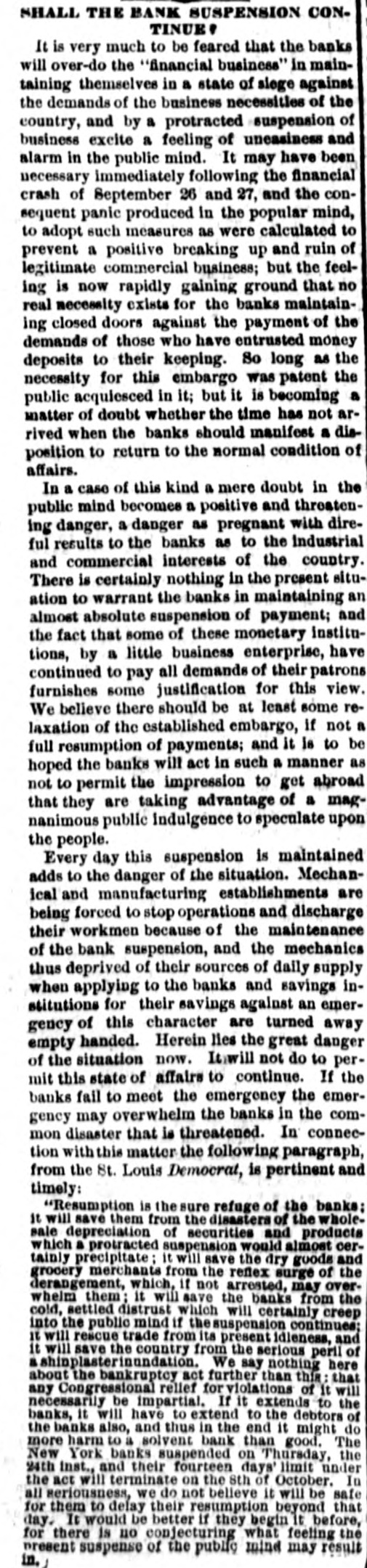
SHALL THE BANK SUSPENSION CONTINUE? It is very much to be feared that the banks will over-do the "financial business" in maintaining themselves in a state of siege against the demands of the business necessities of the country, and by a protracted suspension of business excite a feeling of uneasiness and alarm in the public mind. It may have been necessary immediately following the financial crash of September 26 and 27, and the consequent panic produced in the popular mind, to adopt such measures as were calculated to prevent a positive breaking up and ruin of legitimate commercial business; but the feeling is now rapidly gaining ground that no real necessity exists for the banks maintaining closed doors against the payment of the demands of those who have entrusted money deposits to their keeping. So long as the necessity for this embargo was patent the public acquiesced in it; but it is becoming a matter of doubt whether the time has not arrived when the banks should manifest a disposition to return to the normal condition of affairs. In a case of this kind a mere doubt in the public mind becomes a positive and threatening danger, a danger as pregnant with direful results to the banks as to the industrial and commercial interests of the country. There is certainly nothing in the present situation to warrant the banks in maintaining an almost absolute suspension of payment; and the fact that some of these monetary institutions, by a little business enterprise, have continued to pay all demands of their patrons furnishes some justification for this view. We believe there should be at least some relaxation of the established embargo, if not a full resumption of payments; and it is to be hoped the banks will act in such a manner as not to permit the impression to get abroad that they are taking advantage of a magnanimous public indulgence to speculate upon the people. Every day this suspension is maintained adds to the danger of the situation. Mechanical and manufacturing establishments are being forced to stop operations and discharge their workmen because of the maintenance of the bank suspension, and the mechanics thus deprived of their sources of daily supply when applying to the banks and savings institutions for their savings against an emergency of this character are turned away empty handed. Herein lies the great danger of the situation now. It will not do to permit this state of affairs to continue. If the banks fail to meet the emergency the emergency may overwhelm the banks in the common disaster that is threatened. In connection with this matter the following paragraph, from the St. Louis Democrat, is pertinent and timely: "Resumption is the sure refuge of the banks; it will save them from the disasters of the wholesale depreciation of securities and products which a protracted suspension would almost certainly precipitate; it will save the dry goods and grocery merchants from the reflex surge of the derangement, which, if not arrested, may overwhelm them; it will save the banks from the cold, settled distrust which will certainly creep into the public mind if the suspension continues; it will rescue trade from its present idleness, and it will save the country from the serious peril of a shinplaster inundation. We say nothing here about the bankruptcy act further than this; that any Congressional relief for violations of it will necessarily be impartial. If it extends to the banks, it will have to extend to the debtors of the banks also, and thus in the end it might do more harm to a solvent bank than good. The New York banks suspended on Thursday, the 24th inst., and their fourteen days' limit under the act will terminate on the 8th of October. In all seriousness, we do not believe it will be safe for them to delay their resumption beyond that day. It would be better if they begin it before, for there is no conjecturing what feeling the present suspense of the public mind may result in."


Article from Daily Kennebec Journal, October 16, 1873

Click image to open full size in new tab

Article Text

GENERAL NEWS. Frederick Chase Hutchinson, one of the family of singers, is dead. Pere Hyacinthe has been elected one of the three cures in Geneva by the Old Catholics. It is expected that the New York banks will resume currency payments next week. Newton has decided to cast off its swaddling clothes and become a city, the 17th in Massachusetts. The King of Italy has presented to the Empress of Austria a costly set of jewelry made in Rome. Christian Unity was practically illustrated in New York last Sunday. An Episcopal Bishop administered the Sacrament in a Presbyterian Church. T. Parkin Scott, Judge of the Supreme Bench of Maryland, died at Baltimore Monday morning, aged 70. The Chicago Post says that "if a son of Henry H. Wise is making speeches against his father, he must find himself compelled to change his politics several times a day." Many delegates to the Evangelical Alliance visited Philadelphia Monday and were entertained with a public reception and a banquet at the Continental Hotel, by the Philadelphia branch of the Alliance. The Cincinnati banks resumed payment of currency Monday. There were no runs and no excitement, and business men are very cheerful over the result. Most of the banks received more on deposits than they paid out. The republicans of the French Assembly paid M. Thiers a congratulatory visit Monday. The meetings of the several factions for the designation of members of the general committee of management will be held at various times next week. They have a calf out in Oregon who sports a nice little pair of wings. These ornamental appendages are about the size of turkey wings and crop out just behind the shoulders. Thomas A. Ridgely, formerly Medical Director on General Grant's Staff, was on Monday sentenced to three years' imprisonment in State Prison for breaking into a dwelling house in the daytime and stealing books, which he sold for liquor. "You ought to let me pass here free of charge, considering the benevolent nature of my profession," said a physician to a toll-gate keeper. "Not so," was the reply, "you send too many dead heads through here now." The doctor did not stop to argue the point, but paid his toll and passed on. In the naval battle off Cartagena thirteen men were killed and forty-seven wounded on the rebel fleet. Senor Mayer, a member of the Junta, was killed on board the Numancia. The Richmond Enquirer is attempting, at this late day, to fire the Virginia heart by printing, day after day, in capitals, such par-


Article from New-York Tribune, October 22, 1873

Click image to open full size in new tab

Article Text

CURRENCY RESUMPTION. P. OPINIONS OF W. K. KITCHEN, SHEPHERD KNAPP, APCALHOUN, AND _RESUMPTION MONEY PROACHING C. BY NATURAL PROCESSES PANIC ABUNDANT-WHOLESO EFFECTS OF THE ON THE BANKS. The question of an early resumption subject of payments by the banks was again the currency investigation by TRIBUNE reportere, yesterday, of an bank officials. W. K. Kitchen, said that while be believed was a bad one at the arrangement of among the Park the Bank. beginning, President the Park it pooling would Bank be.injudicious to break it up hastily. The rather no benefit from it, but on the contrary was to derives all the large banks must, but its effect distress amoug weaker institutions, a | reflex of distress among all. to freely, and would doubtless as save loses. quent ing in as prètty Currency continue and giving was conse- com involume. His own bank was able crease accommodation in to merchants as it was to, much but it had paid out a great part of its deposits. Further and not able to give as much as it would wish. The was this, there had been no practical suspension. ability than of currency according to each bank's doubtpayment the rule throughout. Bank reforms would would prove less was out of the trouble, and so far it was grow a beneficial panic. Over-certification he to evils which would be one the banks that had been in the habit had already learned caution. certifying believed have of the been remedied, that way. The of and over- Park Bank itself had never done business in 33 Shepherd Knapp of the Mechanics' Bank, No. Wallsaid he did not believe it best to force full resump banks st., of currency payments just now. Most of the tion had paid out a large proportion of their deposits some of them might be seriously depleted paid and the understanding that currency would be if freely should get abroad. It was better to let the the currency out work its way back gradually, and, with great influx of gold here from abroad, he thought specie payments might be the result. That, of course, would it be better for everybody. Although we could not use for currency, yet it afforded a solid foundation upon and which all values and all paper could stand steadily, a continued apparent suspension of currency seemed to up the event of a resumption of specie. had been entered The likely pooling hurry arrangement into endangered, by the solid banks because the weak ones were and it would be unwise to break it up before all are fully prepared. He knew of no intention on the part and of the large banks to withdraw from it, he certainly had formed no such intention himself As to the loan certificates. they were already being retired. The Mechanics Bank had purchased $300,000 of them at the beginning in order to relieve the merchants and to be ready in case of an emergency; but recently they had returned them and taken back their securities. There had, indeed, been more than twenty millions issued, for it was understood the Committee could issue ad libitum after the last ten million was issued. He (did not know, therefore, just how much therew to be redeemed, nor when they would all be redeemed. Other banks, doubtless. found the loan certificates very convenient. The Mechanics' had no use for them. It had continued to give merchants about as much accommodation as they demanded, and its discounts had increased $160,000 since the days before the panic. One reform likely to grow out of the erisis was a reform in the matter of over-certifying checks. His bank at present required full securities before it certified anything. P.C. Calhoun, President of the Fourth National Bank. said.there had never been any practical suspension. The banks have all paid National bank notes. and there is now an actual surplus of currency in all the banks. A man was there yesterday rushing about to sell $100,000 of National bank notes, and he could not find a buyer. The currency is coming in in great quantity, faster than it ever aid before, and because of the accommodation afforded by loan certificates. it accumulates in the bank If man comes with a check for $100, $400, or the counter, of course; if $500, vaults. he is paid over the amount is larger, $1,000 or $2,000, he is paid by certified check Reporter-As to the loan certificates, Mr. Calhoun, are they likely to soon redeemed if Mr. Calhoun-They could all be redeemed at once, the holders care to do it. We have been carrying $1,200,000 of them, merely to relieve the needs of our customers, but we could return them to-day, if we wished, take back our securities. But we do not think it We consider the loan a best and to so. certificates very good substitute for currency, and while they continue in use the actual currency accumulates. It is not drawback on any of us to make use of them. Brokers' checks are all certified, and always will be certified as long as there are any brokers' checks. The pool arrangement of the Associated Banks does no harm, and ittmay do good. The banks I believe could all draw out of it now, but it might strain some of the weak ones, and again threaten the mercantile interests. It is better to keep up the pool, although we larger banks suffer a little by it, than to break two or three mercantile houses, and have distrust and panic on us again. The accumulation of currency forms very desirable reserve to facilitate, when necessary, the movement of the various crops. But even in that particular, matters are exceedingly easy. A gentle man from the South was here to-day, who says that there is currency enough in the South to move the cotton crop provided we can give them slight advances on five and ten-day bills, due when the cotton arrives. So you may say that currency payments are resumed. There will be no formal proclamation of resumption by the Bank Compittee. Currency will simply assert itself. and in the course of the week every bank in the city will be paying currency as freely as ever. J. E. Williams, of the Metropolitan National Bank. had time only to say, when asked as to the prospects of an early resumption of currency payment, that he thought it best to let it come about naturally rather than to force it by any formal action by the banks. THE IRON TRADE SUFFERING FROM THE STRINGENCY. A TRIBUNE reporter yesterday conversed with several extensive dealers in iron, both American and imported, to obtain their opinions as to the present condition of business and the prospects for the future. Edward Oothout of the firm of W. Oothout & Co., No. 3 CHiff-st., said that the iron trade is now almost at a standstill. The transactions of the past month have been little over 50 per centrol those of the same time last year. Money does not come forward to set in motion the products of the mines and mills, and to move the crops. Moreover, dealers want both confidence and ready means to sustain them in giving orders. At the beginning of the panic collections came in pretty well, but as the alarm and the consequent monetary stringency spread over the country, the receipts stopped, and now there is little coming in. Many of the mills and employing firms are embarrassed to pay their MCD. and either defer full payment or give part of what is due in orders on some bank. In the case of the larger mills and houses this difficulty is chiefly due to the limitations put on currency payments by the banks. Mills and firms which have less resources, beside trouble from this cause, find difficulty also because they can little or and because their not meet their Merchants get their not more. Some usually sell money among obligations nothing, and the will promptly. trustworthy, buy debtors cannot now buyers, do most can only meet their bille with
Article from The Wheeling Daily Intelligencer, October 24, 1873

Click image to open full size in new tab

Article Text

THAT MYSTERIOUS LETTER. You Pay Your Money and Take Your Choice. A DENIAL AUTHORIZED. NEW YORK, Oct. 23.-President Grant authorizes a positive denial of having written Mr. Williams or any one else such a statement as has been made public. THE PRESIDENT REPEATS IIIS FORMER REMARKS. WASHINGTON, Oct. 23.-The President received today a large number of visitors: He was asked about the contents of his recent letter to Mr. Williams, the New York bank President, and said he therein repeated his former remark, namely, that in addition to what had already been done by the government, the only way of relief was for the government to buy exchange; but exchange could not be bought, as the government has no use for it, having already purchased enough on London for the Navy and State Departments to answer present purposes. There is no intention, he further remarked, to draw on the $44,000,000 reserve, except to meet current expenses of the government. The money will be used for no other purpose. NO COPY OF THE LETTER RETAINED. WASHINGTON, Oct. 23.-A New York dispatch says it is stated that no copy of the President's letter to John E. Williams is retained there. Mr. Williams says the letter from President Grant merely acknowledged the receipt of one from him, and expressed his anxious desire to do all he could to relieve the monetary panic. He then asks the question, why cannot the banks some together and make some arrangement for the relief merchants and the public? adding that he would do all in his power to assist them. Mr. Williams says the other published statements as to what the President will do, or promised to do, are reports of a convensation between the President and Mr. Anthony, who brought the President's letter from Washington. MEETING OF BANK PRESIDENTS-RESOLUTIONS. NEW YORK, Oct. 23.-At a meeting of Bank Presidents to-day Mr. Williams, President of the Metropolitan National Bank, submitted a letter he had received from the President. It was very brief, and simply stated that in three or four weeks the President would feel disposed, in case of urgent need, to issue weekly 3,000,000 or 4,000,000 out of the legal reserve. The following resolutions were adopted: Resolved, That the message of the President of the United States to the banks of New York be respectfully and gratefully acknowledged; and we cordially reciprocate his kind wishes and will act in the spirit which he recommends. Resolved, That from and after the first of November next, the equalization of legal tender by the banks of this Association be discontinued. The proposition to use the National bank currency notes in Clearings House settlement was rejected. Mr. Williams, of the firm of Grinnell & Co., said that this morning's story of the Times, that the Union Trust: Company was indebted to the Lake shore two and a half million dollars, was incorrect. The Receiver of the Trust Company made the same statement.