Article Text
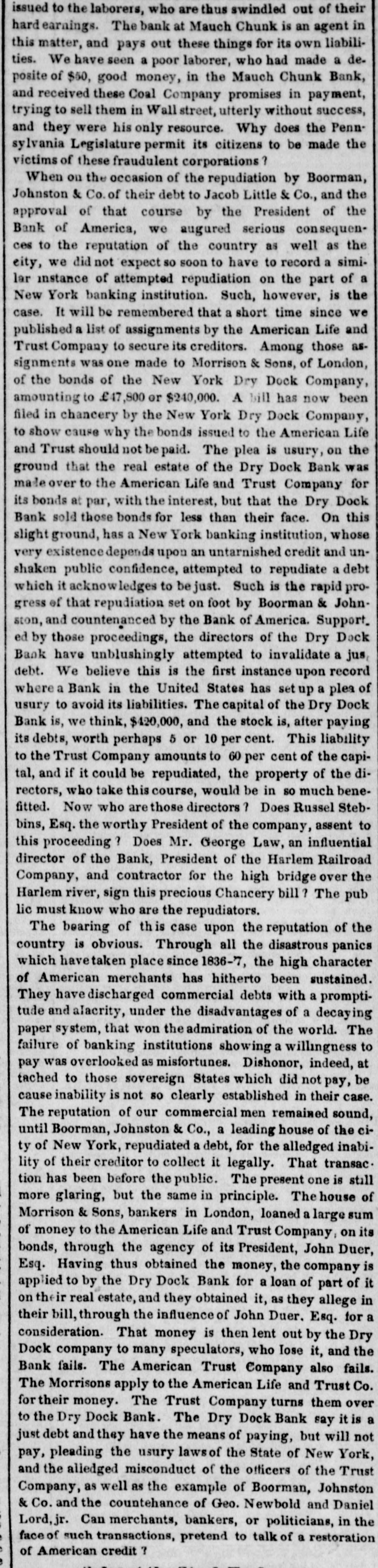
issued to the laborers, who are thus swindled out of their hard earnings. The bank at Mauch Chunk is an agent in this matter, and pays out these things for its own liabilities. We have seen a poor laborer, who had made a deposite of $50, good money, in the Mauch Chunk Bank, and received these Coal Company promises in payment, trying to sell them in Wall street, utterly without success, and they were his only resource. Why does the Pennsylvania Legislature permit its citizens to be made the victims of these fraudulent corporations? When on the occasion of the repudiation by Boorman, Johnston & Co. of their debt to Jacob Little & Co., and the approval of that course by the President of the Bank of America, we augured serious consequences to the reputation of the country as well as the city, we did not expect so soon to have to record a similar instance of attempted repudiation on the part of a New York banking institution. Such, however, is the case. It will be remembered that a short time since we published a list of assignments by the American Life and Trust Company to secure its creditors. Among those assignments was one made to Morrison & Sons, of London, of the bonds of the New York Dry Dock Company, amounting to £47,800 or $240,000. A bill has now been filed in chancery by the New York Dry Dock Company, to show cause why the bonds issued to the American Life and Trust should not be paid. The plea is usury, on the ground that the real estate of the Dry Dock Bank was maleover to the American Life and Trust Company for its bonds at par, with the interest, but that the Dry Dock Bank sold those bonds for less than their face. On this slight ground, has a New York banking institution, whose very existence depends upon an untarnished credit and unshaken public confidence, attempted to repudiate a debt which it acknowledges to be just. Such is the rapid progress of that repudiation set on foot by Boorman & Johnston, and countenanced by the Bank of America. Support_ ed by those proceedings, the directors of the Dry Dock Bank have unblushingly attempted to invalidate a jus, debt. We believe this is the first instance upon record where a Bank in the United States has set up a plea of usury to avoid its liabilities. The capital of the Dry Dock Bank is, we think, $420,000, and the stock is, after paying its debts, worth perhaps 5 or 10 per cent. This liability to the Trust Company amounts to 60 per cent of the capital, and if it could be repudiated, the property of the directors, who take this course, would be in so much benefitted. Now who are those directors? Does Russel Stebbins, Esq. the worthy President of the company, assent to this proceeding ? Does Mr. George Law, an influential director of the Bank, President of the Harlem Railroad Company, and contractor for the high bridge over the Harlem river, sign this precious Chancery bill? The pub lic must know who are the repudiators. The bearing of this case upon the reputation of the country is obvious. Through all the disastrous panics which havetaken place since 1836-7, the high character of American merchants has hitherto been sustained. They have discharged commercial debts with a promptitude and alacrity, under the disadvantages of a decaying paper system, that won the admiration of the world. The failure of banking institutions showing a willingness to pay was overlooked as misfortunes. Dishonor, indeed, at tached to those sovereign States which did not pay, be cause inability is not so clearly established in their case. The reputation of our commercial men remained sound, until Boorman, Johnston & Co., a leading house of the city of New York, repudiated a debt, for the alledged inability of their creditor to collect it legally. That transac. tion has been before the public. The present one is still more glaring, but the same in principle. The house of Morrison & Sons, bankers in London, loaned a large sum of money to the American Life and Trust Company, on its bonds, through the agency of its President, John Duer, Esq. Having thus obtained the money, the company is applied to by the Dry Dock Bank for a loan of part of it on their real estate, and they obtained it, as they allege in their bill, through the influence of John Duer. Esq. for a consideration. That money is then lent out by the Dry Dock company to many speculators, who lose it, and the Bank fails. The American Trust Company also fails. The Morrisons apply to the American Life and Trust Co. for their money. The Trust Company turns them over to the Dry Dock Bank. The Dry Dock Bank say it is a just debt and they have the means of paying, but will not pay, pleading the usury laws the State of New York, and the alledged misconduct of the officers of the Trust Company, as well as the example of Boorman, Johnston & Co. and the countehance of Geo. Newbold and Daniel Lord,jr. Can merchants, bankers, or politicians, in the face of such transactions, pretend to talk of a restoration of American credit ?