First National Bank (Warren, MA)

Episode Information

Episode UID
1156701478
Episode Type
Suspension → Closure
Bank Type
national
Bank ID
115670 national
Charter Number
11567
Start Date
February 21, 1923
Location
Warren, Massachusetts (42.213, -72.191)

Metadata

Model
gpt-5-mini (chosen from majority vote of a three-model LLM ensemble)
Short Digest
b4a2e09ea8c24993

Response Measures

None

Receivership Details

Depositor recovery rate
67.0%
Date receivership started
1923-02-23
Date receivership terminated
1928-04-26
OCC cause of failure
Fraud
Share of assets assessed as good
86.7%
Share of assets assessed as doubtful
11.9%
Share of assets assessed as worthless
1.4%

Description

Closure followed discovery of large missing securities/embezzlement tied to outside operator Joseph Marcino.

Events (4)

1. December 31, 1919 Chartered
Source
historical_nic
2. February 21, 1923 Suspension
Cause
Bank Specific Adverse Info
Cause Details
Discovery of missing bonds/securities (~$212,000–$213,000) and alleged embezzlement/manipulation by outside operator Joseph B. Marcino and involvement of bank president Frank L. Taylor.
Newspaper Excerpt
The First National Bank of this town was closed this morning by order of the directors and is in the hands of national bank examiners.
Source
newspapers
3. February 23, 1923 Receivership
Source
historical_nic
4. February 23, 1923 Receivership
Newspaper Excerpt
Residents of this town face heavy losses as depositors or as stockholders in the First National bank here through the theft of $213,000 of its securities. Bank Examiner Howard W. Black resumed today the work of checking up the bank's affairs... the bank was closed February 20 last, when its president, Frank L. Taylor, disappeared, and James E. Farrell, receiver of the First National bank announced ... first dividend at the rate of 40 per cent upon proved claims.
Source
newspapers

Newspaper Articles (23)

Article from Springfield Evening Union, February 21, 1923

Click image to open full size in new tab

Article Text

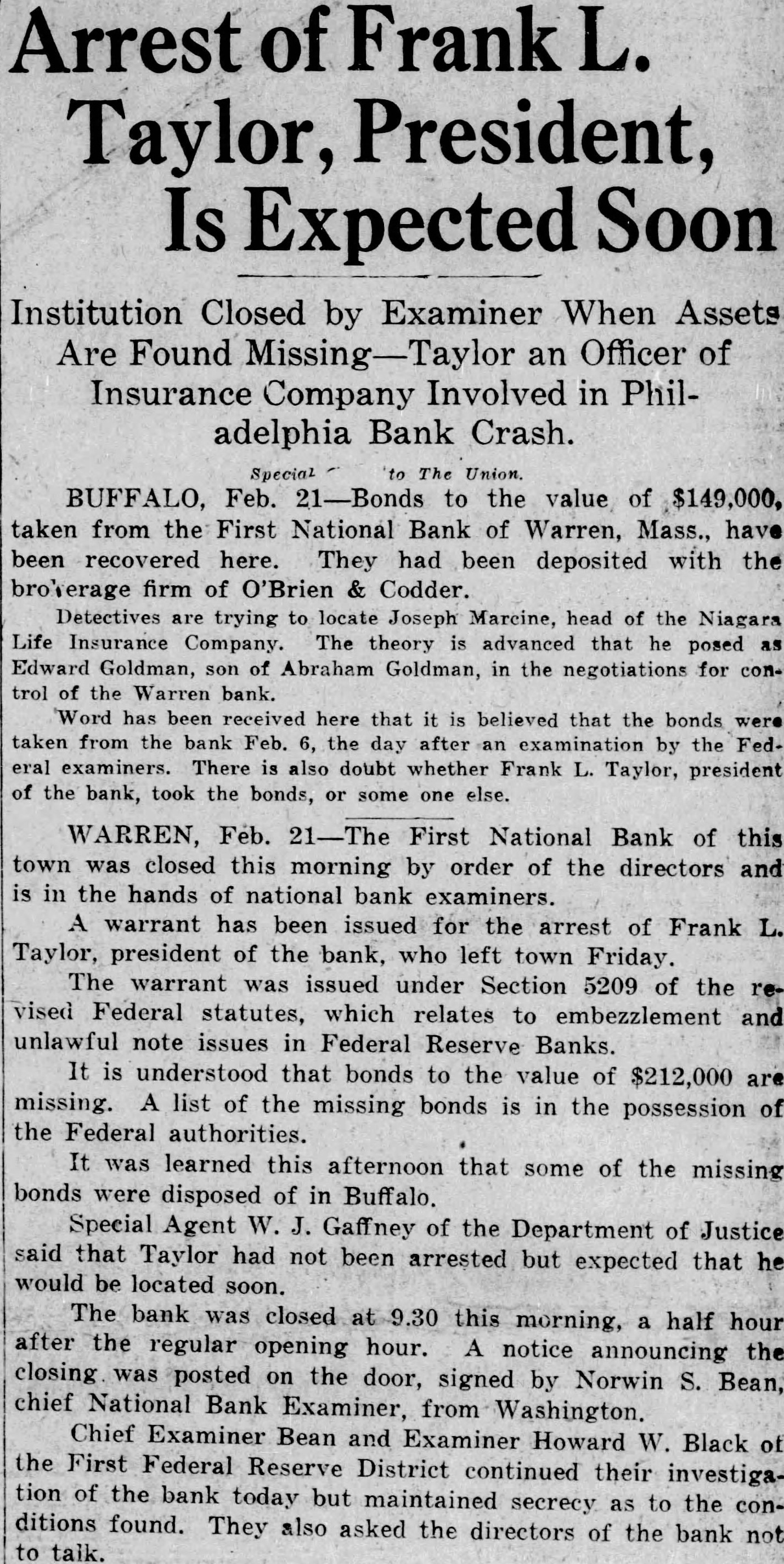
Arrest of Frank L. Taylor, President, Is Expected Soon Institution Closed by Examiner When Assets Are Found Missing—Taylor an Officer of Insurance Company Involved in Philadelphia Bank Crash. Special to The Union. BUFFALO, Feb. 21—Bonds to the value of $149,000, taken from the First National Bank of Warren, Mass., have been recovered here. They had been deposited with the brokerage firm of O'Brien & Codder. Detectives are trying to locate Joseph Marcine, head of the Niagara Life Insurance Company. The theory is advanced that he posed as Edward Goldman, son of Abraham Goldman, in the negotiations for control of the Warren bank. Word has been received here that it is believed that the bonds were taken from the bank Feb. 6, the day after an examination by the Federal examiners. There is also doubt whether Frank L. Taylor, president of the bank, took the bonds, or some one else. WARREN, Feb. 21—The First National Bank of this town was closed this morning by order of the directors and is in the hands of national bank examiners. A warrant has been issued for the arrest of Frank L. Taylor, president of the bank, who left town Friday. The warrant was issued under Section 5209 of the revised Federal statutes, which relates to embezzlement and unlawful note issues in Federal Reserve Banks. It is understood that bonds to the value of $212,000 are missing. A list of the missing bonds is in the possession of the Federal authorities. It was learned this afternoon that some of the missing bonds were disposed of in Buffalo. Special Agent W. J. Gaffney of the Department of Justice said that Taylor had not been arrested but expected that he would be located soon. The bank was closed at 9.30 this morning, a half hour after the regular opening hour. A notice announcing the closing was posted on the door, signed by Norwin S. Bean, chief National Bank Examiner, from Washington. Chief Examiner Bean and Examiner Howard W. Black of the First Federal Reserve District continued their investigation of the bank today but maintained secrecy as to the conditions found. They also asked the directors of the bank not to talk.


Article from Springfield Evening Union, February 21, 1923

Click image to open full size in new tab

Article Text

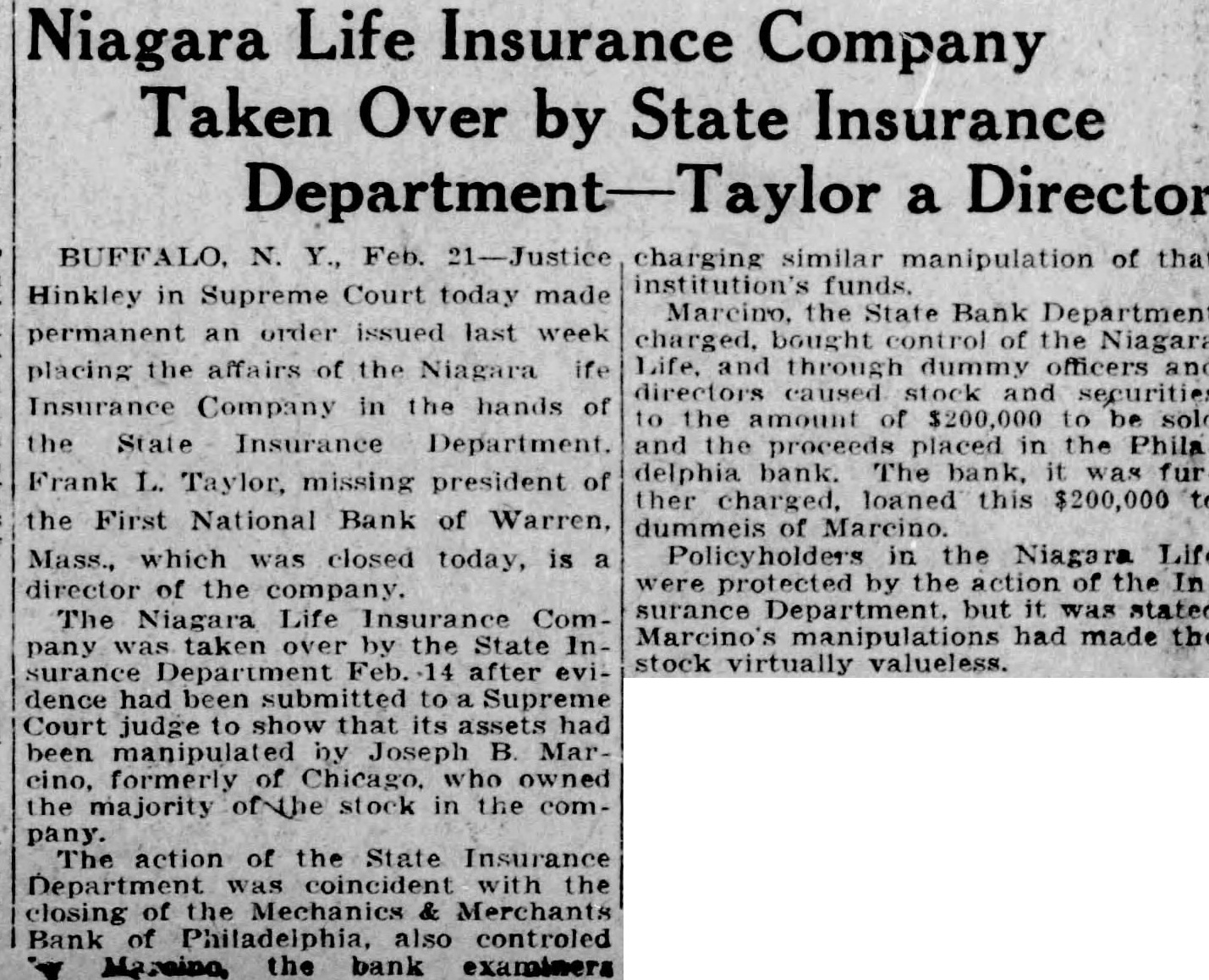
Niagara Life Insurance Company Taken Over by State Insurance Department—Taylor a Director BUFFALO, N. Y., Feb. 21—Justice Hinkley in Supreme Court today made permanent an order issued last week placing the affairs of the Niagara Life Insurance Company in the hands of the State Insurance Department. Frank L. Taylor, missing president of the First National Bank of Warren, Mass., which was closed today, is a director of the company. The Niagara Life Insurance Company was taken over by the State Insurance Department Feb. 14 after evidence had been submitted to a Supreme Court judge to show that its assets had been manipulated by Joseph B. Marcino, formerly of Chicago, who owned the majority of the stock in the company. The action of the State Insurance Department was coincident with the closing of the Mechanics & Merchants Bank of Philadelphia, also controlled by Marcino, the bank examiners charging similar manipulation of that institution's funds. Marcino, the State Bank Department charged, bought control of the Niagara Life, and through dummy officers and directors caused stock and securities to the amount of $200,000 to be sold and the proceeds placed in the Philadelphia bank. The bank, it was further charged, loaned this $200,000 to dummies of Marcino. Policyholders in the Niagara Life were protected by the action of the Insurance Department, but it was stated Marcino's manipulations had made the stock virtually valueless.


Article from The Evening Herald, February 21, 1923

Click image to open full size in new tab

Article Text

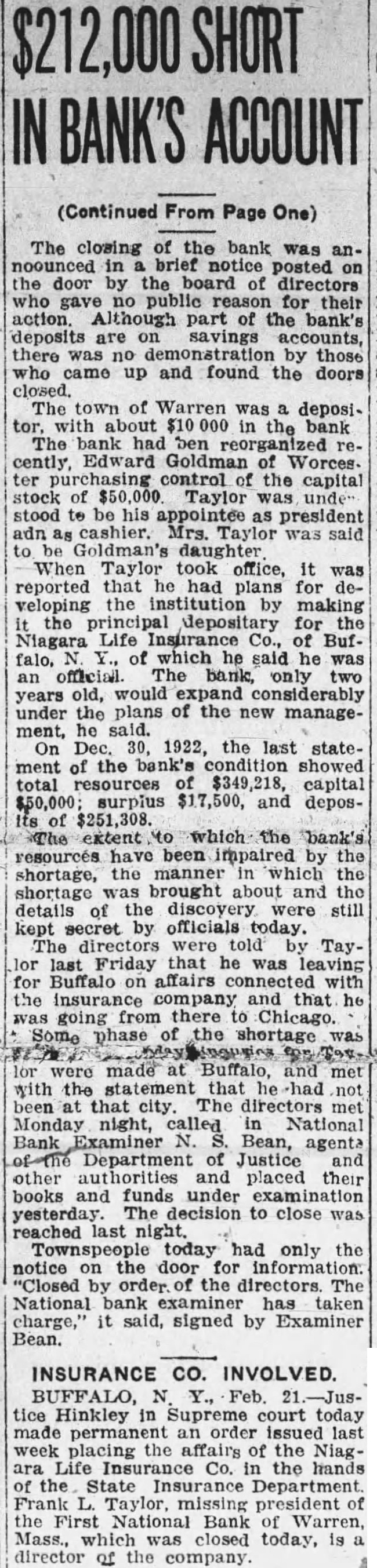
$212,000 SHORT IN BANK'S ACCOUNT (Continued From Page One) The closing of the bank was announced in a brief notice posted on the door by the board of directors who gave no public reason for their action. Although part of the bank's deposits are on savings accounts, there was no demonstration by those who came up and found the doors closed. The town of Warren was a depositor, with about $10,000 in the bank. The bank had been reorganized recently, Edward Goldman of Worcester purchasing control of the capital stock of $50,000. Taylor was understood to be his appointee as president and as cashier. Mrs. Taylor was said to be Goldman's daughter. When Taylor took office, it was reported that he had plans for developing the institution by making it the principal depositary for the Niagara Life Insurance Co., of Buffalo, N. Y., of which he said he was an official. The bank, only two years old, would expand considerably under the plans of the new management, he said. On Dec. 30, 1922, the last statement of the bank's condition showed total resources of $349,218, capital $50,000; surplus $17,500, and deposits of $251,308. The extent to which the bank's resources have been impaired by the shortage, the manner in which the shortage was brought about and the details of the discovery were still kept secret by officials today. The directors were told by Taylor last Friday that he was leaving for Buffalo on affairs connected with the insurance company and that he was going from there to Chicago. Some phase of the shortage was today inquiries for Taylor were made at Buffalo, and met with the statement that he had not been at that city. The directors met Monday night, called in National Bank Examiner N. S. Bean, agents of the Department of Justice and other authorities and placed their books and funds under examination yesterday. The decision to close was reached last night. Townspeople today had only the notice on the door for information. "Closed by order of the directors. The National bank examiner has taken charge," it said, signed by Examiner Bean. INSURANCE CO. INVOLVED. BUFFALO, N. Y., Feb. 21.—Justice Hinkley in Supreme court today made permanent an order issued last week placing the affairs of the Niagara Life Insurance Co. in the hands of the State Insurance Department. Frank L. Taylor, missing president of the First National Bank of Warren, Mass., which was closed today, is a director of the company.


Article from New Britain Herald, February 23, 1923

Click image to open full size in new tab

Article Text

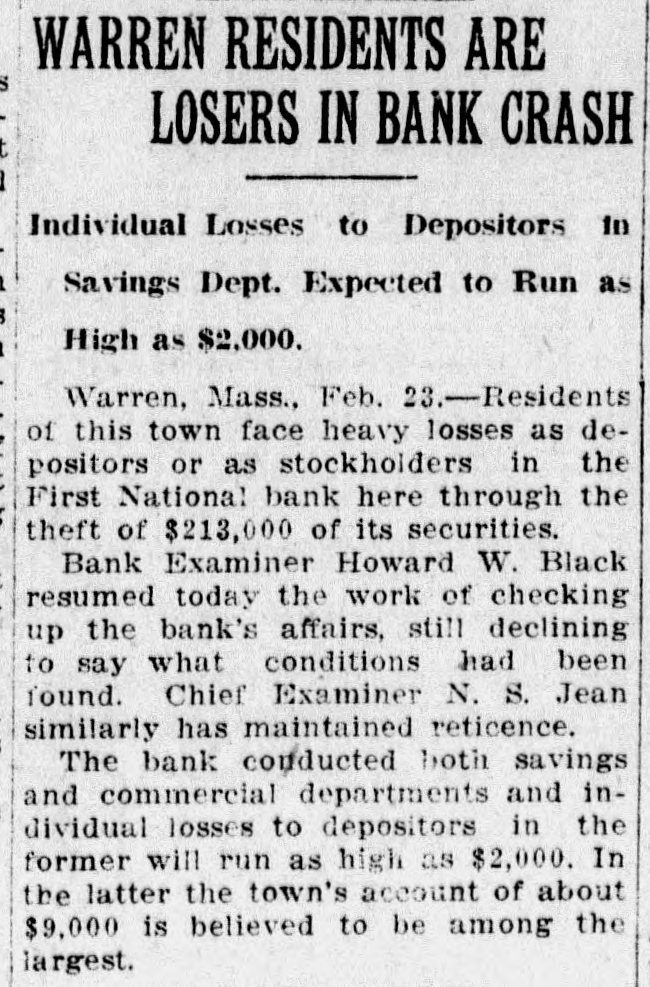
WARREN RESIDENTS ARE LOSERS IN BANK CRASH Individual Losses to Depositors in Savings Dept. Expected to Run as High as $2,000. Warren, Mass., Feb. 23.-Residents of this town face heavy losses as depositors or as stockholders in the First National bank here through the theft of $213,000 of its securities. Bank Examiner Howard W. Black resumed today the work of checking up the bank's affairs, still declining to say what conditions had been found. Chief Examiner N. S. Jean similarly has maintained reticence. The bank conducted both savings and commercial departments and individual losses to depositors in the former will run as high as $2,000. In the latter the town's account of about $9,000 is believed to be among the largest.


Article from The Daily Times, February 23, 1923

Click image to open full size in new tab

Article Text

short $248,000, is the son of an Italian baker of Chicago. While in Buffalo, Marcino extended his holdings, buying the controlling interests in the Merchants and Mechanics bank of Philadelphia, which failed last week, and the First National bank of Warren, Mass., where the discovery of an alleged shortage of $213,000 caused officers to start a search for Marcino and brought about the arrest of Taylor here. "I have always helped him," Mr Goldman said, in referring to the spectacular rise of the former barber. "I got him out of trouble. He ran away with my daughter four years ago. When they eloped I had to make the best of it." Wrecked California Bank About three years ago the bank of Perris, Cal., near Los Angeles, failed, and Marcino's name was named in connection with the collapse. After that he disappeared with his wife, going first to South America and thence to Italy, where he was a purchasing agent for the Italian government during the war. Of his return Mr Goldman said: "They returned to this country about 18 months ago and came to my home. Then I discovered about this California trouble. He begged me to help him and for my daughter's sake I did. Mrs Goldman, my wife, went to California. She paid $5,000 in cash and took notes for $6,000 more to get him out of trouble. "That was the bank of Perris. I understood it failed for $41,000 and A. L. Greenburg of Los Angeles paid $30,000 and we the $11,000." Then Mr Goldman told of his son-in-law's connection with the Warren institution and the Buffalo Insurance Co. "I thought he was on the road to success, and when he asked me to be honorary vice president of the Warren bank, I accepted the position and signed some papers for him." Mr Goldman denied that he had paid large sums of money for his son-in-law, asserting the only money paid to him or for him was in connection with the California episode. Associated with Worthington On the Pacific coast Marcino was reported to have connected with banking institutions at San Pedro, Beaumont, Banning, Venice and Perris. Later he was mentioned in connection with banks in Cedar Point, Ill., where he was said to have been associated with John Worthington, termed "the Wolf of La Salle street," who was sentenced here yesterday to two years in the federal prison, Fairmount, Ind., and Weyauwega, Wis. Eleven years ago Marcino, then 16 years old, donned a barber's coat in a Chicago shop. Subsequently he became an insurance salesman. In 1914 he was said to have been employed by the Globe Insurance Co. Later he was reported to have organized the Public Life Insurance Co., selling policies among Italians. His career as a banker, according to investigations here, started with the Atlas Exchange bank, eventually closed by a bank examiner. From this start he went from one bank to another, the number of which investigators are now bending their efforts to ascertain.


Article from The Courier, February 23, 1923

Click image to open full size in new tab

Article Text

FUGITIVE WRECKER OF BANKS MAY BE DEAD, NOTE HINTS Investigators Follow Marcino's Spectacular Career Thru High Finance. NATIONWIDE SEARCH ON FOR CROOKED FINANCIER Son of Italian Baker Astonishes Police With Magnitude of His Operations. (By the Associated Press) Chicago, Feb. 23.—While authorities in various parts of the United States today continued checking up the operations of Joseph M. Marcino, alias Joseph B. Biata, who rose from a barber to a buyer of banks and whose financial deals were reported to have caused losses approximating $591,000, reports here indicated that he might have committed suicide. That theory found its inception in a letter written by Marcino from some point in Texas or Mexico to Abraham Goldman, Chicago, his father-in-law, and who, according to investigators, supplied the missing man with funds in a greater or lesser amount. The letter, said to contain a minute account of the fugitive's financial career since its beginning here in Chicago, was reported to indicate that Marcino might end his life so that creditors could realize on his life insurance policies, totaling $100,000. "The only thing that remains for me to do," he was reported to have written, "is to disappear from the face of the earth into oblivion, or endure a life of suffering. I only hope within a few years, thru the proceeds of my insurance, to repay creditors." Taylor Faces Arraignment. Today Frank L. Taylor, a former railroad fireman, finally advanced to president of the First National bank of Warren, Mass., by the fugitive, at a salary of $50 a week, faced arraignment in the federal court here following the reported discovery of a $213,000 shortage in accounts of the Warren institution. Marcino, as he was known in Buffalo, N. Y., where he acquired the controlling interest in the Bison Holding corporation, the holding concern of the Niagara Insurance company, the accounts of which investigators have declared are short $248,000, is the son of an Italian baker of Chicago. While in Buffalo Marcino extended his holdings, buying the controlling interests in the Merchants and Mechanics bank, Philadelphia, which failed last week, and the First National bank, Warren, Mass., where the discovery of an alleged shortage of $213,000 caused officers to start a search for Marcino and brought about the arrest of Taylor here. "I have always helped him," Goldman said, in referring to the spectacular rise of the former barber. "I got him out trouble. He ran away with my daughter four years ago. When they eloped I had to make the best of it." Trouble in California. About three years ago the Bank of Perris, Cal., near Los Angeles, failed and Marcino's name was mentioned in connection with the collapse. After that he disappeared with his wife, going first to South America and thence to Italy, where he was a purchasing agent for the Italian government during the war. Of his return, Goldman said: "They returned to this country about 18 months ago and came to my home. Then I discovered about this California trouble. He begged me to help him and for my daughter's sake I did. Mrs. Goldman, my wife, went to California. She paid $5,000 in cash and took notes for $6,000 more to get him out of trouble. "That was the Bank of Perris. I understand it failed later." Then Goldman told of his son-in-law's connection with the Warren institution and the Buffalo Insurance company: "I thought he was on the road to success, and when he asked me to be honorary vice president of the Warren bank I accepted the position and signed some papers for him." With Many Banks. Goldman denied that he had paid large sums of money for his son-in-law, asserting the only money paid to him or for him was in connection with the California episode. On the Pacific coast Marcino was reported to have been connected with banking institutions in San Pedro, Beaumont, Banning, Venice and Perris. Later he was mentioned in connection with banks in Cedar Point, Ill., where he was said to have been associated with John Worthington, termed "the wolf of LaSalle street," who was sentenced here yesterday to two years in the federal prison; Fairmount, Ind., and Weyauwega, Wis. Eleven years ago Marcino, then 16 years old, donned a barber's coat in a Chicago shop. Subsequently, he became an insurance salesman. In 1914 he was said to have been employed by the Globe Insurance company. Later he was reported to have organized the Public Life Insurance company, selling policies among Italians. His career as a banker, according to investigations here, started with the Atlas Exchange bank, eventually closed by a bank examiner. From this start he went from one bank to another, the number of which investigators are now bending their efforts to ascertain."
Article from The Muscatine Journal, February 23, 1923

Click image to open full size in new tab

Article Text

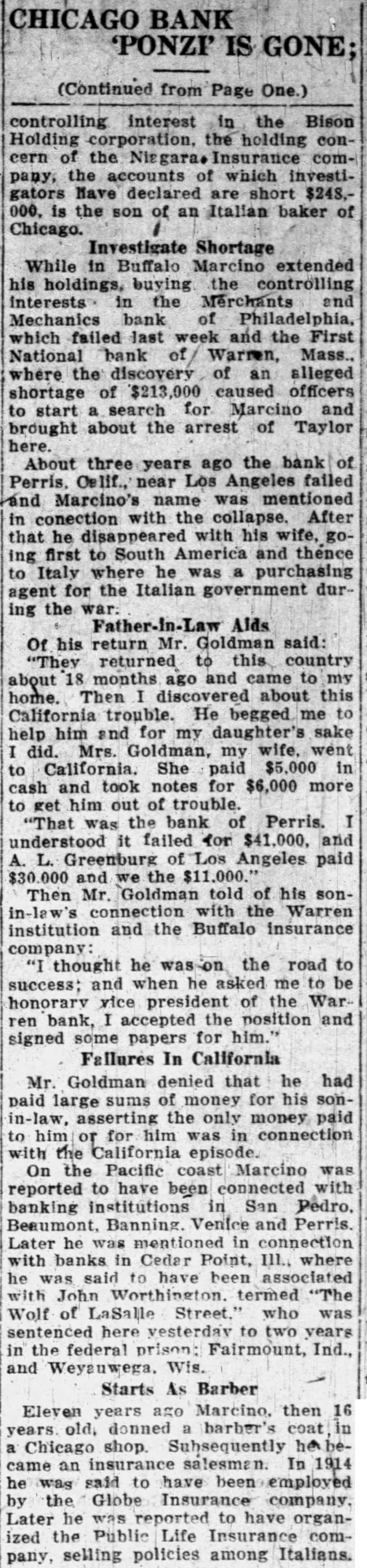
CHICAGO BANK 'PONZI' IS GONE; (Continued from Page One.) controlling interest in the Bison Holding corporation, the holding concern of the Niagara Insurance company, the accounts of which investigators have declared are short $248,000, is the son of an Italian baker of Chicago. Investigate Shortage While in Buffalo Marcino extended his holdings, buying the controlling interests in the Merchants and Mechanics bank of Philadelphia, which failed last week and the First National bank of Warren, Mass., where the discovery of an alleged shortage of $213,000 caused officers to start a search for Marcino and brought about the arrest of Taylor here. About three years ago the bank of Perris, Calif., near Los Angeles failed and Marcino's name was mentioned in connection with the collapse. After that he disappeared with his wife, going first to South America and thence to Italy where he was a purchasing agent for the Italian government during the war. Father-in-Law Aids Of his return Mr. Goldman said: "They returned to this country about 18 months ago and came to my home. Then I discovered about this California trouble. He begged me to help him and for my daughter's sake I did. Mrs. Goldman, my wife, went to California. She paid $5,000 in cash and took notes for $6,000 more to get him out of trouble. "That was the bank of Perris. I understood it failed for $41,000, and A. L. Greenburg of Los Angeles paid $30,000 and we the $11,000." Then Mr. Goldman told of his son-in-law's connection with the Warren institution and the Buffalo insurance company: "I thought he was on the road to success; and when he asked me to be honorary vice president of the Warren bank, I accepted the position and signed some papers for him." Failures In California Mr. Goldman denied that he had paid large sums of money for his son-in-law, asserting the only money paid to him or for him was in connection with the California episode. On the Pacific coast Marcino was reported to have been connected with banking institutions in San Pedro, Beaumont, Banning, Venice and Perris. Later he was mentioned in connection with banks in Cedar Point, Ill., where he was said to have been associated with John Worthington, termed "The Wolf of LaSalle Street," who was sentenced here yesterday to two years in the federal prison; Fairmount, Ind., and Weyauwega, Wis. Starts As Barber Eleven years ago Marcino, then 16 years old, donned a barber's coat in a Chicago shop. Subsequently he became an insurance salesman. In 1914 he was said to have been employed by the Globe Insurance company. Later he was reported to have organized the Public Life Insurance company, selling policies among Italians.


Article from The Boston Daily Globe, February 25, 1923

Click image to open full size in new tab

Article Text

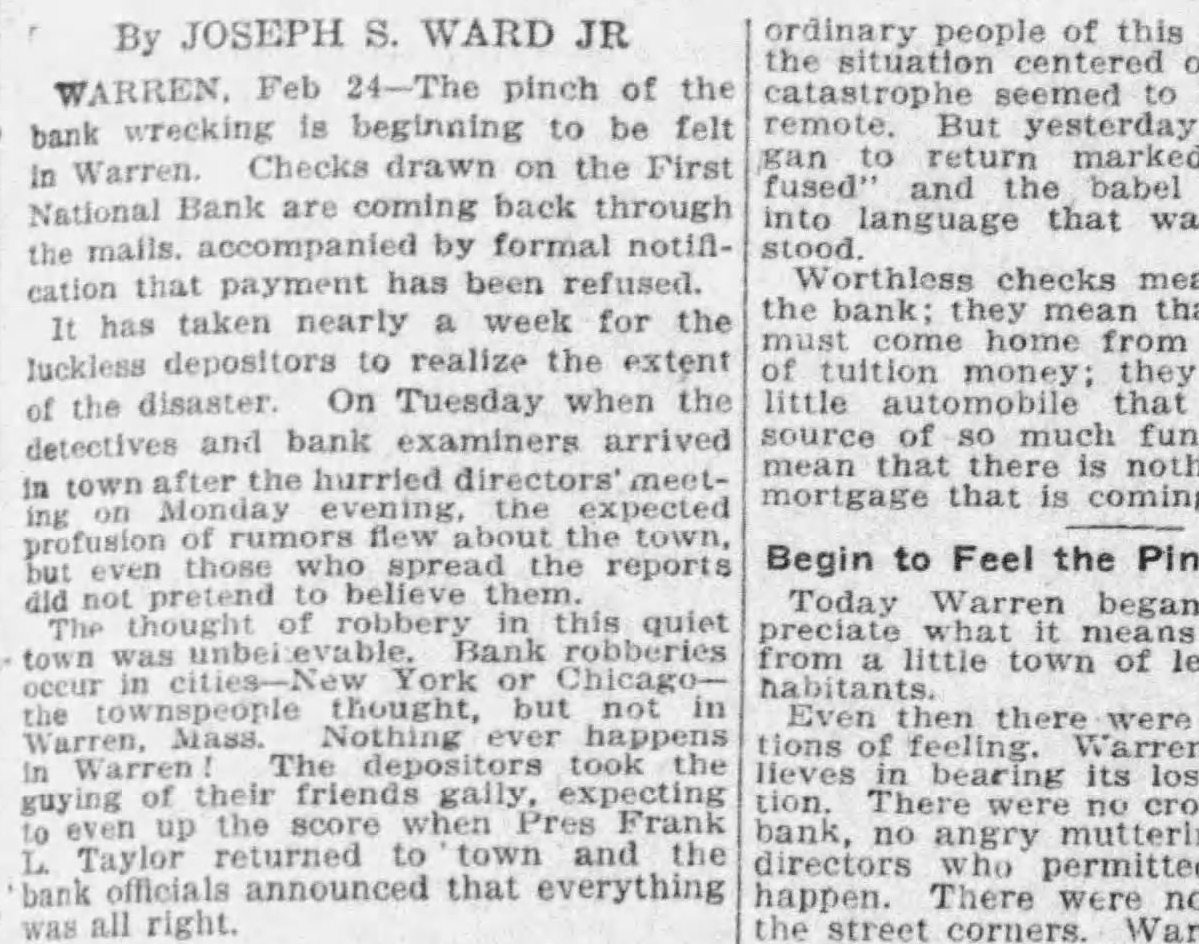
By JOSEPH S. WARD JR WARREN, Feb 24—The pinch of the bank wrecking is beginning to be felt in Warren. Checks drawn on the First National Bank are coming back through the mails, accompanied by formal notification that payment has been refused. It has taken nearly a week for the luckless depositors to realize the extent of the disaster. On Tuesday when the detectives and bank examiners arrived in town after the hurried directors' meeting on Monday evening, the expected profusion of rumors flew about the town, but even those who spread the reports did not pretend to believe them. The thought of robbery in this quiet town was unbelievable. Bank robberies occur in cities—New York or Chicago—the townspeople thought, but not in Warren, Mass. Nothing ever happens in Warren! The depositors took the guying of their friends gaily, expecting to even up the score when Pres Frank L. Taylor returned to town and the bank officials announced that everything was all right. ordinary people of this the situation centered o catastrophe seemed to remote. But yesterday gan to return marked fused" and the babel into language that wa stood. Worthless checks mea the bank; they mean tha must come home from of tuition money; they little automobile that source of so much fun mean that there is noth mortgage that is coming Begin to Feel the Pin Today Warren began preciate what it means from a little town of le habitants. Even then there were tions of feeling. Warren lieves in bearing its los tion. There were no cro bank, no angry mutterin directors who permitte happen. There were no the street corners. War


Article from The Boston Daily Globe, February 25, 1923

Click image to open full size in new tab

Article Text

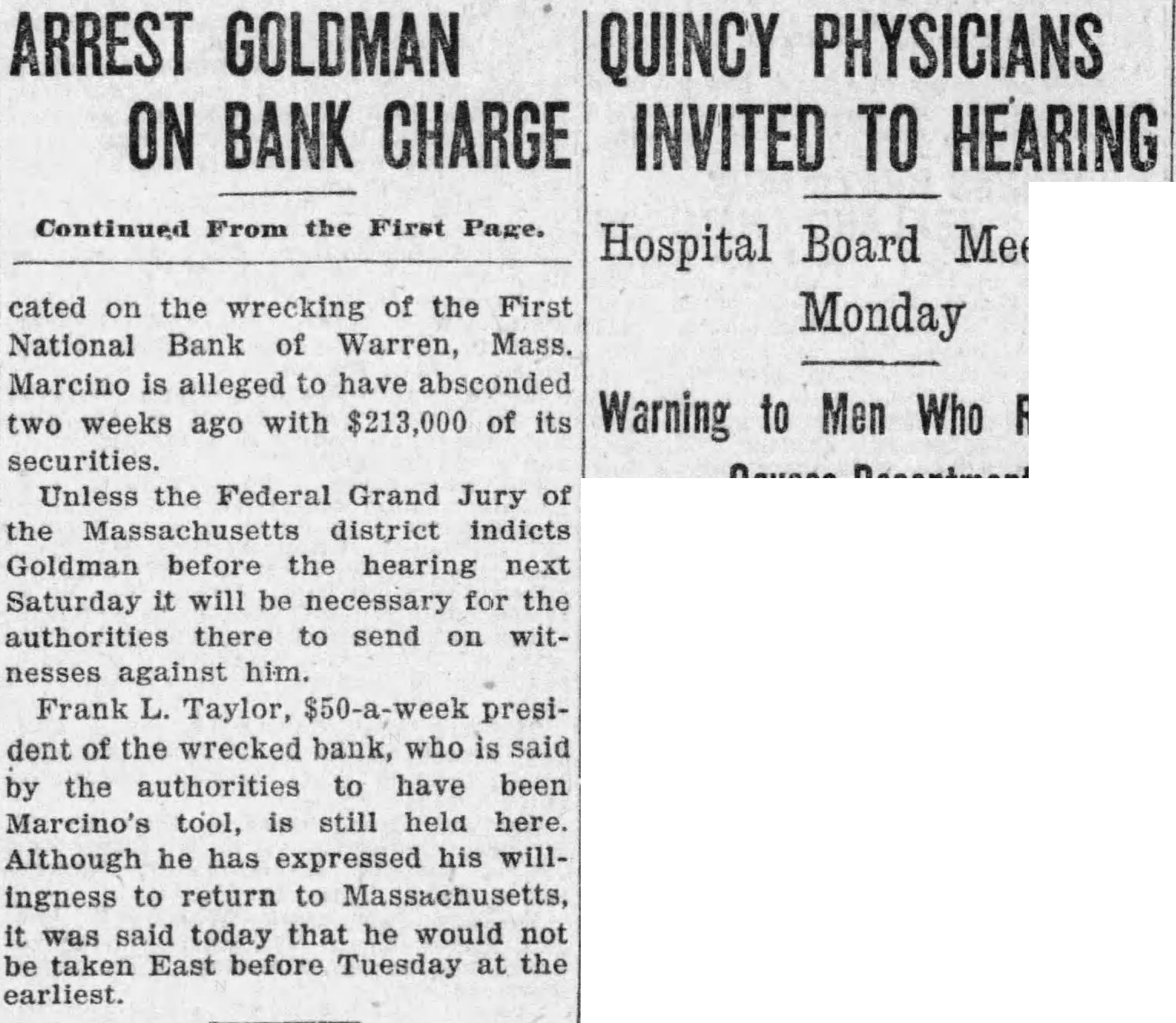
ARREST GOLDMAN ON BANK CHARGE Continued From the First Page. cated on the wrecking of the First National Bank of Warren, Mass. Marcino is alleged to have absconded two weeks ago with $213,000 of its securities. Unless the Federal Grand Jury of the Massachusetts district indicts Goldman before the hearing next Saturday it will be necessary for the authorities there to send on witnesses against him. Frank L. Taylor, $50-a-week president of the wrecked bank, who is said by the authorities to have been Marcino's tool, is still held here. Although he has expressed his willingness to return to Massachusetts, it was said today that he would not be taken East before Tuesday at the earliest.


Article from Kennebec Journal, February 26, 1923

Click image to open full size in new tab

Article Text

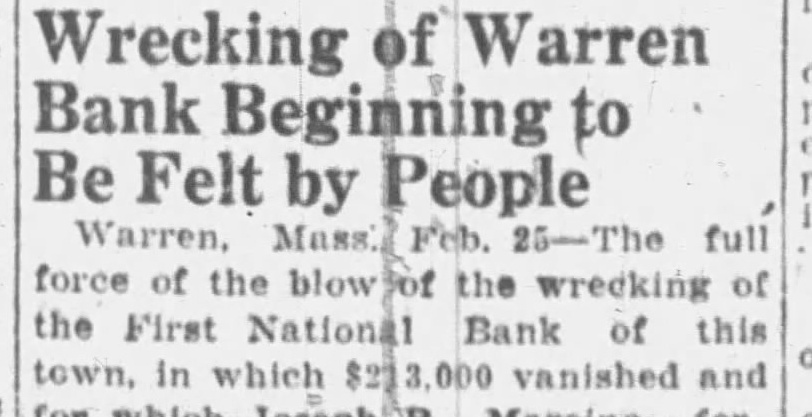
Wrecking of Warren Bank Beginning to Be Felt by People Warren, Mass., Feb. 25—The full force of the blow of the wrecking of the First National Bank of this town, in which $213,000 vanished and for which Joseph R. Manning, for


Article from New Britain Herald, May 2, 1923

Click image to open full size in new tab

Article Text

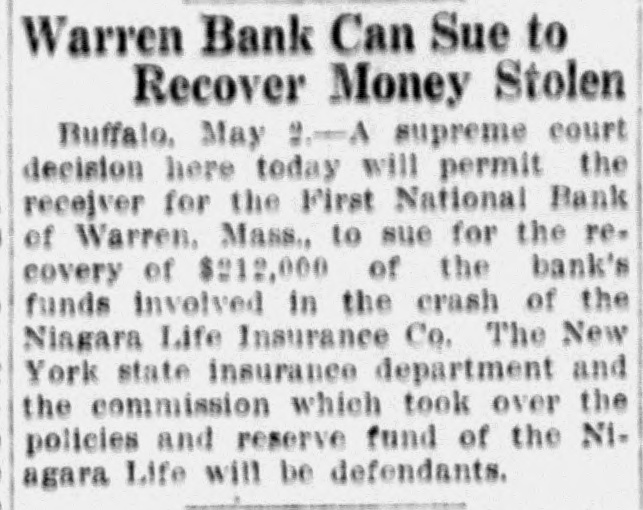
Warren Bank Can Sue to Recover Money Stolen Buffalo, May :-A supreme court decision here today will permit the receiver for the First National Bank of Warren. Mass., to sue for the recovery of $212,000 of the bank's funds Involved in the crash of the Ningara Life Insurance Co. The New York state insurance department and the commission which took over the policies and reserve fund of the NIagara Life will be defendants.


Article from The Portsmouth Herald, May 2, 1923

Click image to open full size in new tab

Article Text

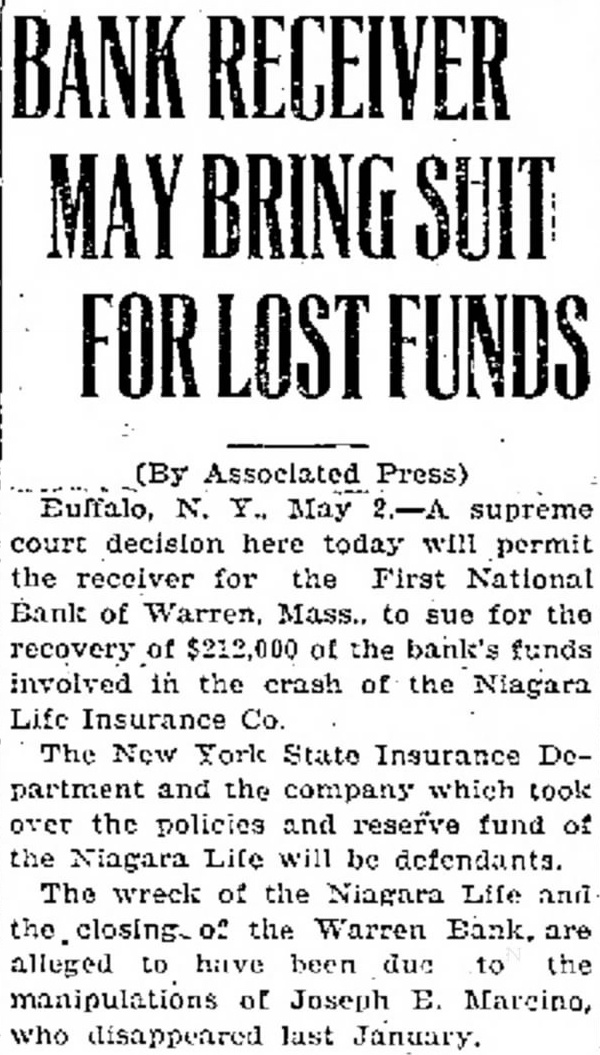
BANK RECEIVER MAY BRING SUIT FOR LOST FUNDS (By Associated Press) Buffalo, N. Y., May 2.—A supreme court decision here today will permit the receiver for the First National Bank of Warren, Mass., to sue for the recovery of $212,000 of the bank's funds involved in the crash of the Niagara Life Insurance Co. The New York State Insurance Department and the company which took over the policies and reserve fund of the Niagara Life will be defendants. The wreck of the Niagara Life and the closing of the Warren Bank, are alleged to have been due to the manipulations of Joseph B. Marcino, who disappeared last January.


Article from The Caledonian-Record, May 2, 1923

Click image to open full size in new tab

Article Text

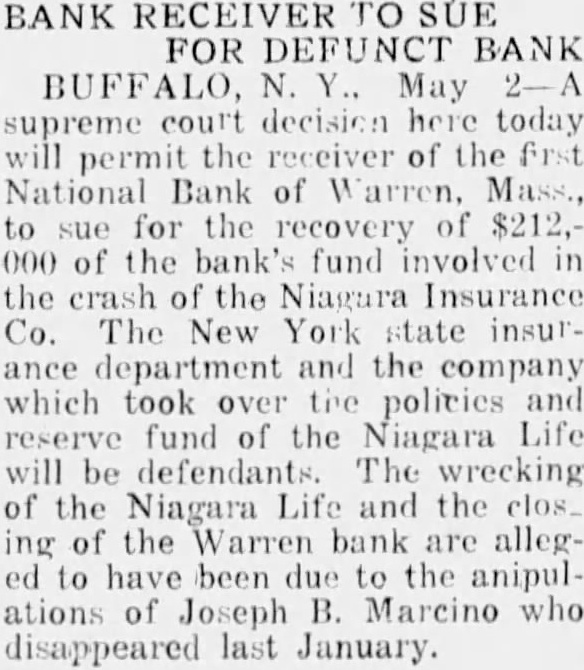
BANK RECEIVER TO SUE FOR DEFUNCT BANK BUFFALO, N. Y., May 2—A supreme court decision here today will permit the receiver of the first National Bank of Warren, Mass., to sue for the recovery of $212,000 of the bank's fund involved in the crash of the Niagara Insurance Co. The New York state insurance department and the company which took over the policies and reserve fund of the Niagara Life will be defendants. The wrecking of the Niagara Life and the closing of the Warren bank are alleged to have been due to the manipulations of Joseph B. Marcino who disappeared last January.


Article from The Boston Daily Globe, May 3, 1923

Click image to open full size in new tab

Article Text

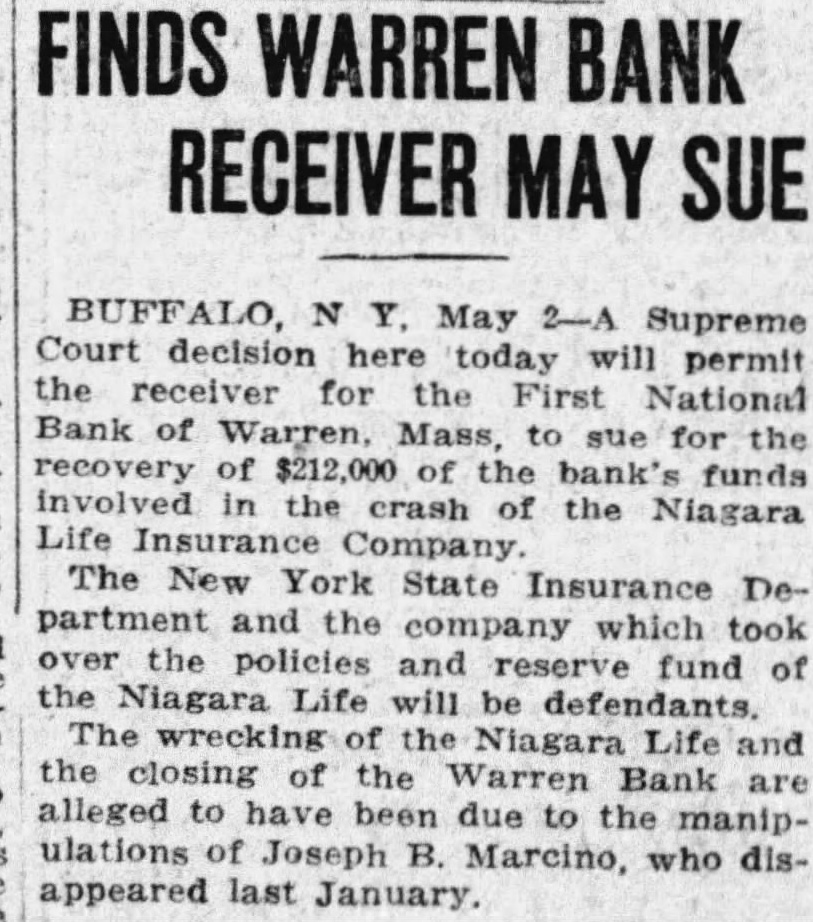
FINDS WARREN BANK RECEIVER MAY SUE BUFFALO, N Y, May 2—A Supreme Court decision here today will permit the receiver for the First National Bank of Warren, Mass, to sue for the recovery of $212,000 of the bank's funds involved in the crash of the Niagara Life Insurance Company. The New York State Insurance Department and the company which took over the policies and reserve fund of the Niagara Life will be defendants. The wrecking of the Niagara Life and the closing of the Warren Bank are alleged to have been due to the manipulations of Joseph B. Marcino, who disappeared last January.


Article from The Boston Daily Globe, May 3, 1923

Click image to open full size in new tab

Article Text

BUFFALO, N Y, May 2—A Supreme Court decision here today will permit the receiver for the First National Bank of Warren, Mass, to sue for the recovery of $212,000 of the bank's funds involved in the crash of the Niagara Life Insurance Company.


Article from New Britain Herald, July 13, 1923

Click image to open full size in new tab

Article Text

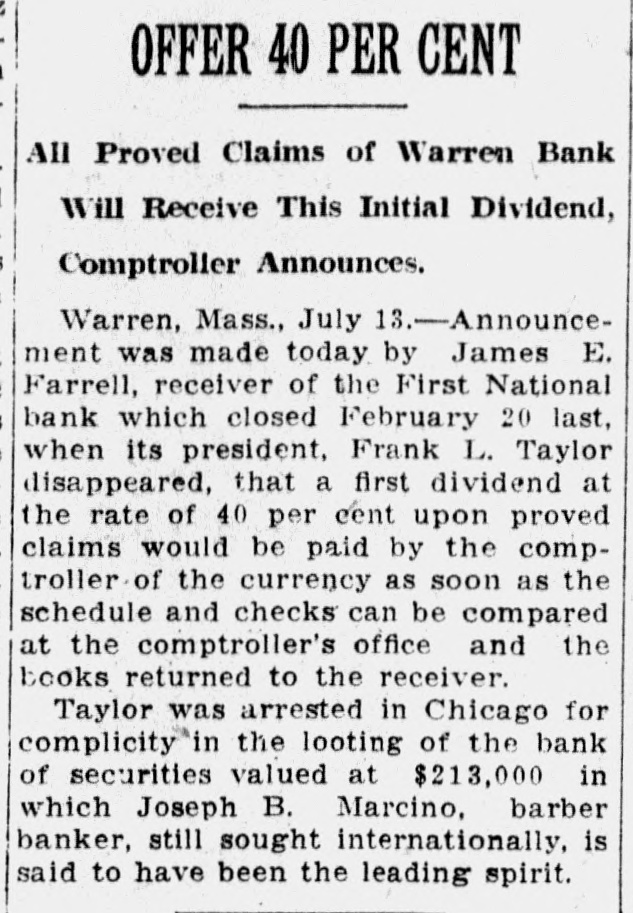
OFFER 40 PER CENT All Proved Claims of Warren Bank Will Receive This Initial Dividend, Comptroller Announces. Warren, Mass., July 13.-Announcement was made today by James E. Farrell, receiver of the First National bank which closed February 20 last, when its president, Frank L. Taylor disappeared, that a first dividend at the rate of 40 per cent upon proved claims would be paid by the comptroller of the currency as soon as the schedule and checks can be compared at the comptroller's office and the books returned to the receiver. Taylor was arrested in Chicago for complicity in the looting of the bank of securities valued at $213,000 in which Joseph B. Marcino, barber banker, still sought internationally, is said to have been the leading spirit.


Article from The Barre Daily Times, July 13, 1923

Click image to open full size in new tab

Article Text

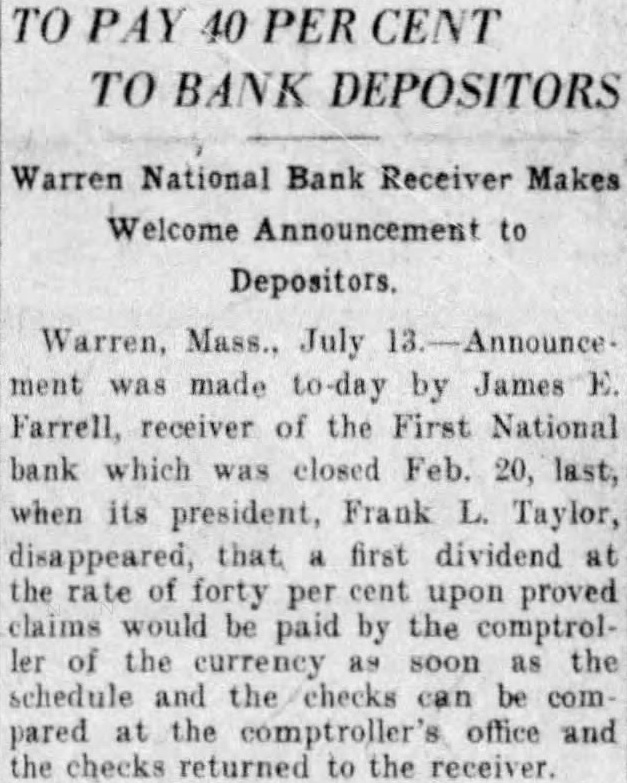
TO PAY 40 PER CENT TO BANK DEPOSITORS Warren National Bank Receiver Makes Welcome Announcement to Depositors. Warren, Mass., July 13.—Announcement was made to-day by James E. Farrell, receiver of the First National bank which was closed Feb. 20, last, when its president, Frank L. Taylor, disappeared, that a first dividend at the rate of forty per cent upon proved claims would be paid by the comptroller of the currency as soon as the schedule and the checks can be compared at the comptroller's office and the checks returned to the receiver.


Article from San Antonio Light, August 28, 1923

Click image to open full size in new tab

Article Text

company, which went out of business. Later he organized the Roma Investment company and Commonwealth Insurance company, then with others obtained control of numerous small banks in Iowa and Illinois. He was indicted in connection with the failure of some of these institutions but. jumped his bail. He married a daughter of Abraham Goldman, wealthy Chicagoan, and then, with the aid of capital said to have been furnished by his father-inlaw, transferred his operations to the East, where he purchased an interest in the Farmers and Merchants bank of Philadelphia, which failed, and then in the Niagara Life Insurance company of Buffalo, which went into receivership. Going to Warren, Mass., he succeeded, with Goldman's aid, in gaining control of the First National bank of Warren. Frank L. Taylor, a Chicago clerk and former railroad brakeman, was installed as head of the institution. Marcino disappeared last February along with bonds held by the bank valued at $213,000. At about the same time Taylor vanished from Warren. Taylor was arrested in Chicago, where, he asserted, he came to notify Goldman that his son-in-law had left with the bank's resources. Goldman and Taylor declared they knew nothing of Marcino's flight with the bonds but Taylor is now serving a year's prison sentence for his part in the affair.


Article from The Springfield Daily Republican, November 7, 1923

Click image to open full size in new tab

Article Text

SUES FORMER HOLDERS OF WARREN BANK STOCK Receiver of Wrecked Institution to Attempt to Recover $35,000 From Them Worcester, Nov. 6—James E. Farrell, receiver for the wrecked First National bank of Warren, filed in superior court today suits of $15,000 each against William J. Thayer and Edward F. Fletcher and $5000 against Howard W. Cowee, all of Worcester, to recover a 100 per cent assessment on their holdings of the bank's capital. The stock involved was sold by the Worcester men to Frank L. Taylor, Joseph B. Marcino and Abraham Goldman, who are charged with wrecking the bank, within 60 days of the bank's insolvency and the receiver claims the Worcester men are liable under the United States laws.


Article from Daily Kennebec Journal, November 7, 1923

Click image to open full size in new tab

Article Text

File Suit $5000 to Recover Percent Assessed Bank Capital Worcester. Mass., Nov. 6.-James E. Farrell, receiver for the wrecked First National Bank of Warren, filed in superior court today suits of $15,000 each against William J. Thayer and Edward F. Fletcher and $5000 against Howard W. Cowee, all of Worcester, to recover a 100 per cent. assessment on their holdings of the bank's capital. The stock involved was sold by the Worcester man to Frank L. Taylor, Joseph B. Marcino and Abraham Goldman, who are charged with wrecking the bank, within 60 days of the bank's insolvency and the receiver claims the Worcester men are liable under the United States laws.


Article from Springfield Evening Union, November 14, 1923

Click image to open full size in new tab

Article Text

Will Be Sent to Atlanta Barber - Banker Pleaded Guilty to Helping Misapplication of $200,000 Bank Funds. INVOLVED IN MANY FINANCIAL TROUBLES Federal Judge Says Five Years Maximum Penalty Is Too Low in Such Cases. Special to The Union. BOSTON, Nov. 14—Joseph B. Marcino, wrecker of the First National Bank of Warren, today pleaded guilty before Judge Morton in the United States District Court here and was sentenced to serve four years and three months at hard labor at Atlanta Federal Penitentiary at Atlanta, Ga. Retracted Former Plea. Asst. U. S. Atty. Sullivan stated to the court that Marcino had pleaded not guilty on Sept. 6 last and now wished to retract the plea and plead guilty. He stated that President Frank L. Taylor last February handed the bank's funds to Marcino, that Marcino went to Buffalo, N. Y., and disposed of them through the brokerage house of O'Brien & Potter. Since his arrest in Mexico and his return to this city, he added Marcino has given some assistance to the bank receivers in their endeavor to relocate and recover some of the stolen securities. Some of his information has been proved inaccurate, Sullivan said, whether purposely so or not he could not say. "He was the prime mover in the embezzlement," Sullivan continued. "He is the one who profited by the embezzlement. I recommend that he be sentenced to serve four years at Atlanta." Atty. Daniel A. Shea for Marcino made some few remarks, but did not seriously oppose the sentence as recommended. Judge Morton stated: "The maximum of five years for a crime such as this, is, in my opinion, too low. In consideration of the fact that he already has served three months, that he has rendered aid to the Government, and that he has pleaded guilty, I will impose a sentence of four years and three months at hard labor at Atlanta Federal Penitentiary." Marcino left the courtroom in the custody of United States Marshal Everett Peaver, and was taken to the marshal's office. Technically his sentence will begin at once. He will be removed to Atlanta within a few days, it is expected. By The Associated Press. BOSTON, Nov. 14—Joseph B. Marcino, who rose from barber to banker and became involved in many financial difficulties in various parts of the country, was sentenced to four years and three months in the Federal penitentiary at Atlanta by Judge Morton in the Federal District Court today. He had pleaded guilty to an indictment for aiding and abetting in misapplication of $200,000 of the funds of the First National Bank of Warren, Mass., last February. Taylor and Goldman. The Warren bank was closed as a result of the looting. Its president, Frank L. Taylor, later pleaded guilty to an indictment for misapplication and is now serving a three-year term in the Plymouth Jail. Abraham Goldman of Chicago was arrested on a charge of embezzlement and is now at liberty under bonds, no date having been set for his trial. Marcino, considered by the authorities as the leading figure in the embezzlement, fled to Mexico, where he was arrested last August and brought back here in September. It developed that he had gained control of the bank and installed Taylor, a bookkeeper, as president with the purpose of gaining easy access to its vaults and obtaining the securities with which he later absconded. Goldman was associated with him in the ownership of the bank.


Article from The Boston Daily Globe, December 5, 1923

Click image to open full size in new tab

Article Text

Three suits were filed in Federal District Court yesterday with a view to making good the shattered finances of the First National Bank of Warren, as a result of the recent swindle scheme which cost the institution more than $200,000, against substantial residents of Worcester, in order to enforce the payment of the 100 percent assessment on the original stock of the bank, which was wrecked last February.


Article from New Britain Herald, February 11, 1924

Click image to open full size in new tab

Article Text

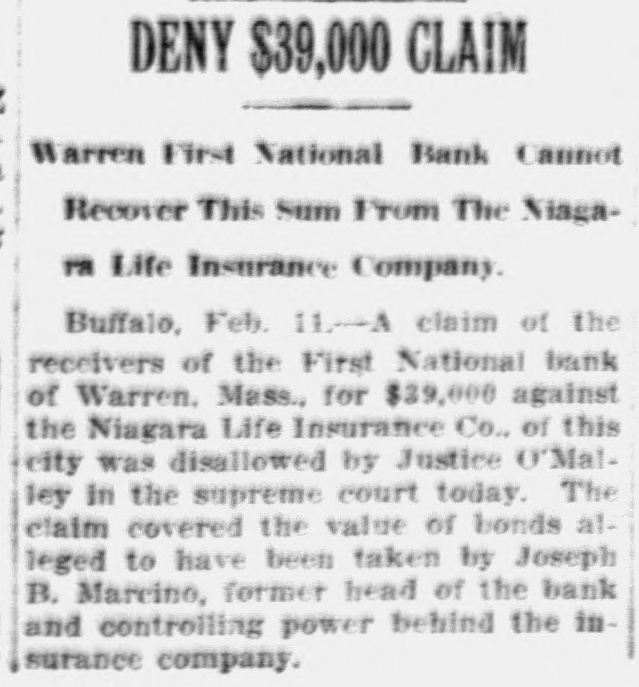
# DENY $39,000 CLAIM Warren First National Bank Cannot Recover This Sum From The Niagara Life Insurance Company. Buffalo, Feb. 11.—A claim of the receivers of the First National bank of Warren, Mass., for $39,000 against the Niagara Life Insurance Co., of this city was disallowed by Justice O'Malley in the supreme court today. The claim covered the value of bonds alleged to have been taken by Joseph B. Marcino, former head of the bank and controlling power behind the insurance company.