Sixpenny Savings Bank (New York, NY)

Episode Information

Episode UID
1213856190939
Episode Type
Suspension β†’ Run β†’ Closure
Bank Type
savings
Bank ID
121385619 hash
Start Date
March 27, 1878
Location
New York, New York (40.714, -74.006)

Metadata

Model
gemini-3-flash-preview (chosen from majority vote of a three-model LLM ensemble)
Short Digest
45ad9e1fb81c938b

Response Measures

None

Description

The bank was ordered to suspend by the State Banking Department before a run occurred; the run/agitation followed the closure.

Events (4)

1. March 27, 1878 Suspension
Cause
Government Action
Cause Details
Ordered closed by the State Superintendent of the Banking Department following an examination.
Newspaper Excerpt
received a notification from the Superintendent of the Banking Department at Albany that the Sixpenny Savings Bank should be closed until further orders.
Source
newspapers
2. March 28, 1878 Run
Cause Details
Agitation and gathering of depositors following the announcement of the bank's suspension.
Measures
Every approach was strongly guarded by police to prevent entry.
Newspaper Excerpt
As early as 7 o'clock this morning crowds began assembling in front of the Six-penny Savings Bank, and by noon it had swelled to about 1,000.
Source
newspapers
3. April 6, 1878 Receivership
Newspaper Excerpt
Mr. William F. Russell, the receiver, took charge April 6
Source
newspapers
4. March 16, 1882 Other
Newspaper Excerpt
Payment of the FOURTH AND FINAL DIVIDEND OF TEN 55/100 PER CENT to the depositors... making total payments EIGHTY FIVE and 65/100 PER CENT
Source
newspapers

Newspaper Articles (24)

Article from Evening Star, March 28, 1878

Click image to open full size in new tab

Article Text

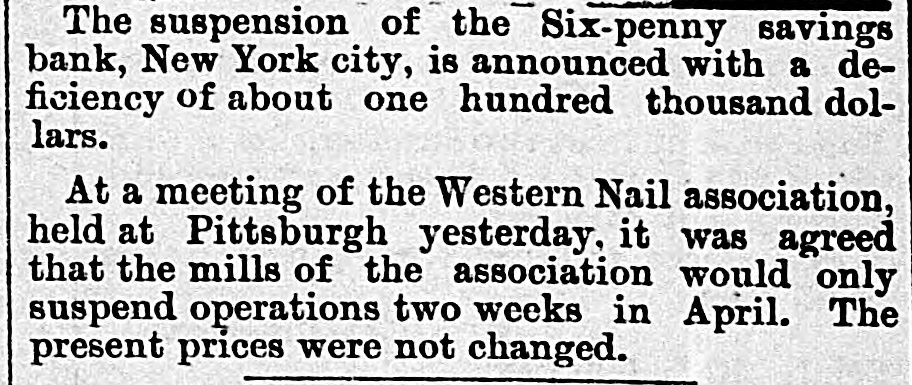
ANOTHER SAVING'S BANK SUSPENSION.-The suspension of the Sixpenny Savings Bank in New York is announced. The deficiency reported is about $100,000. The bank has been doing a large business, and there will be much consternation among the depositors, many of whom are of the working classes.


Article from The Cheyenne Daily Leader, March 28, 1878

Click image to open full size in new tab

Article Text

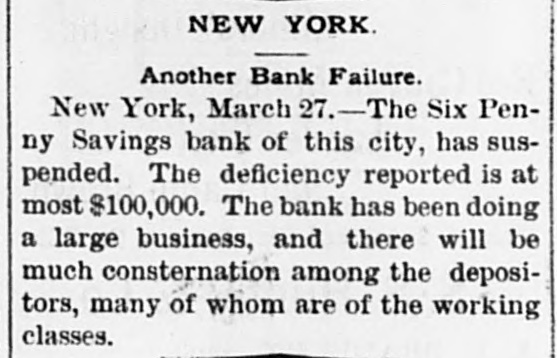
NEW YORK Another Bank Failure. New York, March 27.-The Six Penny Savings bank of this city, has suspended. The deficiency reported is at most $100,000. The bank has been doing a large business, and there will be much consternation among the depositors, many of whom are of the working classes.


Article from The Daily Dispatch, March 28, 1878

Click image to open full size in new tab

Article Text

New York. BANK SUSPENSION. NEW YORK, March 27.-The suspension of the Sixpenny Savings Bank, of this city, is announced. The deficiency is reported at $100,000. Much consternation prevails among the depositors, many of whom are of the working classes.


Article from The New York Herald, March 28, 1878

Click image to open full size in new tab

Article Text

SAVINGS BANKS. The Sixpenny, of This City, Suspended Yesterday. REPORT OF THE EXAMINER. Condition of Other City Savings Banks on the 1st of January A BOSTON BANK ENJOINED. Mr. William Miles. president of the Sixpenny Savings Bank, Astor place, about two o'clock yesterday alternoon received a notification from the Superintendent of the Banking Department at Albany that the Sixpenny Savings Bank should be closed until further orders. Since March 9, or thereabouts, this back had been undergoing a thorough overhauling, the result of which was the flat which President Miles received The news spread rapidly as news of that sort yesterday. was broken, just should usually that the have spreads. bank By the order from Albany the bank sus. pended payment immediately, but it was said last evening that the cashier continued paying until five o'clock. THE DISAPPOINTED. There can scarcely be seen a more pitiable sight than the crowd around a broken bank. It does not make much difference, as far as the unhappy depositors are concerned, whether the bauk is solvent or not; the worst fears are generally those which take possession of the scared depositors, and last evening there was no exception to the rule. The news that this bank was "burst" seemed to spread with mysterious rapidity. At about live o'clock in the afternoon the doors were closed, and as the bank was in the habit of doing business until eight o'clock every evening the alarm grew with wonderful celerity. As the young people began to go home from work the doors on Astor place were crowded with impatient depositors, who clamored rainly for admission. For tw o or three hours, though the crowds were never very large, there was a constant rush in the vicialty of the bank building. The announcement posted on the glass window that the bank was suspended had the effect of making people believe that the financial affairs of the institution were far worse than they may be. Women began to flock around the building at about eight o'clock, the news having by that time reached them. This was the painful part of the scene. The youngsters who had money deposited in the bank laughed and chaffed each other about their loss, but it was no laughing matter for these poor elderly people, whose little all seemed to have gone from them in a moment. They stood in little groups together ou the sidewalk sympathizing with each other, but with despair on their faces. WHAT THE SECRETARY SAYS. From a talk with the relicent secretary of the bank, Mr. Alexander Collins, it was learned that the institution was established in 1853, and that until within done. a few years past a good business was During the past few years, however, the number of depositors began to full off. and the affairs the bank were not. quite so prosperous as 01 they had been. There were nearly thirty-two thousand depositors in all, the accounts being mostly small. The trouble, in the Sepretary's judgment, arose Irom the shrinkage ID the value of securities and in real estate. The building was leased at $17,000 u year and caine into the possession of the Sixpenuy Savings Bank as an indebtedness of the Stuyvesant Bank and was a clear gain, us the rents from the offices Joit the bank clear. THE PRESIDENT'S STATEMENT. The president of the bank, Mr. William Miles, was conversed with as to the situation, and be seemed to teel very keeply the position in which the bank would was placed. He even went so far as say that be rather be dead than that any disgrace should be attached 10 him on account of the financial emburrassments of the institution. He said that in his judgment the bank would pay ninety cents on the dollar, and that 11 it had not been interiered with it could have come out all right. The total liabilities of the institution, Mr. Miles said, were about $1,700,000, and 11 was claimed by the Banking Depart- of ment that there was a deΓΊciency in the assets believe about ave per cent of that amount Ho did not that there would have been such a deficiency it the tu bank had time to retrieve itself. The reduction the amount of deposits for n tweivemorth past about $200,000, but still he believed that was there was no necessity for this action by the Banking Department The bank had in assets about $900,000 ou bond and mortgage and real estate, about $160,000 in United States bonds. about $36,000 in North Carolina bonds, and the balance 01 the total assets in hinted New York an Brooklyn cities bonds. Mr. Miles pretty emphatically thatthere was soul play somewhere in regard to the bank. He said be could HOL place the wrougdoing anywhere, but be telt sure that there was some malevolence in the matter. He would not dare to say what he thought, because be had not ab. solute proof: but be bad is conviction in his own mind that the bank bad not been treated squarely. THE OFFICIALS AND SALARIKE. The following named the officers of the Sixpenny Savings Bank:-President, William Miles; Vice Presidents, Wilson Small James Y. Watson; Secretary, Will Alexander Collius. Directors-Sh M. Van Bureu, iam E. Dean. Cnaries Cromwell, Thomas L. Small, Stephen Hyatt, William H. Adams, Beruard Smythe, Jacob Cromwell and Wilson Small. $6,000 The salary of the president has been a year, the other salurius ranging from $1,500 upward. The total amount paid 10 salaries was $16,000 annually. The real estate owned by the bank 18 mostly located in Harlem. There are thirteen lots on Third avenue, near 107th street, worth about $4,000 lot. Finally. Mr. Miles stated that $1,400 was paid out for yesterday. and that ne feared It would be difficult the bauk to get through the crush it sad received and be able 10 resume again as before.


Article from The Wheeling Daily Intelligencer, March 29, 1878

Click image to open full size in new tab

Article Text

NEW YORK. at e. Saled For the Exposition. NEW YORK, March 28.-The United States steamer Constellation, with about six hundred tons of goods for the Paris Exposition sailed from the navy 8. yard yesterday, and expects to reach it Havre April20th. There still remains six hundred tons to be sent by the it French Line of steamers. d The steam sloop of war Wyoming, went into the dry-dock on Tuesday evening, and yesterday a gang of caulkers and ship carpenters were employed upon her. The copper was stripped off her about four feet below the water line, and the seams were found to need recaulking. The planking in several places was found to be quite rotten and pieces were taken out and replaced. RUN ON THE SIX-PENNY SAVINGS BANK As early as 7 o'clock this morning crowds began assembling in front of the Six-penny Savings Bank, and by noon it had swelled to about 1,000. Every apt proach was strongly guarded, and only the stockholders and officers of the bank were admitted. It was rumored that quite a number of persons keeping stores on Third and Fourth avenues and Broad. way, in the immediate neighborhood, did a discount and deposit business with the bank and drew out their money when needed in checks and without presenting their books. The Secretary of a neighboring savings bank said it was known that for some time past the Six-penny did that sort of a business, knowing it was contrary to the spirit of the law. Regarding the savings bank, his impression was that they would pay about 80 cents on the dollar. Much indignation was expressed by the crowd at a rumor that the bank continued payments yesterday to favored depositors for nearly three hours after the injunction to close had been served. The officers will be held responsible by the depositors if the facts as reported are true. The depositors of the suspended Six Penny Savings Bank met to-night. A committee was appointed to call on the District Attorney and learn if it is feasible to procure an indictment against the bank officers on a charge of perjury. GOLD GOING OUT. The Evening Post says that engagements have been made for the shipment of $1,000,000 of gold coin, in Saturday's steamers, for Europe. The steamer Celtic, which sailed for England to-day, took out $300,000 in double eagles.


Article from The Wheeling Daily Register, March 29, 1878

Click image to open full size in new tab

Article Text

Run on a Savings Bank. NEW YORK, March 28.-As early as 7 o'clock this morning crowds began to as. semble in front of the Six-Penny Sav. ings Back, and by noon the crowd had swelled to about one thousand. Every approach is strongly guarded, and only stockholders and officers were admitted. It was rumored that quite a number of persons keeping stores on Third and Fourth avenues and Broadway, in the immediate neighborhood, had discount and deposit business with the bank and drew out their money when needed on checks and without presenting their books. The Secretary of a neigh. boring savings bank said it was known for some time past that the Six-Penny did that sort of business, knowing it was contrary to the spirit of the law regarding savings banks. His impression was that they would pay about eighty cents on the dollar. Much indignation was expressed by the crowd at a rumor that the bank continued payments yesterday to favored depositors for nearly three hours after the injunction to close had been served. The officers will be held responsible by the depositors if the facts, as reported, are true.


Article from The Portland Daily Press, March 29, 1878

Click image to open full size in new tab

Article Text

NEW YORK. The Suspended Savings Bank. NEW YORK, March 28.-The scenes around the suspended Six Penny Savings Bank to-day were very sad. Many poor and sick women were offering books for 10 per cent. of their deposits, and hard talk was indulged in by many poor men present. The depositors of the bank met to-night. A committee was appointed to wait on the District Attorney and learn if it was feasible to procure indictments against the bank's officers on a charge of perjury. Remains of Late Congressman Leonard The remains of the late John E. Leonard, member of the House of Bepresentatives from Louisiana, who died recently in Cuba, arrived at this port today in the steamship Saratoga from Havana. The body will he taken to Westchester, Pa., his former home, tomorrow, for burial, accompanied by a joint congressional committee appointed to attend the funeral. Senators Eustis, Saunders and Conover and Representatives Ellis, Ward, Tarner, Calking, Stewart and Muller, members of the committee, arrived today from Washington. LONDON, March 26.-The Standard has the following from Rome; The Pope in his allocution today said that the loss of temporal power rendered the free exercise of spiritual power impossible.


Article from Evening Star, March 30, 1878

Click image to open full size in new tab

Article Text

HON. GLENNI W. SCOFIELD, the new register of the Treasury, will arrive Monday next and assume his official duties. not A receiver will be appointed for the Sixpenny Savings bank of New York. n Up to date 15 Molly Maguires have been executed in Pennsylvania. The murders for which they were hanged, however, footup but six.


Article from The Morning Herald, April 1, 1878

Click image to open full size in new tab

Article Text

DOMESTIC. ANOTHER SAVING BANK GONE. NEW YORK, March 31.-At the ;Sixpenny Savings Bank yesterday the same distressing seenes were witnessed as the day before. The beehive above the main entrance on Astor place and its gilded counterparts on the plate windows on either side of the door way suggested melancholy satire to the crowds of poor depositors who clung to the iron bars across the entrance. Others were huldled together upon the steps or grouped about the sidewalk rehearsing the story of their disaster. Old men and women, as well as young men and women, peered into the bank at the solitary clerk in charge there, as if it might be in his power to alleviate their distress. An old man, whose bent figure and horny hands gave ample evidence of toil, said that he had deposited $800, the savings of twelve years, in the broken bank, and now had nothing left to pay his rent. A poor woman, whose husband's body lay at home awaiting burial, had $300 in the bank, but not a penny to defray the funeral expenses The Bank offers 90 cents on the dollar, but 80 much distrust exists that a receiver has been asked for and has been appointed.


Article from The Weekly Union Times, April 5, 1878

Click image to open full size in new tab

Article Text

SAVINGS' BANK BURSTED.-New York, March 27.-The suspension of the Sixpenny Savings' Bank was announced to-day. The deficiency reported is almost $100,000. The bank has been doing a large business, and there will be much consternation among depositors; many of whom are of the work. ing classes.


Article from The Weekly Union Times, April 5, 1878

Click image to open full size in new tab

Article Text

SAVINGS' BANK BURSTED.-Now York, March 27.-The suspension of the Sixpenny Savings' Bank was announced to-day. The deficiency reported is almost $100,000. The bank has been doing a large business, and there will be much consternation among depositors; many of whom are of the working classes.


Article from The Superior Times, April 6, 1878

Click image to open full size in new tab

Article Text

THE EAST. HENRY ASHURST, a prominent member of the stock board of Philadelphia, failed, on the 29th ult., causing great surprise, as he was considered to be the richest member of that board. Liabilities heavy. A PUBLIC reception was given, on the night of tho 28th ult., at Westchester, Pa., to Bayard Taylor, followed by a dinner given by the citizens of Westchester, which was attended by over one hundred guests. AT New York on the morning of the 28th, a crowd began assembling in front of the SixPenny savings bank, and by noon it had swelled to 1,000. Every approach was strongly guarded and only stockholders and officers were admitted. Much indignation was expressed by the crowd at the rumor that the bank continued payments on the 27th to favored depositors for nearly three hours after the injunction to close had been served. The officers will be held responsible by the depositors if the facts reported are true. O. F. BULLARD, who embezzled certain banking association funds, and who escaped from the custody of the sergeant-atarms in February last, was expelled from the Pennsylvania house of representatives on the 27th. THE western nail manufacturers held a meeting at Pittsburg, Pa., on the 27th, and agreed to suspend operations only two weeks in April. The present prices were not changed. IN the suit on the 26th, before Judge Potter, of the supreme court, of Waterbery vs. New York city, on an old grading and filling contract for $50,000, William M. Tweed was taken to court as a witness for the city. He declined to answer, and in explanation read a paper stating that, by the advice of his counsel, he would give no further evidence or information for state or city until the promise made to liberate him, on the condition of his giving testimony, be fulfilled. THE operatives of Fall River, Mass., are urging manufacturers to reduce the hours of labor instead of wages. THE heaviest snow storm of the season prevailed throughout Vermont on the 24th inst. The snow lay fifteen inches deep. TWELVE hundred tons of goods await transportation to the Paris exhibition at the


Article from Frostburg Mining Journal, April 6, 1878

Click image to open full size in new tab

Article Text

THE suspension of the Six Penny Savings Bank, of New York city has affected Abe Jandorf, formerly of this place, to the amount of twelve dollars. He writes home, however, and says he thinks he may yet get eighty cents on the dollar.


Article from The Redwood Gazette, April 11, 1878

Click image to open full size in new tab

Article Text

The Sixpenny Savings Bank of New York City suspended on the 27th. Liabilities, $1,700,000; assets, $1,600,000.


Article from The Sun, April 14, 1878

Click image to open full size in new tab

Article Text

INDIGNANT DEPOSITORS. The Sixpenny's Mortgage on the Spofford Property-Investigation Wanted. At a meeting of the depositors of the Sixpenny Savings Bank vesterday the Rev. Washington Rodman. Channing Stebbins, J. C. J. Langbein. J. D. Meagher. and Morris F. Dowley affixed their signatures to a report in which it is said: There existed among the officers and trustees a ring or clique, to whose mismanagement and dishonesty the disasters which have fallen to the bank are directly attributable. They have no faith in the apparent sincerity of such of the trustees as have offered to contribute toward making up the de ficiency in the assets. We call upon the Attorney-General to investigate the items in the assets known as the Spofford bonds. The committee think there is good ground for indicting the persons engaged in that transaction, and that some of the officers of the Federal Government were parties to this seemingly fraudulent proceeding. In regard to the Spofford bonds, Mr. Channing Stebbins, a member of the investigating committee read the following: We suggest to Receiver Russell of the Sixpenny Savings Bank that he should inquire carefully into the facts connected with the mortgage on the so-called Spofford prop. erty. It is one of four concurrent mortgages, each for $87,500. The mortgages were given in 1874. It was about this time that the Government bired the Spofford property, to be used by the Appraiser's Department of this port The mortgage contains a provision that at any time after one year. on demand, the mortgagor will pay it. This property is rented to the Treasury Department of the United States Government, at a rental of $58,000 a year. This lease expires in about two years. Previous to the rental of the property to the Government in 1874, it had been offered to a capitalist for $235,000. It isidle to inquire if it is worth as much now. in view of the immense shrinkage in real estate. Yet the trustees of the bank have allowed $87,500 of the depositors' money to be advanced on it. for which as security they hold one of four concurrent mortgages for the aggregate amount of $350,000, The Spofford property cannot be sold for $200,000. A voice-No Grant's and Hayes's administrations are connected with the Sixpenny Savings Bank. The committee also reported that the bank officers, when applied to for information. were reticent. Many of the bonds and mortgages were bad, or insufficiently secured. The depositors will probably receive a dividend of forty per cent. within ninety days, and in the end seventy-flve or eighty per cent. An astonishing feature of thecommittee's discoveries was that the President of the bank had negotiated a loan of $41,000 by pledging Government bonds to the amount of $60,000 in the Nassau Bank. Shortly afterward certain favored depositors had drawn this $60,000, together with $56,487. from the savings bank. The committee think that this money was mainly paid to depositors who had been informed by the officers that the bank was about to close. The Rev. Dr. Olcott opposed the adoption of the committee's report. He thought that the bank officers had acted honestly. A storm of hisses greeted him, and he was taunted with being a friend of the bank officers. He retired, and the report was adopted almost unanimously. Mr. Channing Stebbins said that the officers of the bank had intentionally wrecked their own institution: but that when they could not get their own man appointed as receiver they tried to beg off and not have the bank cl. sed. A committed was appointed to see tua the officers of the bank are prosecuted.


Article from Evening Star, April 15, 1878

Click image to open full size in new tab

Article Text

THE SIXPENNY SAVINGS BANK SWINDLE.The committee of depositors of the suspended Sixpenny Savings Bank in New York reported liabilities of $1,810,571, and assets nominally $1,728,146, many of the bonds and mortgages being worthless. The committee was instructed to consult with the receiver as to whether the trustees could not be proceeded against criminally.


Article from New-York Tribune, April 27, 1878

Click image to open full size in new tab

Article Text

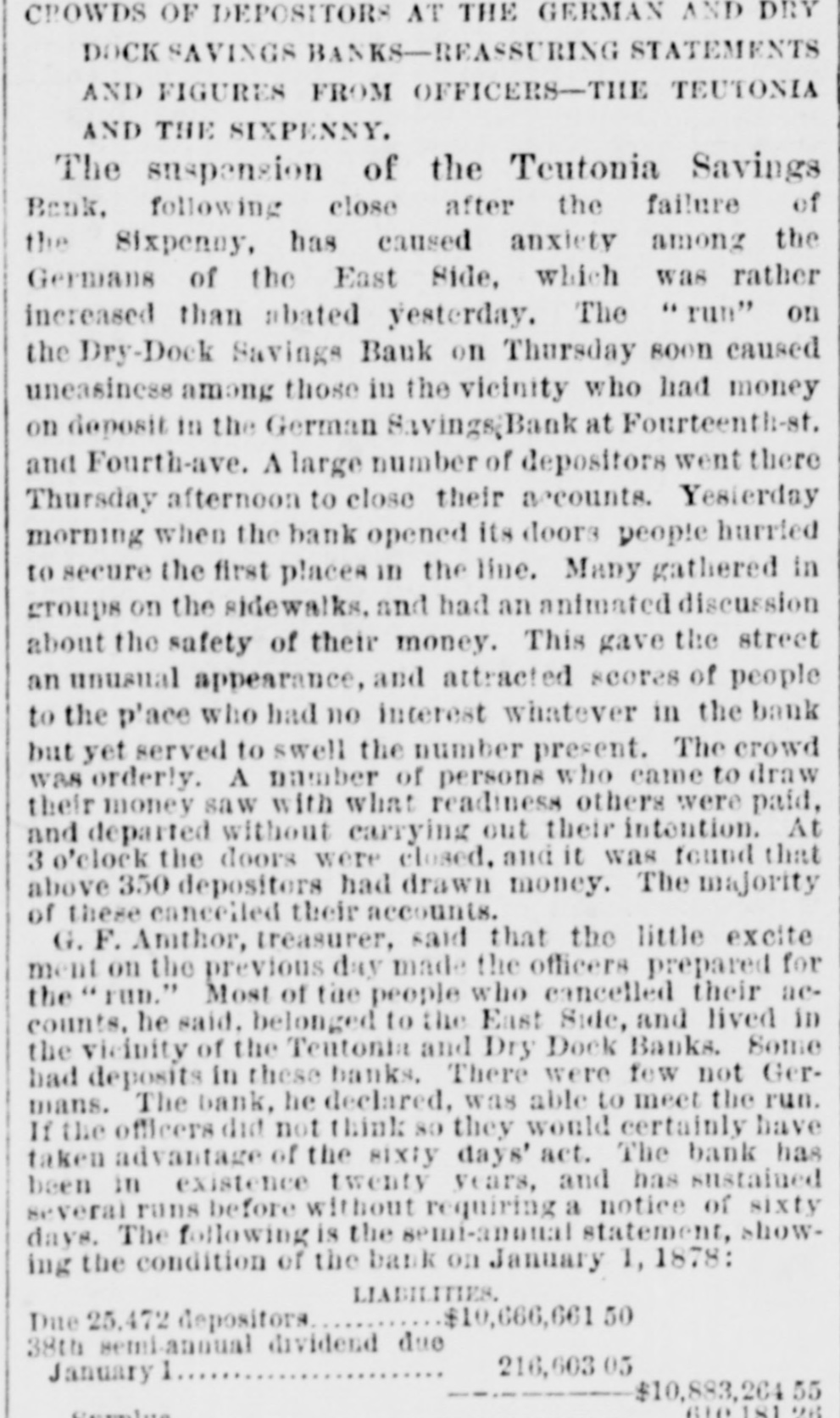
CROWDS OF DEPOSITORS AT THE GERMAN AND DRY DOCK SAVINGS BANKS-REASSURING STATEMENTS AND FIGURES FROM OFFICERS-THE TEUTONIA AND THE SIXPENNY. The suspension of the Teutonia Savings Bank, following close after the failure of the Sixpenny, has caused anxiety among the Germans of the East Side, which was rather increased than abated yesterday. The "run" on the Dry-Dock Savings Bauk on Thursday soon caused uneasiness among those in the vicinity who had money on deposit in the German SavingsjBank at Fourteenth-st. and Fourth-ave. A large number of depositors went there Thursday afternoon to close their accounts. Yesierday morning when the bank opened its doors people hurried to secure the first places in the line. Many gathered in groups on the sidewalks. and had an animated discussion about the safety of their money. This gave the street an unusual appearance, and attracted scores of people to the place who had no interest whatever in the bank but yet served to swell the number present. The crowd was orderly. A number of persons who came to draw their money saw with what readiness others were paid, and departed without carrying out their intention. At 3 o'clock the doors were closed. and it was found that above 350 depositors had drawn money. The majority of these cancelled their accounts. G. F. Amthor, treasurer, said that the little excite ment on the previous day made the officers prepared for the run." Most of the people who cancelled their accounts. he said. belonged to the East Side, and lived in the vicinity of the Teutonia and Dry Dock Banks. Some had deposits in these banks. There were few not Germans. The bank, he declared, was able to meet the run. If the officers did not think so they would certainly have taken advantage of the sixty days' act. The bank has been in existence twenty years, and has sustained several runs before without requiring a notice of sixty days. The following is the semi-annual statement, showing the condition of the bank on January 1, 1878: LIABILITIES. $10,666,661 1 50 Due 25,472 depositors 38th semi-annual dividend due 216,603 05 January 1 $10,883,264


Article from Evening Star, July 23, 1878

Click image to open full size in new tab

Article Text

CONDITION OF THE SIXPENNY BANK.-W. F. Russell, receiver of the Sixpenny bank, of New York, has filed his report, showing the entire assets of the bank, including securities, bonds, &c., to be $1,731,800. Some of the bonds and mortgages held by the bank have been foreclosed, but the property has not been sold.


Article from The New York Herald, July 31, 1878

Click image to open full size in new tab

Article Text

SIXPENNY SAVINGS BANK. PAYING THE DEPOSITORS A FIFTY PER CENT DIVIDEND-GREAT RUSH AT THE BANKSCENES AND INCIDENTS. The announcement that the Sixpenny Savings Bank, which closed its doors four months ago on the immense number of 32,800 depositors, would commence paying a dividend of fifty per cent yesterday, had great interest for the multitude concerned and, as might be expected, there was a large and early attend ance at the bank doors long before ten o'clock, the hour for its regular opening. At six o'clock 10 the morning men and women, boys and girls, had already taken up positions convenient to the bank entrance, but many of the early comers iniled to get in at the first rush, failed again at the second, being weak, and therefore forced to the wall each time. Some of them even failed to get in at all and will have to try their luck over again to-day. It may be imagined how miserable the latter class must have felt after being all day long on their feet under the soaking rain and without food. The sidewalk in Astor place, at the side entrance to. the bank through which the depositors were admitted, was covered for a hundred feet or so by a dense seething mass of both sexes and all ages and conditions of lite. It was wedged 80 close that no one within its exterior limit could possibly get out, and when one or two made a violent effort in this direction the whole crowd shook and swayed like one man. There were a few dozen umbrellas overhead, and those who happened to stand under their dripping peripheries had to stay there and endure the irritation of numerous and constant rills of water coursing down their backs inside their underclothing. CHARACTER OF THE CROWD. Women and young girls of the working class were in strong force, holding on like grim death to their bank books. Boys of the news seliing and shine-'emup professions were numerous. Stout and swarthy laboring men were there with eager, wistful faces, wondering in a vague way as to the meaning of a fifty per cent dividend. Occasionally men, but more trequently women, of refined looks, though in seedy garments, were observed and the general appearance and anxiety visible spoke eloquently of the hard times prevailing. But it was by no means a melancholy concourse. Jibes and jests passed to and tro accom panied by merry peals of laughter. The policemen had a wotul time and were made the butt of many jokes. They had to endure repeated violations of their orders to "Keep back there!" "No pushing from the outside!" "Stand off the steps!" It was too weak and pitiable a crowd to use clubs upon. *Will yees step that scroogin' behind me there?' cried one 01 the stalwart officers in his strong Corkonian accent. "Sure wen't get a penny any sooner by carryin' on that way." "Oh! we're gettin' hungry and want to go home," repiied one in the crowd. "Well, go home till to-morrow," reterted the officer, "Sure the bank's not goin' to run away for a day or two and ye won't be always hungry "That'll do for you, that has your pay sure," spoke up a horny handed son of toll, with a frown on bis face. "I'll engage," exclaimed another toilsome son, if the peelers didn't get their pay they'd make 11 out somehow. " "Whist, there! shouted the officer; "ye're talkin' as much as if ye had ten dollars III the bank, an' ye haven't as much as 'ud buy victuals for a sick grasshopper!" Here came another strong push from behind the officer, and he turned sharply about, and, eyeing them with an attempt to look ferocious, roared, "Be alsy, there, will yez? An' it ye can't be alsy be as alsy as ye can. THEIR ANXIETY TO HAVE THEIR MONEY. The vanguard of the crowd stood on the top steps of the entrance pasted against the ron gutes. At intervals of fifteen or twenty minutes a policeman inside the gates slowly and cautiously opened one of them and let eight or ten depositors tumbio in. At such moments a thrill of excitement passed through the throug and a strong forward pressure followed to the great annoyance of the policeman. The small boys entered into the throug with great zest. "Bet yer half a dollar I've got more in bank than you have," shouted one little fellow with a shocking bad hat and without any coat to another fellow with the same characteristics, and the latter replied spiritedly, "Bet yer ten cents yer haint got half a dollar in the bank to save yer neck,' "And it he had, supplemented a third diminutive, "he only gets fifty cents per divident, and he hain't got no divident at all, and don't get nawthing." In the inter:or of the crowd the heat, confined by the umbrellas and vaporized by the rain, furnished a free Russian bath in which many of the women, especially those of stout habit, appeared ready to faint. Inside the bank a queue of about forty depositors constantly extended from the entrance to the paying teller's window, but it was beyond the power of the bank officers to put any depositor through in quicker time than three minutes, as his book had to go through four hands and he had to sign a receipt and have his handwriting compared with his original signature. At the rate of twenty depositors an hour 120 are suppo od to have been paid yesterday. Most of the depositors were claimants for very small amounts, ranging from eighty cents to $5, but there were some that had comfortable accounts, and one woman was seen to receive a check for $810 on the Union Trust, which she was utterly puzzied what to do with, but was finally persuaded to take and be bappy. WHAT THE SECURITIES REALIZED. Mr. William F. Russell, the receiver, took charge April 6, and between that time and last Friday, when his accounts were passed upon by the Court, realized and collected on the securities of the bank $964,872 94. The deductions to be made from that are $40,000 and interest to the Nassau Bank, $4 400 applied on bond and mortgage by order of the Court and $5,400 for expenses up to date from April 6 for insurance, repairs to property owned by bank, clerks' salaries and incidentals. Of bank assets left on which the receiver expects to pay the next dividend of thirty per cent are United States bonds, '68, $60,000; North Carolina, $37,000; Texas, $37,300; balauce bonds and mortgages on books. $560,000; real estate, cost $118,000; on call loans, $2,500, and a small amount on Arkansas bonds, and fixtures, &c. There are 22,000 depositors under $5, representing a total of $17,000 and an average deposit of eighty cents. The heaviest depositor was Colonel Van Burea, who died the other day, and who claimed for himself and family $52,000. The payment
Article from The Sun, September 3, 1878

Click image to open full size in new tab

Article Text

The Sixpenny Savings Bank. ALBANY, N. Y., Sept. 2.-Justice Westbrook has ordered that William F. Russell, receiver of the Sixpenny Savings Bank of New York, pay to Catharine L. Wolfe for rent. $4,375: to W. H. Rogers. accountant, for services, $600; and that he sell such real estate us has come into his hands as such receiver.


Article from The New York Herald, March 13, 1879

Click image to open full size in new tab

Article Text

NEEDY PEOPLE. At the time-ten o'clock yesterday morning-when the doors of the Manhattan Bank were opened for first time in over four months for the payment of depositors about one hundred people of both sexes and of various conditions of life were in waiting on the Broadway sidewalk. This crowd quickly filled the space outside the officers' desks and was formed into one long loop line, the head beginning at the paying teller's window and the tail ending on the sidewalk. Two policemen were on duty, but their services were only needed for a short while in the morning, as everything was quiet and orderly after the line had been formed. Of course it may be presumed that only those in urgent need of money composed the throng that attended at the bank all day yesterday, for everybody was aware the bank had a large surplus and was ready to meet the demands of all depositors. Had it not been so the rush on the institution might have been alarming. Elderly gentlemen of slender incomes and irritable tempers were noticed in the crowd. There were also many keepers of boarding houses from the neighborhood of St. John's Park, Washington square, Waverley and Clinton places: also young and plainly dressed ladies, who might be school teachers, shop attendants and sewing machine operators. A few swell young men were in the line, but as a rule the depositors seemed to belong to a middle class of business and working people who live in a moderate degree of domestic comfort. No really poor people were observed, such as thronged the doors of the Sixpenny Savings Bank when it was reopened about a year ago by the receiver, half of whom had hardly any shoes on their feet. Youth and old age were in and looked as the pinched long and patient weary, line. though Many of scant the living faces had been their portion. Others were cheerful and lighted up with anticipations of joy in the knowledge that their savings were all safe and were near to their possession. There was little conversation among the people in the line. Each one seemed intent only on getting whatever money he or she purposed drawing out, but when a couple of men acquainted with each other met they joked about the narrow escape they had of losing everything. An additional force of clerks was on hand, and no time was lost in satisfying every demand presented. About two hundred depositors were paid during the day; payments will continue indefinitely, but it is not anticipated by the officers of the bank that the pressure of depositors taking out money will last longer than two weeks. OFFICERS ACCUSED OF NEGLECT OF DUTY. The trial of two officers, Van Norden and Watson, of the Fifteenth precinct, for failing to prevent or discover the burglary of the Manhattan Savings Bank during their tour of patrol duty, was begun yesterday. Captain Byrnes preferred the charges. He maintained that the burglary was perpetrated between the hours of six and half-past nine o'clock, October 27. To substantiate this statement Captain Byrnes produced as witnesses the night watchman who locked the premises securely and ascertained that the interior was unmolested at six A. At that hour he proceeded to the janitor's rooms over the bank by the Bloecker street entrance. He locked the street door after him. At 9:30 the janitor found his way to the street, handcuffed, and gave the alarm. The robbers in the interim having bound and gagged him, Van Norden explained his movements at the hours in question. He said he went on post at 6 A. M.; he tried all his doors several times. The door of the bank he found secured at 6:05, 7:30 and M. He did not learn of the robbery until 9:30. He was relieved from duty at eight o'clock. Watson said he began to patrol the post at eight o'clock: everything appeared to be in its usual condition. He tried the back door at a quarter to nine; afterward he. had to assist Officer McDermott in taking a prisoner to the station house. Commissioner Smith reserved his decision.


Article from New-York Tribune, August 31, 1880

Click image to open full size in new tab

Article Text

THE SIXPENNY SAVINGS BANK. ALBANY, Aug. 30.-By an order granted by Justice Westbrook on Saturday, William F. Russell, receiver of the Sixpenny Savings Bank of New-York, has been authorized to begin proceedings for the foreclosure of a mortgage given on property belonging to the heirs of Paul N. Spofford. of New-York. The mortgage in question is for $87,500. The total mortgage on the property amounts to $262,500.


Article from New-York Tribune, March 15, 1882

Click image to open full size in new tab

Article Text

Savings Banks. THE SIX PENNY SAVINGS BANK.-DIVIDEND NOTICE - Payment of the FOURTH AND FINAL DIVIDEND OF TEN 55100 PER CENT to the de. positors of the SIX PENNY SAVINGS BANK will commence on Thursday morning. 16th day of March, at the office of the Receiver, 744 Broadway, making total payments EIGHTY FIVE and 65 100 PER CENT to depositors. Hours for payments, 10 a. m. to 3 D. m. WILLIAM F. RUSSELL, Receiver. New. York City, March 13, 1882.


Article from New-York Tribune, January 16, 1886

Click image to open full size in new tab

Article Text

Saugerties to-day states that William F. Russell, the well-known politician and financier, has been offered the New-York Sub-Treasurership and declined it, not feeling equal to the discharge of such a duty at his age, seventy-four years. Mr. Russell was the receiver of the Six-penny Savings Bank, in New York, some years ago.