Commercial National Bank (Wilmington, NC)

Episode Information

Episode UID
1217601476
Episode Type
Suspension → Closure
Bank Type
national
Bank ID
121760 national
Charter Number
12176
Start Date
December 30, 1922
Location
Wilmington, North Carolina (34.226, -77.945)

Metadata

Model
gpt-5-mini (chosen from majority vote of a three-model LLM ensemble)
Short Digest
ef02b1156855ab2e

Response Measures

None

Receivership Details

Depositor recovery rate
25.7%
Date receivership started
1923-01-31
Date receivership terminated
1935-10-31
OCC cause of failure
Losses
Share of assets assessed as good
34.3%
Share of assets assessed as doubtful
45.4%
Share of assets assessed as worthless
20.3%

Description

Closure ordered by national bank examiner late Dec 1922; receiver appointed Jan 31, 1923.

Events (4)

1. April 19, 1922 Chartered
Source
historical_nic
2. December 30, 1922 Suspension
Cause
Government Action
Cause Details
Closed by national bank examiner (W. R. Folger) at end of December 1922
Newspaper Excerpt
closed by Examiner W. R. Folger, December 30
Source
newspapers
3. January 31, 1923 Receivership
Source
historical_nic
4. January 31, 1923 Receivership
Newspaper Excerpt
C. L. Williams, national bank examiner, has been named receiver, and is now en route to Wilmington to assume charge of the institution.
Source
newspapers

Newspaper Articles (23)

Article from The Charlotte Observer, January 7, 1923

Click image to open full size in new tab

Article Text

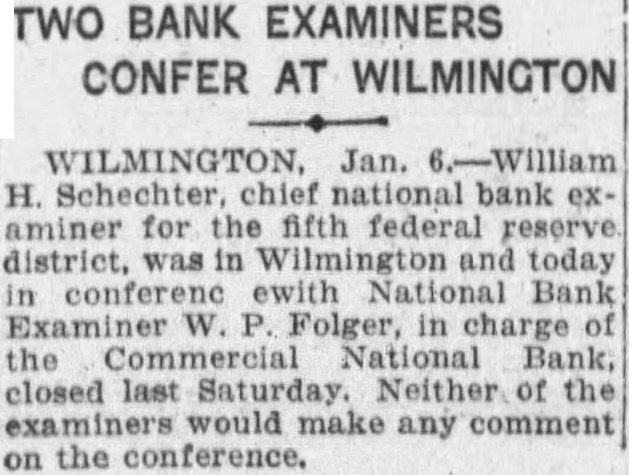
TWO BANK EXAMINERS CONFER AT WILMINGTON WILMINGTON, Jan. 6.—William H. Schechter, chief national bank examiner for the fifth federal reserve district, was in Wilmington and today in conference with National Bank Examiner W. P. Folger, in charge of the Commercial National Bank, closed last Saturday. Neither of the examiners would make any comment on the conference.


Article from The Washington Daily News, January 11, 1923

Click image to open full size in new tab

Article Text

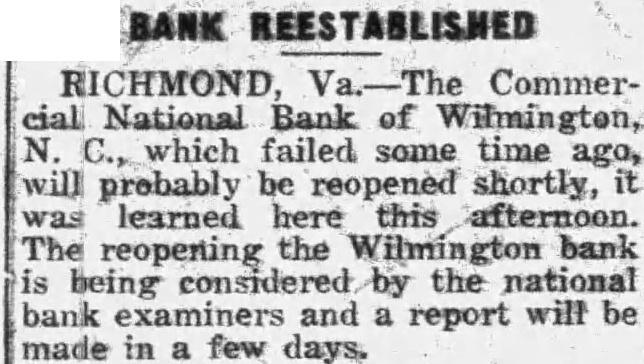
BANK REESTABLISHED RICHMOND, Va.—The Commercial National Bank of Wilmington, N. C., which failed some time ago, will probably be reopened shortly, it was learned here this afternoon. The reopening the Wilmington bank is being considered by the national bank examiners and a report will be made in a few days.


Article from The Herald-Sun, February 1, 1923

Click image to open full size in new tab

Article Text

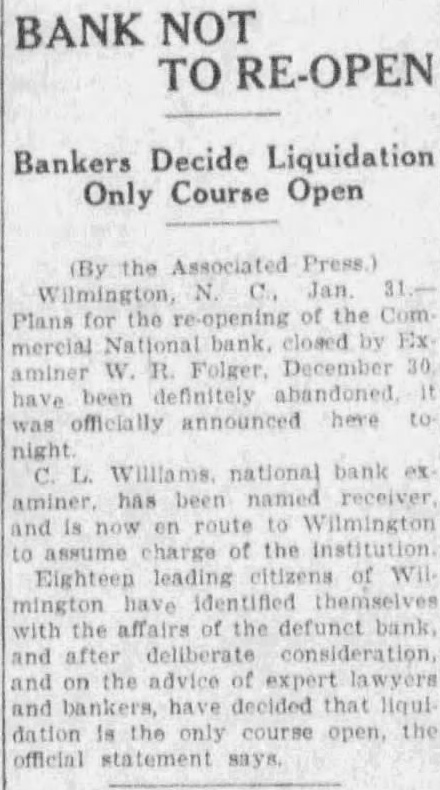
BANK NOT TO RE-OPEN Bankers Decide Liquidation Only Course Open (By the Associated Press.) Wilmington, N. C., Jan. 31.—Plans for the re-opening of the Commercial National bank, closed by Examiner W. R. Folger, December 30, have been definitely abandoned, it was officially announced here tonight. C. L. Williams, national bank examiner, has been named receiver, and is now en route to Wilmington to assume charge of the institution. Eighteen leading citizens of Wilmington have identified themselves with the affairs of the defunct bank, and after deliberate consideration, and on the advice of expert lawyers and bankers, have decided that liquidation is the only course open, the official statement says.


Article from The News and Observer, April 4, 1923

Click image to open full size in new tab

Article Text

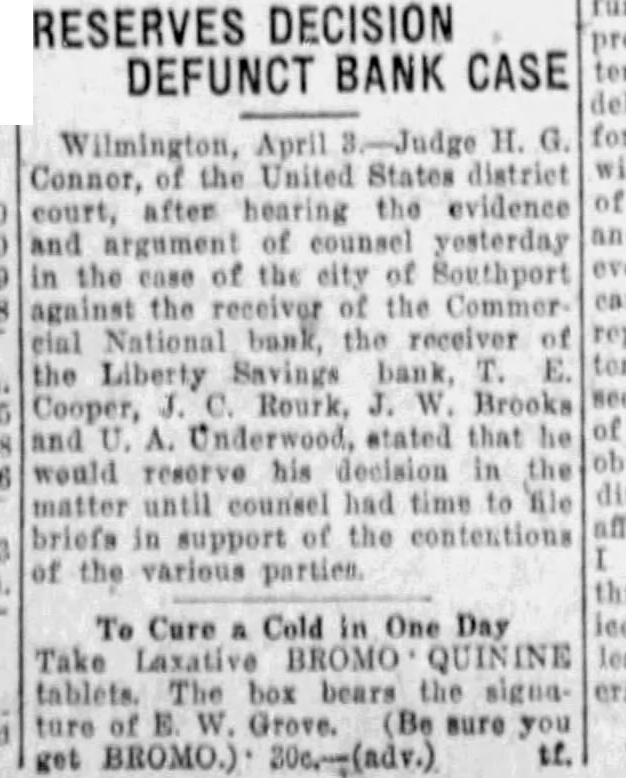
RESERVES DECISION DEFUNCT BANK CASE Wilmington, April 3.—Judge H. G. Connor, of the United States district court, after hearing the evidence and argument of counsel yesterday in the case of the city of Southport against the receiver of the Commercial National bank, the receiver of the Liberty Savings bank, T. E. Cooper, J. C. Rourk, J. W. Brooks and U. A. Underwood, stated that he would reserve his decision in the matter until counsel had time to file briefs in support of the contentions of the various parties. To Cure a Cold in One Day Take Laxative BROMO QUININE tablets. The box bears the signature of E. W. Grove. (Be sure you get BROMO.) 30c.—(adv.) tf.


Article from The Salisbury Post, April 11, 1923

Click image to open full size in new tab

Article Text

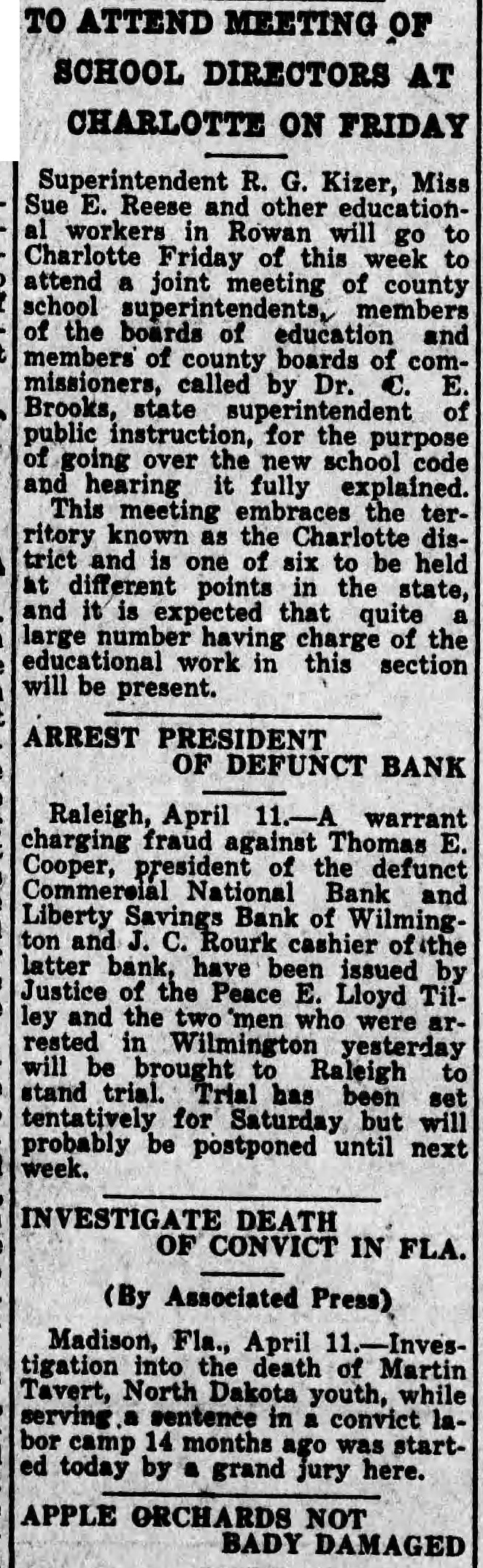
TO ATTEND MEETING OF SCHOOL DIRECTORS AT CHARLOTTE ON FRIDAY Superintendent R. G. Kizer, Miss Sue E. Reese and other educational workers in Rowan will go to Charlotte Friday of this week to attend a joint meeting of county school superintendents, members of the boards of education and members of county boards of commissioners, called by Dr. E. C. Brooks, state superintendent of public instruction, for the purpose of going over the new school code and hearing it fully explained. This meeting embraces the territory known as the Charlotte district and is one of six to be held at different points in the state, and it is expected that quite a large number having charge of the educational work in this section will be present. ARREST PRESIDENT OF DEFUNCT BANK Raleigh, April 11.—A warrant charging fraud against Thomas E. Cooper, president of the defunct Commercial National Bank and Liberty Savings Bank of Wilmington and J. C. Rourk cashier of the latter bank, have been issued by Justice of the Peace E. Lloyd Tilley and the two men who were arrested in Wilmington yesterday will be brought to Raleigh to stand trial. Trial has been set tentatively for Saturday but will probably be postponed until next week. INVESTIGATE DEATH OF CONVICT IN FLA. (By Associated Press) Madison, Fla., April 11.—Investigation into the death of Martin Tavert, North Dakota youth, while serving a sentence in a convict labor camp 14 months ago was started today by a grand jury here. APPLE ORCHARDS NOT BADY DAMAGED


Article from Evening Star, April 15, 1923

Click image to open full size in new tab

Article Text

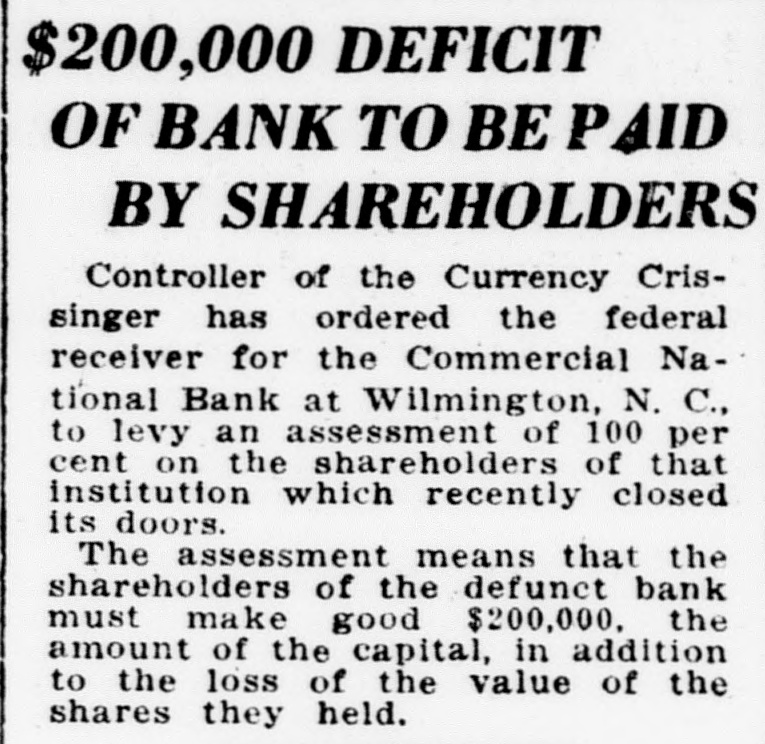
$200,000 DEFICIT OF BANK TO BE PAID BY SHAREHOLDERS Controller of the Currency Crissinger has ordered the federal receiver for the Commercial National Bank at Wilmington, N. C., to levy an assessment of 100 per cent on the shareholders of that institution which recently closed its doors. The assessment means that the shareholders of the defunct bank must make good $200,000. the amount of the capital, in addition to the loss of the value of the shares they held.


Article from Atlanta Tri-Weekly Journal, April 24, 1923

Click image to open full size in new tab

Article Text

rison a member of the state board of health to succeed Charles E. Waddell. Raleigh.-William Bethune, state college student, waives preliminary hearing in city court on a charge of manslaughter growing out of an automobile collision, when Robert Chappell was killed, and is released on $1,000 bond. Lenoir.-Official confirmation lack ing of reports that the Southern Power company intends to develop a hydro-electric project near Rhod hiss. Engineers are said to be making surveys. Raleigh.-Sheriff Lewis is "out of luck" all because he sent A check for $52.25 to the wrong department at Raleigh in payment of Brunswick ccunty taxes, and a Southport bank failed before the check was cashed Greensboro.-Police officers find Frank Falconer, 65, on the side walk, where he had been placed by passers-by. after being run over by an automobile. His injuries are serious. Charlotte.-Officials of Oasis tem ple of the Shrine announce the spring ceremonial, May 24, at Gastonia. Statesville.-Edgar M. Hallyburton, first American soldier to be captured by the Germans in the World war, is fined $150 in federal court here on charges grow ing out of his arrest with a companion while they were in possession of forty gallons of whisky. Raleigh.-Dr. E. C. Brooks, superintendent of public instruction has available for one qualified 1923 high school graduate a four-year scholarship to the Colorado School of Mines. Greensboro. - Students, faculty, trustees and friends of Greensboro college participate in Founders' day exercises, hearing address of Rev. W. A. Lambeth. of Gastonia. Wilmington.-T Italian steamship Ansaldo VII sails for Genoa with a cargo of 15,000 bales of cotton valued at $2,500,000, consigned by Alexander Sprunt & Sons, Inc. Hickory-Dr. Rufus B. Perry, professor of philosophy at Lenoir college, will deliver the baccalaureate sermon May 27 at State college, at Raleigh. Wake Forest-H. Z. Holmes, member of the 1921 law class at Wake Forest college, leaves for England and Ireland to investigate certain claims of heirs in this country to New York property valuued at $300,000,000. Wilmington-Shipments of ber ries from the Chadbourn section this season will be about 400 carloads and about 1,200 carloads from points on the Weldon-Wilmington branch of the A. C. L. Ry., according to railway officials. Jackson Springs-Failure of the peach crop results in large increases in cotton and tobacco acreage in this section. Wilson-Police Chief Lewis, of Middlesex, is wounded by a negro whom the officer slightly wounds in attempt "to arrest the negro, discovered rifling a mail pouch. Jackson Springs-Mrs. J. G. Cole will recover but lose use of an arm as a result of blood poisoning. Raleigh-Reuben Gunter, negro preacher, vindicated in city court of bootlegging while members of his congregation applaud, starts from the court with his liquor but it is retained by officials pending a study of the law. Greensboro-Report of the recent sale of the Carolina and Yadkin railroad by L. M. Cole, commissioner, to O. A. Kirkman and associates for $125,000, is filed in superior court. Charlotte-William F. Buchanan, former leader in local politics, dies after an illness of a year. Wilmington-Fifty 100-pound bags of sugar reported stolen from Clyde Line terminals here are recovered by the police and seven white men are charged with aiding in larceny. Elon College.-Miss Alice Webber, of Morganton, is elected president of the college student body. Raleigh.-Legal action is held by state officials to be necessary if the state recovers $25,000 deposited by the state treasurer in the Commercial National bank, at Wilming ton, which recently was closed. Greensboro-A: L. Brooks, representing city council n the litigation over the Southern railway passenger station bond issue, leaves for Washington to confer with the railways' counsel relative to the effort of local attorneys to restrain the city from issuing the bonds in the amount of $1,300,000, authorized in 1922 for a loan to the railway. Wilmington-S. F. Highsmith is advised by the treasury department of the abolition of the office of chief deputy collector of customs here, and of his promotion to assistant collector for the district which includes the state. Raleigh-Secretary of State Everett is to send Chief Clerk Sawyer to Michigan to study that state's automobile license law operation preparatory to the enforcement, beginning October 1, of the similar, newly enacted law of this state


Article from Wilkes-Barre Times Leader, the Evening News, August 16, 1923

Click image to open full size in new tab

Article Text

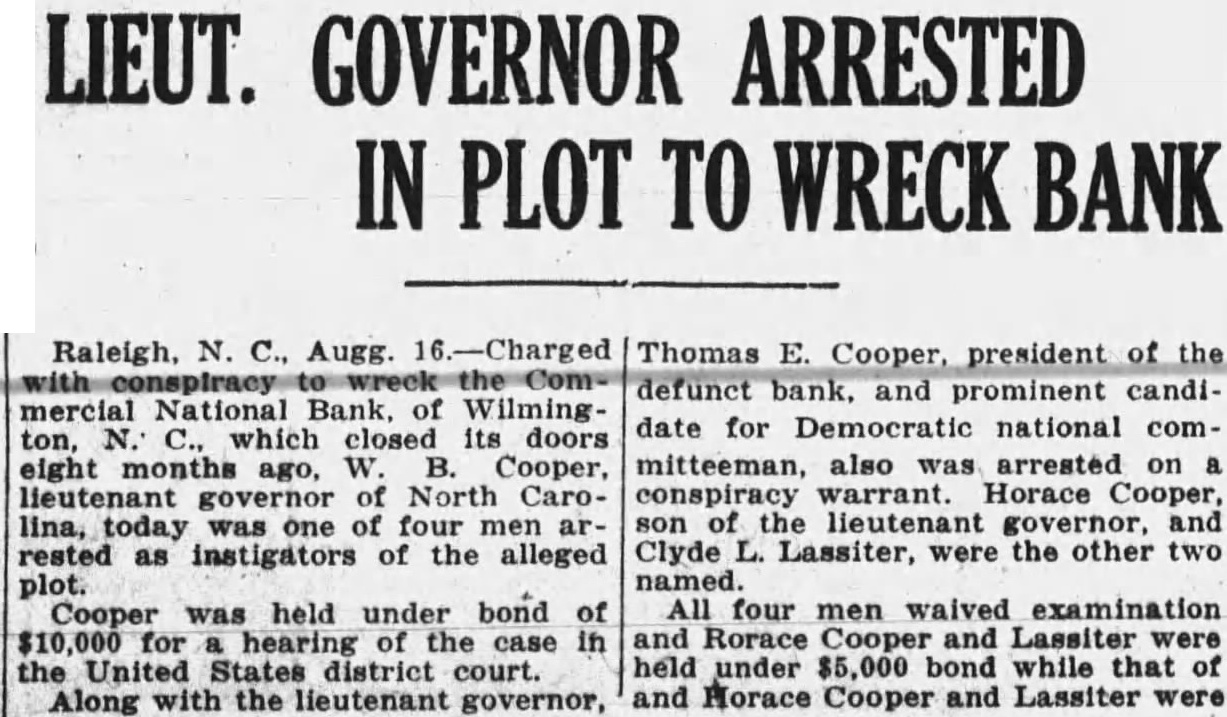
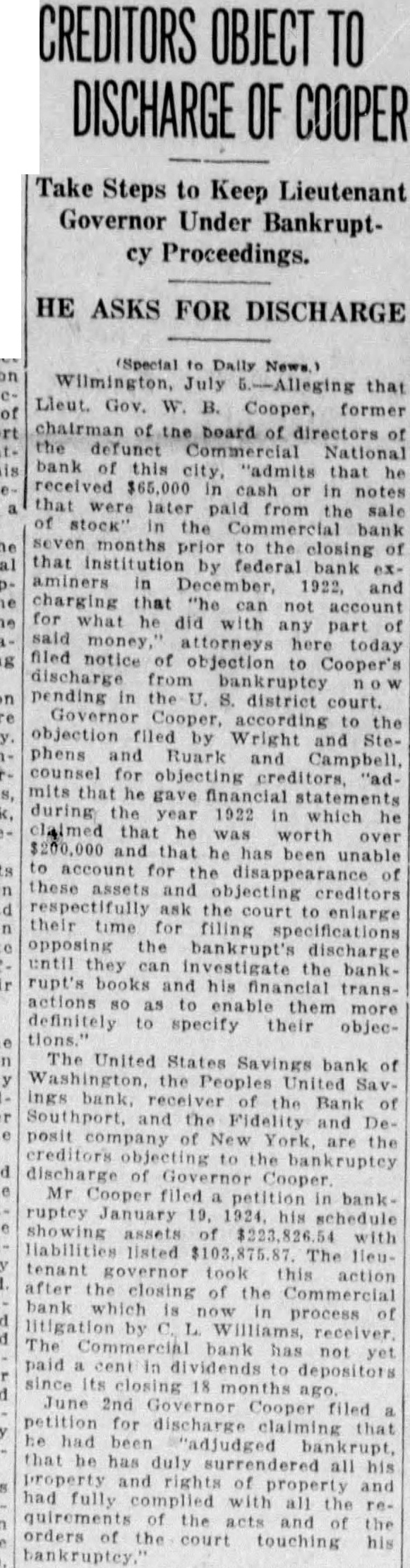
LIEUT. GOVERNOR ARRESTED IN PLOT TO WRECK BANK Raleigh, N. C., Aug. 16.—Charged with conspiracy to wreck the Commercial National Bank, of Wilmington, N. C., which closed its doors eight months ago, W. B. Cooper, lieutenant governor of North Carolina, today was one of four men arrested as instigators of the alleged plot. Cooper was held under bond of $10,000 for a hearing of the case in the United States district court. Along with the lieutenant governor, Thomas E. Cooper, president of the defunct bank, and prominent candidate for Democratic national committeeman, also was arrested on a conspiracy warrant. Horace Cooper, son of the lieutenant governor, and Clyde L. Lassiter, were the other two named. All four men waived examination and Horace Cooper and Lassiter were held under $5,000 bond while that of Thomas E. Cooper was fixed at $10,000.


Article from The Minneapolis Star, August 16, 1923

Click image to open full size in new tab

Article Text

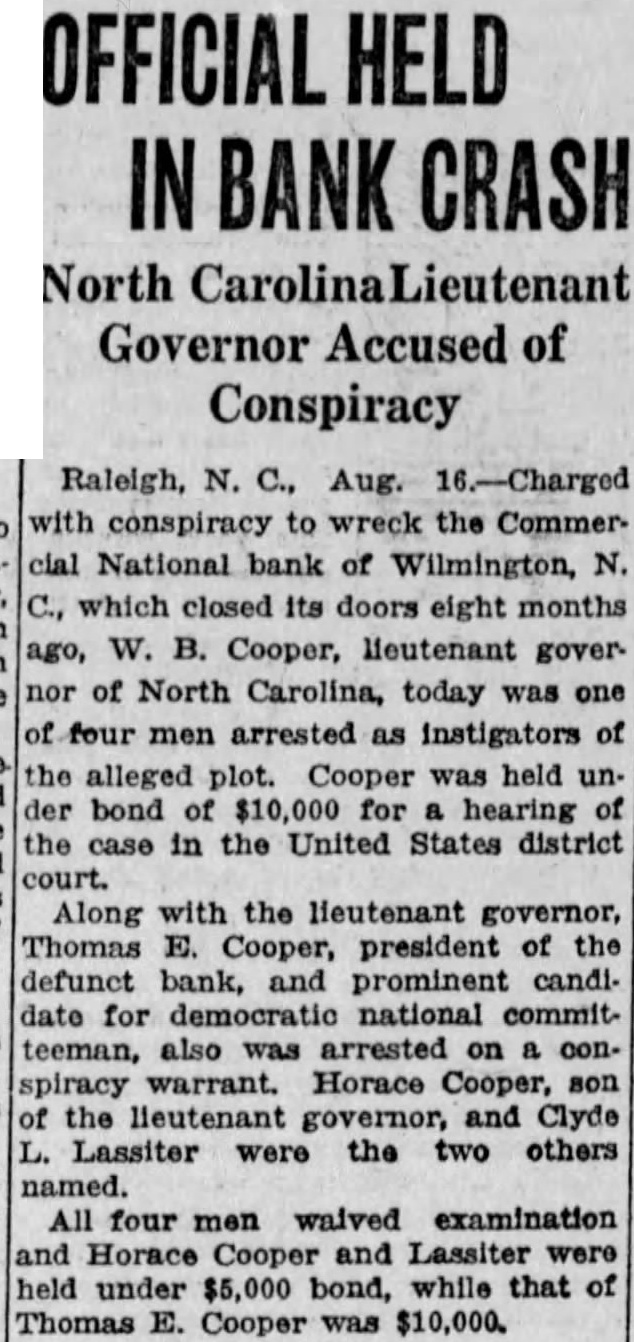
OFFICIAL HELD IN BANK CRASH North Carolina Lieutenant Governor Accused of Conspiracy Raleigh, N. C., Aug. 16.—Charged with conspiracy to wreck the Commercial National bank of Wilmington, N. C., which closed its doors eight months ago, W. B. Cooper, lieutenant governor of North Carolina, today was one of four men arrested as instigators of the alleged plot. Cooper was held under bond of $10,000 for a hearing of the case in the United States district court. Along with the lieutenant governor, Thomas E. Cooper, president of the defunct bank, and prominent candidate for democratic national committeeman, also was arrested on a conspiracy warrant. Horace Cooper, son of the lieutenant governor, and Clyde L. Lassiter were the two others named. All four men waived examination and Horace Cooper and Lassiter were held under $5,000 bond, while that of Thomas E. Cooper was $10,000.


Article from The Evening News, August 16, 1923

Click image to open full size in new tab

Article Text

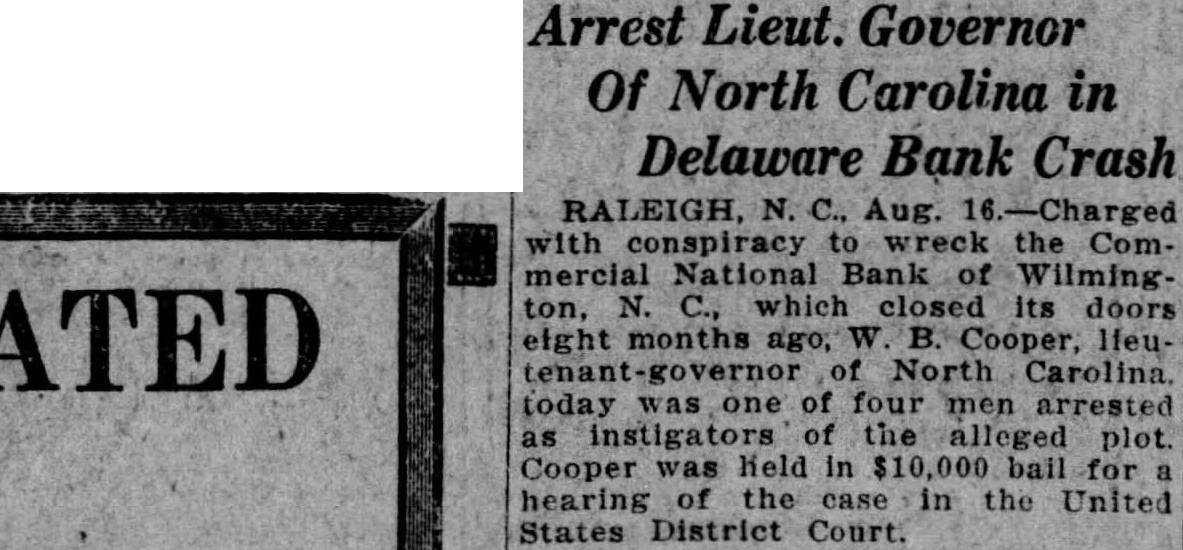
Arrest Lieut. Governor Of North Carolina in Delaware Bank Crash RALEIGH, N. C., Aug. 16.—Charged with conspiracy to wreck the Commercial National Bank of Wilmington, N. C., which closed its doors eight months ago, W. B. Cooper, lieutenant-governor of North Carolina, today was one of four men arrested as instigators of the alleged plot. Cooper was held in $10,000 bail for a hearing of the case in the United States District Court.


Article from Seattle Union Record, August 16, 1923

Click image to open full size in new tab

Article Text

Claim High Official Wrecked N. C. Bank RALEIGH, N. C., Aug. 16.—Charged with conspiracy to wreck the Commercial National Bank of Wilmington, N. C., which closed its doors eight months ago, W. B. Cooper, lieutenant governor of North Carolina, today was one of four men arrested as instigators of the alleged plot. Cooper will be held under bond of $10,000 for a hearing of the case in the United States district court.


Article from Seattle Union Record, August 17, 1923

Click image to open full size in new tab

Article Text

Claim High Official Wrecked N. C. Bank RALEIGH, N. C., Aug. 16.—Charged with conspiracy to wreck the Commercial National Bank of Wilmington, N. C., which closed its doors eight months ago, W. B. Cooper, lieutenant governor of North Carolina, today was one of four men arrested as instigators of the alleged plot. Cooper will be held under bond of $10,000 for a hearing of the case in the United States district court.


Article from The News and Observer, January 11, 1924

Click image to open full size in new tab

Article Text

BANK'S AFFAIRS AIRED IN COURT Thos. E. Cooper Alleged To Have Used Fraud On Southport Bank Southport, Jan. 10.—At the spring term of the Superior Court of Brunswick county, in session this week for the trial of civil cases, his honor, Judge Thomas H. Calvert, presiding, the most interesting case of the Receiver of the Bank of Southport vs. Wells and Howard, to recover on a $5,000 note, came up for trial. It is a case of particular importance, as showing the dealing of Thomas E Cooper at that time of the note issuance in 1922, when he was president both of the Commercial National Bank of Wilmington and the Bank of Southport, both banks wrecked through the Coopers. According to the showing in this case, the note of $5,000, made to the order of "myself," signed by Wells and endorsed by Wells and Howard, was drawn to pay for 50 shares of the stock of the Commercial National, which Thomas E. Cooper is alleged to have represented as worth $116 a share, and that a note was perfectly satisfactory to pay for these shares as he, Cooper, could get the note discounted. This note of Wells and Howard was sent to the Bank of Southport by Cooper, who stated in the letter accompanying the note that the endorsers were movie picture men worth $100,000 and that the note was sent because the Commercial Bank needed the money to take up some real estate paper. The note was discounted by the Bank of Southport. About ten days later, Cooper wrote to the bank here to change the proceeds of the note that had been discounted and credited to the Commercial National to his personal account. The defendants made the plea that the note had been secured from them by fraud and misrepresentation. And that Cooper being president of the Bank of Southport, the bank was party to the fraud, and that the note be declared of fraudulent origin, therefore, of no effect. The defendants offered no witnesses. The plaintiff put on the stand the cashier and vice-president of the Bank of Southport, who testified as to receiving and discounting the note, who knew nothing as to the obtaining of the note, but did know of the signers' business standing. Therefore, the bank was an innocent holder and not concerned as to how Cooper procured the note. While the case was largely a matter of law, four issues were drawn up, the second to be presented to the jury for its decision, yes or no, related to whether the Southport bank should be held as cognizant of the Cooper fraud upon which the note was secured. The jury brought in a verdict in favor of the Southport bank receiver. New Jail Nears Completion. Kenansville, Jan. 10.—Duplin county's new jail is well under construction. When completed it is estimated that the total cost will be around $30,000. The need for a new jail has been felt for many years, the one now in use being in bad repair and very unsanitary. The water, lights and sewerage system of the new jail will be modern and as


Article from News and Record, January 11, 1924

Click image to open full size in new tab

Article Text

WELLS AND HOWARD MUST PAY THE NOTE Jury Favors Bank of Southport In Litigation Over $5,000 Note—Cooper Transaction Aired (Special to Daily News) Southport, Jan. 10.—At the spring term of the Superior court of Brunswick county, in session this week for the trial of civil cases, Judge Thomas H. Calvert presiding, the most interesting case of the receiver of the Bank of Southport vs. Wells and Howard, to recover on a $5,000 note, came up for trial. It is a case of particular importance, as showing the dealing of Thomas E. Cooper, at that time, of the note issuance, in 1922, when he was president both of the Commercial National bank of Wilmington, and the Bank of Southport, both banks being wrecked. According to the showing in the above case, the note of $5,000 made to the order of "myself," signed by Wells, and indorsed by Wells and Howard, was drawn to pay for 50 shares of the stock of the Commercial National, which Thomas E. Cooper had represented was worth $116 per share, and that a note was perfectly satisfactory to pay for these shares, as he, Cooper, could get the note discounted. This note of Wells and Howard was sent to the Bank of Southport by Cooper, who stated in the letter accompanying the note, that the indorsers were moving picture men, worth $100,000, and that the note was sent because the Commercial bank needed the money to take up some real estate paper. The note was discounted by the Bank of Southport. About 10 days later, Cooper wrote to the bank here, to change the proceeds of the note, that had been discounted and credited to the Commercial National, to his personal account. The defendants made the plea that the note had been secured from them by fraud and misrepresentation, and that Cooper being president of the Bank of Southport, the bank was party to the fraud, and that the note be declared of fraudulent origin, therefore of no effect. The defendants offered no witnesses. The plaintiff, put on the stand the cashier and vice-president of the Bank of Southport, who testified as to receiving and discounting the note, who knew nothing as to the obtaining of the note, but did know of the signers' business standing, therefore the bank was an innocent holder, and not concerned as to how Cooper procured the note. While the case was largely a matter of law, four issues were drawn up, the second to be presented to the jury for its decision, yes or no, related to whether the Southport bank should be held as cognizant of the Cooper fraud, upon which the note was secured. The jury brought in a verdict in favor of the Southport bank receiver.


Article from Asheville Citizen-Times, April 3, 1924

Click image to open full size in new tab

Article Text

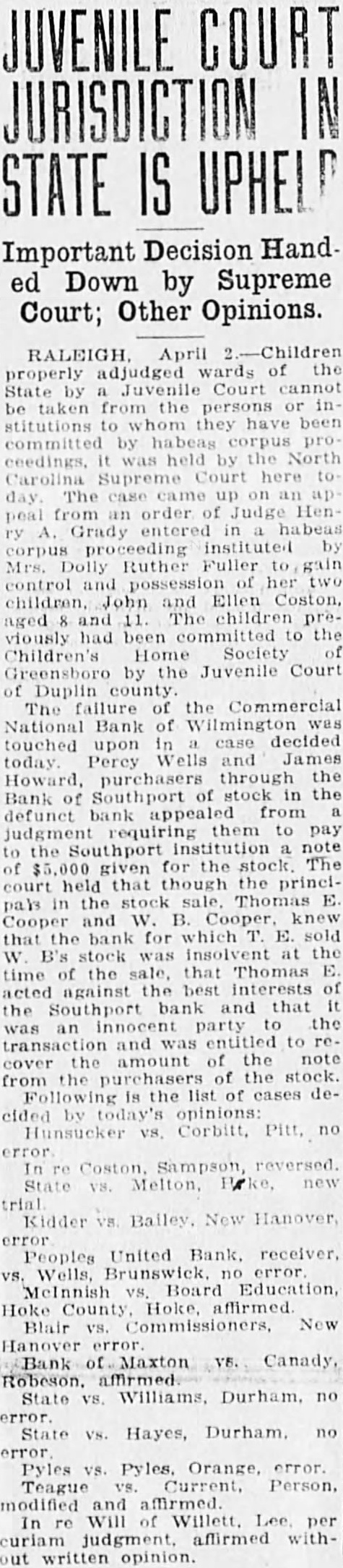
JUVENILE COURT JURISDICTION IN STATE IS UPHELD Important Decision Handed Down by Supreme Court; Other Opinions. RALEIGH, April 2.—Children properly adjudged wards of the State by a Juvenile Court cannot be taken from the persons or institutions to whom they have been committed by habeas corpus proceedings, it was held by the North Carolina Supreme Court here today. The case came up on an appeal from an order of Judge Henry A. Grady entered in a habeas corpus proceeding instituted by Mrs. Dolly Ruther Fuller to gain control and possession of her two children, John and Ellen Coston, aged 8 and 11. The children previously had been committed to the Children's Home Society of Greensboro by the Juvenile Court of Duplin county. The failure of the Commercial National Bank of Wilmington was touched upon in a case decided today. Percy Wells and James Howard, purchasers through the Bank of Southport of stock in the defunct bank appealed from a judgment requiring them to pay to the Southport institution a note of $5,000 given for the stock. The court held that though the principals in the stock sale, Thomas E. Cooper and W. B. Cooper, knew that the bank for which T. E. sold W. B's stock was insolvent at the time of the sale, that Thomas E. acted against the best interests of the Southport bank and that it was an innocent party to the transaction and was entitled to recover the amount of the note from the purchasers of the stock. Following is the list of cases decided by today's opinions: Hunsucker vs. Corbitt, Pitt, no error. In re Coston, Sampson, reversed. State vs. Melton, Polk, new trial. Kidder vs. Bailey, New Hanover, error. Peoples United Bank, receiver, vs. Wells, Brunswick, no error. McInnish vs. Board Education, Hoke County, Hoke, affirmed. Blair vs. Commissioners, New Hanover error. Bank of Maxton vs. Canady, Robeson, affirmed. State vs. Williams, Durham, no error. State vs. Hayes, Durham, no error. Pyles vs. Pyles, Orange, error. Teague vs. Current, Person, modified and affirmed. In re Will of Willett, Lee, per curiam judgment, affirmed without written opinion.


Article from The Herald-Sun, April 3, 1924

Click image to open full size in new tab

Article Text

CHILDREN CANNOT BE REMOVED FROM HOME SAYS COURT After Children Are Once Committed To A Home They Must Remain BANK CASE TOUCHED Court Holds That Southport Bank Is Entitled To Recover Amount From Stock Purchasers Raleigh, N. C., April 2.—Children properly adjudged wards of the state by a juvenile court cannot be taken from the persons or institutions to whom they have been committed by habeas corpus proceedings, it was held by the North Carolina supreme court here today. The case came up on appeal from an order of Judge Henry A. Grady entered in a habeas corpus proceeding instituted by Mrs. Dolly Ruther Fuller to gain control and possession of her two children, John and Ellen Coston, aged 8 and 11. The children previously had been committed to the children's home society of Greensboro by the juvenile court of Duplin county. The failure of the Commercial National bank of Wilmington was touched upon in a case decided today. Percy Wells and James Howard, purchasers through the bank of Southport of stock in the defunct bank appealed from a judgment requiring them to pay to the Southport institution a note of $5,000 given for the stock. The court held that though the principals in the stock sale, Thomas E. Cooper and W. B. Cooper, knew that the bank for which T. E. sold W. B.'s stock was insolvent at the time of the sale, that Thomas E. acted against the best interests of the Southport bank and that it was an innocent party to the transaction and was entitled to recover the amount of the note from the purchasers of the stock. Following is the list of cases decided by today's opinions: Hansucker vs. Corbit, Pitt, no error. In re Coston, Sampson, reversed. State vs Melton, Hoke, new trial. Kidder vs Bailey, New Hanover, error. Peoples United Bank, receiver, vs Wells, Brunswick, no error. McInnish vs Board Education, Hoke county, Hoke, affirmed. Blair vs Commissioners, New Hanover, error. Bank of Maxton vs Canady, Robeson, affirmed. State vs Williams, Durham, no error. State vs Hayes, Durham, no error. Pyles vs Pyles, Orange, error. Teague vs Current, Person, modified and affirmed. In re will of Willett, Lee, per curiam judgment affirmed without written opinion.

Article from The News and Observer, July 31, 1924

Click image to open full size in new tab

Article Text

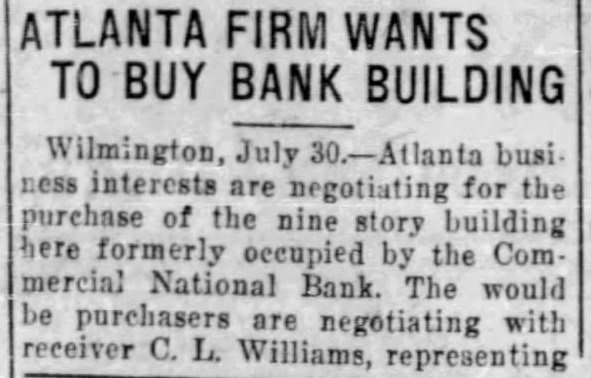
ATLANTA FIRM WANTS TO BUY BANK BUILDING Wilmington, July 30.—Atlanta business interests are negotiating for the purchase of the nine story building here formerly occupied by the Commercial National Bank. The would be purchasers are negotiating with receiver C. L. Williams, representing


Article from The News and Observer, July 30, 1926

Click image to open full size in new tab

Article Text

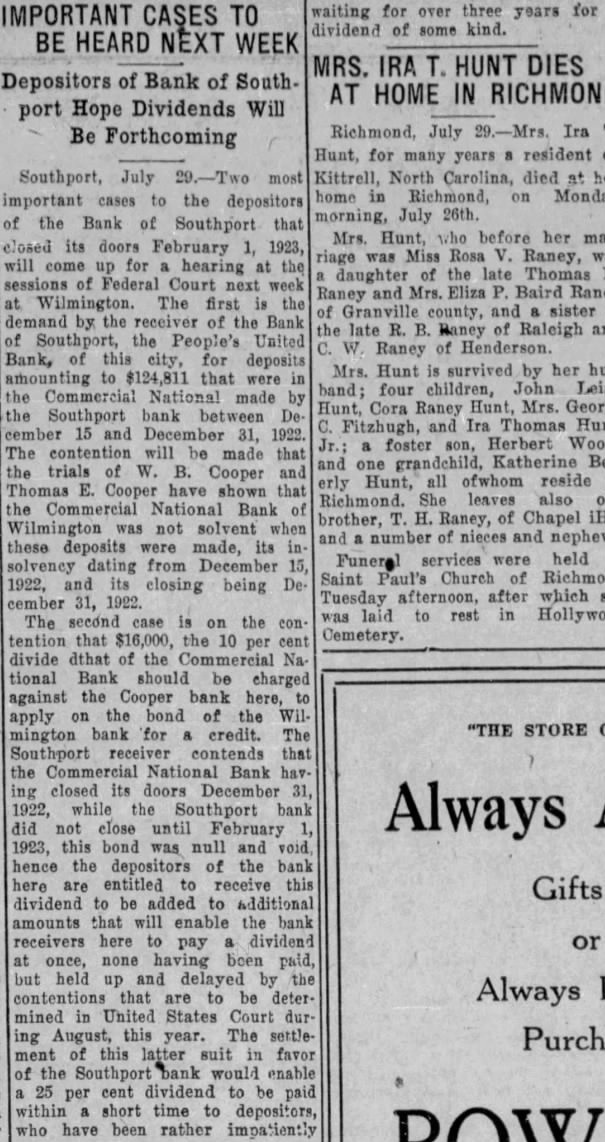
IMPORTANT CASES TO BE HEARD NEXT WEEK Depositors of Bank of Southport Hope Dividends Will Be Forthcoming Southport, July 29.-Two most Kittrell, North Carolina, died at her home in Richmond, on Monday important cases to the depositors morning, July 26th. of the Bank of Southport that Mrs. Hunt, who before her marclosed its doors February 1, 1923, riage was Miss Rosa V. Raney, was will come up for hearing at the a daughter of the late Thomas H. sessions of Federal Court next week Raney and Mrs. Eliza P. Baird Raney at Wilmington. The first is the of Granville county, and sister of demand by the receiver of the Bank the late R. B. Baney of Raleigh and of Southport, the People's United C. W. Raney of Henderson. Bank, of this city, for deposits Mrs. Hunt is survived by her hus. amounting to $124,811 that were in band; four children, John Leigh the Commercial National made by Hunt, Cora Raney Hunt, Mrs. George the Southport bank between De C. Fitzhugh, and Ira Thomas Hunt, cember 15 and December 31, 1922. Jr.; foster son, Herbert Wood; The contention will be made that and one grandchild, Katherine Bevthe trials of W. B. Cooper and erly Hunt, all ofwhom reside in Thomas E. Cooper have shown that Richmond. She leaves also one the Commercial National Bank of brother, T. H. Raney, of Chapel iHII, Wilmington was not solvent when and number of nieces and nephews. these deposits were made, its in Funeral services were held in solvency dating from December 15, Saint Paul's Church of Richmond 1922, and its closing being DeTuesday afternoon, after which she cember 31, 1922. was laid to rest in Hollywood The second case is on the conCemetery. tention that $16,000, the 10 per cent divide dthat of the Commercial Na. tional Bank should be charged against the Cooper bank here, to apply on the bond of the Wilmington bank for & credit. The Southport receiver contends that the Commercial National Bank hav. ing closed its doors December 31, 1922, while the Southport bank did not close until February 1923, this bond was null and void, hence the depositors of the bank here are entitled to receive this dividend to be added to additional amounts that will enable the bank receivers here to pay dividend at once, none having been paid, but held up and delayed by the contentions that are to be deter-


Article from News and Record, January 11, 1928

Click image to open full size in new tab

Article Text

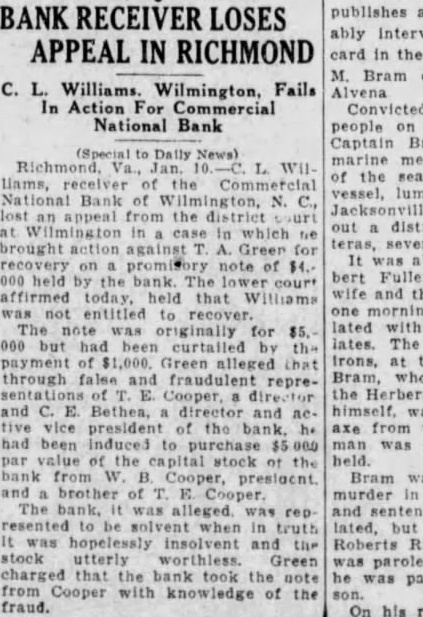
BANK RECEIVER LOSES APPEAL IN RICHMOND C. Williams. Wilmington, Fails In Action Commercial National Bank News) marine the National Bank appeal from the Wilmington case brought against Green recovery promisory note of held the bank. The court affirmed held that Williams entitled note originally for but had been lates. The payment Green alleged that at through false and fraudulent repreand and vice president the axe had been was value the stock held. bank from Cooper, president. brother The rep. resented solvent when lated, but hopelessly insolvent Roberts stock utterly worthless. Green the bank took the from Cooper with knowledge of the fraud. On his


Article Text

SEARCH FOR BANK RECEIVER ENDS IN WILMINGTON HOTEL SEARCH FOR RIOT LEADERS DROPPED Quiet Reigns In Region Of Alabama Crop War That Resulted In One Death county night after 24 hours of the of one that caused of four gro, and arrest six alleged sheriff, leaders the union. of Sheriff Kyle Young this aftercalled posse numbering noon 100 officers and approximately zens who had surrounded swamp three miles from Reeltown where three of the alleged leaders were believed to have sought sanctuary. On his return here Sheriff Young sald the search had called off because swamp made capture of the trio unlikely. Hiding In Swamp Members of the sald the Nehiding in the groes believed in near the home of swamp, which was Jeans, where the two had their Judson and another Negro unidetified. While Sheriff Young declined to discuss his next move permen, officials said the six or eight the posse sought apparently had gone into hiding and would be taken into custody on their return. Have Leaders' Names Officers the names of all the leaders of the lo- (Continued on Page 7. Column Earl W. Jones, Of Statesville, Is Found In Stupefied Condition At Cape Fear Hostelry Dec. search for Jones ended here today when the missing bank receiver was in locked said he was suffering mental disorder, possibly receiver of the Jones, was Commercial National bank here eral years ago, was identified by number of friends and his law, Annie but no indication of recognized them. When found lying across in the Cape Fear hotel Statesville appeared to be condition. Officers and newspapermen carried him to an ambulance where he was taken to hospital Mental Derangement Dr C. B. Koonce, physician attending Jones, said his "stupor purely mental condition." Physically, Dr. Koonce said his condition is normal "There's too much noise, Jones mumbled when found. Physicians said he continued to repeat "there's too much noise" the hospital Sheriff C. David wired the chief bank examiner at Washington advising him Jones' discovery and asking Miss Herring wired Jones' wife at Statesville and it was understood she would arrive here Jones disappeared from Statesville December 5, three hours before he was to have his as of the National bank to W. H. Spradlin An audit the bank's books is now being Recalls Robins Case The the Robins this state last month Robins nationally prohibition was found in the little Whittier after he had been for months and the object of tional His physician said he was suffering from Jones had been registered (Continued on Page 7. Column


Article Text

May Prefer Charges In Jones Case District Attorney Frank C. Patton of said here today he had ordered the Earl former Statesville bank audit of his books and pending probably will be charged with violation his under arrest in Jones, where found mington. ago after having receiver of the December mercial National Bank of few hours before He disappeared he was to the bank's affairs Spredlin. sent Washington to relieve Sheriff C. David Jones. of New in Hanover county hospital. under technical arrest yesorders of Patton but no terday on charges were at that time.


Article Text

Jones Described As Seriously Ill Jones, former bank receiver, was in hospital today physicians described him as seriousJones became ill, relatives said, route home Saturday night. had been released under $5,000 bond from the New Hanover county Wilmington for appearance federal court here April for trial on charges of misapplying and embezzling funds He was specifically charged with taking $1,600 small sums from the Commercial National bank while its receiver here in 1931 and 1932.


Article Text

dividends amounting to 69.77 per cent of their claims. The Commercial National bank of Wilmington, N. C., in receivership Jan. 31, 1923; disbursements, including offsets allowed, to depositors and other creditors aggregated $1,474,760, which represented 55.05 per cent of total liabilities. Unsecured depositors received dividends amounting to 25.68 per cent of their claims.