Page, Bacon & Company (San Francisco, CA)

Episode Information

Episode UID
1237812290662
Episode Type
Run โ†’ Suspension โ†’ Closure
Bank Type
private
Bank ID
123781229 hash
Start Date
February 17, 1855
Location
San Francisco, California (37.780, -122.419)

Metadata

Model
gpt-5-mini (chosen from majority vote of a three-model LLM ensemble)
Short Digest
2cd78aea22e3128a

Response Measures

None

Description

Suspension follows an initial run triggered by the failure of the related St. Louis house; receivers were subsequently appointed.

Events (3)

1. February 17, 1855 Run
Cause
Correspondent
Cause Details
News of the failure of the St. Louis house of Page & Bacon prompted depositors to withdraw funds.
Measures
Paid depositors promptly; paid out roughly $400,000 (also reported half a million paid in some accounts).
Newspaper Excerpt
a run upon their bank, for a few hours, occurred in San Francisco. Every depositor presenting their paper, was promptly paid;
Source
newspapers
2. February 22, 1855 Suspension
Cause
Correspondent
Cause Details
Impaired credit from the suspension/failure of the St. Louis Page & Bacon and inability to raise coin on drafts led the firm to suspend.
Newspaper Excerpt
We must suspend. The suspension of Page & Bacon has impaired our credit. ... We believe and know we are solvent, and will be able to pay, and that soon, and have a large surplus.
Source
newspapers
3. February 27, 1855 Receivership
Newspaper Excerpt
the three principal houses-Page, Bacon & Co., Wells, Fargo & Co., and Adams & Co. -immediately after their suspension had receivers appointed, for the purpose of keeping off their creditors.
Source
newspapers

Newspaper Articles (25)

Article from The Empire County Argus, February 24, 1855

Click image to open full size in new tab

Article Text

PAGE, BACON & Co.--The most exciting intelligence, by the late steamer, was the reported failure of Page & Bacon, of St. Louis. The impression prevailed, at first, that Page, Bacon & Co., of California, would be ruinously involved. A run upon their bank, for a few hours, occurred in San FranFrancisco. Every depositor presenting their paper, was promptly paid; and the excitement soon died away. Page, Bacon & Co. are not in the least in volved in the temporary suspension of Page & Bacon of St. Louis, and will continue their business in this State, as heretofore. Messrs. Page, Bacon & Co. have the entire confidence of business men in this State, and the Tribune says that, notwithstanding the run on this bank in Sacramento, a larger number of certificates of deposit were issued on Saturday than during any other day for twelve months past. Since the above was put in type we hear that P. B. & Co. have suspended payment and gone into liquidation.


Article from The Shasta Courier, February 24, 1855

Click image to open full size in new tab

Article Text

PAGE, BACON & Co.-Immediately on the receipt of the news of the suspension of the great St. Louis House of Page & Bacon, a tremend ous run commenced upon the House of Page, Bacon & Co., of San Francisco. We are glad to state that the evidences of deposit were promptly met by the officers of the bank, who during the first day paid out half a million of dollars. The run has since ceased, the House fully establishing its claim to perfect solvency. At the time the run commenced, the vaults contained over a million of dollars. Mr. Middleton, of San Francisco, states that the earnings of this House has been $1,000,000.


Article from Butte Record, February 24, 1855

Click image to open full size in new tab

Article Text

aid PAGE, BACON $& Co.--The Steamer ai Oregon brought news of the failure of Page & Bacon, Bankers, St: Louis, Mo. Supposing that their failure involved the House of Page, Bacon & Co., of San Francisco, the public made quite a run bas upon that house, but finding everything safe and sound the rnn ceased, and their house now stands among the best in California. Success to them and may Wall st. sink before they do.


Article from Butte Record, March 3, 1855

Click image to open full size in new tab

Article Text

# FAILURE OF BANKING HOUSES.--The news from the eastern States, of the failure of Page & Bacon, Bankers of St. Louis, created a panic, and a run commenced upon the banking houses of this State, which resulted in the suspension of the following houses: Page, Bacon & Co., Adams & Co., Wells, Fargo & Co., (since resumed) Robinson & Co., and Dr. A. S. Wright's Miner's Exchange Bank. Heavy runs were made on B. Davidson's Bank, on Lucas, Turner & Co., and on Drexel, Sather & Church, but they were prepared for the emergency, and met every demand made upon them. Palmer, Cook, & Co., Sanders and Brenham, and Tallant & Wilde were, to a great extent free from the prevailing excitement. While other banking houses were suspending, Mark Brumagim & Co., remained open one hour after the usual time of closing in order to satisfy demands against them. It gives us great pleasure to state that the suspension of Wells, Fargo & Co., was but temporary, and that they were open the next day, paying demands and expressing matter throughout the State as usual. A meeting of the creditors of Page, Bacon, & Co., in San Francisco, will probably result in arrangements for that House to again resume business. At present the great House of Adams & Co., appear to have more completely suspended than any of the others. We can only hope that their suspension may be but temporary, and that they may soon be enabled to again resume business, only the more sound and safe for their temporary suspension.


Article from New-York Daily Tribune, March 20, 1855

Click image to open full size in new tab

Article Text

Our California advices by the Northern Light give the full particulars of the great financial crisis which appears to have been impending over the City of San Francisco for some time past, but which was precipitated by the announcement of the suspension of Page & Bacon in St. Louis. The news of that event reached San Francisco on Saturday Feb. 17, and occasioned an immediate run on the banking-bouse of Page, Bacon & Co, which continued until Thursday, Feb. 22, on the morning of which day they closed their doors. The next day, Friday, the 23d, the suspension of Adams & Co. was declared, which was followed at once by that of Welle, Fargo & Co., Robinson & Co., and the Miners' Bank. A large meeting of the creditors of Page, Bacon & Co. was held on Sunday, the 25th, of which the proceedings are given at length in our columns. In other respects the news by this arrival is not of special importance. A destructive fire occurred at Stockton on the 21st ult., causing a loss of about $50,000. The fiftieth and last vote on the election of United States Senator in the California Legislature resulted as follows: Gwin, 41; Edwards, 36; Roman, 15; Broderick, 12; scattering, 5. The Joint Convention then adjourned. The Northern Light announces the continued success of Chamorro in Central America. The revolutionary leaders have been badly beaten, and will, probably, bring the war to a speedy termination.


Article from The New York Herald, March 21, 1855

Click image to open full size in new tab

Article Text

ment, Washington, on the 17th inst., were:For the redemption of stock $1,172 76 For paying Treasury, debts 51,486 33 For the Customs 103,187 76 113 61 For the War Department. 687 44 For the Navy Department For the Interior Department 63,439 75 The first dividend of fifty per cent to claimants against the Cochituate Bank will be paid at the Webster Bank, Boston, on Thursday next. There has been a fair demand for foreign exchange to-day for remittance by the steamship Nashville, from this port for Liverpool, to-morrow, (Wednes. day,) and full rates have been obtained. We quote on London, 91 a 104 per cent premium; on Paris, 58. 132 a 57. 10; Amsterdam, 41ยฝ a 411; Bremen, 79โ‚ซ a 80; Hamburg, 362 a 37. The steamer will take out upwards of half a million of dollars in specie, a large portion of which will be coin. The California advices received yesterday have had no effect upon our markets. About one half of the rumors and reports in circulation about the different houses involved are false, and efforts have been made both here and in California to excite the public mind as much as possible. The report that Mr. Hoadley no longer acted as the agent of Page, Bacon & Co., started by some of our cotemporaries, is entirely without foundation. No change has been made or contemplated. There is no doubt but that the next steamer from California will bring accounts of the resumption of Page, Bacon & Co., Wells, Fargo & Co., and several other banking houses of San Francisco, a revival of confidence, and a renewai of active business operations. If these houses have not resumed, we see no cause for an interruption of remittances, for there are other houses in San Francisco, of undoubted standing, whose credit has been materially strengthened by the ordeal through which they have passed, ready to transact all the exchange business required. The gold must come here. If not through the hands of Page, Bacon & Cc., or Adams & Co.. it will come through other concerns as speedily and as safely. The amount shipped per week may not, for a short time, be so large, but there will not be any very great accumulation in San Francisco. Gold and gold dust are of more use to merchants and miners in his market than in their own possession in Califor" nia, and we look for an immediate dissppearance of the panic which at one time threatened to destroy he credit of half the banking houses in California. The returns of the anthracite coal trade for severai years past give some very interesting facts regarding the source of supply, and a close examination of the reports from the different companies engaged n the transportation business, will show where the enormous supplies which will be required for future consumption, must come from, or rather by what channel they must reach market :Cost TRADE


Article from Washington Sentinel, March 22, 1855

Click image to open full size in new tab

Article Text

Washington Sentinel. FURTHER FROM CALIFORNIA. The Great Financial Panic-The Bank Suspensions-Highly Interesting Details. The Commencement of the Panic. On the 17th of February, the steamship Oregon arrived at San Francisco, bringing in telligence of the failure of the St. Louis house of Page & Bacon. The San Francisco Herald siys: The news spread with astonishing rapidity in every quarter of the city, and an immense crowd soon gathered in front of the bank, each individual struggling to be first at the counter, as if life and death depended upon the loss or gain of a moment's time. Messrs. Maight and Chambers addressed the crowd, stating that there were sufficient funds in bank to redeem every dollar of their paper, if the assemblage would only maintain order, and make room for the egress of those who had withdrawn their deposits, every demand would be satisfied. A large police force, headed by Marshal McKenzie, were promptly on the spot, and succeeded in some degree in enforcing the observance of order. For some time the pressure of the crowd was SO great that persons after receiving their money were obliged to make their egress by walking upon the heads and shoulders of those in the rear. On the street the scene was even more exciting. Persons were constantly arriving, breathless with haste and clamorous for admittance at the doors guarded by the police. The clamor inside produced the impression on the minds of some that there was danger of suspension, and this impression was taken ad vantage of by parties outside, who in some in stances obtained certificates from panic-stricken holders at enormous discounts. One individual boasted that his profits for one hour had amounted to $1,500 A number of disorderly persons were arrested by the police. A man presented for payment a fictitious check, but notwithstanding the surrounding ex citement, it was immediately detected by the clerk to whom it was presented. Toward noon the excitement subsided, and matters assumed a different aspect, as confidence became restored by the appearance of immense piles of coin from a source which seemed exhaustless. Nearly all the principal banking and mercantile firms were prompt with tenders of as sistance to any extent. These offers, however, were in every instance declined. Meeting of Merchants. At two o'clock that day, a numerous meeting of merchants was held, at which resolutions were adopted, declaring that they believed the worst of the pressure had passed that the sev. weresound, and deserved the confidence of the citizens, and therefore they would continue their deposits and accounts with said banks. A committee of twenty-five was appointed to wait upon Messrs. Page, Ba con & Co., with resolutions of the continued confidence of the community in the house. They returned with a communication to the effect that they would continue their business, as the failure of the St. Louis house in no way affected them. The committee stated that from exhibits made to them they were satisfied that the house was entirely able to meet all its en gagements at any time. The run on Page, Bacon & Co., continued. The run continued throughout the day, and about $400,000 were paid out. The Herald of the next day (the 18th) says: "Messrs. Haight and Chambers obstinately refused deposits all day, as they had no need of them, and every demand on the bank was promptly answered. At the opening of the door on yesterday morning they had in their vaults the sum of $1,120,000, and in the course of the day the call upon them did not amount to over $400,000. They have, therefore, in their vaults, at present, $720,000, in addition to a balance of $832,000 in New York to draw against, bills outstanding to the amount of $630,000, and real estate to the amount of $150,000. Over and above the $1,120,000 they had in their vaults yesterday morning, they did not owe more than $480,000. Against that they have, in available assets, $1,612,000, and this not remotely available but available within the next two weeks, or sooner if necessary-so that the firm can to-morrow pay all demands upon them and retire with a million of dollars. On the 18th the run partially ceased, and all moved on as usual for two or three days. On the 22d the Sierra Nevada arrived, bringing intelligence that the California drafts of the house had been promptly paid at New York, but neither that announcement nor the measures which had been taken to allay the excite ment was effectual in averting the crash. It is supposed that had the Sierra Nevada arrived twenty-fou hours sooner, the excitement would have been allayed. The Suspension of Page, Bacon & Co. On the 22d the firm issued the following card: "BANKING HOUSE OF PAGE, BACON & Co., "San Francisco, Feb. 22, 1855. " We must suspend. The suspension of Page & Bacon has impaired our credit. We have large funds in New York, and in transitu, to us unavailable. We cannot raise coin on our bills. The coin is not in the country. We believe and know we are solvent, and will be able to pay, and that soon, and have a large sur PAGE, BACON & Co." plus. The Evening News of that date says: The 'run' drew out about $500,000. Impaired confidence and the cessation of deposits have since acted against them. Drafts continued to come in, and the specie in their vaults was reduced to less than $100,000. Under these circumstances, and the uncertainty attend ing the action of the creditors of Page & Ba con in New York, D. B. Chambers, a former partner, deemed it proper to close up the affairs of the concern at once, and thereupon, with consent of parties, enjoined the firm from trans acting further business, Jos. B. ella, esq., being appointed receiver." The Sierra Nevada, it appears, arrived in the evening, several hours after the suspension. The Suspension of Adams & Co. Although the 22d was a holiday, and no business doing, a run was made on Adams & Co., during which $200,000 were drawn from the vaults, while the deposits amounted to only $10,000. Apprehending a continuance of the panie, and entertaining doubts as to their ability to breast the storm, the doors of the banking-house were closed on the 23d, and the following announcement posted in a conspicuous place: BANKING HOUSE OF ADAMS & Co.,
Article from Washington Sentinel, March 22, 1855

Click image to open full size in new tab

Article Text

ing house all day, with the hope of learning something in regard to the condition of the establishment, but nothing definite could be ascertained. In the afternoon the following card was published BANKING HOUSE OF ADAMS & Co., San Francisco, Feb. 23. The undersigned, resident partner of Adams & Co., California, in view of the suspension of payment this day, deems it his duty to present to their creditors, friends, and to the public at large, a brief statement of the causes that have led to the calamity. The event of to-day is equally at variance with their feelings and pecuniary interests, but was acceded by a duty to their depositors paramount to all other considerations. The like misfortune that has overtaken one of the most prominent banks in the State, has so far destroyed confidence as to have occasioned a "run" on yesterday, which drew from our vaults over $200,000, while the deposites did not reach $10,000-and this on a holiday, when business was apparently forgotten in the festivities of the occasion. Our abilities to sustain a continued run was by no means an impossibility, but with the experience of the past week before us, SO long as room for a doubt remained, it became clearly our duty to treat all alike, and to repay the forbearance of friends and creditors throughout the mines by exhausting our available means for the exclusive benefit of more urgent claims. Besides, in the regular course of our business, our coin had been exchanged for dust, in anticipation of shipment by to-morrow's steamer. It is well known that the demand of gold for shipment has for many months far exceeded the supply of dust from the mines to meet this deficiency coin has been withdrawn from the circulation of the country at about the rate of one million dollars per month-leaving merely sufficient for the most ordinary wants of business, and producing an unparalleled and increasing pressure. These facts, with the extreme panic produced by Page, Bacon & Co.'s suspension, compel us for the protection of all to close our doors. It is our intention, immediately, to submit out affairs to a committee of known and trustworthy citizens, whose report, we are confident, will demonstrate the propriety of our course, and the ability of Adams & Co. to discharge their obligations. Meanwhile, we ask of our friends to continue the confidence we have so long enjoyed, assuring the public that we shall employ the same honesty of purpose and energy in action, in relieving all who may sustain embarrassment by our suspension, that we have ever exhibited in our transactions in California. I. C. WOODS. Page, Bacon & Co. Some attachments were also placed on this establishment yesterday. The books are locked up in the vault, the key of which is in the possession of the receiver, Mr. Wells; and as the sheriff was present, it would not be prudent to open it till the attachments, which only amount to a few thousand dollars are, paid off. The attachments were issued out of the Twelfth District Court, and were for the following amounts: N. Holland VS. D. Chambers et al., $3,784 00 James Grant VS. D. D. Page et al., 3,850 65 C. Hofflin vs. same, 3,882 46 6,807 67 T. J. L. Smiley vs. same, 78 Total amount of attachments, $18,324 A General Run-Other Suspensions. The suspension of Adams & Co. created a perfect panic on he 23d, and a general run on all the banking houses. Wells, Fargo & Co. soon closed, temporarily, as they could not procure coin in exchange for bars, stowed away in their vaults. The Miners' Exchange Bank soon followed suit, for the same reason. Robinson & Co.'s Saving's Bank did not open its doors that morning, which added to the excitement, as a great many poor persons had deposited their earnings there. A tremendous rush was made on Lucas, Turner & Co., but the doors were thrown open, and every certificate that was presented was promptly cashed. About one o'clock the excitement here began to die out, and before the time for closing the bank arrived, not a single depositor could be seen. From an early hour the doors of B. Davidson & Co. were beset with crowds of depositors, but as in the above case, dollar for dollar was paid out; and before the hour for closing, confidence was entirely restored. A run was also made on Drexel, Sather & Church, but the utmost order was maintained, and everybody who had claims on the establishment was satisfied. The officers express themselves ready to meet all demands upon them. Palmer, Cook & Co.'s was the only prominent banking house in the city which the tremendous storm of the 23d did not at all affect. While crowds beset the doors of all the other banking houses, everything was quiet there, and the ordinary business of the counting room was transacted in the usual way. There was no run on the banking house of Tallant & Wilds on the 23d. In the early part of the day, a few depositors presented their certificates, but all demands were promptly met, and everything went on as usual. Sanders & Brenham promptly met all demands. End of the Excitement. Everything was very quiet on the 24th, and the only visible traces left after the terrible financial storm which had just swept over the city, were the closed doors of some of the most prominent and respected bankers. There was, of course, an entire stagnation of business. A San Francisco Journal says: " Such a general upheaving of the masses was never before witnessed in this city, and we question very much whether even the great fires by which San Francisco has been more than once laid in ruins, could be considered as wide-spread a calamity as the suspension of the banks yesterday. There can be no doubt that much of it is owing to the people themselves. We did not see, nor can we see, what grounds there were for so general a panic. The advices from New York by the Sierra Nevada, in relation to Page, Bacon & Co., were decidedly favorable." Meeting of the Creditors of Page, Bacon Co. On the 25th a meeting of the creditors of this house was held, when their assets were reported at $2,171,818, and their liabilities at $1,302,950, leaving a balance of $868,868.

Article from Wilmington Journal, March 23, 1855

Click image to open full size in new tab

Article Text

The San Francisco Failures. The Emperor Nicholas and Bill Poole have been both cast into the shade by the news of the immense failures in California, received by the Northern Light. The failures, or even the temporary suspension of great houses like Page, Bacon & Co., Wells, Fargo & Co., and Adams & Co, could not but create a general panic and carry before the storm which it raised, all the weaker vessels. It is therefore certain that the number of failures in San Francisco must turn out to be very large, and as almost every house on the Pacific coast is connected with some similar house at the east, the effects of these failures will be felt almost as deeply in New York and Boston as they have been in San Francisco. The amount which may eventually be lost by means of the failures or suspensions of the greater banking houses may not be great, considered directly, but the actual amount of loss which may indirectly result, would be difficult to estimate. It must be large. Our land of gold however, is, after all, flourishing, prosperous and civilized, compared with Australia, where the Miners and the Authorities are at open war. The authorities demand that every miner shall take out and pay for a license or permit to mine-the mining lands being public or government property.This the miners refuse to do. The commissioners demanded of the miners their licenses with drawn swords and fixed bayonets-the miners wouldn't pay. The soldiers were called in and fired,-the miners fired back, taking refuge in the bush and picking off the soldiers. It is doubtful if there ever was a spot in California quite as wild as the Ballarat Mines in Australia. The British government is at war, and perhaps the colonists think that now is their opporunity to throw off the yoke.


Article from The New York Herald, March 25, 1855

Click image to open full size in new tab

Article Text

The News. No signs of the Atlantic at twelve o'clock last might. Size is now in her fifteenth day out from Liverpool. By the arrival of the stea ner George Law, we have late and interesting news from California, the West Coast of Mexice, the South Pacific, Australia, and the Isthmus of Penama. Our San Francisco advices are to the 1st inst.three days later. Fell details of the news are given in another part of this morning's paper. The monetary excitement continued to increase in San Francisco and other parts of the State, and the people were rapidly being brought to a consciousness of the hollowness of a portion of the business community. They had very nearly or quite reached the bettom, however, and were beginning to look around for some substantial basis on which they might again raise themselves. Among all the establishments which suspended during the first onset the house of Wells, Fargo& Co. is the only one that has re_ sumed and re-established their business operations; but it was presumed that Page, Bacon & Ce., with the assistance that had been tendered them, would shortly be enabled to take their stand among the solvent bankers. As for the others-Adams & Co., Robinson & Co., Wright's Exchange Bank, and Read & Co., of Sacramento-there was very little hope of their ever emerging from the vortex, the former and the last named concerns having applied for the benefit of the insolvent a ct. The extent of the run on the banking houses in San Francisco, during the excitement, may be imagined by reading the. following table, showing the amount of monow drawn ent previous to the gnspension:


Article from Worcester Daily Spy, March 26, 1855

Click image to open full size in new tab

Article Text

TEN DAYS LATER FROM CALIFORNIA. ARRIVAL OF THE GEORGE LAW. 317,800 DOLLARS IN GOLD!! The steamship George Law left Aspinwall at half-past 12 o'clock on the morning of the 16th inst., and arrived at New York at halfpast 10 Saturday morning. She brings the California mails of March 1, $317,800 in treasure, on freight, and 234 passengers. Col. Fremont is among the passengers by the Geo. Law. The San Francisco correspondent of the New York Tribune writes as follows in relation to the financial difficulties that commenced just previous to the sailing of the last steamer. The amount of money drawn from the banks during the panic is estimated at three millions of dollars. The three principal houses-Page, Bacon & Co., Wells, Fargo & Co., and Adams & Co. -immediately after their suspension had receivers appointed, for the purpose of keeping off their creditors. On the 27th, Wells, Fargo & Co. called a meeting of their heaviest depositors, who agreed to wait upon them 30 and sixty days for the amounts due them, whereupon that house immediately resumed, and is now in active operation. It would have been fortunate for the public, if Adams & Co. could have come out in a similar manner, but it is feared, and very generally believed, that that house is insolvent.J. C. Wood, the principal manager of the concern, has applied for the benefit of the Insolvent Act. The statement made by him, of the assets and liabilities of the house, show it to have been one of the worst managed concerns in the country. In the assets are the following items:-


Article from New-York Daily Tribune, March 26, 1855

Click image to open full size in new tab

Article Text

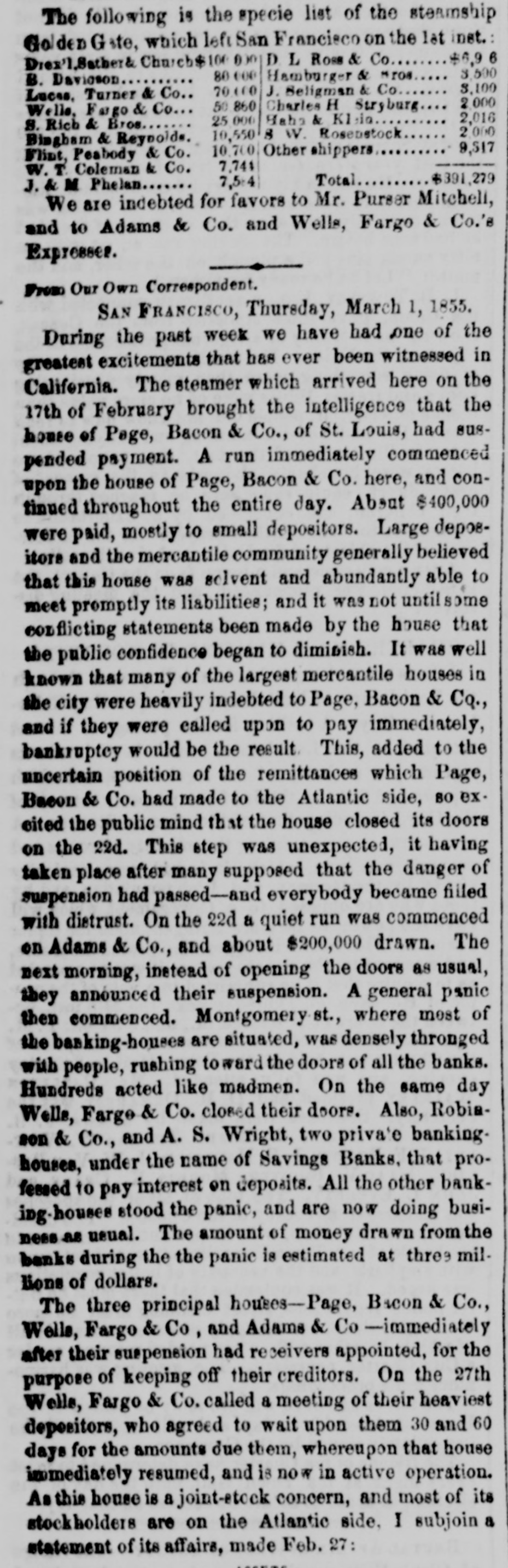
The following is the specie list of the steamship Golden Gste, which left San Francisco on the let inst. D L Ross & Co $6,96 Diex'l.Sather& Church$ 3,500 000 Hamburger & Mros B. Davieson $,100 70,000 J. Seligman & Co Lucas, Turner & Co.. 2,000 50.860 Charles H Stryburg Wells, Fago & Co... 2,016 Haba & Klin 25,000 S. Rich & Bros 2,000 8 W. Rosenstock 10,550 Bingham & Reynolds. 9,517 10,700 Other shippers Flint, Peabody & Co. 7.741 W. T Coleman k Co. $391,279 Total 7,5 4 J. & M Phelan We are indebted for favors to Mr. Purser Mitchell, and to Adams & Co. and Wells, Fargo & Co.'s Expresses. From Our Own Correspondent. SAN FRANCISCO, Thursday, March 1, 1855. During the past week we have had one of the greatest excitements that has ever been witnessed in California. The steamer which arrived here on the 17th of February brought the intelligence that the house of Page, Bacon & Co., of St. Louis, had suspended payment. A run immediately commenced upon the house of Page, Bacon & Co. here, and continued throughout the entire day. About $400,000 were paid, mostly to small depositors. Large depositore and the mercantile community generally believed that this house was solvent and abundantly able to meet promptly its liabilities; and it was not untilsome conflicting statements been made by the house that the public confidence began to diminish. It was well known that many of the largest mercantile houses in the city were heavily indebted to Page, Bacon & Cq., and if they were called upon to pay immediately, bankruptcy would be the result. This, added to the uncertain position of the remittances which Page, Bacon & Co. had made to the Atlantic side, so ex. eited the public mind that the house closed its doors on the 22d. This step was unexpected, it having taken place after many supposed that the danger of suspension had passed-and everybody became filled with distrust. On the 22d a quiet run was commenced on Adams & Co., and about $200,000 drawn. The next morning, instead of opening the doors as usual, they announced their suspension. A general panic then commenced. Montgomery st., where most of the banking-houses are situated, was densely thronged with people, rushing to ward the doors of all the banks. Hundreds acted like madmen. On the same day Wells, Farge & Co. closed their doors. Also, Robiason & Co., and A. S. Wright, two private bankinghouses, under the name of Savings Banks, that professed to pay interest on deposits. All the other banking-houses stood the panic, and are now doing business as usual. The amount of money drawn from the banks during the the panic is estimated at three millions of dollars. The three principal houses-Page, Bacon & Co., Wells, Fargo & Co, and Adams & Co -immediately after their suspension had receivers appointed, for the purpose of keeping off their creditors. On the 27th Wells, Fargo & Co. called a meeting of their heaviest depositors, who agreed to wait upon them 30 and 60 days for the amounts due them, whereupon that house immediately resumed, and is now in active operation. As this house is a joint-stock concern, and most of its stockholders are on the Atlantic side, I subjoin a statement of its affairs, made Feb. 27:


Article from Washington Sentinel, March 27, 1855

Click image to open full size in new tab

Article Text

GRONGE HERVELS THE ao THE LAW. Three DayS Later from California. The Financial Panic Subsided-Resumption of Wells, Fargo & Co.-The House of Page, Bacon & Co. open to special Depositorsplication of Adams & Co. for the benefit of the Insolvent Laws-The House Threatened -yung sburang D fo D fiq Shipments of Gold Excitement at ShastaRain at fast-The Mines, dec. The steamer George Law arrived at New York on Saturday with dates from San Francisco to the 1st instant, only three days later. She brought 234 passengers, among them Colonel Fremont, and $317,800 in gold. The following are the principle consignees: Messrs. Drexel & Co., $100,000: Metropolitan Bank, $70,000; Rich & Brothers, $25,000; Wells, Fargo & Co., $50,000; Adams & Co., $10,000, with other smaller amounts, reaching in all $317,800. The steamship "Golden Gate," Allan McLane, commander, left San Francisco at 10.30 p. m., on the 1st, and made the run to Panama in 11 days and 4 hours, (running time,) the quickest time ever make by any steamer on the Pacific. The outward passengers by the "George Law" were landed at Aspinwall on the morning of the 15th, and left Panama on the "Golden Age" the same day. From the San Francisco Herald, March 1st. The Bank Excitement. The excitement of the past few days seems to have, in some degree, subsided, and as the public became informed of the true position of banking affairs, a disposition is manifest to await the result rather than risk a serious loss by pressing immediate liquidation. of . "II M We take great pleasure in announcing that Wells, Fargo & Co. resumed business yesterday, and everything connected with their estab. lishment went on as usual. The suit of Washburn and others against Pordee, commenced in the Fourth District Court, in which the injunetion was granted, has been discontinued, and an order was entered vacating the appointment jo suairs the jo statement V Receiver. B jo the house shows the assets to be $743,499, and the liabilities $354,394. Nearly all their offices in the interior were able to stand the run upon them without being compelled to shut their doors. Page, Bacon & Co. The banking house of Messrs. Page, Bacon & Co., was open yesterday to special depositors, and parties having property placed in the custody of this house for safe-keeping were afforded an opportunity to withdraw the same. The bank will be open again to-day. Messrs. Page, Bacon & Co. promise, in their new arrangement for resuming their business, to issue certificates of deposit, bearing interest at one per cent per month, which certificates are guaranteed by some of our first men to the 199 dollars. Jo million B JOAO Jo funous bond guaranteeing the certificates has been uoos se puu puu executed as the amount required by the firm is made up, which will, doubtless, be done shortly, the certificates will be issued and the house placed basis. pood B uodn of TP swepv This firm have confessed themselves insolvent, and applied for the benefit of the insolvent act. A stay of all proceedings on the part of the creditors of the firm, and of I. C. Woods is ordered by Judge Lake, and notice is given that the creditors appear on the 31st of March, to show cause why the prayer of the insolvent to be discharged from his debts should not be granted. Application of Adams & Co. for the benefit JO U--AUT Instruction the 10 their affairs. A petition in insolvency was filed in the Fourth District Court by Mr. Isaiah C. Woods, of the firm of Adams & Co., praying to make a cession of his estate and that of his copartnership, to his creditors, and to be released from his debts. The petitioner recites that "in consequence of the general panic which took possession of the people throughout the State, the said firm have recently been called upon to pay an unusual large proportion of the moneys and debts which they owe, and not having on hand sufficient money to meet said demands, within the true meaning of the act," &c., &c. In submitting the schedule of his assets, the : BABS pettion "I entered into the co-partnership of Adams & Co. on the 12th day of May, 1854. I was then perfectly solvent, and possessed property and means over and above all my debts and engagements of the value of two hundred and fifty thousand dollars. I have individually sustained no losses of any considerable amount, nor has the firm of Adams & Co. since I into said co-partnership, except in the preciation of the market value of the erty owned by me and them. The cause of the failure of said firm is only the fact of being called upon to redeem all its liabilities in cash at once, which, from the nature of the business, and the well recognized implied understanding between depositors and banks, is not expected." The following is a statement of the affairs of the House, and of Mr. Woods, individually, made up from the schedules on file: Balance of bank accounts against the house, say $275,000 Balance of certificates 705'167 Bills of exchange on Adams & Co. N., York. 100,000 Liabilities of the country offices, established at 000'00S Total $1,582,19 Individual debts of C. Wood, on which judgments have been confessed. 000'19 Grand total of liabilities. The following is the account of the assets of House the Debts due by depositors, who haveoverdrawn their accounts, say $200000 Negotiable notes and bills 2735796 Notes in suit and over due, say 000'94


Article from Spirit of the Times, March 27, 1855

Click image to open full size in new tab

Article Text

Startling News from California. DISASTROUS FAILURES ! NEW YORK, March 19. The Northern Light arrived off Sandy Hook last evening, and reached her dock after 10 this morning. She brings San Francisco dates to the 26th, brought down by the Uncle Sam, and brings 252 passengers, and $92,000. Gold business is entirely prostrate, caused by the suspension of five banking houses. The news of Page & Bacon's difficulty reached San Francisco on the 17th, causing a great run on the house. They met the run and paid half a million,1 A meeting of merchan. and bankers declared the house sound, and restored confidence, and affairs seemed to wear a better aspect. On the 22d, however, Page, Bacon, & Co. suspended, followed on the 23d by Adams & Co., Wells, Fargo and Co., Robison and Co., and Wright's Miners Deposit. The excite. ment is intense. Adams and Co. closed all branches without paying a dollar, except in San Francisco, where, on the 22d, they stood a run of $200,000. Wells, Fargo & Company closed here, S but the country branches paid as long as coin could be obtained in exchange for dust and bars. The house announced e that they would resume in San Francisco e on the 26th. It was feared that Adams & Co, could not resume under sixty days, if at all. Page, Bacon & Co. would probably 1 resume in a few days, depositors having granted time on $400,000, and their assets being larger. The failure was I caused by the detention of the steamer until the 26th There are rumors of heavy failures r amongst merchants, but nothing authentic. Owing to the scarcity of water, but little gold has been taken from the mines. , Heavy rains commenced on the 25th, and still continued when the steamer left. No election for Senator. The joint convention adjourned sine die on the 15th, by a vote of 63 to 44. Those who voted in the minority were principally friends of Gwin. News from the Kern river is of an exciting character. The miners are said to be averaging from $10 to $20 a day, and steamers are going down crowded with passengers. On the morning of the 18th the St. Charles Hotel and Hillman's Hotel, San Francisco, were distroyed by fire. Loss $50,000. In Nevada 16 houses were destroyed by fire on the 21st. r Indian troubles aro on the increase.โ€” e Some 10 white men and about 70 Indians S killed. The native Californians held several meetings at San Francisco for f the purpose of taking steps to emigrate e to Sonora. The Maniposa Gold Mining Company, a London concern, was sold S by the Sheriff. The Washington Legislature made Olympia the Capital of the Territory.A letter from Page, Bacon & Co., states that they would certainly resume e business on the first of March in San e Francisco and all branches.


Article from The New York Herald, April 3, 1855

Click image to open full size in new tab

Article Text

THE LATEST NEWS. BY MAGNETIC AND PRIN TING TELEGRAPHS. One Week Later from California. arrival OF THE DANIF WEBSTER AT NEW ORLEANS -PAGE, BACON & C' ABOUT TO RESUME PAYMENT -MORE BUSINESS FAILURES-THE DANIEL WEBSTER FIRED INT' BY A SPANISH ORUISER-DEATH OF GEN. CHAMO are CONFIRMED, ETC., ETC. NEW ORLEANS, March 31, 1855. By the ster .mship Daniel Webster, at this port last night, we r are dates from San Francisco to the 9th ultimo. None the suspended bankers had resumed payment, but tb excitement had subsided. It was thought probabl that none of the bankers would resume payment, ex sept Messrs. Page, Bacom & Co. Since the previous steamer sailed, two new failures wre-reported-Messra Chappin, Sawyer & Co., and J. B. Comery. The Supreme Court had decided that persons enclosing land in the mining region, could not hold it against miners. From Oregon we learn that a conventional arrangement had been entered into for the extinguishment of the Indian titles to all lands in Willamette Valley. Our correspondent at Sen? Juan (Nicaragua), writes that General Chamorro. chief of the revolutionary party, is dead, and that the revolution was considered at an end. The captain of the Daniel Webster reports that on his outward passage to San Juan, he was brought to by shots from a Spanish sloop of war, an officer from which boarded the steamer, and after examining her papers, permitted her to proceed on her voyage. The Star of the West left San Juan for New York on Saturday, the 24th ult., with three hundred ihousand dollars in specie. on freight. The clipper ship Fiyaway arrived at San Francisco on the 2d ult., the Cairo on the 3d, and the Electric, Cleopatra and Humbeldt on the 4th-all from New York.


Article from Semi-Weekly Standard, April 7, 1855

Click image to open full size in new tab

Article Text

ONE WEEK LATER FROM CALIFORNIA. Arrival of the Daniel Webster at New Orleansโ€” Page, Bacon &' Co., about to resume paymentMore Business Failures-The Daniel Webster Fired into by a Spanish Cruiser. NEW ORLEANS, March 31.-By the steamship Daniel Webster, at this port last night, we have dates from San Francisco to the 9th ultimo. None of the suspended bankers had resumed payment, but the excitement had subsided. It was thought probable that none of the bankers would resume payment, except Messrs. Page, Bacon & Co. Since the previous steamer sailed, two new failures are reported-Messrs. Chappin, Sawyer & Co., and J. B. Comery. The Supreme Court had decided that persons enclosing land in the mining region, could not hold it against miners. From Oregon we learn that a conventional arrangement had been entered into for the extinguishment of the Indian titles to all lands in Willamette Valley. Our correspondent at San Juan (Nicaragua) writes that General Chamorro, chief of the revolutionary party, is dead, and that the revolution was considered at an end. The captain of the Daniel Webster reports that on his outward passage to San Juan, he was brought to by shots from a Spanish sloop of war, an officer from which boarded the steamer, and after examining her papers, permitted her to proceed on her voyage. The Star of the West left San Juan for New York on Saturday, the 24th ult., with three hundred thousand dollars in specie on freight.


Article from New-York Daily Tribune, April 9, 1855

Click image to open full size in new tab

Article Text

The Union for Havre will take, we believe, but a an. amount of gold; at present we can hear of but about $120,000. It is generally anticipated that the Bank Statement on Monday will show 8 decline of a million in the specie line-the result of the large shipment by the Atlantic. Some parties estimate the loss at even & higher figure. The Sub-Treasury and Assay Offices have paid out during the week about $250,000 more than was received. We received to-day $710,000 in gold by the Illinois, which will fully supply the amount wanted for the Bosto steamer of Wednesday next. The Illinois brings considerably more gold than was aticipated, and her arrival assisted the buoyar feeling in the street to-day. By & reference to the list of consignees, it will be seen to be much more general than formerly. The amount shipped from San Francisco was $921,519, of which $710,167 came to this port. Business in San Francisco continued dull. None of the suspended banking-houses had resumed, although Page, Bacon & Co. proposed to do so on the 26th March. That house has unfortunately complicated their matters by drawing on New-York in favor of their depositors. As an assignment has been made by Mr. Bacon, of course the drafts cannot be paid, and must go back again, and cause new trouble and a new suspension. Several of these drafts on Mr. Hoadley were presented to-day. The rains continued, and the miners were doing well,


Article from Weekly North Carolina Standard, April 11, 1855

Click image to open full size in new tab

Article Text

ONE WEEK LATER FROM CALIFORNIA. Arrival of the Daniel Webster at New OrleansPage, Bacon & Co., about to resume paymentMore Business Failures-The Daniel Webster Fired into by a Spanish Cruiser. NEW ORLEANS, March 31.-By the steamship Daniel Webster, at this port last night, we have dates from San Francisco to the 9th ultimo. None of the suspended bankers had resumed payment, but the excitement had subsided. It was thought probable that none of the bankers would resume payment, except Messrs. Page, Bacon & Co. Since the previous steamer sailed, two new failures are reported-Messrs. Chappin, Sawyer & Co., and J. B. Comery. The Supreme Court had decided that persons enclosing land in the mining region, could not hold it against miners. From Oregon we learn that a conventional arrangement had been entered into for the extinguishment of the Indian titles to all lands in Willamette Valley. Our correspondent at San Juan (Nicaragua) writes that General Chamorro, chief of the revolutionary party, is dead, and that the revolution was considered at an end. The captain of the Daniel Webster reports that on his outward passage to San Juan, he was brought to by shots from a Spanish sloop of war, an officer from which boarded the steamer, and after examining her papers, permitted her to proceed on her voyage. The Star of the West left San Juan for New York on Saturday, the 24th ult., with three hundred thousand dollars in specie on freight. THE CINCINNATI SLAVE CASE. Imprisonment of the United States Marshal-Disappearance of the Slave. CINCINNATI, April - -The United States Marshal has, been committed to jail for contempt of court, in refusing to produce the slave Rosetta, before Judge Parker. It has been found that Rosetta is secreted from the authorities, having been taken from the jail. A report has reached here that a large number of armed men are coming down to-night from Maysville, to take the girl by force to Kentucky, but it is not generally believed. The absence of the girl from jail is causing much excitement. LATER NEWS FROM HAYTI. The Coffee Market-Our Relations with St. Do mingo. BOSTON, April 2.-An arrival at this port bring dates from Hayti to the 14th of March. The coffee crop is reported short, and is selling at $115 per 100 lbs., Haytien currency. The impression in Hayu was, that the proposed treaty between the United States and St. Domingo would never, in its present form, receive the sanc tionยฎ OF the


Article from Herald of the Times, April 12, 1855

Click image to open full size in new tab

Article Text

CALIFORNIA.-San Francisco advices to the 9th ult., received at New Orleans, state that none of the suspended bankers had resumed payment, but it was thought that Page, Bacon & Co., would resume. Wells, Fargo & Co. resumed on the 27th February, as before mentioned.


Article from The Daily Minnesota Pioneer, April 14, 1855

Click image to open full size in new tab

Article Text

NEW ORLEANS, April 2. By the steamship Daniel Webster, at this port last night, we have advices from San Francisco to the 9th. None of the suspended bankers had resumed payment, but the excitement had subsided. It was thought probable that none of the suspended bankers would resume payment, except Page, Bacon & Co. Since the previous steamer sailed, two new failures are reported. Messrs. Chapin & Co., and J. B. Connover.


Article from The Daily Dispatch, May 1, 1855

Click image to open full size in new tab

Article Text

CALIFORNIA FINANCIAL PANIC.-A San Francis^ CO correspondent of the New York Daily Times thus makes light over the perplexities of a email capitalist in that city. who was in trouble for a safe place of investment: "A Dutchman who had a couple of hundred dollars in Page, Bacon & Co.'s drew it out, and after carrying it about an hour or two, thinking Adams & Co. must be perfectly safe, deposited there, Happening to hear some doubts expressed about them an hour later he became alarmed and drew it out again, took it to Wright's and opened an ac. count with him. He had not got ten rods from the door before he saw a man rushing to his office looking wild. Poor Sourkrout thought the devil must be to pay theretoo and rthwith drew a check for his two hundred. He continued to deposit and draw again at nearly every banking house in town, when, tired out and thoroughly in despair, he sat down upon a curbstone, wiped the perspiration from his face, and soliloquised thus: 'Mine Got, mine Got, where shall I put mine dollars I Me put 'em in ten different panks; 80 soon I put 'em tere he bekin to prake I gets him out and he no proke! I take my monis home and BOWS him up in ter petticoat of mine vrow, and spose she prakes I prakes her head.' And struck with the idea he rushed for home, and probably has rejoiced over his plan, which more might have followed and been better off."


Article from Staunton Spectator, May 16, 1855

Click image to open full size in new tab

Article Text

THE DUTCHMAN AND HIS BANK ACCOUNT.โ€” During the money panic at San Francisco, a poor Dutchman who had a couple of hundred dollars in Page, Bacon & Co's drew it out, and after carrying it about an hour or two, thinking Adams & Co. must be perfectly safe, deposited there; happening to hear some doubts expressed about them an hour later, he became alarmed, and drew it out again; took it to Wright's, and opened an account with him; he had not got ten yards from the door before fie saw a man rushing in his office looking wild. Poor Sourkrout thought the devil must be to pay there too, and forthwith drew a check for his two hundred. He continued to desposit and draw again at nearly every banking-house in town, when getting tired out, and thoroughly in despair, sat down upon a curbstone, wiped the perspiration from his face and soliloquized thus : 'Mine Cot, Mine Cot, vere shall I put mine tollar ? Me put him in ten different Pank; SO soon I put him tere he pekin to break-I gets him out, and no preak. I tink every man vos proke. I take him home, and SOWS him up in ter petticoat of my vrow, and spose she prake I prakes her head ;'' and struck with the idea, he rushed for home, and probable found cause to rejoice over his new and safe sub-treasury.


Article from Washington Sentinel, June 7, 1855

Click image to open full size in new tab

Article Text

From the San Francisco Herald, May 13, Suspension of Page, Bacon & Co. As might naturally be expected from the news brought by the steamer, a run on Page, Bacon & Co. was commenced yesterday, as soon as the Banking House was opened. A large force of police was stationed inside, and every exertion was made to preserve order. The depositors were admitted one by one, entering at one door, and going out at another. We were informed that before commencing business, Page, Bacon, & Co. had $317,000 in their vaults; which was all paid to the depositors, and those who had procured attachments against the firm on the preceding night. In the morning, Page, Bacon & Co. confessed judgment for the sum of $400,000 in favor of the guarantors of the time certificates issued after the first suspension. In pursuance of this confession of judgment, an execution was issued, and placed in the hands of Sheriff Gorham, who a few minutes before 12 o'clock effected an entrance, and levied upon the remaining property of the firm. The doors were immediately closed. It was in the Herald of yesterday that among other attachments one had been issued for the sum of $75,000. The complaint was, however, afterward withdrawn, as the money had been on special deposite, and under the circumstances no process of law was necessary for its recovery. We were informed that on the closing of the house there was nothing in the vault but some $6,000 or $7,000 in gold dust, which had been placed there on special deposite, and could not therefore be touched. A judgment was also confessed yesterday by Page, Bacon & Co., in favor of F. M. Haight, for the sum of $2,000 on a promissory note, payable in sixty days. hat the assets are, we have at present no means of ascertaining; but it is thought that both here and at St. Louis they will be more than sufficient to cover the liabilities. Considerable anxiety was felt yesterday in regard to the $200,000 sent home by Page, Bacon & Co. by the Golden Gate, but it is thought that in accordance with the ruling of the Posmaster General on a former occasion, the gold dust sent home can be secured for the payment of the drafts, and that no loss will be sustained. Some time after the bank had closed, a poor woman contrived to gain admittance and presented a check for $700. There was not a dollar in the vault which could be made available. The poor woman appeared very much distressed, and Mr. Page handed to her his watch, valued at $350, and $25-all the change he had in his poeket, and also informed her that he would be personally responsible for the remainder. By telegraph last night, we learn that the house of Page, Bacon & Co., at Sacramento, paid all demands presented at the counter yesterday, and published a notice stating that there was sufficient funds in their vaults to meet all demands. It was expected that the bank would resume business this morning. PAGE, BACON & Co., IN SACRAMENTO.-The news of the failure of Page & Bacon, says the State Journal, received last evening, caused consternation almost equal to that of a month or two since. Depositors were alarmed, and a grand rush was made toward the offices of the sheriff and county elerk. A deputy sheriff is on duty watching the banking house of Page, Bacon & Co., to see that no treasure is abstracted. The Shipping List says: The failure of the two largest banking-houses in California-that of Page, Bacon & Co., and Adams & Co., now complete and irrevocablemay well call attention to the way in which the banking business has been conducted in this country. We find that the heaviest business has been done here by establishments connected with large concerns in the East, and in the cases of the houses mentioned above, that connection proved their ruin. There can be no doubt that Page, Bacon & Co., in California, were solvent until they commenced to assist the St. Louis house. Adams & Co. were failed by the mismรฅnagement of the old partners, who, attempting to regulate in New York affairs in San Francisco, involved the concern in bad debts, from which the new partnership could not extricate itself before it was overtaken by the crash produced by the suspension of Page, Bacon & Co. That other houses did not go down with them is owing to the fact that some of them did too small a business to fail on, and that others received extraneous aid of an extraordinary character. The system of banking here wants immediate and strict supervision. We can have no confidence in establishments which are not of us and among us. A house which can be failed by parties thousands of miles away, over whom it can exercise no control, is not to be trusted here. We want local banks-ones which are secured here and managed here; to such only can we trust. Since the above was written, we learn by the arrival of the Nicaragua steamer that by an assignment to D. Hoadley, Messrs. Page, Bacon & Co. have protected as far as they could the parties who took par exchange by sacrificing those who purchased from them after their resumption! This is doing a banking business in a new styleone never heard of before, to our knowledge, and one not likely to be followed by any respectable house hereafter. It is also stated at the close, that Mr. Page has made over four hundred acres of his St. Louis property to protect his bondsmen. The value of it is yet to be determined. From the San Francisco Union of March 24. The Resources of the Gadsden Purchase. We translate, from the German Journal, the following notice of the resources of the Gadsden purchase. written after personal observation by


Article from The Cedar County Advertiser, August 15, 1855

Click image to open full size in new tab

Article Text

h Bank Accou t Pa During t e money panie at an FranCISCO, a poor Dutenman who had a coupt of hundred dollars in Page, Bacon & Co.'s drew 11 out, and after carrying 11 about an hour or wo, thinking Adams & Co. must be perfectly sale, deposited there. Happening to hear some doubts about an hour later, he became alarmed. and drew it out again. took it to Wright's and opened an account with bun; he had not gone ten yards from the door before he saw a man rushing to his office. looking wild. Poor Sourkrout thought the devil must be to pay there, too, and forthwith drew a check for his two hundred. He continued to deposit and draw again at nearly every banking house in town, when. getting tired out, and nearly 10 despair, be sat down upon a curb-stone. wiped the perspiration from his face, and soliloquized thus: *Mine Cot, mine Cot, vere shall I rut mine tollar? Me put him in ten differ. ent bank; so soon [ put him tere he pekia to break; I gets unn out and he no break. I link every man vas broke. I take hin home and sow him up in ter petticoat of mine vrow, and spose she break 1 break her head ," and struck with the idea, he rushed for home, and probably found occasion to rejoice of his new and sale sub-treasury.


Article from The Nevada Democrat, February 10, 1858

Click image to open full size in new tab

Article Text

, Tne Financial Panic in the West. 0 A correspondent of the Bulletin, writing from Peoria, Illinois, says: When I last wrote you it was amid "the wreck of matter and the crash of worlds." The banks had exploded-suspended Since then we have had time to look around us and take account of the killed, wounded and missing. The Illinois banks did not suspend. for two reasons: one was because they had few heavy depositors to run in upon them for gold, and the other because their bills were in the stocking legs of old-fogy farmers, who were not panic-stricken. Prentice, of the Louisville Journal, took the panic very easy. He charged Ohio with being a blackguard State, because its citizens threatened to mob any man who demanded specie.Prentice said that in Kentucky they were more gentlemaaly-they only threw rotten eggs at them! It was the depositors more than the billholders, who made the late banking troubles. The edge of the panic is now blunted. The effects are about the same as the crisis which commenced in San Francisco on 22d of February, 1855, when Page, Bacon & Co., went by the board. Prices do not recede as yet; but there are no buyers. Men in debt will be comto sell at what a sacwill not pay rifice. pelled Buyers will be prices at considered sacrifice, these forced or sales, when they can buy a "great-bargain" rates; and finally, all property will recede to that standard. Illinois made immensely on her grain during the European war. This threw up the prices of land, accordingly, until much of the West was surveyed up into cities and corner lots.The bankrupts keep along, at present, by borrowing at very high rates of interest. The wild-goose and wild-cat times of '36 were rewithout much change of programme, in and '57 is a perenacted, '56; '37, with change of formers. The shifts to make currency in Illinois are very ingenious and sometimes amusing. if not profitable. Here, a broker goes from 1,500 to 2,000 miles off and makes an arrangement with some John Doc to become cashier of a wildcat bank and to carry his office in his hat. The bills of this bank are then struck off and bre't into Illinois to purchase grain from farmers.The grain buyers deal altogether in this eurWhen enough money is issued, the bank and the for a currency! So rency. capsizes much paper poor grain-raisers foot No the wonder loss. came down upon the of in the inflation Message. President Mind, Buchanan prices President Atlantic attributes States it all to in the the his erroneous issues of bank paper. He says that it drives our country's industrial pursuits out of the market, because when prices are 80 dear Europe underworks us. This is true. Land uncultivated in this State, four years ago, bro't only five dollars an aere, and in '56 it readily dollars; was the West, of throughout brought twenty and bank this worth inflations. the effect, five A man here in '56 who was not over thousand dollars was a pauper and teo destitute for a respectable poor-house. But times have changed. This crisis in the money market will be succeeded by several years of stagnation and business prostration not very different from what has taken place on your side of the continent.