Wilshire National Bank (Los Angeles, CA)

Episode Information

Episode UID
1257701598
Episode Type
Run โ†’ Suspension โ†’ Closure
Bank Type
national
Bank ID
125770 national
Charter Number
12577
Start Date
February 27, 1933
Location
Los Angeles, California

Metadata

Model
gpt-5-mini (chosen from majority vote of a three-model LLM ensemble)
Short Digest
535474cd2f550ff9

Response Measures

Accommodated withdrawals, Borrowed from banks or large institutions, Fed/other loan, Full suspension, Books examined

Receivership Details

Depositor recovery rate
100.0%
Date receivership started
1934-01-22
Date receivership terminated
1936-11-23
Share of assets assessed as good
31.7%
Share of assets assessed as doubtful
43.7%
Share of assets assessed as worthless
24.6%

Description

Known receivership date (1934-01-22) differs from one article's March 27, 1934 receivership wording; used official receivership date.

Events (6)

1. September 13, 1924 Chartered
Source
historical_nic
2. February 27, 1933 Run
Cause
Macro News
Cause Details
Runs followed widespread publicity of banking moratoria and holiday proclamations in other states (Michigan moratorium and similar news), generating a regional/national panic affecting California banks.
Measures
Banks met withdrawals by borrowing from the Federal Reserve Bank of San Francisco and drawing on reserve balances.
Newspaper Excerpt
a substantial run on California banks developed. This relatively heavy run lasted for three days -February 27, February 28 and March 1-
Source
newspapers
3. March 2, 1933 Suspension
Cause
Government Action
Cause Details
Governor Rolph proclaimed a state banking holiday (three-day moratorium) closing California banks to stop runs.
Newspaper Excerpt
proclamation of the governor of California closing all banks in the state for a three-day period.
Source
newspapers
4. March 13, 1933 Other
Newspaper Excerpt
Reopening of banks under licenses issued by the secretary of the treasury and by state authorities commenced on March 13 and proceeded ... most 12th district banks had resumed customary operations, although a good many were either in the hands of conservators or had been closed for liquidation. (Wilshire noted elsewhere as failing to open).
Source
newspapers
5. January 22, 1934 Receivership
Source
historical_nic
6. January 22, 1934 Receivership
Newspaper Excerpt
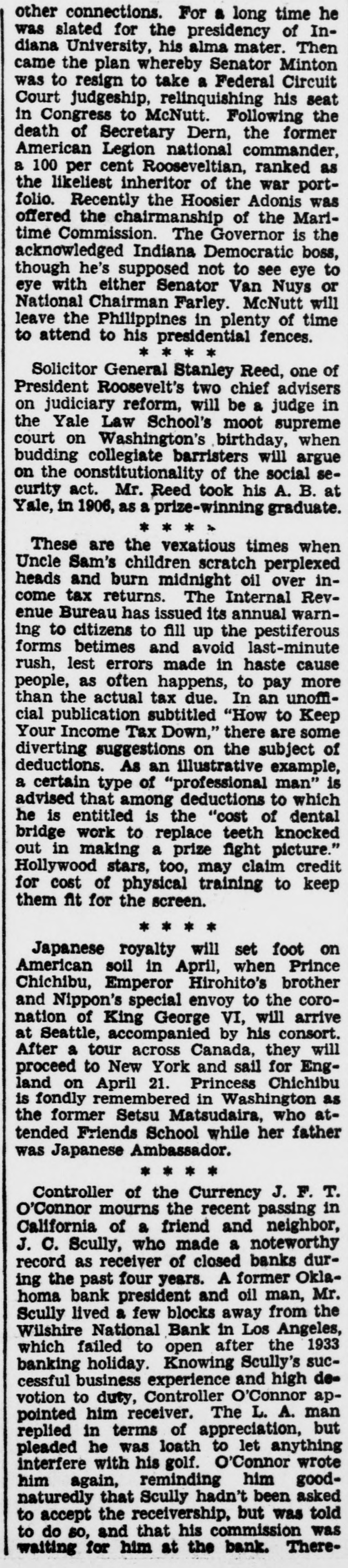
Wilshire National Bank, Los Angeles; which failed to open after the 1933 banking holiday. Knowing Scully's successful business experience and high devotion to duty, Controller O'Connor appointed him receiver. ... Scully ... was told to do so, and that his commission was waiting for him at the bank. (article notes Scully as receiver later).
Source
newspapers

Newspaper Articles (7)

Article Text

SEVENTEEN STATES CHECK RUNS ON BANK Seven More Join Movement to Restrict Withdrawals of Deposited Moneys THREE AND FOUR DAYS TO BE TEMPORARY HOLIDAYS Situation Easing in Some States as Legislatures Planned Curb Laws Mississippi, Arizona, Nevada and in Oregon today joined the states. which there are limitations placed on the withdrawals of deposits from banks. in which limitations on withdrawals now exist. The proclamation of Gov. Ralph at San Francisco makes mandatory the closing of California banks (or three-day period ending Saturday The three-day holiday called Gov. Murray in Oklahoma for same period also is mandatory. The of Gov. Allen of Louisiana provides for the sation until the end of the week "all public business including Banks and other public enterprises." Mississippi the decree of state banking called only (Continued On Page Two)


Article Text

BANK CLOSING'S EFFECTS Thousands of theories are being voiced as to the causes and effects of the closing Thursday morning of all of the banks in California. Wise men who stand high in the financial world differ in their opinions on these two angles of the great crisis, so one guess is just about as good as another. But the fact remains that the three-days' holiday of closed banks will surely prevent any "run" on the banks which might come at this time. And "run" on bank is the worst thing that can happen, financially, to any community. It means, if carried far enough, that the bank must close permanently, and that means loss to the depositors as whole and the men who stand back of the bank stockholders. By the time the banks re-open next Monday it is thought the frenzy of withdrawal will have been overcome either in the minds of the people or through legislation making it compulsory. Other states that have declared similar banking holidays are now re-opening their banks with satisfactory results and business resumed in the normal channels. Let us have faith that this will be the outcome in California. Meanwhile, efforts to continue trade and business activity as usu will be made in Escondido. with an exchange worked out on confidence in the integrity of the merchants, business men and all citizens whose promises to pay are regarded as "good." So the whole thing sifts down to the matter of confidence, which is really the ultimate need and necessity of the situation, all the way from Escondido to New York, or even to Washington.


Article Text

California Bank Extended Holiday Until Thursday Few Institutions Expected to Open Tuesday Morning SAN FRANCISCO, March Federal Reserve Bank of San Francisco closed today for the duration of California's banking holiday. Rolph tonight proclaimed an extension of the Callfornia bank holiday until Thursday, March The new three-day period will begin Monday with general holiday similar to the one now in effect. the governor said. The holiday Tuesday and Wednesday will be effective under terms of the special holiday bill passd today by the legislature. Provisions of the bill affect only banks and permit them to open or remain closed, it was explained. The action was taken by the governor after the assembly had approved the special holiday bill by vote of 54 or by exactly the required two-thirds vote. The senate passed the measure with only one opposition vote. The holiday extension will be fective for the three-day period re. gardless of what action is taken on specific bank bill now before the legislature, the governor said. Action on this measure was delayed until Monday. SAN FRANCISCO, March officials were bit puzzled tonight as they tried to determine course of action to follow Tuesday, when "special holiday," proclaimed by Governor Rolph, becomes effective. Under bill passed by the state legislature late today, the governor was permitted to proclaim special as well as general holidays. The banking moratorium was extended until March with the understanding that Monday would be general and Tuesday and Wednesay a cial holiday On special holiday banks may close or be opened as their officers desire. It was believed some banks would open Tuesday and Wednesday while most of them would remain closed until the legislature approves bill permitting restriction of withOfficials of the Bank of America discussed the situation tonight but said they probably would not reach decision or have an announcement to make until Monday. Wells Fargo Bank and Trust Company officials were understood to be desirous of opening Directors of other banks preferred to follow along with the majority and wait for some protective legislation.


Article Text

BUSINESS CONDITIONS IN 12TH DISTRICT Banking developments in the 12th district, as in the United States generally, were of dominant importance during late February and the first half of March.- No outstanding changes in the general business or financial situation had been apparent during the first six weeks of the year, although the failure of two rather large and several smaller banks in January had been followed by withdrawals of deposits from other banks. About the time that the force of this adverse influence appeared to be coming to an end, however, widespread publicity given to the Michigan banking moratorium and to other unfavorable banking situations began to have an effect in the 12th district, and immediately following announcement of banking holidays or restrictions in other eastern states on February 25 a substantial run on California banks developed. This relatively heavy run lasted for three days -February 27, February 28 and March 1-when it was brought to an end by a proclamation of the governor of California closing all banks in the state for a three-day period. This action in California was followed by runs on banks in other far western states and by March 3 emergency banking restrictions had been placed in effect in all 12th district states. Withdrawal of currency during the week ending March 1, while at a re. cord rate, was SO short-lived that its effect upon district banks deposits was relatively small. Currency payments by banks to depositors were about 30 million dollars during the week ending March 1, compared with deposits in those banks of considerably more than three billion dollars at the beginning of this year. Banks met the unusual demand for currency by borrowing from the Federal Reserve bank of San Francisco and by drawing upon their reserve balances, which had been built up during the first half of February through transfers of funds from other parts of the United States. Reopening of banks under licenses issued by the secretary of the treasury and by state authorities commenced on March 13 and proceeded 20 most 12th district banks had resumed customary operations, although a good many were either in the hands of conservators or had been closed for liquidation. Currency which had been withdrawn prior to the closing of banks on March 2 was redeposited in large amounts between March 13 and March 20 and considcrably more gold coin was turned in to the Federal Reserve bank of San Francisco than had been withdrawn from January 1 to March 4. 1933. Redeposited currency was sent in to the reserve bank to repay borrowings and to increase reserve balances. Volume of production was slightly smaller in February than in January. Department store sales and intercoastal trafic through the Panama canal increased, but the number of cars of freight loaded on district railroads during the month decreased. Other trade measures changed little. Petroleum production during February approximated that of the preceding month. The cut of lumber declined contrary to the seasonal movement and the volume of engineering construction decreased sharply. Employment conditions remained about the same in February as in January. Commodity prices declined slightly during February, but advanced considerably during and immediately following the banking holiday in March. Non-statistical reports inicate that the banking restrictions during the first half of March reduced business activity. particularly retail sales volume. The engagement of Miss Edna May Bradbury and Willis Cruse has been anounced. Miss Bradbury, laughter of Mr. and Mrs. Lou Bradbury. was the incentive for a surprise party one recent evening given by a number of friends. During the evening she was presented with a shower of gifts for her new home.


Article Text

Bank Receiver Notes Boost in Southland Realty Seaside National Liquidator Encouraged by Number of Inquiries. Improvement in the Southern California real estate market in the last sixty days was reported this morning by J. C. Scully, receiver of the Seaside National Bank, who is directing liquidation of that institution. "I am encouraged by the number of inquiries we have received since January 1 regarding the acquisition of property held by the bank," Scully said. "I believe that we have had more bona fide inquiries since the first of the year than were received in the entire preceding year. It is a hopeful sign." Scully, who took over the receivership of Seaside National of this city and the First National Bank of Newport on the retirement of C. E. Walles, January 1, has had many years of experience in the banking business and in handling the affairs of insolvent financial institutions. Scully for the last year has been receiver also for the Wilshire National of Los Angeles and the First National Bank of San Gabriel. Evidence of his ability in handling liquidations is found in the fact that the Wilshire institution has paid 65 per cent in dividends in the last year. The San Gabriel Bank has paid back 40 per cent to depositors and another dividend is expected within ninety days. Scully is a native of Oklahoma, but has been a resident of Southern California sixteen years. He engaged in banking in Oklahoma as well as having substantial oil interests there. The Seaside National, which closed its doors three years ago, has paid out 67 1/2 per cent in dividends to depositors. K. J. Eriksmoen, who has assisted in the liquidation of twenty-five financial institutions in his career, is assisting Scully, in the capacity of chief clerk.

Article Text

Bank Depositors to Get Dividend Depositors of the First National Bank of San Gabriel who have filed claims were notified yesterday by J. C. Scully, receiver, that checks were on hand covering 25 per cent of their claims. A previous liquidating dividend of 40 per cent brings total dividends now to 65 per cent. Mr. Scully took charge of the bank as receiver March 27, 1934. He is also receiver for three other banks: Wilshire National Bank, Los Angeles; Seaside National Bank, Long Beach, and First National Bank, Newport.


Article from Evening Star, February 19, 1937

Click image to open full size in new tab

Article Text

other connections. For a long time he was slated for the presidency of Indiana University, his alma mater. Then came the plan whereby Senator Minton was to resign to take a Federal Circuit Court judgeship, relinquishing his seat in Congress to McNutt. Following the death of Secretary Dern, the former American Legion national commander, a 100 per cent Rooseveltian, ranked as the likeliest inheritor of the war portthe Hoosier Adonis was The Indiana time acknowledged boss, he's supposed not see though folio. offered Commission. Recently the chairmanship Democratic Governor to of the Nuys eye is Mari- the or to eye with either Senator Van National Chairman Farley. McNutt will leave the Philippines in plenty of time to attend to his presidential fences. * * * * Solicitor General Stanley Reed, one of President Roosevelt's two chief advisers on judiciary reform, will be a judge in Law court the Yale on Washington's School's birthday, moot supreme when budding collegiate barristers will argue on the constitutionality of the social security act. Mr. Reed took his A. B. at Yale, in 1906, as a prize-winning graduate. * * * 4 These are the vexatious times when Uncle Sam's children scratch perplexed heads and burn midnight oil over income tax returns. The Internal Revenue Bureau has issued its annual warning to citizens to fill up the pestiferous forms betimes and avoid last-minute rush, lest errors made in haste cause people, as often happens, to pay more than the actual tax due. In an unoffcial publication subtitled "How to Keep Your Income Tax Down," there are some on the diverting suggestions subject example, of deductions. As an illustrative a certain type of "professional man" is advised that among deductions to which he is entitled is the "cost of dental bridge work to replace teeth knocked out in making a prize fight picture." Hollywood stars, too, may claim credit for cost of physical training to keep them fit for the screen. Japanese royalty will set foot on American soil in April, when Prince Chichibu, Emperor Hirohito's brother envoy and Nippon's special to will the arrive coronation of King George VI, at Seattle, accompanied by his consort. After a tour across Canada, they will proceed to New York and sail for England on April 21. Princess Chichibu is fondly remembered in Washington as the former Setsu Matsudaira, who attended Friends School while her father was Japanese Ambassador. * * Controller of the Currency J. F. T. O'Connor mourns the recent passing in California of a friend and neighbor, who made a noteworthy of closed record J. C. Scully, as receiver banks Okla- during the past four years. A former homa bank president and oil man, Mr. Scully lived a few blocks away from the Wilshire National Bank in Los Angeles, which failed to open after the 1933 banking holiday. Knowing Scully's successful business experience and high devotion to duty, Controller O'Connor appointed him receiver. The L. A. man replied in terms of appreciation, but pleaded he was loath to let anything interfere with his golf. O'Connor wrote him again, reminding him goodnaturedly that Scully hadn't been asked to accept the receivership, but was told to do so, and that his commission was waiting for him at the bank. There-