gemini-3-flash-preview (chosen from majority vote of a three-model LLM ensemble)
Short Digest
584961999a9b7396
Response Measures
None
Description
The bank experienced a run in 1897 but remained open; the final closure in 1899 was a direct suspension by the state examiner without a contemporaneous run.
Events (4)
1.January 4, 1897Run
Cause
Local Banks
Cause Details
Suspension of the Germania and Allemannia banks in St. Paul.
Measures
Invoked sixty and ninety days' notice of withdrawals clause.
Newspaper Excerpt
The suspension of the Germania and Allemannia banks caused something of a run, as it is always the case, on the savings banks.
Source
newspapers
2.July 7, 1899Suspension
Cause
Government Action
Cause Details
Closed by State Bank Examiner Pope due to excessive real estate holdings and insolvency.
Newspaper Excerpt
The Savings Bank of St. Paul... has been compelled to close its doors. The bank was closed by State Bank Examiner Pope
Source
newspapers
3.July 25, 1899Other
Newspaper Excerpt
The plan is to petition the court to allow the bank to go into voluntary liquidation... This plan will permit the bank to open its doors and receive new deposits, and avoid the expense of a receivership. In short the plan is more for a continuance than a reorganization
Source
newspapers
4.August 21, 1899Receivership
Newspaper Excerpt
Depositors of Savings Bank of St. Paul Will please leave their pass books at the bank to be balanced. Edward J. Hodgson, Receiverb
Source
newspapers
Newspaper Articles (24)
1.January 5, 1897The Saint Paul GlobeSaint Paul, MN
Click image to open full size in new tab
Article Text
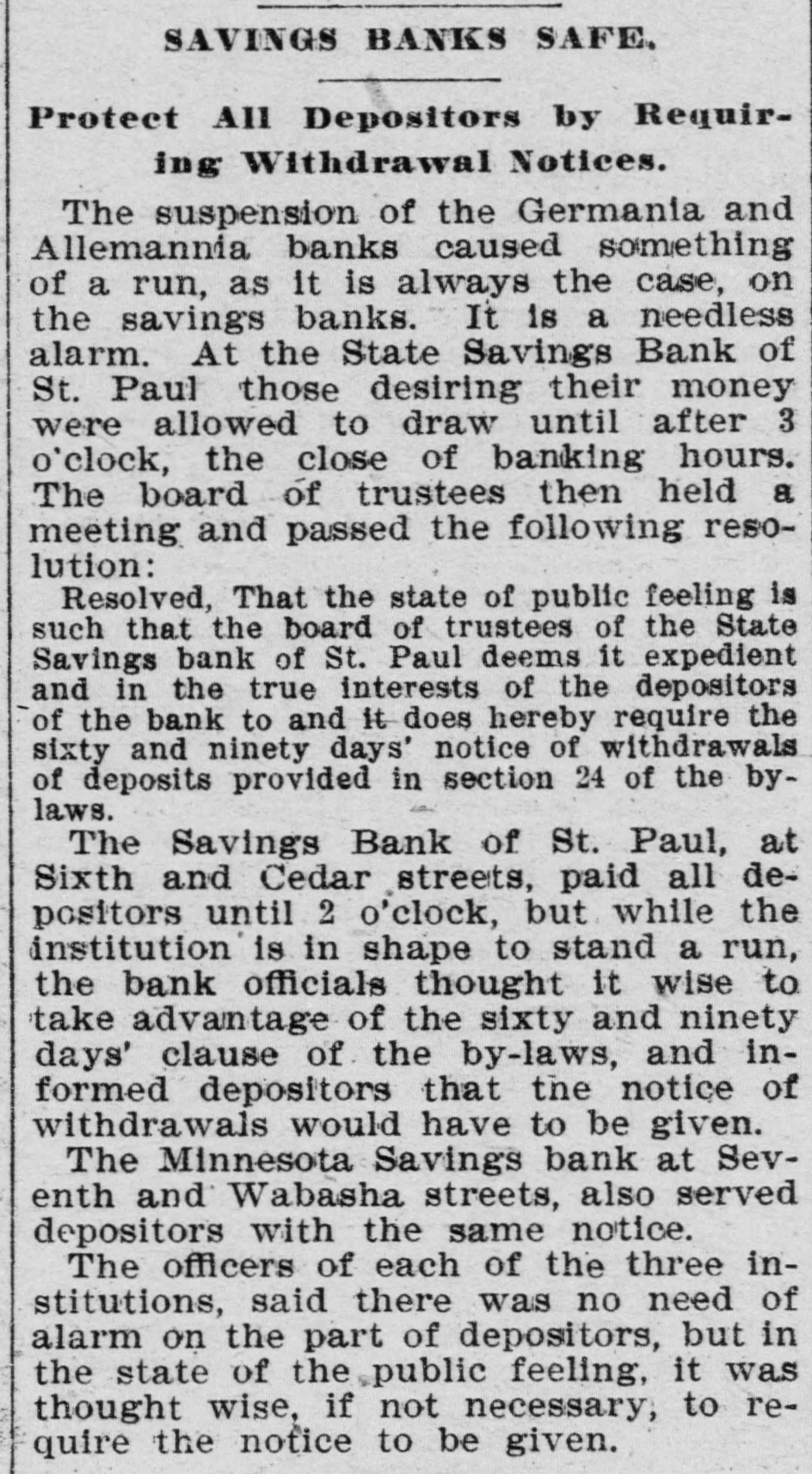
SAVINGS BANKS SAFE. Protect All Depositors by Requiring Withdrawal Notices. The suspension of the Germania and Allemannia banks caused something of a run, as it is always the case, on the savings banks. It is a needless alarm. At the State Savings Bank of St. Paul those desiring their money were allowed to draw until after 3 o'clock, the close of banking hours. The board of trustees then held a meeting and passed the following resolution: Resolved, That the state of public feeling is such that the board of trustees of the State Savings bank of St. Paul deems it expedient and in the true interests of the depositors of the bank to and it does hereby require the sixty and ninety days' notice of withdrawals of deposits provided in section 24 of the bylaws. The Savings Bank of St. Paul, at Sixth and Cedar streets, paid all depositors until 2 o'clock, but while the institution is in shape to stand a run, the bank officials thought it wise to take advantage of the sixty and ninety days' clause of the by-laws, and informed depositors that the notice of withdrawals would have to be given. The Minnesota Savings bank at Seventh and Wabasha streets, also served depositors with the same notice. The officers of each of the three institutions, said there was no need of alarm on the part of depositors, but in the state of the public feeling, it was thought wise, if not necessary, to require the notice to be given.
2.July 8, 1899The Labor WorldDuluth, MN
Click image to open full size in new tab
Article Text
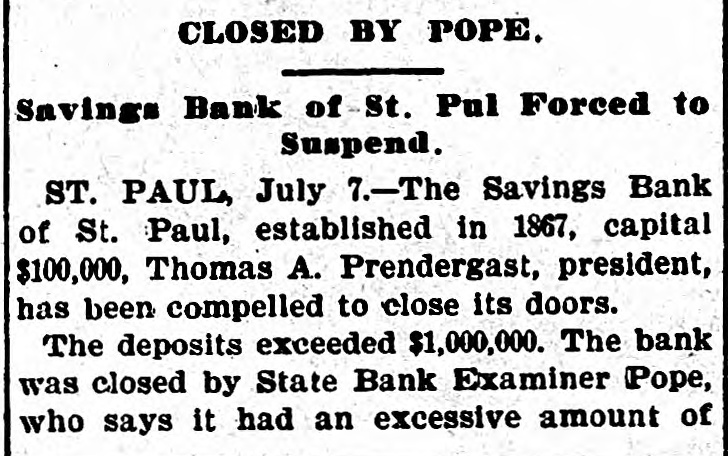
CLOSED BY POPE. Savings Bank of St. Pul Forced to Suspend. ST. PAUL, July 7.-The Savings Bank of St. Paul, established in 1867, capital $100,000, Thomas A. Prendergast, president, has been compelled to close its doors. The deposits exceeded $1,000,000. The bank was closed by State Bank Examiner Pope, who says it had an excessive amount of
3.July 8, 1899The Saint Paul GlobeSaint Paul, MN
Click image to open full size in new tab
Article Text
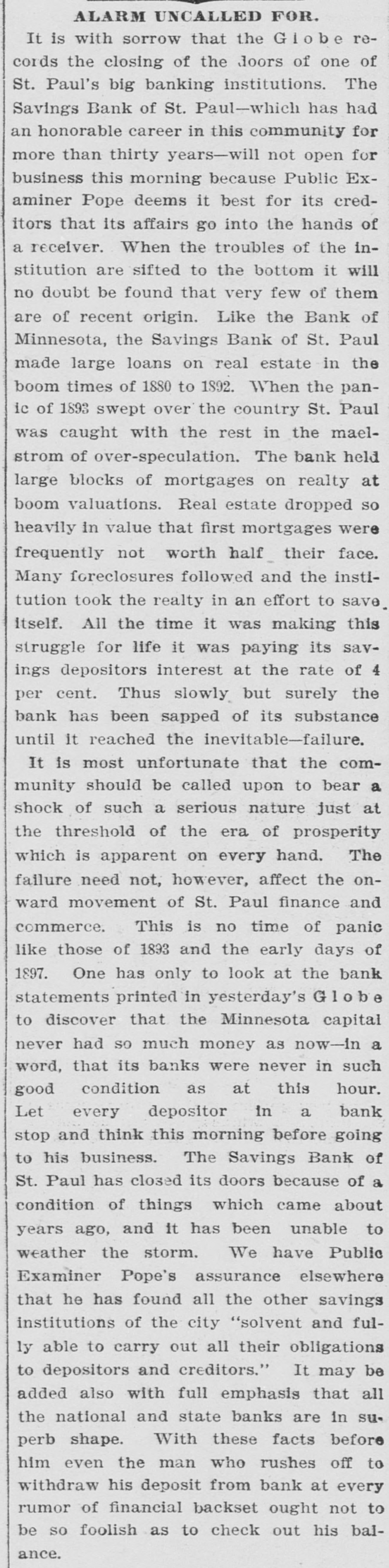
ALARM UNCALLED FOR. It is with sorrow that the Globe records the closing of the doors of one of St. Paul's big banking institutions. The Savings Bank of St. Paul-which has had an honorable career in this community for more than thirty years-will not open for business this morning because Public Examiner Pope deems it best for its creditors that its affairs go into the hands of a receiver. When the troubles of the institution are sifted to the bottom it will no doubt be found that very few of them are of recent origin. Like the Bank of Minnesota, the Savings Bank of St. Paul made large loans on real estate in the boom times of 1880 to 1892. When the panic of 1893 swept over the country St. Paul was caught with the rest in the maelstrom of over-speculation. The bank held large blocks of mortgages on realty at boom valuations. Real estate dropped SO heavily in value that first mortgages were frequently not worth half their face. Many foreclosures followed and the institution took the realty in an effort to save Itself. All the time it was making this struggle for life it was paying its savings depositors interest at the rate of 4 per cent. Thus slowly but surely the bank has been sapped of its substance until it reached the inevitable-failure. It is most unfortunate that the community should be called upon to bear a shock of such a serious nature just at the threshold of the era of prosperity which is apparent on every hand. The failure need not, however, affect the onward movement of St. Paul finance and commerce. This is no time of panic like those of 1893 and the early days of 1897. One has only to look at the bank statements printed in yesterday's Globe to discover that the Minnesota capital never had so much money as now-in a word, that its banks were never in such good condition as at this hour. Let every depositor in a bank stop and think this morning before going to his business. The Savings Bank of St. Paul has closed its doors because of a condition of things which came about years ago, and It has been unable to weather the storm. We have Public Examiner Pope's assurance elsewhere that he has found all the other savings institutions of the city "solvent and fully able to carry out all their obligations to depositors and creditors." It may be added also with full emphasis that all the national and state banks are in superb shape. With these facts before him even the man who rushes off to withdraw his deposit from bank at every rumor of financial backset ought not to be so foolish as to check out his balance.
4.July 15, 1899Arizona RepublicanPhoenix, AZ
Click image to open full size in new tab
Article Text
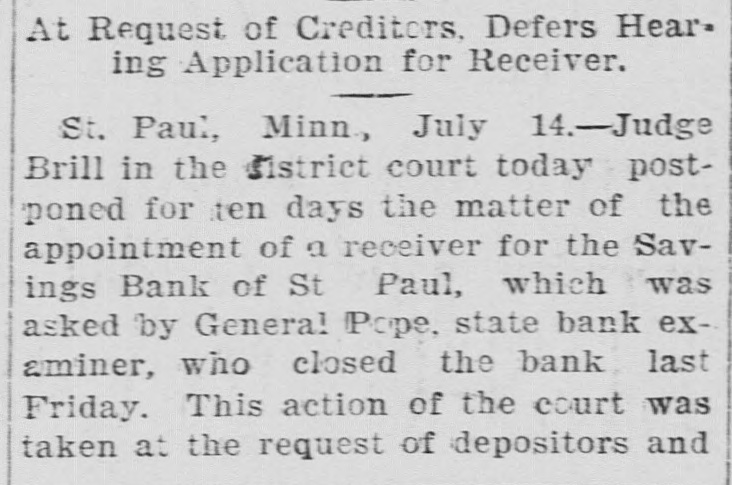
At Request of Creditors. Defers Hearing Application for Receiver. St. Paul, Minn, July 14.-Judge Brill in the district court today postponed for ten days the matter of the appointment of a receiver for the Savings Bank of St Paul, which was asked by General Pope, state bank examiner, who closed the bank last Friday. This action of the court was taken at the request of depositors and
5.July 16, 1899The Saint Paul GlobeSaint Paul, MN
Click image to open full size in new tab
Article Text
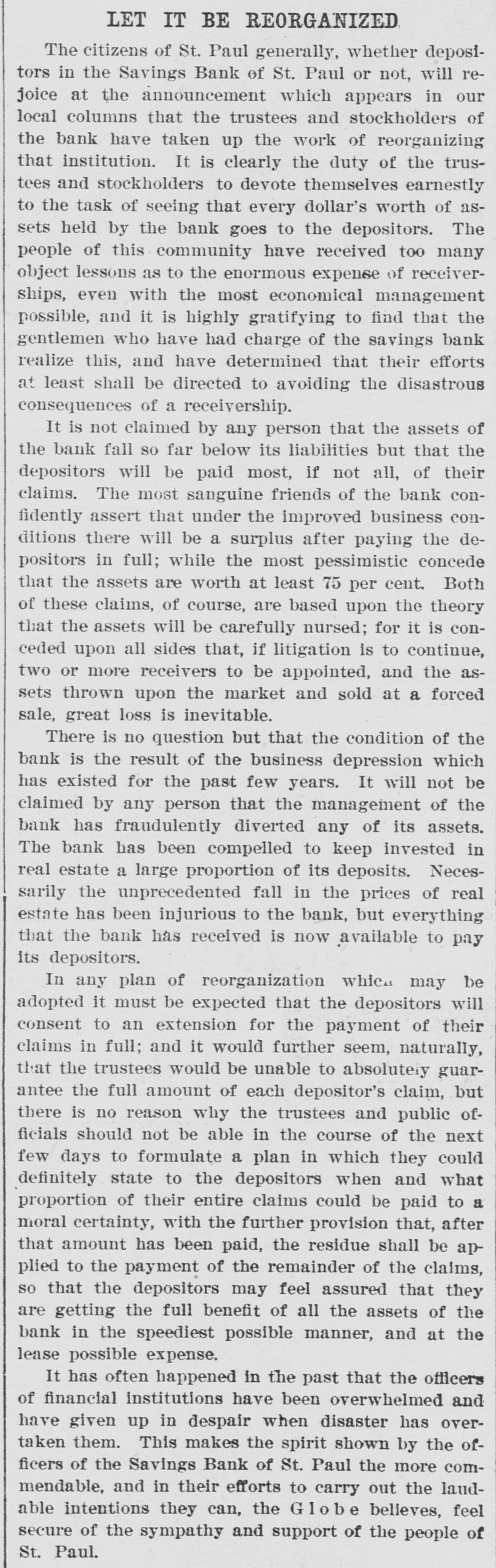
LET IT BE REORGANIZED The citizens of St. Paul generally, whether depositors in the Savings Bank of St. Paul or not, will rejoice at the announcement which appears in our local columns that the trustees and stockholders of the bank have taken up the work of reorganizing that institution. It is clearly the duty of the trustees and stockholders to devote themselves earnestly to the task of seeing that every dollar's worth of assets held by the bank goes to the depositors. The people of this community have received too many object lessons as to the enormous expense of receiverships, even with the most economical management possible, and it is highly gratifying to find that the gentlemen who have had charge of the savings bank realize this, and have determined that their efforts at least shall be directed to avoiding the disastrous consequences of a receivership. It is not claimed by any person that the assets of the bank fall SO far below its liabilities but that the depositors will be paid most, if not all, of their claims. The most sanguine friends of the bank confidently assert that under the improved business conditions there will be a surplus after paying the depositors in full; while the most pessimistic concede that the assets are worth at least 75 per cent. Both of these claims, of course, are based upon the theory that the assets will be carefully nursed; for it is conceded upon all sides that, if litigation is to continue, two or more receivers to be appointed, and the assets thrown upon the market and sold at a forced sale, great loss is inevitable. There is no question but that the condition of the bank is the result of the business depression which has existed for the past few years. It will not be claimed by any person that the management of the bank has fraudulently diverted any of its assets. The bank has been compelled to keep invested in real estate a large proportion of its deposits. Necessarily the unprecedented fall in the prices of real estate has been injurious to the bank, but everything that the bank has received is now available to pay its depositors. In any plan of reorganization which may be adopted it must be expected that the depositors will consent to an extension for the payment of their claims in full; and it would further seem, naturally, that the trustees would be unable to absolutely guarantee the full amount of each depositor's claim, but there is no reason why the trustees and public officials should not be able in the course of the next few days to formulate a plan in which they could definitely state to the depositors when and what proportion of their entire claims could be paid to a moral certainty, with the further provision that, after that amount has been paid, the residue shall be applied to the payment of the remainder of the claims, so that the depositors may feel assured that they are getting the full benefit of all the assets of the bank in the speediest possible manner, and at the lease possible expense. It has often happened in the past that the officers of financial institutions have been overwhelmed and have given up in despair when disaster has overtaken them. This makes the spirit shown by the officers of the Savings Bank of St. Paul the more commendable, and in their efforts to carry out the laudable intentions they can, the Globe believes, feel secure of the sympathy and support of the people of St. Paul.
6.July 20, 1899The Princeton UnionPrinceton, MN
Click image to open full size in new tab
Article Text
IT is bad policy, on general principles, to place a bank in the hands of a receiver so long as there is any possibility of its meetings its obligations through the ordinary methods. A receivership is a very expensive experiment to begin with, and the fact that a receiver is necessary advertises the embarassment of the bank and depreciates the value of its assets to an extent that renders it extremely difficult to get even approximately the value of the bank's holdings. There is hardly a bank in the State, no matter what its financial condition, but has large real estate securities, which, if forced to immediate sale, would bring less than the face of the notes against it, even though the real estate itself might be intrinsically worth the face of the note. Whatever the outcome of the closing of the St. Paul Savings Bank there must be heavy losses resulting to the depositors through the precipitate action of the public examiner in closing the bank, appointing a receiver and forcing a sale of the assets. It looks as though the public examiner had acted more with reference to the political than the financial interests of those involved in the muddle.
7.July 21, 1899The Saint Paul GlobeSaint Paul, MN
Click image to open full size in new tab
Article Text
DOLLAR FOR DOLLAR THAT IS WHAT DEPOSITORS OF ST. PAUL SAVINGS BANK EXPECT SENATE CHAMBER MEETING Committee Not Ready to Make Full Report, as the Time Allowed Was Too Short-It Is Demonstrated That Affairs of the Bank Are in Such Shape That the Appointment of a Receiver Can Be Avoided.
8.July 21, 1899The Saint Paul GlobeSaint Paul, MN
Click image to open full size in new tab
Article Text
# SAVINGS BANK OF ST. PAUL
## How the Appointment of a Receiver Can Be Avoided.
Three hundred depositors of the Savings Bank of St. Paul met in the senate chamber at the capitol last night and listened to a report of the general committee appointed to investigate the bank's affairs. J. J. Egan presided and opened the meeting with a review of the action taken by the depositors at different times since the failure. Little business was done and the reports submitted were not complete, as the committee had found that their time was too short to prepare a full statement. Arrangements were made for a meeting on the evening of Aug. 11, at which time printed summaries of the reports of the depositors and courts' committees will be distributed and detailed information given of the work of investigation.
The main interest of the meeting centered about the report of the committee appointed on July 9 to investigate the bank's books; real estate, commercial paper, tax certificates and other assets, with a view of presenting the depositors with an accurate statement of the affairs of the insolvent institution. As chairman of the committee, J. E. Stryker gave the following report.
"Your committee have found that in the time at their disposal they could not prepare more than a partial report. We have made considerable effort to get at the facts, but the magnitude of the undertaking prevented its completion before this meting. After considering the task before us the committee was divided into four subcommittees as follows:
A committee to investigate the bank's real estate. A committee to examine the commercial paper of the institution not secured by real estate. A committee to look after the remaining items of assets, such as cash on hand, stocks and bonds and other matters.
The real estate committee found that owing to the number of pieces of real estate held by the bank, a thorough investigation would be impossible in the time at their disposal. They investigated partially, but are as yet unable to give a full report. Twelve different pieces of property were looked over and estimates made and these were compared with the estimates of the court's committee, which is engaged on the same work. The results were satisfactory. Of the other subcommittees, the one appointed to look after the bank's commercial paper found it difficult to complete their work and ask for additional time. The committee on tax certificates meets with the same difficulty, as it cannot readily secure necessary data.
The work of the committees, however, incomplete, has demonstrated, however, that the affairs of the bank are in such a condition that a receivership may be avoided with careful management. Present conditions are much more favorable than at first thought. Of the item of stocks and bonds it has been ascertained that the book figures, $93,000, are correct. This amount can be realized and the committee already has an offer to take the item for this amount. The gentleman who makes it will trust to the profits above this figure from the disposition of these assets as his commission. Of the commercial paper, the committee have been unable to complete a report. It is certain that this item will show some loss, how much cannot be said. There will also be some loss on the tax certificates. The committee has worked in conjunction with the committee of the court, which has gone through three-fourths of the real estate items, and would advise the depositors that its final report can be depended on for an exact statement of facts.
No one should become panicky yet. The showing so far is more favorable than anticipated. The committee especially advises against disposing of certificates of deposit to Minneapolis or other parties at a discount. If the depositors do not receive dollar for dollar they will obtain nearly that. Between two-thirds and three-fourths of the assets are contained in the items of real estate and real estate mortgages. Mr. Stryker was asked for an opinion as to what amount the commercial paper would bring. He replied that he was unable to express an opinion for the committee, but personally considered that it would be worth about $110,000.
Since the meeting held in Labor hall Judge Brill has granted the additional twenty-five days before taking final action, which was asked for by the depositors' committee. He has also instructed the court committee to file its report within five days of the expiration of the period in order to give the depositors time to review the report and make a statement before a depositors' meeting. M. R. Prendergast opened a short discussion with a suggestion to the stockholders that if any scheme of reorganization is effected a committee of depositors be appointed to place a valuation on all mortgaged property and all real estate owned by the bank.
"After this is done," he explained, "the depositors should be allowed to buy in real estate with their deposits and in this way utilize this item of assets. I would also suggest that since the depositors have been receiving 3 and 4 per cent on their money for the past few years they allow this committee to rebate this amount for two years and deduct it with the understanding that if the bank pays dollar for dollar they receive their interest before other claims are paid."
The only discussion out of the routine was occasioned by a motion of P. J. McDonald that before the next meeting, to be held Aug. 11, the depositors' committee prepare a printed statement of the report of the court committee for the use and information of the depositors. This raised a storm of criticism and was not clearly understood. C. W. Griggs restored order by explaining that a summarized report of the work of the court and depositors' committee would answer the purpose. A motion to the effect that such a statement be printed was carried.
9.July 25, 1899The Saint Paul GlobeSaint Paul, MN
Click image to open full size in new tab
Article Text
A meeting of the trustees of the Savings Bank of St. Paul was held yesterday afternoon and a plan talked over which has the approval of Bank Examiner Pope and will obviate the necessity of the appointment of a receiver. Another meeting of the trustees will be held this morning at 11 o'clock, and the minor details of the plan decided upon. The plan is to petition the court to allow the bank to go into voluntary liquidation, with four of the trustees to be elected by the full board to have charge of the affairs of the institution. This plan will permit the bank to open its doors and receive new deposits, and avoid the expense of a receivership. In short the plan is more for a continuance than a reorganization, and as it appears to be the best plan that has been submitted, and is for the interest of all parties concerned, it will doubtless be allowed by the court, if the necessary number of depositors' signatures is secured. A paper will be immediately circulated among those holding pass books for their signatures, and if 85 per cent of the depositors favor this course the affairs of the bank will be wound up by liquidation. The following, without any of the smaller details, is the plan which has been submitted to the bank examiner and which has been approved and will doubtless be adopted at today's meeting and submitted to the depositors: First-The immediate payment of 15 per cent on all deposits. Second-The payment of 60 per cent within the next three years, or 20 per cent in each of the years, 1900, 1901 and 1902; 20 per cent to bear interest at 2 per cent from July 1, 1900. Third-The balance of the 25 per cent in residue certificates, to be payable without interest, July 1, 1903. All of the assets of the bank and the earnings of the future to be appropriated to the payment of these certificates. Fourth-The deposits received in the future, to be invested separately, and not to be used under any circumstances for the payment of old indebtedness. Fifth-The stockholders to deposit their entire holdings with the state bank examiner, with the stipulation that in so doing the liability of stockholders is not waived in the least. Sixth-No new stock is to be issued from now on. Seventh-The bank hereafter is to do purely a savings bank business and no commercial banking business. Eighth-During the continuance of the agreement, the bank examiner is to have the right, after consulting with the creditors, to appoint four of the trustees of the bank. Gen. Pope was seen yesterday regarding the matter and said, "The plan has the approval of this office, and will doubtless be sanctioned by the depositors. The payment of 15 per cent. of all claims against the bank includes interest up to July 1. The bank, if reopened for the purpose of liquidation, will confine its business entirely to straight savings bank business, and no commercial transactions will be permitted. In this way the depositors will get much more out of the assets than if a receiver was appointed. The money deposited with the bank, if it is reopened under the proposed plan, will be invested under savings bank rules. The plan leaves the nomination of the four trustees to have charge of the bank with the public examiner, and men will be nominated who will represent the depositors." Thomas D. O'Brien, who represents the bank, was seen yesterday and had little to say regarding the plan, except that he thought no doubt it would be adopted, and said he thought it for the best ininterests of all concerned. There are fully 5,000 deposiors and if the plan goes through a meeting will be called to explain the plan in detail. Something more than a rough draft will be prepared at today's meeting of the trustees and the matter put in greater detail.
10.July 27, 1899The Princeton UnionPrinceton, MN
Click image to open full size in new tab
Article Text
THERE is one significant fact in connection with the closing of the Savings Bank of St. Paul, and the squabble over the receivership, and that is of the 500 or more depositors no one wants a receiver appointed. Those depositors have probably been reading up on receivers. In the sense in which that term is customarily used the receiver, doesn't "do a thing" to the depositors and the deposits.
11.August 2, 1899The Redwood GazetteRedwood Falls, MN
Click image to open full size in new tab
Article Text
has been closed by direction of the state bank examiner. Nothing but the most urgent of reasons can jusjustify this proceeding. In most cases it is far preferable for the stock holders of institutions of this character to wind up its affairs under the supervision of its governing board rather than be placed to the extraordinary expense usually attendant upon enforced liquidation. Every one is aware that these expenses are very considerable and indeed oftentimes burdensome. They fall upon a class of men whose trials have been only begun by the suspension and which culminate in the settlement of a final account of the finances of the institution usually allowing large fees to the receiver and his legal advisers. Our experience as a people of late years has been by no means happy in affairs of this kind." * * * Ex-Senator Fuller of the Little Falls Transcript is one of the many editors who believe that the governor and the bank examiner acted unwisely in closing up the Savings Bank of St. Paul. He says: "The closing of the Savings Bank of St. Paul by Public Examiner Pope is strongly denounced by many. A large number of depositors protest against the action. The Pioneer Press is emphatic in claiming that the action of the public examiner was against the interests of the depositors. Gov. Lind and Examiner Pope are blamed with hasty and unwarranted action."
12.August 21, 1899The Saint Paul GlobeSaint Paul, MN
Click image to open full size in new tab
Article Text
Depositors of Savings Bank of St. Paul Will please leave their pass books at the bank to be balanced. Edward J. Hodgson, Receiverb
13.August 22, 1899The Saint Paul GlobeSaint Paul, MN
Click image to open full size in new tab
Article Text
Depositors of Savings Bank of St. Paul Will please leave their pass books at the bank to be balanced. Edward J. Hodgson, Receiver.
14.August 27, 1899The Saint Paul GlobeSaint Paul, MN
Click image to open full size in new tab
Article Text
THEY OWED THE BANK. For That Reason Depositors Could Not Withdraw Money. George E. Snell & Co. appeared before Judge Otis in district court yesterday on an order to show cause why the receiver of the Savings Bank of St. Paul should not turn over to them certain money deposited in the bank on July 7, the day on which the bank examiner assumed control of the institution. The firm had deposited $350 and wanted to come in under the order directing the refunding of the money deposited on the day of the closing. Receiver Hodgson showed the court that the plaintiffs were indebted to the bank in excess of the amonut in question and the order to show cause was dismissed. New York and return $26.50 via the "Soo
15.September 23, 1899The Saint Paul GlobeSaint Paul, MN
Click image to open full size in new tab
Article Text
FOR SALE. I OFFER for sale all the fixtures of the Savings Bank of St. Paul. Apply to Edward J. Hodgson, receiver, St. Paul, Minn.
16.October 8, 1899The Saint Paul GlobeSaint Paul, MN
Click image to open full size in new tab
Article Text
HODGSON'S FIRST. | Receiver of the Savings Bank of St. Paul Files a Report. E. J. Hodgson, as receiver of the Savings Bank of St. Paul, yesterday filed in district court a report of the liabilities of the institution July 7, 1899, the date of suspension. The total liabilities of the bank are $1,071,991.76, made up of the following items:
17.November 19, 1899The Saint Paul GlobeSaint Paul, MN
Click image to open full size in new tab
Article Text
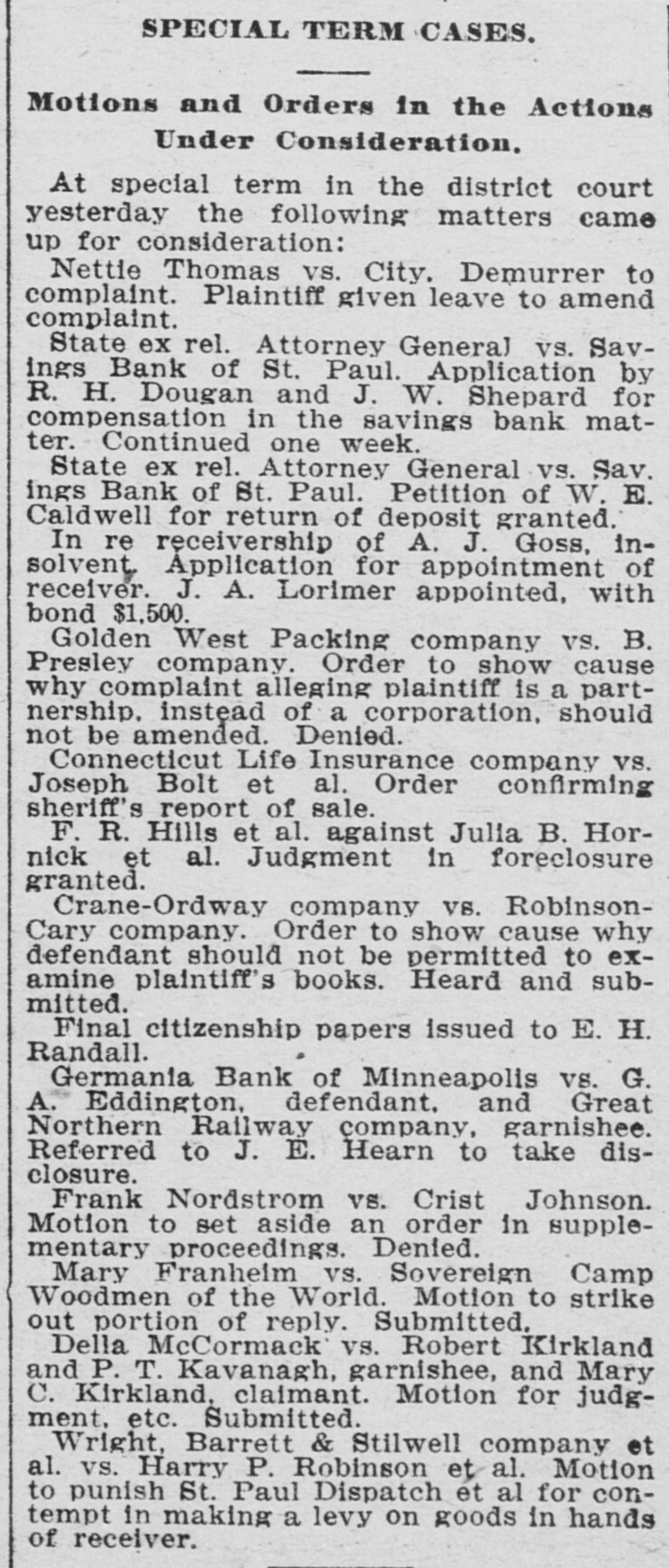
SPECIAL TERM CASES. Motions and Orders in the Actions Under Consideration, At special term in the district court yesterday the following matters came up for consideration: Nettle Thomas vs. City. Demurrer to complaint. Plaintiff given leave to amend complaint. State ex rel. Attorney General vs. Savings Bank of St. Paul. Application by R. H. Dougan and J. W. Shepard for compensation in the savings bank matter. Continued one week. State ex rel. Attorney General vs. Sav. ings Bank of St. Paul. Petition of W. E. Caldwell for return of deposit granted. In re receivership of A. J. Goss, insolvent. Application for appointment of receiver. J. A. Lorimer appointed, with bond $1,500. Golden West Packing company vs. B. Presley company. Order to show cause why complaint alleging plaintiff is a partnership. instead of a corporation, should not be amended. Denied. Connecticut Life Insurance company VS. Joseph Bolt et al. Order confirming sheriff's report of sale. F. R. Hills et al. against Julia B. Hornick et al. Judgment in foreclosure granted. Crane-Ordway company vs. RobinsonCary company. Order to show cause why defendant should not be permitted to examine plaintiff's books. Heard and submitted. Final citizenship papers issued to E. H. Randall. Germania Bank of Minneapolis vs. G. A. Eddington, defendant. and Great Northern Railway company, garnishee. Referred to J. E. Hearn to take disclosure. Frank Nordstrom VS. Crist Johnson. Motion to set aside an order in supplementary proceedings. Denied. Mary Franheim vs. Sovereign Camp Woodmen of the World. Motion to strike out portion of reply. Submitted. Della McCormack vs. Robert Kirkland and P. T. Kavanagh, garnishee, and Mary C. Kirkland, claimant. Motion for judgment, etc. Submitted. Wright, Barrett & Stilwell company et al. vs. Harry P. Robinson et al. Motion to punish St. Paul Dispatch et al for contempt in making a levy on goods in hands of receiver.
18.January 21, 1900The Saint Paul GlobeSaint Paul, MN
Click image to open full size in new tab
Article Text
Notice to the Depositors of the Savings Bank of St. Paul.
The time for filing claims against the said bank expires February 23, 1900.
EDWARD J. HODGSON, receiver.
19.September 1, 1900The Saint Paul GlobeSaint Paul, MN
Click image to open full size in new tab
Article Text
Receiver Sues on a Note. E. J. Hodgson, as receiver of the Savings Bank of St. Paul, has sued Benedict A. Cox on a note for $585.60. Goes to Minneapolis.
20.November 3, 1900The Saint Paul GlobeSaint Paul, MN
Click image to open full size in new tab
Article Text
The receiver of the Savings Bank of St. Paul announces a second dividend to depositors. The Savings Bank of Minnesota, with 2,300 depositors, is apparently a complete wreck, and its officers are still at large.
21.March 26, 1901The Saint Paul GlobeSaint Paul, MN
Click image to open full size in new tab
Article Text
Judge Brill has ordered the receiver of the Savings Bank of St. Paul to pay a dividend of 5 per cent, which depositors can obtain at the offices of the Security Trust company.
22.September 11, 1903The Saint Paul GlobeSaint Paul, MN
Click image to open full size in new tab
Article Text
Notice to creditors of The Savings Bank of St. Paul: Checks in payment of dividend No. 4 are ready for delivery at the office of Security Trust Co. PRESENT PASS BOOKS. EDWARD J. HODGSON, Receiver.
23.May 24, 1904The Saint Paul GlobeSaint Paul, MN
Click image to open full size in new tab
Article Text
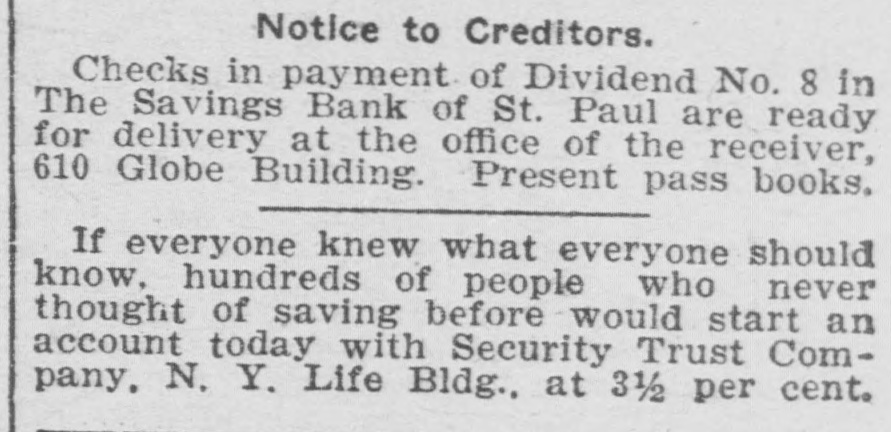
Notice to Creditors. Checks in payment of Dividend No. 8 in The Savings Bank of St. Paul are ready for delivery at the office of the receiver, 610 Globe Building. Present pass books.
24.March 29, 1905The Saint Paul GlobeSaint Paul, MN
Click image to open full size in new tab
Article Text
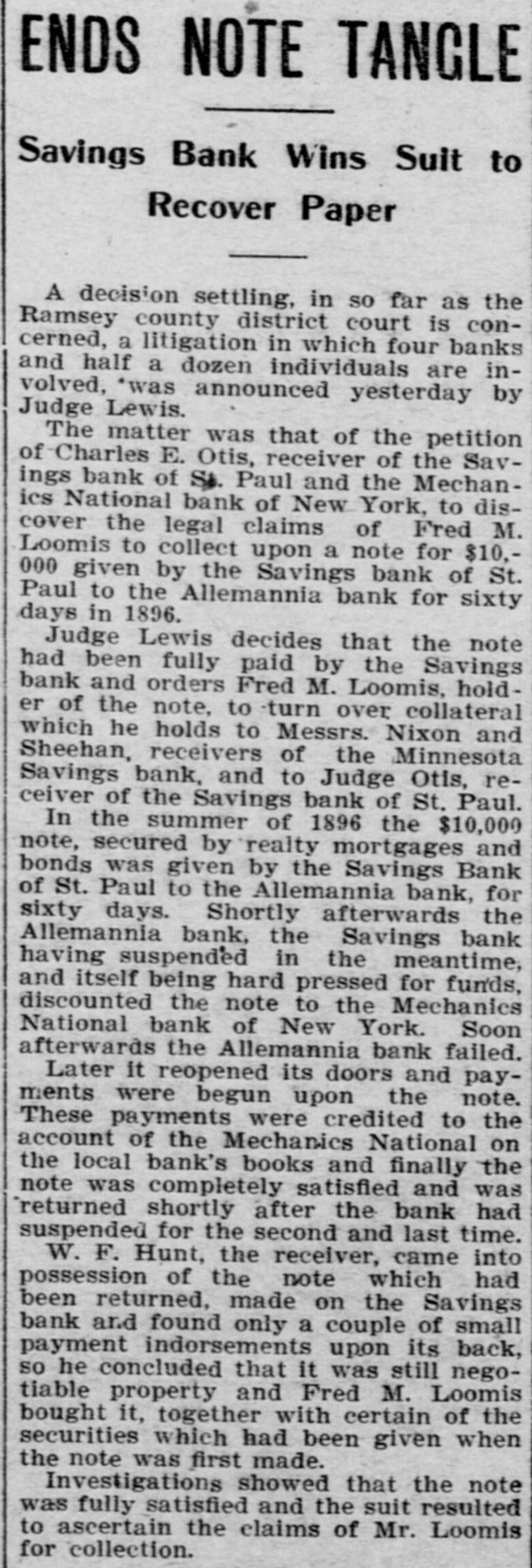
ENOS NOTE TANGLE Savings Bank Wins Suit to Recover Paper A decision settling, in so far as the Ramsey county district court is concerned, a litigation in which four banks and half a dozen individuals are involved, was announced yesterday by Judge Lewis. The matter was that of the petition of Charles E. Otis, receiver of the Savings bank of St. Paul and the Mechanics National bank of New York, to discover the legal claims of Fred M. Loomis to collect upon a note for $10,000 given by the Savings bank of St. Paul to the Allemannia bank for sixty days in 1896. Judge Lewis decides that the note had been fully paid by the Savings bank and orders Fred M. Loomis, holder of the note, to turn over collateral which he holds to Messrs. Nixon and Sheehan, receivers of the Minnesota Savings bank, and to Judge Otis, receiver of the Savings bank of St. Paul. In the summer of 1896 the $10,000 note, secured by `realty mortgages and bonds was given by the Savings Bank of St. Paul to the Allemannia bank, for sixty days. Shortly afterwards the Allemannia bank, the Savings bank having suspended in the meantime, and itself being hard pressed for funds, discounted the note to the Mechanics National bank of New York. Soon afterwards the Allemannia bank failed. Later it reopened its doors and payments were begun upon the note. These payments were credited to the account of the Mechanics National on the local bank's books and finally the note was completely satisfied and was returned shortly after the bank had suspended for the second and last time. W. F. Hunt, the receiver, came into possession of the note which had been returned, made on the Savings bank and found only a couple of small payment indorsements upon its back, so he concluded that it was still negotiable property and Fred M. Loomis bought it, together with certain of the securities which had been given when the note was first made. Investigations showed that the note was fully satisfied and the suit resulted to ascertain the claims of Mr. Loomis for collection.
Bank runs are almost always and everywhere a deterioration of bank fundamentals.
But not for you.
You are the measure-zero exception: great fundamentals, solid bank, and yet the Diamond Dybvig fairy spread its rumor. Depositors woke up. Your collateral was not prepositioned. The Clearinghouse had it for you.
Do not pass Go. Do not collect $200. Go directly to jail… or worse.