First State Bank (Corwith, IA)

Episode Information

Episode UID
135031191295
Episode Type
Suspension โ†’ Closure
Bank Type
state
Bank ID
13503119 hash
Start Date
November 19, 1907
Location
Corwith, Iowa (42.993, -93.957)

Metadata

Model
gpt-5-mini (chosen from majority vote of a three-model LLM ensemble)
Short Digest
2f96dd045a95c230

Response Measures

None

Description

OCR variant of cashier's name appears as Standring/Sandring in sources.

Events (3)

1. November 19, 1907 Suspension
Cause
Bank Specific Adverse Info
Cause Details
Cashier (John Standring/Sandring) absconded after forging/selling forged paper (~$75,000), precipitating liquidation.
Newspaper Excerpt
On November 19, 1907, John Standring disappeared and the bank went into liquidation.
Source
newspapers
2. February 4, 1908 Receivership
Newspaper Excerpt
Receiver W. C. Oelke for the First State bank, on February 4 received a check for $10,000 from the Fidelity Bonding Company of Maryland, the amount for which the absconding Cashier Standring was bonded.
Source
newspapers
3. March 13, 1911 Other
Newspaper Excerpt
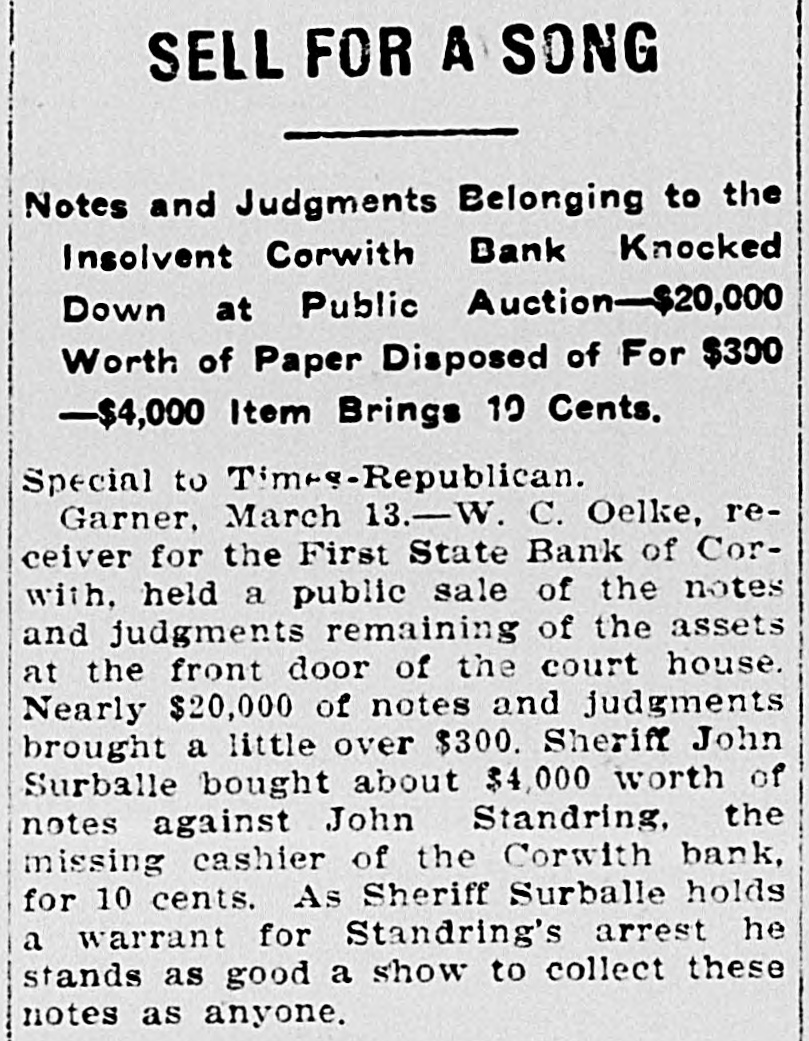
W. C. Oelke, receiver for the First State Bank of Corwith, held a public sale of the notes and judgments remaining of the assets at the front door of the court house. Nearly $20,000 of notes and judgments brought a little over $300.
Source
newspapers

Newspaper Articles (7)

Article from Evening Times-Republican, February 12, 1908

Click image to open full size in new tab

Article Text

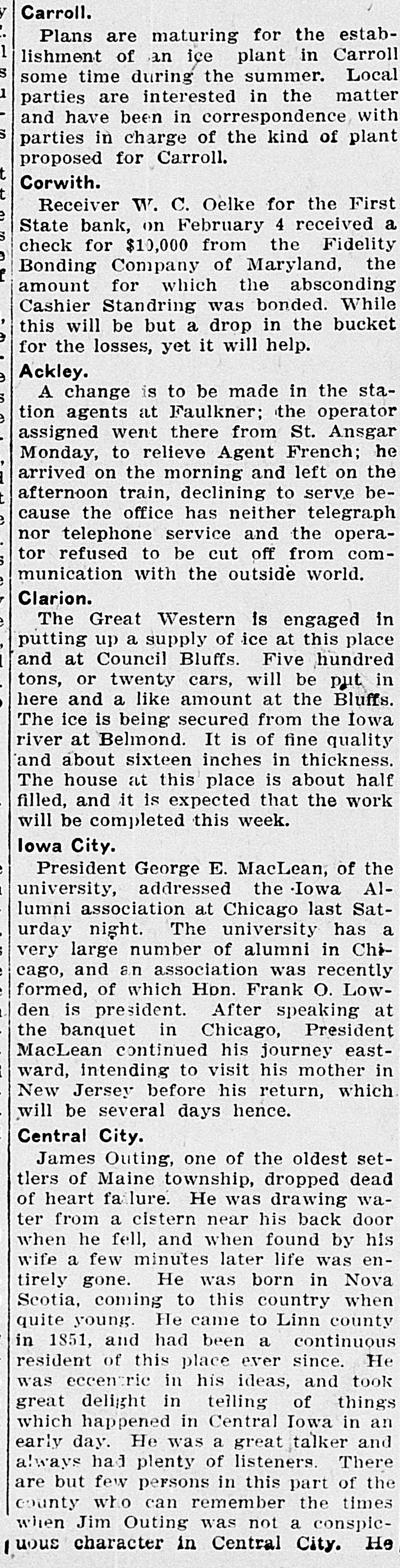
Carroll. Plans are maturing for the establishment of an ice plant in Carroll some time during the summer. Local parties are interested in the matter and have been in correspondence with parties in charge of the kind of plant proposed for Carroll. Corwith. Receiver W. C. Oelke for the First State bank, on February 4 received a check for $10,000 from the Fidelity Bonding Company of Maryland, the amount for which the absconding Cashier Standring was bonded. While this will be but a drop in the bucket for the losses, yet it will help. Ackley. A change is to be made in the station agents at Faulkner; the operator assigned went there from St. Ansgar Monday, to relieve Agent French; he arrived on the morning and left on the afternoon train, declining to serve because the office has neither telegraph nor telephone service and the operator refused to be cut off from communication with the outside world. Clarion. The Great Western is engaged in putting up a supply of ice at this place and at Council Bluffs. Five hundred tons, or twenty cars, will be put in here and a like amount at the Bluffs. The ice is being secured from the Iowa river at Belmond. It is of fine quality and about sixteen inches in thickness. The house at this place is about half filled, and it is expected that the work will be completed this week. lowa City. President George E. MacLean, of the university, addressed the Iowa Allumni association at Chicago last Saturday night. The university has a very large number of alumni in Chicago, and an association was recently formed, of which Hon. Frank O. Lowden is president. After speaking at the banquet in Chicago, President MacLean continued his journey eastward, intending to visit his mother in New Jersey before his return, which will be several days hence. Central City. James Outing, one of the oldest settlers of Maine township, dropped dead of heart failure. He was drawing water from a cistern near his back door when he fell, and when found by his wife a few minutes later life was entirely gone. He was born in Nova Scotia, coming to this country when quite young. He came to Linn county in 1851, and had been a continuous resident of this place ever since. He was eccentric in his ideas, and took great delight in telling of things which happened in Central Iowa in an early day. He was a great talker and always had plenty of listeners. There are but few persons in this part of the county who can remember the times when Jim Outing was not a conspicuous character in Central City. He
Article from Evening Times-Republican, February 15, 1908

Click image to open full size in new tab

Article Text

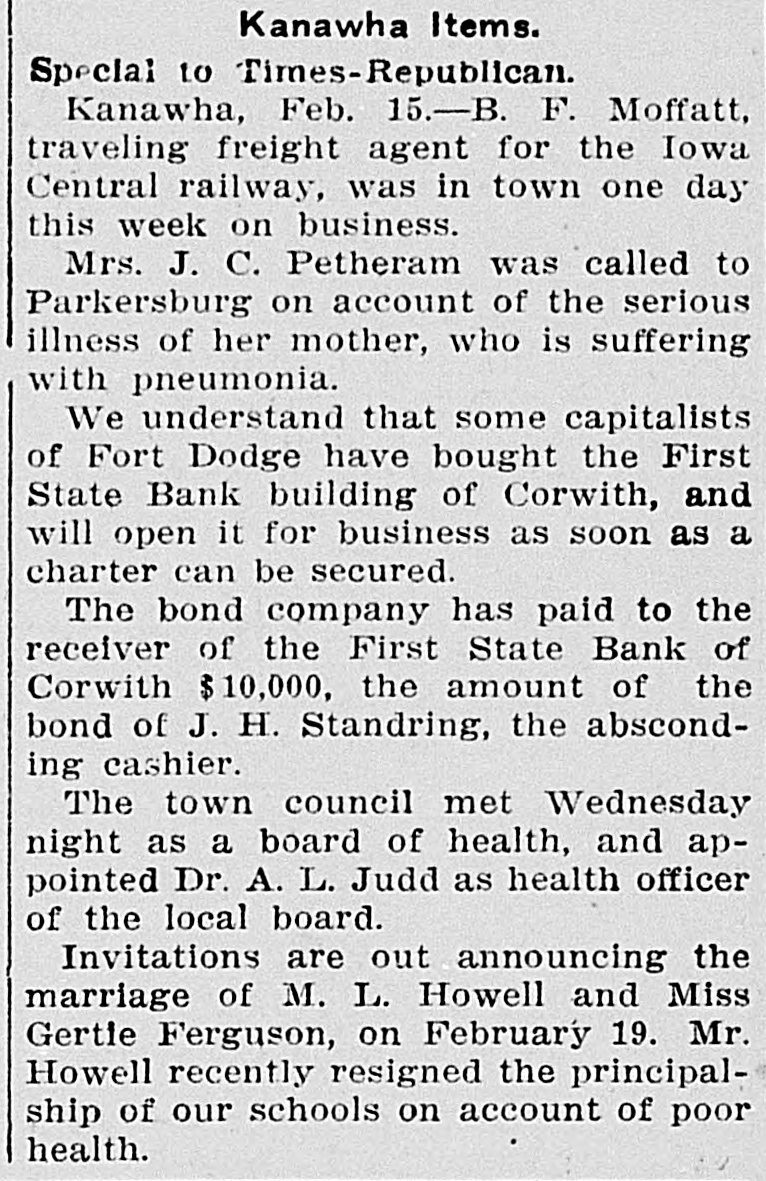
Kanawha Items. Special to Times-Republican. Kanawha, Feb. 15.-B. F. Moffatt, traveling freight agent for the Iowa Central railway, was in town one day this week on business. Mrs. J. C. Petheram was called to Parkersburg on account of the serious illness of her mother, who is suffering with pneumonia. We understand that some capitalists of Fort Dodge have bought the First State Bank building of Corwith, and will open it for business as soon as a charter can be secured. The bond company has paid to the receiver of the First State Bank of Corwith $ 10,000, the amount of the bond of J. H. Standring, the absconding cashier. The town council met Wednesday night as a board of health, and appointed Dr. A. L. Judd as health officer of the local board. Invitations are out announcing the marriage of M. L. Howell and Miss Gertie Ferguson, on February 19. Mr. Howell recently resigned the principalship of our schools on account of poor health.


Article from Evening Times-Republican, March 13, 1911

Click image to open full size in new tab

Article Text

SELL FOR A SONG Notes and Judgments Belonging to the Insolvent Corwith Bank Knocked Down at Public Auction-$20,000 Worth of Paper Disposed of For $300 -$4,000 Item Brings 10 Cents. Special to Times-Republican. Garner, March 13.-W. C. Oelke, receiver for the First State Bank of Corwith, held a public sale of the notes and judgments remaining of the assets at the front door of the court house. Nearly $20,000 of notes and judgments brought a little over $300. Sheriff John Surballe bought about $4,000 worth of notes against John Standring, the missing cashier of the Corwith bank, for 10 cents. As Sheriff Surballe holds a warrant for Standring's arrest he stands as good a show to collect these notes as anyone.


Article from Evening Times-Republican, June 6, 1911

Click image to open full size in new tab

Article Text

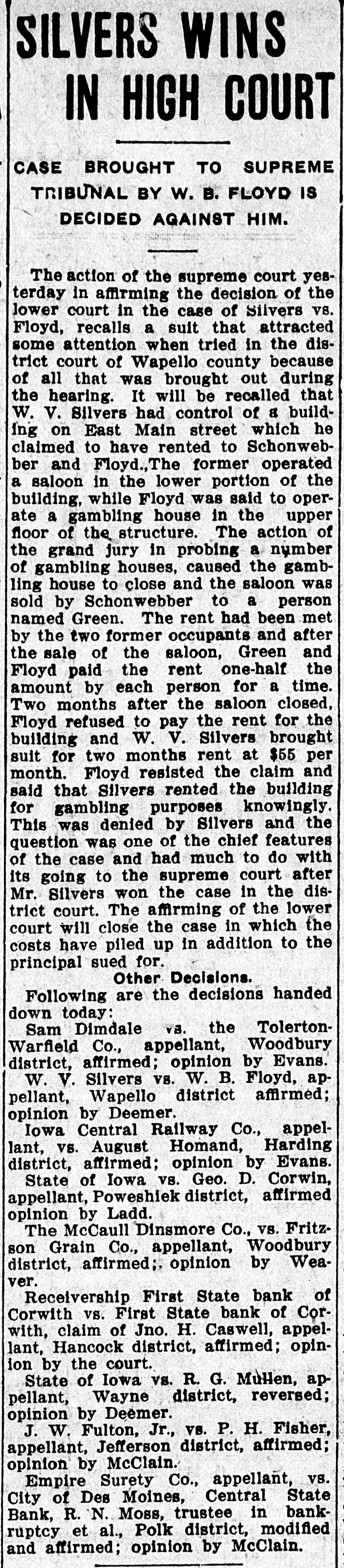
JUNE TERM SUPREME COURT. Several Important Decisions Expected During Month. Special to Times-Republican. Des Moines, June 6.-The state supreme court began the June term here today. Several important decisions are expected during the term. The following opinions were handed down today: Dimsdale versus Tollerton-Warfeld Company, appellant. Woodbury district. Affirmed. Silvers vs. Floyd, appellant. Wapello district. Affirmed. Iowa Central Railway Company, appellant, vs. Homan. Hardin district. Affirmed. State vs. Corwen, appellant. Poweshiek district. Affirmed. McCaull-DInsmore Company vs. Fritzson Grain Company, appellant. Woodbudy district. Affirmed. Fulton vs. Fisher, appellant. Jefferson district. Affirmed. Receivership First State Bank of Corwith vs. First State Bank of Corwith. appellant. Hancock district. Affirmed. Empire State Surety Company. appellant, vs. city of Des Moines, et al. Polk district. Modified and affirmed. State vs. Mullen, appellant. Wayne district. Reversed.


Article from Ottumwa Tri-Weekly Courier, June 8, 1911

Click image to open full size in new tab

Article Text

SILVERS WINS IN HIGH COURT CASE BROUGHT TO SUPREME TRIBUNAL BY W. B. FLOYD IS DECIDED AGAINST HIM. The action of the supreme court yesterday in affirming the decision of the lower court in the case of Silvers vs. Floyd, recalls a suit that attracted some attention when tried in the district court of Wapello county because of all that was brought out during the hearing. It will be recalled that W. V. Silvers had control of a building on East Main street which he claimed to have rented to Schonwebber and Floyd., The former operated a saloon in the lower portion of the building, while Floyd was said to operate a gambling house in the upper floor of the structure. The action of the grand jury in probing a number of gambling houses, caused the gambling house to close and the saloon was sold by Schonwebber to a person named Green. The rent had been met by the two former occupants and after the sale of the saloon, Green and Floyd paid the rent one-half the amount by each person for a time. Two months after the saloon closed, Floyd refused to pay the rent for the building and W. V. Silvers brought suit for two months rent at $55 per month. Floyd resisted the claim and said that Silvers rented the building for gambling purposes knowingly. This was denied by Silvers and the question was one of the chief features of the case and had much to do with its going to the supreme court after Mr. Silvers won the case in the district court. The affirming of the lower court will close the case in which the costs have piled up in addition to the principal sued for. Other Decisions. Following are the decisions handed down today: Sam Dimdale v3. the TolertonWarfield Co., appellant, Woodbury district, affirmed; opinion by Evans. W. V. Silvers vs. W. B. Floyd, appellant, Wapello district affirmed; opinion by Deemer. Iowa Central Railway Co., appellant, vs. August Homand, Harding district, affirmed; opinion by Evans. State of Iowa vs. Geo. D. Corwin, appellant, Poweshiek district, affirmed opinion by Ladd. The McCaull Dinsmore Co., vs. Fritzson Grain Co., appellant, Woodbury district, affirmed; opinion by Weaver. Receivership First State bank of Corwith vs. First State bank of Corwith, claim of Jno. H. Caswell, appellant, Hancock district, affirmed; opinion by the court. State of Iowa vs. R. G. Mullen, appellant, Wayne district, reversed; opinion by Deemer. J. W. Fulton, Jr., vs. P. H. Fisher, appellant, Jefferson district, affirmed; opinion by McClain. Empire Surety Co., appellant, vs. City of Des Moines, Central State Bank, R. N. Moss, trustee in bankruptcy et al., Polk district, modified and affirmed; opinion by McClain.


Article from Evening Times-Republican, May 20, 1914

Click image to open full size in new tab

Article Text

BANKER CORWITH FORMER WEARIED OF DOUBLE LIFE HE LED IN TEXAS. HAD GAINED CONFIDENCE OF MEN IN NEW HOME Hold Responsible Position and Managed Affairs of Large Company of Ranchmen Dewnfall Due to Desire to Gain Fortune in Short TimeSympathy Expressed. Special to Times-Republican. Garner, May 20-The return of John H. Standring, the Corwith banker, who suddenly reuppeared here yesterday after an absence of seven years, pleaded guilty to fifteen indictments for forgery and was sentenced to fifteen years in prison, created a profound sensation here. His return was brought about by the fact that altho he was prospering on a ranch in Texas, holding the confidence of wealthy and powerful capitalists, with a growing opportunity to again amass a comfortable competency, he longed for his family and to be free from the awful suspense of living a double life. With the courageous purpose of voluntarily giving himself up to the courts and paying the penalty of his wrong doing, and atone in the best way he could for his errors, he began more than a year ago to pave the way for the denouement of yesterday. And his story reads like a romance. A Splendid Beginning. Twenty-seven years ago John Standring as a lad, bright-eyed and full of promise, only 15 years of age, began a clerkship in the Stilson bank. He had applied himself assiduously to the schools of his neighborhood so that he was an unusually good accountant and penman. First as office boy, then as clerk and subsequently as cashier of the bank he developed to be one of the of popular and progressive citizens this part of Iowa. He had the reputation for honesty and probity which few young men possessed and but for unfortunate speculations he would still have been one of the most trusted and prominent men in this part of the state. He was so competent and so likable that he was made cashier of the First State Bank when it was changed from the private bank of O. H. Stilson & Co. He also married his employer's sister,' so he enjoyed the fullest confidence and close relationship of the principal stockholder of the bank. The Old Story. On Nov. 19, 1907, John Standring disappeared and the bank went into liquidation. It was found that Standring had forged paper to the amount of nearly $75,000 and the condition of the bank was deplorable. The depositors secured the services of attorneys and they succeeded in getting out of the wreck 97 cents on the dollar for the depositors. The stockholders of the bank and other banks which had taken the forged notes, however, lost about $75,000 in the transaction. The largest loser was a relative of Standring, losing more than one-third of the entire amount. He was a capitalist living in the east and fortunately had ample means for his needs after sustaining the loss. The rest of the losses were divided among six or eight Iowa banks whose loss was from $5,000 to $15.000 each. Standring took $500 with him and left $500 in hiding for his wife and family to give them support till he could find some means of earning a livlihood. He went to Minneapolis but before officers could locate him he was in Texas, where apparently he disappeared from sight. The $500 he left for his wife he placed in hiding and wrote her where she would find it. In the same letter he sent back to the bank and the creditors the deeds of everything he possessed amounting to 800 acres of good Iowa land and which sold at $65 and $75 per acre for the satisfaction of the creditors. If Standring had been able to have tided over the financial reverses of the panic and held his Iowa land till now, the rise in value would have discharged every obligation and he would have been a free man instead of a hunted lawbreaker Another incident con-nected with his career is that he was, when a young man, the victim of a forger himself and paid $2,000 for a farm to find shortly after that the owner's name had been forged to the deed and he lost his little all. Thought He Would Recoup. Standring, like all others of warped judgment, got into trouble speculating with the funds of the bank. His first venture was in California oil lands, and then he bought Texas rice lands to recoup, and this venture was as disastrous as the first. In order to protect the funds of the bank he forged notes and sold them to his relatives and other banks. He kept paying old notes by forging new ones, but seeing that he could not play the game much longer, disappeared. Depositers Paid. After the depositors had been paid almost in full indictments were returned against the officers of the bank and the same attorney who toDoes Tango


Article from The Madison Daily Leader, May 21, 1914

Click image to open full size in new tab

Article Text

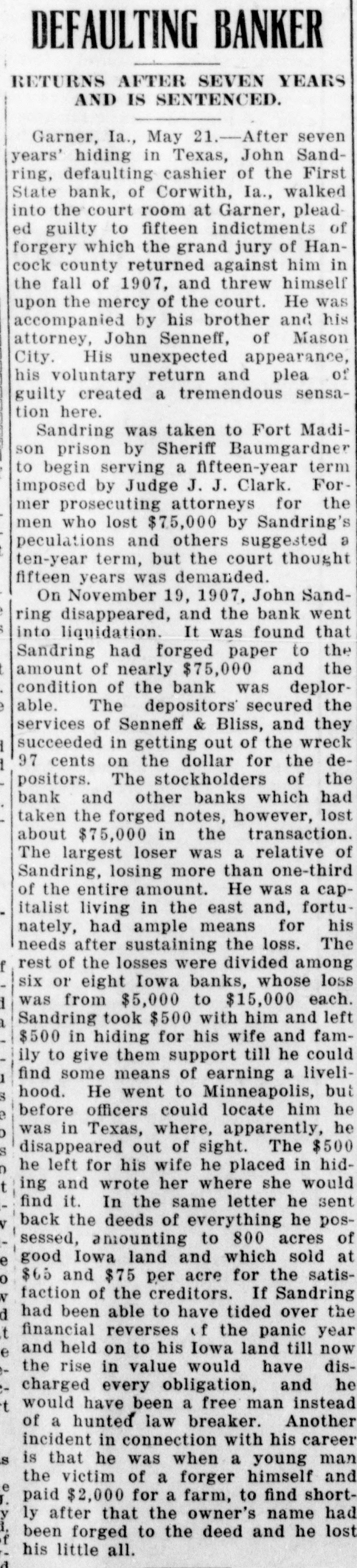
DEFAULTING BANKER RETURNS AFTER SEVEN YEARS AND IS SENTENCED. Garner, Ia., May 21.-After seven years' hiding in Texas, John Sandring, defaulting cashier of the First State bank, of Corwith, Ia., walked into the court room at Garner, pleaded guilty to fifteen indictments of forgery which the grand jury of Hancock county returned against him in the fall of 1907, and threw himself upon the mercy of the court. He was accompanied by his brother and his attorney, John Senneff, of Mason City. His unexpected appearance, his voluntary return and plea of guilty created a tremendous sensation here. Sandring was taken to Fort Madison prison by Sheriff Baumgardner to begin serving a fifteen-year term imposed by Judge J. J. Clark. Former prosecuting attorneys for the men who lost $75,000 by Sandring's peculations and others suggested a ten-year term, but the court thought fifteen years was demanded. On November 19, 1907, John Sandring disappeared, and the bank went into liquidation. It was found that Sandring had forged paper to the amount of nearly $75,000 and the condition of the bank was deplorable. The depositors' secured the services of Senneff & Bliss, and they succeeded in getting out of the wreck 97 cents on the dollar for the depositors. The stockholders of the bank and other banks which had taken the forged notes, however, lost about $75,000 in the transaction. The largest loser was a relative of Sandring, losing more than one-third of the entire amount. He was a capitalist living in the east and, fortunately, had ample means for his needs after sustaining the loss. The rest of the losses were divided among six or eight Iowa banks, whose loss was from $5,000 to $15,000 each. Sandring took $500 with him and left $500 in hiding for his wife and family to give them support till he could find some means of earning a livelihood. He went to Minneapolis, but before officers could locate him he was in Texas, where, apparently, he disappeared out of sight. The $500 he left for his wife he placed in hiding and wrote her where she would find it. In the same letter he sent back the deeds of everything he possessed, amounting to 800 acres of good Iowa land and which sold at $65 and $75 per acre for the satisfaction of the creditors. If Sandring had been able to have tided over the financial reverses of the panic year