13825. Derryfield Savings Bank (Manchester, NH)

Bank Information

Episode Type
Suspension → Closure
Bank Type
state
Start Date
July 29, 1893
Location
Manchester, New Hampshire (42.996, -71.455)

Metadata

Model
gpt-5-mini
Short Digest
89f63e42

Response Measures

None

Description

Articles from July–August 1893 report disappearance of cashier Charles F. Morrill, discovery of large deficiencies, trustees turning affairs over to a receiver and the bank being wound up. This is a suspension followed by receivership/closure driven by bank-specific embezzlement and mismanagement (Moore/Morrill).

Events (2)

1. July 29, 1893 Receivership
Newspaper Excerpt
the trustees of the Derryfield Savings Bank ... turned over their affairs into the hands of a receiver.
Source
newspapers
2. July 29, 1893 Suspension
Cause
Bank Specific Adverse Info
Cause Details
Disappearance of cashier-treasurer Charles F. Morrill and discovery of large amounts of worthless paper/embezzlement and mismanagement connected with Dr. J. C. Moore and Morrill led trustees to turn affairs over to a receiver.
Newspaper Excerpt
A meeting of the directors of the Derryfield Savings bank ... it was voted to apply to the court for the appointment of a receiver to wind up the affairs of the bank.
Source
newspapers

Newspaper Articles (7)

Article from The Providence News, July 29, 1893

Click image to open full size in new tab

Article Text

CITIZENS ARE ALARMED. Bank Cashier Morrill Missing From Manchester. AN ABUSE OF TRUSTS IS HINTED. He Held a Prominent Position in Three Institutions -Anxiety Now Felt for People's Fire Insurance Company1 Bak Examiner Uncommunicative. MANCHESTER, N. H., July 29.-The city Is stirred as it seldom has been by the pensational developments which have recorded the disappearance of Charles F. Morrill, cashier and treasurer of three of the representative financial institutions of the city. A meeting of the directors of the Derryfield Savings bank, of which institution Mr. Morrill was the treasurer, was held yesterday afternoon, and it was voted to apply to the court for the appointment of B. receiver to wind up the affairs of the bank. The feeling at the meeting was That the entire capital stock of $100,000 bad been wiped out by worthless paper. As is ordinarily the case, there are two plaims set up as to Mr. Morrill's destination on Wednesday. One party maintains that he went south and was seen that day in the Haymarket square depot, Boston, while the other is to the effect that he went toward the Canadian line. The authority that he went north is absolutely Invincible. Added to the fact that he is known to have passed Wednesday night in Concord, and there is not much left of the Boston story. The Principal Anxiety that is now felt over Mr. Morrill's de parture is on account of the People's Fire Insurance company. This institution was founded after the passage of the celebrated valued policy law by Dr. Moore. Mr. Morrill was its treasurer. Mr. Moore was its president and Mr. Morrill treasurer of the National Bank of the Commonwealth. As a result the companies' securities were all stored away in the safety deposit vaults of the suspended institution. What condition they are in nobody knows. When ugly rumors commenced to float about regarding the condition of things in the Commonwealth bank the directors of the People's Insurance company called a meeting to elect a successor to Mr. Morrill astreasurer. It was supposed that he would libe present and make a statement of the condition of the company, but to the dismay of the directors he Could Not Be Found. The greatest depression exists here as a result of the uncertainty into which everything is plunged. If the National Bank of the Commonwealth proves to be Insolvent, according to law the stockholders can be holden for twice the amount of capital stock, and should anything happen to the People's Fire, in addition many young men who have stock in both instutions Would Be Ruined. With a shut down on the Amoskeag and the above-condition of things staring Manchester in the face, the gloom here is something oppressive. It is but fair to the missing cashier to say that he has a large amount of public sympathy, and there is an inclination to hold others beside himself responsible for any wrong doing that may come to light. Bank Examiner Gatchell of Massachumetts has taken charge of the commonwealth's books, Mr. Dorr being called to Exeter by the troubles there, but, like his predecessor, he is as silent regarding the bank's condition as a graven image.

Article from The Morning Call, July 30, 1893

Click image to open full size in new tab

Article Text

whv credit should not be sound. "No nation." said Harter, "bas ever successfully carried on business under two standards. PORTLAND'S TROUBLE. Three More Banks Fail to Open Their Doors. PORTLAND, Or., July 29.-Three banks failed to open their doors this morning. They were the Commercial National, Portland Savings and Ainsworth National. With the exception of a slight run on the First National there is no excitement. A notice posted on each of the suspended banks says the banks were forced to temporarily suspend, owing to the heavy withdrawal of deposits during the last sixty days and inability to realize on seourities. Dopositors will be paid in full. The Commercial National Bank has a paid-up capital stock of $250,000. Frank Dekum is president. The Portland Savings Bank is under the same management. L. L. Hawkins is president of the Alosworth National, which has a capital stock of $100,000. The statement of the Commercial National and Ainsworth National published July 12, shows the resources as follows: Commercial, $1,950,000; Ainsworth, $687.000. Deposits Commercial, $1,450,000; Ainsworth, $447,000. The Ainsworth National is a United States depository. No statement is yet made of the condition of the Portland Savings Bank. It has a capital stock of $260.000. with a surplus of $202,000. At the closing hour the situation was quiet, all other banks having stood the run. At each of the suspended banks a police officer is stationed to prevent any disorder. Small groups of men are standing on the streets discussing the situation, but there is no sign of any violence. All the three banks which were closed to-day are considered among the strongest in the city and depositors appear to have no fear of losing a cent. It is probable that all three banks will resume in a few days. On account of it being the end of the week most of the banks paid out more than was received. The Merchants' National, where the run occurred yesterday, received deposits in excess of the money paid out. J. Lowenberg, president of the Merchants', yesterday hypothecated all his real property in the city, and is said to have secured $200,000 in cash. This restored confidence and many persons drew their money from other banks and deposited it there. D. P. Thompson was appointed receiver of the Portland Savings Bank this afternoon. The statement of this bank shows resources estimated at $2,950,000. which 18 considered a conservative estimate. Its liabilities are placed at $2,475,000. During the last sixty days there has been a shrinkage of $600,000. while $800,000 has been withdrawn from the Commercial National during the same period. The Commercial National paid out $100,000 yesterday. A small bank at Forest Grove has closed owing to the Commercial National's suspension. The statement of the Union Banking Company, which closed yesterday. shows assets of $98,000 with liabilities of $53,000. The city has a claim for $13,000 and is the principal creditor. YOUNGSTOWN, Ohio, July 29.-As a.result of malicious rumors 8 run was started on the Dollar Savings and Trust Company this morning. The bank required legal notice, and not a dollar was paid out. It has wealthy stockholders. A number of merchants withdrew large sums from other banks and deposited with it, allaying the excitement. KANKAKEE, III., July 29.-The First National Bank failed this morning. The assets are sufficient to pay depositors in full. AKRON. Ohio, July 29-The Citizens' Savings and Loan Association failed this morning. It will pay in full. Capital, $100,000; surplus, $80,000. NEW WHATCOM, Wash., July 29.-This morning the following notice was posted on the doors of the Puget Sound Loan, Trust and Bank Company: "Owing to the constant withdrawals of deposits and inability to realize on securities this bank has suspended temporarily." The bank was incorporated under the State laws In 1890. with a capital stock of $125,000. The liabilities are $50,000 and the assets $200,000. WASHINGTON, July 29.-Comptroller Eckels appointed Louis C. Phelps receiver of the Merchants' National Bank of Great Falls, Mont. EAU CLAIRE, Wis., July 29.-The Commercial Bank, capital $50,000, was placed in the hands of a receiver to-day. President Allen said: "We calculate that the depositors will not lose a dollar." There were light runs on other banks. BOSTON. July 29.-A special from Manchester, N. H., says: Disclosures to-day tend to show that Cashier Morrell knew the worst and ran away rather than face the music. A director stated that in addition to the $60,000 of doubtful paper thrown out of the Derryfield Savings Bank, there is from $10,000 to $18,000 due depositors. It is now thought the deficiency in the bank mav go to $100,000. Rich Red Blood


Article from Watertown Republican, August 2, 1893

Click image to open full size in new tab

Article Text

ROBBED THREE BANKS. A New Hampshire Financier Proves to Be an Embezzler. MANCHESTER, N. H., July 28.-It is rumored that Charles F. Merell, the treasurer of the Derryfield Savings Bank and the People's Insurance Company, and the cashier of the suspended Bank of the Commonwealth, has absconded. He is said to be short in his accounts in all three institutions. An examination is now going on. Merell has not been seen since Wednesday and his family is in ignorance of his whereabouts.


Article from The Indianapolis Journal, December 10, 1895

Click image to open full size in new tab

Article Text

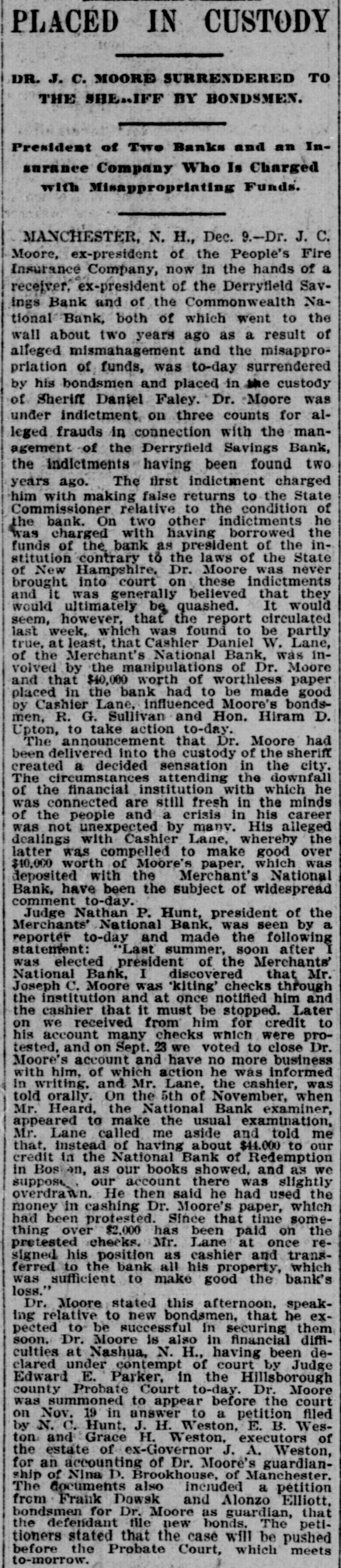
PLACED IN CUSTODY DR. J. c. MOORE SURRENDERED TO THE SHE..IFF BY BONDSMEN. President of Two Banks and an Insurance Company Who Is Charged with Misappropriating Funds. MANCHESTER, N. H., Dec. 9.-Dr. J. C. Moore, ex-president of the People's Fire Insurance Company, now in the hands of a receiver, ex-president of the Derryfield Savings Bank and of the Commonwealth National Bank, both of which went to the wall about two years ago as a result of alleged mismahagement and the misappropriation of funds, was to-day surrendered by his bondsmen and placed in the custody of Sheriff Daniel Faley. Dr. Moore was under indictment on three counts for alleged frauds in connection with the management of the Derryfield Savings Bank, the indictments having been found two years ago. The first indictment charged him with making false returns to the State Commissioner relative to the condition of the bank. On two other indictments he was charged with having borrowed the funds of the bank as president of the institution contrary to the laws of the State of New Hampshire, Dr. Moore was never brought into court on these indictments and it was generally believed that they would ultimately be quashed. It would seem, however, that the report circulated last week, which was found to be partly true, at least, that Cashier Daniel W. Lane, of the Merchant's National Bank, was involved by the manipulations of Dr. Moore and that $40,000 worth of worthless paper placed in the bank had to be made good by Cashier Lane, influenced Moore's bondsmen, R. G. Sullivan and Hon. Hiram D. Upton, to take action to-day. The announcement that Dr. Moore had been delivered into the custody of the sheriff created a decided sensation in the city. The circumstances attending the downfall of the financial institution with which he was connected are still fresh in the minds of the people and a crisis in his career was not unexpected by many. His alleged dealings with Cashier Lane, whereby the latter was compelled to make good over $40,000 worth of Moore's paper, which was deposited with the Merchant's National Bank, have been the subject of widespread comment to-day. Judge Nathan P. Hunt, president of the Merchants' National Bank, was seen by a reporter to-day and made the following statement: "Last summer, soon after I was elected president of the Merchants' National Bank, I discovered that Mr. Joseph C. Moore was 'kiting' checks through the institution and at once notified him and the cashier that it must be stopped. Later on we received from him for credit to his account many checks which were protested, and on Sept. 23 we voted to close Dr. Moore's account and have no more business with him, of which action he was informed in writing, and Mr. Lane, the cashier, was told orally. On the 5th of November, when Mr. Heard, the National Bank examiner, appeared to make the usual examination, Mr. Lane called me aside and told me that, instead of having about $44.000 to our credit in the National Bank of Redemption in Bos on, as our books showed, and as we suppose our account there was slightly overdrawn. He then said he had used the money in cashing Dr. Moore's paper, which had been protested. Since that time something over $2,000 has been paid on the protested checks. Mr. Lane at once resigned his position as cashier and transferred to the bank all his property, which was sufficient to make good the bank's loss." Dr. Moore stated this afternoon, speaking relative to new bondsmen, that he expected to be successful in securing them soon. Dr. Moore is also in financial difficulties at Nashua, N. H., having been declared under


Article from Essex County Herald, January 3, 1896

Click image to open full size in new tab

Article Text

ber of the state senate from the sixth sepatorial district. His chief work during his term of office was his part in securing the passage of the measure which created the present state board of health. In 1884 Dartmouth College at its June commencement conferred on him the degree A. M. In the summer of 1885,the New Hampshire entirely recast the insurance the state, and a Legislature laws of after prolonged struggle enacted the "valued policy law." To meet the condition of affairs thus presented. New Hampshire capitalists speedily undertook the formation of local insurance companies, and Dr. Moore, seeing in this an for the exercise which had 30 long investment opportunity ability for the profitable lain of of dormant, his the financial millions and of money which he and the New Hampshire Club represented. secured a charter for the People's Fire Insurance Company, which met SO diastrou an end in the summer of 1893. To the presidency of this company, Dr Moore secured his own election. and Charles F. Morrill became treasurer. This, it is believed. was Moore's first business connection with Morrill, and the partnership then struck was destined to be one of the most remarkable in New Hampshire's financial history, involving. before it was ended. the wrecking of three great financial institutions and carrying to the people of Manchester a direct money loss of more than $1,000,000. Accordingl . in 1889, the Legislature was induced to grant a charter for the Merrimack Mortgage & Debenture Company, and the charter as it was originally granted by the Legislature was vetoed by Gov. Goodell. It was afterward amended, however, and received the executive approval. Under this charter business was begun and continued for nearly three years, when the name of the corporation was changed to Derryfield Savings Bank and Charles .Morrill was chosen treasurer. The Merrimack Mortgage & Debenture Company was always a little off color. and it now appears that it was during the short life of that institution that Dr. Moore first resorted to questionable means for securing the funds he so much needed. The panic of 1893 was little felt in New Hampshire outside of the Queen City of Manchester. and the actual erash which occurred among the banking institutions of that city was preceded by weeks of undefined rumor in which the affairs of the Derryfleid Savings Bank and the National Bank of the Commonwealth were prominent. The legal aspect of the case next called for consideration, and Bank Examiner Dorr of New Hampshire called upon the comptroller for assistance in untangling the Common wealth's affairs. Bank Examiner Gatehell of Massachusetts was accordingly dispatched and the two with Dist.-Atty to gether Manchester, Remich, examiners. took poses tosion of the Commonwealth's books, and made an exhaustive examination. which resulted. in January, 1894, in the indictment of both Mo re and Morrill for abstraction, embezzlement and misuse of money. the substitution of funds and credits, and the general manipulation of the bank's assets. In the meantime, the trustees of the Derryfield Savings Bank. after several stormy meetings, turned over their affairs into the hands of a receiver. and the People's Fire Insurance Company suffered a like late. Both of these transfers were preceded and accompanied by an expert examination of the accounts.


Article from Spirit of the Age, January 4, 1896

Click image to open full size in new tab

Article Text

ber of the state senate from the sixth senatorial district. His chief work during his term of office was his part in securing the passage of the measure which created the present state board of health. In 1884 Dartmouth College at its June commencement conferred on him the degree A. M. In the summer of 1885, the New Hampshire Legislature entirely recast the Insurance laws of the state, and after a prolonged struggle enacted the "valued policy law." To meet the condition of affairs thus presented, New Hampshire capitalists speedily undertook the formation of local insurance companies, and Dr. Moore, seeing in this an opportunity for the exercise of his financial ability which had so long lain dormant, an for the profitable inve-tment of the millions of money which be and the New Hampshire Club represented, secured n charter for the People's Fire Insurance Company. which met so diastrous au end in the summer of 1893. To the presidency of this company, Dr Moore secured his own election. and Charles F. Morrill became treasurer. This, it is believed. was Moore's first business connection with Morrill, and the partnership then struck was destined to be one of the most remarkable in New Hampshire's financial history, involving, before it was ended, the wrecking o three great financial institutions and carrying to the people of Manchester a direct money loss of more than $1,000,000. Accordingl . in 1889, the Legislature was induced to grant a charter for the Merrimack Mortgage & Debenture Company, and the charter as it was originally granted by the Legislature was vetoed by Gov. Goodell. It was a'terward amended, however, and received the executive approval. Under this charter business was begun and continued for nearly three years. when the name of the corporation was changed to Derryfield Savings Bank and Charles F. Morrill was chosen treasurer. The Merrimack Mortgage & Debenture Company was always a little off color. and it now appea's that it was during the short life of that institution that Dr. Moore first resorted to questionable means for securing the funds he so much needed. The panic of 1893 was little felt in New Hampshire outside of the Queen City of Manchester, and the actual crash which occurred among the banking institutions of that city was preceded by weeks of undefloned rumor in which the affairs of the Derryfield Savings Bank and the National Bank of the Commionwealth were prominent. The legal aspect of the case next called for consideration, and Bank Examiner Dorr of New Hampshire called upon the comptroller for assistance in untangling the Common. wealth's affairs. Bank Examiner Gatehell of Massachusetts was accordingly dispatched to Manehester. and the two examiners, together with Dist.-Atty Remich, took poses. sion of the Commonwealth's books, and made an exhaustive examination. which re. sulted, in January, 1894. in the indictment of both Mo re and Morrill for abstraction, embezzlement and misuse of money. the substitution of funds and credits. and the general manipulation of the bank's assets In the meantime, the trustees of the Derryfield Savings Bank. after several stormy meetings, turned over their affairs into the hands of a receiver. and the People's Fire Insurance Company suffered a like fate. Both of these tran-fers were preceded and accompanied by an expert examination of he accounts.


Article from Daily Kennebec Journal, March 20, 1909

Click image to open full size in new tab

Article Text

Former New Hampshire Financier Is Dead. Passes Away on Friday at His Home In Laconia. Long In Poor Health He Finally Succumbs to Paralysis. Laconia, N. H., March 19.-The career of a once notable figure in New Hampshire finance closed at sunset tonight in the passing of Dr. Joseph Clifford Moore. who died at his cottage in Lakeport. where since. his downfall from a position of power and influence. he had lived the quiet life of a country physician. In the height of his career Dr. Moore was known as the New Hampshire "Napoleon of finance" and in addition to controlling banks and other corporations was a factor in politics to be reckoned with. The failure of the National Bank of the Commonwealth. Derryfield Savings Bank and People's Fire Insurance Co., all of Manchester. in 1893. following the flight of Charles F. Morrill, cashier of the National Bank and treasurer of the other concerns, to Argentine republic, where he died seven or eight years ago, ended the business life of Dr. Moore, who was president of all three. Joseph C. Moore was born in Loudon, N. H.. Aug. 22, 1845, the son of Dr. D. F. and Frances S. Moore. His father was a well-known physician with a somewhat limited practice. Joseph worked in summer and went to school in winter. and after a time saved money enough to pursue a course at the New York Medical College. On his return in 1866 he went into the practice of medicine with his father in Lake Village and for 13 years followed a country physician's routine. He found time and meney to invest in a number of business enterprises, and gained an insight into methods and plans which aided him greatly afterward in the prosecution of his various business matters. In 1879 he went to Manchester and with Dr. J. H. Riedell. then of Boston and Stillson Hutchins of Washington. D. C., purchased the Evening Union and established a morning paper of the same name. In time Dr. Moore became sole owner of the Union, which was a financial success. In the state election of 1880 he was made a member of the State Senate from the 6th Senatorial district. His chief work during his term of office was his part in securing the passage of the measure which created the present State Board of Health. In 1884 Dartmouth College. at its June Commencement. conferred on him the degree of Master of Arts. In 1886. Dr. Moore established the People's Fire Insurance Co. He became president and made Charles F. Morrill of Manchester treasurer. This was Moore's first business connection with Morrill. The names of both men became well known throughout New