Continental National Bank (New York, NY)

Episode Information

Episode UID
138900885
Episode Type
Run β†’ Suspension β†’ Reopening
Bank Type
national
Bank ID
13890 national
Charter Number
1389
Start Date
September 20, 1873
Location
New York, New York (40.714, -74.006)

Metadata

Model
gemini-3-flash-preview (chosen from majority vote of a three-model LLM ensemble)
Short Digest
e5b4ec32ebbff677

Response Measures

Accommodated withdrawals

Description

The bank experienced a run triggered by a false telegraphic report of its suspension during the Panic of 1873; it also participated in the general New York City bank suspension of currency payments.

Events (5)

1. July 5, 1865 Chartered
Source
historical_nic
2. September 20, 1873 Suspension
Cause
Government Action
Cause Details
General suspension of currency payments by New York City banks during the Panic of 1873.
Newspaper Excerpt
At 3 o'clock, on Saturday, the Banks of New York suspended payment, closed their doors
Source
newspapers
3. September 22, 1873 Run
Cause
Rumor Or Misinformation
Cause Details
A false report was telegraphed across the country stating that the bank had suspended.
Random Run
Yes
Random Run Snippet
false report telegraphed all over the country that the bank had suspended; corrected later
Measures
The bank responded to all calls for withdrawals.
Newspaper Excerpt
T.G.S. Flint said that a report had been telegraphed all over the country on Saturday that the bank had suspended... There had been a tremendous run by letter telegraphal day Monday and yesterday
Source
newspapers
4. October 1, 1873* Reopening
Newspaper Excerpt
It is expected that the New York banks will resume currency payments next week.
Source
newspapers
5. May 25, 1901 Voluntary Liquidation
Source
historical_nic

Newspaper Articles (7)

Article from Wilmington Daily Commercial, September 22, 1873

Click image to open full size in new tab

Article Text

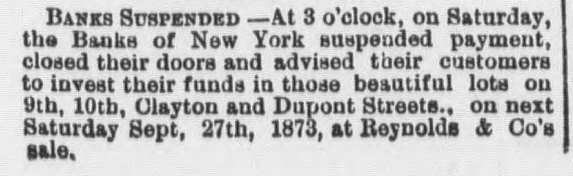
BANKS SUSPENDED β€” At 3 o'clock, on Saturday, the Banks of New York suspended payment, closed their doors and advised their customers to invest their funds in those beautiful lots on 9th, 10th, Clayton and Dupont Streets., on next Saturday Sept, 27th, 1873, at Reynolds & Co's sale.


Article from Wilmington Daily Gazette, September 22, 1873

Click image to open full size in new tab

Article Text

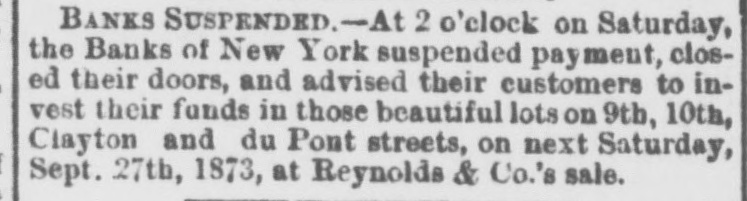
BANKS SUSPENDED.β€”At 2 o'clock on Saturday, the Banks of New York suspended payment, closed their doors, and advised their customers to invest their funds in those beautiful lots on 9th, 10th, Clayton and du Pont streets, on next Saturday, Sept. 27th, 1873, at Reynolds & Co.'s sale.


Article from New-York Tribune, September 24, 1873

Click image to open full size in new tab

Article Text

PRESSURE UPON THE BANKS. CURRENCY EXCEEDINGLY SCARCE-DEMANDS FOR LOANS POURING IN FROM THE COUNTRY-THE CROPS MUST BE MOVED. upon of the downtown to ascertain their viewa. A reporter the banks Presidents of THE of TRIBUNE many called, leading The yesterday, questions asked had reference chiefly to the demand for loans from city customers and e drain from banks out of town. The reporter found a marked difference between the banks doing business for the brokers and those transacting a strictly mercantile business. Money was scarce everywhere, and discounts could not readily be obtained. The best commercial paper was offered at two per cent a day, but the money could not be had. OUTSIDE DEMAND FOR LOANS. W. K. Kitchen, President of the Park Bank, told the reporter that the calls on the bank were not very great from the city, as they paid large amounts only on certified checks from the Clearing-house, and the demand for loans was not so large as one might suppose. The demand from country banks, however, was simply enormous, and could be in the banks to country amounted to not be raised in an banks met. banks which could The in the deposits city hour. a belonging The vast not sum, haven't got it; they ought to have taken on Saturit day the action which they took on Monday, and was a great mistake that they failed to do so. To a customer who called for a loan-We will let you have the money as soon as we can. Send around to your customers and make them pay up. This is a good time to collect in money. THE COMMERCIAL WORLD NOT AFFECTED. Geo. S. Coe, President of the American Exchange Bank, said that his institution was not a brokers' bank, and the demands for loans from merchants were not greater than usual. The commercial world was not affected in the least as yet, and he saw no reason why they need be. The out-of-town demand for money is always large at this season of the year, but is larger now than usual owing to the panic. Their deposits are small in proportion to their capital, and they are meeting demands from all sources. He looked upon the trouble as a stock-brokers' affair which need not troubln outsiders. The stock gamblers, he said, were drawing money from the banks, and stood ready with it in their pockets to buy stocks whenever they could put them down low enough. MONEY NEEDED FOR MOVING CROPS. John E. Williams, President of the Metropolitan Bank, told the reporter that they did a strictly commercial business, and were not affected in any way by the panic. There was great demand from out of town for money with which to move the crops. That was the cause of the trouble. "Our wealth in us poor and when a sudden call for grain Wall-st. Cooke's made failure created in currency, money Jay in it was n't in the city. The wheat was nor one was in a good." never 80 Every large the foreign hurry demand crop to get so his crop to the sea, and his bank sent out $100,000 a day for five or six weeks. The demand had somewhat increased, and some of the country bankers had gone wild. One man was day or two ago who had $70,000 on deposit and $40,000 in greenbacks in his pockets, and still wanted to get a discount. Mr. Williams told him to go home and cool off. The national currency, Mr. Williams said, is all out of the city; there is probably not more than $1,000,000, and perhaps not more than half a million in the banks. If they had all been paying out gold they would have been compelled to suspend. The great trouble was caused by the large amounts of worthless railroad bonds and stocks forced on the market by false representations. A JUBILANT BANK. At the Fourth National Bank the aspect of things had greatly changed since Monday. There were few persons at the paying teller's desk, but there was a long line of depositors at the window of the receiving teller reaching half around the bank. At 3 o'clock the line had not been shortened, and half an hour later it numbered 26. Mr. Lane, the cashier. told the reporter that they had found themselves a creditor bank at the Clearing-house, and were feeling quite jubilant over it. Heretofore they had been on the debtor side. The worst of the trouble, he thought, was over; there would still be ruin among the bankers, but the trouble of the banks, he thought, was over. After the suspension of Henry Clews & Co. a report was circulated on the street that the Fourth National Bank had suspended. The reporter returned, and was told that the report had probably arisen from their refusal to clear for Henry Clews & Co., but that the situation was unchanged since the former visit. The cashier pointed to the line of depositors, as if this were a sufficient answer to all questions of their elvency. A THRUST AT BROKERS' BANKS. W. H. Scott. President of the Hanover National Bank, said that they kept no brokers' accounts, and there was no unusual city demand, while the number had increased from the not be met: pouring the of panic their in, began. depositors and could Demands largely country there was since were currency to meet no which did a who dealt in business; fears for enough the the bankers banks in the city strictly them. stocks banking He would had not probably have to go down before things became settled. BROKERS MAKING SETTLEMENTS. Tappan, President of the Gallatin National Bank, said that the demand for loans was light. The brokers seemed to be settling up their affairs, exchanging stocks, and getting rid of collaterals, rather than incurring new obligations. There was a process of liquidation going on all around. They had no correspondents except in Philadelphia, and the out-of-town demand was limited to that city, but the demand from there was heavy. NO UNUSUAL CITY DEMAND, The reporter found everything quiet at the Continental National Bank. T.G.S. Flint said that a report had been telegraphed all over the country on Saturday that the bank had suspended; and the result was that their out-of-town customers were calling in their deposits. There had been a tremendous run by letter telegraphal day Monday and yesterday, and they did not know what was the cause until yesterday. They had responded to all calls, and unless there were a change within a few days they would liquidate their entire out-of-town indebtedness. The false report was circulated in had been no unusual denot how much ruthem, but it had inthe mand. mor country, had He caused could and there say certainly harm been city the inrious to their customers and to many from whom


Article from National Republican, October 4, 1873

Click image to open full size in new tab

Article Text

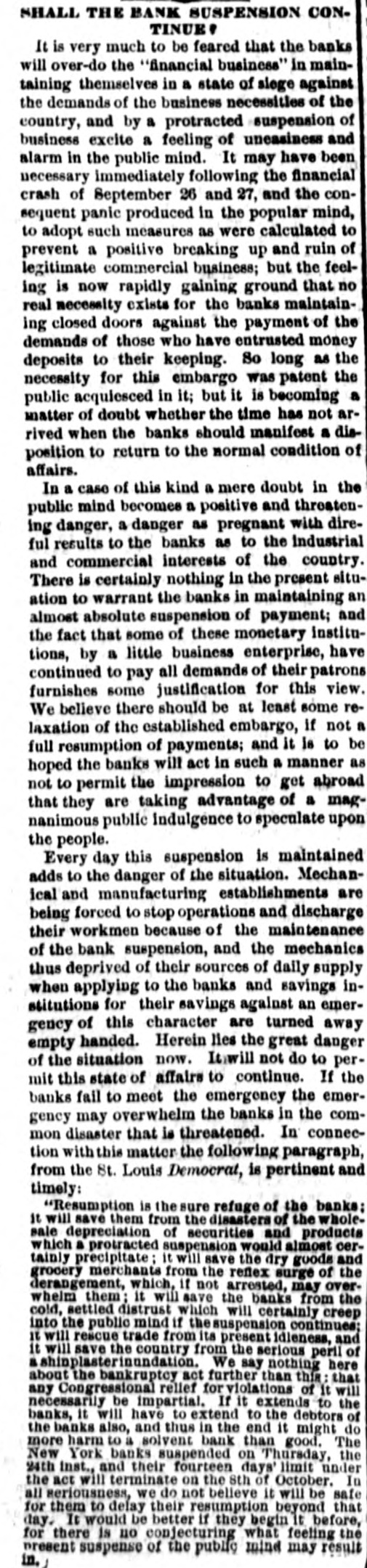
SHALL THE BANK SUSPENSION CONTINUE? It is very much to be feared that the banks will over-do the "financial business" in maintaining themselves in a state of siege against the demands of the business necessities of the country, and by a protracted suspension of business excite a feeling of uneasiness and alarm in the public mind. It may have been necessary immediately following the financial crash of September 26 and 27, and the consequent panic produced in the popular mind, to adopt such measures as were calculated to prevent a positive breaking up and ruin of legitimate commercial business; but the feeling is now rapidly gaining ground that no real necessity exists for the banks maintaining closed doors against the payment of the demands of those who have entrusted money deposits to their keeping. So long as the necessity for this embargo was patent the public acquiesced in it; but it is becoming a matter of doubt whether the time has not arrived when the banks should manifest a disposition to return to the normal condition of affairs. In a case of this kind a mere doubt in the public mind becomes a positive and threatening danger, a danger as pregnant with direful results to the banks as to the industrial and commercial interests of the country. There is certainly nothing in the present situation to warrant the banks in maintaining an almost absolute suspension of payment; and the fact that some of these monetary institutions, by a little business enterprise, have continued to pay all demands of their patrons furnishes some justification for this view. We believe there should be at least some relaxation of the established embargo, if not a full resumption of payments; and it is to be hoped the banks will act in such a manner as not to permit the impression to get abroad that they are taking advantage of a magnanimous public indulgence to speculate upon the people. Every day this suspension is maintained adds to the danger of the situation. Mechanical and manufacturing establishments are being forced to stop operations and discharge their workmen because of the maintenance of the bank suspension, and the mechanics thus deprived of their sources of daily supply when applying to the banks and savings institutions for their savings against an emergency of this character are turned away empty handed. Herein lies the great danger of the situation now. It will not do to permit this state of affairs to continue. If the banks fail to meet the emergency the emergency may overwhelm the banks in the common disaster that is threatened. In connection with this matter the following paragraph, from the St. Louis Democrat, is pertinent and timely: "Resumption is the sure refuge of the banks; it will save them from the disasters of the wholesale depreciation of securities and products which a protracted suspension would almost certainly precipitate; it will save the dry goods and grocery merchants from the reflex surge of the derangement, which, if not arrested, may overwhelm them; it will save the banks from the cold, settled distrust which will certainly creep into the public mind if the suspension continues; it will rescue trade from its present idleness, and it will save the country from the serious peril of a shinplaster inundation. We say nothing here about the bankruptcy act further than this; that any Congressional relief for violations of it will necessarily be impartial. If it extends to the banks, it will have to extend to the debtors of the banks also, and thus in the end it might do more harm to a solvent bank than good. The New York banks suspended on Thursday, the 24th inst., and their fourteen days' limit under the act will terminate on the 8th of October. In all seriousness, we do not believe it will be safe for them to delay their resumption beyond that day. It would be better if they begin it before, for there is no conjecturing what feeling the present suspense of the public mind may result in."


Article from Daily Kennebec Journal, October 16, 1873

Click image to open full size in new tab

Article Text

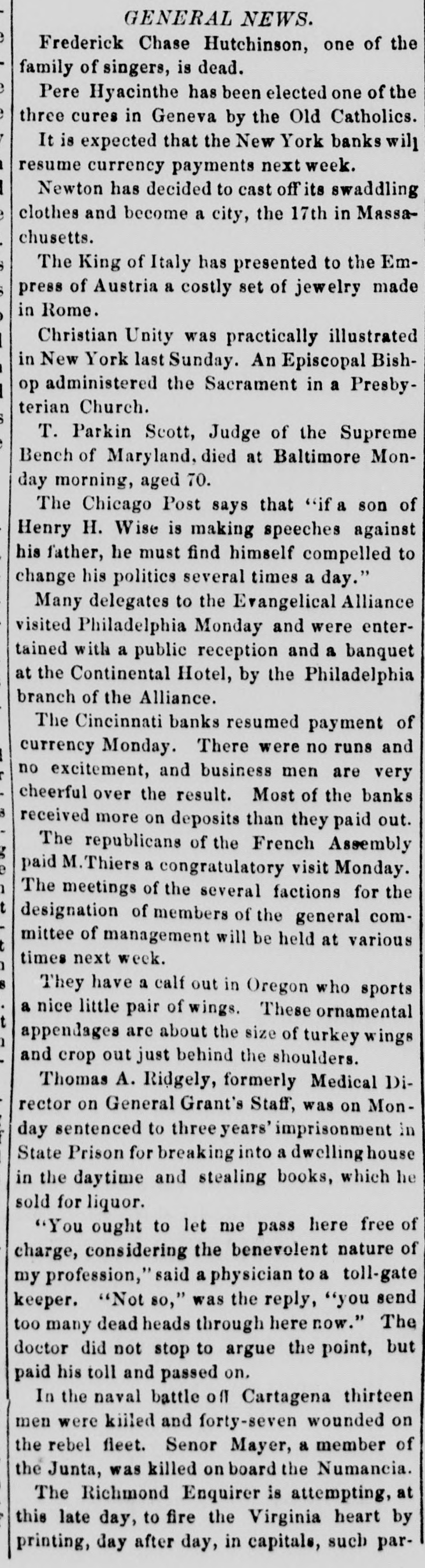
GENERAL NEWS. Frederick Chase Hutchinson, one of the family of singers, is dead. Pere Hyacinthe has been elected one of the three cures in Geneva by the Old Catholics. It is expected that the New York banks will resume currency payments next week. Newton has decided to cast off its swaddling clothes and become a city, the 17th in Massachusetts. The King of Italy has presented to the Empress of Austria a costly set of jewelry made in Rome. Christian Unity was practically illustrated in New York last Sunday. An Episcopal Bishop administered the Sacrament in a Presbyterian Church. T. Parkin Scott, Judge of the Supreme Bench of Maryland, died at Baltimore Monday morning, aged 70. The Chicago Post says that "if a son of Henry H. Wise is making speeches against his father, he must find himself compelled to change his politics several times a day." Many delegates to the Evangelical Alliance visited Philadelphia Monday and were entertained with a public reception and a banquet at the Continental Hotel, by the Philadelphia branch of the Alliance. The Cincinnati banks resumed payment of currency Monday. There were no runs and no excitement, and business men are very cheerful over the result. Most of the banks received more on deposits than they paid out. The republicans of the French Assembly paid M. Thiers a congratulatory visit Monday. The meetings of the several factions for the designation of members of the general committee of management will be held at various times next week. They have a calf out in Oregon who sports a nice little pair of wings. These ornamental appendages are about the size of turkey wings and crop out just behind the shoulders. Thomas A. Ridgely, formerly Medical Director on General Grant's Staff, was on Monday sentenced to three years' imprisonment in State Prison for breaking into a dwelling house in the daytime and stealing books, which he sold for liquor. "You ought to let me pass here free of charge, considering the benevolent nature of my profession," said a physician to a toll-gate keeper. "Not so," was the reply, "you send too many dead heads through here now." The doctor did not stop to argue the point, but paid his toll and passed on. In the naval battle off Cartagena thirteen men were killed and forty-seven wounded on the rebel fleet. Senor Mayer, a member of the Junta, was killed on board the Numancia. The Richmond Enquirer is attempting, at this late day, to fire the Virginia heart by printing, day after day, in capitals, such par-

Article from New-York Tribune, December 14, 1876

Click image to open full size in new tab

Article Text

CIVIL NOTES. Assignments for the benefit of creditors have been filed with the County Clerk by Thomas A. Dowling and John Hardman to George Gallagher, and by Albert B. Deveuport to Charles P. Peabody. In the suit of Georgiana Miller in the Superior Court for divorce from her husband, George F. Miller, Judge Sandford yesterday refused to confirm the report of the referee in her favor on the ground that the proceedings were not free from the taint of collusion. In Common Pleas, Trial Term, before Judge Robinson, the suit of Gustav Friedlander against The City of New-York has been on trial for three days. The case grew out of injuries received from a fall on the ice in Chuton-place. The jury disagreed, standing eleven for the plaintiff and one for the defendant. The trial of a suit by the administrator of Thomas Parley, who was killed by a train at Niuetlethst. and Fourth-ave. while the Fourth Avenue Improve ment was In progress, against the New-York Central and Hudson River Railroad Company, was begun yesterday in the Court of Common Pleas before Chief-Justice Daly. The ease is still on. The argument of the motion in the suit of John Landesiuum against Adolphus Hoffman, to release the defendant from arrest, was had yesterday before Judge Brady, in Supreme Court, Chambers. The plantit personally protested against any imputation on his that he had entrapped the defendant here to arrest him. Judge Brady reserved his decision. Elmira S. Sutherland was married about 15 years ago to Henry M. Sutherland, but after 7 years she left her husband, charging him with ill treatment. Her husband has sued for a divorce from her, and a referee has twice reported in his favor, but the Court refused to confirm either report, and sent the case for a trial by jury, when the plaintiff not appearing the case was die missed. The ease came yesterday before Judge Bridy in Supreme Court. Chambers, on a writ of babeas corpus sued out by the mother to recover her child, now 3 pretty girl about 12 years old, whom she at one time to placed in the care of James Sitherland, better known the public by his theatrical name of Bob Hart." The girl and Mr. Sutherland testified yesterday, and the hear ing was adjourned. In the suit of Foley against Rathbone, in which Rathbone's partner, Wetmore-bis answers seens ing to the judge unsatisfactory-was fined the amounted Foley's Judgment, and has appealed, three motions middle on behalf of Wetmore have been decided by Judge Law rence in Supreme Court, Special Term. He refuses 10 appoint a receiver of the funds of Wetmore & Rathbone in the Continental National Bank. On the other hand he refuses to release those funds from the operation of as injunction further than a previous order had released them. and he denies an application to prevent the child tors from further questioning Mr. Wetwore, but with leave to renew the application If the examination because oppressive.


Article from Daily Globe, September 8, 1881

Click image to open full size in new tab

Article Text

ALL AROUND THE GLOBE. The New York produce and cotton exchange, clearing house, and all banks will be closed to-day. The mayors of New York and Brooklyn have issued proclamations calling on all to close their places of business, and trade will be suspended in both cities. Robert Steep, of Manville, Kan., nine miles west of there, while crossing the railroad track in a wagon, was killed by railroad train No. 3. Alex. Grey, of Allegheny City, one of the wardens of the western penitentiary, received serious injuries on the Pennsylvania railroad, at Seaman Place, yesterday, dying several hours afterwards.