Plainfield Bank (Plainfield, NJ)

Episode Information

Episode UID
1411598690566
Episode Type
Suspension โ†’ Closure
Bank Type
state
Bank ID
141159869 hash
Start Date
February 11, 1847
Location
Plainfield, New Jersey (40.634, -74.407)

Metadata

Model
gpt-5-mini (chosen from majority vote of a three-model LLM ensemble)
Short Digest
6ab984c4426752dc

Response Measures

None

Description

Charter was repealed by New Jersey legislature and receivers appointed immediately.

Events (2)

1. February 11, 1847 Receivership
Newspaper Excerpt
The New Jersey Legislature ... appointed Receivers. The act is to take effect immediately. The bills of the Plainfield Bank are not redeemed this morning, and a great crowd has collected around the Sun office.
Source
newspapers
2. February 11, 1847 Suspension
Cause
Government Action
Cause Details
New Jersey Legislature repealed the bank's charter and appointed receivers, immediately stopping redemption of notes.
Newspaper Excerpt
The Bill to abolish the charter of the Plainfield Bank passed both Houses, received the Governor's signature and became a law in less than two hours after it was introduced.
Source
newspapers

Newspaper Articles (18)

Article from New-York Daily Tribune, February 12, 1847

Click image to open full size in new tab

Article Text

Plainfield Bank. Correspondence of The Tribune. TRENTON. Feb. 11, 1847. The Bill to abolish the charter of the Plainfield Bank passed both Houses, received the Governor's signature and became a law in less than two hours after it was introduced. A part of the Receivers left in the evening train and probably reached Plainfield before midnight. Their object was to prevent the flight of the funds of the Bank, which were ample yesterday morning when the Committee left Plainfield. This rapid course of Legislation was considered necossery to protect the interests of the holders of its bills and other creditors of the Bank. A private Express is said to have started for the Bank as soon as the Bill passed. No doubt Moses Y. Beach's associates had a spy to Trenton to give them early information. X. Y.Z. From the Newark Daily Advertiser. The accounts as given by the officers to the committee have not yet been reported but are about as follows : ASSETS. LIABILITIES. Circulation. $9,000 $115,000 Specie, 6,500 100,000 Specie Funds Capital Stock 85,000 Notes Receivable Depositors and inte100,000 rest accounts about Other Assets, 2,000 $200,500 $217,000 200,500 Excess of liabilities, $16,500 This statement does not indicate a very rotten institution," but the Committee were not satisfied that the assets really belonged to the bank. It is also understood that not a single share of the stock was owned in the State, and that the Directors who are required by the charter to own 5 shares at least, just before their appointment had five shares assigned them, which were afterward surrendered to the owner again. Two of the Receivers took a private conveyance at Rahway in the night for Plainfield, and are now probably in possession of the funds unless removed before they arrived. We have received a slip from The Sun complaining of the proceedings of the Legislature N.8 unfair and asserting that the Bank was in a sound condition. On the subject of & redemption of the notes, it says: If the funds thus unconstitutionally taken possession of and now in the hands of the Receivers, were transferred to the Bank. its officers. we are assured, would pledge themselves to redeem every dollar of its notes in circulation. and prevent all loss to any parties what. over. giving abundant security to that effect. If the Legislature refuse this offer and continue to hold in their hands all the means of the Bank. on them must test the responsibility of all the consequences, If the bills should not be fully redeemed. We know of no possible loss which can accur to the community, unless the means of the Bank thus improperly seized, are as improperly squandered by the Receivers. Meantime. the redemption of the notes having been suspended by the Receivers, the latter are calling in the assets of the Bank at Plainfield, and will soon commence taking up the notes in circulation. This naturally causes delay in the redemption of the notes. but if properly managed by the Receivers, every dollar in circulation will be redeemed in specie.
Article from New-York Daily Tribune, February 13, 1847

Click image to open full size in new tab

Article Text

The Plainfield Bank. To THE PUBLIC.-W have already given in de Jail the recent summary. uncalled for and exceedingly bereb, as well as illegal proceedings of the Legislature of New.Jersey in reference to the Platofield Bank, in which we are deeply interested as stockholders That these proceedings were summary, uncalled for and barsh, no member of that Legislature, not even excepting those most forward in procuring and getting them up. entertains N singia doubt, so far as We have beard. The course taken was such as was most caloulated of all others to ensure . greater or less loss by many bill-bolders unacquainted with the technicalities of the law. The proceedings were illegal by usurping a power excredly guaranteed to the institution, that of closing its effairs by its own officers so long as it was in state of perfect solvency and soundness. This matter might be investigated legally by the officers and stockholders of the Bank. and the proceedings would doubtless be set aside, but the litigation thus involved would only cause farther loss and suspense to the bill holders. But leaving this subject and waving all our legal and moral rights, which have been trampled upon with impunity, we turn our attention only to the entire security of bill-holders from loss. To further this object, we have already taken measures to cooperate with the Receivers who are appointed by the Legislature, and render them all possible assistance in the fall and just redemption of every dollar in circulation. But we cannot act as principals in the matter-that power is taken from the Bank and from us as its agents, and transferred to the Receivers, whose course will probably be to realize the assets of the Bank with as little delay as possible, and so often as any amount secumulates in their bands, to declare dividends secord. ingly, and thus in the course of a few months-sa soon as its affairs can fairly be closed-the whole amount of each note will be placed within reach of every bill holder. Though immediate redemption is prohibited by the Receivers, we caution and request all persona holding any bills of the bank not to sacritice them in any way, because we assure them that they WILL be made good to the last dollar. For these purposes-co&peratiful with the Receivers and the final redemption of every demand against the Plainfield Bank-we shall hold in readiness every energy, every exertion, and every means in our power, entrely regardless of losses to ourselves. in such arrangements we feel that eader the circum staylors, and under the unexampled persecution which has followed us, we are justly entitled to the sympathy of the community generally. Had common justice toward the Bank and those interested been observed, the redemption of the notes would never have been suspendM. Y. BEACH & SONS, ed for a single hour. New-York, February 12, 1847.


Article from The Daily Union, February 13, 1847

Click image to open full size in new tab

Article Text

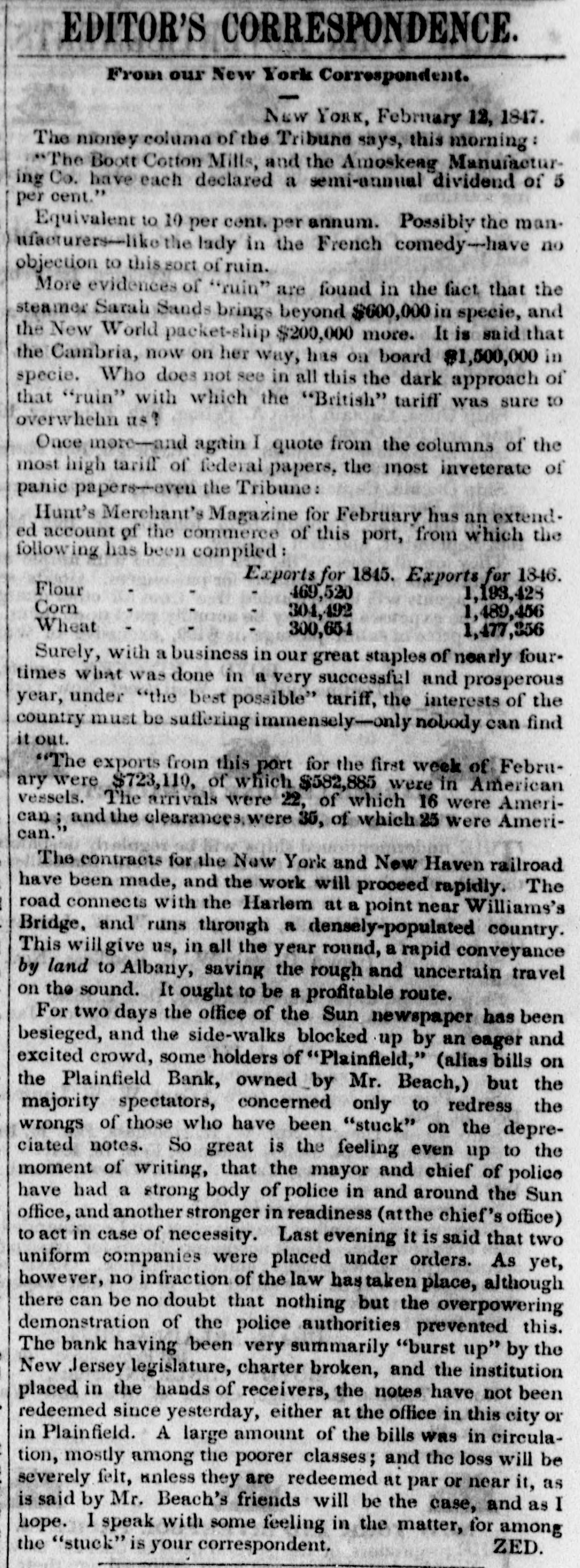
EDITOR'S CORRESPONDENCE. From our New York Correspondent. New YORK, February 12, 1847. The money columa of the Tribune says, this morning The Boott Cotton Mills, and the Amoskeng Manufacturing Co. have each declared a semi-annual dividend of 5 per cent." Equivalent to 10 per cent. per annum. Possibly the maninfacturers-like the lady in the French comedy-have no objection to this sort of ruin. More evidences of "ruin" are found in the fact that the steamer Sarah Sands brings beyond $600,000 in specie, and the New World packet-ship $200,000 more. It is said that the Cambria, now on her way, has on board $1,500,000 in specie. Who does not see in all this the dark approach of that "ruin" with which the "British" tariff was sure to overwhehn us? Once more-and again I quote from the columns of the most high tariff of federal papers, the most inveterate of panic papers-oven the Tribune: Hunt's Merchant's Magazine for February has an extended account of the commerce of this port, from which the following has been compiled Exports for 1845. Exports for 1846. Flour 469,520 1,193,428 Corn 304,492 1,489,456 Wheat 300,651 1,477,356 Surely, with a business in our great staples of nearly fourtimes what was done in a very successful and prosperous year, under "the best possible" tariff, the interests of the country must be suffering immensely-only nobody can find it out. "The exports from this port for the first week of February were $723,110, of which $582,885 were in American vessels. The arrivals were 22, of which 16 were American and the clearances were 35, of which 25 were American. The contracts for the New York and New Haven railroad have been made, and the work will proceed rapidly. The road connects with the Harlem at a point near Williams's Bridge, and runs through a densely-populated country. This willgive us, in all the year round, a rapid conveyance by land to Albany, saving the rough and uncertain travel on the sound. It ought to be a profitable route. For two days the office of the Sun newspaper has been besieged, and the side-walks blocked up by an eager and excited crowd, some holders of "Plainfield," (alias bills on the Plainfield Bank, owned by Mr. Beach,) but the majority spectators, concerned only to redress the wrongs of those who have been "stuck" on the depreciated notes. So great is the feeling even up to the moment of writing, that the mayor and chief of police have had a strong body of police in and around the Sun office, and another stronger in readiness (atthe chief's office) to act in case of necessity. Last evening it is said that two uniform companies were placed under orders. As yet, however, no infraction of the law hastaken place, although there can be no doubt that nothing but the overpowering demonstration of the police authorities prevented this. The bank having been very summarily "burst up" by the New Jersey legislature, charter broken, and the institution placed in the hands of receivers, the notes have not been redeemed since yesterday, either at the office in this city or in Plainfield. A large amount of the bills was in circulation, mostly among the poorer classes; and the loss will be severely felt, unless they are redeemed at par or near it, as is said by Mr. Beach's friends will be the case, and as I hope. I speak with some feeling in the matter, for among ZED. the "stuck" is your correspondent.


Article from The New York Herald, February 13, 1847

Click image to open full size in new tab

Article Text

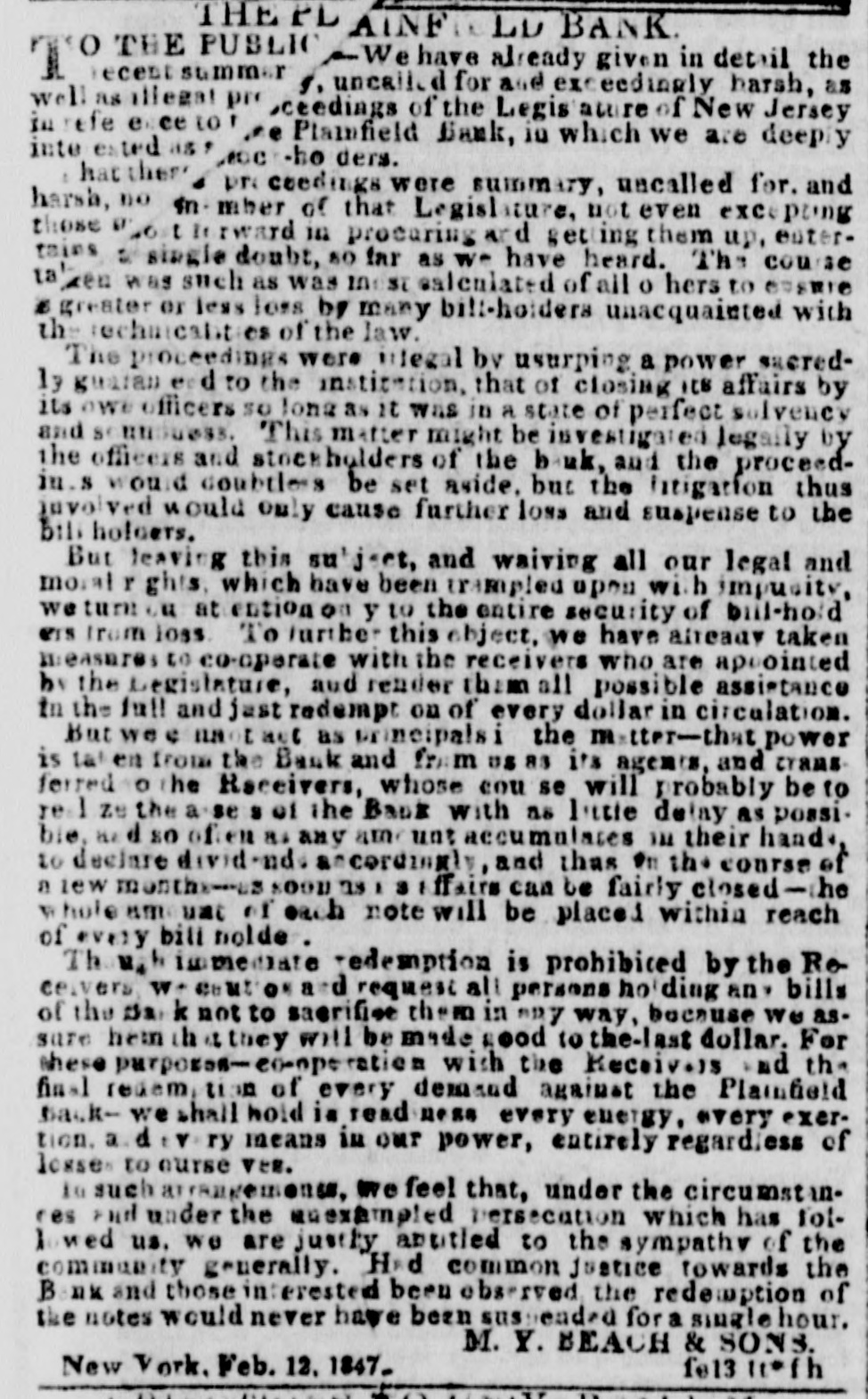
THE rL AINF LU BANK o PUBLIC THE We have already given in detail the ecent summer I, uncalle d for and exc feedingly barsh, as as illegal well pre sceedings of the Legis attre of New Jersey e refe ce to se Planfield Bank, in which we are deeply inte ested as JCC ho ders. hat there pr. ceedings were summ ry, uncalled for. and no harsh, in mber of that Legislature, not even exc pring those It rward 141 procuring and getting them up, eatertains single doubt, so far as we have heard. The cou se taken was such as was most salculated of all o hers to COSTIC . greater or less less by many bill-holders unacquainted with th technicality es of the law. The proceedings were illegal by usurping a power sacred13 guaran end to the institution, that of closing ICB affairs by its owe officers so long as it was in a state of perfect solvency and s unduess. This matter might be investigated legally by the officers and stock holders of the bank, and the proceedin. would coubtles be set aside. but the litigation thus involved would only cause further loss and suspense to the bill holders. But leaving this su'ject, and waiving all our legal and moral r ghts, which have been trampled upon with impusity, we turn ou at ention on y to the entire security of bill-hold ets from loss To urther this object, we have already taken measures to co-operate with the receivers who are apoointed by the Legislature, and render them all possible assistance In the full and just redempt on of every dollar in circulation. But we e as principals i the matter-that power is tal en from the Bank and US as its agents, and trans ferred he Receivers, whose cou se will probably be to re: Ze the a se s of the Bank with as little delay as possibie, and so often as any am unt accumulates in their hand. to declare divid nd. an cordingly, and thas 11 the course of a lew months US 8001 as 31 fairs can be fairly closed whole am uat of each note will be place within reach of every bill holde. Th M+ immediate redemption is prohibiced by the Rece. vers W caut on and request all persons hoding an bills of the 32 k not to sacrifiee them in any way, because we assure hem th a they will be made good to the-last dollar. For these purposes- co-operation wish the Receivers nd thfinal redem time of every demand against the Plainfield back- we shall hold is read ness every energy, every exertion. a d r y ry means in our power, entirely regardless of losse to curse VER. to such arrangements, we feel that, under the circumst inces and under the unexampled Persecution which has folwed us. we are justy antitled to the sympathy of the community generally. Had common justice towards the B nk and those in erested been observed the redemption of the notes would never have been sus endra for single hour. M. Y. EEACH & SONS. New York. Feb. 12. 1847. fe13 11*th


Article from The Daily Spy, February 15, 1847

Click image to open full size in new tab

Article Text

THE PLAINFIELD BANK. There has been quite an excitement in New York in relation to the condition of Plainfield Bank in New Jersey, which is owned almost entirely by Moses Y. Beach, of New York, proprietor of the Sun. It was reported in olvent, and an examining committee of the legislature reported in favor of appointing Receivers. Many rumors are in circulation, among others, that it has about one hundred and fifty thousand dollars in circulation, and that its genuine assets are very small.


Article from Richmond Daily Whig, February 15, 1847

Click image to open full size in new tab

Article Text

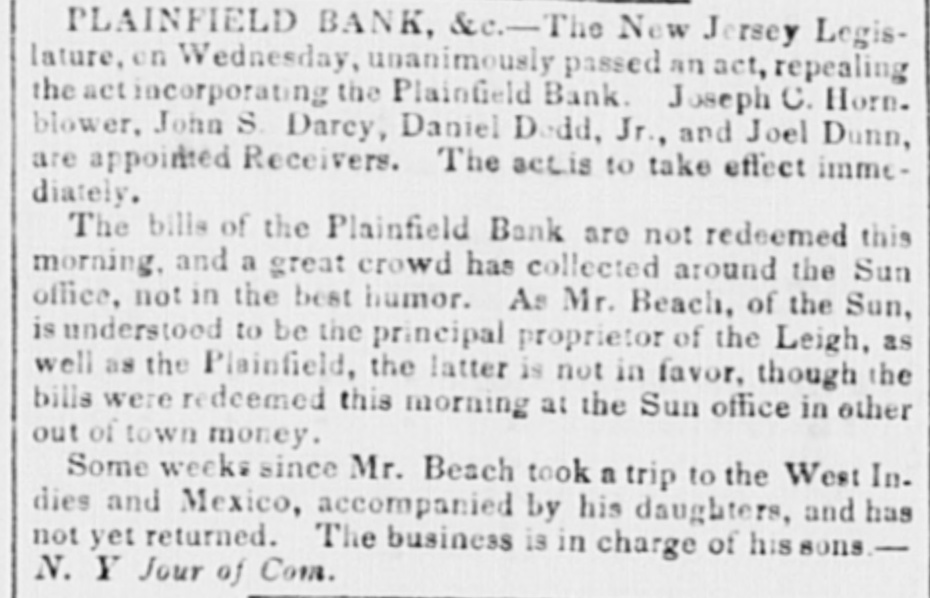
PLAINFIELD BANK, &c.-The New Jersey Legislature, on Wednesday, unanimously passed an act, repealing the actincorporating the Plainfield Bank Joseph C. Horn. blower. John S. Darcy, Daniel Dedd, Jr., and Joel Dunn, are appointed Receivers. The actis to take effect immediately. The bills of the Plainfield Bank are not redeemed this morning. and a great crowd has collected around the Sun office. not in the best humor. As Mr. Beach, of the Sun, is understood to be the principal proprietor of the Leigh, as well as the Plainfield, the latter is not in favor, though the bills were redeemed this morning at the Sun office in other out of town money. Some weeks since Mr. Beach took a trip to the West In. dies and Mexico, accompanied by his daughters, and has not yet returned. The business is in charge of hissonsN. Y Jour of Com.


Article from The Columbia Democrat, February 20, 1847

Click image to open full size in new tab

Article Text

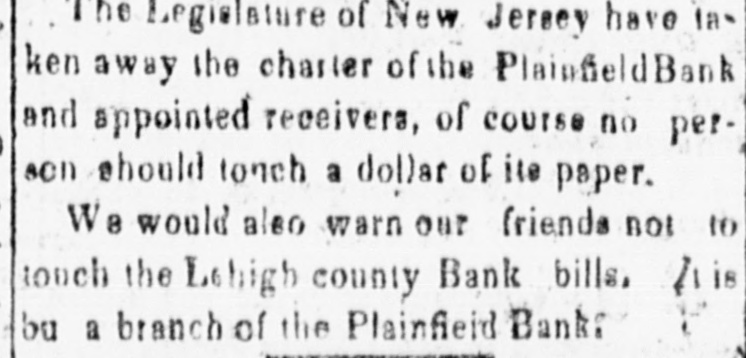
The Legislature of New Jersey have 18. ken away the charter of the Plainfield Bank and appointed receivers, of course no person should tonch a dollar of ite paper. We would also warn our friends not to touch the Lehigh county Bank bills, ti is bu a branch of the Plainfieid Bank:


Article from New-York Daily Tribune, March 25, 1847

Click image to open full size in new tab

Article Text

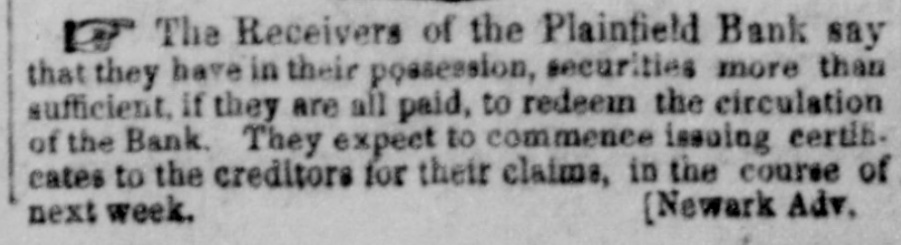
The Receivers of the Plainfield Bank say that they have in their possession, securities more than sufficient. if they are all paid, to redeem the circulation of the Bank. They expect to commence issuing certificates to the creditors for their claims, in the course of next week. (Newark Adv.


Article from New-York Daily Tribune, August 21, 1847

Click image to open full size in new tab

Article Text

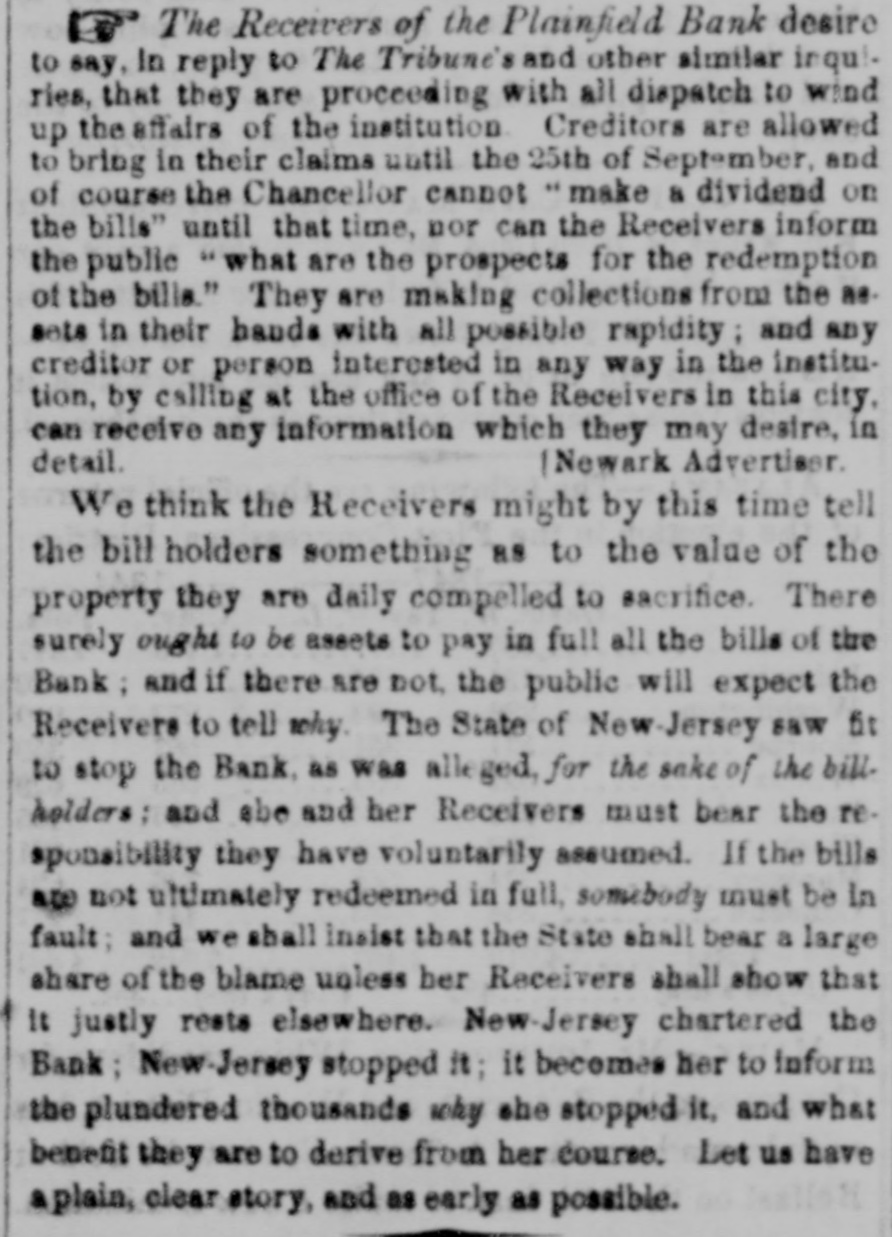
The Receivers of the Plainfield Bank desire to say, In reply to The Tribune's and other similar in quiries, that they are proceeding with all dispatch to wind up the affairs of the institution Creditors are allowed to bring in their claims until the 25th of September, and of course the Chancellor cannot "make & dividend on the bills" until that time, nor can the Receivers inform the public "what are the prospects for the redemption of the bills." They are making collections from the as. sets in their hands with all possible rapidity and any creditor or person interested in any way in the institution, by calling at the office of the Receivers in this city, can receive any information which they may destre, in detail. Newark Advertiser. We think the Receivers might by this time tell the bill holders something as to the value of the property they are daily compelled to sacrifice. There surely oughs to be assets to pay in full all the bills of the Bank: and if there are not, the public will expect the Receivers to tell why. The State of New Jersey saw fit to stop the Bank, as was alleged, for the sake of the bill. holders: and abe and her Receivers must bear the re. sponsibility they have voluntarily assumed. If the bills age not ultimately redeemed in full, somebody must be In fault; and we shall insist that the State shall bear a large share of the blame unless ber Receivers shall show that It justly rests elsewhere. New Jersey chartered the Bank: New Jersey stopped it; it becomes her to inform the plundered thousands why she stopped it, and what benefit they are to derive from her course. Let us have plain, clear story, and as early as possible.


Article from Jeffersonian Republican, August 26, 1847

Click image to open full size in new tab

Article Text

The Receivers of the Plainfield Bank are proceeding with all dispatch to wind up the affairs of the institution. Creditors are allowed to bring in their claims until the 25th of September, and of course the Chancellor cannot "make a dividend on the bills" until that time, nor can the receivers inform the public "what are the prospects for the redemption of the bills." They are making collections from the assets in their hands with all rapidity, and any creditor or person interested in any way in the institution, by calling at the office of the Receivors in this city, can receive any information which they may desire, in detail.- Newark Daily,


Article from New-York Daily Tribune, November 12, 1847

Click image to open full size in new tab

Article Text

COMMERCIAL AND MONEY MATTERS. For Sales of Stocks. &c. see Fourth Page. THURSDAY, P. M. The downward tendency of the Fancies has been resumed, and prices fell off. Treasury Notes were also lower than at any time since the loan was taken.Sales at the Second Board at 1/2 premium. In Bills there is no movement of importance.The supply is ample, and the rate for first-class bills91@ % Very few bills excepting Bank bills are selling. Freights continue very dull, and heavy freight has been taken for Liverpool in the packets at 20a, and to transient ships at 18a-Cotton is Id, Grain nominally 5d @ dd. and Flour 18d, with little or none offering. Some of the shipowners have been obliged to buy produce to fill up with. The Chancellor of New Jersey has ordered the books of the Plainfield Bank to be reopened for the issu. ing of certificates for the bills of that institution handed in to the Receivers. Thompson of 64 Wall-st. buys the notes at 40 cents on the dollar. We understand that the Money market is exceedingly stringent in Boston. The Banks are doing lit. tle or nothing in the way of discounts, and good paper in the street sells at 12 to 18 per cent. A very large jobbing house, Mesers. Kimball, Jewett & Co. failed there yesterday for upward of $200,000. Letters from London say that the great bill-discounting houses which are unquestioned have very large same of money on band which they dare not use.Overend, Gurney & Co. are said to have a million sterling lying idle. At Philadelphia money is not very difficult to be obtained. From 10 to 12 per cent. may be called the rate of discount on the best commercial paper. At Baltimore the demand for money is on the increase. Exchange on New-York has advanced to 1 per cent premium. Money, however, can be obtained for short loans on undoubted securities at fair rates.The Banks generally continue to afford facilities to the trading community to & liberal extent. The Auditors appointed to make distribution of the funds in the hands of the Trustees, under deed of assignment made by the Bank of the United States, May 1, 1841, have reported a farther dividend of 16 per cent upon the balance of principal and interest to June 15. 1847, on the post notes provided for by that assignment. The notes entitled to the benefit of this assignment are all dated in December, 1840, and each is numbered with one of the numbers, in 8 series from 7,543 to 9,644, both inclusive. There were 8,121 half eagles coined at the Dahlonega (Ga.) Branch Mint in the month of October, amounting to $40,605. The following are the comparative returns of the value of imports and exports, cash duties, amount of tonnage and number of arrivals and clearances at Philadelphia for the third quarter of 1846, and for the third quarter in 1847:


Article from Jeffersonian Republican, November 18, 1847

Click image to open full size in new tab

Article Text

has The Plainfiled Bank. An order has been issued by the Chancellor of New Jersey, directing the receivers of the Plainfield Bank 10 re-open their books, that the balance of the bill holders may come in for their share of the assets. edi behavouts bod


Article from New-York Daily Tribune, December 28, 1847

Click image to open full size in new tab

Article Text

Gov. Young-Plaindete Bank-New-JerseyM. Y. Beach & Sons, &cc. We published, some days since, a statement that Gov. Young had hesitated to surrender two of the jounger Beaches on & to quisition from New. Jersey. based on a charge of embezzlement or swindling in the matter of the Plainfield Bank; and to-day we give place to a card from Means. Beach & Sona, designed to viodicate their characters from the imputations which the fact that New-Jereey has made an earnest (though for the present ineffectual) call for them is calculated to give rise to. Oar readers will carefully scratinize its asseverations in the light of the fact already known, and form an impartial judgment. Whether any of the Mesars. Beaches have really been guilty of offences against the laws of New Jersey or not, we do not believe that Gov. Young has acted or will act in the premises without due deliberation and a decided conviction that the ground taken by him is that which the Constitution dictates. The position taken years ago by Gov. Seward, that citizens of New-York are not to be surreudered upon requisitions from the Executives of other States unless some offence is charged which is a crime against the laws of this State, has become a part of our settled public law. Of course no Governor of New York will henceforth surrender any citizen without careful inquiry and mature deliberation. Offences against laws or institutes condemning acts which are but locally regarded as crimeswill not be considered 58 subjecting the offender to extradition. If this be deemed wrong, the fault is not Gov. Young's -Perhaps we do not understand this Plainfield business very well; but we urgently advise the persons called for by New Jersey, if consciously innocent, to step across the Jersey Ferry, surrender themselves to the proper authorities. and stand trial. They can easily get bail and the very best of counsel-counsel who never yet suffered an innocent man to be convicted when employed and well paid to defend bim. With such advocates as the New-York Bar ffords, and cash to pick and choose among them, it is idle to suppose that any local prejadice or transitory excitement could prevail to the defeat of justice and the criminal conviction of honest men. Why not avoid the danger by meeting it half way? Another point: The Mesers. Beaches complain bitterly of harsh usage from New Jersey, her LegisIsture, Receivers, &c. &c.-with regard to which we express no opinion. It is manifest that the luckless bill-holders of the Plainfield at the time of its suppression have bad the worst of the matter so far, however serious the grievances of New. Jersey or the Mesars Beaches. It is admitted, we believe, that this Bank belonged (with the exception of a mere tritle of its stock. if any) to the Messrs Beaches-that its debts, its assets. were theirs : that its large circulation had been set afort and its proceeds had been realized by them, ao far so they were not in the viunts of the Bank when New Jersey closed it Now, why might not the Messrs Beacheshave justredeemed the outstanding notes, out of their ample property, and then demanded of the Receivers the surrender of their asmeta? The Bank's debta being paid, who but the bankers hid a shadow of a cision on these assets? What pretext could have remained for the continuance of the Receivers' functions and salaries --


Article from The New York Herald, January 11, 1848

Click image to open full size in new tab

Article Text

THE PLAINFIELD BANK.-We again call on the receivers of this Institution, to redeem the circulation now outstanding, by accepting the offer of its recent proprietors, or to be condemned by all honest men in the community. The Legislature of the State of New Jersey will meet today. There are applications for nearly a dozen new banks before that venerable body, and we hope there is honesty enough in the Legislature to take steps calculated to induce or compel the receivers of the Plainfield Bank to do their duty before it will think it necessary to chartet any more shaving institutions. We have sent a reporter to Trenton, to watch that body in this business.


Article from The New York Herald, January 12, 1848

Click image to open full size in new tab

Article Text

THE PLAINFIELD BANK AGAIN AND AGAIN.When will the receivers at Newark be feady to accept the proposition made to them, and pay the public for the broken bills in their hands, of this defunet institution n


Article from New-York Daily Tribune, February 5, 1848

Click image to open full size in new tab

Article Text

Holders of Plainfield Bank money are in formed that the time for presenting bills to the Receivers expires this week. It is said that only about $65,000, or little more than half of the admitted circulation, has been presented for redemption The rest is supposed to have been bought up by the brokers-possibly agents of the Beaches. The Receivers are supposed to have some 840,000 of available assets-80 that the bills already in their hands will probably be worth more than has been [Newark Adv. expected.


Article from Herald of the Times, and Rhode Islander, February 17, 1848

Click image to open full size in new tab

Article Text

# GOLD MINE IN CONNECTICUT Among the assets of M. Y. Beach & Sons, which the receivers of the Plainfield Bank, New Jersey, laid their hands on, was a gold mine, situated in the northern part of Connecticut. In the name of wooden nutmegs, what next?


Article from New-York Daily Tribune, August 2, 1848

Click image to open full size in new tab

Article Text

PLAINFIELD BANK.-We are authorized to say to our inquiring correspondents that the Receivers of the Plainfield Bank cannot pay a dividend out of the funds in their hands until a suit now pending in the Court of Chancery of the State of New-Jersey against them, involving almost the entire amount of those funds, is definitively disposed of: but that negotiations are now in progress. and the Receivers have every reason to believe will soon be consummated, which will enable them to close up the concern