Click image to open full size in new tab
Article Text
# Wor's efore the Legislature.
HAY VS. LEAKE ES TE.
Mr. Patterson introduced in the Senate a bill to determine the claim of James Hay to the real property and the proceeds thereof of John G. Leake, deceased.
Sec. 1. James Hay is hereby authorized within one year from the passage of this act to serve upon the Attorney General a complaint, in which he shall be named as plaintiff and the people of this State defendants, in which complaint it shall be alleged that the plaintiff is the heir of John G. Leake, deceased, and that as such heir is entitled to the proceeds of the sales of the real estate, and also to the possession of any which remains unsold which belonged to the said deceased at the time of his death.
Sec. 2. Within twenty days from the service of the said complaint the Attorney General shall serve an answer on the said plaintiff or his attorney, in which the several allegations contained in said complaint shall be denied.
Sec. 3. The issue thus joined shall be noticed for trial by the plaintiff, and placed upon the calendar of the Supreme Court at any circuit appointed to be held in the county where by the plaintiff the venue shall be laid, and shall be tried by a jury.
Sec. 4. From the joining of the said issue down to and including the trial and judgment, the same rules of practice of law and evidence shall be applicable to this case as are applicable to causes between individuals.
Sec. 5 provides that should Hay obtain a verdict by which he is declared heir to the estate of the late J. G. Leake, then he is to enter into possession, after deducting the costs of suit, the same as if he had been a citizen of this State at the time of the death of Leake; but at the same time Hay is to be held for any legal claim by any other legal heir who may establish a claim.
Sec. 6 allows Hay to use as evidence the testimony taken under two certain commissions issued by the Governor and Chancellor of the State of New Jersey.
# SAVINGS BANKS.
Mr. Sloan's bill on this subject is substantially as follows:-
That wherever savings banks have heretofore been authorized by an act of the Legislature, and the persons so constituted for such bank have not duly organized according to law, or have only nominally organized without proceeding to business, or whenever in the exercise of duties as a corporation they have invested any moneys deposited with them as such institution in any different form from that required by law, there charters are repeated; their failure to make proper reports, or falsified reports, works a like forfeiture of charter.
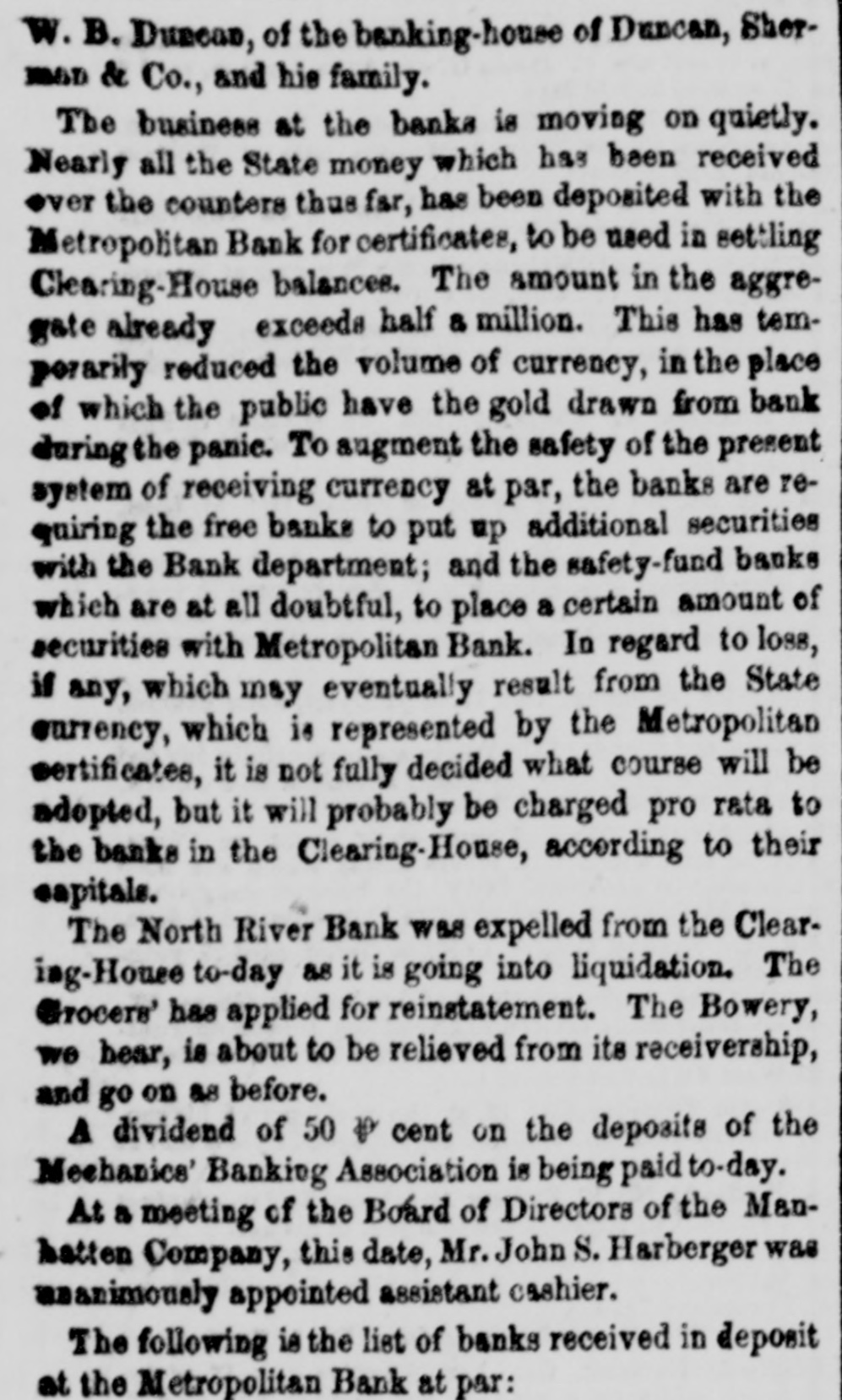
# NORTH RIVER AND GROCERS' BANKS AND THE MECHANICS' BANKING ASSOCIATION.
Mr. Brandreth's bill relative to these institutions provides-
1. That their failure to publish (while under injunction) the statement called for by the law of 1853 shall not be deemed a refusal or neglect under the second section of that act.
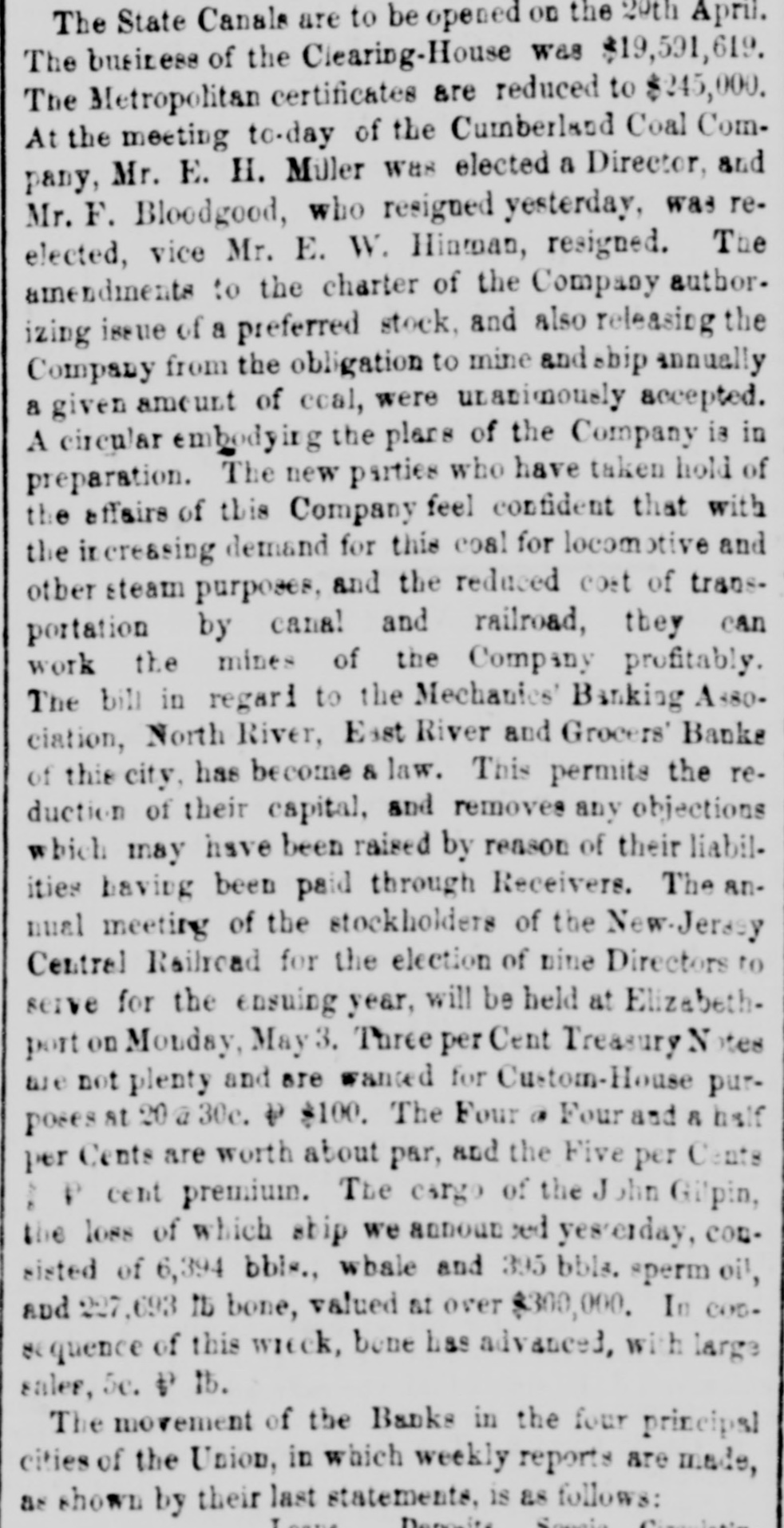
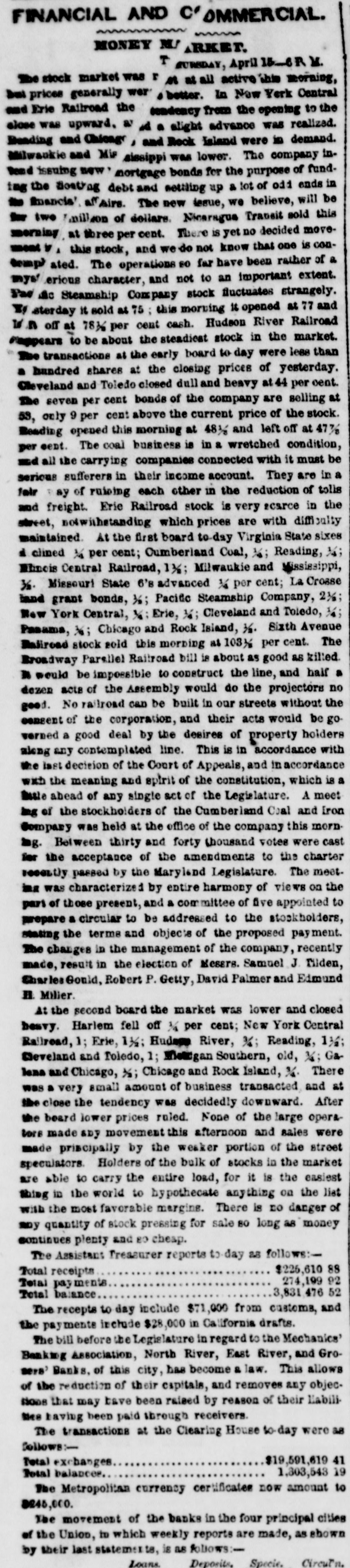
2. On the return by the receiver of the surplus remaining in his hands, after liquidating all claims to the directors of these banks, it makes it lawful for the directors, within thirty days after such return, or after having resumed the business of banking, to reduce their capital to an amount which shall be then equal to the value of such property above their debts and liabilities, and the par value of the shares to be reduced in like ratio; but in no case shall their capital be less than $100,000. They may, however, subsequently increase their capital to the full amount (and no more) named in their original articles of association.
3. When the directors of these banks shall elect to so reduce their capital, they shall notify the Bank Superintendent, who shall cause their books to be examined, and if necessary to examine the officers and directors under oath; and the Superintendent, from facts so obtained, shall determine the value of such capital. It shall not be lawful, however, to reduce such capital to an amount less than the value so fixed by the Bank Superintendent.
To take effect immediately.
# RIGHT OF EMINENT DOMAIN.
Mr. Sloan's bill, amending the act in relation to the appointment of commissioners to take property for public purposes, provides-That in all cases in which the law authorizes or requires the appointment, for the purposes of taking private property, to be used for public purposes, or making awards or assessments for public or local improvements, not less than thirty days notice of the application for such shall be given to all parties who may be in any way interested therein, in such manner as may be prescribed by the court or other authority authorized to make such appointments.
# WAREHOUSEMEN AND WHARFINGERS.
The bill proposed to be introduced by Senator Ames on this subject, provides-
1. That no warehouseman or wharfinger shall issue any receipt or other voucher for any goods, wares, merchandise, grain, or other produce or commodity to any person or persons purporting to be the owner or owners thereof, unless such goods, &c., shall have been bona fide received by such warehouseman, wharfinger or other person, and shall be in store and under his control at the time of issuing such receipt.
2. No such receipt to be issued as security for money loaned or other indebtedness, unless the merchandise is actually in the possession of the warehouseman at the time of issuing such receipt.
3. No warehouseman or wharfinger shall issue any second receipt for merchandise while any outstanding receipt is uncancelled, either in whole or in part.
4. The warehouseman shall not remove or transfer any merchandise beyond his immediate control where a receipt has been given, without the written consent of the party holding such receipt.
5. Any violation of the provisions of the act to be punished by a fine not exceeding $1,000, or by imprisonment in the State prison for a term not exceeding five years, or both. The parties aggrieved have the power to institute civil suits, also for all damages that may have accrued by reason of the violation of any part of this law.
The act to take effect immediately.
# SOUTH BAY STEAM FERRY COMPANY.
Mr. Mills' bill to incorporate the Great South Bay Steam Ferry Company, constitutes S. F. Griffin, E T. Smith, J. W. Pelletreme, and others, a body corporate, with a capital stock of $15,000, with power to increase to $15,000, for the purpose of building and running steam ferries between New York and Katchabonnock, Suffolk county, with the usual powers of such corporations.
# REFORM IN KINGS COUNTY PRISONS.
Mr. Duryea's bill relative to the jails in Kings county, provides for the appointment of a matron to have charge of female prisoners, by the Board of Supervisors, at such salary as said Board shall fix; empowers the Board to make rules and orders for the classification, separation, employment, &c. of all prisoners in any county prison, and obliges sheriffs and jailors to obey such orders; obliges the separation of witnesses from criminals, of juveniles from adults, of parties charged with crime from those convicted, and forbids any association between them. It also authorizes and requires the Board to make proper provisions for the safe keeping of prisoners, at the expense of the county.
# NEW YORK AND ERIE RAILROAD WAY FARE.
The bill of Mr. W. B. Jones to regulate way fare on this road prohibits the company from demanding or receiving from way passengers any greater rate of fare per mile than is charged for through passengers, and imposes a fine of $50 for violation.
# CENTRAL AMERICAN COMMERCIAL AND INDUSTRIAL COMPANY.
Mr. T. Jones' bill to incorporate the Central American Commercial and Industrial Company names as corporators Mere. Erastus Corning, E. D. Morgan, John L. Schoolcraft, William J. Perkins, Charles B. Hoard, John Cochran, Henry H. Elliott, Walter S. Burgess, E. George Squier, Randolph Martin, Wald Hutchins, John H. Peck and John Anderson. The object of the company is to facilitate emigration to Central America. The capital stock of the company is not to exceed $300,000, in shares of $100. The bill confers the ordinary privileges granted to such corporations.
# THE LIBEL LAW.
Mr. Beach has introduced the following bill:-
Sec. 1. In all actions for libel so much of malicious intent only shall be presumed by the fact of the publication as is necessary to sustain the action. Exemplary or vindictive damages shall only be awarded on proof of malice.
Sec. 2. The jury may determine the amount of damage caused by any libellous publication without the production of specific proof thereof.
# FIRST JUDICIAL DISTRICT.
Senator Scott's bill relative to the Supreme Court of the First Judicial district provides-
First That the power to grant, modify and dissolve injunctions in the First Judicial district shall be vested exclusively in the Justices of the Supreme Court in that district, as fully as the same was formerly vested in the Court of Chancery of the State, and gives the Justices full power to make such rules relative to this branch of their jurisdiction as they may deem discreet.
Second. Provides for the election of three additional Justices of the Supreme Court for the First district at the next State election, to hold office for eight years.
Third. Reduces the number of Justices of the Superior Court to three.
Fourth. Provides that, by consent of either party, causes involving more than $5,000 may be transferred from the Superior Court to the Supreme Court.
Fifth. Appeals shall be brought in all cases from final judgment of the Superior Court or Court of Common Pleas to the Supreme Court of the First district.
# BOARD OF SUPERVISORS.
Mr. Schell proposes to amend the law of last winter, relative to the supervisors of New York by digiditur