Vincennes National Bank (Vincennes, IN)

Episode Information

Episode UID
145401111
Episode Type
Suspension โ†’ Closure
Bank Type
national
Bank ID
14540 national
Charter Number
1454
Start Date
July 6, 1892
Location
Vincennes, Indiana (38.677, -87.529)

Metadata

Model
gpt-5-mini (chosen from majority vote of a three-model LLM ensemble)
Short Digest
333f00126183f4b6

Response Measures

None

Receivership Details

Depositor recovery rate
86.7%
Date receivership started
1892-07-22
Date receivership terminated
1900-10-24
OCC cause of failure
Fraud
Share of assets assessed as good
29.2%
Share of assets assessed as doubtful
30.0%
Share of assets assessed as worthless
40.9%

Description

Failure followed discovery of large shortages tied to president Wilson M. Tyler and his suicide.

Events (4)

1. July 17, 1865 Chartered
Source
historical_nic
2. July 6, 1892 Other
Newspaper Excerpt
President Wilson M. Tyler committed suicide, found lying across the grave of his daughter; shortage of the president revealed afterwards is assigned as the cause of insolvency in articles reporting July 9-14, 1892.
Source
newspapers
3. July 22, 1892 Receivership
Source
historical_nic
4. July 22, 1892 Suspension
Cause
Bank Specific Adverse Info
Cause Details
Insolvency caused by large shortages/embezzlement by president Wilson M. Tyler, discovered after his suicide.
Newspaper Excerpt
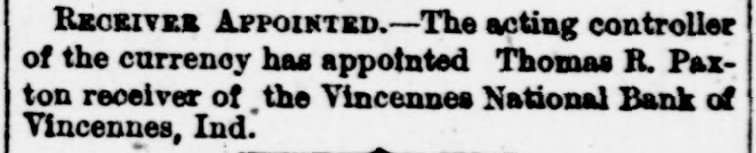
The acting controller of the currency has appointed Thomas R. Paxton receiver of the Vincennes National Bank of Vincennes, Ind.
Source
newspapers

Newspaper Articles (14)

Article from Grand Rapids Herald, July 11, 1892

Click image to open full size in new tab

Article Text

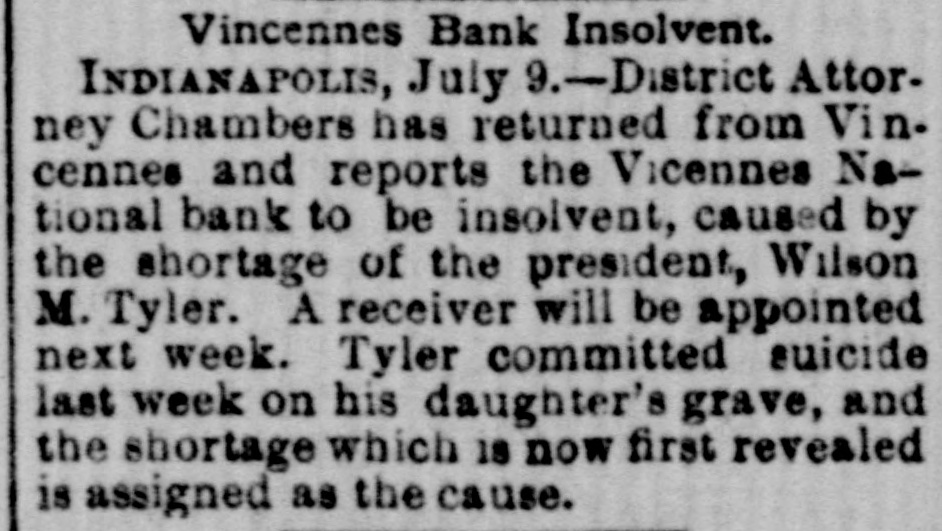
Vincennes Bank Insolvent. INDIANAPOLIS, July 9.-District Attorney Chambers has returned from Vincennes and reports the Vicennes National bank to be insolvent, caused by the shortage of the president, Wilson M. Tyler. A receiver will be appointed next week. Tyler committed suicide last week on his daughter's grave, and the shortage which 18 now first revealed is assigned as the cause.


Article from The Indianapolis Journal, July 14, 1892

Click image to open full size in new tab

Article Text

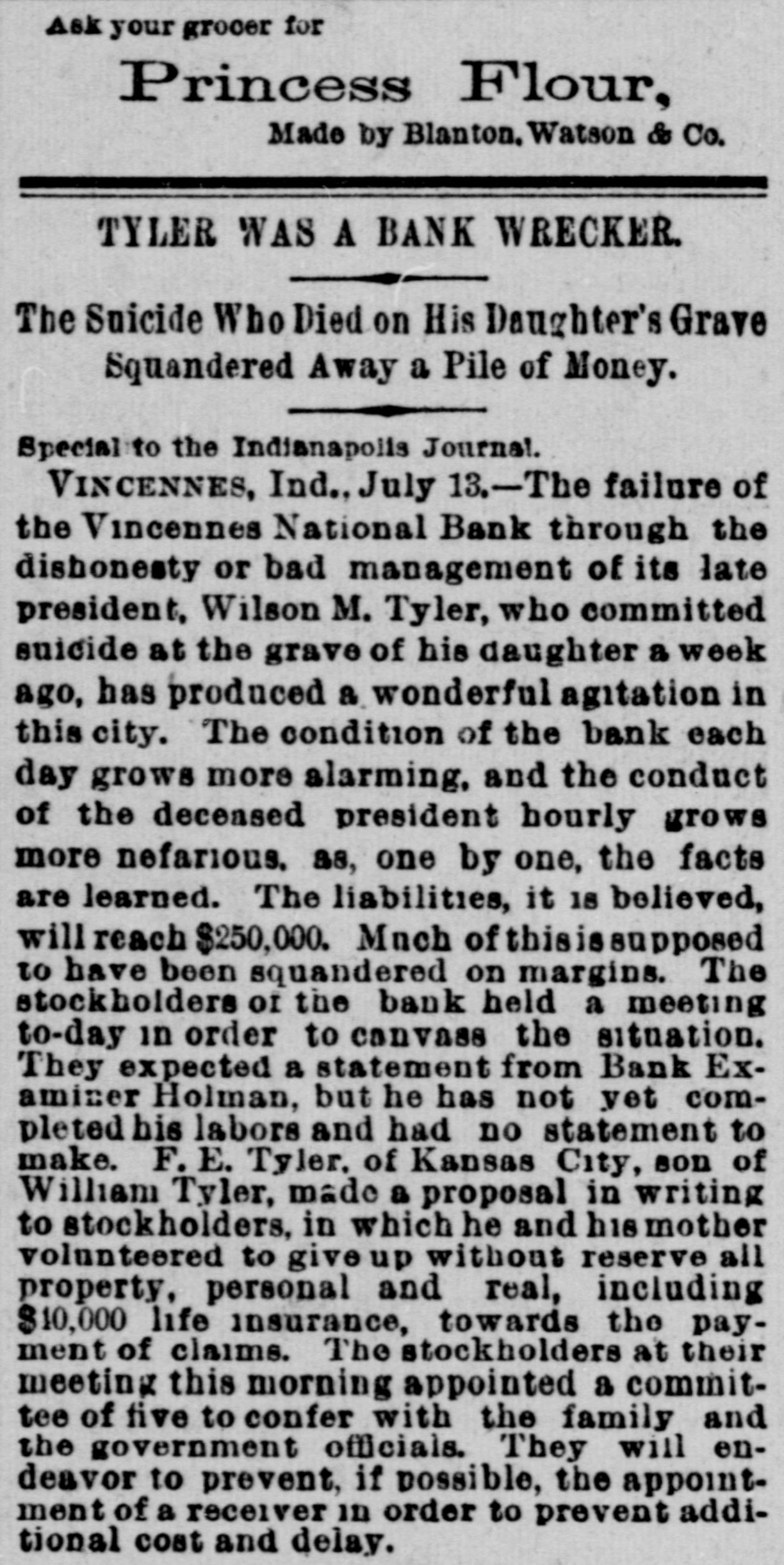
Ask your grocer for Princess Flour, Made by Blanton. Watson & Co. TYLER WAS A BANK WRECKER. The Suicide Who Died on His Daughter's Grave Squandered Away a Pile of Money. Special to the Indianapoils Journal. VINCENNES, Ind., July 13.-The failure of the Vincennes National Bank through the dishonesty or bad management of its late president, Wilson M. Tyler, who committed suicide at the grave of his daughter a week ago, has produced a wonderful agitation in this city. The condition of the bank each day grows more alarming. and the conduct of the deceased president hourly grows more nefarious. as, one by one, the facts are learned. The liabilities, it 18 believed, will reach $250,000. Much of thisissupposed to have been squandered on margins. The stockholders or the bank held a meeting to-day in order to canvass the situation. They expected a statement from Bank Examiner Holman, but he has not yet completed his labors and had no statement to make. F. E. Tyler. of Kansas City, son of William Tyler, made a proposal in writing to stockholders, in which he and his mother volunteered to give up without reserve all property, personal and real, including $10,000 life insurance, towards the payment of claims. The stockholders at their meeting this morning appointed a committee of five to confer with the family and the government officials. They will endeavor to prevent, if possible, the appointment of a receiver in order to prevent additional cost and delay.


Article from The Wilmington Daily Republican, July 14, 1892

Click image to open full size in new tab

Article Text

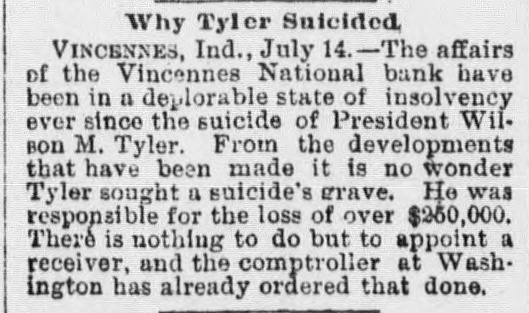
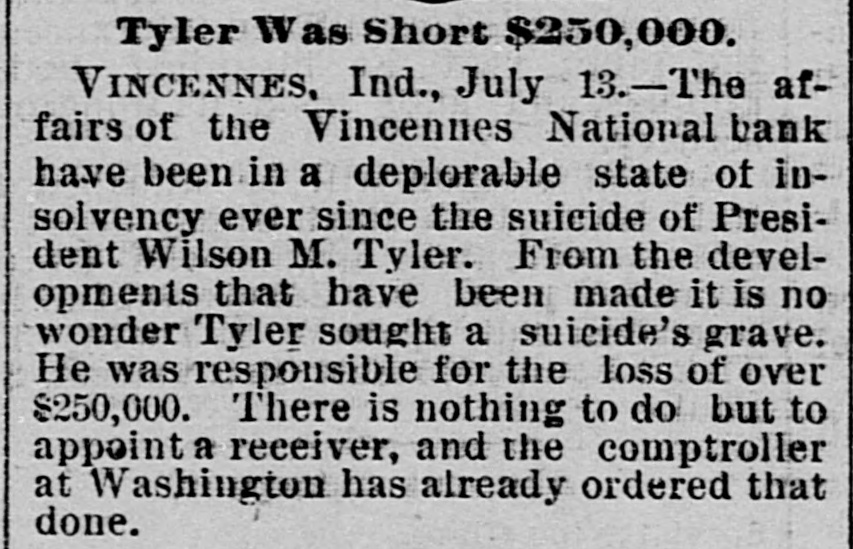
Why Tyler Suicided VINCENNES, Ind., July 14.-The affairs of the Vincennes National bank have been in a deplorable state of insolvency ever since the suicide of President WilBON M. Tyler. From the developments that have been made it is no wonder Tyler sought a suicide's grave. He was responsible for the loss of over $250,000. There is nothing to do but to appoint a receiver, and the comptroller at Washington has already ordered that done.


Article from New-York Tribune, July 14, 1892

Click image to open full size in new tab

Article Text

STOLE A QUARTER OF A MILLION. Vincennes, Ind., July 13.-The affairs of the Vincennes National Bank have been in a deplorable state of insolvency ever since the suicide of President Wilson M. Tyler. Tyler was responsible for the loss of over $250,000. There Is nothing to do but to appoint a receiver and the Controller at Washington has already ordered that done.


Article from Alexandria Gazette, July 21, 1892

Click image to open full size in new tab

Article Text

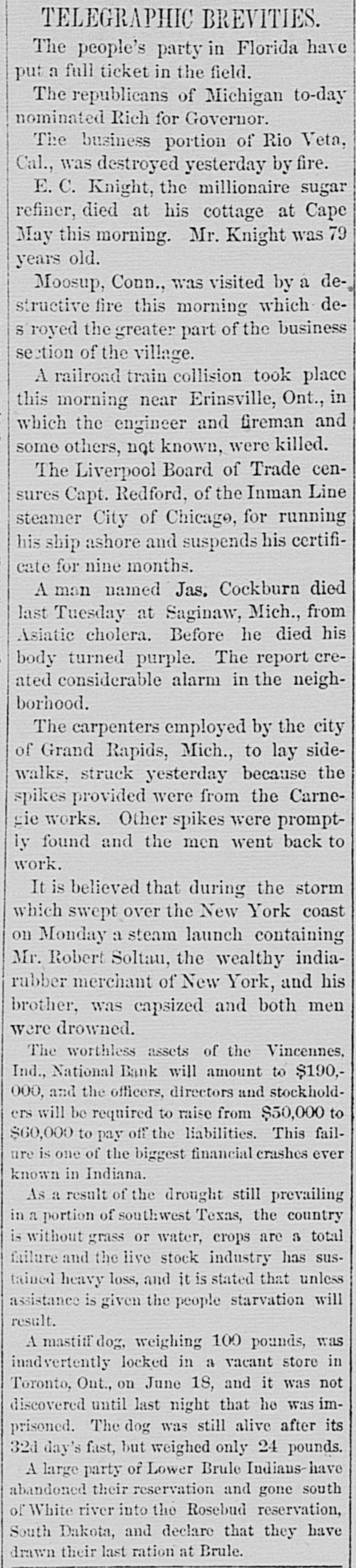
TELEGRAPHIC BREVITIES. The people's party in Florida have put a full ticket in the field. The republicans of Michigan to-day nominated Rich for Governor. The business portion of Rio Veta, Cal., was destroyed yesterday by fire. E. C. Knight, the millionaire sugar refiner, died at his cottage at Cape May this morning. Mr. Knight was 79 years old. Moosup, Conn., was visited by a destructive fire this morning which deS royed the greater part of the business section of the village. A railroad train collision took place this morning near Erinsville, Ont., in which the engineer and fireman and some others, not known, were killed. The Liverpool Board of Trade censures Capt. Redford, of the Inman Line steamer City of Chicago, for running his ship ashore and suspends his certificate for nine months. A man named Jas. Cockburn died last Tuesday at Saginaw, Mich., from Asiatic cholera. Before he died his body turned purple. The report created considerable alarm in the neighborhood. The carpenters employed by the city of Grand Rapids, Mich., to lay sidewalks, struck yesterday because the spikes provided were from the Carnegie works. Other spikes were promptly found and the men went back to work. It is believed that during the storm which swept over the New York coast on Monday a steam launch containing Mr. Robert Soltau, the wealthy indiarubber merchant of New York, and his brother, was capsized and both men were drowned. The worthless assets of the Vincennes, Ind., National Bank will amount to $190,000, and the officers, directors and stockholders will be required to raise from $50,000 to $60,000 to pay off the liabilities. This failure is one of the biggest financial crashes ever known in Indiana. As a result of the drought still prevailing in a portion of southwest Texas, the country is without grass or water, crops are a total failure and the live stock industry has sustained heavy loss, and it is stated that unless assistance is given the people starvation will result. A mastiff dog, weighing 100 pounds, was inadvertently locked in a vacant store in Toronto, Ont., on June 18, and it was not discovered until last night that he was imprisoned. The dog was still alive after its 32d day's fast, but weighed only 24 pounds. A large party of Lower Brule Indians-have abandoned their reservation and gone south of White river into the Rosebud reservation, South Dakota, and declare that they have drawn their last ration at Brule.


Article from Evening Star, July 22, 1892

Click image to open full size in new tab

Article Text

P RECEIVER APPOINTED.-The acting controller of the currency has appointed Thomas R. Paxton receiver of the Vincennes National Bank of Vincennes, Ind.


Article from Rock Island Daily Argus, July 23, 1892

Click image to open full size in new tab

Article Text

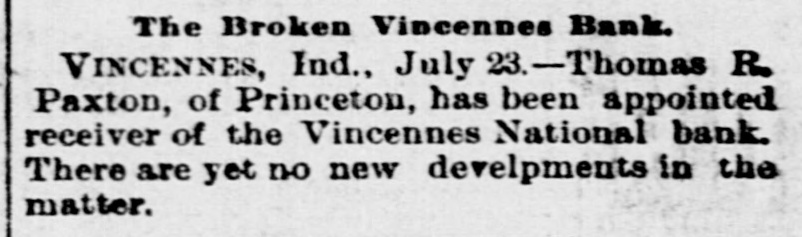
The Broken Vincennes Bank. VINCENNES, Ind., July 23.-Thomas R. Paxton, of Princeton, has been appointed receiver of the Vincennes National bank. There are yet no new develpments in the matter.


Article from The Indianapolis Journal, December 29, 1892

Click image to open full size in new tab

Article Text

# Offers to Compromise the Claim. Thomas R. Paxton, receiver of the defunct Vincennes National Bank, yesterday filed a report with Judge Baker, of the United States Court, concerning an indebtedness of Hiram A. Foulks, late cashier, amounting to $5,012.03. It is stated that Foulks agrees to compromise the claim, which he disputes, for $4,413.24, and the receiver recommends that the offer be accepted.


Article from Audubon County Republican, March 16, 1893

Click image to open full size in new tab

Article Text

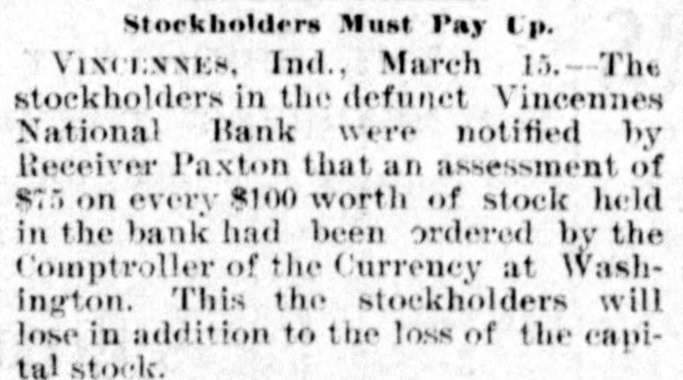
Stockholders Must Pay Up. VINCENNES, Ind., March 15.--The stockholders in the defunet Vincennes National Bank were notified by Receiver Paxton that an assessment of 875 on every 8100 worth of stock held in the bank had been ordered by the Comptroller of the Currency at Washington. This the stockholders will lose in addition to the loss of the capital stock.


Article from Rock Island Argus, December 22, 1893

Click image to open full size in new tab

Article Text

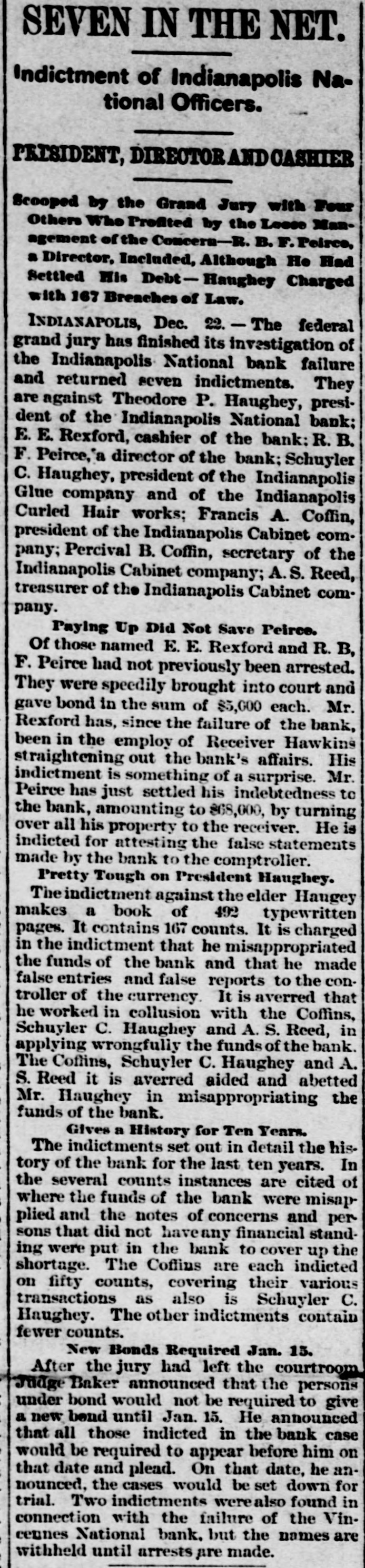
SEVEN IN THE NET. Indictment of Indianapolis National Officers. PRESIDENT, DIRECTOR ANDOASHIER Scooped by the Grand Jury with Four Others Who Profited by the Leese Management of the Concern-R. B. F. Poirce, a Director, Included, Although He Had Settled His Debt-Hanghey Charged with 167 Breaches of Law. INDIANAPOLIS, Dec. 22. - The federal grand jury has finished its investigation of the Indianapolis National bank failure and returned seven indictments. They are against Theodore P. Haughey, president of the Indianapolis National bank; E. E. Rexford, cashier of the bank: R.B. F. Peirce,'a director of the bank: Schuyler C. Haughey, president of the Indianapolis Glue company and of the Indianapolis Curled Hair works: Francis A. Coffin, president of the Indianapolis Cabinet company; Percival B. Coffin, secretary of the Indianapolis Cabinet company; A. S. Reed, treasurer of the Indianapolis Cabinet company. Paying Up Did Not Save Peirce. Of those named E. E. Rexford and R.B. F. Peirce had not previously been arrested. They were speedily brought into court and gave bond in the sum of $5,000 each. Mr. Rexford has, since the failure of the bank, been in the employ of Receiver Hawkins straightening out the bank's affairs. His indictment is something of a surprise. Mr. Peirce has just settled his indebtedness to the bank, amounting to 868,000, by turning over all his property to the receiver. He is indicted for attesting the false statements made by the bank to the comptroller. Pretty Tough on President Haughey. The indictment against the elder Haugey makes a book of 492 typewritten pages. It contains 167 counts. It is charged in the indictment that he misappropriated the funds of the bank and that he made false entries and false reports to the controller of the currency It is averred that he worked in collusion with the Coffins, Schuyler C. Haughey and A. S. Reed, in applying wrongfully the funds of the bank. The Coflins, Schuyler C. Haughey and A. S. Reed it is averred aided and abetted Mr. Haughey in misappropriating the funds of the bank. Gives a History for Ten Years. The indictments set out in detail the history of the bank for the last ten years. In the several counts instances are cited of where the funds of the bank were misapplied and the notes of concerns and persons that did not haveany financial standing were put in the bank to cover up the shortage. The Coffius are each indicted on fifty counts, covering their various transactions as also is Schuyler C. Haughey. The other indictments contain fewer counts. New Bonds Required Jan. 15. After the jury had left the courtroom Judge Baker announced that the persons under bond would not be required to give a new bend until Jan. 15. He announced that all those indicted in the bank case would be required to appear before him on that date and plead. On that date, he announced, the cases would be set down for trial. Two indictments were also found in connection with the failure of the Vinceunes National bank. but the names are withheld until arrests are made.


Article from The Indianapolis Journal, December 22, 1893

Click image to open full size in new tab

Article Text

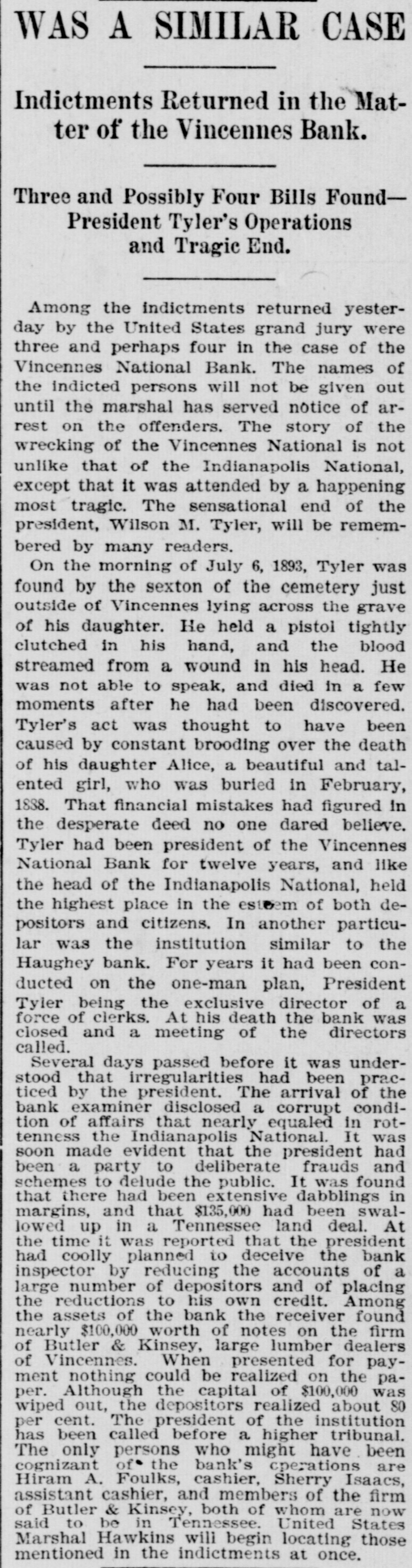
WAS A SIMILAR CASE Indictments Returned in the Matter of the Vincennes Bank. Three and Possibly Four Bills FoundPresident Tyler's Operations and Tragic End. Among the indictments returned yesterday by the United States grand jury were three and perhaps four in the case of the Vincennes National Bank. The names of the indicted persons will not be given out until the marshal has served notice of arrest on the offenders. The story of the wrecking of the Vincennes National is not unlike that of the Indianapolis National, except that it was attended by a happening most tragic. The sensational end of the president, Wilson M. Tyler, will be remembered by many readers. On the morning of July 6, 1893, Tyler was found by the sexton of the cemetery just outside of Vincennes lying across the grave of his daughter. He held a pistol tightly clutched in his hand, and the blood streamed from a wound in his head. He was not able to speak, and died in a few moments after he had been discovered. Tyler's act was thought to have been caused by constant brooding over the death of his daughter Alice, a beautiful and talented girl, who was buried in February, 1888. That financial mistakes had figured in the desperate deed no one dared believe. Tyler had been president of the Vincennes National Bank for twelve years, and like the head of the Indianapolis National, held the highest place in the esteem of both depositors and citizens. In another particular was the institution similar to the Haughey bank. For years it had been conducted on the one-man plan, President Tyler being the exclusive director of a force of clerks. At his death the bank was closed and a meeting of the directors called. Several days passed before it was understood that irregularities had been practiced by the president. The arrival of the bank examiner disclosed a corrupt condition of affairs that nearly equaled in rottenness the Indianapolis National. It was soon made evident that the president had been a party to deliberate frauds and schemes to delude the public. It was found that there had been extensive dabblings in margins, and that $135,000 had been swallowed up in a Tennessee land deal. At the time it was reported that the president had coolly planned to deceive the bank inspector by reducing the accounts of a large number of depositors and of placing the reductions to his own credit. Among the assets of the bank the receiver found nearly $100,000 worth of notes on the firm of Butler & Kinsey, large lumber dealers of Vincennes. When presented for payment nothing could be realized on the paper. Although the capital of $100,000 was wiped out, the depositors realized about 80 per cent. The president of the institution has been called before a higher tribunal. The only persons who might have been cognizant of the bank's operations are Hiram A. Foulks, cashier, Sherry Isaacs, assistant cashier, and members of the firm of Butler & Kinsey, both of whom are now said to be in Tennessee. United States Marshal Hawkins will begin locating those mentioned in the indictments at once.


Article from The Indianapolis Journal, January 13, 1894

Click image to open full size in new tab

Article Text

Vincennes Bank Wreck. Judge Baker, of the federal court, has approved the sale of $10,000 worth of real estate by Thomas R. Paxton, receiver of the Vincennes National Bank. He has also allowed Morris, Newberger & Curtis, Duncan & Smith, and Wm. A. Ketcham $5,250 for services as attorneys for the unsecured creditors of the Indianapolis Car Manufacturing Company.


Article from The Indianapolis Journal, May 23, 1894

Click image to open full size in new tab

Article Text

# Vincennes Case Transferred. Judge Baker, of the federal court, has issued a decree ordering the transfer of the suit of Thomas R. Paxton, receiver of the Vincennes National Bank, against the Vincennes Manufacturing Company, from the Knox Circuit Court to the federal court. The defendant asked for a judgment against the bank for $12,000.


Article from The Indianapolis Journal, December 16, 1898

Click image to open full size in new tab

Article Text

Defunct Vincennes Bank. Thomas R. Paxton, receiver of the defunct Vincennes national bank, began suit in the Federal Court yesterday to recover a 25 per cent. assessment on the capital stock of the bank from the stockholders. This will make the second assessment of 25 per cent. which the stockholders have been compelled to pay.