National Trust Company (New York, NY)

Episode Information

Episode UID
1479944390936
Episode Type
Run โ†’ Suspension โ†’ Closure
Bank Type
private
Bank ID
147994439 hash
Start Date
December 5, 1877
Location
New York, New York (40.714, -74.006)

Metadata

Model
gpt-5-mini (chosen from majority vote of a three-model LLM ensemble)
Short Digest
ea4d1c6f8919e088

Response Measures

None

Description

Sources show initial rumor-driven run (Dec 5โ€“6), enforcement of the ten-day rule, suspension in mid-December, and appointment of a receiver shortly after.

Events (4)

1. December 5, 1877 Run
Cause
Rumor Or Misinformation
Cause Details
Malicious reports/rumors of insolvency circulated in Wall Street and the press, causing heavy withdrawals.
Measures
Posted notice requiring ten days' notice for withdrawals; paid out small sums and certified checks for small amounts to calm depositors.
Newspaper Excerpt
The posting of a notice this morning requiring ten days' notice followed signs of a run.
Source
newspapers
2. December 14, 1877 Suspension
Cause
Rumor Or Misinformation
Cause Details
Following the run and recommendations of the special bank examiner, the company required ten days' notice and then suspended operations.
Newspaper Excerpt
The National Trust Company ... suspended yesterday
Source
newspapers
3. December 15, 1877 Receivership
Newspaper Excerpt
The Supreme Court of New York yesterday appointed William J. Best Receiver of the National Trust Company.
Source
newspapers
4. January 5, 1878 Other
Newspaper Excerpt
The receiver of the National Trust Company has been authorized by the court to pay a dividend of fifty per cent.
Source
newspapers

Newspaper Articles (22)

Article from Daily Press and Dakotaian, December 5, 1877

Click image to open full size in new tab

Article Text

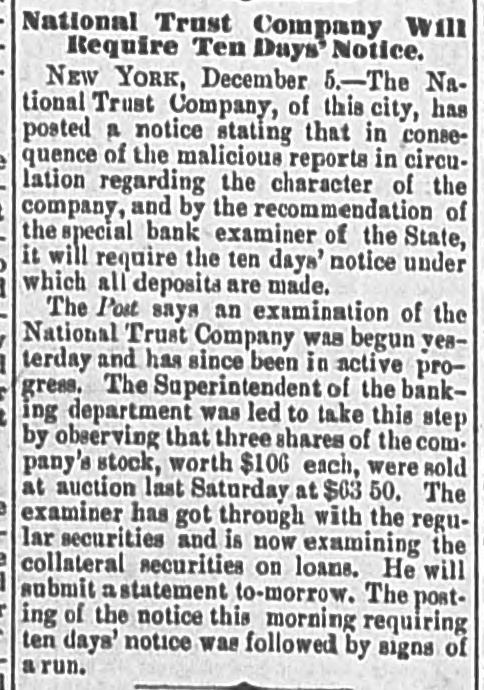
NEW YORK. THE NATIONAL TRUST COMPANY. New York, Dec. 5.-The National Trust Company of this city has posted a notice stating that in consequence of malicious reports in circulation regarding the character of the company, and by the recommendation of the special bank examiner of the state, they require 10 days notice, under which all deposits are made. The Evening Post says : "The examination of the affairs of the National Trust Company began yesterday, and has since been in active progress. The examiner has got through with the regular securities and is now EXamining the collateral securities on loans. He will submit a statement to-morrow. Posting of a notice this morning, requiring 10 days notice, followed signs of a run


Article from The Rock Island Argus, December 5, 1877

Click image to open full size in new tab

Article Text

The National Trust Company of New York Calling for Time-Their Affairs Being Examined. NEW YORK, Dec. ..The New York National Trust Co. of this city, has posted notices stating that in consequence of malicious reports in circulation regarding the character of the company, and by recommendation of the special bank examiners of the state we require the 10 days notice under which all deposits are made. NEW YORK, Dec. 5.-The Evening Post says: the examination of the affairs of the National Trust company began yesterday, and has since been in active progress. The examiner has got through with the regular securities and is now examining in collateral securities on loans. He will submit a statement to-morrow. The posting of notice this morning requiring 10 days notice was followed by signs of a run.


Article from The Cheyenne Daily Leader, December 6, 1877

Click image to open full size in new tab

Article Text

NEW YORK. Condition of the National Trust Company. New York, Dec. 5.-The Evening Post says an examination of the affairs of the National Trust company was begun yesterday and has since been in active progress. The Superintendent of the Banking Department was led to take this step by observing that three shares of the company's stock of $106 each were sold at auction last Saturday at $63.50 each. The examiner has got through with the regular securities, and is now examining the collateral securities on loans. He will submit a statement to-morrow. The posting of a notice this morning requiring ten days' notice followed the signs of a run.


Article from The Wheeling Daily Intelligencer, December 6, 1877

Click image to open full size in new tab

Article Text

National Trust Company will Require Ten Days' Notice. NEW YORK, December -The National Trust Company, of this city, has posted a notice stating that in consequence of the malicious reports in circulation regarding the character of the company, and by the recommendation of the special bank examiner of the State, it will require the ten days' notice under which all deposits are made. The Post says an examination of the National Trust Company was begun veaterday and has since been in active progress. The Superintendent of the banking department was led to take this step by observing that three shares of the com. pany's stock, worth $106 each, were sold at auction last Saturday at $03 50. The examiner has got through with the regular securities and is now examining the collateral securities on loans. He will submit statement to-morrow. The posting of the notice this morning requiring ten days' notice was followed by signs of run.


Article from The Sun, December 6, 1877

Click image to open full size in new tab

Article Text

THE TEN-DAY RULE. NATIONAL TRUST COMP DOING ITS BEST FOR DEPOSITORS. are Satisfied with President Mangam's Action-Some Accommodated, and the Outof-Town Business Men Attended To. unusually large throng had gathered the office of the National Trust Company at Broadway. at 10 A. M. yest. rday. Rumors of company's insolvency. which had been cirin Wall street the day previous, had evhad a disquieting effect, which the hasy-issued circular of the President had failed remove. The paying teller's window was open, and for two hours the payments made as rapidly as possible. The deposembraced all classes. some withdrawing as as $10,000 and $20,000, and others only a hundreds. At noon $400,000 had been paid The officers held a consultation. and it decided. in order "to allay the panic," that ten-day rule" should be enforced. Special Examiner Best. who has been investigatthe company's accounts. approved of this cision. and the following notice was accordposted in a conspicuous place on the telwindow: THE DE POSITORS OF THE NATIONAL TRUST COMPANY: In sequence of the malicious reports in circulation re: the character of this company. and by the rec. mendation of Mr. Best, the Special Bank Examiner of State. we hereby give notice that we require the ten notice under which all deposits are made. D R MANGAM, President cordially endorse the action of President Mangam in quiring the notice of ten days referred to above. WILLIAM J. BEST. Special Examiner, &c. About forty persons were in the office at the and the appearance of the notice caused grumbling. Charges were made that the had specially favored certain individuin the matter of withdrawing their deposits, no proof of this was furnished. After the excitement the feeling quieted down. the neral expression being that the officers had the best thing for the depositors, under circumstances. A gentleman who had $2,000 depositsaid to a SUN reporter, Well, they re deome to my money as long as they keep it Another said: It's all right. They done what the Union Dime people did, and hough it's a little hard on some of us. it's the thing for the depositors altogether." Notwithstanding the notice. the teller continto certify checks and pay out small sums, however, on orders from the President, Darius R. Mangam, who sat in a handsome in the southenstern corner of the main supported by two of the trustees. Messrs. arbell and Temple. Mr. Mangam is a pleasantitured gentleman. 50 or 55 years of age: tall.


Article from The Interior Journal, December 7, 1877

Click image to open full size in new tab

Article Text

THE German National Bank, of Chicago, the National Trust Company of New York, and the Peoples' Bank of Winchester, III., suspended yesterday, and yet Hayes adheres to the resumption hill.


Article from The New York Herald, December 8, 1877

Click image to open full size in new tab

Article Text

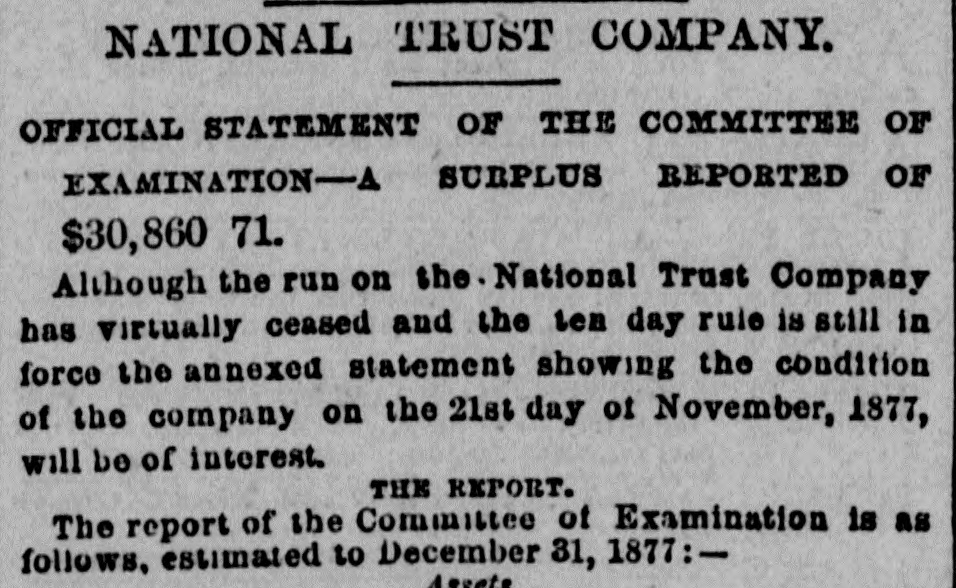
NATIONAL TRUST COMPANY. OFFICIAL STATEMENT OF THE COMMITTEE OF EXAMINATION-A SURPLUS REPORTED OF $30,860 71. Although the run on the. National Trust Company has virtually ceased and the icn day rule is still in force the annexed statement showing the condition of the company on the 21st day of November, 1877, will be of interest. THE REPORT. The report of the Committee of Examination is as follows. estimated to December 31, 1877:Assets


Article from The New York Herald, December 10, 1877

Click image to open full size in new tab

Article Text

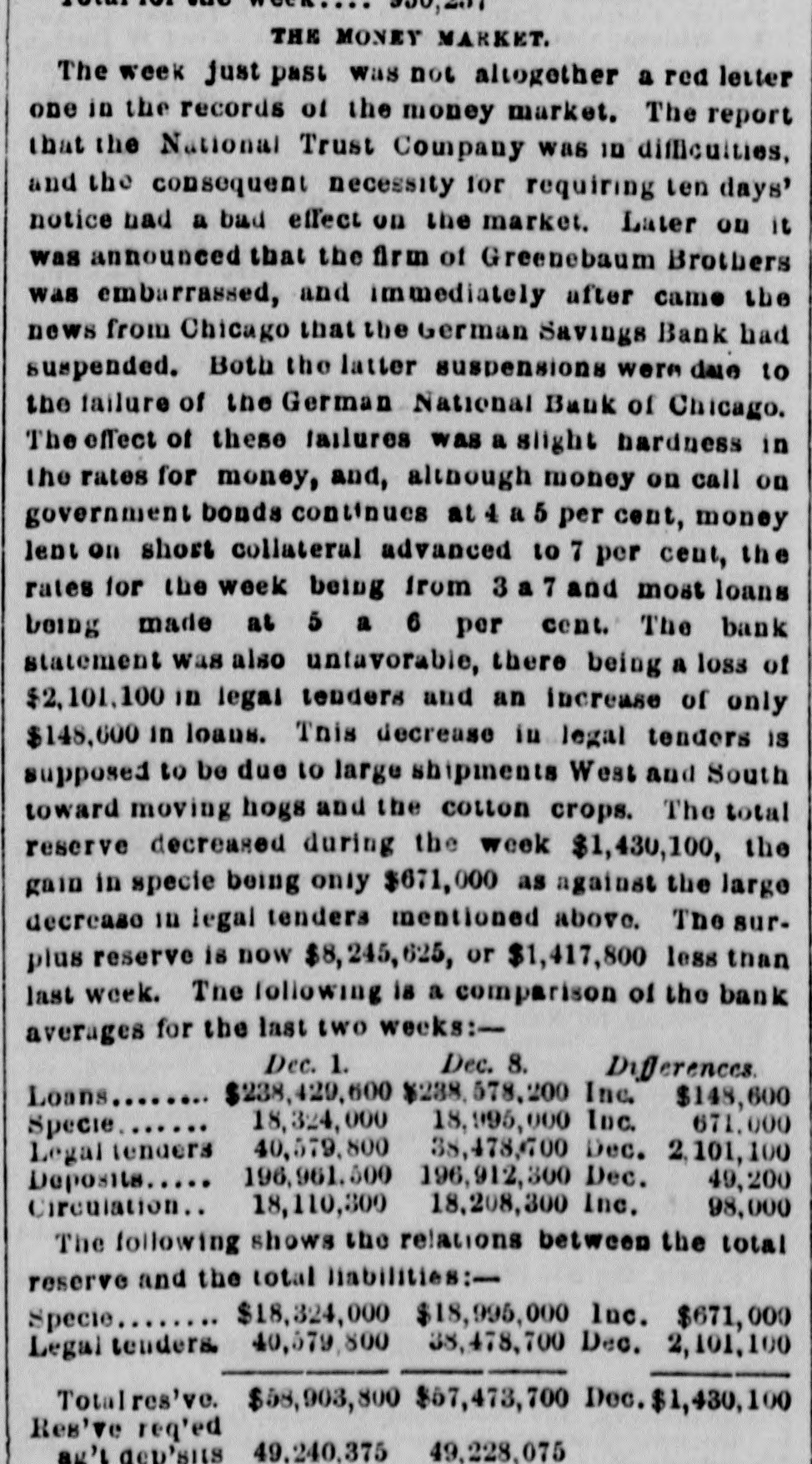
THE MONEY MARKET. The week just past was not altogether a red letter one in the records of the money market. The report that the National Trust Company was in difficulties, and the consequent necessity for requiring ten days' notice had a bad effect on the market. Later on it was announced that the firm of Greenebaum Brothers was embarrassed, and immediately after came the news from Chicago that the German Savings Bank had suspended. Both the latter suspensions were date to the failure of the German National Bank of Chicago. The effect of these failures was a slight hardness in the rates for money, and, although money on call on government bonds continues at 4 a 5 per cent, money lent on short collateral advanced to 7 per cent, the rates for the week being from 3 a 7 and most loans being made at 5 a 6 per cent. The bank statement was also unfavorable, there being a loss of $2,101,100 in legal tenders and an increase of only $148,600 in loans. This decrease in legal tenders is supposed to be due to large shipments West and South toward moving hogs and the cotton crops. The total reserve decreased during the week $1,430,100, the gain in specie being only $671,000 as against the large decrease in legal tenders mentioned above. The surplus reserve is now $8,245,625, or $1,417,800 less than last week. The following is a comparison of the bank averages for the last two weeks:Dec. 8. Dec. 1. Differences. Loans $238,429,600 $238. 578,200 Inc. $148,600 18,324,000 18,995,000 Inc. 671,000 Specie 40,579,800 38,478,700 Dec. 2,101,100 Legal tenders 196,961,500 196,912,300 Dec. 49,200 Deposits 18,208,300 Inc. Circulation. 18,110,300 98,000 The following shows the relations between the total reserve and the total liabilities:$18,324,000 $18,995,000 Inc. $671,000 Specie 40,579,800 38,478,700 Dec. 2,101,100 Legal tenders. Totalres've. $58,903,800 $67,473,700 Dec. $1,430,100 Res've req'ed 49,228,075 49.240.375


Article from Chicago Daily Tribune, December 10, 1877

Click image to open full size in new tab

Article Text

# Recent Currency Changes---The Disappearance of Small Bills. Clearings in Seventeen Citles---Condition of the United States Treasury. The Produce Markets More Active-Hog Plenty and Easy-Provisions Strong. Wheat and Corn Excited, but Closed Easier-Barley Dull-Oats Steady. # FINANCIAL. The banks of Chicago are to-day in a better and sounder condition than those of any other city in the country. That is the one good result of the recent failures of savings and national banks. Institutions that were weak and threatened the stability of the others have gone down, and the fittest survive. Chicago can say, as no other city in the country can safely do, that the last bank wrecks of the panic have been swept away. The virtual failure of the National Trust Company is not the only symptom of possible trouble in New York. It may be regarded as certain that in all the principal cities in the country there are unsound financial institutions which have since the panic been struggling for existence in the hope that a turn would come to save them. The year 1877 has been a disastrous failure for those who have been waiting since 1873 for a rising tide to float them off. It can be safely said of Chicago that its remaining nationals banks are all sound, and that it is financially stronger than any other city. The loan market during the week was inactive. The mud blockade was unbroken, and affected general trade in city and country unfavorably. There were only moderate offerings of good paper. Rates of discount were 7@ 10 per cent at the banks to regular customers. On the street, call loans were 6 per cent. New York exchange was quoted Saturday between banks at par. The currency movement was increased by orders from the hog districts. The clearings of the week are reported as follows by Manager D. R. Halo, of the Chicago Clearing-House:


Article from The Wheeling Daily Intelligencer, December 15, 1877

Click image to open full size in new tab

Article Text

-The - Supreme Conrt of New York yesterday appointed William J. Best Receiver of the National Trust Company.


Article from The Sun, December 16, 1877

Click image to open full size in new tab

Article Text

THE CLOSED TRUST COMPANY. Receiver Best Tells the Depositors that They WIN Probably be Paid In Full. At the opening of business yesterday, a crowd of excited depositors gathered at the Na. tional Trust Company's office. and as soon as Receiver Best appeared, clamored for admission to his presence. Mr. Best quitted the office. soon after the opening, for the purpose of filing his bonds. His surettes are Author 2 Bond street: John J. Burchill, 708 Lexington avenue, and George Caulfield, and the bond is for $200,000. Mr. Burchill is a contractor. and is one of the largest depositors with the company. Early in the day the following notice was posted:


Article from The Morning Herald, December 18, 1877

Click image to open full size in new tab

Article Text

THE HERALD. 15. 1877 Delaw 71mington. HERALD NOTES. 00 The Texas-Pacific Railroad was probably supported by the House. The Oriental Savings Bank of Grand, / treet, New York, has exploded. Servia formally declares, war and her croops are on the way to the front. The National Trust Company, of New York, has gone to ruin. Deficit, $700,000. Mr. Ryland has withdrawn from the Benatorial contest in California. Mr. Dalane's health is somewhat im proved. He purposes spending the winter Cannes. Samuel Tyler, the Senior Professor in the Law Department of Columbia University, Washington, died at Georgetown, Saturday. Dr. Ninian Pinkney, a retired medical director, United States Navy, after brief illness, died Saturday at his home in Easton, Talbot county, Md. Europe expended for telegraphic messages last year $14,400,000. The military telegraph line around the Texas frontier to E1 Paso and up to Misula, New Mexico, has been completed. The crush 10 hear Moody and Sankey was so great in Providence that a horse car was crowded off the track, and clothing was ruined. The City of Peking, on ber last voyage, brought 100 packages of silk worm egge from Japan to San Francisco, consigned to a firm in Italy. The Congregational Church, of Walcott decided that the use of wine at the communion table tends to promote intemperance. Water is hereafter to be used. Oh! By the new route from Portpatrick to p Stranraer, new passage 'twixt the England and Scotland, is but twenty-two miles, and Belfast is within nine hours of Glasgow. President Sherman Broadwell, of the decayed Claimmont Savings Bank, is in jail for perjury in concealing fraud. It 18 rumored that Thomas H. Whitman the murdered Staten Island merchant, has turned up at home, not half 80 dead 88 he was. Dom Pedro's visit has already come to th good. Tbe Brazilian government has voted B a yearly subsidy of $100,000, during ten years, for a line of steamers to the United States. 10 Davenport, Iowa, is where the last clerical at escapade took place. A nice minister raised on borrowed what cash money he could forged checks, and then vamosed the ranch SO Of forty<three varieties of apples tested 13 by M. Truelle, of the Chemical Society of American found Paris, contain the red the genette was th to largest amount of sugar. TI A Scotchman has that alcoholic everybody who drinks proposed liquore should be compelled to take out a license. This, at $5 ahead a year would raise a very pretty revenue. re citizens of Nevada ro Leading want the boundary line of California and Nevada fixed at the summit of the Sierras so that in their State can have Surprise and Honey Lake valleys. of no th A woman fifty-nine years old, with her at in La having son, arrived walked Grange, Oregon, recently, !hither from her home in he pl Indiana. She carried a pack weighing 75 pounds. CO J to The London Gardeners' Chrontile says that a bunch of grapes from Lady Charles ille's, Klogs county, Ireland, 21 feet pounds and 5 ounces in is E inte beheavies weight. long ver grown wart in " HII in I. fewer Three when Phosburgh la n sudde 14 d 1 way show e: de " water poured in " the K1 c.r 1-dr distance. of dis su blocks, ell. hat they T m severay so fast and nearly drowned pl of The Bank of Russia 14 supper of 10 bold for 40 met differ reserve of $125,000,000 to be the outhed only as a last resource; but now be in osinnations are thrown out that this grea se um Is not really there. of du Bellef In the existence of a subterranean pli ake near Newburyport, Maes. led to the par etc inking of a well. Clear water was found de de depth of fifty feet, lu such quantities Be hat there is a talk of supplying the city dr ith it. of K oth A committee of country schoolboys visit sol Edwin Booth, in Utica, for the purpose ke f him to act in their Ph was to in T heir engaging idea appear themselves exhibition. Hamlet,' with Mr. Booth in the title role


Article from National Republican, December 18, 1877

Click image to open full size in new tab

Article Text

THE National Trust Company, of New York, has been placed in the hands of a receiver. .


Article from The New Orleans Daily Democrat, December 22, 1877

Click image to open full size in new tab

Article Text

A Bad Break, [St. Louis Globe-Democrat, 19th inst.] The report of the examiner of the National Trust Company of New York is a most interesting and exhaustive document, but it lacks one element of value-It was made about four years too late. Its interest now is purely historical and speculative, as showing how a great banking corporation was wrecked, and as suggesting how it might have been saved. But if the examination on which the report is based had been made at the time when it ought to have been made-if it had been made upon the terms and circumstances contemplated by the lawthe failure would have been avoided; the loss would have fallen on those who would have had only their own actions to bear the blame of, and the banking business would have been spared a shock which is too serious not to excite alarm. Anything which imperils the security of $7,000,000 of deposits in a single bank imperils the security of $500,000,000 of savings in all the banks of the country. A bank panic is one of the most contagious of outbreaks. A general stampede of depositors would be as injurious as a rush of a frightened audience in a densely crowded hall, only on a vastly larger scale. and such a stampede may occur at any time if such rotten institutions as the National Trust Company are allowed to continue doing business. and if the laws which are enacted for the protection of property and the punishment of fraud are disregarded and ignored by those charged with their enforcement. It speaks volumes for the good sense of the American people that they have resisted the frequent temptations which have invited such a panic, and it would be well to take advantage of that good sense, while it lasts, to take pr+ cautions against the possible consequences of its being overthrown. In the case of the National Trust Company. a compliance with the plain law of its charter would have rendered ailure impossible: but the law was never complied with. and the bank examiner could not possibly have known anything of its condition for years past. The law directed that the funds which constituted its trust should be invested in mortgages on real estate in "the State of New York, or stocks or bonds of the United States or of incorporated cities in the State." These were the only securities it had a right to buy. but the examiner finds it loaded up with wild-cat bonds of every description. third mortgages and stocks with three mortgages in front of them. Everybody now sees that the concern is rotten and must have been rotten for some time: it makes so bad a showing that the Grand Jury has taken it up. and the chances are that some of its directors will follow the illustrious convicts, Case and Gilman, who are serving the State at Sing Sing. But the conviction of a fraudulent director does no good to any one. What is needed is that fraud should be rendered impossible, not 80 much by punishment as by prevention. There are laws that provide for the reasonable and proper supervision of banks, but they are never enforced, and banks which are solvent are obliged to see suspicion cast on their reputations by such disclosures as the one under notice. The interests of sound banking demand that the real condition of all banks should be at all times known to the public as well as to the bank examiner: and it would be worth while for the bankers of the United States to take active steps, and to enforce the authority they possess for the prevention of disasters by which they must all suffer.


Article from Public Ledger, January 5, 1878

Click image to open full size in new tab

Article Text

The National Trust Company. NEW YORK, January 5.-The receiver of the National Trust Company has been authorized by the court to pay a dividend of fifty per cent.


Article from National Republican, January 11, 1878

Click image to open full size in new tab

Article Text

RECEIVER BEST. of the suspended National Trust Company of New York, began paying to depositors a dividend of fifty per cent. Fuesday morning.


Article from New-York Tribune, January 24, 1878

Click image to open full size in new tab

Article Text

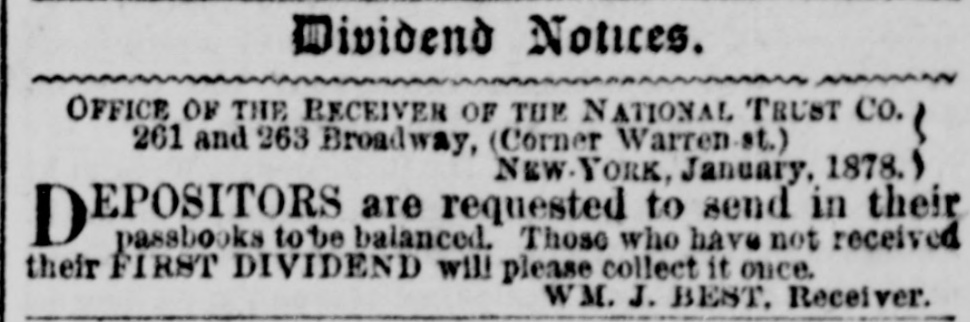
OFFICE OF THE RECEIVER OF THE NATIONAL TRUST Co. 261 and 263 Broadway, (Corner Warren-st.) NEW-YORK, January, 1878. EPOSITORS are requested to send in their passbooks to be balanced. Those who have not received their FIRST DIVIDEND will please collect it once. WM. J. BEST. Receiver.


Article from New-York Tribune, January 30, 1878

Click image to open full size in new tab

Article Text

OFFICE OF THE RECEIVER OF THE NATIONAL TRUST Co. 261 and 263 Broadway, (Corner Warren-st.) NEW-YORK, January, 1878. EPOSITORS are requested to send in their D passbooks to be balanced. Those who have not received their FIRST DIVIDEND will please collect it once. WM. J. BEST, Receiver.


Article from The Rock Island Argus, January 7, 1879

Click image to open full size in new tab

Article Text

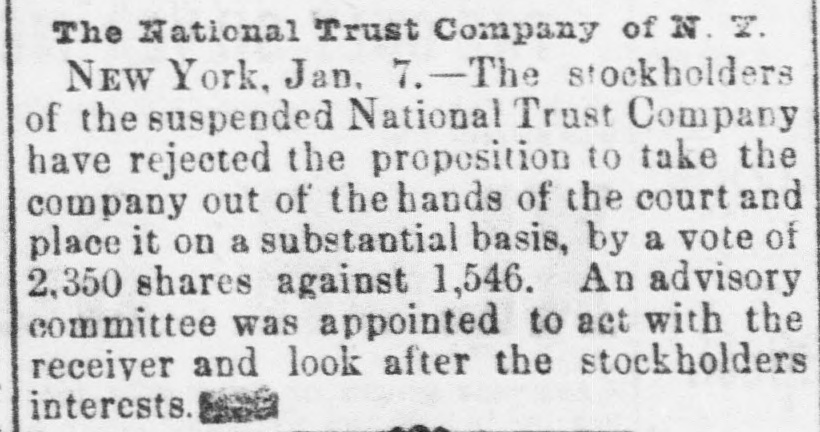
The National Trust Company of N. V. NEW York, Jan. 7.-The stockholders of the suspended National Trust Company have rejected the proposition to take the company out of the hands of the court and place it on a substantial basis, by a vote of 2,350 shares against 1,546. An advisory committee was appointed to act with the receiver and look after the stockholders interests.


Article from The New York Herald, January 7, 1879

Click image to open full size in new tab

Article Text

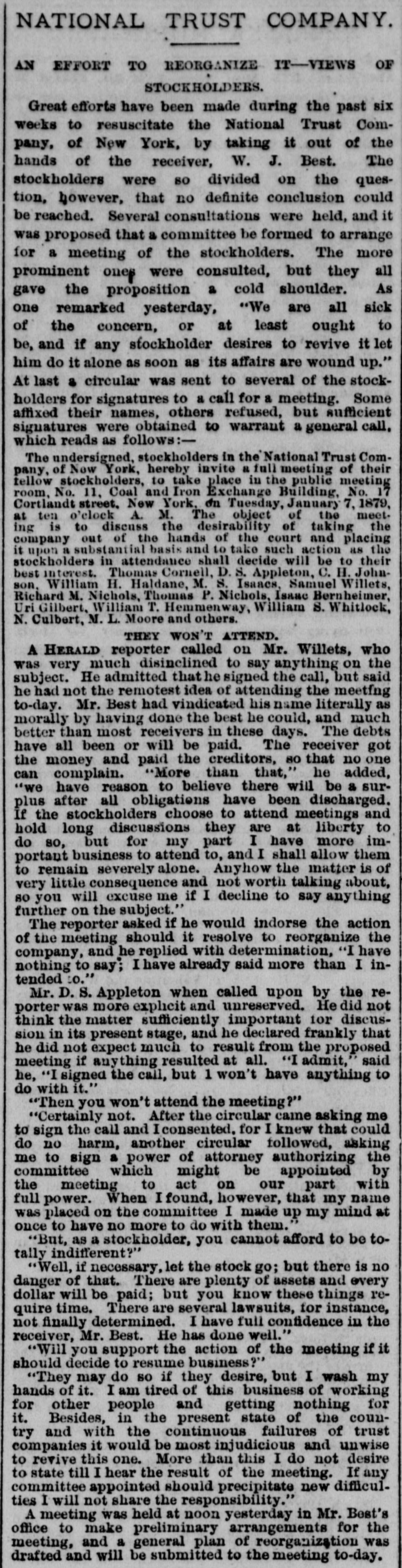
NATIONA TRUST AN EFFORT TO REORGANIZE IT-VIEWS OF STOCKHOLDERS. Great efforts have been made during the past six weeks to resuscitate the National Trust Company, of New York, by taking it out of the hands of the receiver, W. J. Best. The stockholders were so divided on the question, however, that no definite conclusion could be reached. Several consultations were held, and it was proposed that a committee be formed to arrange for a meeting of the stockholders. The more prominent ones were consulted, but they all gave the proposition a cold shoulder. As one remarked yesterday, "We are all sick of the concern, or at least ought to be, and if any stockholder desires to revive it let him do it alone as soon as its affairs are wound up." At last a circular was sent to several of the stockholders for signatures to a call for a meeting. Some affixed their names, others refused, but sufficient signatures were obtained to warrant a general call. which reads as follows:The undersigned, stockholders in the National Trust Company, of Now York, hereby invite a full meeting of their fellow stockholders, to take place in the public meeting room, No. 11, Coal and Iron Exchange Building, No. 17 Cortlandt street. New York, on Tuesday, January 7, 1879, at ten o'clock A. M. The object of the meeting is to discuss the desirability of taking the company out of the hands of the court and placing it upon a substantial basis and to take such action as the stockholders in attendance shall decide will be to their best interest. Thomas Cornell, D. S. Appleton, C. H. Johnson. William H. Haldane, M. S. Isaacs, Samuel Willets, Richard M. Nichols, Thomas P. Nichols, Isaac Bernheimer, Uri Gilbert, William T. Hemmenway, William S. Whitlock, N. Culbert, M. L. Moore and others. THEY WON'T ATTEND. A HERALD reporter called on Mr. Willets, who was very much disinclined to say anything on the subject. He admitted that he signed the call, but said he had not the remotest idea of attending the meeting to-day. Mr. Best had vindicated his name literally as morally by having done the best he could, and much better than most receivers in these days. The debts have all been or will be paid. The receiver got the money and paid the creditors, 80 that no one can complain. "More than that," he added, "we have reason to believe there will be a surplus after all obligations have been discharged. If the stockholders choose to attend meetings and hold long discussions they are at liberty to do so, but for my part I have more important business to attend to, and I shall allow them to remain severely alone. Anyhow the matter is of very little consequence and not worth talking about, so you will excuse me if I decline to say any thing further on the subject.' The reporter asked if he would indorse the action of the meeting should it resolve to reorganize the company, and he replied with determination, "I have nothing to say; I have already said more than I intended to." Mr. D. S. Appleton when called upon by the reporter was more explicit and unreserved. He did not think the matter sufficiently important for discussion in its present stage, and he declared frankly that he did not expect much to result from the proposed meeting if anything resulted at all. "Iadmit," said he, "Isigned the call, but 1 won't have anything to do with it.' "Then you won't attend the meeting?" "Certainly not. After the circular came asking me to sign the call and Iconsented. for I knew that could do no harm, another circular followed, asking me to sign a power of attorney authorizing the committee which might be appointed by the meeting to act on our part with full power. When Ifound, however, that my name was placed on the committee I made up my mind at once to have no more to do with them. But, as a stockholder, you cannot afford to be totally indifferent?' "Well, if necessary, let the stock go; but there is no danger of that. There are plenty of assets and every dollar will be paid; but you know these things require time. There are several lawsuits, for instance, not finally determined. I have full confidence in the receiver, Mr. Best. He has done well." Will you support the action of the meeting if it should decide to resume business?' "They may do so if they desire, but I wash my hands of it. I am tired of this business of working for other people and getting nothing for it. Besides, in the present state of the country and with the continuous failures of trust companies it would be most injudicious and unwise to revive this one. More than this I do not desire to state till I hear the result of the meeting. If any committee appointed should precipitate new difficulties I will not share the responsibility." A meeting was held at noon yesterday in Mr. Best's office to make preliminary arrangements for the meeting, and a general plan of reorganization was drafted and will be submitted to the meeting to-day.
Article from The Wheeling Daily Intelligencer, January 8, 1879

Click image to open full size in new tab

Article Text

The New York Trust Company. NEW YORK, January 7.-The stockholders of the suspended National Trust Company rejected the proposition to take the company out of the hands of court and place it on " substantial basis, by a vote of 3,350 shares, against 1,546. An advisory committee was appointed to net with the receiver and,look after the stockholders' interests.


Article from The New York Herald, February 26, 1879

Click image to open full size in new tab

Article Text

NATIONAL TRUST COMPANY. Permission was given yesterday by Judge Donohue to the Attorney General to bring suit for the dissolution of the National Trust Company. As will be remembered, the company suspended on December 14, 1877, since which time it has been in the hands of William J. Best, who was appointed receiver. Recently a majority of the stockholders signed an agreement for the dissolution of the company, in which agreement power was given to Messrs. Marsh & Wallis to represent them and procure on their behalf from the Attorney General authority to bring suit for its dissolution. This authority was procured, after which Mr. Samuel S. Constant, a stockholder, applied to Judge Donohue for an order to show cause why the company should not be dissolved on the ground that it had violated the provisions of its charter, and that in all probability the stockholders would not receive a dividend of more than twenty-five per cent. This order was granted, and, on a hearing yesterday before Judge Donohue, in Supreme Court, Chambers, the permission stated above was granted.