Woodlawn Trust & Savings Bank (Chicago, IL)

Episode Information

Episode UID
1483204091590
Episode Type
Suspension → Closure
Bank Type
trust
Bank ID
148320409 hash
Start Date
June 22, 1932
Location
Chicago, Illinois (41.850, -87.650)

Metadata

Model
gpt-5-mini (chosen from majority vote of a three-model LLM ensemble)
Short Digest
6bcec59b33e3f5f2

Response Measures

None

Description

Sources disagree on the year of closing (1931 vs. 1932); closure by state auditor is clear.

Events (5)

1. June 22, 1932 Receivership
Newspaper Excerpt
William L. O'Connell, receiver for the bank, which was closed by order of the state auditor on June 22, 1932, says that $454,000 was on deposit in the bank to the credit of postal savings when the bank closed.
Source
newspapers
2. June 22, 1932 Suspension
Cause
Government Action
Cause Details
Taken over/closed by order of the Illinois state auditor and placed in receivership
Newspaper Excerpt
the bank, which was closed by order of the state auditor on June 22, 1932
Source
newspapers
3. March 31, 1935 Receivership
Newspaper Excerpt
$700,000 Mailed to 30,000 Depositors of 2 Closed Banks ... Woodlawn Trust and Savings bank ... is paying a 5 per cent dividend, amounting to $245,000, to 14,000 depositors. The bank closed June 22, 1931.
Source
newspapers
4. October 30, 1935 Other
Newspaper Excerpt
The Woodlawn Trust and Savings Bank of Chicago has appealed to the District of Columbia supreme court to compel ... trustees of the postal savings system to return collateral posted by the bank which has been closed.
Source
newspapers
5. March 31, 1938 Other
Newspaper Excerpt
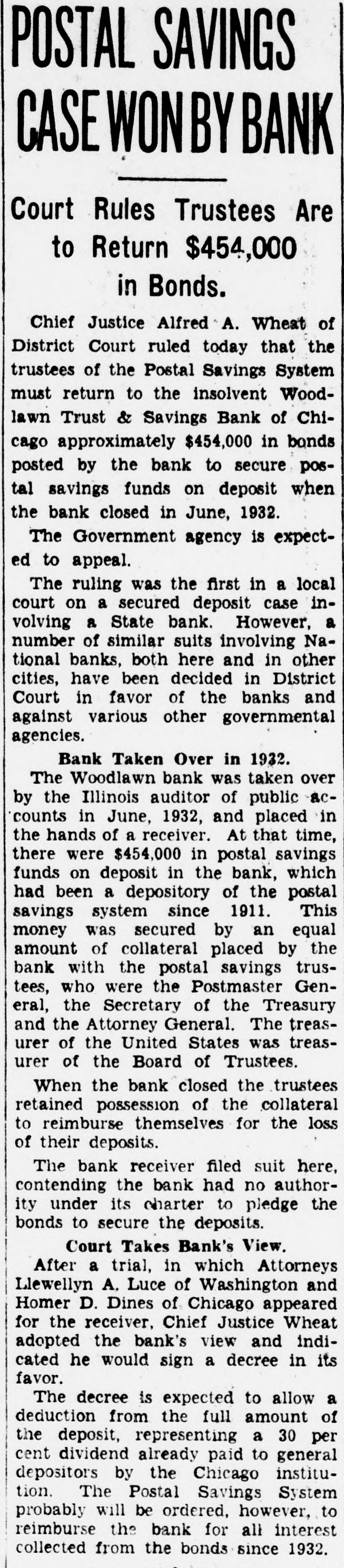
POSTAL SAVINGS CASE WON BY BANK ... Chief Justice ... ruled ... trustees of the Postal Savings System must return to the insolvent Woodlawn Trust & Savings Bank of Chicago approximately $454,000 in bonds posted by the bank to secure postal savings funds on deposit when the bank closed in June, 1932.
Source
newspapers

Newspaper Articles (6)

Article Text

CO-OP OWNERS REFUSED LIST OF BONDHOLDERS Bank Receiver Smiles at Court Ruling. BY AL CHASE. Citing a recent decision of Circuit Court Judge Philip J. Finnegan that an equity owner has a right to know whom he owes, the twenty-one tenant owners of the Essex cooperative apartment building at the northeast corner of 76th street and Essex ave. nue, asked H. C. Vernon, receiver of the Woodlawn Trust and Savings bank, for list of bondholders. This was refused by Mr. Vernon who stated that it would be turned over to a bondholders protective committee composed of himself, the forfer president and two former directors of the closed bank. None of these, It is claimed, own any Essex bonds. The full amount of interest due on June 20 on the outstanding bonds, or $2,748. was on deposit in the Woodlawn Trust and Savings bank ready for payment when that institution closed. Wishing to preserve its equity, the tenant owners, organized as the Essex Building corporation, whose stockholders are the tenant owners, raised additional funds to meet interest payments. Cash Ready for Interest. Burke F. Ward, one of the tenant owners and secretary of the Essex corporation, announces that funds are now on deposit at the Northern Trust company and bondholders may obtain payment by application at his office at 2602 East 75th street. Mr. Ward, when asking Mr. Vernon, as receiver, for the bondholders' list in order to notify the owners of the bonds that cash was on hand for interest payments, told of the Judge Finnegan decision which ordered the receiver of the Depositors State bank to turn over list of bondholders to the equity owner. Mr. Vernon said that was ridieulous no such decision had been made or would be made," said Mr. Ward. His comment was: We've beaten a number of such cases.' I persisted that my information was based on fact. Dares Him to Try. His anewsr was: If you're so sure. why don't you get an attorney and try and get the list explained that was just what I was trying to avoid, expense, so that we might continue to pay our inter est, taxes and other running expenses: that had no desire to run up needless bills that in the end would only force us into foreclosure Mr. Ward stated that since the building was built the corporation has paid $6,400 annually on the principal: also interest, taxes, repairs, and all current expenses. The original mort gage of $130,000 has been reduced to $31,600. This was due in June, 1932 We fully expect to be able to re finance the building on favorable terms and we're anxious to save possible $7,000 or $8,000 expense on a bondholders' committee so that such an amount could be used for further amortization of the bonds and pay ment of taxes," said Mr. Ward. Taxes All Paid. Following is financial statement of the Essex for twelve months ending Jan. 1, 1932: INCOME From assessments Jan. 1931. to Jan. $21,051 Interest paid Taxes, paid full. coal decorating and all other expenses 4.470 Total expenses $13.791 Prepayments made on loan 6,400 Total Cash on hand Jan. 1. 1932 860 feel that the directors of the corporation. all responsible business and professional men, are entirely capable of being an officto bond. holders' committee to work out the present difficulties which were in no way the fault of the company," said Mr. The Essex was financed originally by the Woodlawn Trust and Savings bank. The directors of the Essex Building corporation are: Cecil W. Judd, president: Andrew Todd, treasurer; Burke F. Ward, secretary; James Fox and Herbert Miller.

Article Text

$700,000 Mailed to 30,000 Depositors of 2 Closed Banks Checks amounting to almost $700,000 will be received tomorrow by 30,000 depositors with funds in the closed Woodlawn Trust and Savings bank and the Sheridan Trust and Savings bank, State Auditor Edward J. Barrett announced last night after the checks had been placed in the mail. The two banks were among the larger outlying institutions to fall during the various runs and have been among the slowest to return money to depositors. Woodlawn Trust and Savings bank, 1180 East 63d street, is paying a 5 per cent dividend, amounting to $245,000, to 14,000 depositors. This brings the total return to 35 per cent. The bank closed June 22, 1931. Sheridan Trust and Savings bank, 4753 Broadway, is paying a 10 per cent dividend, amounting to $450,000, to 16,000 depositors. This brings the total return to 30 per cent. The bank closed June 8, 1931. When the Sheridan bank closed it owed the Continental Illinois National Bank and Trust company $1,100,000. This has been paid in full. The bank also owed the Reconstruction Finance corporation $1,100,000, which has been reduced to $150,000. Woodlawn Trust and Savings bank has paid in full a debt of $1,100,462 on bills owed when the bank closed. It also had a postal savings deposit of $450,000, but collateral more than sufficient to cover the claim is held by United States postal authorities. Analysis made at the end of 1934 indicated that further return will be made to depositors, although prospects point to a comparatively small final payout. Losses on converting the best assets to cash had amounted to 20 per cent at that time.


Article Text

(By United Press). Addis Ababa, Oct. 30.—A major battle between Ethiopian and Italian forces was in progress today on the Ogaden front, according to wholly unconfirmed reports circulating in Addis Ababa. Advices from the northern front indicated Ethiopian commanders there have not much hope of retaking towns now in the hands of the Italian invaders, especially where the Italians have had time to consolidate their new positions. Although the advance guard of the Italians is reported to have penetrated within 35 miles of Makale, the northward movements of Ethiopian troops counted upon to check the southward drive of the troops commanded by Gen. Emilio de Bono has not yet been completed. Experts here fear this delay may enable the Italians to fortify the strategic points they have occupied so strongly that hope of retaking them would be slim. It is pointed out that the Ethiopian defenders are not even equipped with tools needed to cope with barbed wire entanglements. They are further handicapped by the inadequacy of their communications, which is hampering rapid concentrations of the negus' troops. An illustration of how imperfect these communications are was furnished by the fact that it took four days for news of the Italian bombing of Megalo to reach the capital. (By United Press). Rome, Oct. 30.—Organization the northern front have repulsed a new Ethiopian attempt to cross the Setit river and invade Eritrea, the Exchange Telegraph correspondent with the northern army reported today. The raiders lost a number of prisoners, the correspondent reported. They were said to be of a force of 10,000 men detailed to attack the right flank of the Italian army. At the point of attack the river is the boundary between Ethiopia and Eritrea, near the Sudan border. Further east, the correspondent reported, Italian scouting (Continued on Page 2). wreckage and dragged two of the imprisoned men to safety. The scorching flames burned their clothing and singed their arms and faces. Major Ployer Hill of the army air corps was pulled from the wreckage, injured critically. Later at Miami Valley hospital physicians said he had only a slight chance of recovery. If he lives, he will lose the sight of both eyes. His skull was fractured and he was burned severely. Leslie Tower, Seattle, Wash., chief test pilot of the Boeing Company, which built the great fighting plane, also was helped from the twisted mass by the officers. He was less seriously hurt. The others, Lieut. Donald L. Putt, of Wright field, John Cutting, Wright field civilian observer, and Mark H. Coogler, mechanic, were able to crawl from the bomber. All were taken to the hospital where it was said their injuries were not of a serious nature. Have Baby Son. Mr. and Mrs. Bernard Purvis, residing at 461 North Conde street, are the parents of a fine baby boy born Tuesday morning. Mother and son are reported getting along nicely. Mrs. Purvis prior to her marriage was Miss Pauline Lynas. Closed Chicago Bank, Suing Postal Savings for Collateral, Cites Liability Washington, Oct. 30. — The Woodlawn Trust and Savings Bank of Chicago has appealed to the District of Columbia supreme court to compel James A. Farley, Henry Morgenthau Jr. and Homer S. Cummings, as trustees of the postal savings system, to return collateral posted by the bank which has been closed, to secure the full payment of the system funds deposited there. William L. O'Connell, receiver for the bank, which was closed by order of the state auditor on June 22, 1932, says that $454,000 was on deposit in the bank to the credit of postal savings when the bank closed. As security for this deposit, the bank had placed $300,000 in bonds with the system, the petition says. Illinois courts and federal courts have held since that banks of the state have no authority to pledge their securities as a guaranty for governmental deposits, it is contended, and such pledges can be exacted only on express designation of the secretary of the treasury in the case of government funds. Funds of the postal savings, according to the bank's receiver, are private deposits and cannot have priority in liquidation of banking institutions. may be put into effect as of November 7. November 14 is now the latest date mentioned, not the earliest. The "general staff" of the penalties committee will meet tomorrow morning to recommend a date for imposition of the new penalties. The full penalties committee of 52 nations—of whom 50 are expected to join the boycott—will meet in the afternoon. Thirty-six nations have telegraphed the league secretariat their decision to apply the boycott and the stoppage plan on the date to be decided. As for the penalties already operative, 40 nations have imposed the arms embargo against Italy and 36 have shut off financial and credit relations. Some delegates, arriving here for tomorrow's meetings, believe that the boycott of Italian goods will produce an immediate, notable effect on Italy's economic situation and that if it is conscientiously applied it will seriously cripple Italy within three months. "Minute Men" Organize. (By United Press). Fort Wayne, Oct. 30.—Farmers of Allen county are forming a "minute men's" organization for the support of the agricultural adjustment program. A minister says that lean men are destined for the bad place. This is hard on editors, who are proverbially lean—on account of their low diet.


Article Text

In 1933, the first year a loan was offered, approximately 197,000 growers borrowed $120,500,000 at a loan rate of 45 cents. Under that program 270,000,000 bushels of corn were stored. In 1934, due chiefly to the unexpected drought, corn supplies were restricted and prices rose considerably above the loan rate of 55 cents a bushel. As a result, about 15,500 farmers borrowed $11,038,390 and stored 20,067,818 bushels. Under past programs, only corn-hog contract signers were eligible to borrow. The 1935 plan is expected to contain similar restrictions. Eligible borrowers must have their supplies in cribs which provide safe storage for sealing for two years. The Oct. 1 estimate of the 1935 corn crop indicated an increase of 836,000,000 bushels over the 1934 figure of 1,377,000,000 bushels. This increase is expected to mean materially lower corn prices on the 1935 corn crop which AAA officials would consider a strong argument for a lower loan rate than in 1934. A minister says that lean men are destined for the bad place. This is hard on editors, who are proverbially lean—on account of their low diet. occupied so strongly that hope of retaking them would be slim. It is pointed out that the Ethiopian defenders are not even equipped with tools needed to cope with barbed wire entanglements. They are further handicapped by the inadequacy of their communications, which is hampering rapid concentrations of the negus' troops. An illustration of how imperfect these communications are was furnished by the fact that it took four days for news of the Italian bombing of Megalo to reach the capital. (By United Press). Rome, Oct. 30.—Organization the northern front have repulsed a new Ethiopian attempt to cross the Setit river and invade Eritrea, the Exchange Telegraph correspondent with the northern army reported today. The raiders lost a number of prisoners, the correspondent reported. They were said to be of a force of 10,000 men detailed to attack the right flank of the Italian army. At the point of attack the river is the boundary between Ethiopia and Eritrea, near the Sudan border. Further east, the correspondent reported, Italian scouting Continued on Page 2. Have Baby Son. Mr. and Mrs. Bernard Purvis, residing at 461 North Conde street, are the parents of a fine baby boy born Tuesday morning. Mother and son are reported getting along nicely. Mrs. Purvis prior to her marriage was Miss Pauline Lynas. Closed Chicago Bank, Suing Postal Savings for Collateral, Cites Liability Washington, Oct. 30. — The Woodlawn Trust and Savings Bank of Chicago has appealed to the District of Columbia supreme court to compel James A. Farley, Henry Morgenthau Jr. and Homer S. Cummings, as trustees of the postal savings system, to return collateral posted by the bank which has been closed, to secure the full payment of the system funds deposited there. William L. O'Connell, receiver for the bank, which was closed by order of the state auditor on June 22, 1932, says that $454,000 was on deposit in the bank to the credit of postal savings when the bank closed. As security for this deposit, the bank had placed $300,000 in bonds with the system, the petition says. Illinois courts and federal courts have held since that banks of the state have no authority to pledge their securities as a guaranty for governmental deposits, it is contended, and such pledges can be exacted only on express designation of the secretary of the treasury in the case of government funds. Funds of the postal savings, according to the bank's receiver, are private deposits and cannot have priority in liquidation of banking institutions. "Minute Men" Organize. (By United Press). Fort Wayne, Oct. 30.---Farmers of Allen county are forming a "minute men's" organization for the support of the agricultural adjustment program.


Article Text

Closed Chicago Bank, Suing Postal Savings for Collateral, Cites Liability Washington, Oct. 30. — The Woodlawn Trust and Savings Bank of Chicago has appealed to the District of Columbia supreme court to compel James A. Farley, Henry Morgenthau Jr. and Homer S. Cummings, as trustees of the postal savings system, to return collateral posted by the bank which has been closed, to secure the full payment of the system funds deposited there. At the time the Woodlawn bank closed, the postal savings system had $240,000 on deposit. This was paid in full after the bank closed. As security for this deposit, the bank had placed $300,000 in bonds with the system, the petition says. Illinois courts and federal courts have held since that banks of the state have no authority to pledge their securities as a guaranty for governmental deposits, it is contended, and such pledges can be exacted only on express designation of the secretary of the treasury in the case of gov-


Article from Evening Star, March 31, 1938

Click image to open full size in new tab

Article Text

POSTAL SAVINGS CASE WONBY BANK Court Rules Trustees Are to Return $454,000 in Bonds. Chief Justice Alfred A. Wheat of District Court ruled today that the trustees of the Postal Savings System must return to the insolvent Woodlawn Trust & Savings Bank of Chicago approximately $454,000 in bonds posted by the bank to secure postal savings funds on deposit when the bank closed in June, 1932. The Government agency is expected to appeal. The ruling was the first in a local court on a secured deposit case involving a State bank. However, a number of similar suits involving National banks, both here and in other cities, have been decided in District Court in favor of the banks and against various other governmental agencies. Bank Taken Over in 1932. The Woodlawn bank was taken over by the Illinois auditor of public accounts in June, 1932, and placed in the hands of a receiver. At that time, there were $454,000 in postal savings funds on deposit in the bank, which had been a depository of the postal savings system since 1911. This money was secured by an equal amount of collateral placed by the bank with the postal savings trustees, who were the Postmaster General, the Secretary of the Treasury and the Attorney General. The treasurer of the United States was treasurer of the Board of Trustees. When the bank closed the trustees retained possession of the collateral to reimburse themselves for the loss of their deposits. The bank receiver filed suit here, contending the bank had no authority under its charter to pledge the bonds to secure the deposits. Court Takes Bank's View. After a trial, in which Attorneys Llewellyn A. Luce of Washington and Homer D. Dines of Chicago appeared for the receiver. Chief Justice Wheat adopted the bank's view and indicated he would sign a decree in its favor. The decree is expected to allow a deduction from the full amount of the deposit, representing a 30 per cent dividend already paid to general depositors by the Chicago institution. The Postal Savings System probably will be ordered, however, to reimburse the bank for all interest collected from the bonds since 1932.