Bank closed at the March 1933 banking holiday and placed in receivership; prolonged litigation by former president Wade H. Cooper delayed distributions.
Events (8)
1.March 5, 1933Suspension
Cause
Government Action
Cause Details
Closed at the end of the March 1933 federal banking holiday and subsequently refused a license by the controller of the currency.
Newspaper Excerpt
closed during the President's bank holiday in March, 1933
Source
newspapers
same day
2.March 5, 1933Receivership
Newspaper Excerpt
in the hands of a conservator ... Wilbur H. Zepp, conservator of the United States Savings Bank; later receivers Carter B. Keene and Frederick J. Young are named in the articles
Source
newspapers
+15 months
3.June 18, 1934Other
Newspaper Excerpt
U.S. SAVINGS BANK TO PAY $1,000,000 65% on Deposits to Be Hastened, Following Ruling of Treasury.
Source
newspapers
+26 days
4.July 14, 1934Other
Newspaper Excerpt
U. S. SAVINGS DUE TO RETURN MILLION Depositors Will Get 65 Per Cent Dividend Beginning Next Week.
Source
newspapers
+3 months
5.October 12, 1934Other
Newspaper Excerpt
plan to open a bank in the building of the insolvent United States Savings Bank ... being liquidated
Source
newspapers
+12 months
6.October 18, 1935Other
Newspaper Excerpt
Distribution of a 15 per cent dividend to depositors, who already have received a 65 per cent payment, has been made possible through a Reconstruction Finance Corp. loan
Source
newspapers
+9 months
7.July 24, 1936Other
Newspaper Excerpt
PAYS 10 PCT. Payment of a 10 per cent dividend to depositors and creditors of the defunct United States Savings Bank was authorized today
Source
newspapers
+20 months
8.April 8, 1938Other
Newspaper Excerpt
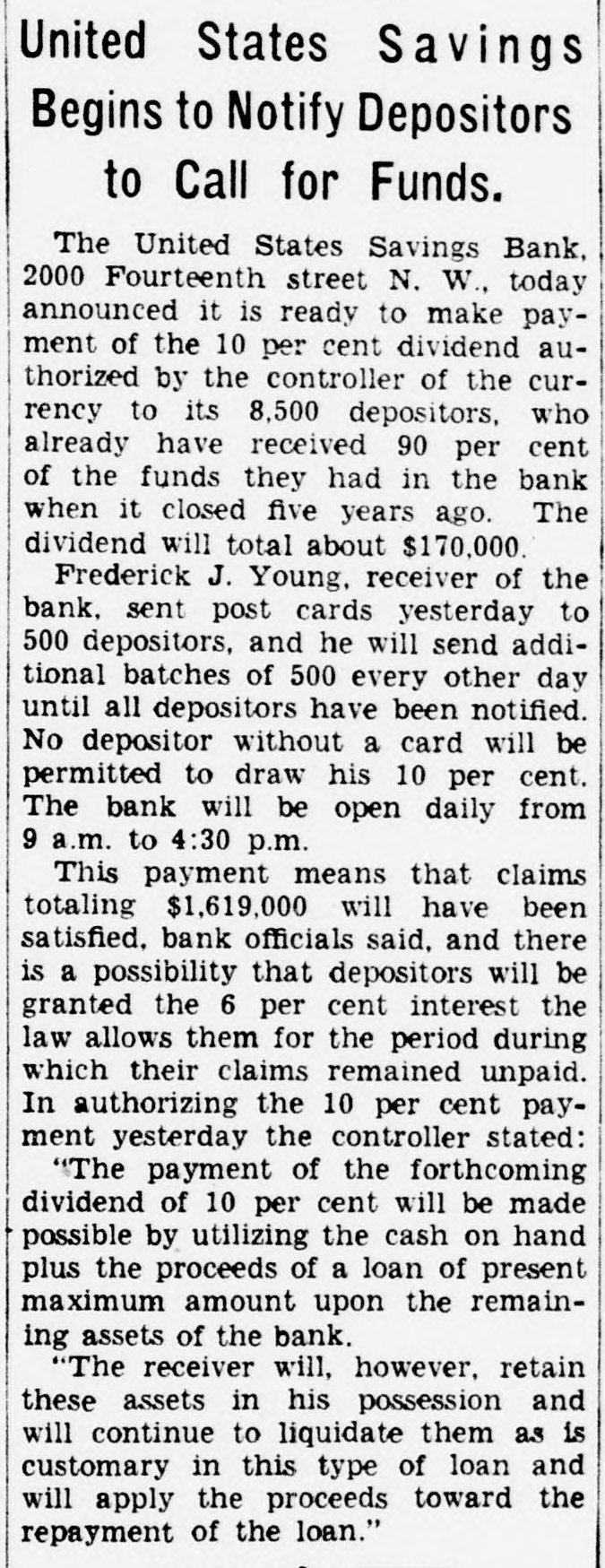
United States Savings Begins to Notify Depositors to Call for Funds. The United States Savings Bank ... announced it is ready to make payment of the 10 per cent dividend
Source
newspapers
Newspaper Articles (22)
1.May 29, 1933The Washington TimesWashington, DC
Click image to open full size in new tab
Article Text
COOPER FIGHTS TO BALK BANK IN MERGER Insists U. S. Savings Will Pay More by His Plan Than by Joining With Hamilton While Treasury officials and Wilbur H. Zepp, conservator of the United States Savings Bank, are prepared to sign the final papers merging the "prime" assets of the institution with the new Hamilton National Bank, Col. Wade H. Cooper, president and majority stockholder, is waging a "last-ditch" battle to reopen his bank independently. Colonel Cooper is conferring officials of the staff of the of the Comptroller with Currency seeking last-minute approval of a reopening plan which, he claims, will release 75 per cent of deposits immediately. Sees Depositor Backing The merger plan, Cooper contends, offers only 50 per cent immediate release of deposits frozen in member banks, all of which have been conducted by conservators since the banking holiday. He said today that he had submitted his plan to the Treasury officials several weeks ago and that, if Treasury approval were granted, he would have no particular difficulty in obtaining the assent of the required percentage of depositors. Zepp For Merger Zepp, vice president and conservator, has agreed to the merger. As conservator he is a Government official and has broad powers. But his decision is subject to approval by the Comptroller. The campaign to obtain subscriptions to the 50,000 shares of stock which are to provide $1,000,000 capital and $250,000 surplus for the new Hamilton is expected to be completed this week. Officials of the Franklin National are confident that the campaign to reopen individually will succeed. They report that 70 per cent of the required 75 per cent of depositors have agreed to the plan. Stockholders to Meet A meeting of the stockholders of the Federal-American National Bank and Trust Company has been called for 8 p. m. Wednesday at which officials of the new Hamilton National will explain details of the merger plan and urge stock subscriptions. The is to be meeting held at the Federal-American Bank Building, Fourteenth and G Streets Northwest. Creditors of the Commercial National Bank, which was taken over by a receiver February 28, began filing their claims today, a line short forming at the bank's windows when it opened at 9 a. m. Sixty days have been allotted for filing claims.
2.June 2, 1933Evening StarWashington, DC
Click image to open full size in new tab
Article Text
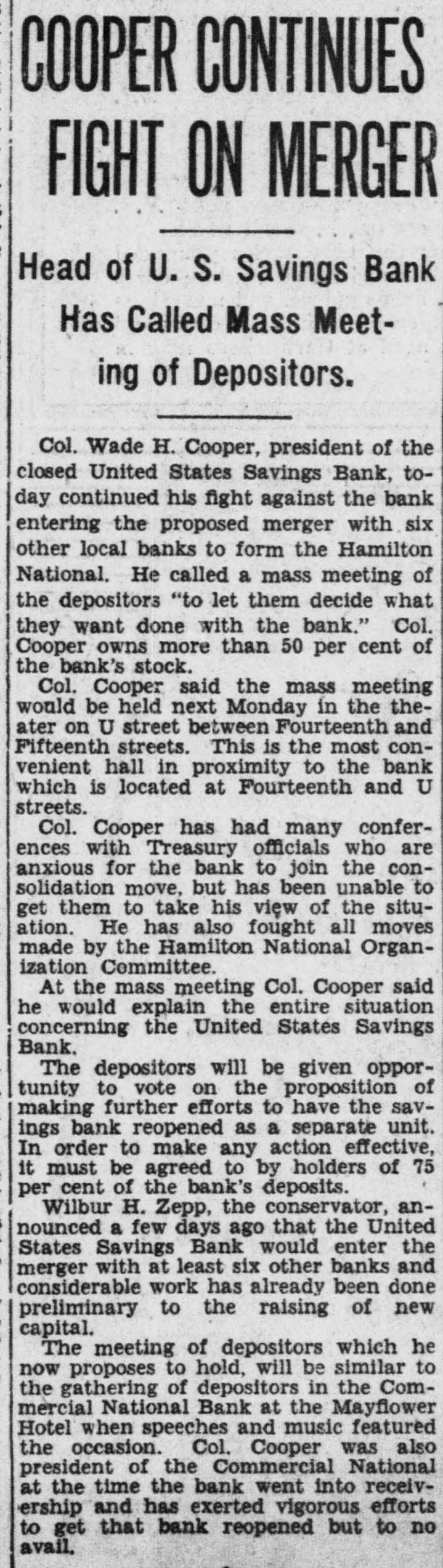
COOPER CONTINUES FIGHT ON MERGER Head of U. S. Savings Bank Has Called Mass Meeting of Depositors. Col. Wade H. Cooper, president of the closed United States Savings Bank, today continued his fight against the bank entering the proposed merger with six other local banks to form the Hamilton National. He called a mass meeting of the depositors "to let them decide what they want done with the bank." Col. Cooper owns more than 50 per cent of the bank's stock. Col. Cooper said the mass meeting would be held next Monday in the theater on U street between Fourteenth and Fifteenth streets. This is the most convenient hall in proximity to the bank which is located at Fourteenth and U streets. Col. Cooper has had many conferences with Treasury officials who are anxious for the bank to join the consolidation move, but has been unable to get them to take his view of the situation. He has also fought all moves made by the Hamilton National Organization Committee. At the mass meeting Col. Cooper said he would explain the entire situation concerning the United States Savings Bank. The depositors will be given opportunity to vote on the proposition of making further efforts to have the savings bank reopened as a separate unit. In order to make any action effective, it must be agreed to by holders of 75 per cent of the bank's deposits. Wilbur H. Zepp, the conservator, announced a few days ago that the United States Savings Bank would enter the merger with at least six other banks and considerable work has already been done preliminary to the raising of new capital. The meeting of depositors which he now proposes to hold, will be similar to the gathering of depositors in the Commercial National Bank at the Mayflower Hotel when speeches and music featured the occasion. Col. Cooper was also president of the Commercial National at the time the bank went into receivership and has exerted vigorous efforts to get that bank reopened but to no avail.
3.July 19, 1933Evening StarWashington, DC
Click image to open full size in new tab
Article Text
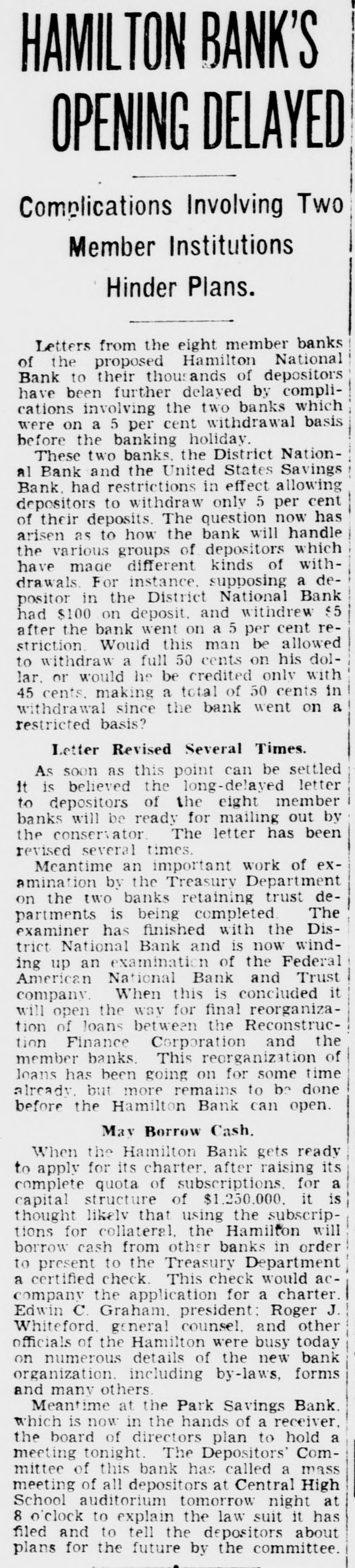
HAMILTON BANK'S OPENING DELAYED Complications Involving Two Member Institutions Hinder Plans. Letters from the eight member banks of the proposed Hamilton National Bank to their thousands of depositors have been further delayed by complications involving the two banks which were on a 5 per cent withdrawal basis before the banking holiday. These two banks. the District National Bank and the United States Savings Bank, had restrictions in effect allowing depositors to withdraw only 5 per cent of their deposits. The question now has arisen as to how the bank will handle the various groups of depositors which have made different kinds of withdrawals. For instance. supposing a depositor in the District National Bank had $100 on deposit. and withdrew $5 after the bank went on a 5 per cent restriction. Would this man be allowed to withdraw a full 50 cents on his dollar. or would he be credited only with 45 cents. making a total of 50 cents in withdrawal since the bank went on a restricted basis? Letter Revised Several Times. As soon as this point can be settled it is believed the long-delayed letter to depositors of the eight member banks will be ready for mailing out by the conservator The letter has been revised several times. Meantime an important work of examination by the Treasury Department on the two banks retaining trust departments is being completed. The finished Bank now trict examiner National has and with is the wind- Dising up an examination of the Federal American National Bank and Trust company When this is concluded it will open the way for final reorganization of loans between the Reconstruction Finance Corporation and the member banks. This reorganization of loans has been going on for some time already but more remains to be done before the Hamilton Bank can open. May Borrow Cash. When the Hamilton Bank gets ready to apply for its charter. after raising its complete quota of subscriptions. for a capital structure of $1,250,000. it is thought likely that using the subscriptions for collateral, the Hamilton will borrow cash from other banks in order to present to the Treasury Department a certified check This check would accompany the application for a charter. Edwin C. Graham, president: Roger J. Whiteford. general counsel. and other officials of the Hamilton were busy today on numerous details of the new bank organization. including by-laws, forms and many others. Meantime at the Park Savings Bank. which is now in the hands of a receiver. the board of directors plan to hold a meeting tonight. The Depositors' Committee of this bank has called a mass meeting of all depositors at Central High School auditorium tomorrow night at 8 o'clock to explain the law suit it has filed and to tell the depositors about plans for the future by the committee.
4.September 2, 1933The Washington TimesWashington, DC
Click image to open full size in new tab
Article Text
COOPER CLAIMS PLOT TO RUIN INSTITUTIONS Treasury Heads Named in Plea To Keep U. S. Savings As Independent Col. Wade H. Cooper. president of the United States Savings Bank, and holder of 56 per cent of its capital stock. today appealed to the District Supreme Court for an injunction to restrain Treasury officials from forcing his bank into the Hamilton National Bank merger. Through Attorneys W. Bissell Thomas, John W. Staggers and same in Louis counsel L. which Whitestone, represented the him blocking court approval of the names as Colonel Hamilton Cooper contracts yesterday, defendants SecreT. tary of William the Treasury: H. Woodin, J. F. O'Connor. comptroller of the currency; his deputy, F. G. Awalt: Walter J. Cummings, assistant R. Milford, retary of and the W. Treasury; Irving Shuman W. secthe Treasury Zepp, of the former reorganization Department: vice president Wilbur division. of H. United States Saving Bank. and E. C. Graham, president of the Hamilton National Bank. Rule Signed Justice Adkins signed rule requiring the defendants to a show cause the be rule tion will should Tuesday be not heard why before granted. injunc- Justice The who the same him Jennings time Bailey, have placed will before at the banks for pating petitions the eight in of the closed merger conservators partici- court of of assets to approval the $900,000 Hamilton of the of transfer Bank, including over those of the United Staes Savings Bank. It is charged that since March the 5. holiday when began, the national defendants banking to large spiracy part have of been the gain engaged banking control in of assets a a con- in are wreck furtherance the District about to of of deliberately Columbia, that conspiracy and in eight prosperous banks of the District. "Bleeding" Seen These eight banks at the time of the banking holiday had a capital structure of $5,000,000 and deposits totaling $27.000.000. Under eight the Hamilton banks would Bank bleed plan their these assets to build a capital structure of $1,000,000, with available deposits approximating $10,000,000, the court is told. Colonel Cooper says that his one, bank ous has earning always been from a 40 prosper- to 60 per cent on its stock of $100,000 up to the time of the banking holiday. deceding During the the holiday period his of bank's panic preposits fell from $2,500,000 to $1. in is value, 800,000. but its its securities capital structure shrunk yet unimpaired, he said. Farce Charged The defendants have conspired to force his bank into the Hamilon the pay to of ton its system quick depositors assets by taking 50 per $900,000 promise cent of in hands of their the claim. bank leaving conservator the frozen assets liquidate, own Left which to its Colonel will devices. Cooper be difficult Colonel alleges. to a subremitted Cooper claims, to the under Treasury plan but the conon of bank have fendants, jected spiracy because his the of part alleged could the deper cent of and dated claims paid 75 sufficient immediately, depositor liquiassets to pay the remainder within a short time. Sentenced Youth
5.October 4, 1933The Washington TimesWashington, DC
Click image to open full size in new tab
Article Text
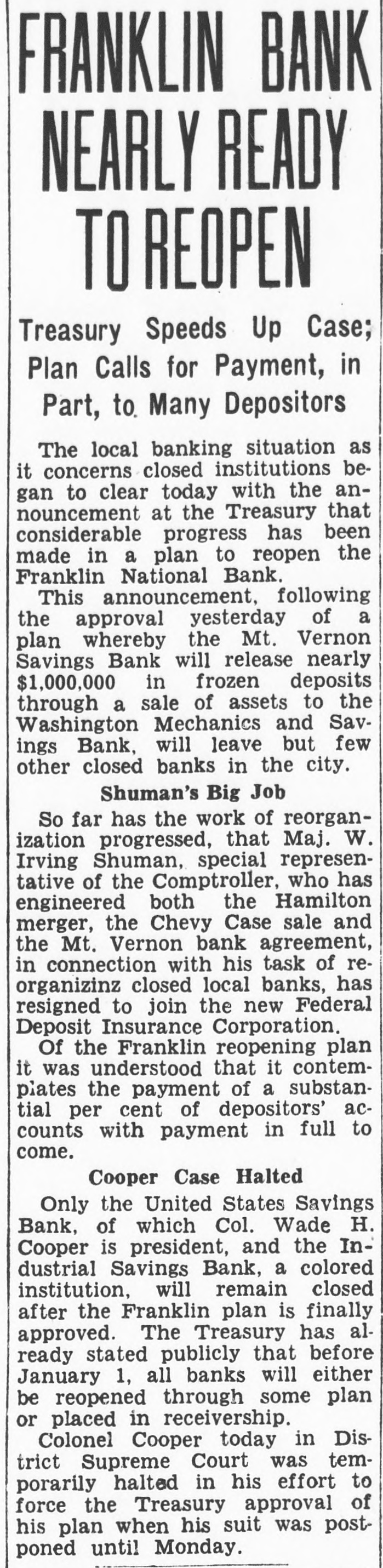
FRANKLIN BANK NEARLY READY TO REOPEN Treasury Speeds Up Case; Plan Calls for Payment, in Part, to. Many Depositors The local banking situation as it concerns closed institutions began to clear today with the announcement at the Treasury that considerable progress has been made in a plan to reopen the Franklin National Bank. This announcement, following the approval yesterday of a plan whereby the Mt. Vernon Savings Bank will release nearly $1,000,000 in frozen deposits through a sale of assets to the Washington Mechanics and Savings Bank, will leave but few other closed banks in the city. Shuman's Big Job So far has the work of reorganization progressed, that Maj. W. Irving Shuman, special representative of the Comptroller, who has engineered both the Hamilton merger, the Chevy Case sale and the Mt. Vernon bank agreement, in connection with his task of reorganizinz closed local banks, has resigned to join the new Federal Deposit Insurance Corporation. Of the Franklin reopening plan it was understood that it contemplates the payment of a substantial per cent of depositors' accounts with payment in full to come. Cooper Case Halted Only the United States Savings Bank, of which Col. Wade H. Cooper is president, and the Industrial Savings Bank, a colored institution, will remain closed after the Franklin plan is finally approved. The Treasury has already stated publicly that before January 1, all banks will either be reopened through some plan or placed in receivership. Colonel Cooper today in District Supreme Court was temporarily halted in his effort to force the Treasury approval of his plan when his suit was postponed until Monday.
6.October 5, 1933The Washington TimesWashington, DC
Click image to open full size in new tab
Article Text
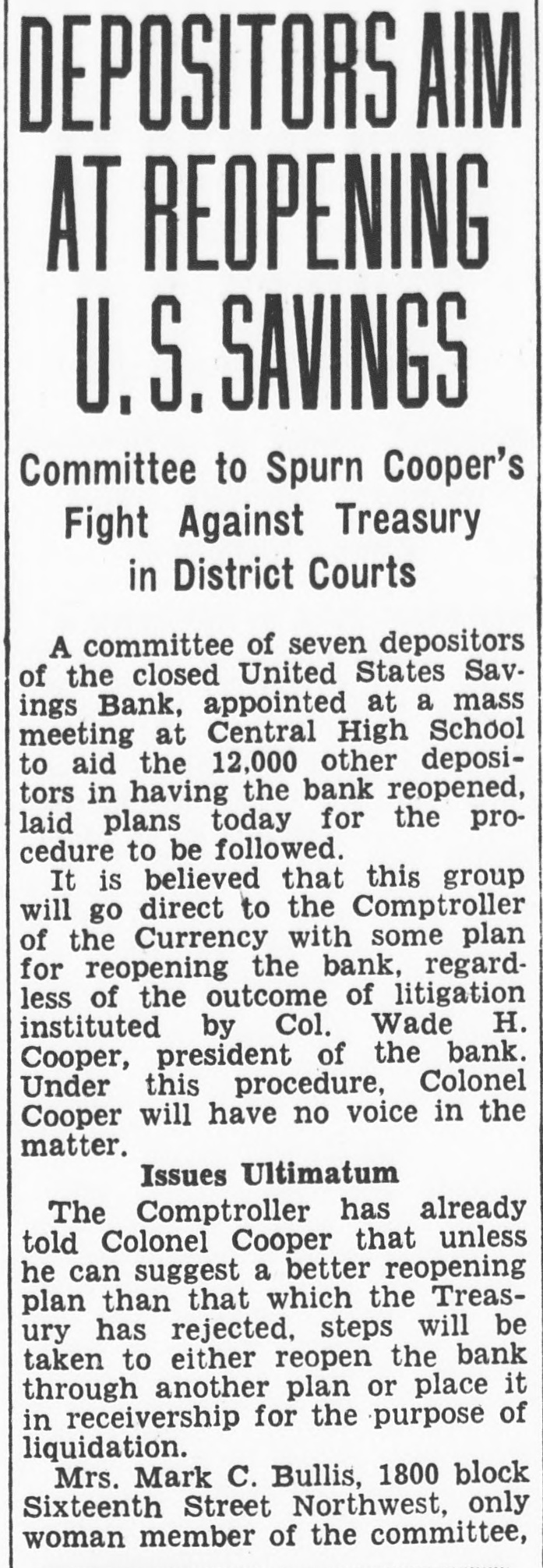
DEPOSITORS AIM AT REOPENING SAVINGS Committee to Spurn Cooper's Fight Against Treasury in District Courts A committee of seven depositors of the closed United States Savings Bank, appointed at a mass meeting at Central High School to aid the 12,000 other depositors in having the bank reopened, laid plans today for the procedure to be followed. It is believed that this group will go direct to the Comptroller of the Currency with some plan for reopening the bank, regardless of the outcome of litigation instituted by Col. Wade H. Cooper, president of the bank. Under this procedure, Colonel Cooper will have no voice in the matter. Issues Ultimatum The Comptroller has already told Colonel Cooper that unless he can suggest a better reopening plan than that which the Treasury has rejected, steps will be taken to either reopen the bank through another plan or place it in receivership for the purpose of liquidation. Mrs. Mark C. Bullis, 1800 block Sixteenth Street Northwest, only woman member of the committee,
7.October 13, 1933The Washington TimesWashington, DC
Click image to open full size in new tab
Article Text
CASE TO DECIDE KNOTTY LEGAL QUESTIONS Claims of Numerous Parties to Action Conflict; Federal Officers Involved Counsel for the many parties represented in litigation surrounding the Park Savings Bank, which, with shortages exceeding $2,000,000, is in the hands of a Treasury receiver, today in District Supreme Court had the trial date set for October 25. Justice Jesse C. Adkins is scheduled to hear the case but it is possible that it may be transferred to Justice Jennings Bailey. The Parks Savings case is con sidered the most important of local banking cases because of the unusual questions of law raised during the efforts of depositors to salvage their savings from the wreckage following the suicide last spring of Robert S. Stuntz, vice president. Treasury Power Tested A depositors' committee represented by Attorneys E. Hilton Jackson and William E. Richardson began the litigation when they challenged the right of the Treasury to place a conservator in the bank, which they claimed was an Alabama corporation. It was then discovered the bank's charter had expired some years previously, and then the Treasury placed a receiver in charge. Stockholders and directors then became involved when it was claimed that, in view of the expiration of the bank charter, the depositors were operating as a copartnership and the stockholders were liable for the return of $50,000 in stock dividends they had been paid. Meanwhile three other banks in the District which have been closed since the holiday, reported progress in their plans. Agreement Near It was reported that Franklin National Bank officials are about to come to an agreement with the Comptroller on the differences in their respective plans for reopening, and the Washington Mechanics and Savings and Mt. Vernon groups are encouraged in their effort to pay more than the original 35 per cent on deposits provided in the initial agreement merging the two. Attorneys for Col. Wade H. Cooper state that probably Monday they will ask the District Supreme Court for an early trial date on Col. Cooper's suit to compel the Treasury to relicense his United States Savings Bank.
8.November 5, 1933Evening StarWashington, DC
Click image to open full size in new tab
Article Text
BANKS MAY COME INTO COURT AGAIN United States Savings and Parks Savings Are Still in Litigation. Progress was made last week in disposition of the unlicensed bank situation in the District of Columbia, with prospect that the two banks in litigation will come before the courts again t is week. The case of the United States Savings Bank, which has been hanging fire ever since this institution was dropped from the Hamilton National Bank merger, will come up for hearing Tuesday morning before Justice Jennings Bailev in District Supreme Court. Depositors of the Park Savings Bank. wh last week lost their fight for a court receiver to replace the Treasury Department receiver. plan to file an amended bill in an effort to collect as much as possible from the directors and stockholders. Two Receivers Named. Two receivers were appointed for eight unlicensed banks. one of whom has taken charge. with the other scheduled to arrive this week. Former Gov. Cary A. Hardee of Florida has already taken over the remaining assets of the Federal-American National Bank & Trust Co. and the old Chevy Chase Savings Bank. Norman R. Hamilton of Portsmouth. Va., is planning to arrive here next Wednesday to take charge of six other unlicensed banks, which are the District National Bank, the Northeast Savings Bank, the Eventh Street Savings Bank. Washington Savings Bank, Woodridge-Langdon Savings Bank and the Potomac Savings Bank. Meantime negotiations for a merger of the Franklin National Bank with the Washington Mechanics Savings and the Mount Vernon Savings Banks have been under way, without a complete agreement having been reached. It was understood last night that progress had been made in the negotiations. although final decision had not been made as to whether the Franklin would merge or try to reopen alone. The Mount Vernon-Mechanics merger is making rapid progress, officials said last night. 4 Banks Unlicensed. As the District of Columbia situation stands today, according to Controller of the Currency O'Connor, in a review of the unlicensed banks of the Nation last night. there were 13 unlicensed banks here at the close of the President's holiday in March: nine of these have been licensed, chartered or placed in liquidation, and four of these are still unlicensed. Of these four. two plans have been approved. one for the Mount Vernon Savings Bank to merge with the Washington Mechanics, and the other for the reopening of the Franklin National Bank. Officials of the Franklin bank have not yet given their full agreement, however, to the Treasury plan. One plan has been disapproved, according to the controller's tabulation. This is presumed to be the plan for the United States Savings Bank, whose president, Col. Wade H. Cooper, is fighting the Treasury in the courts to force adoption of the Cooper plan. And finally, one plan for license is under consideration, that of the Industrial Savings Bank, a colored institution. which hopes to reorganize into a national bank. The United States Bank long has been in the courts, since Col. Cooper made such a fight to keep it out of the 4 Hamilton National Bank merger that the Treasury voluntarily withdrew it (Continued on Page 2, Column 4.)
9.November 19, 1933Evening StarWashington, DC
Click image to open full size in new tab
Article Text
Counsel to Be Heard by Justice Jennings Bailey Tomorrow. MERGER PLAN RUMORED IF GOVERNMENT WINS Cooper Victory Would Mean Reopening With 65% Paid Depositors at Present Time. Fate of the United States Savings Bank soon will be decided, after arguments of the case scheduled to take place tomorrow in District Supreme Court before Justice Jennings Bailey. Col. Wade H. Cooper, president of the bank, is attempting to force the Treasury Department to reopen his bank according to terms of the Cooper plan, which has been rejected by the Treasury. Should Cooper win, he would reopen the bank under a plan to allow the depositors 65 per cent of their deposits in cash while waiving the other 35 per cent, which would be paid later. Should Cooper loose, it is believed some action would be taken soon to settle the future of this bank, which was refused a license on March 14, at the end of the President's banking holiday. Reports Concern Outcome. There have been unconfirmed reports that in case the Government wins the court battle, the United States Savings Bank might join the merger of the Washington Mechanics Savings Bank, Mount Vernon Savings Bank, and the Franklin National Bank. On completion of argument tomorrow by counsel it is believed Justice Bailey probably would take the case under advisement for consideration a few days before announcing his decision. Meantime plans moved rapidly forward for the merger of the two unlicensed banks with the open Washington Mechanics Savings Bank, to form the new Mechanics Franklin Savings Bank. Representatives of the Reconstruction Finance Corporation and the Franklin Bank will spend most of the day today going over assets of the Franklin to determine how much can be made available to depositors of the Franklin. It has been estimated that there would be available to depositors somewhere between 65 and 75 per cent. Park Savings Case Delayed. The Park Savings Bank case, still pending in District Supreme Court, yesterday was postponed, when the Depositors' Committee was allowed until November 27 to file an amended bill. This committee is attempting to establish the liability of directors and stockholders under the statutes of Alabama, because of the fact that this State issued the bank charter. Justice Jesse C. Adkins, in denying the depositors their request for a court receiver to replace the Treasury receiver now in charge of the bank, reserved the rights of the depositors in the following language: "It is further ordered that the court's decision on the foregoing matters is without prejudice to the right of the plaintiffs or the receiver of the Park Savings Bank to assert the various liabilities of the directors and stockholders of such bank as such liabilities may appear. such questions of liability being hereby expressly reserved for further determination by this court."
10.February 21, 1934Portland Press HeraldPortland, ME
Article Text
Crew Is Outfitted To Walk Through Fire
Duty Is To Rescue Fliers From Fiery Deaths In Plane Crashes
Feb. Able to walk through fire in suits, the crew the "crash wagon" at the naval air base prepared rescue fliers from death roaring flames. The four in the truck crew are covered from head foot the fireresisting attire. Their first duty is reach the pilots should planes dirigibles crash Moffett Field.
Named Bank Keene. native Maine and frequent summer has receiver for the United appointed States Savings Bank 14th and wideknown Washington attorney. former chief postoffice inspector.
The letters were put into the
Nearly all the letters started and ended They addressed love Delaware, Greenwood where she visited relatives.
11.June 18, 1934Evening StarWashington, DC
Click image to open full size in new tab
Article Text
U.S. SAVINGS BANK TO PAY $1,000,000 65% on Deposits to Be Hastened, Following Ruling of Treasury. Depositors of the insolvent United States Savings Bank will be paid a dividend of 65 per cent, amounting to a it was learned time, more than $1,000,000, within officially short early this afternoon. The Treasury Department, followon the heels of a decision of of ing the quickly Court Appeals of the District favorable to the Government, made plans to pay swiftly the dividend as soon as it will be physically possible to do so at the bank. A formal statement on the matter is to be issued expected from the the currency office of the controller of within the next 24 hours, explaining details. Decision Is Upheld. The Court of Appeals upheld the decision of the District Supreme Court, declaring that the controller of was the currency justified did in in regard exercising the authority he The was Wade H. verse to this to bank. Col. decision Cooper, presi- ads dent bank, who fought the case for of months the through both courts. will The payment of the dividend make available to depositors roughly $1,068,000, based on the figures of a total deposit liability of $1,644,000. This dividend is 15 per cent larger than the 50 per cent dividend which this bank was to have paid in the with blocked proposed National Bank, merger by the Col. Hamilton Cooper. it was The difference of 15 per cent, learned, is due to collections made at the bank since it was thrown into the hands of a receiver and to an improvement in its holdings since that time. United States Savings Bank has petrel been The the stormy since of the it local was banking situation ever closed by the controller of the currency at the time of the President's and refused a to at the close of reopen bank holiday that holiday. license enable the bank to pay 65 it was In per order cent, to learned, arrangehave been completed to get a the ments loan from Reconstruction Finance the Corporation to provide funds on eligible securities of the bank. Fight of Col. Cooper. Col. Cooper has fought the Government since it first closed the Commercial National Bank, of which he was president, late in February, 1933, and the United States Savings Bank, of which he also was president, at the close of the President's bank holiday. in March, 1933. When a move was made to include the United States Savings Bank in the new Hamilton National Bank merger Cooper took the case to court and fought it to the point where the Government and the Hamilton Bank attorneys withdrew efforts to include the bank in the merger and dropped it suddenly from all consideration. then went to court Col. force Cooper controller of the to the currency to reopen the bank on plans proposed by Cooper himself, but every plan Cooper put forward was the rejected by Court controller. Justice In Jen- District Supreme nings Bailey upheld the controller and rendered a decision adverse to Col. who apto the Court pealed Cooper, immediately of Appeals of the District.
12.June 29, 1934Evening StarWashington, DC
Click image to open full size in new tab
Article Text
SUIT MAY DELAY DIVIDEND OF BANK Treasury Officials Study Cooper Action to Determine Payment Policy. Payment of the 65 per cent dividend of about $1.000.000 to depositors of the United States Savings Bank, which had been scheduled to begin next Monday morning, may be postponed indefinitely because of the new suit which Col. Wade H. Cooper, former president of the bank. filed in District Supreme Court yesterday, against Treasury Department officials. Although Cooper's counsel, W. Bissell Thomas, indicated that no rule or preliminary injunction was asked in the suit, because Cooper did not wish to prevent the depositors from getting the dividend. there appeared considerable doubt early today about the whole question of the dividends. Treasury Making Study. Treasury officials were making a careful study to determine whether it would be wise for the receiver to go ahead now with payment of the dividend as planned. Cooper in his suit claims the bank now is solvent and asks a temporary injunction to restrain Carter B. Keene, receiver, from acting as receiver and withholding the banking house. with its assets, from the officers, directors and stockholders. The Government has always insisted the bank is insolvent. If this new move of Cooper's should postpone payment of the dividena, it would be the second time he has blocked distribution of funds to depositors of the bank. Fought Merger. The first time was when it had been planned to include the United States Savings Bank in the Hamilton National Bank merger. Cooper went to court to fight the merger and in the midst of the hearing the Government and the Hamilton bank dropped the savings bank suddenly from the merger. The savings bank would have paid 50 per cent to depositors last year had this institution been included in the Hamilton bank. At the savings bank, at Fourteenth and U streets, plans had been completed to begin payment Monday morning and the entire business and residential community was eagerly awaiting the first funds from the bank since it was closed in March, 1933. John F. Moran, receiver for the bank. has extended the official time for creditors of the insolvent institution to file claims up to July 21.
13.July 12, 1934The Washington TimesWashington, DC
Click image to open full size in new tab
Article Text
PLANS SPEEDED BY TREASURY OFFICIALS Comptroller Attorneys Urge Payments Be Made Despite Suit There were definite indications today that officials of the Treasury Department are moving forward with plans to pay out shortly more than $1,000,000 in dividends to depositors in the closed United States Savings Bank. The bank was ready two weeks ago to pay a 65 per cent dividend, but a suit brought against Treasury officials by its former president, Col. Wade H. Cooper, threw a monkey wrench into the plans. Suit May Be Ignored The bank collapsed with total deposits of $1,892,480 and has paid out no dividends. Colonel Cooper's suit was brought against Secretary of the Treasury Morgenthau and Comptroller of the Currency J. F. T. O'Connor. In effect, the suit, which was filed in District Supreme Court June 28, says that the bank should be restored to Colonel Cooper and its former directors. It was learned on high authority today that attorneys for the Comptroller of the Currency want to pay out the money regardless of the suit. They point out that in the absence of a suit for an injunction there is a question whether Colonel Cooper has a right to interfere with the payment of the money. Studied By Treasury Attorneys for the Secretary of the Treasury are considering the problem from their angle and on their decision rests the fate of the depositors. Their decision should be made within a few days and if they concur in their opinion with lawyers Carter B. for the Mr. bank, O'Connor. the Keene, receiver will be of advised to go ahead with immediate payment of a 65 per cent dividend. An answer to Colonel Cooper's suit is expected to be filed in District Supreme Court today or tomorrow. Unless attorneys for the Treasury do concur, depositors will wait many months before obtaining relief. Colonel Cooper's suit and the answer to be filed will not be heard until some time in the fall. Colonel Cooper claimed today that if the bank were turned back to him and the former directors, depositors would receive 100 cents on the dollar. He said if the capital were found impaired the stockholders stood ready to make up the losses.
14.July 14, 1934Evening StarWashington, DC
Click image to open full size in new tab
Article Text
U. S. SAVINGS DUE TO RETURN MILLION Depositors Will Get 65 Per Cent Dividend Beginning Next Week. Payment of the postponed 65 per cent dividend to depositors and creditors of the United States Savings Bank will begin early next week, it was announced today by Controller of the Currency J. F. T. O'Connor. This dividend, which was to have been paid not later than July 1. was delayed by the action of Col. Wade H. Cooper, former president of the bank, who filed another of his series of suits against the Government. Notices will be sent to depositors informing them when to call at the bank. In a formal statement Controller O'Connor explained that answer to this suit was being filed in court today and that payment of the dividend would proceed. In the answer. which was filed later. the Government asked the District Supreme Court to dismiss the Cooper suit on the ground it is an attempt to interfere with the exclusive and official administrative discretion of the controller of the currency. Claiming the bank is solvent. Col. Cooper had asked that it be returned to its officers and directors. The answer asking dismissal of the suit was filed through Attorney George Barse. $1,000,000 to Be Paid. The dividend will make available about $1,000,000 to creditors of the bank who have had nothing out of it since it closed during the President's bank holiday in March, 1933. In his formal statement, the controller explained that on June 18 he had announced that the dividend would be paid not later than July 1. "On June 28," the statement continued, "Col. Cooper filed a suit on his own behalf and on behalf of the United States Savings Bank as a corporation, seeking to set aside the appointment of the receiver for the bank and to compel the return of the bank and its assets to its officers, directors and stockholders. The controller is filing an answer to this suit, setting forth that in his judgment the bank is not in condition to be reopened and that it should proceed in receivership liquidation. Caused Postponement. "The filing of this suit made it necessary to postpone payment of the dividend in order that certain questions raised by the filing of the suit could be considered. "These questions have now been determined and we have decided that payment of this dividend should be made without further delay. "The depositors and creditors of the bank have been deprived of their funds since the bank was closed in March, 1933, and we feel very strongly that their distress should be soon as is that the merelieved expected as clerical possible. and It chanical details necessary to have the dividend money available can be completed within the course of the next few ays-certainly by the first part of this coming week. will be sent them positors "Post cards notifying of to the the date deto call at the bank for their dividend checks. Please do not call prior to the date therein indicated, inasmuch as it will be impossible to distribute all of the checks at once, and it will be necessary to spread the distribution over a period of days." Although no specific time has been fixed for the first check to be paid out. it was understood that this may be on Tuesday or Wednesday mornings. although subject to change.
15.October 12, 1934Evening StarWashington, DC
Click image to open full size in new tab
Article Text
U. S. SAVINGS BANK PLAN BEFORE TREASURY HEADS John A. Dore, Stockholder, Scheduled to Confer on Proposed Opening. John A. Dore, a stockholder in the United States Savings Bank, was scheduled to confer with Treasury officials yesterday in regard to a proposed plan to open a bank in the building of the insolvent United States Savings Bank, at Fourteenth and U streets. Dore is a member of a group of stockholders, which has sent out a letter to stockholders to determine their reaction to a plan he has in mind. The United States Savings Bank is in the hands of a receiver appointed by the controller of the currency and is being liquidated. Wade H. Cooper, former president of the bank, still is pressing litigation to attempt to reopen the institution.
16.February 7, 1935Evening StarWashington, DC
Click image to open full size in new tab
Article Text
Bank Receiver, as Detective, Traces Owner of Old Account Thanks to the work of Carter B. of Justice Brewer, whose name apKeene, receiver for the defunct United pears on two diplomas awarded Keene States Savings Bank, the grand by George Washington University. daughter of a late United States SuKeene learned that one of the origpreme Court justice today received a inal incorporators of the bank, and check for 65 per cent of a substantial for a time its president, was the late savings account established for her 29 James L. Kerrick, a son-in-law of Justice Brewer. years ago by the distinguished jurist. Mrs. Henrietta Wells Kennard was A further check-up was made of 1 the account in the records of the Disyear old when her grandfather, Justice David J. Brewer, opened the trict Probate Court, where Justice account for his granddaughter. He Brewer's will was administered, and from there Keene traced the ownerneglected to tell the child's parents and she grew to womanhood unaware ship to Mrs. Kennard, now a resident she possessed a substantial sum of of Cambridge, Mass. money, the exact amount of which Keene said today many first diviKeene declines to divulge. dend checks have been ready for When Keene took over receivership months for delivery to former patrons and began paying dividends on the of the bank who have proved their frozen deposits, none of his staff could claims, but have not called to receive locate the owner of the account listed payment. He said the bank is open to Henrietta Wells. The account card from 9 a.m. to 5 p.m. and every assistwas bought to the attention of the ance will be rendered to those who receiver, who recognized the signature call to inquire about their accounts.
17.May 18, 1935Evening StarWashington, DC
Click image to open full size in new tab
Article Text
to Be New Release of C. R. F. After Approval Loan. OF REPORTS SOLVENCY INCORRECT DECLARED of Value Assets $1,131,992.64 in Held Cited LiquidaAnalysis tion Figure. Savings Bank, was Cooper United Col. States Wade another H. 15 per cent will soon. an of the of president which deposited pay in Controller official dividend to of not say, when was the which would however, to the This by office payment did Re- be made May Application Finance was Corporation further loan constructexplained.1 was for the additional have 13, it to bank as the dividend. with ceived a 65 Depositors.com per r cent of the new be this dividend, expedited of the possible view courts statement Payment as said, in "will after in approval of the the proceed- fact to suit much R. F. now C. loan, is the in collapsed the ings. terminate Cooper recently case involvinwich of in Commercial president, court Col. duringational Bank, and now is Garneld also Hospital. Denied. to reports United Selvency Report published States elsebe analysis the Savings where according Bank the to of an condition considered of the of of solvent, last statement made by the office the bank, vesterday. an estimated of $1, controller "The reportmainincontroller's shows assets note exof the the foot of 'replanation. value 131,992.64, said "However, represents this estimate the the states ultithe of of items that present estimate value' the the guaranceiver's iguidation values are not or by as mate that said by the receiver they should as and either and that either or teed the not be controller accepted prospective final assets dividends include of for basis and have that been liabilities, those of would this case of the loan cent. be repayment in otherwhich standing Finance Corporation secured purpose include paying the out- ob- the It tion the of 65 per mind that assets so which the as tained stantial further first dividend should quantity classified valued borne include of in unacceptable the have possible classifi- a previ- subreopening having ously from been the of standpoint the heretofore bank, this been settled to the by cation litigation further called total out'Attention is shows amounting fact that deposit the report The liabilities unpaid Finance amount Corp. $682,027.23. truction was 600, to that of as of be 20,932.34, standing to the Reconstru March must 31, 1935, added of interest $674, liabilities Corp accrued loan which as total of of unpaid time deposition $1, Finance making a plus unpaid loan liability of 377,559.57. Interest the court Total decisioned of $168,500. a the their deand creditors upo rate to lawful the bank positors "Under are entitled prevailing suspension interest of claims claims at date the of creditors from the the date the interest upon up fully paid. to to $168, March make depositors are bank the to unpaid to 31, liabilities would 1935, Accrued depositors an aggregate said and 500. liability interest Reoutstanding This including to due on the creditors, the amount including Finance 31. 1935, reas of based value of claims, interest construction plus Hence, March liquidation Corp., upon the of $1, on assets plus the March cash 31, ceiver's remaining as of outhand the it of will $281 1,846.96 be noted as that of that the of date all standing exceeded 1935, the cash on hand value This by esti- apcost assets, including the mated proximately deficit liquidation does not of liquidated. the assets, capital nor redoes it of gardless future allow of by whom for necessary at this point, structure to emphasize the foreor It is figures by reiterationeference with be taken that as to final asset divigoing value should for not prospective future dends basis or distribution.
18.October 18, 1935Evening StarWashington, DC
Click image to open full size in new tab
Article Text
U.S. SAVINGS BANK SUIT WEIGHED Payment of $256,500 to Depositors Hangs on Justice Wheat's Decision. Payment of $256,500 in dividends to depositors of the closed United States Savings Bank hangs on the decision of Chief Justice Alfred A. Wheat of District Supreme Court, in a case brought before him late yesterday. This was disclosed by George P. Barse, general counsel of the Treasury Department's Division of Insolvent National Banks, at the conclusion of a hearing on a motion to dismiss the suit brought by the bank to compel the Controller of the Currency and the Secretary of the Treasury to lift the receivership of the bank and restore it to its officers. Distribution of a 15 per cent dividend to depositors, who already have received a 65 per cent payment, has been made possible through a Reconstruction Finance Corp. loan, and is being delayed by the suit, which represents the latest effort of Col. Wade H. Cooper, former president, to regain control of the bank he once headed. Barse declared. Chief Justice Wheat took the motion under advisement after Barse and his associate, George B. Springston, had argued that all substantial issues involved in the suit already had been passed on by the local courts. Philip H. Marcum, bank attorney, contends the courts never have had before them the question of the bank's solvency at the time it was placed in the hands of a receiver. He claimed this action by the controller was unjustified and intended to destroy the institution. A report of the receiver. Carter B. Keene, last Summer. showed the bank not only is solvent, but also has sufficient funds to restore its capital structure, Marcum stated.
19.July 24, 1936The Washington TimesWashington, DC
Click image to open full size in new tab
Article Text
COOPER'S BANK
PAYS 10 PCT.
Payment of a 10 per cent dividend to depositors and creditors of the defunct United States Savings Bank was authorized today by the Comptroller of the Currency.
This dividend will approximate $170,000 and brings total payments made to $1,537,930, 90 per cent of claims against the institution. The payment was made possible through a loan from the RFC obtained by Carter B. Keene, receiver for the bank.
Dividends of 65 per cent and 15 per cent were previously paid. Payment of this latest dividend had been held up pending the outcome of a suit brought by Col. Wade H. Cooper, former president of the bank, to dissolve the receivership.
Last Monday the Court of Appeals for the District dismissed the action, which had been brought against the Secretary of the Treasury, the Comptroller of Currency and the receiver for the bank.
20.March 3, 1937Evening StarWashington, DC
Click image to open full size in new tab
Article Text
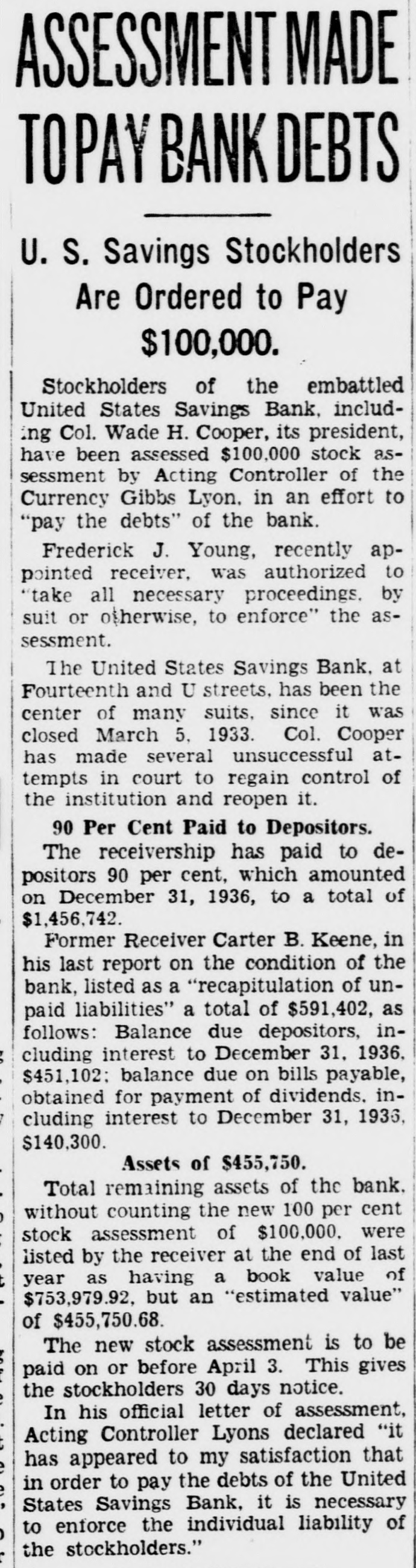
ASSESSMENT MADE TOPAY BANK DEBTS U
S. Savings Stockholders Are Ordered to Pay $100,000. Stockholders of the embattled United States Savings Bank, including Col. Wade H. Cooper, its president, have been assessed $100,000 stock assessment by Acting Controller of the Currency Gibbs Lyon. in an effort to "pay the debts" of the bank. Frederick J. Young, recently appointed receiver, was authorized to "take all necessary proceedings, by suit or otherwise, to enforce" the assessment. The United States Savings Bank, at Fourteenth and U streets, has been the center of many suits, since it was closed March 5. 1933. Col. Cooper has made several unsuccessful attempts in court to regain control of the institution and reopen it. 90 Per Cent Paid to Depositors. The receivership has paid to depositors 90 per cent, which amounted on December 31, 1936, to a total of $1,456,742. Former Receiver Carter B. Keene, in his last report on the condition of the bank, listed as a "recapitulation of unpaid liabilities" a total of $591,402. as follows: Balance due depositors, including interest to December 31. 1936. $451,102: balance due on bills payable, obtained for payment of dividends. including interest to December 31, 1936. $140,300. Assets of $455,750. Total remaining assets of the bank. without counting the new 100 per cent stock assessment of $100,000. were listed by the receiver at the end of last year as having a book value of $753,979.92. but an "estimated value" of $455,750.68. The new stock assessment is to be paid on or before April 3. This gives the stockholders 30 days notice. In his official letter of assessment, Acting Controller Lyons declared "it has appeared to my satisfaction that in order to pay the debts of the United States Savings Bank, it is necessary to enforce the individual liability of the stockholders."
21.April 8, 1938Evening StarWashington, DC
Click image to open full size in new tab
Article Text
United States Savings Begins to Notify Depositors to Call for Funds. The United States Savings Bank, 2000 Fourteenth street N. W., today announced it is ready to make payment of the 10 per cent dividend authorized by the controller of the currency to its 8,500 depositors, who already have received 90 per cent of the funds they had in the bank when it closed five years ago. The dividend will total about $170,000. Frederick J. Young, receiver of the bank, sent post cards yesterday to 500 depositors, and he will send additional batches of 500 every other day until all depositors have been notified. No depositor without a card will be permitted to draw his 10 per cent. The bank will be open daily from 9 a.m. to 4:30 p.m. This payment means that claims totaling $1,619,000 will have been satisfied, bank officials said, and there is a possibility that depositors will be granted the 6 per cent interest the law allows them for the period during which their claims remained unpaid. In authorizing the 10 per cent payment yesterday the controller stated: "The payment of the forthcoming dividend of 10 per cent will be made possible by utilizing the cash on hand plus the proceeds of a loan of present maximum amount upon the remaining assets of the bank. "The receiver will, however, retain these assets in his possession and will continue to liquidate them as is customary in this type of loan and will apply the proceeds toward the repayment of the loan."
22.February 1, 1940Evening StarWashington, DC
Click image to open full size in new tab
Article Text
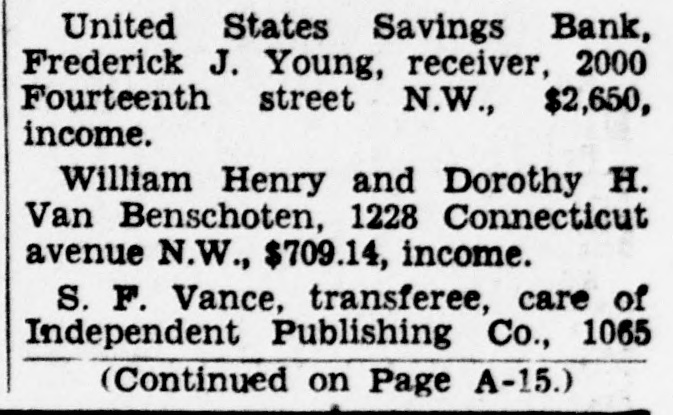
United States Savings Bank, Frederick J. Young, receiver, 2000 Fourteenth street N.W., $2,650, income. William Henry and Dorothy H. Van Benschoten, 1228 Connecticut avenue N.W., $709.14, income. S. F. Vance, transferee, care of Independent Publishing Co., 1065 (Continued on Page A-15.)
Bank runs are almost always and everywhere a deterioration of bank fundamentals.
But not for you.
You are the measure-zero exception: great fundamentals, solid bank, and yet the Diamond Dybvig fairy spread its rumor. Depositors woke up. Your collateral was not prepositioned. The Clearinghouse had it for you.
Do not pass Go. Do not collect $200. Go directly to jail… or worse.
Flag Article for Review
Flag Episode for Review
United States Savings Bank · Episode ID 15006471599