Lewis Johnson & Company (Washington, DC)

Episode Information

Episode UID
15007471379
Episode Type
Suspension โ†’ Closure
Bank Type
private
Bank ID
1500747 routing
Routing Number
15-0074
Start Date
November 16, 1914
Location
Washington, District of Columbia (38.895, -77.036)

Metadata

Model
gpt-5-mini (chosen from majority vote of a three-model LLM ensemble)
Short Digest
ea9d3626e6b4c05d

Response Measures

None

Description

No contemporaneous bank run is described; firm consented to bankruptcy and receivers were appointed.

Events (2)

1. November 16, 1914 Receivership
Newspaper Excerpt
Justice McCoy on hearing the petition appointed J. Miller Kenyon ... and W. Morris Lammond ... as receivers.
Source
newspapers
2. November 16, 1914 Suspension
Cause
Bank Specific Adverse Info
Cause Details
Firm insolvent after stock market collapse and wartime disruptions; admitted inability to settle and consented to bankruptcy.
Newspaper Excerpt
the first symptoms of the end came this morning, when checks were not honored over the counter.
Source
newspapers

Newspaper Articles (13)

Article from Evening Star, November 16, 1914

Click image to open full size in new tab

Article Text

Lewis Johnson & Co. Placed in Hands of Receivers by Consent. CREDITORS CLAIMING $10,500 FILE PETITION No Statement Furnished Court. John W. Henry and Benjamin W. Woodruff Compose the Firm. Creditors of John William Henry and Benjamin W. Woodruff, trading as Lewis Johnson & Co., bankers and brokers, of 1505 Pennsylvania avenue northwest, today filed in the District Supreme Court a petition to have them adjudged bankrupt. Three creditors filed the request, declaring their claims aggregate $10,500. The bankers consented to be declared bankrupt. Justice McCoy on hearing the petition appointed J. Miller Kenyon, a lawyer, and W. Morris Lammond, a bookkeeper for the firm, as receivers. He placed the bond at $50,000 and later in the afternoon signed a decree adjudging the firm bankrupt, and referring the case to E. S. McCalmont, referee in bankruptcy, before whom all further proceedings will be taken. No Statement Furnished Court. No statement of the assets and liabilities of the firm was furnished the court. The creditors are George W. Weber, who has a claim of $4,500; Alfred R. Elmore, $5,000, and Arthur M. Travers, $1,000. They allege that the banking firm is insolvent and present to the court a letter signed by Messrs. Henry and Woodruff, in which they admit their inability to settle in full with their creditors and acknowledge a willingness that the firm and each of them individually may be adjudged bankrupt. Attorney Charles C. Tucker represented the creditors. The bankers were represented by Attorneys, A. S. Worthington, T. Percy Myers and Charles L. Frailey. History of Firm. The firm of Lewis Johnson & Co. was organized in 1858, and has had a long career in the city, standing high in financial and security circles. The original founder of the company died some years ago, but the old firm name has been maintained right down to date. In the early years of the firm the banking business was given almost exclusive attention, but more recently the security operations have overshadowed the banking end. Up to recently the firm has rated very high. but with the depression that came over Wall street, the dropping off in trade and the very heavy expense incident to the conduct of the business the firm came upon troublesome times. When the European war broke out and the stock exchange closed, with an absolute loss of all trading, affairs are said to have become more and more straightened. Attempts were made to tide over the financial difficulties, but what might have been a very easy proposition in normal times was impossible in times like these and it was not until every effort had been made that the firm considered the end at hand. Banks Will Lose Nothing. It is understood that the banks of the city will lose nothing; that approximately $200,000 of obligations to them are fully secured; indeed, that a margin of 15 to 20 per cent in favor of Lewis Johnson & Co. may be reasonably calculated, as bankers are not disposed to enlarge loans at this time. In the matter of deposits, information is to the effect that about $80,000 deposits are credited to different people on the books, with but a comparatively small number of people owning the cash. The firm was not a member of the clearing house association, nor did any national bank clear for it. Its checks were payable over the counter, and the first symptoms of the end came this morning, when checks were not honored over the counter. Charles T. Williams retired from the firm some two years ago; William A. Marnes retired early in the present year. The individual members are J. William Henry and Benjamin Woodruff, who are well known men of Washington and have a host of friends.
Article from South Bend News-Times, November 17, 1914

Click image to open full size in new tab

Article Text

GO INTO BANKRUPTCY, WASHINGTON Nov. 17.-The private banking firm of Lewis Johnson & Co., filed a bankruptcy petition this morning and a receiver was appointed.


Article from The Washington Herald, November 17, 1914

Click image to open full size in new tab

Article Text

BANKERS ARE NAMED IN BANKRUPTCY ACTION G. W. Weber, A. R. Elmore, and A. M. Travers Creditors of Lewis Johnson & Co. An involuntary petition in bankruptcy was filed in the District Supreme Court yesterday against Lewis Johnson & Co., bankers, 1505 Pennsylvania avenue northwest. John William Henry and Benjamin W. Woodruff, who, individually and as copartnership. traded under that name, are named as bankrupts. George W. Weber, Alfred R. Elmore and Arthur M. Travers are the creditors. In their petition they allege that Lewis Johnson & Co. have failed to pay balances due on certain stock transactions Weber alleges the company failed to pay him $4,500 due on account of certain stock transactions. Elmore claims $5,000 and Travers $1,500. In its answer the company admits it is unable to make these payments and agrees to being declared bankrupt. This is the first financial failure occurring in Washington In some time, and in this case the business of the firm is purely speculative. The assets and liabilities of the company were not named in the proceedings. Receivers have enot been named by the court. Lewis Johnson & Co. yesterday made the following statement: "The suspension of Lewis Johnson & Co. and the proceedings in bankruptcy have been precipitated by the long-continued bad state of the stock market and the uncertainties of the financial situation at this time. "The matter is now in the Bankruptcy Court. and it is impossible at present to state exactly the condition of the firm until a report is made to the court by the receiver showing the exact assets and liabilities." It is understood some of the larger creditors of Lewis Johnson & Co. have a plan under way for the reorganization and financing of the business. The plan contemplates the formation of a corporation which shall take over the customers' contracts and commitments and ultimately satisfy the debts of the firm. This plan has been approved by a number of the creditors.


Article from The Elbert County Tribune, November 20, 1914

Click image to open full size in new tab

Article Text

Washington Bank in Receivership. Washington.-Lewis Johnson & Co., one of the oldest firms of private bankers here, filed a voluntary petition in bankruptcy.


Article from The Washington Times, November 21, 1914

Click image to open full size in new tab

Article Text

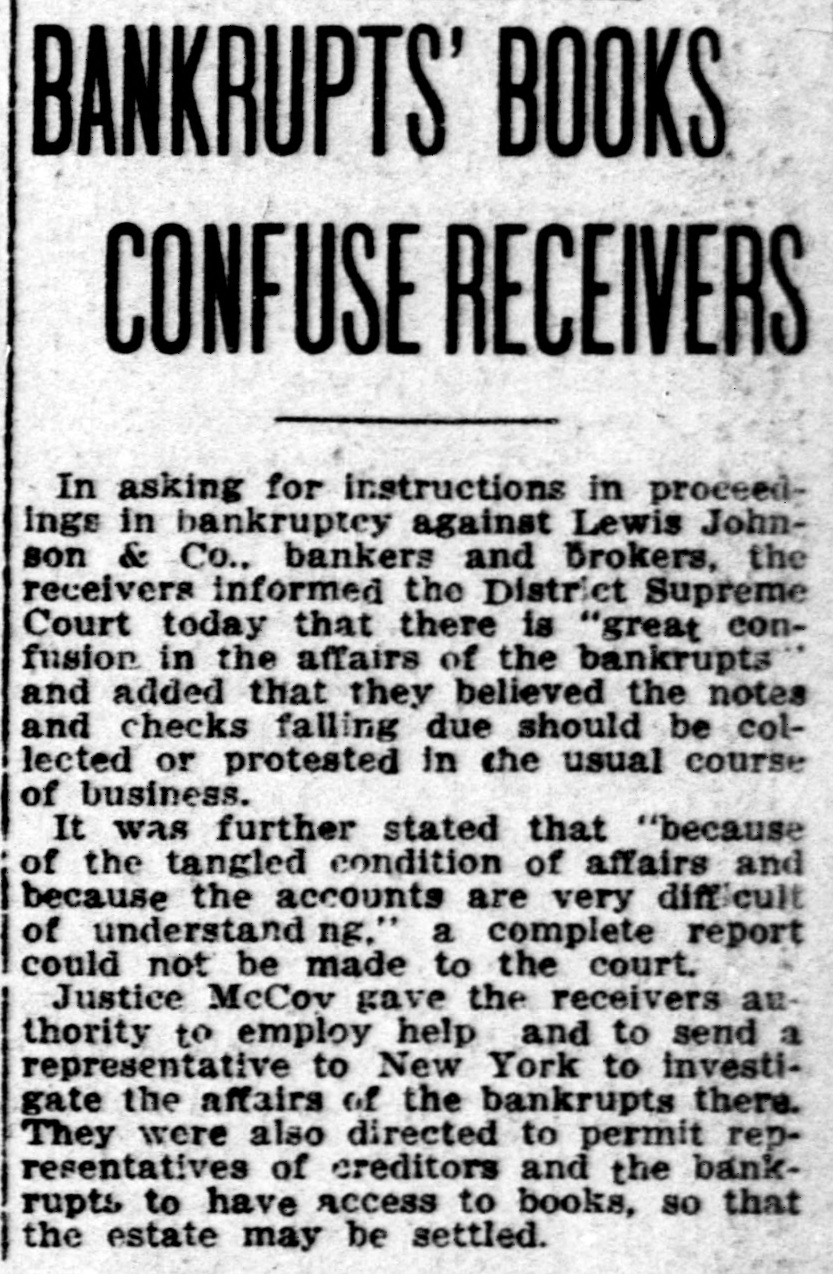
BANKRUPTS' BOOKS CONFUSE RECEIVERS In asking for instructions in proceedIngs in bankruptcy against Lewis Johnson & Co., bankers and brokers, the receivers informed the District Supreme Court today that there is "great confusion in the affairs of the bankrupts and added that they believed the notes and checks falling due should be collected or protested in the usual course of business. It was further stated that "because of the tangled condition of affairs and because the accounts are very diff cult of understand ng." a complete report could not be made to the court. Justice McCov gave the receivers authority to employ help and to send a representative to New York to investigate the affairs of the bankrupts there. They were also directed to permit representatives of creditors and the bankrupts to have access to books, so that the estate may be settled.


Article from Evening Star, December 3, 1914

Click image to open full size in new tab

Article Text

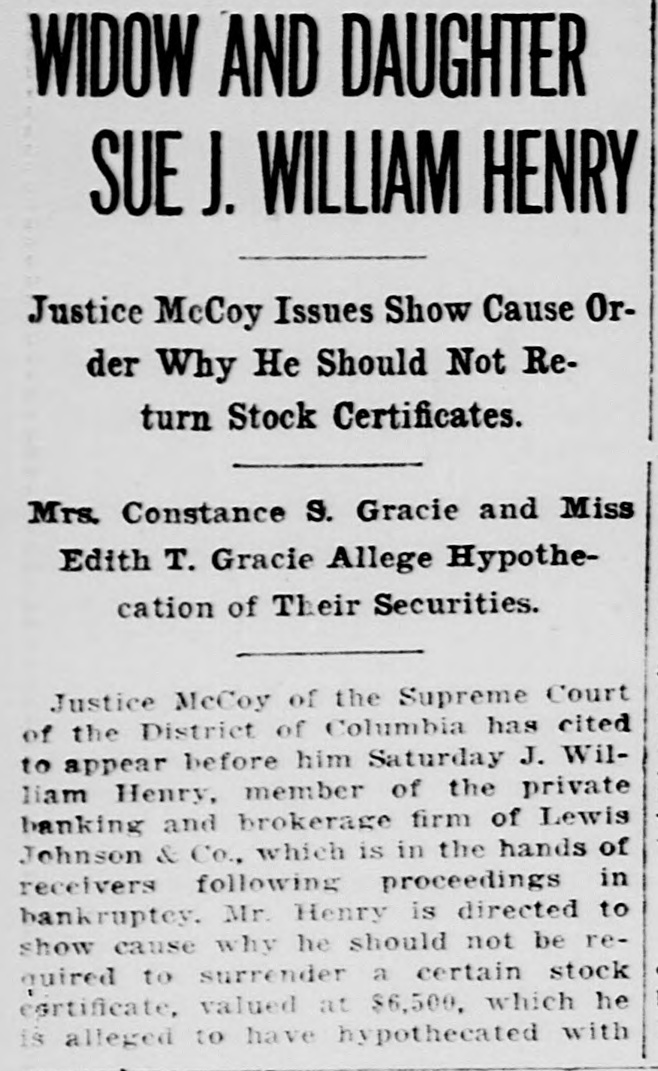
WIDOW AND DAUGHTER SUE J. WILLIAM HENRY Justice McCoy Issues Show Cause Order Why He Should Not Return Stock Certificates. Mrs. Constance S. Gracie and Miss Edith T. Gracie Allege Hypothecation of Their Securities. Justice McCoy of the Supreme Court of the District of Columbia has cited to appear before him Saturday J. William Henry, member of the private banking and brokerage firm of Lewis Johnson & Co., which is in the hands of receivers following proceedings in bankruptcy. Mr. Henry is directed to show cause why he should not be required to surrender a certain stock cortificate, valued at $6,500, which he is alleged to have hypothecated with


Article from The Washington Herald, December 8, 1914

Click image to open full size in new tab

Article Text

# BANKRUPTS' MOVE PROTESTED. Arlington Insurance Company Files Answer to Receivers' Petition. The Arlington Fire Insurance Company, in its answer, filed yesterday, to the petition of receivers for the bank-rupt Lewis Johnson & Co., bankers, in which it was asked that the quarters of the bankers, at 1505 Pennsylvania avenue, be relinquished, protested against the receivers' wishes. A five-year lease, entered into in 1911, it is claimed by the fire insurance company, which granted the lease, should be viewed as an asset. The receivers wished to give up the offices to save the annual rental of $6,500.


Article from The Washington Herald, December 9, 1914

Click image to open full size in new tab

Article Text

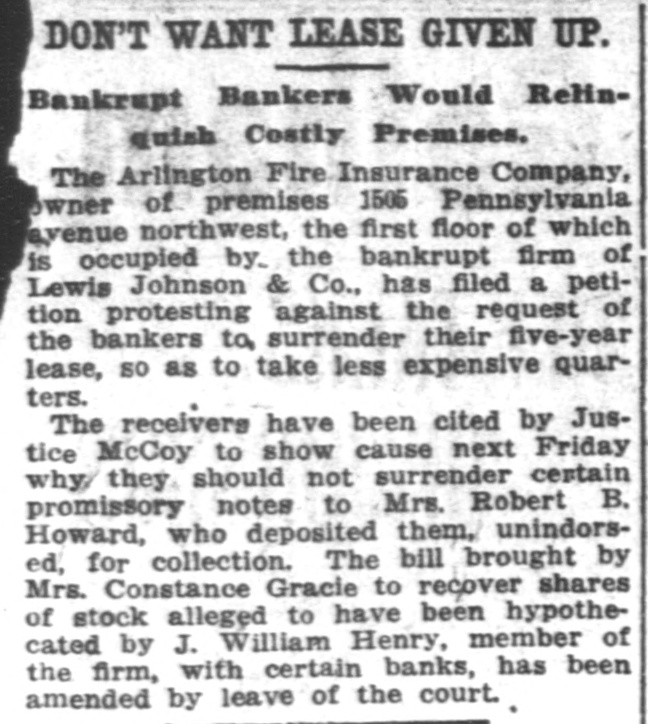
DON'T WANT LEASE GIVEN UP. Bankrupt Bankers Would Relinquish Costly Premises. The Arlington Fire Insurance Company, owner of premises 1505 Pennsylvania avenue northwest, the first floor of which is occupied by. the bankrupt firm of Lewis Johnson & Co., has filed a petition protesting against the request of the bankers to, surrender their five-year lease, SO as to take less expensive quarters. The receivers have been cited by Justice McCoy to show cause next Friday why they should not surrender certain promissory notes to Mrs. Robert B. Howard, who deposited them, unindorsed, for collection. The bill brought by Mrs. Constance Gracie to recover shares of stock alleged to have been hypothecated by J. William Henry, member of the firm, with certain banks, has been amended by leave of the court.


Article from The Washington Times, December 17, 1914

Click image to open full size in new tab

Article Text

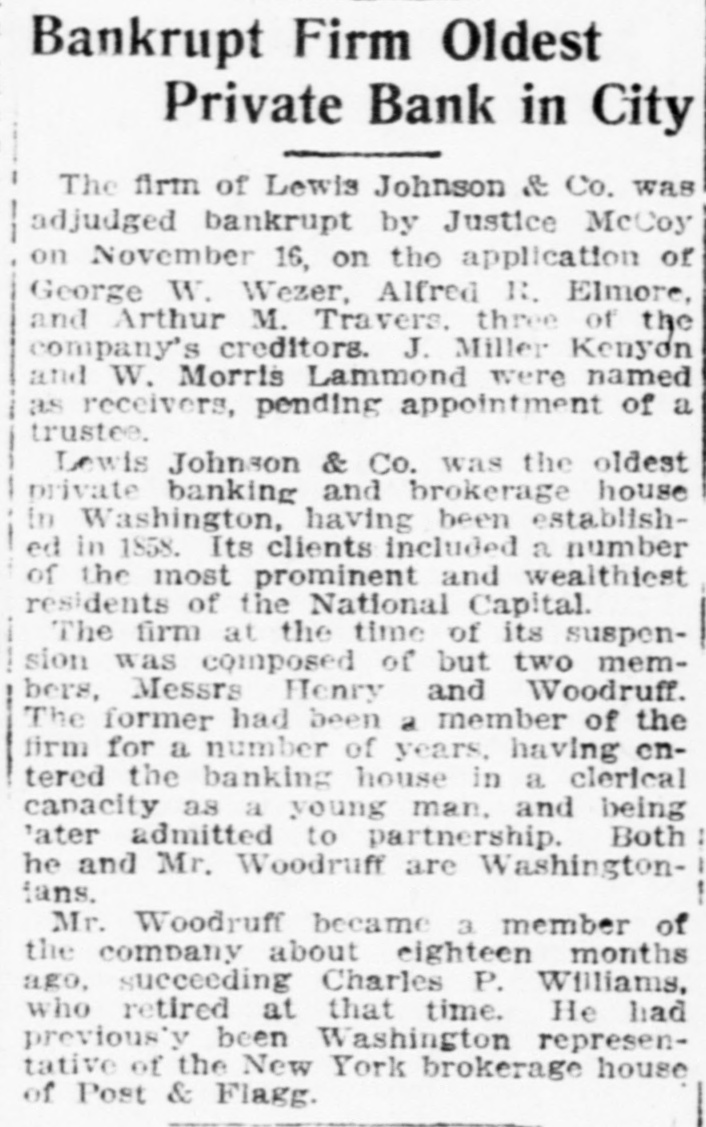
Bankrupt Firm Oldest Private Bank in City The firm of Lewis Johnson & Co. was adjudged bankrupt by Justice McCoy on November 16, on the application of George W. Wezer, Alfred R. Elmore, and Arthur M. Travers. three of the company's creditors. J. Miller Kenyon and W. Morris Lammond were named as receivers, pending appointment of a trustee. Lewis Johnson & Co. was the oldest private banking and brokerage house in Washington, having been established in 1858. Its clients included a number of the most prominent and wealthiest residents of the National Capital. The firm at the time of its suspension was composed of but two members, Messrs Henry and Woodruff. The former had been a member of the firm for a number of years, having entered the banking house in a clerical capacity as a young man, and being 'ater admitted to partnership. Both he and Mr. Woodruff are Washingtonians. Mr. Woodruff became 3. member of the company about eighteen months ago, succeeding Charles P. Williams, who retired at that time. He had previously been Washington representative of the New York brokerage house of Post & Flagg.


Article from Evening Star, December 21, 1914

Click image to open full size in new tab

Article Text

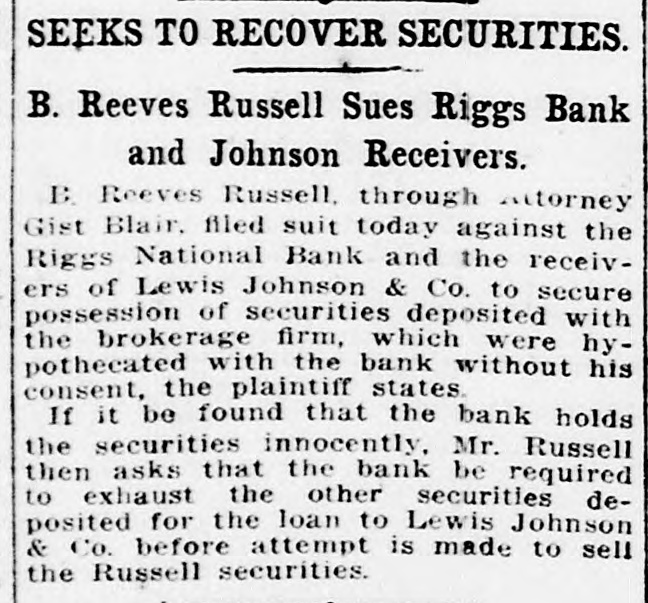
SEEKS TO RECOVER SECURITIES. B. Reeves Russell Sues Riggs Bank and Johnson Receivers. B. Reeves Russell, through Atorney Gist Blair, filed suit today against the Riggs National Bank and the receivers of Lewis Johnson & Co. to secure possession of securities deposited with the brokerage firm, which were hypothecated with the bank without his consent, the plaintiff states. If it be found that the bank holds the securities innocently, Mr. Russell then asks that the bank be required to exhaust the other securities deposited for the loan to Lewis Johnson & Co. before attempt is made to sell the Russell securities.


Article from The Washington Herald, December 27, 1914

Click image to open full size in new tab

Article Text

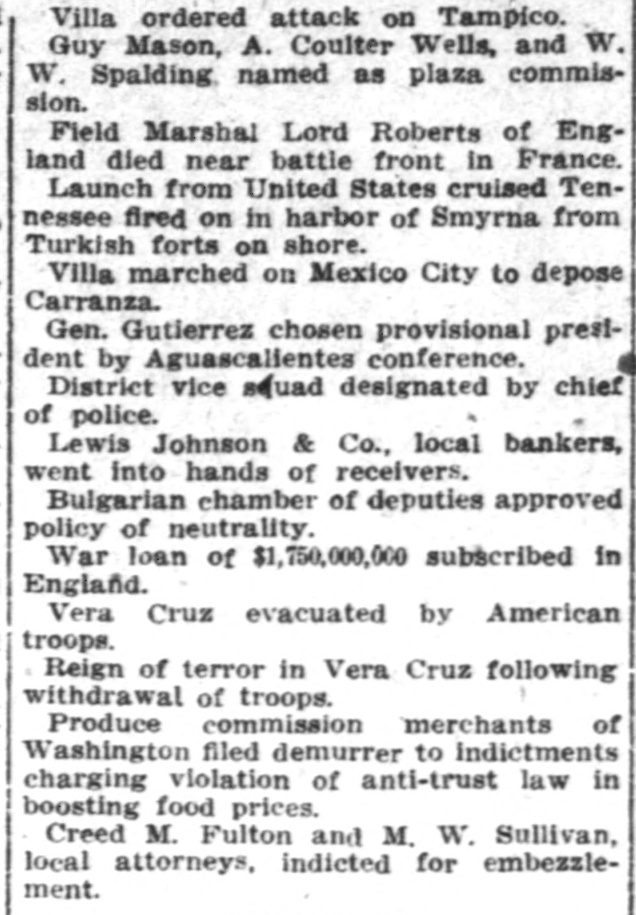
Villa ordered attack on Tampico. Guy Mason, A. Coulter Wells, and W. W. Spalding named as plaza commission. Field Marshal Lord Roberts of England died near battle front in France. Launch from United States cruised Tennessee fired on in harbor of Smyrna from Turkish forts on shore. Villa marched on Mexico City to depose Carranza. Gen. Gutierrez chosen provisional president by Aguascalientes conference. District vice squad designated by chief of police. Lewis Johnson & Co., local bankers, went into hands of receivers. Bulgarian chamber of deputies approved policy of neutrality. War loan of $1,750,000,000 subscribed in England. Vera Cruz evacuated by American troops. Reign of terror in Vera Cruz following withdrawal of troops. Produce commission merchants of Washington filed demurrer to indictments charging violation of anti-trust law in boosting food prices. Creed M. Fulton and M. W. Sullivan, local attorneys, indicted for embezzlement.


Article from The Washington Herald, March 25, 1919

Click image to open full size in new tab

Article Text

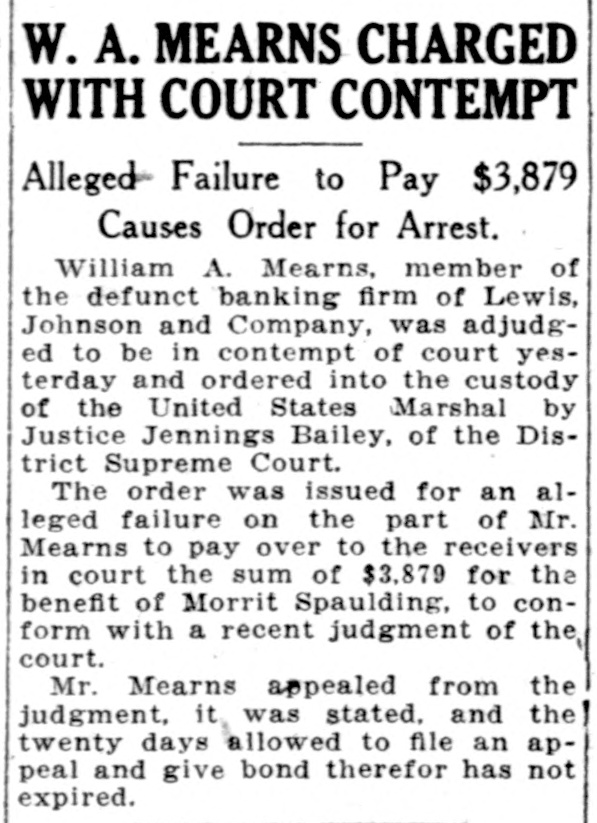
# W. A. MEARNS CHARGED # WITH COURT CONTEMPT Alleged Failure to Pay $3,879 Causes Order for Arrest. William A. Mearns, member of the defunct banking firm of Lewis, Johnson and Company, was adjudged to be in contempt of court yesterday and ordered into the custody of the United States Marshal by Justice Jennings Bailey, of the District Supreme Court. The order was issued for an alleged failure on the part of Mr. Mearns to pay over to the receivers in court the sum of $3,879 for the benefit of Morrit Spaulding, to conform with a recent judgment of the court. Mr. Mearns appealed from the judgment, it was stated, and the twenty days allowed to file an appeal and give bond therefor has not expired.


Article from The Washington Herald, March 30, 1919

Click image to open full size in new tab

Article Text

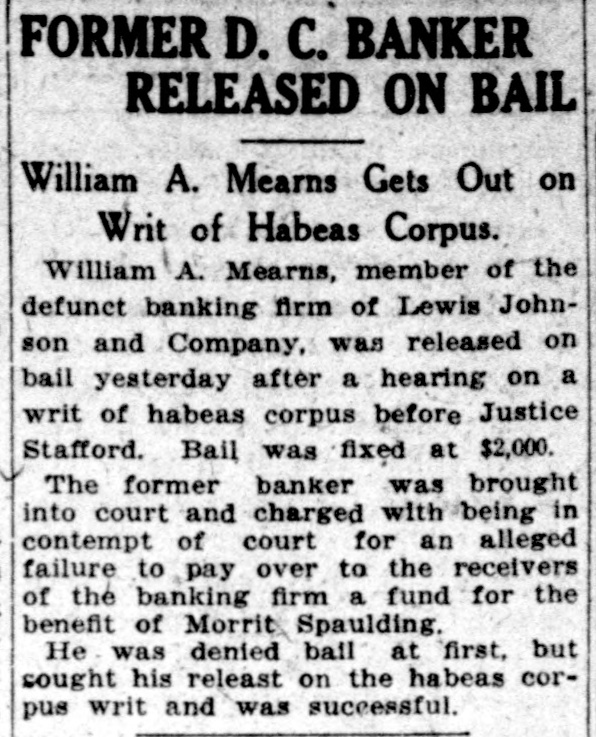
FORMER D. C. BANKER RELEASED ON BAIL William A. Mearns Gets Out on Writ of Habeas Corpus. William A. Mearns, member of the defunct banking firm of Lewis Johnson and Company, was released on bail yesterday after a hearing on a writ of habeas corpus before Justice Stafford. Bail was fixed at $2,000. The former banker was brought into court and charged with being in contempt of court for an alleged failure to pay over to the receivers of the banking firm a fund for the benefit of Morrit Spaulding. He was denied ball at first, but sought his releast on the habeas corpus writ and was successful.