Continental Trust Company (Washington, DC)

Episode Information

Episode UID
15007571561
Episode Type
Suspension โ†’ Closure
Bank Type
trust
Bank ID
1500757 routing
Routing Number
15-0075
Start Date
January 18, 1930
Location
Washington, District of Columbia (38.895, -77.036)

Metadata

Model
gpt-5-mini (chosen from majority vote of a three-model LLM ensemble)
Short Digest
9ec45ff9ae9787ab

Response Measures

None

Description

Receiver appointed Feb 28, 1933; bank had ceased banking operations after 1930 merger and remained in receivership until liquidation completed.

Events (5)

1. January 18, 1930 Other
Newspaper Excerpt
the Continental Trust Company was merged with the Commercial National Bank on January 18, 1930
Source
newspapers
2. February 28, 1933 Receivership
Newspaper Excerpt
A receiver was appointed for the Continental February 28, 1933, for the purpose of collecting a stock assessment
Source
newspapers
3. February 28, 1933 Suspension
Cause
Government Action
Cause Details
Receiver appointment by Comptroller of the Currency and placement into receivership following bank collapse
Newspaper Excerpt
A receiver was appointed for the Continental February 28, 1933, for the purpose of collecting a stock assessment
Source
newspapers
4. September 15, 1934 Other
Newspaper Excerpt
records of the two banks have been moved to the Park Savings Bank ... beginning Monday affairs will be transacted there
Source
newspapers
5. November 15, 1937 Other
Newspaper Excerpt
The Continental Trust Co. of this city was among 31 receiverships closed during October ... depositors and creditors of record were paid in full
Source
newspapers

Newspaper Articles (11)

Article from The Washington Times, September 15, 1934

Click image to open full size in new tab

Article Text

Liquidation Work To Shift Monday This is the last day on which liquidation matters of the North Capitol Savings Bank and the Continental Trust Company, will he handled from the two institutions. Receiver John F. Moran announced yesterday records of the two banks have been moved to the Park Savings Bank at Fourteenth and Kenyon Streets, and beginning Monday affairs will be transacted there.


Article from Evening Star, September 30, 1934

Click image to open full size in new tab

Article Text

CONTINENTAL TRUST CO. DIVIDENDS ASKED REPAID Receiver Files Suit in D. C. Supreme Court to Recover $105,000 From 126 Persons. John F. Moran, receiver for the Continental Trust Co., yesterday filed suit in District Supreme Court to recover $105,000 from 125 shareholders and directors who allegedly received dividends after the trust company was insolvent. The suit, filed through Attorney Brice Clagett, asserted they were paid after the trust company had been merged with the Commercial National Bank. An accounting and return of the payments was asked. Among defendants is Wade H. Cooper, former president of the trust company.


Article from The Washington Times, June 28, 1935

Click image to open full size in new tab

Article Text

COURT TO ACT IN BANK TANGLE The District Supreme Court yesterday was asked to make final determination of the liability of the Continental Trust Company to the Commercial National Bank in connection with the merger of the two institutions on January 18, 1930, and on which is predicated the indictment of Col. Wade H. Cooper, president of both banks. Further complicating the involved nature of the suit which is an equity proceeding, the alignment of parties reveals Robert C. Baldwin, appointed by the Comptroller of the Currency as receiver for the Commercial National Bank, appearing as plaintiff against another Treasury receiver, John F. Moran, of the Continental. Mr. Baldwin claims that the Continental Trust Company has not paid all of the $2,803,903.96 indebtedness to the Commercial National Bank which the latter assumed at the time of the merger as deposit liabilities of the Continental. The court is also asked to allow other claims against the Continental's assets which Colonel Cooper and his directors are said to have declared and paid out of Continental assets, although the assets were pledged to the Commercial National Bank.


Article from Evening Star, October 27, 1935

Click image to open full size in new tab

Article Text

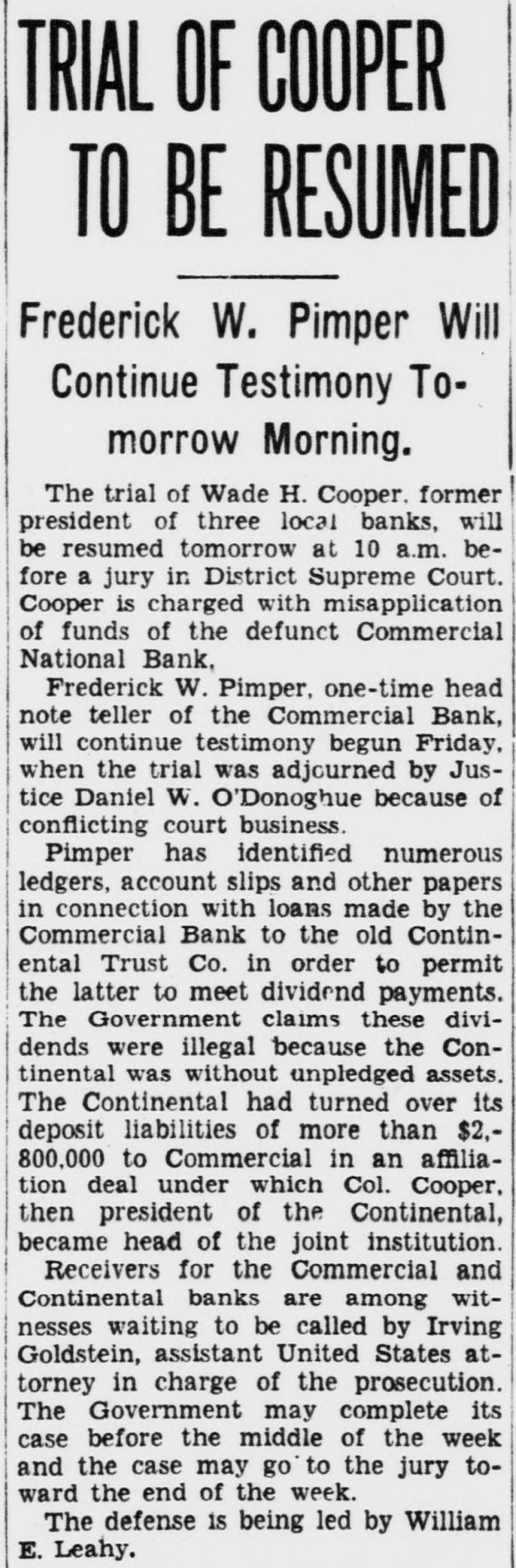
TRIAL OF COOPER TO RE DD RESUMED Frederick W. Pimper Will Continue Testimony Tomorrow Morning. The trial of Wade H. Cooper. former president of three local banks, will be resumed tomorrow at 10 a.m. before a jury in District Supreme Court. Cooper is charged with misapplication of funds of the defunct Commercial National Bank, Frederick W. Pimper, one-time head note teller of the Commercial Bank, will continue testimony begun Friday, when the trial was adjourned by Justice Daniel W. O'Donoghue because of conflicting court business. Pimper has identified numerous ledgers, account slips and other papers in connection with loans made by the Commercial Bank to the old Continental Trust Co. in order to permit the latter to meet dividend payments. The Government claims these dividends were illegal because the Continental was without unpledged assets. The Continental had turned over its deposit liabilities of more than $2,800,000 to Commercial in an affiliation deal under which Col. Cooper. then president of the Continental, became head of the joint institution. Receivers for the Commercial and Continental banks are among witnesses waiting to be called by Irving Goldstein, assistant United States attorney in charge of the prosecution. The Government may complete its case before the middle of the week and the case may go to the jury toward the end of the week. The defense is being led by William E. Leahy.


Article from Evening Star, October 28, 1935

Click image to open full size in new tab

Article Text

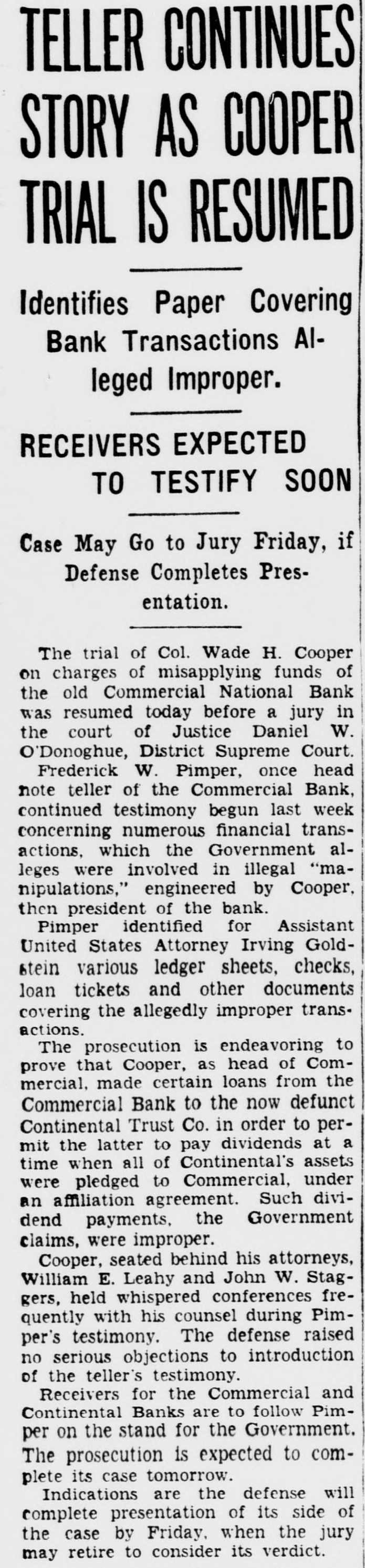
TELLER CONTINUES STORY AS COOPER TRIAL IS RESUMED Identifies Paper Covering Bank Transactions Alleged Improper. RECEIVERS EXPECTED TO TESTIFY SOON Case May Go to Jury Friday, if Defense Completes Presentation. The trial of Col. Wade H. Cooper on charges of misapplying funds of the old Commercial National Bank was resumed today before a jury in the court of Justice Daniel W. O'Donoghue, District Supreme Court. Frederick W. Pimper, once head note teller of the Commercial Bank, continued testimony begun last week concerning numerous financial transactions, which the Government alleges were involved in illegal "manipulations," engineered by Cooper, then president of the bank. Pimper identified for Assistant United States Attorney Irving Goldstein various ledger sheets, checks, loan tickets and other documents covering the allegedly improper transactions. The prosecution is endeavoring to prove that Cooper, as head of Commercial, made certain loans from the Commercial Bank to the now defunct Continental Trust Co. in order to permit the latter to pay dividends at a time when all of Continental's assets were pledged to Commercial, under an affiliation agreement. Such dividend payments, the Government claims, were improper. Cooper, seated behind his attorneys, William E. Leahy and John W. Staggers, held whispered conferences frequently with his counsel during Pimper's testimony. The defense raised no serious objections to introduction of the teller's testimony. Receivers for the Commercial and Continental Banks are to follow Pimper on the stand for the Government. The prosecution is expected to complete its case tomorrow. Indications are the defense will complete presentation of its side of the case by Friday, when the jury may retire to consider its verdict.


Article from Evening Star, February 28, 1936

Click image to open full size in new tab

Article Text

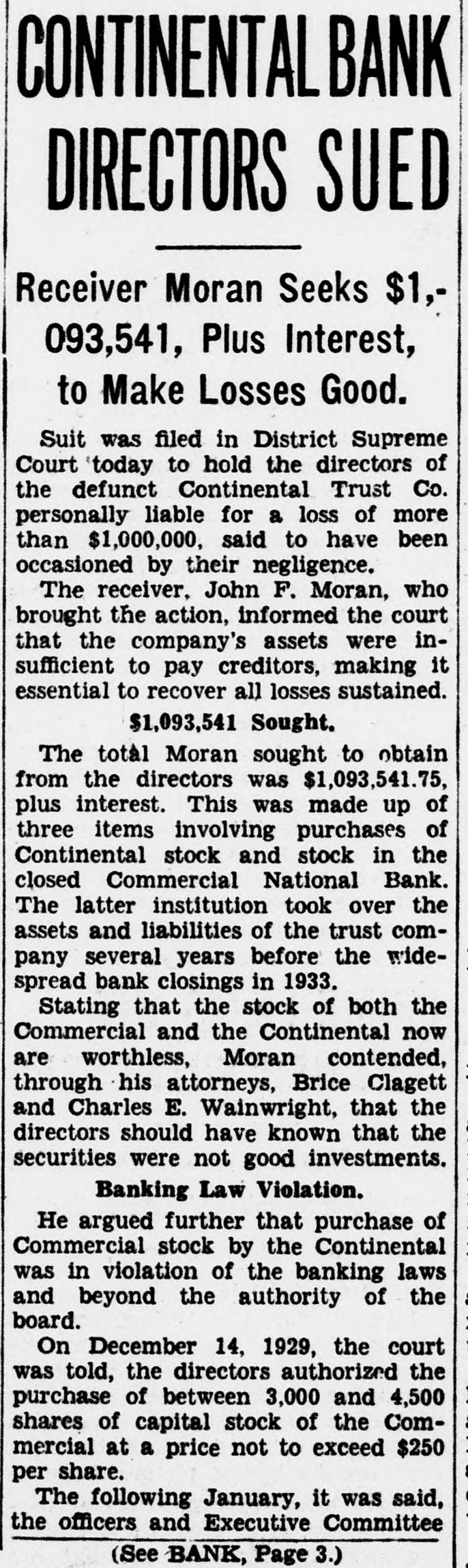
CONTINENTAL B BANK DIRECTORS SUED Receiver Moran Seeks $1,093,541, Plus Interest, to Make Losses Good. Suit was filed in District Supreme Court today to hold the directors of the defunct Continental Trust Co. personally liable for a loss of more than $1,000,000, said to have been occasioned by their negligence. The receiver, John F. Moran, who brought the action, informed the court that the company's assets were insufficient to pay creditors, making it essential to recover all losses sustained. $1,093,541 Sought. The total Moran sought to obtain from the directors was $1,093,541.75, plus interest. This was made up of three items involving purchases of Continental stock and stock in the closed Commercial National Bank. The latter institution took over the assets and liabilities of the trust company several years before the widespread bank closings in 1933. Stating that the stock of both the Commercial and the Continental now are worthless, Moran contended, through his attorneys, Brice Clagett and Charles E. Wainwright, that the directors should have known that the securities were not good investments. Banking Law Violation. He argued further that purchase of Commercial stock by the Continental was in violation of the banking laws and beyond the authority of the board. On December 14, 1929, the court was told, the directors authorized the purchase of between 3,000 and 4,500 shares of capital stock of the Commercial at a price not to exceed $250 per share. The following January, it was said, the officers and Executive Committee (See BANK, Page 3.)
Article from The Washington Times, January 23, 1937

Click image to open full size in new tab

Article Text

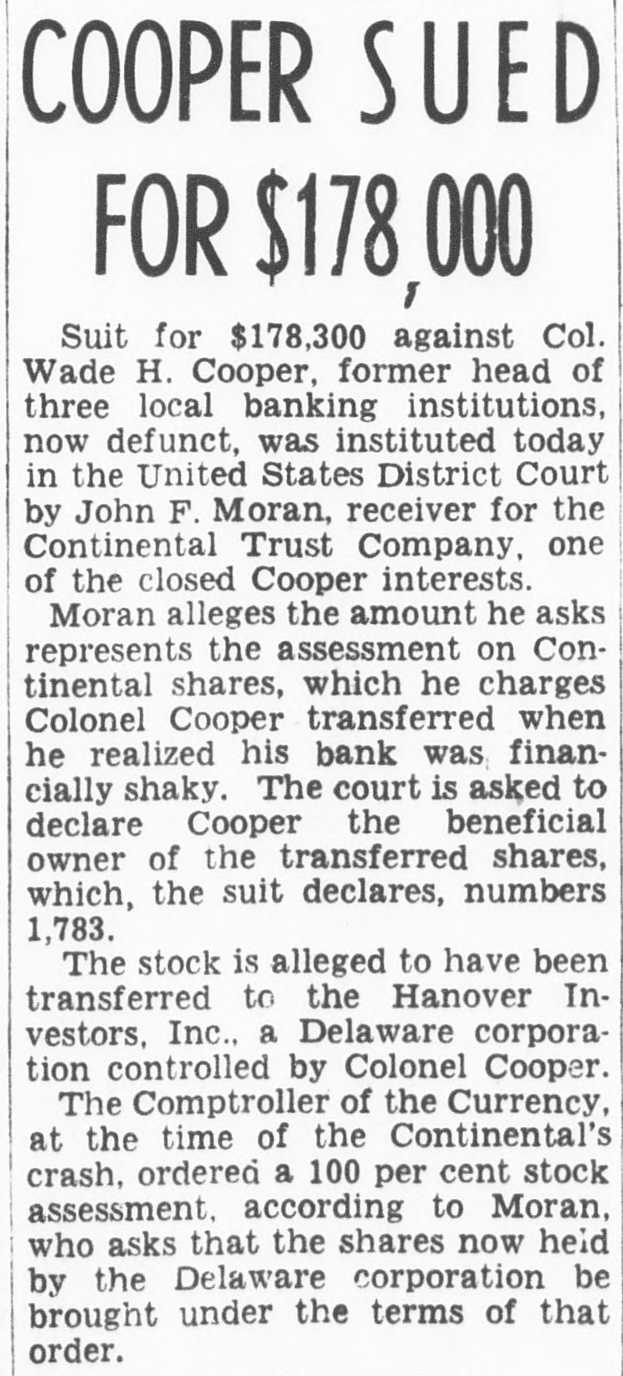
COOPER SUED FOR $178 000 Suit for $178,300 against Col. Wade H. Cooper, former head of three local banking institutions, now defunct, was instituted today in the United States District Court by John F. Moran, receiver for the Continental Trust Company, one of the closed Cooper interests. Moran alleges the amount he asks represents the assessment on Continental shares, which he charges Colonel Cooper transferred when he realized his bank was financially shaky. The court is asked to declare Cooper the beneficial owner of the transferred shares, which, the suit declares, numbers 1,783. The stock is alleged to have been transferred to the Hanover Investors, Inc., a Delaware corporation controlled by Colonel Cooper. The Comptroller of the Currency, at the time of the Continental's crash, ordered a 100 per cent stock assessment, according to Moran, who asks that the shares now held by the Delaware corporation be brought under the terms of that order.


Article from The Washington Times, February 23, 1937

Click image to open full size in new tab

Article Text

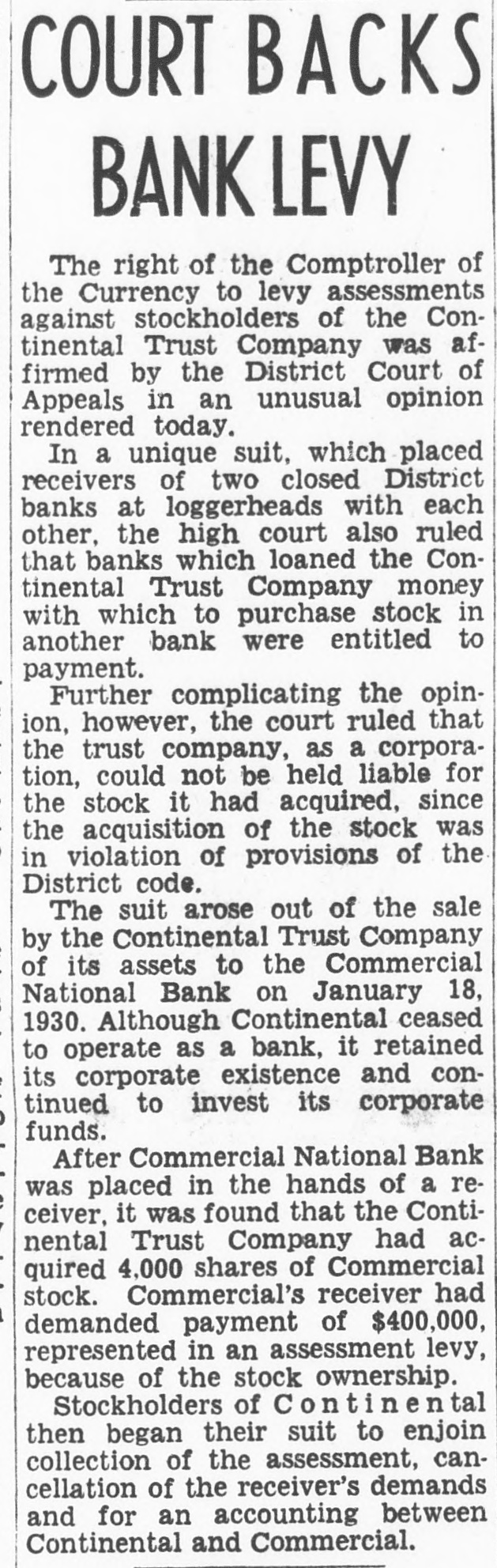
COURT BACKS BANK LEVY The right of the Comptroller of the Currency to levy assessments against stockholders of the Continental Trust Company was affirmed by the District Court of Appeals in an unusual opinion rendered today. In a unique suit, which placed receivers of two closed District banks at loggerheads with each other, the high court also ruled that banks which loaned the Continental Trust Company money with which to purchase stock in another bank were entitled to payment. Further complicating the opinion, however, the court ruled that the trust company, as a corporation, could not be held liable for the stock it had acquired, since the acquisition of the stock was in violation of provisions of the District code. The suit arose out of the sale by the Continental Trust Company of its assets to the Commercial National Bank on January 18, 1930. Although Continental ceased to operate as a bank, it retained its corporate existence and continued to invest its corporate funds. After Commercial National Bank was placed in the hands of a receiver, it was found that the Continental Trust Company had acquired 4,000 shares of Commercial stock. Commercial's receiver had demanded payment of $400,000, represented in an assessment levy, because of the stock ownership. Stockholders of Continental then began their suit to enjoin collection of the assessment, cancellation of the receiver's demands and for an accounting between Continental and Commercial.


Article from Evening Star, March 18, 1937

Click image to open full size in new tab

Article Text

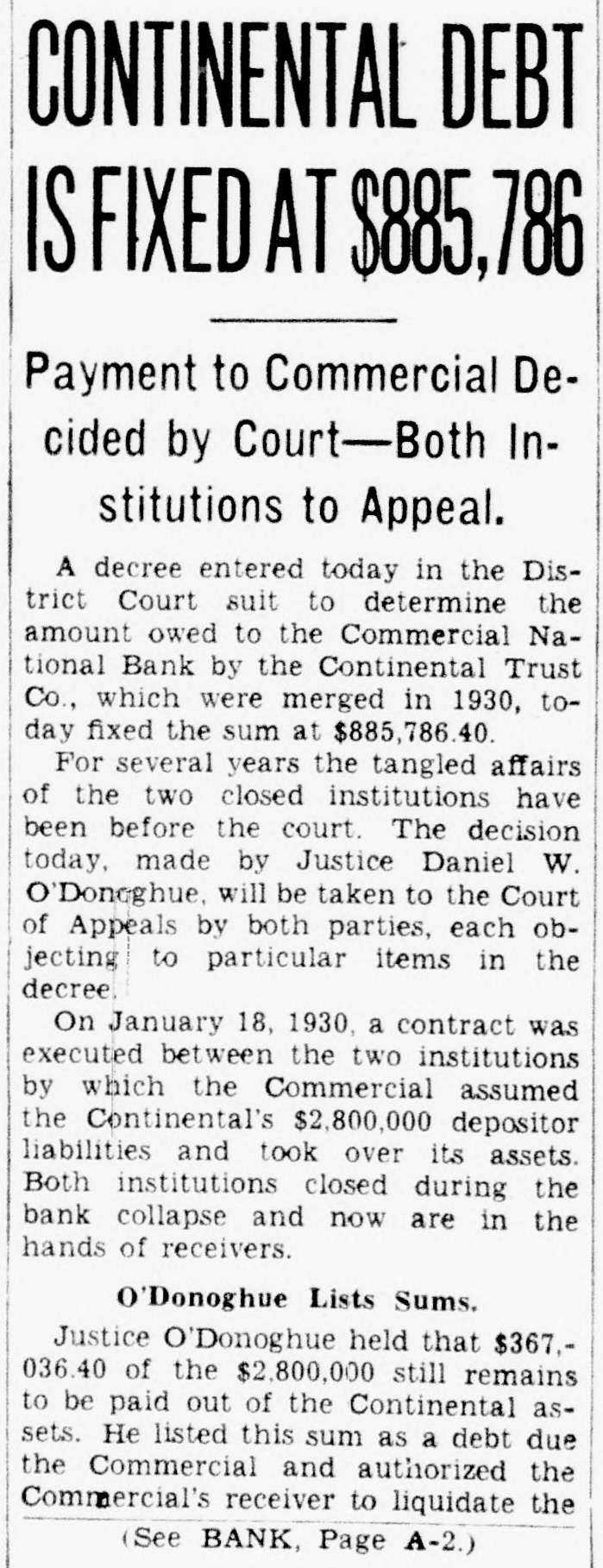
CONTINENTAL DEBT IS FIXED AT $885,786 COOC Payment to Commercial Decided by Court-Both Institutions to Appeal. A decree entered today in the District Court suit to determine the amount owed to the Commercial National Bank by the Continental Trust Co., which were merged in 1930, today fixed the sum at $885,786.40. For several years the tangled affairs of the two closed institutions have been before the court. The decision today, made by Justice Daniel W. O'Dongghue, will be taken to the Court of Appeals by both parties, each objecting to particular items in the decree. On January 18, 1930, a contract was executed between the two institutions by which the Commercial assumed the Continental's $2,800,000 depositor liabilities and took over its assets. Both institutions closed during the bank collapse and now are in the hands of receivers. O'Donoghue Lists Sums. Justice O'Donoghue held that $367.036.40 of the $2,800,000 still remains to be paid out of the Continental assets. He listed this sum as a debt due the Commercial and authorized the Commercial's receiver to liquidate the (See BANK, Page A-2.)


Article from Evening Star, November 15, 1937

Click image to open full size in new tab

Article Text

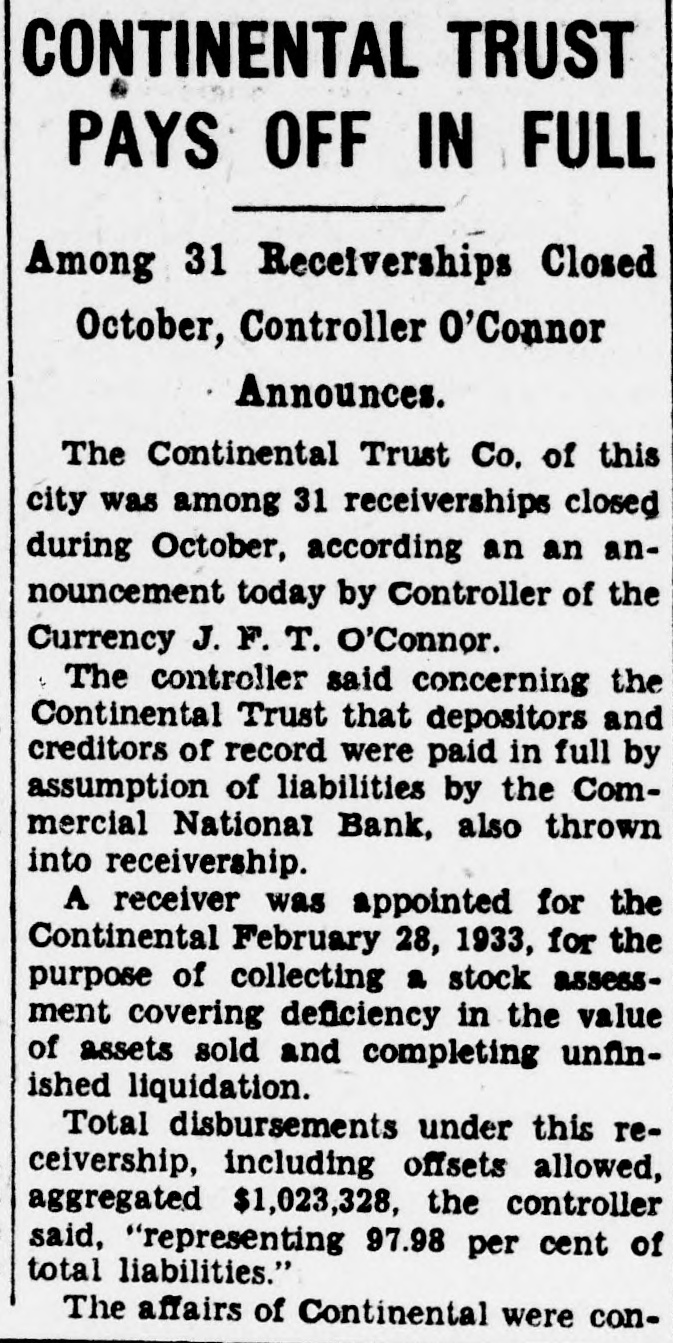
CONTINENTAL TRUST PAYS OFF IN FULL Among 31 Receiverships Closed October, Controller O'Connor Announces. The Continental Trust Co. of this city was among 31 receiverships closed during October, according an an announcement today by Controller of the Currency J. F. T. O'Connor. The controller said concerning the Continental Trust that depositors and creditors of record were paid in full by assumption of liabilities by the Commercial National Bank, also thrown into receivership. A receiver was appointed for the Continental February 28, 1933, for the purpose of collecting a stock assessment covering deficiency in the value of assets sold and completing unfinished liquidation. Total disbursements under this receivership, including offsets allowed, aggregated $1,023,328, the controller said, "representing 97.98 per cent of total liabilities." The affairs of Continental were con-


Article from The Washington Times, November 15, 1937

Click image to open full size in new tab

Article Text

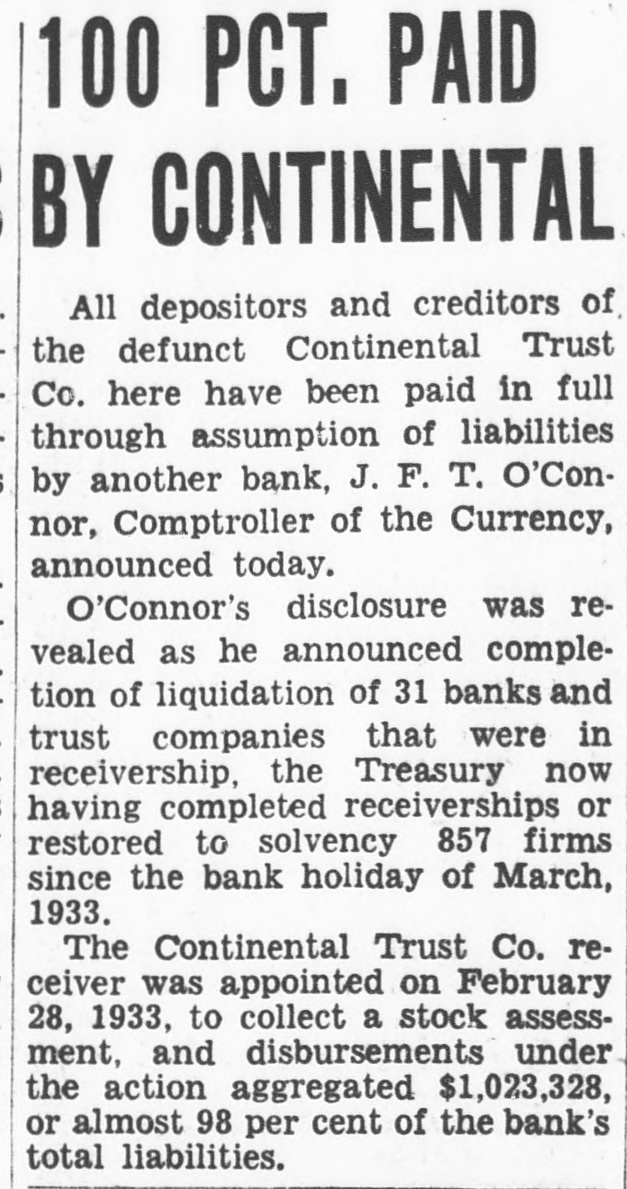
100 PCT. PAID BY CONTINENTAL All depositors and creditors of the defunct Continental Trust Co. here have been paid in full through assumption of liabilities by another bank, J. F. T. O'Connor, Comptroller of the Currency, announced today. O'Connor's disclosure was revealed as he announced completion of liquidation of 31 banks and trust companies that were in receivership, the Treasury now having completed receiverships or restored to solvency 857 firms since the bank holiday of March, 1933. The Continental Trust Co. receiver was appointed on February 28, 1933, to collect a stock assessment, and disbursements under the action aggregated $1,023,328, or almost 98 per cent of the bank's total liabilities.