Washington Savings Bank (Washington, DC)

Episode Information

Episode UID
15009171599
Episode Type
Run β†’ Suspension β†’ Closure
Bank Type
savings
Bank ID
1500917 routing
Routing Number
15-0091
Start Date
March 1, 1933
Location
Washington, District of Columbia (38.895, -77.036)

Metadata

Model
gpt-5-mini (chosen from majority vote of a three-model LLM ensemble)
Short Digest
c378de1e07e1889d

Response Measures

None

Description

Closure followed the March 1933 national holiday; bank never reopened and went into receivership later in 1933.

Events (3)

1. March 1, 1933 Run
Cause
Macro News
Cause Details
Heavy withdrawals and general banking panic in the days before the March 1933 national banking holiday prompted withdrawal restrictions.
Measures
Invoked 60-day clause/limited withdrawals (some permitting 10% up to $100).
Newspaper Excerpt
Several savings banks here invoked the 60-day clause on withdrawal of savings accounts... Among the local banks which have adopted this rule ... Washington Savings Bank.
Source
newspapers
2. March 6, 1933 Suspension
Cause
Government Action
Cause Details
Closed by presidential proclamation/national banking holiday and did not reopen thereafter.
Newspaper Excerpt
The bank was one of 13 which failed to reopen following the President's banking holiday.
Source
newspapers
3. November 1, 1933 Receivership
Newspaper Excerpt
The five local banks were found insolvent at the time receivers were appointed November 1, 1933... receiver Norman R. Hamilton; Washington Savings Bank listed among banks to be liquidated by receiver Norman Hamilton and later payments made to depositors by Receiver Hamilton and successors.
Source
newspapers

Newspaper Articles (15)

Article from Evening Star, March 1, 1933

Click image to open full size in new tab

Article Text

LOCAL BANKS ACT TO PROTECT FUNDS District National Limits Withdrawals-Others Invoke 60Day Clause on Savings. The District National Bank opened today on a 5 per cent withdrawal basis, following action taken by the directors early this morning, for the protection of depositors. President Joshua Evans, jr., announced. (The following notice was addressed today to the depositors in the bank: "Owing to heavy withdrawals of deposits during the last few days, and in order to safeguard all of our depositors, the board of directors has passed a resolution allowing depositors to withdraw 5 per cent of their balances in this bank at the close of business February 28, 1933, until further notice. All new deposits and new accounts opened March 1, 1933, and thereafter are subject to 100 per cent withdrawal at any time after actual realization cf funds by the bank." 60-Day Clause Invoked. The officials stressed the fact that all deposits made today and after this date can be withdrawn in full at any time. It was announced in the financial district that most of the local building and loan associations have invoked their time clauses on withdrawals, limiting the amount to $100. For larger amounts notice must be given in advance. Officials said the rule would be in force for the present. Several savings banks here invoked the 60-day clause on withdrawal of savings accounts. Some of these banks permit the withdrawal of 10 per cent up to $100. Above that amount, the 60day or two-month notice, is being required. Protective Measure. Among the local banks which have adopted this rule-the same plan which has been adopted extensively in other cities-are: United States Savings Bank, Chevy Chase Savings Bank, Security Savings & Commercial Bank, Park Savings Bank, Seventh Street Savings Bank, Washington Savings Bank, Anacostia Bank, Mount Vernon Savings Bank and the Northeast Savings Bank. (In an earlier edition of The Star the name of the Washington Mechanics' Savings Bank was included with those involking the 60-day clause. This was incorrect.) Officials said the action was taken merely as a protective measure, both for the banks and for the depΓ³sitors. The Commercial National Bank. which closed yesterday, has been placed in the hands of Robert C. Baldwin, a receiver of the office of the controller of the currency. Mr. Baldwin has taken over the receivership from J. L. Bailey, who took charge when the bank was closed. It was explained that Mr. Bailey will remain for a while in his capacity as a national Bank examiner to assist Mr. Baldwin. Has Considerable Experience. In the meantime, it was said at the Treasury Department, the new receiver probably will use a large part of the staff of the bank for his work. The new receiver. before Joining the office of the Controller of th Γ¨ Currency, had considerable liquidating experience. Under the auspices of the Government he has been receiver for e bank at Lynn, Mass., since the latter part of 1931, and has been directing its liquidation. An official of the Treasury said in regard to Mr. Baldwin: "By reason of his ability in liquidating that bank, the Treasury Department saw fit to transfer him to the Commercial National Bank. We have every confidence that he will administer the affairs of the institution in a manner satisfactory to all concerned."
Article from Evening Star, March 14, 1933

Click image to open full size in new tab

Article Text

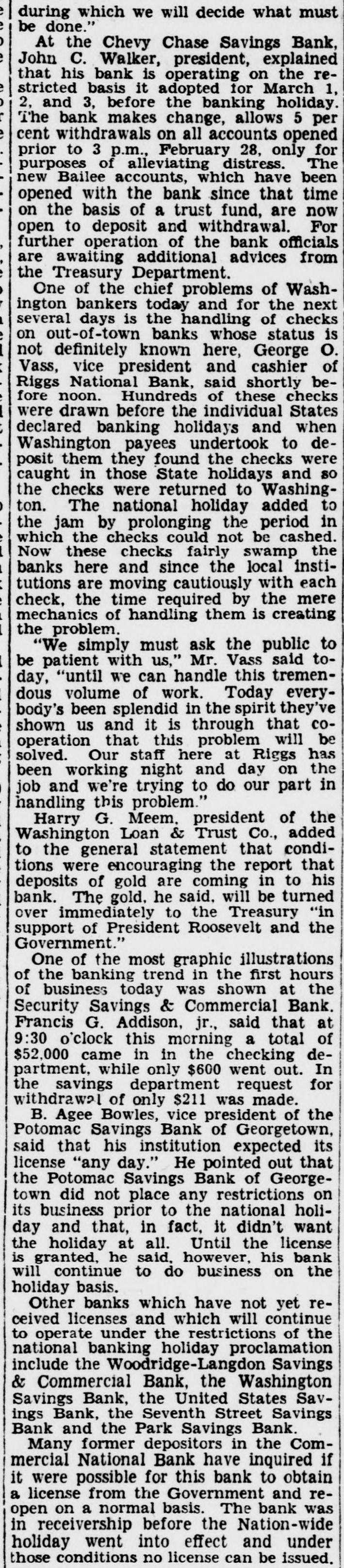
during which we will decide what must be done." At the Chevy Chase Savings Bank, John C. Walker, president, explained that his bank is operating on the restricted basis it adopted for March 1, 2, and 3, before the banking holiday. The bank makes change, allows 5 per cent withdrawals on all accounts opened prior to 3 p.m., February 28, only for purposes of alleviating distress. The new Bailee accounts, which have been opened with the bank since that time on the basis of a trust fund, are now open to deposit and withdrawal. For further operation of the bank officials are awaiting additional advices from the Treasury Department. One of the chief problems of Washington bankers today and for the next several days is the handling of checks on out-of-town banks whose status is not definitely known here, George O. Vass, vice president and cashier of Riggs National Bank, said shortly before noon. Hundreds of these checks before the individual States holidays declared were drawn banking and to when deWashington payees undertook posit them they found the checks were caught in those State holidays and so the checks were returned to Washington. The national holiday added to the jam by prolonging the period in which the checks could not be cashed. Now these checks fairly swamp the banks here and since the local institutions are moving cautiously with each check, the time required by the mere mechanics of handling them is creating the problem. "We simply must ask the public to be patient with us," Mr. Vass said today, "until we can handle this tremendous volume of work. Today everybody's been splendid in the spirit they've shown us and it is through that cooperation that this problem will be solved. Our staff here at Riggs has been working night and day on the job and we're trying to do our part in handling this problem." Harry G. Meem. president of the Washington Loan & Trust Co., added to the general statement that condithe of are coming tions deposits were encouraging gold report in to that his bank. The gold. he said. will be turned over immediately to the Treasury "in support of President Roosevelt and the Government." One of the most graphic illustrations of the banking trend in the first hours of business today was shown at the Security Savings & Commercial Bank. Francis G. Addison, jr., said that at 9:30 o'clock this morning a total of $52,000 came in in the checking department, while only $600 went out. In the savings department request for withdrawal of only $211 was made. B. Agee Bowles, vice president of the Potomac Savings Bank of Georgetown, said that his institution expected its license "any day." He pointed out that the Potomac Savings Bank of Georgetown did not place any restrictions on its business prior to the national holiday and that, in fact, it didn't want the holiday at all. Until the license is granted, he said. however, his bank will continue to do business on the holiday basis. Other banks which have not yet received licenses and which will continue to operate under the restrictions of the national banking holiday proclamation include the Woodridge-Langdon Savings & Commercial Bank, the Washington Savings Bank, the United States Savings Bank, the Seventh Street Savings Bank and the Park Savings Bank. Many former depositors in the Commercial National Bank have inquired if it were possible for this bank to obtain a license from the Government and reopen on a normal basis. The bank was in receivership before the Nation-wide holiday went into effect and under those conditions no license can be issued.


Article from Evening Star, September 16, 1933

Click image to open full size in new tab

Article Text

CONSIDER OPENING DATE OF HAMILTON Bank Directors Meeting Today in Effort to Reach Final Decision. BULLETIN. The last legal step in the local courts looking toward the opening of the Hamilton National Bank was taken in District Supreme Court t day when Justice Jennings Bailey approved leases of seven bank properties to the new institution at a total annual basic rental of $45.500. The leases were executed by conservators of five of seven banks involved. three of the properties belonging to the old Federal-American National Bank & Trust Co. The Board of Directors of the new Hamilton National Bank was meeting today to make a final decision on the date on which the bank is to open for business. Immediately after the decision is made, conservators of the seven banks which will sell assets to the new institution, will begin the task of calculating the value of the assets to be turned over. with adjustments for interest due, on the opening date. This task, which involves a separate calculation for each note. bond. mortgage or other assets to be turned over, will occupy not less than a week. so that the earliest date that could be selected is Monday, September 25. On the day selected. depositors in the seven banks going into the merger will be able to obtain one-half of the amounts to their credit in the closed banks by application to the Hamilton Bank. The money has been tied up since March 6, when all banks were ordered closed by presidential proclamation. Since that time none of the banks placed under consrevators here has opened except the Chevy Chase Bank, which was bought by the Riggs National Bank. The seven banks going into the merger are the District and FederalAmerican National Banks and the Woodridge-Langdon, Northeast, Potomac, Seventh Street and Washington Savings Banks. There are nine other closed banks here. Of these, the Commercial National, Park Savings, North Capitol, International Exchange, Departmental Banks and the Bank of Brightwood are in the hands of receivers and will not reopen. The Franklin National, United are in States ings Savings the and hands Mount of conservators, Vernon Savwho are negotiating for the opening of their respective banks.


Article Text

Virginian Named With Hardee as Bank Receiver WASHINGTON, Nov. Connor, comptroller of the currency, announced today that Cary Hardee, former governor of Florida, and Norman Hamilton, Virginia publisher, had been appointed receivto liquidate eight District of Columbia banks now operated by servators. The comptroller explained the move was constructive, designed to hasten payment of dividends to depositors from assets remaining after other District banks took over of the busiof the banks to be liquidated. The eight local institutions are the Federal National bank, the Chevy Chase Savings bank. the District National bank, the Northeast Savings bank, the Seventh Street ings the Washington Savings bank, the Savings and bank and the tomac Savings bank.


Article from Evening Star, June 17, 1934

Click image to open full size in new tab

Article Text

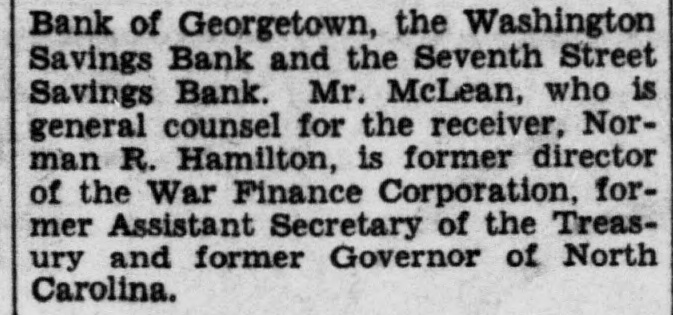
Bank of Georgetown, the Washington Savings Bank and the Seventh Street Savings Bank. Mr. McLean, who is general counsel for the receiver, Norman R. Hamilton, is former director of the War Finance Corporation, former Assistant Secretary of the Treasury and former Governor of North Carolina.


Article from Evening Star, July 8, 1934

Click image to open full size in new tab

Article Text

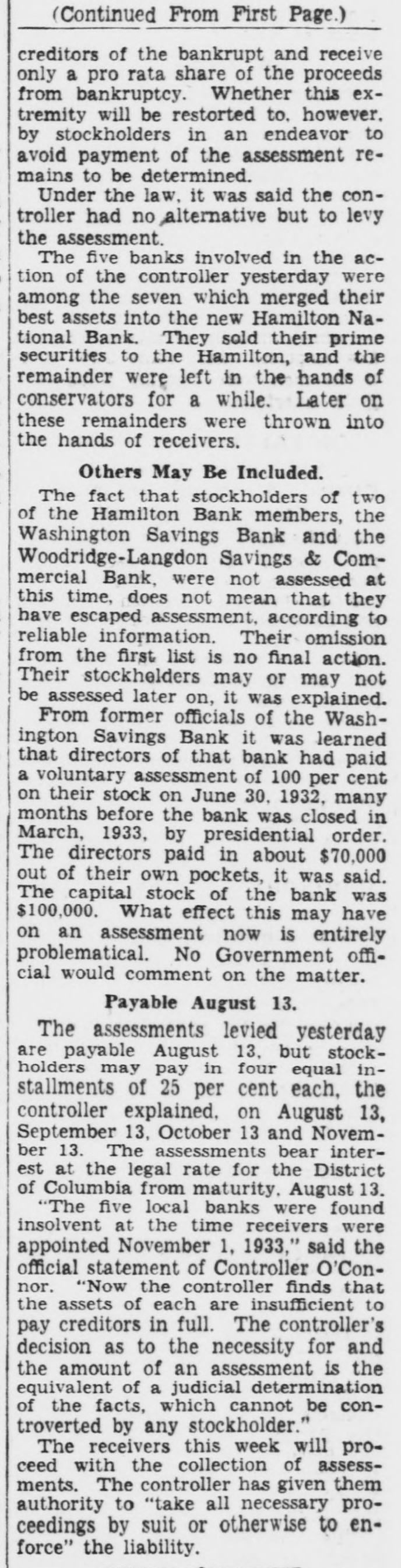
(Continued From First Page.) creditors of the bankrupt and receive only a pro rata share of the proceeds from bankruptcy. Whether this extremity will be restorted to. however. by stockholders in an endeavor to avoid payment of the assessment remains to be determined. Under the law, it was said the controller had no alternative but to levy the assessment. The five banks involved in the action of the controller yesterday were among the seven which merged their best assets into the new Hamilton National Bank. They sold their prime securities to the Hamilton, and the remainder were left in the hands of conservators for a while. Later on these remainders were thrown into the hands of receivers. Others May Be Included. The fact that stockholders of two of the Hamilton Bank members, the Washington Savings Bank and the Woodridge-Langdon Savings & Commercial Bank, were not assessed at this time, does not mean that they have escaped assessment, according to reliable information. Their omission from the first list is no final action. Their stockhelders may or may not be assessed later on, it was explained. From former officials of the Washington Savings Bank it was learned that directors of that bank had paid a voluntary assessment of 100 per cent on their stock on June 30. 1932, many months before the bank was closed in March, 1933, by presidential order. The directors paid in about $70,000 out of their own pockets, it was said. The capital stock of the bank was $100,000. What effect this may have on an assessment now is entirely problematical. No Government official would comment on the matter. Payable August 13. The assessments levied yesterday are payable August 13, but stockholders may pay in four equal installments of 25 per cent each, the controller explained, on August 13, September 13, October 13 and November 13. The assessments bear interest at the legal rate for the District of Columbia from maturity. August 13. "The five local banks were found insolvent at the time receivers were appointed November 1, 1933," said the official statement of Controller O'Connor. "Now the controller finds that the assets of each are insufficient to pay creditors in full. The controller's decision as to the necessity for and the amount of an assessment is the equivalent of a judicial determination of the facts, which cannot be controverted by any stockholder." The receivers this week will proceed with the collection of assessments. The controller has given them authority to "take all necessary proceedings by suit or otherwise to enforce" the liability.


Article from The Washington Times, July 26, 1934

Click image to open full size in new tab

Article Text

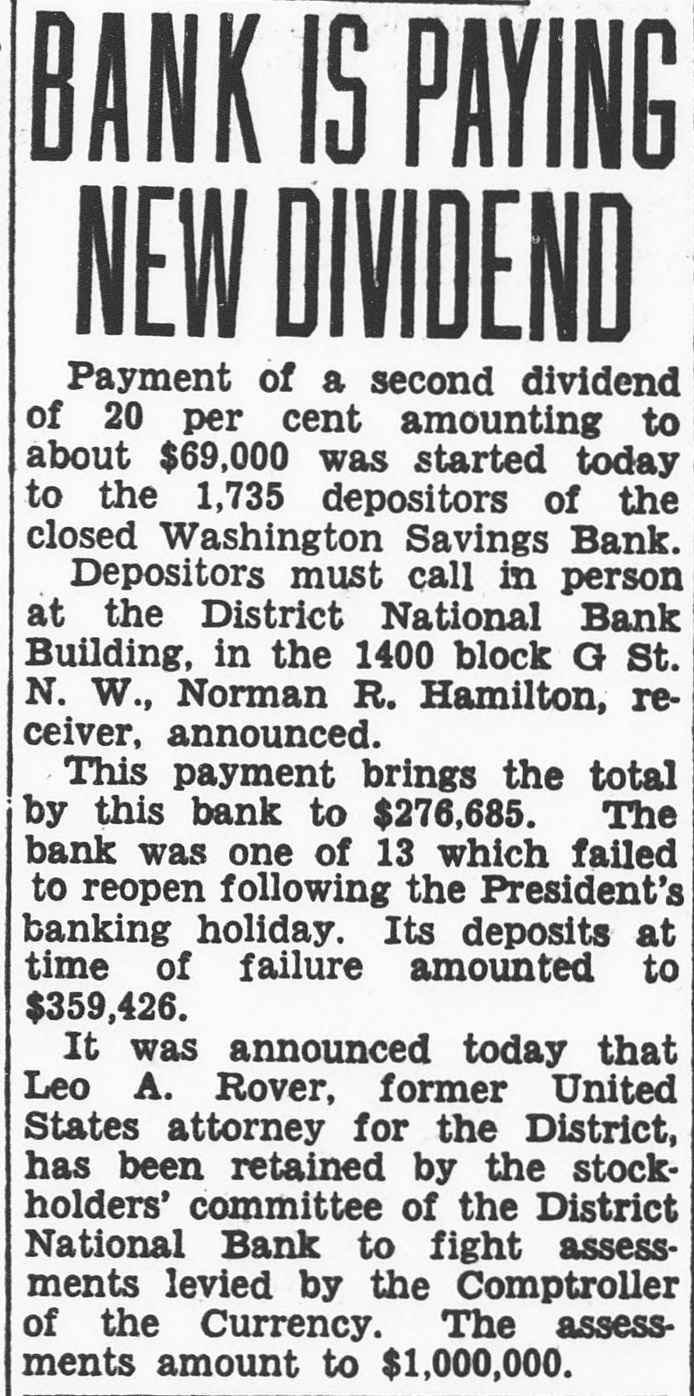
BANK IS PAYING NEW DIVIDEND Payment of a second dividend of 20 per cent amounting to about $69,000 was started today to the 1,735 depositors of the closed Washington Savings Bank. Depositors must call in person at the District National Bank Building, in the 1400 block G St. N. W., Norman R. Hamilton, receiver, announced. This payment brings the total by this bank to $276,685. The bank was one of 13 which failed to reopen following the President's banking holiday. Its deposits at time of failure amounted to $359,426. It was announced today that Leo A. Rover, former United States attorney for the District, has been retained by the stockholders' committee of the District National Bank to fight assessments levied by the Comptroller of the Currency. The assessments amount to $1,000,000.


Article from Evening Star, October 5, 1934

Click image to open full size in new tab

Article Text

Recent 20 Per Cent Dividend. Depositors in the Washington Savings Bank recently were awarded a dividend of 20 per cent, totaling $72,819. and this is still being paid out by Receiver Hamilton at his office in the District National Bank Building. This was in addition to the previous 50 per cent dividend of $182,049. "When the above three dividends are paid," explained Hamilton, "it will mean that depositors in the Seventh Street Savings Bank will have received $80 for every $100 they had on deposit at the time of closing: for the Northeast Savings Bank the payments will amount to $75 for every $100. and for the Washington Savings Bank the payments will total $70 for every $100 the depositors had in the closed banks at the time it closed."


Article from The Washington Times, April 2, 1935

Click image to open full size in new tab

Article Text

BANK SETTLES BOND SUIT The daring robber of the Washington Savings Bank, now defunct, in which the door of the safe deposit vault was blown off, was recalled in District Supreme Court today with the settlement of the suit of Carl J. Poch, for the loss of a quantity of bonds that were stolen at the time. Mr. Poch, appearing as committee for the estate of Frank Poch, a patient at the Veterans Hospital at Perryville, Va., fared better than depositors of the closed institution, the assets of which have been taken over by the Hamilton National Bank. His claim, for $5,900, was settled by agreement with Roger J. Whiteford, counsel for Receiver Norman R. Hamilton, for $4,000. William B. Wolf represented the committee.


Article from Evening Star, April 19, 1935

Click image to open full size in new tab

Article Text

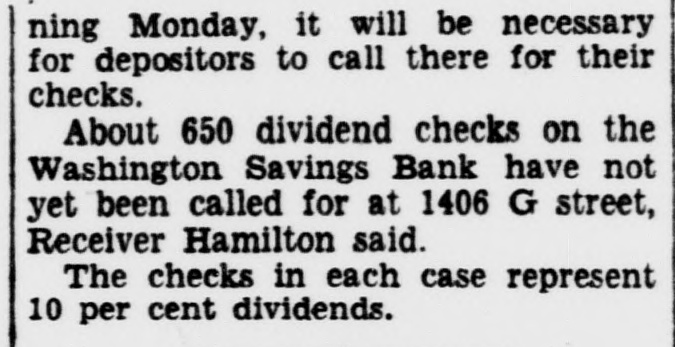
ning Monday, it will be necessary for depositors to call there for their checks. About 650 dividend checks on the Washington Savings Bank have not yet been called for at 1406 G street, Receiver Hamilton said. The checks in each case represent 10 per cent dividends.


Article from Evening Star, July 3, 1935

Click image to open full size in new tab

Article Text

BRICE CLAGETT NEW HAMILTON COUNSEL Succeeds Late Angus W. McLean in Receivership of Five Banks Here. Brice Clagett, attorney and former newspaper man, has been appointed counsel for Norman R. Hamilton, receiver of five insolvent banks of this city, succeeding the late Angus W. McLean. it was learned today. Mr. Clagett will participate in the extensive litigation already revolving around the banks in charge of Mr. Hamilton, particularly the District National Bank. He will have associated with him Charles E. Wainwright, attorney, formerly with the Treasury Department, who was associated with Mr. McLean. The banks concerned are the District National Bank, Potomac Savings Bank. Northeast Savings Bank, Seventh Street Savings Bank and Washington Savings Bank


Article from The Washington Times, July 14, 1936

Click image to open full size in new tab

Article Text

RECEIVERSHIPS CHANGE HANDS Norman R. Hamilton has been succeeded as receiver for the District National Bank by Justus S. Wardell. The final report issued by Hamilton yesterday estimates value of remaining assets at $2,314,598.19. More than $1,000,000 has been paid on a total RFC loan of $1,193,641.72. Further dividends to depositors are not likely until pending court actions are disposed of. Hamilton has also turned over to Wardell the receiverships of the Potomac Savings Bank, the Northeast Savings Bank, the Seventh Street Savings Bank and the Washington Savings Bank, all still in process of liquidation.


Article from Evening Star, December 1, 1937

Click image to open full size in new tab

Article Text

Yule Club Funds Distributed. More than $7,000,000 in Christmas Savings Club funds has just been received by the members who belonged to the clubs during the past year. They were conducted by 18 Washington banks. The money was already being put into circulation today for Christmar shopping, payment of year end bills, insurance premiums and a hundred other purposes to which members say they apply the club payments. The Washington Savings Bank also started payment today, through Receiver J. S. Wardell, of $70,000 to 1,890 depositors who were calling at 1306 G street for their money.


Article from The Washington Times, December 1, 1937

Click image to open full size in new tab

Article Text

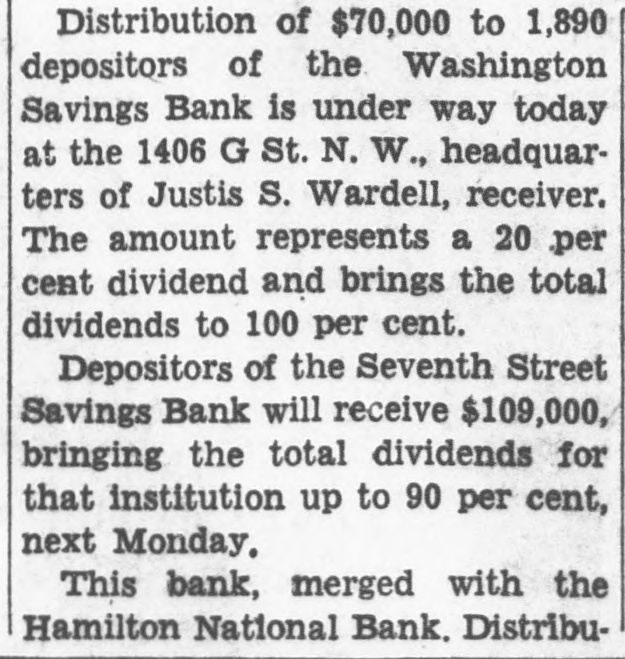
Distribution of $70,000 to 1,890 depositors of the Washington Savings Bank is under way today at the 1406 G St. N. W., headquarters of Justis S. Wardell, receiver. The amount represents a 20 per cent dividend and brings the total dividends to 100 per cent. Depositors of the Seventh Street Savings Bank will receive $109,000, bringing the total dividends for that institution up to 90 per cent, next Monday. This bank, merged with the Hamilton National Bank. Distribu-


Article from Evening Star, November 16, 1939

Click image to open full size in new tab

Article Text

the trust the receiver before long will be forced to shut off any further claims. Receiver Wardell has paid more than 100 per cent to depositors in another closed bank, the Washington Savings Bank, whose 3,000 depositors have received a total of 110.24 per cent on their accounts.