Prudential Bank (Washington, DC)

Episode Information

Episode UID
15011571591
Episode Type
Run Only
Bank Type
state
Bank ID
1501157 routing
Routing Number
15-0115
Start Date
July 15, 1932
Location
Washington, District of Columbia (38.895, -77.036)

Metadata

Model
gpt-5-mini (chosen from majority vote of a three-model LLM ensemble)
Short Digest
4c2ddde28ddfd75a

Response Measures

None

Description

Bank suffered a July 1932 run and remained open; later consolidated and placed in receivership (1932–1936) but articles do not show the suspension directly caused by the run.

Events (5)

1. July 15, 1932 Run
Cause
Rumor Or Misinformation
Cause Details
False rumors circulated in downtown/white business houses that the bank had failed, merchants refused checks, prompting withdrawals.
Measures
Mass meetings, pulpit appeals, depositors signed pledges limiting withdrawals to 10% for 30 days; prominent citizens made deposits to shore up funds.
Newspaper Excerpt
a two-day run on it last Friday and Saturday
Source
newspapers
2. July 18, 1932 Other
Newspaper Excerpt
resumed business as usual Monday morning; conditions at the bank had returned to normal, with hundreds of depositors... making redeposits. Depositors... signed agreements not to withdraw more than 10 per cent... during the next 30-day period, thus relieving any possible pressure on the bank's funds.
Source
newspapers
3. August 26, 1932 Other
Newspaper Excerpt
advanced making the total received on loans from the Finance Corporation $100,000. During a run on the bank in July the finance corporation investigated the status of the institution and advanced $15,000 as part of a loan ... the examiners found the bank solvent ... granted loan of an additional $75,000. On August 26 an additional $10,000 was advanced making the total received on loans from the Reconstruction Finance Corporation $100,000.
Source
newspapers
4. September 1, 1932* Other
Newspaper Excerpt
The Prudential Bank, colored, which consolidated with the Industrial Savings Bank in September, 1932, was formally placed in receivership in March, 1936, and attempts now are being made to collect a stock assessment from shareholders.
Source
newspapers
5. March 1, 1936* Receivership
Newspaper Excerpt
The Prudential Bank... was formally placed in receivership in March, 1936
Source
newspapers

Newspaper Articles (15)

Article from Evening Star, July 21, 1932

Click image to open full size in new tab

Article Text

NORMAL CONDITIONS AT PRUDENTIAL BANK Edward A. Baker, cashier of the Prudential Bank, 715 Florida avenue, said today that conditions at the bank had returned to normal, with hundreds of depositors who had withdrawn their money making redeposits. A small run over the past week end was attributed by bank officials to "false rumors" circulated in the downtown section. Mr. Baker said more than $10.000 in deposits was received at the bank yesterday and that a number of new accounts had been opened. Depositors representing $120.000. he said. have signed agreements not to withdraw more than 10 per cent of their accounts during the next 30-day period, thus relieving any possible pressure on the bank's funds.


Article Text

WASHINGTON, July 21β€”While a bank examiner kept watch, ready at any minute to close the institution, the Prudential Bank, 715 Florida avenue northwest, weathered a two-day run on it last Friday and Saturday and resumed business as usual Monday morning. The run was stemmed only after a stubborn fight, into which every resource was flung and minute speakers were called into action to persuade depositors not to withdraw their funds. From every pulpit in the city Sunday an appeal was made against a continuation of the run. Meanwhile officers and directors of the bank were in conference working out plans for keeping the bank open. At the most critical moment Saturday, when closing seemed inevitable, Mortimer M. Harris, an attorney, climbed into a chair and announced to the crowd in the bank that E. A. Clements, a reputed "numbers" operator, would make a deposit of $5,000. Clements left the bank hurriedly. For those who were besieging the tellers' windows, the minutes dragged slowly by. Finally he came back and brought with him a stack of bills totaling $5,000. He handed them to John R. Hawkins, president of the bank, with the declaration, "That's what I think of Pru-


Article from The Northwest Enterprise, July 28, 1932

Click image to open full size in new tab

Article Text

Biggest Negro Bank In Capital Remains Solvent WASHINGTON.- The Prudential Bank, headed by Dr. John R. Hawkins, weathered an almost paralyzing "run" on its resources last week, after four white banks had closed their doors. The Prudential weathered a twoday run on it last Friday and Saturday and resumed business as usual Monday morning. The "run" was stemmed only after a stubborn fight, into which all of the institution's resources were flung, and speakers were called in to persuade the depositors that the condition of the bank was sound, and that their monies were well protected. From every pulpit in the city Sunday, an appeal was made against the continuation of the run. Meanwhile officers and directors of the bank held long conferences, working out plans which would assure the bank's continuation of business. Officers of the bank reached as many depositors as they possibly could and asked them to attend a a meeting at Mount Carmel Baptist Church Friday night. At that meeting they were asked to sign pledges (Continued on Page 3.)


Article Text

Run Rumor ses On Prudential Bank In Washington Biggest Negro Bank In Capital Remains Solvent WASHINGTON.- The Prudential Bank, headed by Dr. John R. Hawkins, weathered an almost paralyzing "run" on its resources last week, after four white banks had closed their doors. The Prudential weathered a twoday run on it last Friday and Saturday and resumed business as usual Monday morning. The "run" was stemmed only after a stubborn fight, into which all of the institution's resources were flung, and speakers were called in to persuade the depositors that the condition of the bank was sound, and that their monies protected. From every pulpit in the city Sunday, an appeal was made against the continuation of the run. Meanwhile officers and directors of the bank held long conferences, working out plans which would assure the bank's continuation of business. Officers of the bank reached as many depositors as they possibly could and asked them to attend meeting at Mount Carmel Baptist Church Friday night. At that meeting they were asked to sign pledges (Continued on Page 3.)


Article Text

U. S. Sends Money to Prudential Bank WASHINGTON, D. C., July Prudential bank having withstood a three-day run on it, its officers and directors plan a campaign to add to the number of depositors and stockholders and strengthen the institution financially, John R. Hawkins, president, announced at a meeting of depositors in the auditorium of the GarnetPatterson junior high school last Monday night. The stock of the bank Mr. stated Only stock has sold. The was never been offered the The comptroller of the remaining to the Gets Strong Support At meeting stockholders last the of the situation of the bank presented with the directors, he no time the Prudential bank They to their pledged in and to present aid in for The Prudential opened July deposits totaling $42. reached of the of slump in considered class in bond bonds and situation brought a depreciation and restless Colored banks would presumed stood the Mr. came to with us before came and deposited Gets U. S. Cash government bonds took and securities and were went to Finance corporation offered and they and for cepted the run us urged depositors not funds piration of their pledge and not to more per cent withdraw the the charter He that from increase to that no been The he the would be the proper thing much do and as much surplus as possible.


Article from Twin-City Herald, July 30, 1932

Click image to open full size in new tab

Article Text

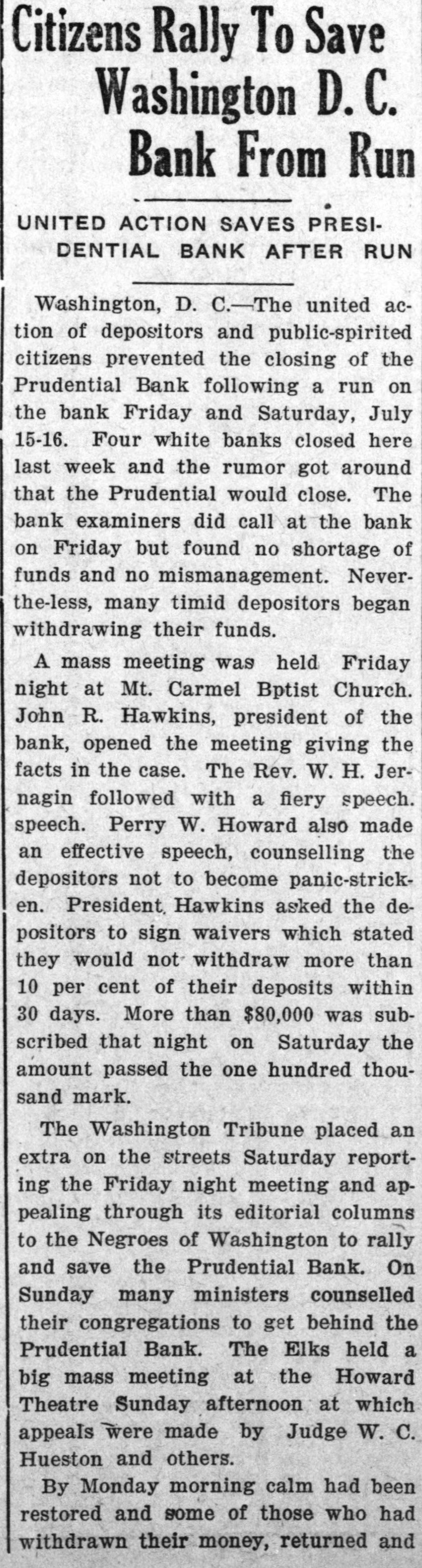
Citizens Rally To Save Washington D.C. Bank From Run UNITED ACTION SAVES PRESIDENTIAL BANK AFTER RUN Washington, D. C.-The united action of depositors and public-spirited citizens prevented the closing of the Prudential Bank following a run on the bank Friday and Saturday, July 15-16. Four white banks closed here last week and the rumor got around that the Prudential would close. The bank examiners did call at the bank on Friday but found no shortage of funds and no mismanagement. Neverthe-less, many timid depositors began withdrawing their funds. A mass meeting was held Friday night at Mt. Carmel Bptist Church. John R. Hawkins, president of the bank, opened the meeting giving the facts in the case. The Rev. W. H. Jernagin followed with a fiery speech. speech. Perry W. Howard also made an effective speech, counselling the depositors not to become panic-stricken. President Hawkins asked the depositors to sign waivers which stated they would not withdraw more than 10 per cent of their deposits within 30 days. More than $80,000 was subscribed that night on Saturday the amount passed the one hundred thousand mark. The Washington Tribune placed an extra on the streets Saturday reporting the Friday night meeting and appealing through its editorial columns to the Negroes of Washington to rally and save the Prudential Bank. On Sunday many ministers counselled their congregations to get behind the Prudential Bank. The Elks held a big mass meeting at the Howard Theatre Sunday afternoon at which appeals were made by Judge W. C. Hueston and others. By Monday morning calm had been restored and some of those who had withdrawn their money, returned and


Article from The Omaha Guide, August 6, 1932

Click image to open full size in new tab

Article Text

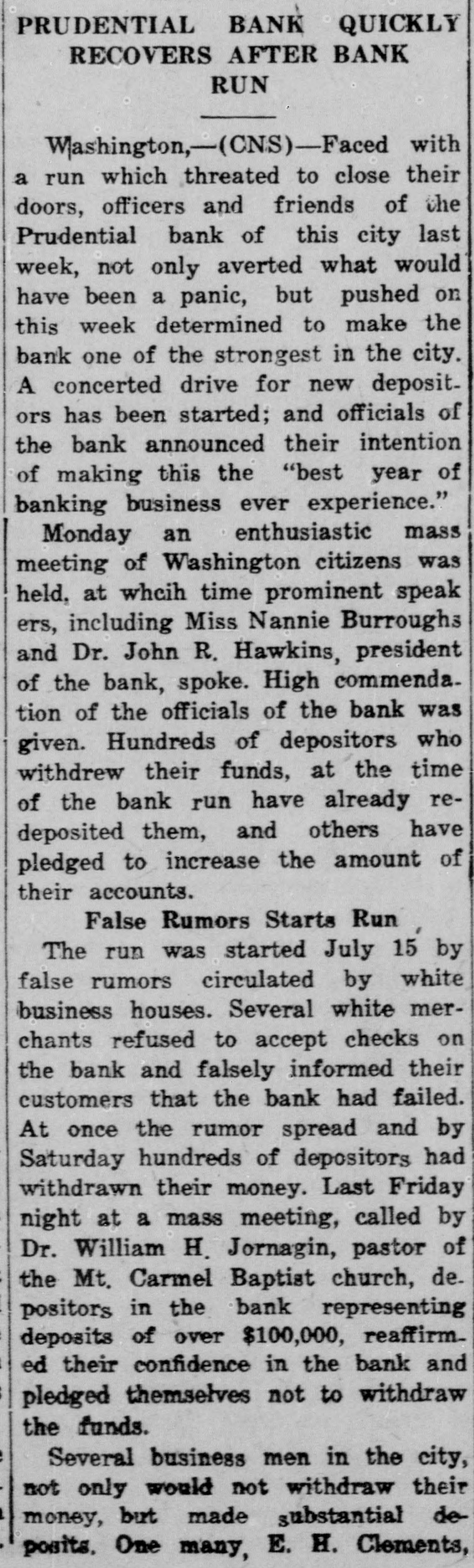
PRUDENTIAL BANK QUICKLY RECOVERS AFTER BANK RUN Wlashington,-(CNS)-Faced with a run which threated to close their doors, officers and friends of the Prudential bank of this city last week, not only averted what would have been a panic, but pushed on this week determined to make the bank one of the strongest in the city. A concerted drive for new depositors has been started; and officials of the bank announced their intention of making this the "best year of banking business ever experience." Monday an enthusiastic mass meeting of Washington citizens was held, at wheih time prominent speak ers, including Miss Nannie Burroughs and Dr. John R. Hawkins, president of the bank, spoke. High commendation of the officials of the bank was given. Hundreds of depositors who withdrew their funds, at the time of the bank run have already redeposited them, and others have pledged to increase the amount of their accounts. False Rumors Starts Run The run was started July 15 by false rumors circulated by white business houses. Several white merchants refused to accept checks on the bank and falsely informed their customers that the bank had failed. At once the rumor spread and by Saturday hundreds of depositors had withdrawn their money. Last Friday night at a mass meeting, called by Dr. William H. Jornagin, pastor of the Mt. Carmel Baptist church, de. positors in the bank representing deposits of over $100,000, reaffirmed their confidence in the bank and pledged themselves not to withdraw the funds. Several business men in the city, not only would not withdraw their money, but made substantial deposits. One many, E. H. Clements,


Article Text

LOANS WASHINGTON Prudential Bank this has received loan from the Reconstruction Finance Corporation according nouncement made Saturday Dr. John R. Hawkins, president of the bank During run the bank July finance tigated the status institution $15,000 part loan to be made tollowing more complete examination the bank's affairs. This loan was listed the the loans made report by the for the month July, which was made public cently The examiners the corporation found bank with suffithe cient warrant the making of the loan and the granted loan of additional $75,000. On August $10,000 was advanced making the total received on loans from the Finance Corporation $100,000.


Article Text

$100,000 LENT PRUDENTIAL WASHINGTON, D.C. β€” (CNS) β€” The Prudential Bank of this city has received a loan of $100,000 from the Reconstruction Finance Corporation, according to an announcement made Saturday by Dr. John R. Hawkins, president of the bank. During a run on the bank in July, the finance corporation investigated the status of the institution and advanced $15,000 as a part of a loan to be made following a more complete examination of the bank's affairs. This loan was listed in the report of the loans made by the corporation for the month of July which was made public recently. The examiners of the corporation found the bank solvent, with sufficient securities to warrant the making of the requested loan and the bank was granted a loan of $75,000 more. On August 26 an additional $10,000 was advanced making the total received on loan from the Reconstruction Finance Corporation $100,000.


Article Text

BANK GETS $100,000 FROM FINANCE CORPORATION WASHINGTON- N The Prudential Bank of this city has received a loan of $100,000 from the Reconstruction Finance Corpora tion according to an announcement made Saturday by Dr. John R. Hawkins, president of the bank During a run on the bank in July the finance corporation investigat ed the status of the institution and advanced $15,000 as part of a loan to be made following a more complete examination of the bank's affairs. This loan was listed in the report of the loans made by the corporation for the month of July, which was made public recently The examiners of the corporation found the bank solvent, with sufficient securities to warrant the making of the requested loan and the bank was granted loan of an additional $75,000 On August 26 an additional $10,000 was advaneed making the total received on loans from the Reconstruction Finance Corporation $100,000. Patronize Our Advertisers!


Article from Evening Star, December 31, 1936

Click image to open full size in new tab

Article Text

This bank paid out a total of 40 per 7 cent, amounting to $800,000, when some of its assets were taken over $ by the City Bank of Washington. The trustees of the liquidating trust report that liquidation of the remaining assets are "reasonably satisfactory" and that the proceeds from these assets have been used to pay off the Reconstruction Finance Corp. loan of $850,000, which was obtained by the Mount Vernon Savings Bank in order to pay the 40 per cent distribution to depositors. The trustees reported further that by the terms of the "trust indenture" by which they operate no funds can be borrowed to pay a dividend to the depositors. Consequently, proceeds of liquidation of assets will have to be accumulated in an amount that will be reasonably proportioned to the cost of distribution. Many depositors have failed to call for their dividend checks in almost every one of the closed banks. They still come in from time to time for checks. Consequently, the amounts paid out by the receiverships actually increase, although the dividends declared remain in percentage the same. Payments by Other Banks. The latest figures on disbursements on the other closed banks of the city are shown as follows: Departmental Bank, 80 per cent, amounting to $617,144. North Capitol Savings, 25 per cent, amounting to $235,122. Potomac Savings, 62 1/2 per cent, amounting to $1,282,257. Park Savings, 25 per cent, amounting to $760,030. This bank is in litigation, which may be settled during the year 1937. Seventh Street Savings, 80 per cent, amounting to $845,188. Woodridge-Langdon Savings & Commercial, 100 per cent, $400,000. Washington Savings, 80 per cent, $279,015. Potomac Savings, 62 1/2 . per cent, $1,282,257. The Continental Trust Co., which merged with the Commercial National Bank long before the latter. went into receivership, also is in the hands of a receiver and in complicated litigation in its relations both with stockholders and the Commercial Bank. It has paid no receivership dividends. The Industrial Slivings Bank, colored institution, paid 35 per cent, amounting to $192,000, to depositors when it reorganized into the Industrial Bank of Washington, a new institution, now operating at Eleventh and U streets. The Prudential Bank, colored, which consolidated with the Industrial Savings Bank in September, 1932, was formally placed in receizership in March, 1936, and attempts now are being made to collect a stock assessment from shareholders.

Article from Evening Star, July 2, 1937

Click image to open full size in new tab

Article Text

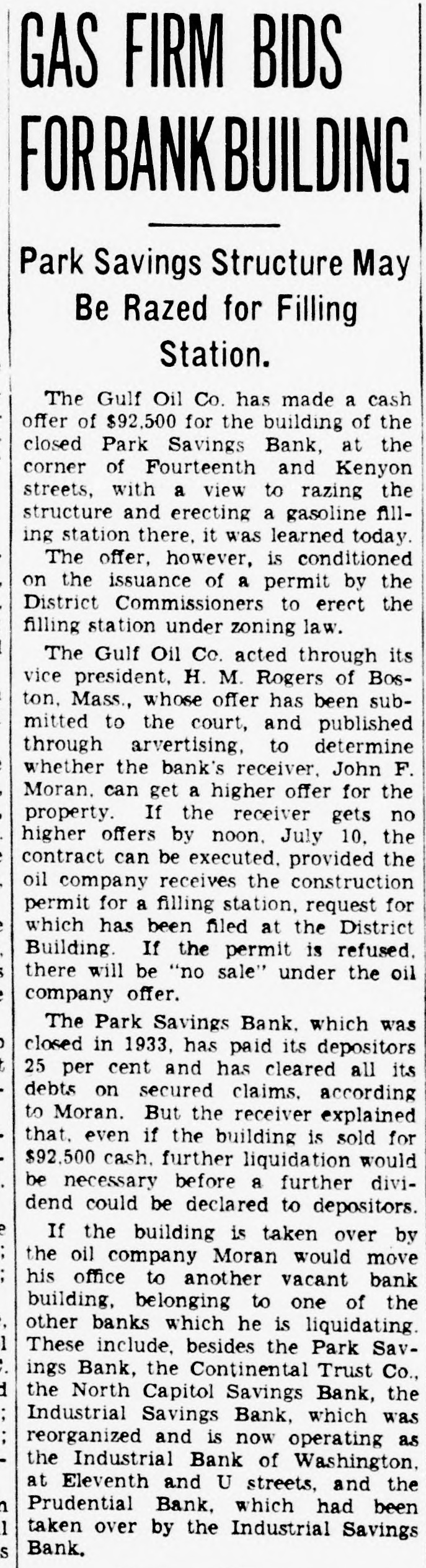
GAS FIRM BIDS FOR BANK BUIL LDING Park Savings Structure May Be Razed for Filling Station. The Gulf Oil Co. has made a cash offer of $92,500 for the building of the closed Park Savings Bank, at the corner of Fourteenth and Kenyon streets, with a view to razing the structure and erecting a gasoline filling station there, it was learned today. The offer, however, is conditioned on the issuance of a permit by the District Commissioners to erect the filling station under zoning law. The Gulf Oil Co. acted through its vice president, H. M. Rogers of Boston, Mass., whose offer has been submitted to the court, and published through arvertising, to determine whether the bank's receiver. John F. Moran, can get a higher offer for the property. If the receiver gets no higher offers by noon. July 10, the contract can be executed. provided the oil company receives the construction permit for a filling station, request for which has been filed at the District Building If the permit is refused. there will be "no sale" under the oil company offer. The Park Savings Bank. which was closed in 1933, has paid its depositors 25 per cent and has cleared all its debts on secured claims. according to Moran. But the receiver explained that. even if the building is sold for $92.500 cash, further liquidation would be necessary before a further dividend could be declared to depositors. If the building is taken over by the oil company Moran would move his office to another vacant bank building, belonging to one of the other banks which he is liquidating These include, besides the Park Savings Bank, the Continental Trust Co., the North Capitol Savings Bank, the Industrial Savings Bank, which was reorganized and is now operating as the Industrial Bank of Washington, at Eleventh and U streets, and the Prudential Bank. which had been taken over by the Industrial Savings Bank.


Article from Evening Star, March 6, 1938

Click image to open full size in new tab

Article Text

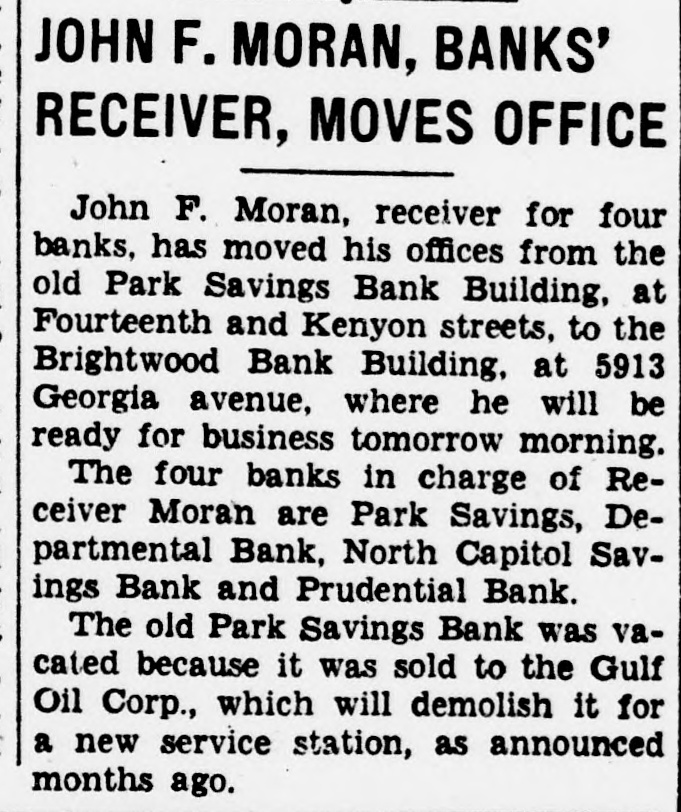
JOHN F. MORAN, BANKS' RECEIVER, MOVES OFFICE John F. Moran, receiver for four banks, has moved his offices from the old Park Savings Bank Building, at Fourteenth and Kenyon streets, to the Brightwood Bank Building, at 5913 Georgia avenue, where he will be ready for business tomorrow morning. The four banks in charge of Receiver Moran are Park Savings, Departmental Bank, North Capitol Savings Bank and Prudential Bank. The old Park Savings Bank was vacated because it was sold to the Gulf Oil Corp., which will demolish it for a new service station, as announced months ago.


Article from Evening Star, March 7, 1938

Click image to open full size in new tab

Article Text

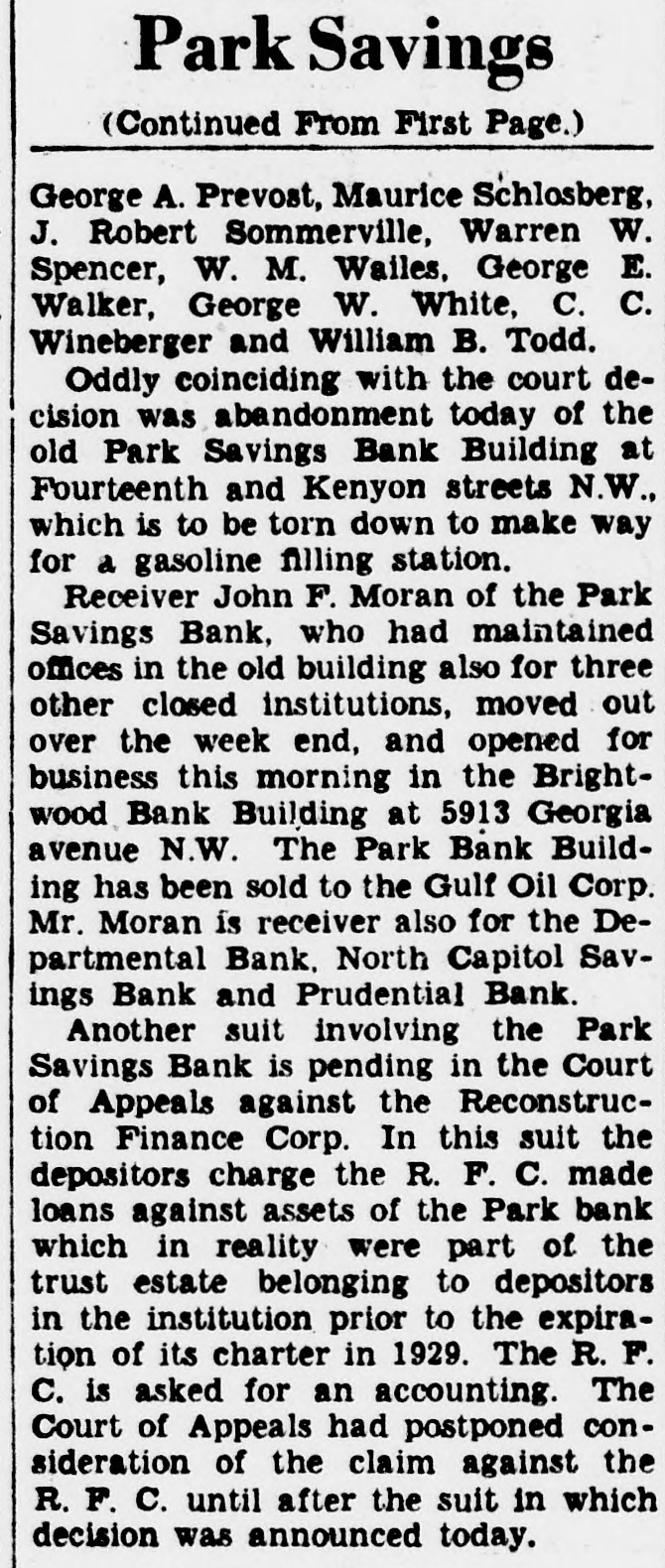
Park Savings (Continued From First Page.) George A. Prevost, Maurice Schlosberg, J. Robert Sommerville, Warren W. Spencer, W. M. Wailes, George E. Walker, George W. White, C. C. Wineberger and William B. Todd. Oddly coinciding with the court decision was abandonment today of the old Park Savings Bank Building at Fourteenth and Kenyon streets N.W., which is to be torn down to make way for a gasoline filling station. Receiver John F. Moran of the Park Savings Bank, who had maintained offices in the old building also for three other closed institutions, moved out over the week end, and opened for business this morning in the Brightwood Bank Building at 5913 Georgia avenue N.W. The Park Bank Building has been sold to the Gulf Oil Corp. Mr. Moran is receiver also for the Departmental Bank. North Capitol Savings Bank and Prudential Bank. Another suit involving the Park Savings Bank is pending in the Court of Appeals against the Reconstruction Finance Corp. In this suit the depositors charge the R. F. C. made loans against assets of the Park bank which in reality were part of the trust estate belonging to depositors in the institution prior to the expiration of its charter in 1929. The R. F. C. is asked for an accounting. The Court of Appeals had postponed consideration of the claim against the R. F. C. until after the suit in which decision was announced today.


Article from Evening Star, June 30, 1939

Click image to open full size in new tab

Article Text

his office of the Park Savings Bank, from 5913 Georgia avenue N.W. to the Riggs National Bank Building at Fourteenth street and Park road N.W., where he will be ready for business tomorrow. He also is receiver in the same office for the North Capitol Savings Bank, Departmental Bank and Prudential Bank.