Bank of the United States (New York, NY)

Episode Information

Episode UID
1502541290450
Episode Type
Suspension โ†’ Closure
Bank Type
state
Bank ID
150254129 hash
Start Date
June 17, 1837
Location
New York, New York (40.714, -74.006)

Metadata

Model
gpt-5-mini (chosen from majority vote of a three-model LLM ensemble)
Short Digest
598399f77bee40de

Response Measures

None

Description

Articles consistently describe the bank as insolvent/rejected but do not give a precise suspension date or formal receivership statement.

Events (1)

1. June 17, 1837 Suspension
Cause
Bank Specific Adverse Info
Cause Details
Notes widely rejected in New York and other cities; bank regarded as insolvent and 'broken' with large losses and specie drained
Newspaper Excerpt
The notes of the Bank of the United States...are no longer current...It is considered insolvent, and the most culpable of all the broken banks
Source
newspapers

Newspaper Articles (5)

Article from Richmond Enquirer, January 13, 1835

Click image to open full size in new tab

Article Text

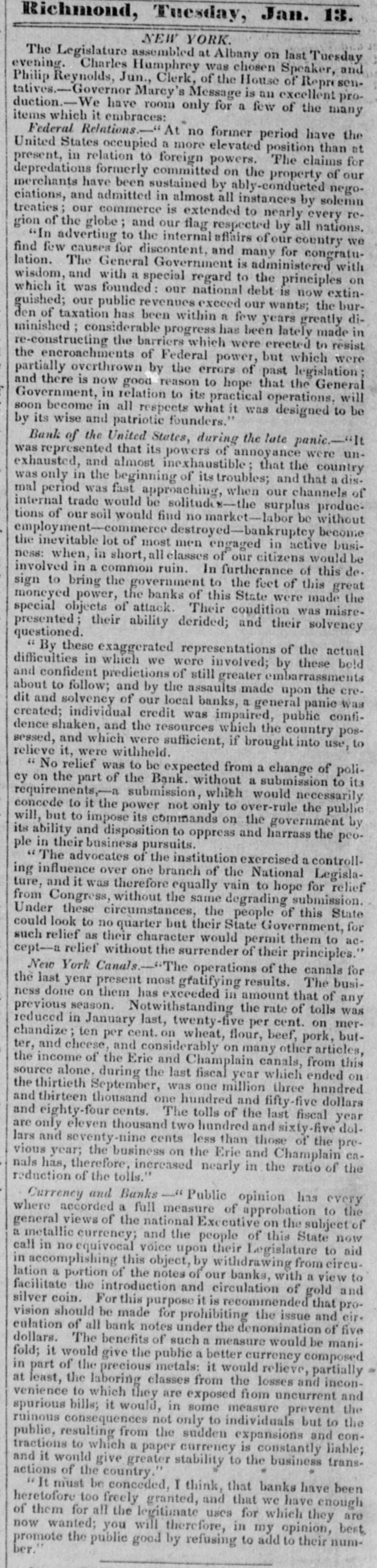
Richmond, Tuesday, Jan. 13. NEW YORK. The Legislature assembled at Albany on last Tuesday evening. Charles Humphrey was chosen Speaker, and Philip Reynolds, Jun., Clerk, of the House of Represen- tatives. Governor Marcy's Message is an excellent pro- duction. We have room only for a few of the many items which it embraces: Federal Relations." At no former period have the United States occupied a more elevated position than at present, in relation to foreign powers. The claims for depredations formerly committed on the property of our merchants have been sustained by ably-conducted nego- ciations, and admitted in almost all instances by solemn treaties; our commerce is extended to nearly every re- gion of the globe; and our flag respected by all nations. "In adverting to the internal affairs of our country we find few causes for discontent, and many for congratu- lation. The General Government is administered with wisdom, and with a special regard to the principles on which it was founded: our national debt is now extin- guished; our public revenues exceed our wants; the bur- den of taxation has been within a few years greatly di- minished; considerable progress has been lately made in re-constructing the barriers which were erected to resist the encroachments of Federal power, but which were partially overthrown by the errors of past legislation; and there is now good reason to hope that the General Government, in relation to its practical operations, will soon become in all respects what it was designed to be by its wise and patriotic founders." Bank of the United States, during the late panic. It was represented that its powers of annoyance were un- exhausted, and almost inexhaustible; that the country was only in the beginning of its troubles; and that a dis- mal period was fast approaching, when our channels of internal trade would be solitudes the surplus produe- tions of our soil would find no market-labor be without employment-commerce destroyed-bankruptcy become the inevitable lot of most men engaged in active busi- ness: when, in short, all classes of our citizens would be involved in a common ruin. In furtherance of this de- sign to bring the government to the feet of this great moneyed power, the banks of this State were made the special objects of attack. Their condition was misre- presented; their ability derided; and their solvency questioned. "By these exaggerated representations of the actual difficulties in which we were involved; by these bold and confident predictions of still greater embarrassments about to follow; and by the assaults made upon the cre- dit and solvency of our local banks, a general panic was created; individual credit was impaired, public confi- dence shaken, and the resources which the country pos- sessed, and which were sufficient, if brought into use, to relieve it, were withheld. "No relief was to be expected from a change of poli- cy on the part of the Bank. without a submission to its requirements, a submission, which would necessarily concede to it the power not only to over-rule the public will, but to impose its commands on the government by its ability and disposition to oppress and harrass the peo- ple in their business pursuits. "The advocates of the institution exercised a controll- ing influence over one branch of the National Legisla- ture, and it was therefore equally vain to hope for relief from Congress, without the same degrading submission. Under these circumstances, the people of this State could look to no quarter but their State Government, for such relief as their character would permit them to ac- cept-a relief without the surrender of their principles." New York Canals. The operations of the canals for the last year present most gratifying results. The busi- ness done on them has exceeded in amount that of any previous season. Notwithstanding the rate of tolls was reduced in January last, twenty-five per cent. on mer- chandize; ten per cent. on wheat, flour, beef, pork, but- ter, and cheese, and considerably on many other articles, the income of the Erie and Champlain canals, from this source alone, during the last fiscal year which ended on the thirtieth September, was one million three hundred and thirteen thousand one hundred and fifty-five dollars and eighty-four cents. The tolls of the last fiscal year are only eleven thousand two hundred and sixty-five dol- lars and seventy-nine cents less than those of the pre- vious year; the business on the Erie and Champlain ca- nals has, therefore, increased nearly in the ratio of the reduction of the tolls." Currency and Banks-"Public opinion has every where accorded a full measure of approbation to the general views of the national Executive on the subject of a metallic currency; and the people of this State now call in no equivocal voice upon their Legislature to aid in accomplishing this object, by withdrawing from circu- lation a portion of the notes of our banks, with a view to facilitate the introduction and circulation of gold and silver coin. For this purpose it is recommended that pro- vision should be made for prohibiting the issue and cir- culation of all bank notes under the denomination of five dollars. The benefits of such a measure would be mani- fold; it would give the public a better currency composed in part of the precious metals: it would relieve, partially at least, the laboring classes from the losses and incon- venience to which they are exposed from uncurrent and spurious bills; it would, in some measure prevent the ruinous consequences not only to individuals but to the public, resulting from the sudden expansions and con- tractions to which a paper currency is constantly liable; and it would give greater stability to the business trans- actions of the country." * "It must be conceded, I think, that banks have been heretofore too freely granted, and that we have enough of them for all the legitimate uses for which they are now wanted; you will therefore, in my opinion, best promote the public good by refusing to add to their num- ber."

Article from Richmond Enquirer, June 5, 1835

Click image to open full size in new tab

Article Text

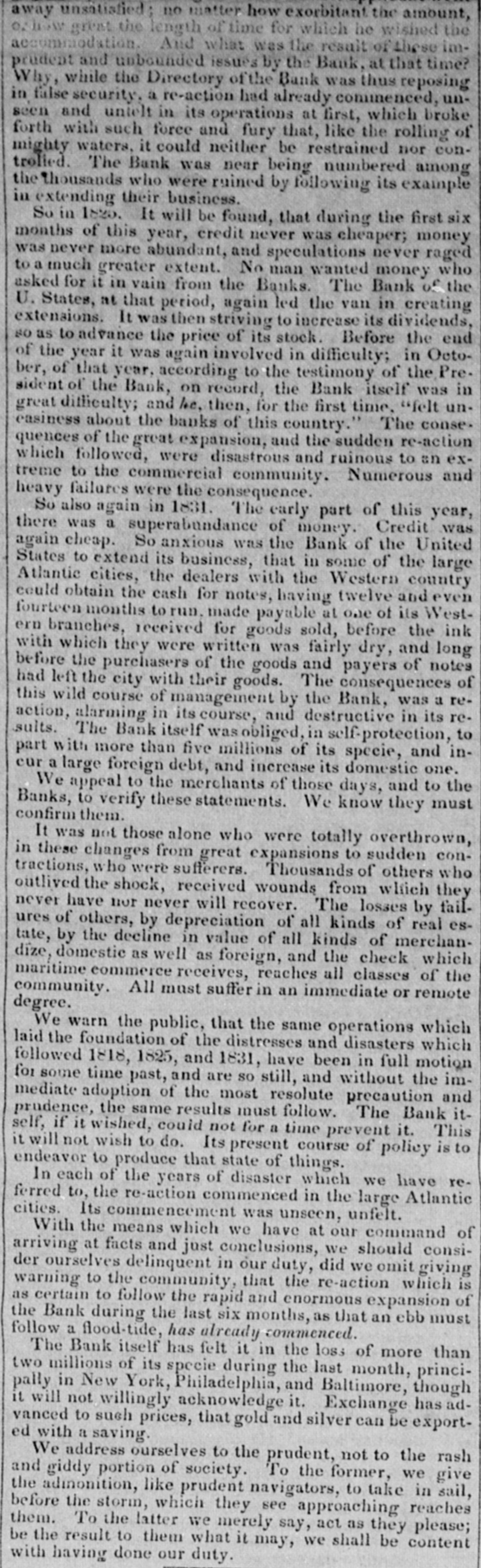
away unsatisfied no matter how exorbitant the amount, grient the length of time for which he wished the accommodation And what was the result of these imprudent and unbounded issues by the Bank, at that time? Why, while the Directory of the Bank was thus reposing in false security. a re-action had already commenced, unseen and untelt in its operations at first, which broke forth with such force and fury that, like the rolling of mighty waters, it could neither be restrained nor controlled. The Bank was near being numbered among the thousands who were ruined by following its example in extending their business. So in 1820. It will be found, that during the first six months of this year, credit never was cheaper; money was never more abundant, and speculations never raged to a much greater extent. No man wanted money who asked for it in vain from the Banks. The Bank of the U. States, at that period, again led the van in creating extensions. It was then striving to increase its dividends, so as to advance the price of its stock. Before the end of the year it was again involved in difficulty; in Oetober, of that year, according to the testimony of the Pre. sident of the Bank, on record, the Bank itself was in great difficulty; and be. then, for the first time. "felt uneasiness about the banks of this country. The conse. quences of the great expansion, and the sudden re-action which followed, were disastrous and ruinous to an extreme to the commercial community. Numerous and heavy failures were the consequence. So also again in 1831. The early part of this year, there was a superabundance of money. Credit was again cheap. So anxious was the Bank of the United States to extend its business, that in some of the large Atlantic cities, the dealers with the Western country could obtain the cash for notes, having twelve and even fourteen months to run. made payable at one of its Western branches, received for goods sold, before the ink with which they were written was fairly dry, and long before the purchasers of the goods and payers of notes had left the city with their goods. The consequences of this wild course of management by the Bank, was a reaction, alarming in its course, and destructive in its results. The Bank itself was obliged, in protection, to part with more than five millions of its specie, and incur a large foreign debt, and increase its domestic one. We appeal to the merchants of those days, and to the Banks, to verify these statements. We know they must confirm them. It was not those alone who were totally overthrown, in these changes from great expansions to sudden contractions, who were sufferers. Thousands of others who outlived the shock, received wounds from which they never have nor never will recover. The losses by failures of others, by depreciation of all kinds of real estate, by the decline in value of all kinds of merchandize, domestic as well as foreign, and the check which maritime commerce receives, reaches all classes of the community. All must suffer in an immediate or remote degree. We warn the public, that the same operations which laid the foundation of the distresses and disasters which followed 1818, 1825, and 1831, have been in full motion for some time past, and are so still, and without the immediate adoption of the most resolute precaution and prudence, the same results must follow. The Bank itself, if it wished, could not for a time prevent it. This it will not wish to do. Its present course of policy is to endeavor to produce that state of things. In each of the years of disaster which we have referred to, the re-action commenced in the large Atlantic cities. Its commencement was unseen, unfelt. With the means which we have at our command of arriving at facts and just conclusions, we should consider ourselves delinquent in our duty, did we omit giving warning to the community, that the re-action which is as certain to follow the rapid and enormous expansion of the Bank during the last six months, as that an ebb must follow a flood-tide, has already commenced. The Bank itself has felt it in the loss of more than two millions of its specie during the last month, principally in New York, Philadelphia, and Baltimore, though it will not willingly acknowledge it. Exchange has advanced to such prices, that gold and silver can be exported with a saving. We address ourselves to the prudent, not to the rash and giddy portion of society. To the former, we give the admonition, like prudent navigators, to take in sail, before the storm, which they see approaching reaches them. To the latter we merely say, act as they please; be the result to them what it may, we shall be content with having done our duty.


Article from Iowa News, June 17, 1837

Click image to open full size in new tab

Article Text

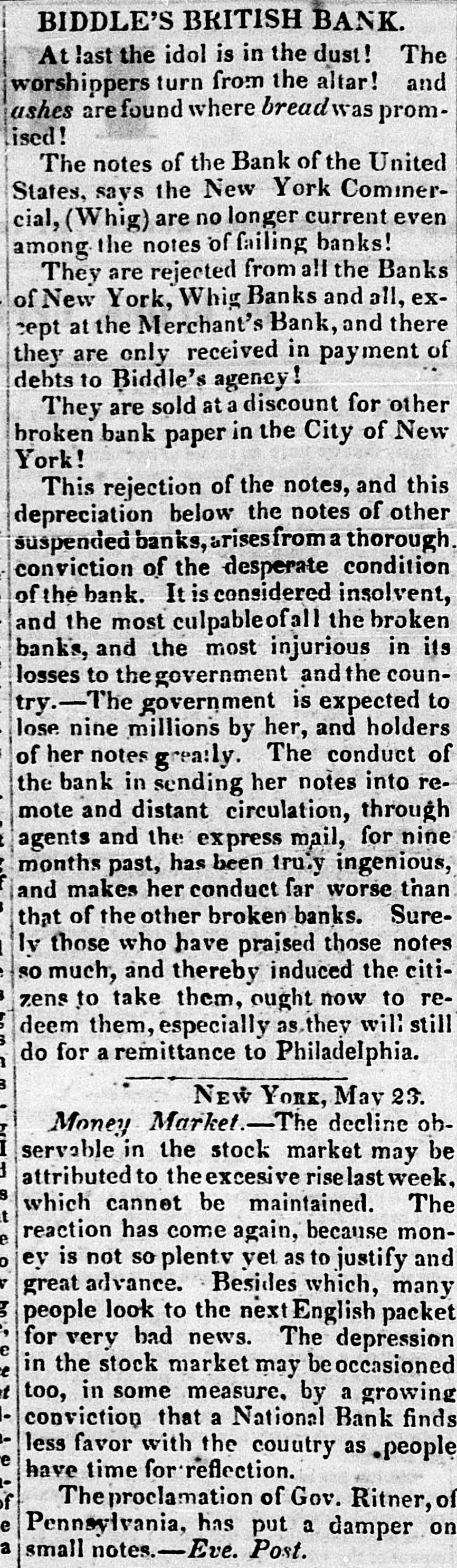
BIDDLE'S BRITISH BANK. At last the idol is in the dust! The worshippers turn from the altar! and ashes arefound where bread was promised! The notes of the Bank of the United States, says the New York Cominercial, (Whig) are no longer current even among the notes of failing banks! They are rejected from all the Banks of New York, Whig Banks and all, except at the Merchant's Bank, and there they are only received in payment of debts to Biddle's agency! They are sold at a discount for other broken bank paper in the City of New York! This rejection of the notes, and this depreciation below the notes of other suspended banks, arisesfrom a thorough conviction of the desperate condition of the bank. It is considered insolvent, and the most culpable of all the broken banks, and the most injurious in its losses to the government and the country.-The government is expected to lose nine millions by her, and holders of her notes greatly. The conduct of the bank in sending her notes into remote and distant circulation, through agents and the express mail, for nine months past, has been truly ingenious, and makes her conduct far worse than that of the other broken banks. Surelv those who have praised those notes so much, and thereby induced the citizens to take them, ought now to redeem them, especially as they will still do for a remittance to Philadelphia. NEW YORK, May 23. Money Market.-The decline observable in the stock market may be attributed to the excesive rise last week, which cannet be maintained. The reaction has come again, because monev is not so plentv yet as to justify and great advance. Besides which, many people look to the next English packet for very bad news. The depression in the stock market may be occasioned too, in some measure, by a growing conviction that a National Bank finds less favor with the country as .people have time for reflection. of The proclamation of Gov. Ritner, of e Pennsylvania, has put a damper on a small notes.-Eve. Post.


Article from Lynchburg Virginian, October 26, 1837

Click image to open full size in new tab

Article Text

10. 11 itself both TO their hopes and en fears. It saysto them. in effect. that whenever restime specie payments. (provided it be before certainday.) your notes. under the restrictions of the II shall be receivable in payments of everybranch of e public revenue, whether for lands or customs: it it you do not resume by that day. your notes all nothe received 111 payment of publis dues even longh ya may thereafter resine. The banks will us be doubly stimulated to a resu nition of specie lyyments-by the promise of a benefit on the one and-by the exhibition of a penalty on the o er. With these provisions 1 do not doubt the early re tablishment ofa sound and healday state of things that is the present condition of the country, and hat the treath ent it demands? It we look around , we find all the greatsources of national prosperistill unimpated-the land, the labor, the capital of e country in then accustomed fertili and abunmcc. And yet industry is paralysed, commerce a stand. the currency degraded and deranged, the ecious metals fled from circulation, the land overin with spurious substitutes of money, exposing ciy interest of society to insecurity and hazardinsecutity and hozard involving alike the wages labor. the value of property, the fulfilment of conacts, all the at quisitions of the past and all the pes of the future. Now what is the remedy for is extraordinary state of the body politic 11 is imprehended 111 a single word. The restoration of afidence. It will be admitted, on all hands, that the first ing to be brought about, with a view to the ame ration of the present condition of things, is the urn specie payments by the banks. But that ura cannot be effected without the restoration of infidence; and confidence IS to he restored main by the policy and example of the Government.ith its aid in the re-est bistment of confidence, thing sclearer than the ability of the banks, at an dy day. to resume and maintain specie payments. I us for a moment, look at the condition of the matry and of the banks 111 regard to those patient . which tornthe leading elements of this ques 11.- And first as to the stock of precious metals 11) e country. The supply 11 the country is most a ndant, for altho' a good deal has gone out reotly. to par offour foreigndebt, an equal, or nearly alquasting has come in. It is shown by official urnsthat the importations and exportations of spe. during the year. VETY nearly balanced eachother. 10 quantity in the country at this moment. accord to the estimates and statements we have receivfrom the Treasury Department. is nearly three es a g reat as it was four years ago. Th means enable the banks to resume and sustain specie ments are, the any le and inquestionable, soon as confidence shall be restored. Then, as to balance of 0111 foreign debt. which forms another portant element of this question-in has a use of oustant and progressive reduction for the SIX months and with the aid of the new t 'P' which is now coming 111. and the great dumintt 11 of foreign importe, we shall soon see it entirely ringuished. At the S me time. the great BLASS of banks throughout the country have endiligent preparing themselves for it return to specie payuts. by it steady and judicious I duction of then culation. Nothing, then, is wanting to a speedy accomplishut of that great object but the restoration conence. and 11 depends mainly on the action and lies 01 the Government to supply that requisite.-" currency of the country 18. at this moment, in condition of a body in state of suspend heart still beats-the principle vitality IS unextingushed-but the active trueusof hic are suspended. Let the government but rather the breath of confidence into it and will once be resuscitated. the more necessary that government should give its aid to this work of storing confidence. because. whether justly or un sily. 11 IS from the Government that the greatest uger of hostility is apprehended. Let this ap. chension, then. be queted by some pledge of curity, by so i.e taken 0. encouragement and confince. The Senator from South Carolina, (Mr. 'ALP UN.) asserted yesterday, that the disease of the nutry is debt. the only remedy stine. and that be lied much more on the cotton and tobacco crops rebel, than upon action of the Government r. the debt of the country, as I have already rearked. has nearly reached its either actual payments or the bankruptcy of unfortu te debtors. But it this were not SO. the cotton d tobacco O crops, though essential ingredients of rea 1. do HOL supersede the necessity of other and xiliary remedies. Examples are not wanting in e financial history of this and other countries, to ow the magical effects of confidence 111 periods of eat public distress. and how that confidence dendson the conduct and policy of the government ne year 1793 was a period of the severest commeril distress III England. More than a hundred untry banks became bankrupt, and the whole untry seemed destined to a similar catastrophe en d single act of the government encouraging produced immediate and general relief.ilude to the offer made by the British government, that crisis of suffering and alarm, to lend to solnt dealers five millions of pounds 111 Exchequer lls. A consider ble part of the sum WHIS not taken even applied for : but the simple offer of the credit the government. in restoring confidence between 11 and man, elicited the dormant resources of the antry, and relieved atonce the general distress. e have had a similar and striking example in r own country. You well recollect, Mr. Presiut, the memorable pante of 1834, which enstred on e removal of the deposites from the Bank of the nited States. The storm which was raised on that casion. was directed chiefly on the great commerI emporium of New York. The legislature of it patriotic and powerful State, with a paternal usibility to the interests and sufferings of her citins, came forward and authorized the creation of a ck of six millions of dollars to be lent to the liks. for the purpose of sustaining them under the traordinary pressure to which they were exposed. hat was ! Not a solitary dollar wa in by the banks, but the offer itself operated like a arm. It restore confidence, and relicced the pres rc. These examples may serve to show gentleen that there is some practical virtue in contince, and in the moral power of tite government to What


Article from The Washington Herald, September 19, 1920

Click image to open full size in new tab

Article Text

Jar Tightens Wall Street's Grip on Fame as World's Thoroughfare of Sensations By RAYMOND G. CARROLL Pearl streets is the location of the birth of life insurance business in (Copyright. 1920, by Public Ledger Co.) America-an enterprise brought to New York, Sept. 18.-0f the Wall Street by Morris Robinson, a streets of New York, Wall Street is Scotchman from Canada. Nearby is the site of the very house where by long odds the most famous. Its Capt. Kidd resided for a time. diminutive size does not detract Further on is the Tontine Building, from its importance as the greatest reminiscent of the Tontine Coffee of all financial centers. House. Now let us start back from Pearl The street has physical dignity, street on the south side of Wall for both of its sides are lined with buildings of the most costly and street. First we come upon the compelling grandeur. We shall enoffices of the American Sugar Refinter from its mouth at Broadway. ing Company, "The Sugar Trust." At No. 1 is the First National Bank. Important financial institutions of This grim edifice still called "Fort the early days succeed each other Sherman" because of the part it including the old Baltimore firm of played in the resumption of specie Brown Brothers and Company. Next payments when John Sherman was is the National City Bank and the Secretary of the Treasury. Next old U. S. Custom House itself erectdoor we have the Schermerhorn ed upon the site of the original Building, owned by the Astor estate, Merchants' Exchange destroyed by which in the days passed into slumthe great fire of 1835. ber, was the site of the old first A Notable Block. Presbyterian meeting house where In the block between William Jonathan Edwards preached. street and Broad street before reachBank on Tavern Site, ing the Morgan Building we have On the corner of Nassau street the U. S. Trust Company and the rises the well-known Bankers' Equitable Trust Company, whose Trust Co. which occupies the exact president, Alvin W. Kroch, was cut location of John Simmons' tavern by glass from the bomb explosion which was frequented by Henry while seated at his desk. During Brevgort and Washington Irving the panic of 1907 the same offices, Jumping to Nassau street we have then the Trust Company of North a view of the U. S. Subtreasury, America, was a storm center with the massive bronze replica Now we have reached what is of George Washington in the center probably the most widely known of the steps. Here once stood the bank in the world-J. P. Morgan & first city hall built by the British Co. It is a low, attention-gripping in 1699. The new building that building of classic outline. The rose in its place is now filled with structure is new, but this afternoon the gold of London Paris, acit looked as if it had been machine cumulated during the great war. gunned. Site of Old Assay Office. Directly across Broad street is Adjoining the Subtreasury is the the stock exchange, a ten-story site of the famous assay office. marble building that cost $3,000,000 It used to be the New York branch with its six Corinthian columns risof the Bank of the United States ing to the fifth floor. The pediment until "Old Hickory" Jackson sucstatues represent integrity, agriculceeded in killing the institution ture, mining. motive power, science and brought a panic on the country and mechanics. in so doing. All Marked by Blast. The next building has been OCAll of the group were marked and cupied for 120 years by the Mannicked by the crash of glass and hattan Company which purchased flying debris. Office buildings dot the plot in 1799. the south side of Wall street beNext along Wall street are four tween Broad and Broadway. All century old banks-the Bank of New had their windows blown out. York, the Bank of Manhattan, the You can walk Wall street from Merchants Bank, and the Bank of end to end and return in less than America. The first was organized fifteen minutes. Yet more history by Alexander Hamilton and the sechas been made in that short stretch ond by Aaaon Burr. than anywhere in the country. In the block between William and