Accommodated withdrawals, Full suspension, Books examined
Receivership Details
Depositor recovery rate
100.0%
Date receivership started
1904-04-04
Date receivership terminated
1915-09-30
OCC cause of failure
Fraud
Share of assets assessed as good
28.6%
Share of assets assessed as doubtful
50.4%
Share of assets assessed as worthless
21.0%
Description
Newspapers consistently report a heavy drain and an unexpected run (April 4, 1904) that forced the bank to close; the Comptroller/Controller appointed a receiver (National Bank Examiner M. R. Sturtevant / A. R. Sturtevant) and the institution remained in receivership. OCR/print variations in sources use both Capital and Capitol National Bank; provided bank name is used. Cause traced to heavy withdrawals exacerbated by the recent failure/suit involving the Holdenville National Bank (a local bank), not to a discrete misinformation event.
Events (5)
1.March 9, 1892Chartered
Source
historical_nic
2.April 4, 1904Receivership
Source
historical_nic
3.April 4, 1904Run
Cause
Local Banks
Cause Details
Heavy drain of deposits over prior month plus an unexpected run triggered after the failure/suit involving the Holdenville National Bank; more than $100,000 paid out during the run.
Measures
Paid out large cash withdrawals (reported >$100,000) until directors/president closed the doors to stop payments.
Newspaper Excerpt
The failure was caused by a heavy drain during the last month and an unexpected run this morning.
Source
newspapers
4.April 4, 1904Suspension
Cause
Local Banks
Cause Details
Suspension followed the run and was attributed indirectly to the recent suit and failure of the Holdenville National Bank (of which the Guthrie bank's president was also involved) and the heavy deposit drain.
Newspaper Excerpt
The Capital National Bank ... closed its doors to-day. It was placed in the hands of the Comptroller of the Currency.
Source
newspapers
5.April 5, 1904Receivership
Newspaper Excerpt
The Controller of the Currency ... has appointed National Bank Examiner M. R. Sturtevant receiver.
Source
newspapers
Newspaper Articles (22)
1.April 5, 1904New-York TribuneNew York, NY
Click image to open full size in new tab
Article Text
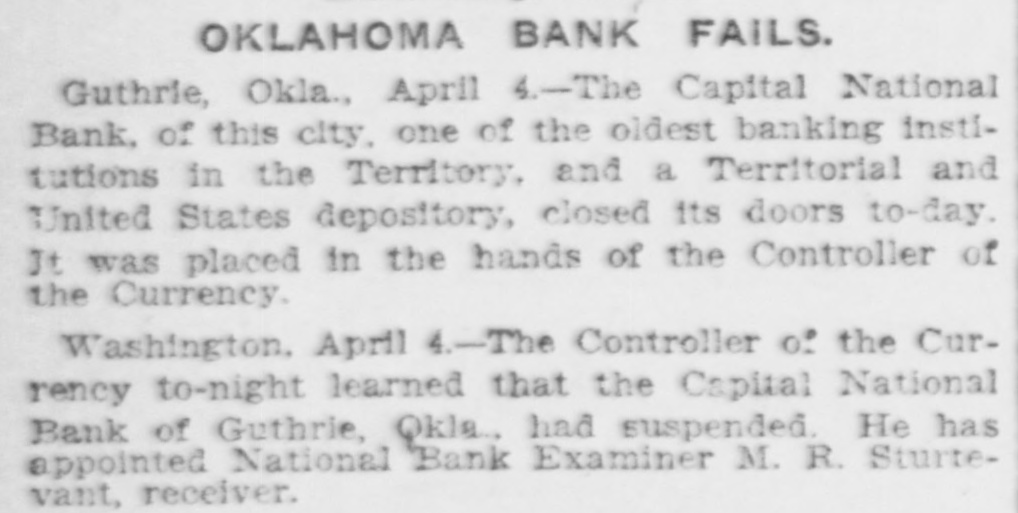
OKLAHOMA BANK FAILS. Guthrie, Okla., April 4.-The Capital National Bank, of this city, one of the oldest banking institutions in the Territory, and a Territorial and United States depository, closed its doors to-day. It was placed in the hands of the Controller of the Currency Washington, April 4.-The Controller of the Currency to-night learned that the Capital National Bank of Guthrie, Qkla. had suspended. He has appointed National Bank Examiner M. R. Sturtevant, receiver.
2.April 5, 1904The St. Louis RepublicSaint Louis, MO
Click image to open full size in new tab
Article Text
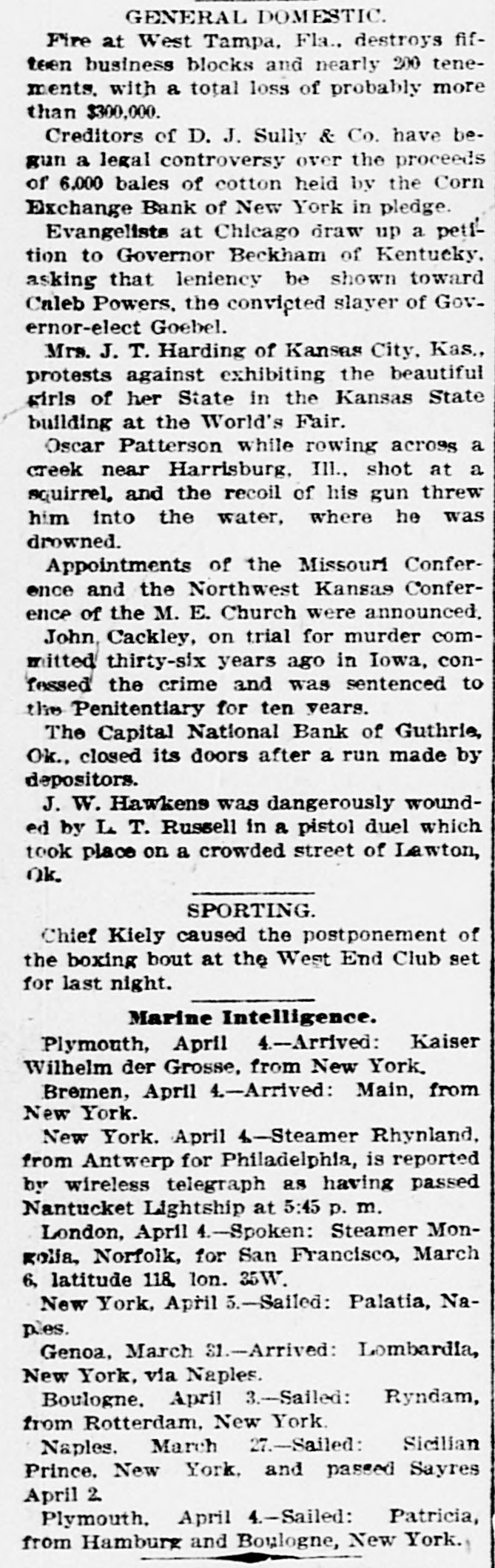
GENERAL DOMESTIC. Fire at West Tampa, Fla., destroys fifteen business blocks and nearly 200 tenements. with a total loss of probably more than $300,000. Creditors of D. J. Sully & Co. have begun a legal controversy over the proceeds of 6,000 bales of cotton held by the Corn Exchange Bank of New York in pledge. Evangelists at Chicago draw up a petition to Governor Beckham of Kentucky. asking that leniency be shown toward Caleb Powers. the convicted slayer of Governor-elect Goebel. Mrs. J. T. Harding of Kansas City, Kas,, protests against exhibiting the beautiful girls of her State in the Kansas State building at the World's Fair. Oscar Patterson while rowing across a creek near Harrisburg, III., shot at a squirrel, and the recoil of his gun threw him into the water, where he was drowned. Appointments of the Missouri Conferonce and the Northwest Kansas Conference of the M. E. Church were announced. John, Cackley, on trial for murder committed thirty-six years ago in Iowa, confessed the crime and was sentenced to the Penitentiary for ten years. The Capital National Bank of Guthrie, Ok., closed its doors after a run made by depositors. J. W. Hawkens was dangerously wounded by L T. Russell in a pistol duel which took place on a crowded street of Lawton, Ok. SPORTING. Chief Kiely caused the postponement of the boxing bout at the West End Club set for last night. Marine Intelligence. Plymouth, April 4.-Arrived: Kaiser Wilhelm der Grosse, from New York. Bremen, April 4.-Arrived: Main, from New York. New York. April 4-Steamer Rhynland. from Antwerp for Philadelphia, is reported by wireless telegraph as having passed Nantucket Lightship at 5:45 p. m. London, April 4.-Spoken: Steamer Mongolia, Norfolk, for San Francisco, March 6, latitude 118. lon. 35W. New York, April 5.-Sailed: Palatia, Naples. Genoa, March S1.-Arrived: Lombardia, New York, via Naples. Boulogne. April 3.-Sailed: Ryndam, from Rotterdam. New York. Naples. March 27.-Sailed: Sicilian Prince. New York, and passed Sayres April 2. Plymouth. April 4.-Sailed: Patricia, from Hamburg and Bowlogne, New York.
3.April 5, 1904The Daily Morning Journal and CourierNew Haven, CT
Click image to open full size in new tab
Article Text
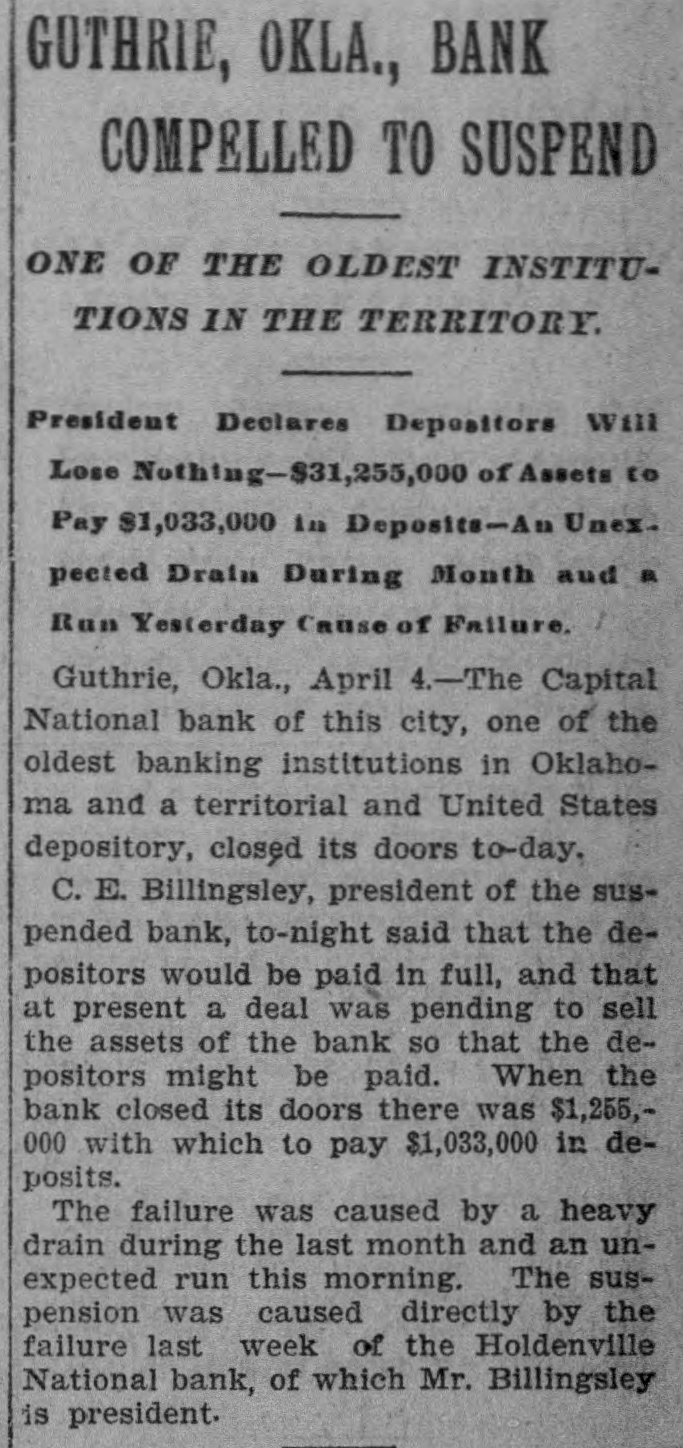
GUTHRIE, OKLA., BANK COMPELLED TO SUSPEND ONE OF THE OLDEST INSTITUTIONS IN THE TERRITORY. President Declares Depositors Will Lose Nothing-$31,255,000 of Assets to Pay $1,033,000 in Deposits-An Unex. pected Drain During Month aud a Run Yesterday Cause of Failure. Guthrie, Okla., April 4.-The Capital National bank of this city, one of the oldest banking institutions in Oklahoma and a territorial and United States depository, closed its doors to-day. C. E. Billingsley, president of the suspended bank, to-night said that the depositors would be paid in full, and that at present a deal was pending to sell the assets of the bank so that the depositors might be paid. When the bank closed its doors there was $1,255,000 with which to pay $1,033,000 in deposits. The failure was caused by a heavy drain during the last month and an unexpected run this morning. The suspension was caused directly by the failure last week of the Holdenville National bank, of which Mr. Billingsley is president.
4.April 5, 1904The Montgomery AdvertiserMontgomery, AL
Click image to open full size in new tab
Article Text
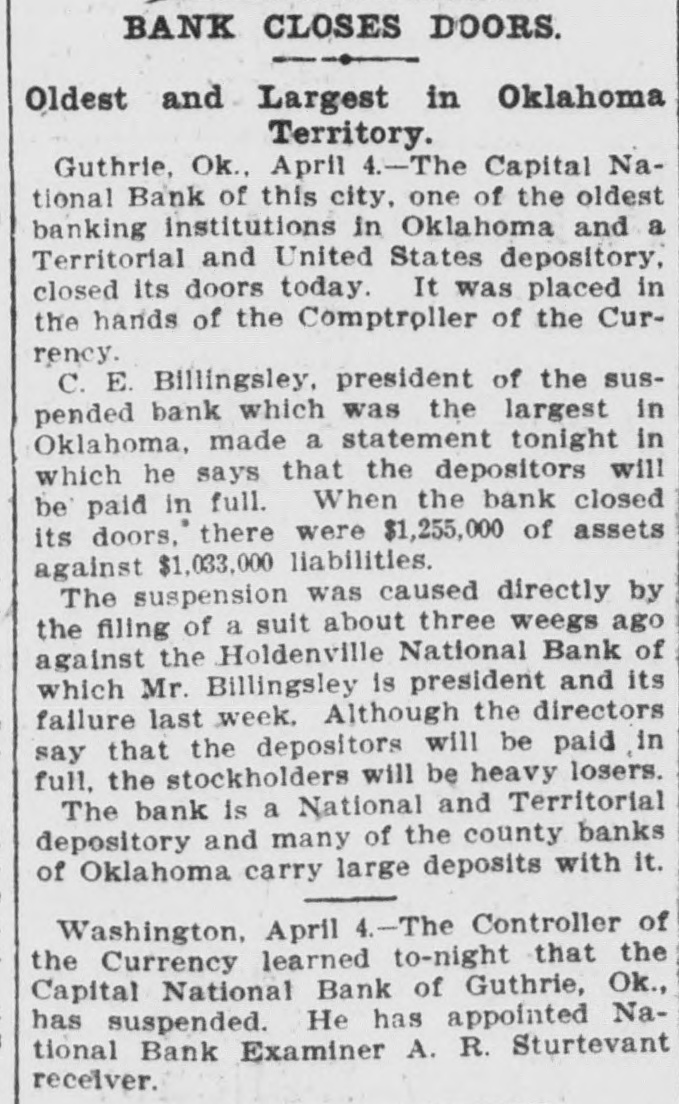
BANK CLOSES DOORS. Oldest and Largest in Oklahoma Territory. Guthrie, Ok., April -The - Capital National Bank of this city, one of the oldest banking institutions in Oklahoma and a Territorial and United States depository, closed its doors today. It was placed in the hands of the Comptroller of the Currency. C. E. Billingsley, president of the suspended bank which was the largest in Oklahoma, made a statement tonight in which he says that the depositors will be paid in full. When the bank closed its doors, there were $1,255,000 of assets against $1,033,000 liabilities. The suspension was caused directly by the filing of a suit about three weegs ago against the Holdenville National Bank of which Mr. Billingsley is president and its failure last week. Although the directors say that the depositors will be paid in full, the stockholders will be heavy losers. The bank is a National and Territorial depository and many of the county banks of Oklahoma carry large deposits with it. Washington, April 4.-The Controller of the Currency learned to-night that the Capital National Bank of Guthrie, Ok., has suspended. He has appointed National Bank Examiner A. R. Sturtevant receiver.
5.April 5, 1904The Times DispatchRichmond, VA
Click image to open full size in new tab
Article Text
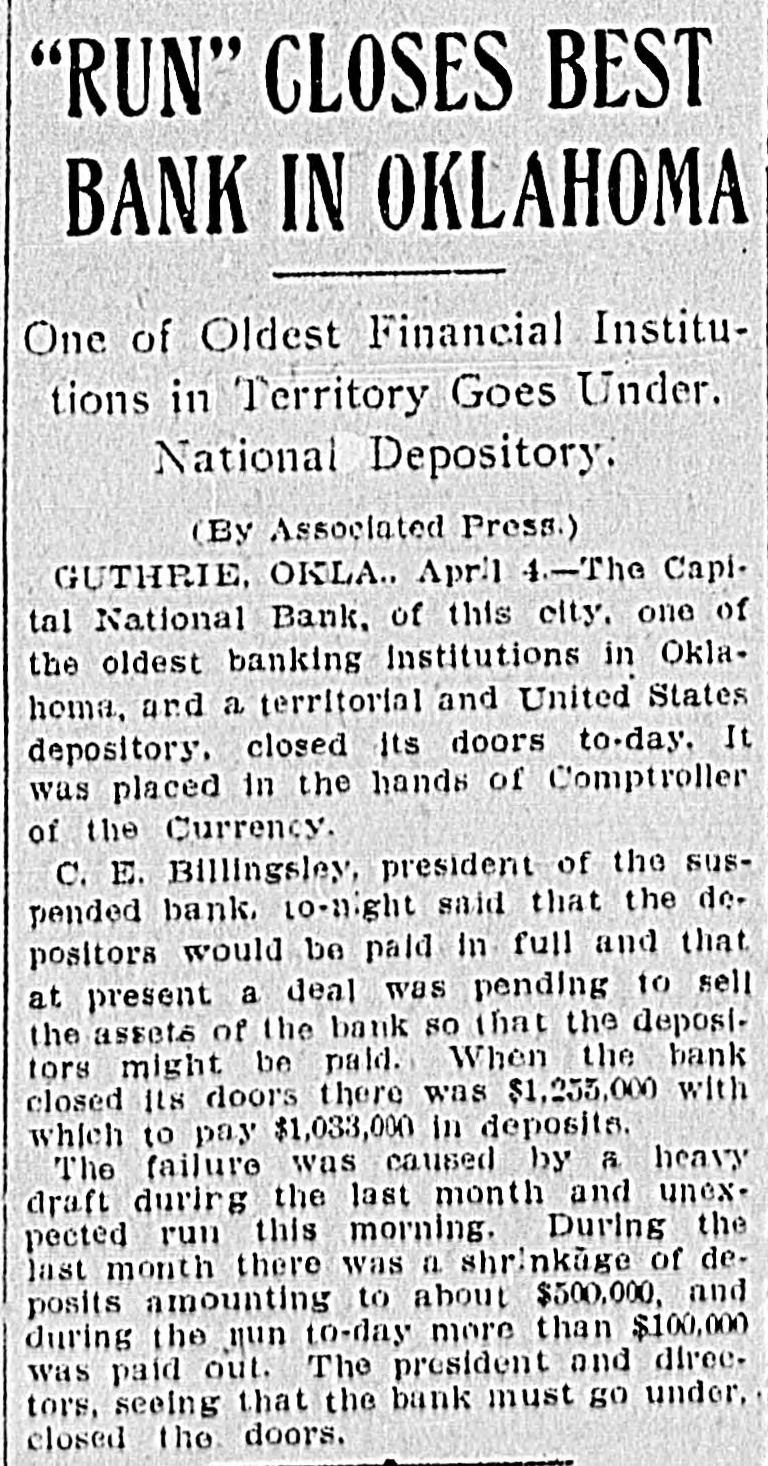
"RUN" CLOSES BEST BANK IN OKLAHOMA One of Oldest Financial Institutions in Territory Goes Under. National Depository. (By Associated Press.) GUTHRIE, OKLA.. April 4--The Capi. tal National Bank, of this city. one of the oldest banking institutions in Oklahoma, and a territorial and United States depository. closed its doors to-day, It was placed in the hands of Comptroller of the Currency. C. E. Billingsley, president of the suspended bank. to-night said that the depositors would be paid in full and that at present a deal was pending to sell the assets of the bank so that the depositors might be paid. When the bank closed its doors there was $1,255,000 with which to pay $1,033,000 in deposits. The failure was caused by a heavy draft during the last month and unexpected run this morning. During the last month there was a shrinkage of deposits amounting to about $500,000, and during the nun to-day more than $100,000 was paid out. The president and direc. tors, seeing that the bank must go under, closed the doors.
6.April 5, 1904The Savannah Morning NewsSavannah, GA
Click image to open full size in new tab
Article Text
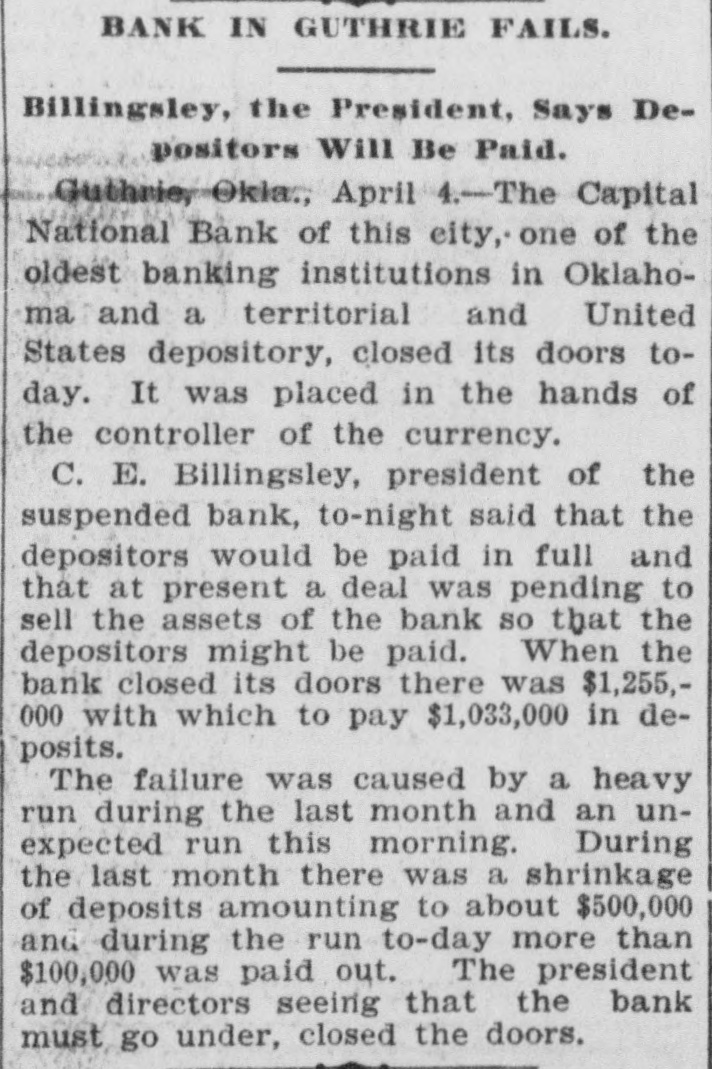
BANK IN GUTHRIE FAILS. Billingsley, the President, Says Depositors Will Be Paid. Guthrie, Okia., April 4.-The Capital National Bank of this city, one of the oldest banking institutions in Oklahoma and a territorial and United States depository, closed its doors today. It was placed in the hands of the controller of the currency. C. E. Billingsley, president of the suspended bank, to-night said that the depositors would be paid in full and that at present a deal was pending to sell the assets of the bank so that the depositors might be paid. When the bank closed its doors there was $1,255,000 with which to pay $1,033,000 in deposits. The failure was caused by a heavy run during the last month and an unexpected run this morning. During the last month there was a shrinkage of deposits amounting to about $500,000 and during the run to-day more than $100,000 was paid out. The president and directors seeing that the bank must go under, closed the doors.
7.April 5, 1904The Topeka State JournalTopeka, KS
Click image to open full size in new tab
Article Text
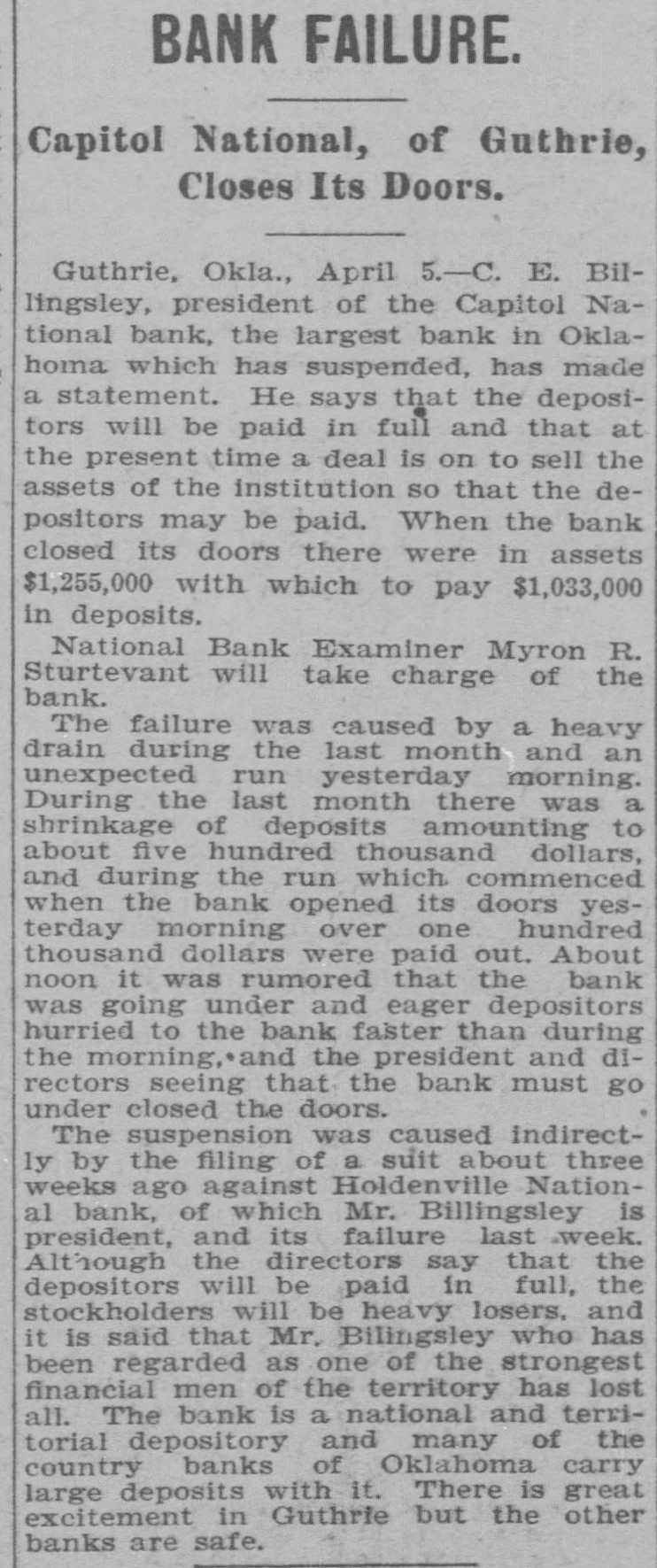
BANK FAILURE. Capitol National, of Guthrie, Closes Its Doors. Guthrie, Okla., April 5.-C. E. Billingsley, president of the Capitol National bank, the largest bank in Oklahoma which has suspended, has made a statement. He says that the depositors will be paid in full and that at the present time a deal is on to sell the assets of the institution so that the depositors may be paid. When the bank closed its doors there were in assets $1,255,000 with which to pay $1,033,000 in deposits. National Bank Examiner Myron R. Sturtevant will take charge of the bank. The failure was caused by a heavy drain during the last month and an unexpected run yesterday morning. During the last month there was a shrinkage of deposits amounting to about five hundred thousand dollars, and during the run which commenced when the bank opened its doors yesterday morning over one hundred thousand dollars were paid out. About noon it was rumored that the bank was going under and eager depositors hurried to the bank faster than during the morning, and the president and directors seeing that the bank must go under closed the doors. The suspension was caused indirectly by the filing of a suit about three weeks ago against Holdenville National bank, of which Mr. Billingsley is president, and its failure last week. Although the directors say that the depositors will be paid in full, the stockholders will be heavy losers, and it is said that Mr. Bilingsley who has been regarded as one of the strongest financial men of the territory has lost all. The bank is a national and territorial depository and many of the country banks of Oklahoma carry large deposits with it. There is great excitement in Guthrie but the other banks are safe.
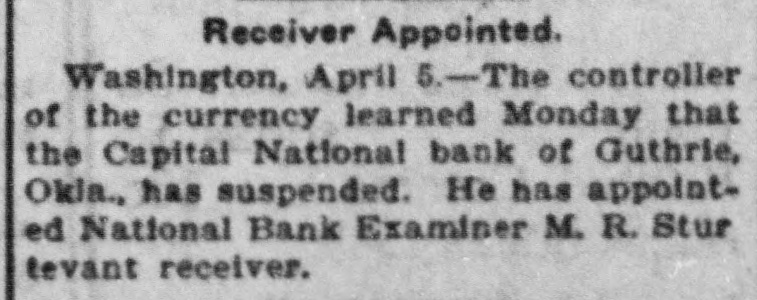
Receiver Appointed. Washington, April 5.-The controller of the currency learned Monday that the Capital National bank of Guthrie, Okla., has suspended. He has appointed National Bank Examiner M. R. Stur tevant receiver.
9.April 5, 1904The San Francisco CallSan Francisco, CA
Click image to open full size in new tab
Article Text
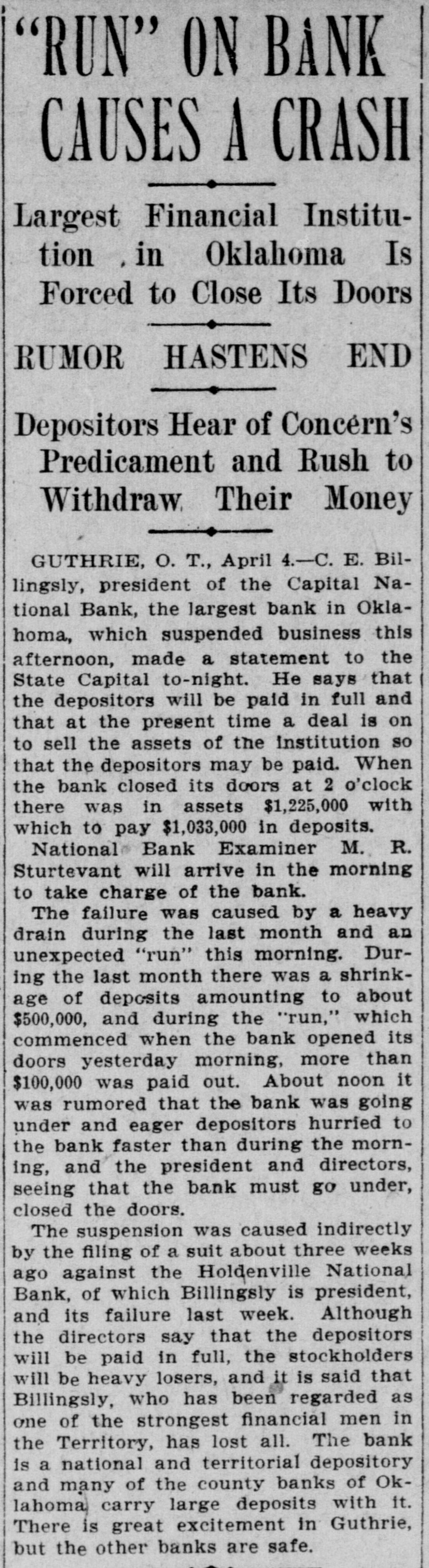
"RUN" ON BANK CAUSES A CRASH Largest Financial Institution in Oklahoma Is Forced to Close Its Doors HASTENS END RUMOR Depositors Hear of Concern's Predicament and Rush to Withdraw Their Money GUTHRIE, O. T., April 4.-C. E. Billingsly, president of the Capital National Bank, the largest bank in Oklahoma, which suspended business this afternoon, made a statement to the State Capital to-night. He says that the depositors will be paid in full and that at the present time a deal is on to sell the assets of the institution so that the depositors may be paid. When the bank closed its doors at 2 o'clock there was in assets $1,225,000 with which to pay $1,033,000 in deposits. National Bank Examiner M. R. Sturtevant will arrive in the morning to take charge of the bank. The failure was caused by a heavy drain during the last month and an unexpected "run" this morning. Durlast month there was a shrinkof and ing $500,000, age the deposits during amounting the "run," to which about commenced when the bank opened its doors yesterday morning, more than $100,000 was paid out. About noon it was rumored that the bank was going under and eager depositors hurried to the bank faster than during the morning, and the president and directors, seeing that the bank must go under, closed the doors. The suspension was caused indirectly by the filing of a suit about three weeks ago against the Holdenville National Bank, of which Billingsly is president, and its failure last week. Although the directors say that the depositors will be paid in full, the stockholders will be heavy losers, and it is said that Billingsly, who has been regarded as one of the strongest financial men in the Territory, has lost all. The bank is a national and territorial depository and many of the county banks of Oklahoma carry large deposits with it. There is great excitement in Guthrie, but the other banks are safe.
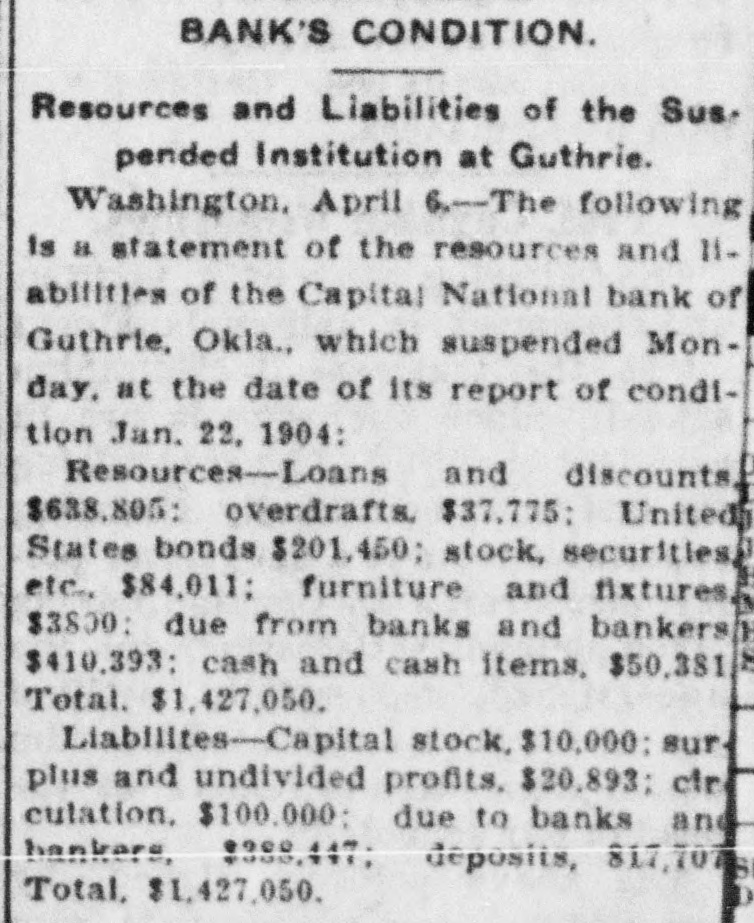
BANK'S CONDITION. Resources and Liabilities of the Sus. pended Institution at Guthrie. Washington, April 6.-The following Is a statement of the resources and 11abilities of the Capital National bank of Guthrie, Okla., which suspended Monday. at the date of its report of condition Jan. 22, 1904: Resources-Loans and discounts $638,805 overdrafts. $37,775 United States bonds $201,450; stock, securities, etc., $84,011; furniture and fixtures $3800: due from banks and bankers $410,393; cash and cash items, $50,381 Total. $1,427,050. Liabllites-Capital stock, $10,000; surplus and undivided profits. $20,893; cir culation, $100.000; due to banks and bankers, déposits, 817,707 Total, $1,427,050.
11.April 6, 1904The Guthrie Daily LeaderGuthrie, OK
Click image to open full size in new tab
Article Text
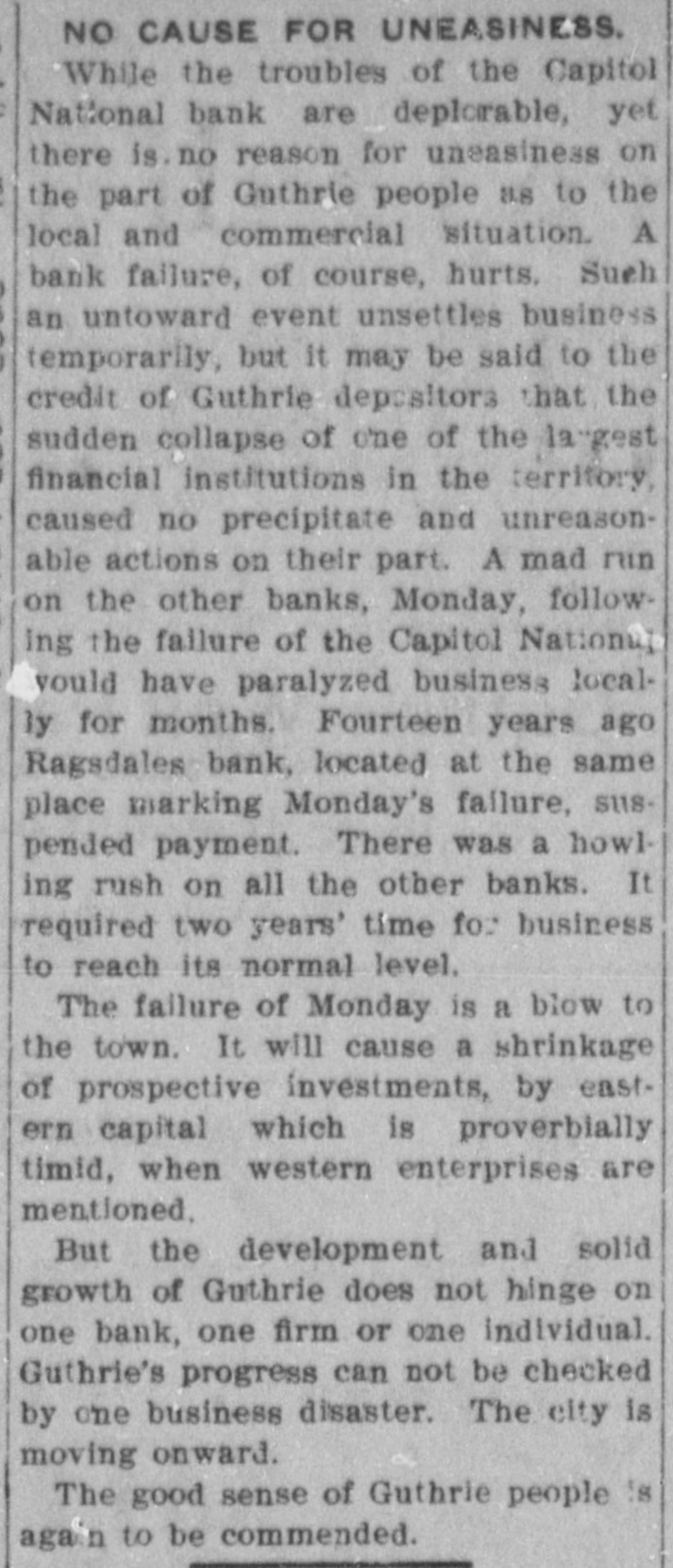
NO CAUSE FOR UNEASINESS. While the troubles of the Capitol National bank are deplorable, yet there is no reason for uneasiness on the part of Guthrie people 88 to the local and commercial situation. A bank failure, of course, hurts. Such an untoward event unsettles business temporarily, but it may be said to the credit of Guthrie depositors that the sudden collapse of one of the largest financial institutions in the territory, caused no precipitate and unreasonable actions on their part. A mad run on the other banks, Monday, following the failure of the Capitol National vould have paralyzed business locally for months. Fourteen years ago Ragsdales bank, located at the same place marking Monday's failure, suspended payment. There was a howling rush on all the other banks. It required two years' time for business to reach its normal level. The failure of Monday is a blow to the town. It will cause a shrinkage of prospective investments, by eastern capital which is proverbially timid, when western enterprises are mentioned. But the development and solid growth of Guthrie does not hinge on one bank, one firm or one individual. Guthrie's progress can not be checked by one business disaster. The city is moving onward. The good sense of Guthrie people is again to be commended.
12.April 6, 1904The Denison ReviewDenison, Dow City, IA
Click image to open full size in new tab
Article Text
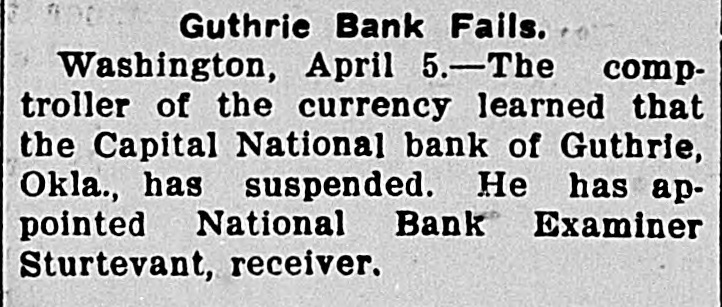
Guthrie Bank Fails. Washington, April 5.-The comptroller of the currency learned that the Capital National bank of Guthrie, Okla., has suspended. He has appointed National Bank Examiner Sturtevant, receiver.
13.April 6, 1904The Salt Lake HeraldSalt Lake City, UT
Click image to open full size in new tab
Article Text
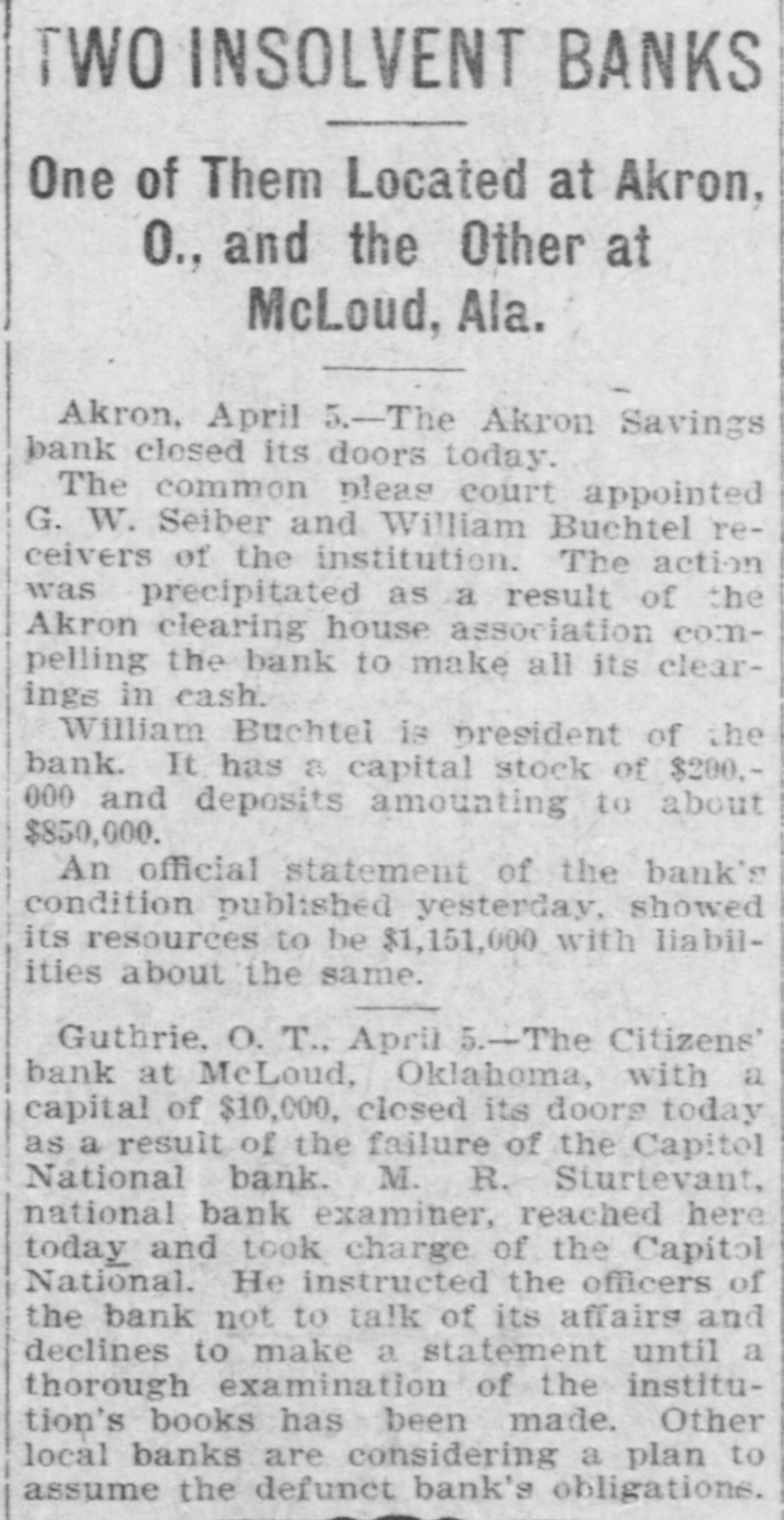
TWO INSOLVENT BANKS One of Them Located at Akron, 0., and the Other at McLoud, Ala. Akron, April 5.-The Akron Savings bank closed its doors today. The common pleas court appointed G. W. Seiber and William Buchtel receivers of the institution. The action was precipitated as a result of the Akron clearing house association compelling the bank to make all its clearings in cash. William Buchtel is president of the bank. It has a capital stock of $200.000 and deposits amounting to about $850,000. An official statement of the bank's condition published yesterday, showed its resources to be $1,151,000 with liabilities about the same. Guthrie, O. T., April -The Citizens' bank at McLoud, Oklahoma, with a capital of $10,000, closed its doors today as a result of the failure of the Capitol National bank. M. R. Sturtevant, national bank examiner, reached here today and took charge of the Capitol National. He instructed the officers of the bank not to talk of its affairs and declines to make a statement until a thorough examination of the institution's books has been made. Other local banks are considering a plan to assume the defunct bank's obligations.
14.April 9, 1904Bisbee Daily ReviewBisbee, AZ
Click image to open full size in new tab
Article Text
Bank Crash Follows Run by Depositors CAPITAL NATIONAL OF GUTHRIE FORCED TO CLOSE ITS DOORS PRESIDENT SAYS ALL DEBTS WILL BE PAID. Cashier Farmers' Bank of Auburn Arrested For Embezzlement-Another Cashier Who Skipped is Arrested at St. Joseph, Mo. Guthrie, Okla, April 8.-Shrinkage in deposits of more than $500,000 in the past month, followed by a run of frightened depositors, caused the failare of the Capital National bank of this city today. The bank was weathering the storm this morning, and had paid out $100,000 to depositors, when a report gained circulation that the institution was about to go under. With the spread of the rumor the number of frightened depositors increased, and the bank was forced to close its doors. National Bank Examiner Myron R. Sturtevant will take charge tomorrow. President C. E. Billingsley tonight issued a statement that the bank was solvent and the depositers would be paid in full. He declares that a deal is under way whereby the assets of the institution will be sold and all obligations met. The assets are $1,255,000, while the deposits total $1,033,000. The directors indorse Mr. Billingsley's statement. Although the depositors will be paid in full the stockholders will lose heavily. The suspension was caused indirectly by the failure of the Holdenville National bank last week, of which Mr. Billingsley was president. Fort Wayne, Ind., April 8.-Albert Robbins, president, and Edward Robbins cashier, of the defunct Farmers' bank of Auburn, were arrested today charged with having received money after the bank had become insolvent. They were brought at once before Justice of the Peace Walters, and were bound over to the circuit court in bonds of $5,000 each. Their troubles are due to speculation in business enterprises started with money belonging to the bank and borrowed without ade,uate security. Other prosecutions are threatened, and the grand jury will take up the cases. Cleveland, April 8.-A telegram was received today by Chief of Police Kohler from St. Joseph, Mo., announcing that George C. Clewell, the missing secretary and treasurer of the recently asigned Federal Trust company of Cleveland, had been arrested there The charge against Clewell was a shortage of $10,000 in his accounts with the Federal Trust company. The warrant for his arrest had been sworn out by J. C. Gllchrist, the president of that company, and it was placed in the hands of the Bankers' Surety company, which was on Clewell's bond in the sum of $10,000. It had been arranged some time ago that the Guardian Trust and the Federal Trust company were to combine their business, the latter company to be absorbed, but rumors of rregularities in the accounts of the Federal company made an assignment necessary before the program for the consolidation could be carried out The Guardian Trust company has as sumed all the business of the Federal company, and, other than the disappearance of Clewell the merger has been regarded 00 a closed incident.
15.April 12, 1904Wausau PilotWausau, WI
Click image to open full size in new tab
Article Text
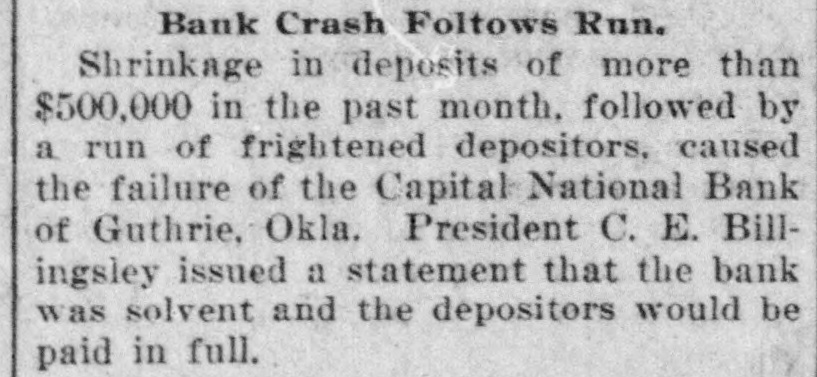
Bank Crash Foltows Run. Shrinkage in deposits of more than $500,000 in the past month. followed by a. run of frightened depositors, caused the failure of the Capital National Bank of Guthrie, Okla. President C. E. Billingsley issued a statement that the bank was solvent and the depositors would be paid in full.
16.April 20, 1904The Guthrie Daily LeaderGuthrie, OK
Click image to open full size in new tab
Article Text
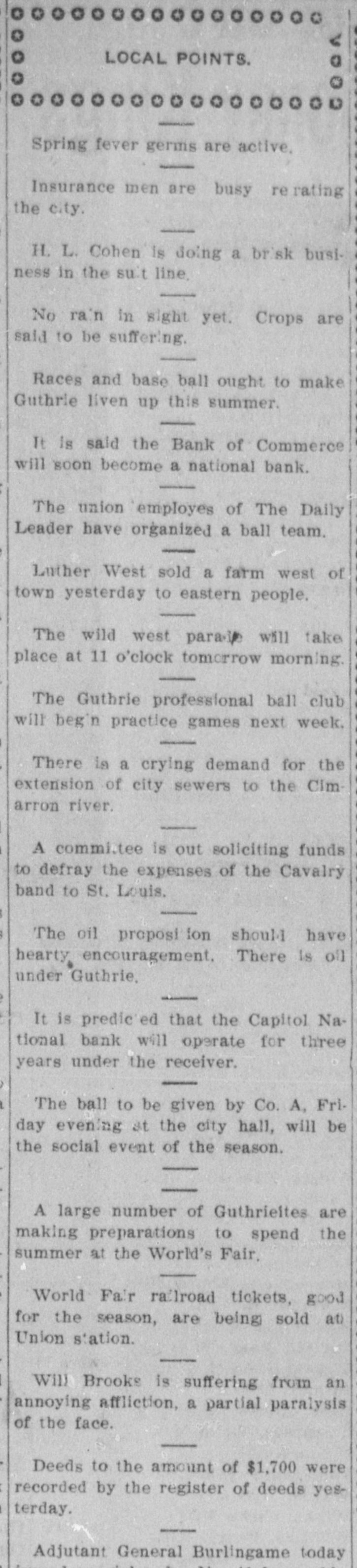
LOCAL POINTS. 0 Spring fever germs are active. | Insurance men are busy re rating the city. | H. L. Cohen is doing a brisk business in the suit line. | No rain in sight yet. Crops are said to be suffering. Races and base ball ought to make Guthrie liven up this summer. | It is said the Bank of Commerce will soon become a national bank. The union employes of The Daily Leader have organized a ball team. Luther West sold a farm west of town yesterday to eastern people. | The wild west parade will take place at 11 o'clock tomorrow morning. | The Guthrie professional ball club will begin practice games next week. There is a crying demand for the extension of city sewers to the Cimarron river. A committee is out soliciting funds to defray the expenses of the Cavalry band to St. Louis. The oil proposi ion should have hearty encouragement. There is oil under Guthrie. It is predic ed that the Capitol National bank will operate for three years under the receiver. The ball to be given by Co. A, Friday evening st the city hall, will be the social event of the season. A large number of Guthrieites are making preparations to spend the summer at the World's Fair. World Fair railroad tickets, good for the season, are being sold at Union station. I Will Brooks is suffering from an annoying affliction, a partial paralysis of the face. Deeds to the amount of $1,700 were recorded by the register of deeds yesterday. Adjutant General Burlingame today
17.July 8, 1904The Guthrie Daily LeaderGuthrie, OK
Click image to open full size in new tab
Article Text
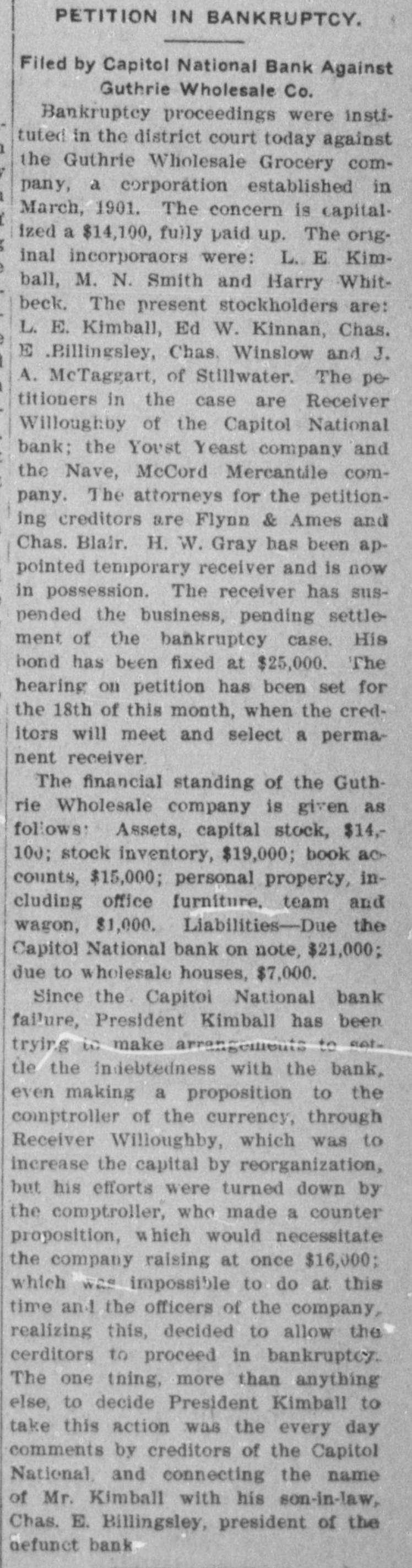
# PETITION IN BANKRUPTCY.
Filed by Capitol National Bank Against Guthrie Wholesale Co.
Bankruptcy proceedings were instituted in the district court today against the Guthrie Wholesale Grocery company, a corporation established in March, 1901. The concern is capitalized a $14,100, fully paid up. The original incorporaors were: L.. E. Kimball, M. N. Smith and Harry Whitbeck. The present stockholders are: L. E. Kimball, Ed W. Kinnan, Chas. E.Pillingsley, Chas, Winslow and J. A. McTaggart, of Stillwater. The petitioners in the case are Receiver Willoughby of the Capitol National bank; the Youst Yeast company and the Nave, McCord Mercantile company. The attorneys for the petitioning creditors are Flynn & Ames and Chas. Blair. H. W. Gray has been appointed temporary receiver and is now in possession. The receiver has suspended the business, pending settlement of the bankruptcy case. His bond has been fixed at $25,000. The hearing on petition has been set for the 18th of this month, when the creditors will meet and select a permanent receiver.
The financial standing of the Guthrie Wholesale company is given as follows: Assets, capital stock, $14,100; stock inventory, $19,000; book accounts, $15,000; personal property, including office furniture, team and wagon, $1,000. Liabilities-Due the Capitol National bank on note, $21,000; due to wholesale houses, $7,000.
Since the Capitoi National bank failure, President Kimball has been trying to make arrangements to settle the indebtedness with the bank, even making a proposition to the comptroller of the currency, through Receiver Willoughby, which was to increase the capital by reorganization, but his efforts were turned down by the comptroller, who made a counter proposition, which would necessitate the company raising at once $16,000; which was impossible to do at this time and the officers of the company, realizing this, decided to allow the cerditors to proceed in bankruptcy. The one thing, more than anything else, to decide President Kimball to take this action was the every day comments by creditors of the Capitol National, and connecting the name of Mr. Kimball with his son-in-law, Chas. E. Billingsley, president of the defunct bank
18.September 7, 1904The Guthrie Daily LeaderGuthrie, OK
Click image to open full size in new tab
Article Text
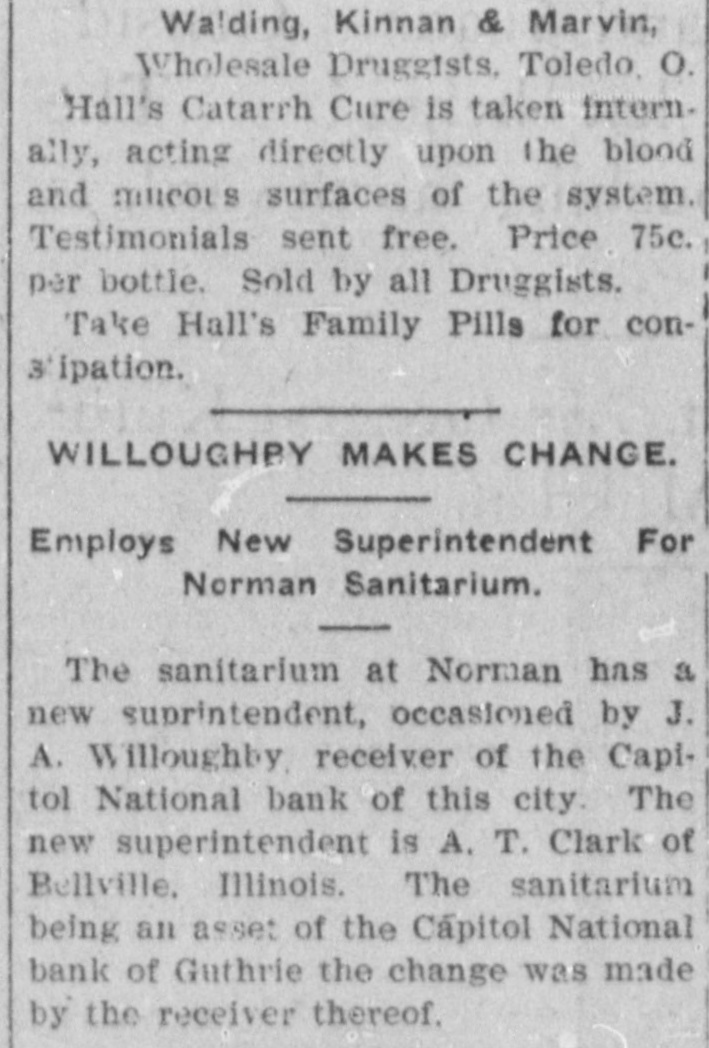
Walding, Kinnan & Marvin, Wholesale Druggists, Toledo, O. Hall's Catarrh Cure is taken intern. ally, acting directly upon the blood and mucous surfaces of the system. Testimonials sent free. Price 75c. per bottle. Sold by all Druggists. Take Hall's Family Pills for con3'ipation. WILLOUGHEY MAKES CHANGE. Employs New Superintendent For Norman Sanitarium. The sanitarium at Norman has a new suprintendent, occasioned by J. A. Willoughby receiver of the Capitol National bank of this city. The new superintendent is A. T. Clark of Bellville, Illinois. The sanitarium being all asset of the Capitol National bank of Guthrie the change was made by the receiver thereof.
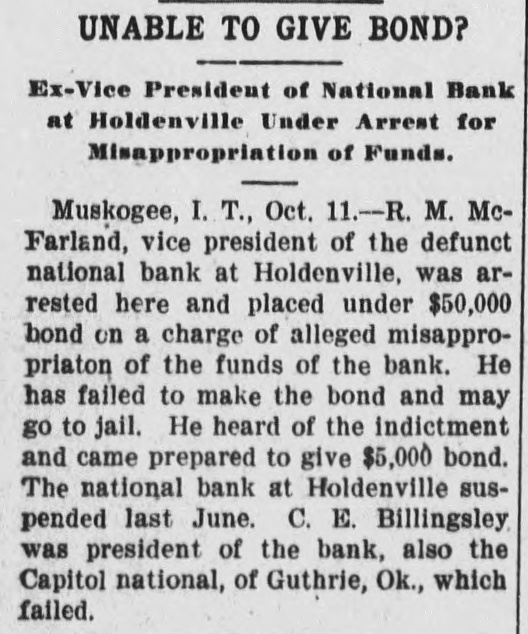
UNABLE TO GIVE BOND? Ex-Vice President of National Bank at Holdenville Under Arrest for Misappropriation of Funds. / Muskogee, I. T., Oct. 11.-R. M. McFarland, vice president of the defunct national bank at Holdenville, was arrested here and placed under $50,000 bond on a charge of alleged misappropriaton of the funds of the bank. He has failed to make the bond and may go to jail. He heard of the indictment and came prepared to give $5,000 bond. The national bank at Holdenville suspended last June. C. E. Billingsley was president of the bank, also the Capitol national, of Guthrie, Ok., which failed.
20.November 12, 1904The Guthrie Daily LeaderGuthrie, OK
Click image to open full size in new tab
Article Text
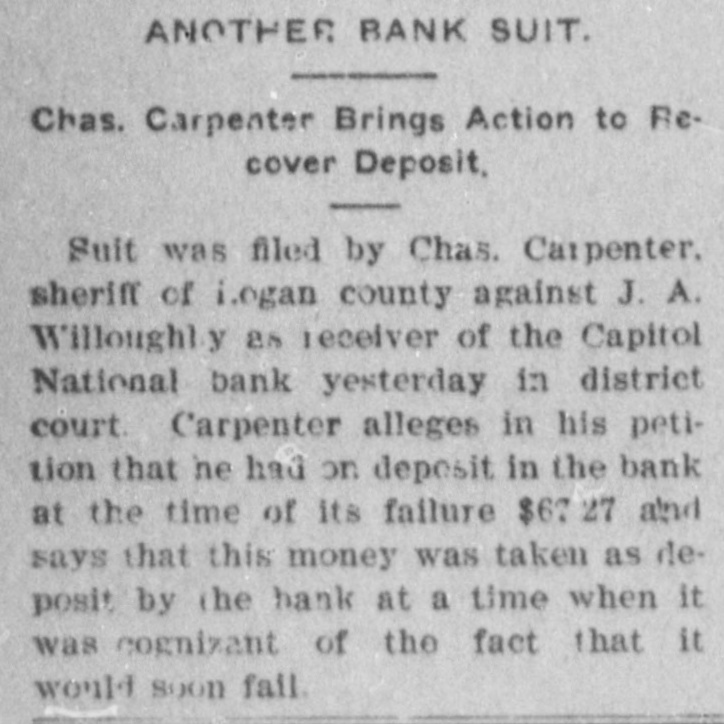
ANOTHER BANK SUIT. Chas. Carpenter Brings Action to Recover Deposit, Suit was filed by Chas. Carpenter. sheriff of i.ogan county against J. A. Willoughty as receiver of the Capitol National bank yesterday in district court. Carpenter alleges in his petition that he had on deposit in the bank at the time of its failure $67.27 and says that this money was taken as deposit by the bank at a time when it was cognizant of the fact that it would soon fail.
21.February 16, 1905The Beaver HeraldBeaver, OK
Click image to open full size in new tab
Article Text
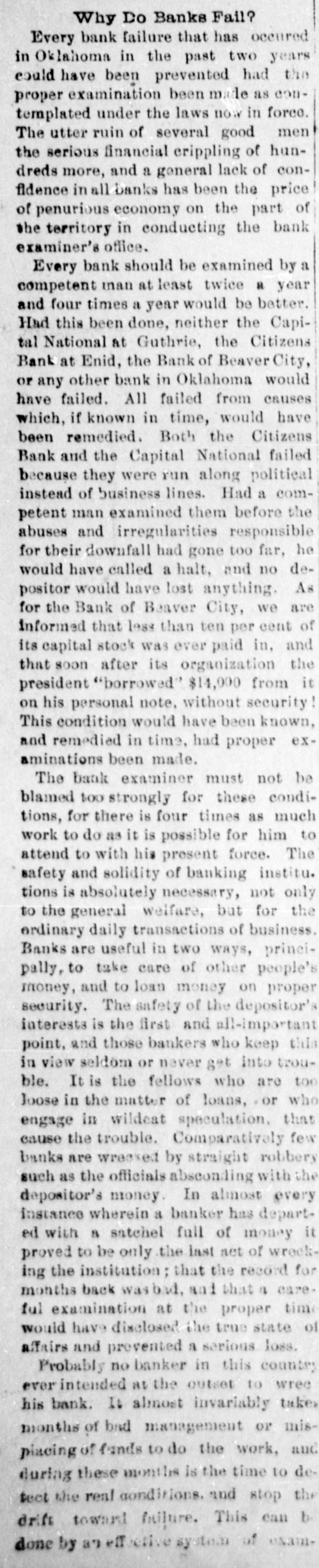
Why Do Banks Fail? Every bank failure that has occured in Oklahoma in the past two years could have been prevented had the proper examination been made as contemplated under the laws now in force. The utter ruin of several good men the serious financial crippling of hundreds more, and a general lack of confidence in all banks has been the price of penurious economy on the part of the territory in conducting the bank examiner's office. Every bank should be examined by a competent man at least twice a year and four times a year would be better. Had this been done, neither the Capital National at Guthrie, the Citizens Bank at Enid, the Bank of Beaver City, or any other bank in Oklahoma would have failed. All failed from causes which, if known in time, would have been remedied. Both the Citizens Bank and the Capital National failed because they were run along political instead of business lines. Had a competent man examined them before the abuses and irregularities responsible for their downfall had gone too far, he would have called a halt, and no depositor would have lost anything. As for the Bank of Beaver City, we are informed that less than ten per cent of its capital stock was ever paid in, and that soon after its organization the president "borrowed" $14,000 from it on his personal note, without security This condition would have been known, and remedied in time, had proper examinations been made. The bank examiner must not be blamed too strongly for these conditions, for there is four times as much work to do as it is possible for him to attend to with his present force. The safety and solidity of banking institu. tions is absolutely necessary, not only to the general welfare, but for the ordinary daily transactions of business. Banks are useful in two ways, principally, to take care of other people's money, and to loan money on proper security. The safety of the depositor's interests is the first and all-important point, and those bankers who keep this in view seldom or never get into trouble. It is the fellows who are too Joose in the matter of loans, or who engage in wildeat speculation. that cause the trouble. Comparatively few banks are wreased by straight robbery such as the officials absconding with the depositor's money. In almost every instance wherein a banker has departed with a satchel full of money it proved to be only the last net of wrecking the institution; that the record for months back was bad, and that a careful examination at the proper time would have disclosed the true state of affairs and provented a serious loss. Probably no banker in this country ever intended at the outset to wree his bank. It almost invariably takes months of bad management or misplacing of funds to do the work, and during these months is the time to defeet the real conditions. and stop the drift toward failure, This can b done by an eff etive sy stem of exam-
22.March 23, 1905The Guthrie Daily LeaderGuthrie, OK
Click image to open full size in new tab
Article Text
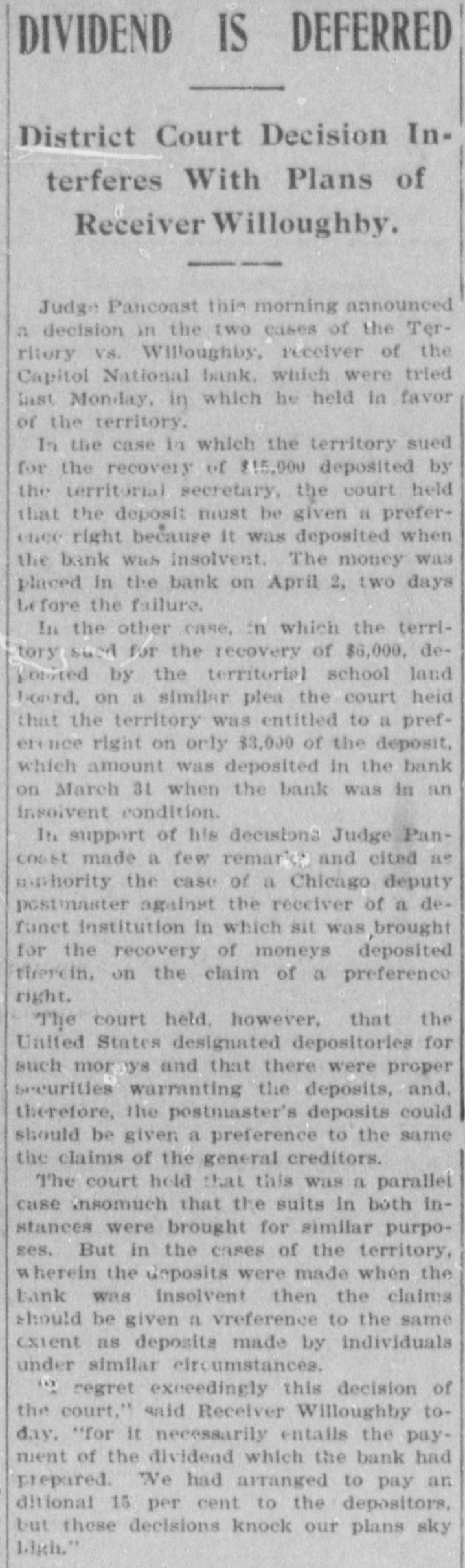
# DIVIDEND IS DEFERRED
# District Court Decision In-
terferes With Plans of
Receiver Willoughby.
Judge Pancoast this morning announced a decision in the two cases of the Territory vs. Willoughby, receiver of the Capitol National bank, which were tried last Monday, in which he held in favor of the territory.
In the case in which the territory sued for the recovery of $15,900 deposited by the territorial secretary, the court held that the deposit must be given a preference right because it was deposited when the bank was insolvent. The money was placed in the bank on April 2, two days before the failure.
In the other case, in which the territory sued for the recovery of $6,000, deposited by the territorial school land board, on a similar plea the court held that the territory was entitled to a preference right on only $3,000 of the deposit, which amount was deposited in the bank on March 31 when the bank was in an insolvent condition.
In support of his decisions Judge Pancoast made a few remarks and cited as authority the case of a Chicago deputy postmaster against the receiver of a defunct institution in which sit was brought for the recovery of moneys deposited therein, on the claim of a preference right.
The court held, however, that the United States designated depositories for such moneys and that there were proper securities warranting the deposits, and, therefore, the postmaster's deposits could should be given a preference to the same the claims of the general creditors.
The court held that this was a parallel case insomuch that the suits in both instances were brought for similar purposes. But in the cases of the territory, wherein the deposits were made when the bank was insolvent then the claims should be given a vreference to the same extent as deposits made by individuals under similar circumstances.
"I regret exceedingly this decision of the court," said Receiver Willoughby today, "for it necessarily entails the payment of the dividend which the bank had prepared. We had arranged to pay an additional 15 per cent to the depositors, but these decisions knock our plans sky high."