Article Text
The issue of standard silver dollars for the week which ended April 19, was $254,988. For the corresponding period last year $109,499.
FREE NEWSPAPER POSTAGE.
The bill introduced by Representative Henley, to encourage education in the statas and territories provides that all newspapers hereafter published in the several states and territories, in any language what-so-ever, shall be carried free of postage through the mails within the timits of the United States and Territories.
NON-CONCURRENCE.
At a meeting of the house committee on appropriations Representative Randall was instructed to report back the naval appropriation bill with a recommendation that the house non-concur with the senate amendments. The amendments increased the appropriation over $600,000.
Representative Townshend was also instructed to report back the postoffice appropriation bill with a recommendation that the house non concur in the senate amendments. The amendments increased the appropriation about $3,500,000.
SOLDIERS' HOMES.
The house committee on military, instructed Representative Rosecrans to report favorably a joint resolution for the appointment of William B. Franklin, Conneticut; John C. Black, Illinois, and Thomas. W. Hyde, Maine, to fill vacancies in the board of managers of the national soldiers' house.
On motion of Mr. Morrison, chairman, Mr. Rosecrans was instructed to lay before the present board of managers, complaints made by prominent men in Dayton, Ohio, against Governor Patrick, of the soldiers' home at Dayton. If the board does not deem its complaints against him sufficient to justify his removal, the committee will ask an investigation of the management of the Dayton home by the home.
THE PACIFIC RAILROADS.
The house committee on Pacific railroads to-day continued consideration of the proposed amendment to the Thurman sinking fund act. The committee agreed to report amendments to bring within the provisions of the act in addition those roads already Included, the Kansas Pacific, Sioux City & Pacific, and the central branch of the Union Pacific roads, and to increase the net per cent. of earnings of all roads that are to go into sinking funding from 25 to 37½ per cent. The secretary of the treasury in the third amendment, is empowered to make an investment of the sinking fund on the first mortgage in any of the subsidized companies or in government securities.
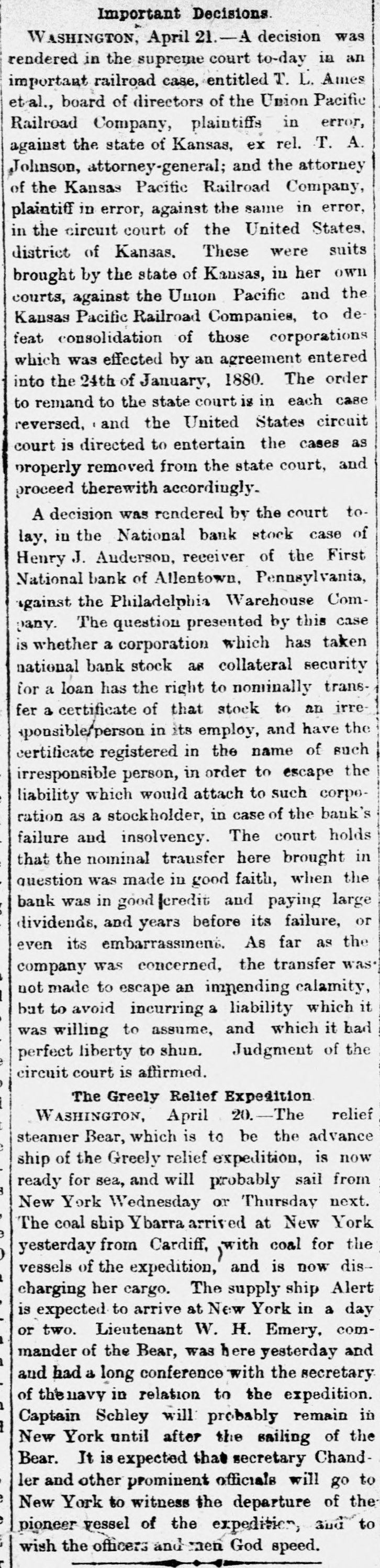
BANK STOCK DECISION.
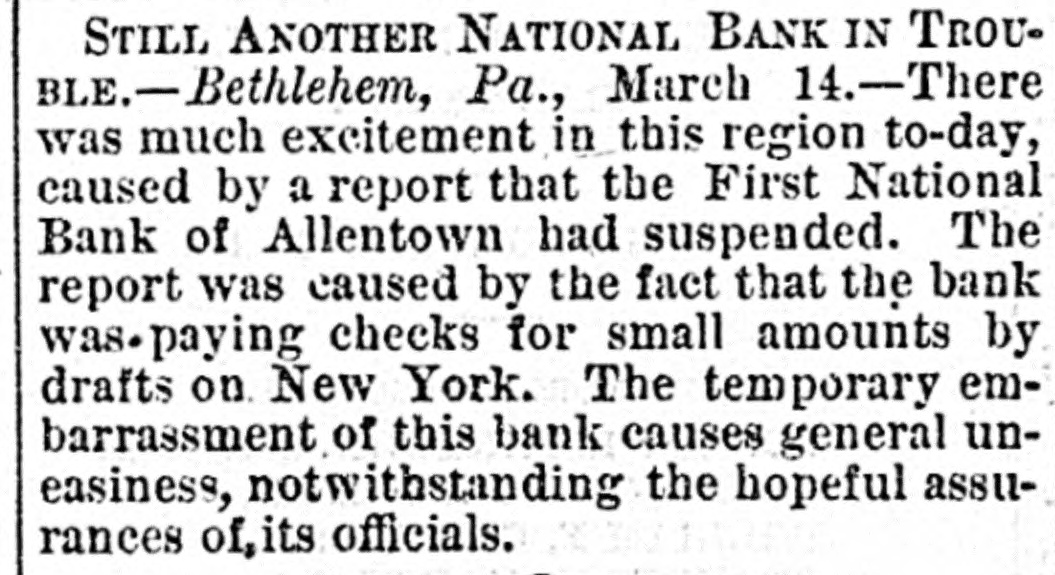
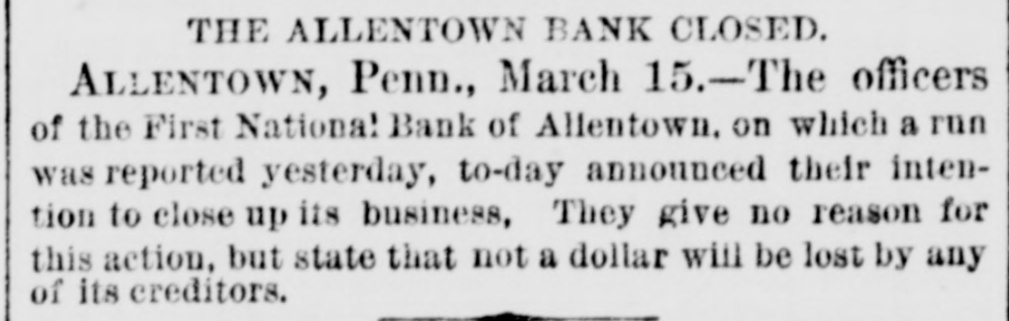
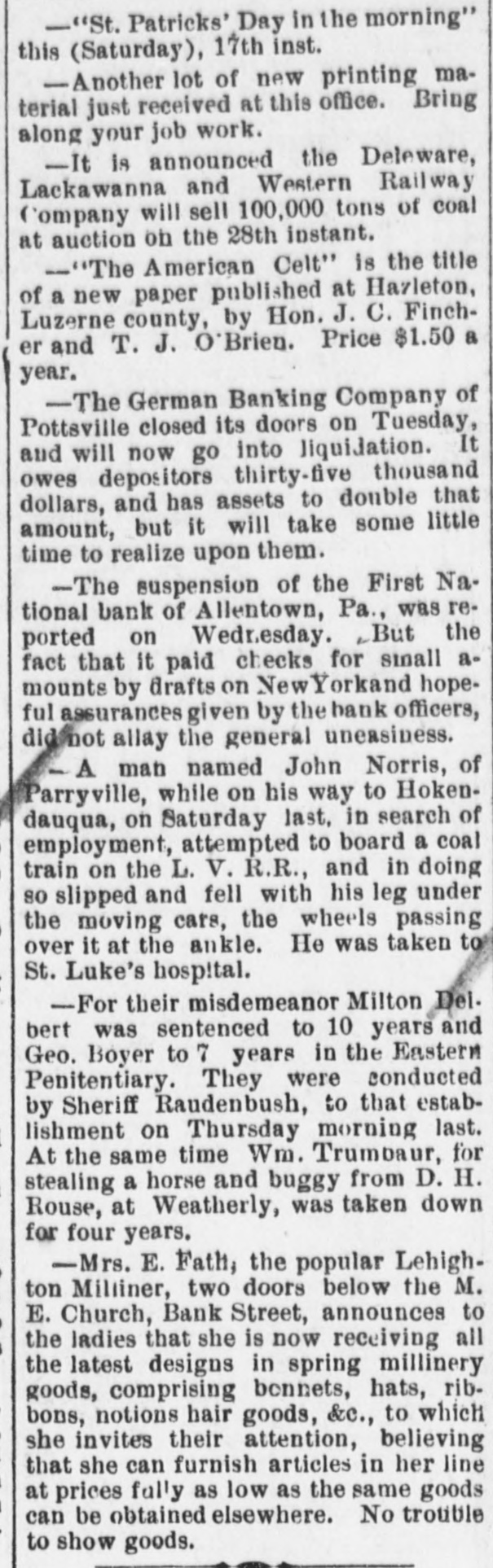
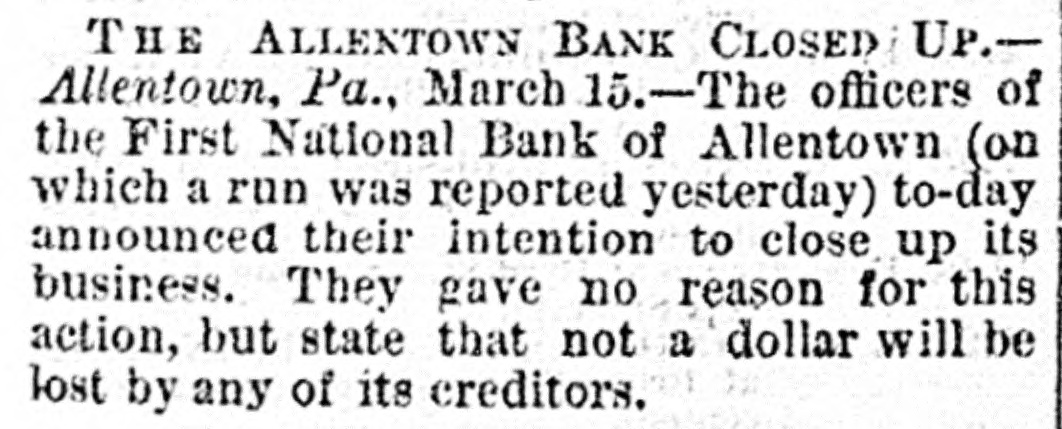
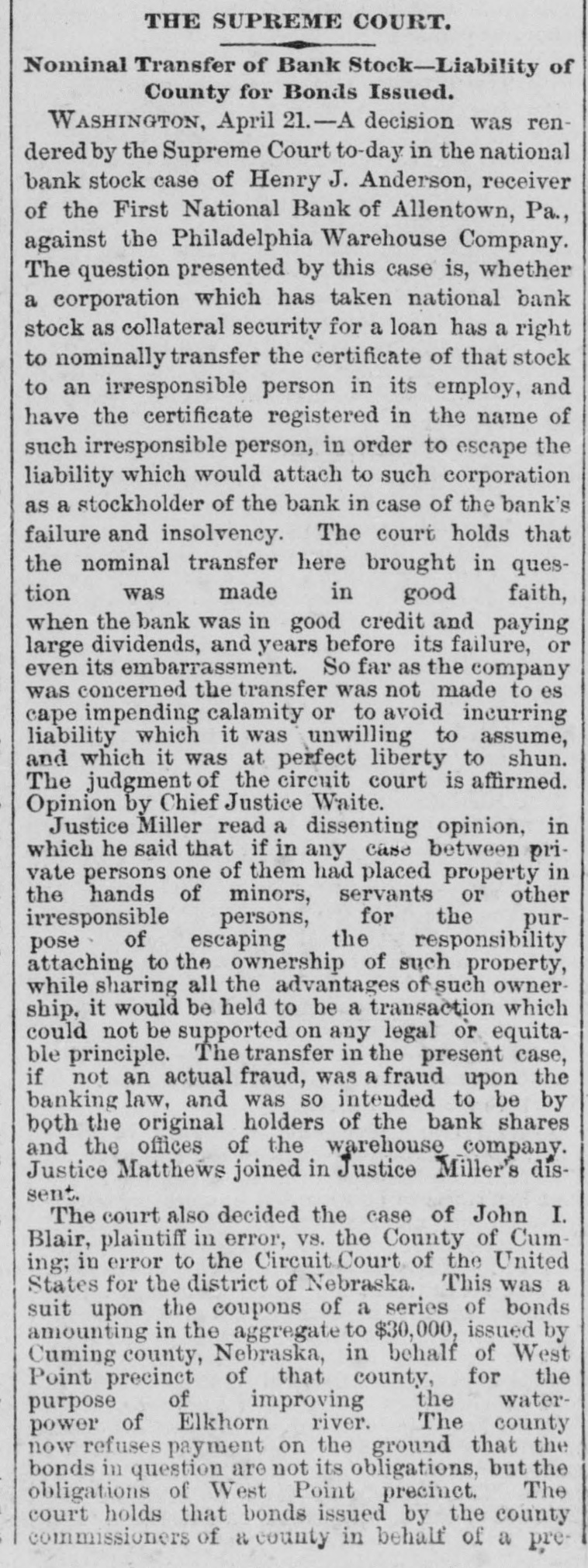
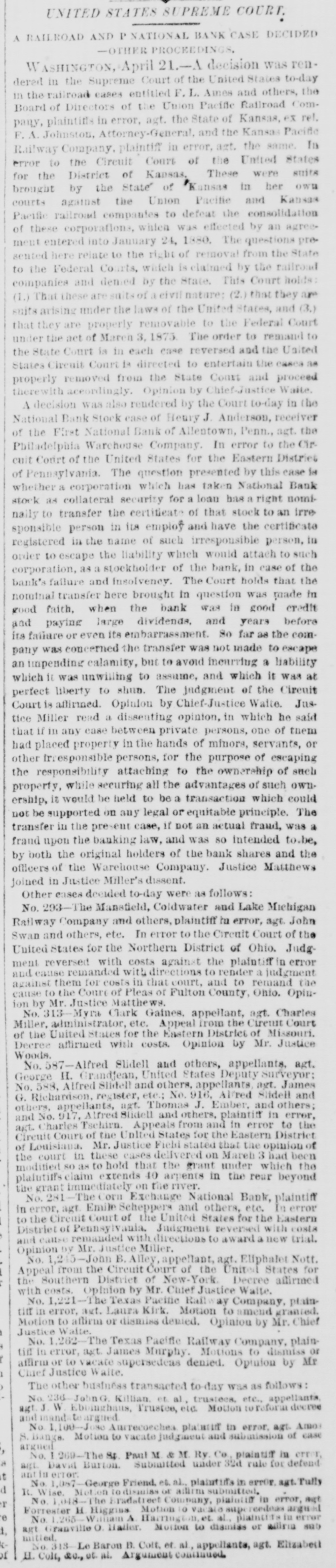
A decision also rendered by the court to-day, in the National bank stock case of Henry Jas. Anderson, receiver of the First National bank of Allentown, Pa., against the Philadelphia Warehouse company. The question presented by the case is, whether a corporation, which has taken National bank stock as a collateral security for a loan, has the right to nominally transfer the certificate of that stock to an irresponsible person in its employ, and have the certificate registered in liability which would attach to such corporation as a stockholder of the bank in case of the bank's failure and insolvency, the court holds, the nominal transfer here brought in question was made in good faith, when the bank was in good credit and paying large dividends, and years before its failure, or even its embarrassment. So far as the company is concerned the transfer was not made to escape pending calamity, but to avoid incurring liability which it was unwilling to assume, and at perfect liberty to shun. The judgment of the circuit court is affirmed. Opinion by Chief Justice Waite. Justice Miller read a dissenting opinion, in which he said, if, in any case between private persons, one of them had placed property in the hands of minors, servants or other irresponsible persons, for the purpose of escaping the responsibility attaching to the ownership of such property, while securing all the advantages of such ownership, it would be held to be a transaction which could not be supported on any legal or equitable principle. The transfer in the present case, if not actual fraud, was fraud upon the banking law, and was so intended to be, by both the original holders of the bank shares and the officers of the warehouse company. Justice Mathews joined in Justice Miller's dissent.
WATER WAYS IMPROVEMENT DECISION.
The court also decided the case of John T. Blair, plaintiff, in error vs. the county of Cuming in error, circuit court of the United States, district of Nebraska. This was a suit upon coupons of a series of bonds amounting in the aggregate to $30,000 issued by Cuming county, Nebraska, in behalf of West Point precinct in that county for the purpose of improving the water power of the Elkhorn river. The county now refuses payment on the ground that the bonds in question are not its obligations, but the obligation of West Point precinct. The court holds that, "bonds issued by the county commissioners of the county in behalf of a precinct of that county, to aid a company in improving the water pawer of a river, for the purpose of propelling public grist mills, are issued to aid in constructing work of internal improvement within the meaning of the act of Nebraska, February 15, 1869, as amended by the act of March 3, 1870, and that the suit on the coupons of such bonds is properly brought against this county." The judgment is reversed with costs, and the cause remanded, with a direction to overrule the demurrer to the petition and to take such further proceedings in the cause as may be required by law, and as shall not be inconsistent with the opinion of this court.
THE PATENT LAWS.
The senate and house bills, relating to the practice in patent suits, both of which were upon the senate calendar, and which has long been a "special order" awaiting its turn after the bankruptcy bill for consideration, have been, upon motion of Senator Mcl'herson, recommitted, no objection having been made by the members of the committee on patents. This action is based upon numerously signed petitions, embracing hundreds of names of prominent inventors, manufacturers, merchants, bankers and others, who ask that they be afforded an opportunity to appear and point out what they consider the mischievous features of the bill. A widespread sentiment in op-sition to ti