First National Bank (Kansas City, MO)

Episode Information

Episode UID
161200885
Episode Type
Run → Suspension → Reopening
Bank Type
national
Bank ID
16120 national
Charter Number
1612
Start Date
September 25, 1873
Location
Kansas City, Missouri (39.100, -94.579)

Metadata

Model
gpt-5-mini (chosen from majority vote of a three-model LLM ensemble)
Short Digest
39c0f34fbccb96ce

Response Measures

Accommodated withdrawals, Clearinghouse loan, Public signal of financial health, Capital injected, Full suspension, Books examined

Clearinghouse involved: Yes (loan, examination, or other measures)

Receivership Details

Depositor recovery rate
100.0%
Date receivership started
1878-02-11
Date receivership terminated
1881-07-06
OCC cause of failure
Losses
Share of assets assessed as good
60.9%
Share of assets assessed as doubtful
17.1%
Share of assets assessed as worthless
22.0%

Description

Contemporary reports conflict: some papers (Nov 25) report voluntary liquidation while others (Jan 5) report resumption; chronology implies run→suspension→reopening.

Events (6)

1. November 23, 1865 Chartered
Source
historical_nic
2. September 25, 1873 Run
Cause
Rumor Or Misinformation
Cause Details
Panic driven by rumor of heavy indebtedness of L. M. Hunter to the bank and general distrust during national panic, producing heavy withdrawals
Measures
Bank paid out heavily then suspended; directors met and later arranged recapitalization and reopening
Newspaper Excerpt
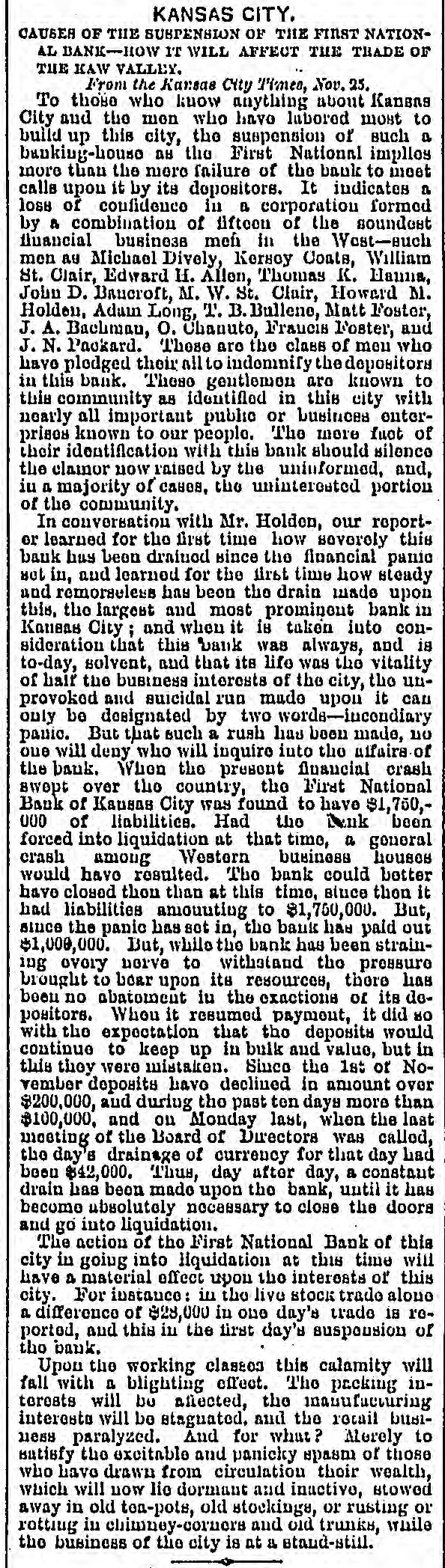
the unprovoked and suicidal run made upon it ... day's drainage ... $42,000
Source
newspapers
3. September 25, 1873 Suspension
Cause
Rumor Or Misinformation
Cause Details
Immediate suspension caused by heavy withdrawals following incendiary rumors and loss of depositor confidence
Newspaper Excerpt
the banks of that city had suspended. ... First National ... had closed their doors.
Source
newspapers
4. November 25, 1873 Other
Newspaper Excerpt
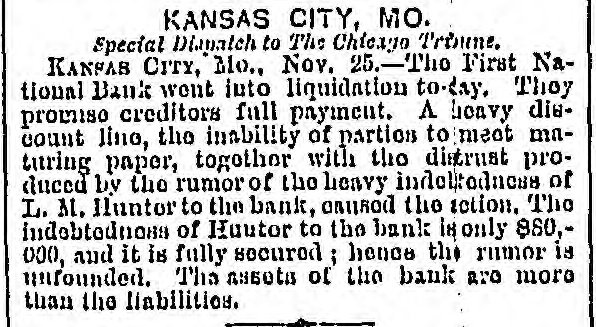
The First National Bank of Kansas City, Mo., has gone into voluntary liquidation. / went into liquidation to-day. They promise creditors full payment. ... rumor of the heavy indebtedness of L. M. Hunter ... caused the action. The rumor is unfounded. The assets of the bank are more than the liabilities.
Source
newspapers
5. January 5, 1874 Reopening
Newspaper Excerpt
the First National Bank of Kansas City ... have resumed payment. / resumed payment on Jan. 5 and announced to-day their ability to pay all demands against them in full.
Source
newspapers
6. February 11, 1878 Receivership
Source
historical_nic

Newspaper Articles (15)

Article from Wood County Reporter, October 2, 1873

Click image to open full size in new tab

Article Text

the 24th, the authorities had been disappointed at the renewal of the financial trouble in New York on that day. It was reported that the Secretary of the Treasury had telegraphed to the President that, in his judgment, the purchase of bonds should cease whenever the amount of currency used should reach $12,000,000. The President had not replied to this dispatch. An application had been made to the Secretary by leading financial men to anticipate the redemption of the $20,000,000 of five per cent. gold bonds falling due in January next. A Milwaukee (Wis.) dispatch of the 24th says the Chamber of Commerce of that city had suspended operations, and that there would be no trading in grain until further notice. A telegram from Wilkesbarre, Pa., of the 24th announced that Brown & Gary, bankers of that city, had suspended. A Baltimore dispatch of the 24th announced that all the banks of the city had stopped currency payment. Brown, Lancaster & Cowell, agents of the Chesapeake & Ohio Railway, having houses in Baltimore, New York and Richmond, had also suspended. Little Rock, Ark., dispatches of the 24th say the money panic in that city continued, caused not so much by Eastern financial complications as by the refusal of the city banks to take the shinplasters that have been current there. According to a dispatch from Richmond, Va., the Richmond Dollar Savings Bank had suspended, and Taylor & Williams, bankers, had failed. A dispatch to the Associated Press, from Brownsville, Texas, of September 24, says that a series of butcheries and robberies had recently been committed in Mexico, the victims in every case being Americans. The perpetrators of these crimes were arrested, and their guilt fully established, yet not one of them had been punished, the authorities being either indifferent or powerless. The facts had been reported by the Consuls to Washington, in the hopes that redress would be demanded. Information had been received at Washington, on the 24th, that Collector Weidner, of the Second District of Alabama, was a defaulter to the amount of $20,000. Orders had been issued for his arrest. The wheat crop, according to the returns to the statistical division of the Agricultural Department, published on the 24th, presented an average of 95, which is about the same as the September report of 1872. The area of cultivation had been much larger this year than last. The Chicago Journal of the 25th says that it had become necessary to say that the banks of Chicago had not suspended payment or closed their places of business. The action of the preceding night was not in consequence of a panic but to prevent a panic. They had not ceased business, were continuing to receive deposits and pay out such sums as might be needed for ordinary business transactions, but where sums were demanded to hoard or withdrawn from business operations they had resolved to delay the payment of these until the financial storm had passed. The currency stringency in that city had had the effect to bring the extensive hog and cattle trade to a stand still, it being impossible to make cash sales. The Union Live Stock Yards contained 30,000 hogs and 10,000 head of cattle, all that the yards could possibly accommodate, and the live stock commission merchants had notified the railroads and country shippers that no more live stock would be received until further notice. According to a dispatch to the Associated Press the Cincinnati Clearing-House Association had adopted on the 25th a resolution substantially the same as that adopted on the 24th by the banks of Chicago. A dispatch from Kansas City, Mo., of the 25th, says that the banks of that city had suspended. A Memphis dispatch of the 25th says that the First National and De Soto banks, of that city, had closed their doors. There was great excitement in that city in consequence. A New York dispatch of the 25th says the day has been a comparatively quiet one in Wall street. The means of relief adopted by the banks in effecting bank clearances by loan certificates had eased the pressure on themselves but had not materially aided others. The extreme caution of those institutions, and their anxiety to protect themselves, had added largely to the actual scarcity of money, and there were grievous complaints from the great commercial world and the Produce Exchange in particular. Earnest appeals had been made to the Government for relief, and resolutions had been adopted by the Produce Exchange suggesting to the Treasurer the issue of currency to the banks and bankers on evidence that gold had been deposited in the Bank of England to the credit of the United States to be used only in buying exchange. The breadstuffs market was still under the influence of the block in exchange. A Washington dispatch of the 25th says that the President had returned to that city permanently. At a consultation held between the President, the Secretary of the Treasury and the Attorney-General, the latter officer held that the bonds of 1874 could not be redeemed legally before maturity. It was therefore decided that the Treasury could take no further steps to relieve the New York market, except as it was affected by the regular transactions of the department. Dr. Linderman, the Director of the Bureau of the Mint, had predicted that the effect of the stock panic would be to hasten the resumption of specie payments. He said that within a month, it was his belief, that silver and gold coin would be a medium of circulation at currency rates. In anticipation of this result, he had ordered the mints to largely increase the coinage, and stated that more bullion would be coined during the next three months than at any previous time in the same period. Secretary Richardson had stated that it would be a good policy for all the banks to suspend further currency payments. It was rumored, in Washington, on the 25th, that the President had been advised to call an extra session of Congress. A dispatch from St. Louis, of the 25th, says that the banks of that city had held a meeting on the evening of that day and resolved to


Article from Dodgeville Chronicle, October 3, 1873

Click image to open full size in new tab

Article Text

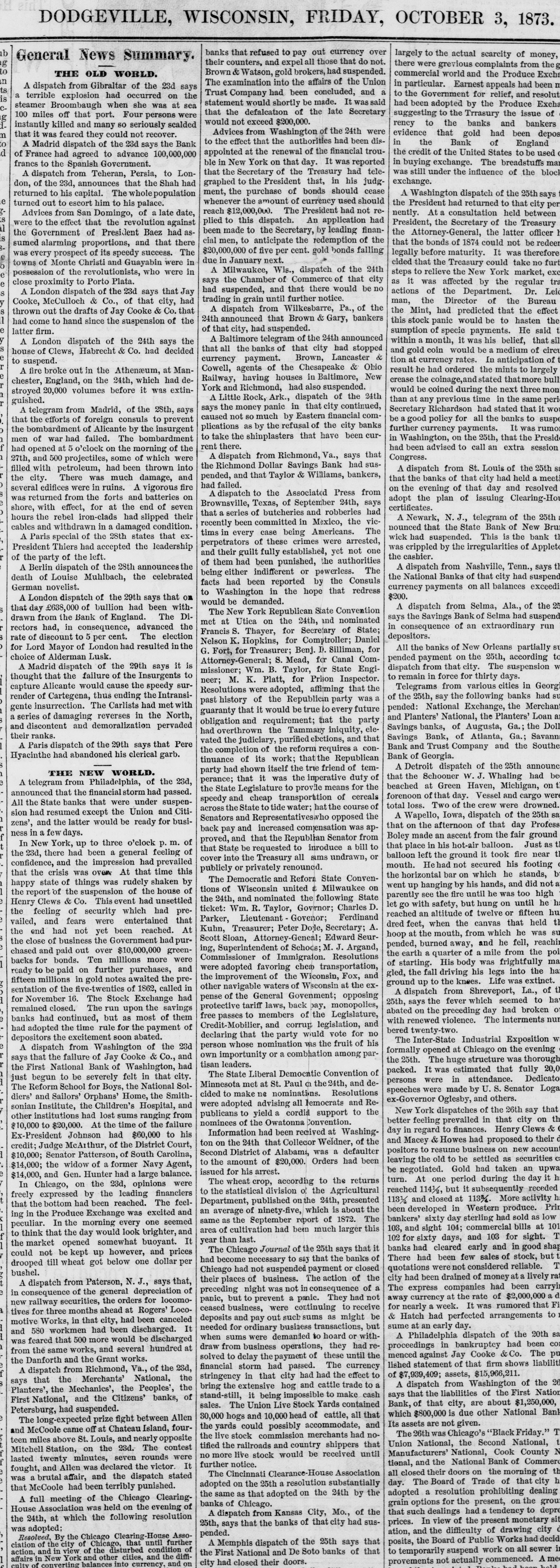
1873. DODGEVILLE, WISCONSIN, FRIDAY, OCTOBER 3, 1b banks that refused to pay out currency over largely to the actual scarcity of money General News Summary. their counters, and expels those that do not. there were grevious complaints from the to Brown & Watson, gold brokers, had suspended. THE OLD WORLD. commercial world and the Produce Exch in The examination into the affairs of the Union in particular. Earnest appeals had been A dispatch from Gibraltar of the 23d says its Trust Company had been concluded, and to the Government for relief, and resolu a terrible explosion had occurred on the is statement would shortly be made. It was said had been adopted by the Produce Exch steamer Broombaugh when she was at sea that the defalcation of the late Secretary suggesting to the Trrasury the issue of 100 miles off that port. Four persons were would not exceed $200,000. rency to the banks and bankers instantly killed and many so seriously scalded Advices from Washington of the 24th were that it was feared they could not recover. evidence that gold had been depo to the effect that the authorities had been disin the Bank of England A Madrid dispatch of the 23d says the Bank appointed at the renewal of the financial trouthe credit of the United States to be used of France had agreed to advance 100,000,000 in buying exchange. The breadstuffs m ble in New York on that day. It was reported francs to the Spanish Government. was still under the influence of the bloc that the Secretary of the Treasury had teleA dispatch from Teheran, Persia, to Lonexchange. graphed to the President that, in his judgdon, of the 23d, announces that the Shah had ment, the purchase of bonds should cease returned to his capital. whole population A Washington dispatch of the 25th says le whenever the amount of currency used should turned out to escort him to his palace. the President had returned to that city pe reach $12,000,000. The President had not reAdvices from San Domingo, of late date, nently. At consultation held between plied to this dispatch. An application had were to the effect that the revolution against President, the Secretary of the Treasury been made to the Secretary, by leading finanthe Government of President Baez had asthe Attorney-General, the latter officer cial men, to anticipate the redemption of the that the bonds of 1874 could not be redee sumed alarming proportions, and that there $20,000,000 of five per cent. gold bonds falling legally before maturity. It was therefor was every prospect of its speedy success. The due in January next. cided that the Treasury could take fur towns of Monte Christi and Guayabin were in A Milwaukee, Wis., dispatch of the 24th possession of the revolutionists, who were in steps to relieve the New York market, ex says the Chamber of Commerce of that city as it was affected by the regular tr close proximity to Porto Plata. had suspended, and that there would be no actions of the Department. Dr. Le A London dispatch of the 23d says that Jay trading in grain until further notice. man, the Director of the Bureau Cooke, McCulloch & Co., of that city, had A dispatch from Wilkesbarre, Pa., of the the Mint, had predicted that the effect thrown out the drafts of Jay Cooke & Co. that 24th announced that Brown & Gary, bankers this stock panic would be to hasten th had come to hand since the suspension of the of that city, had suspended. latter firm. sumption of specie payments. He said A Baltimore telegram of the 24th announced si within a month, it was his belief, that A London dispatch of the 24th says the that all the banks of that city had stopped and gold coin would be medium of circ house of Clews, Habrecht & Co. had decided currency payment. Brown, Lancaster & tion at currency rates. In anticipation of to suspend. Cowell, agents of the Chesapeake & Ohio A fire broke out in the Athenium, at Manresult he had ordered the mints to largely Railway, having houses in Baltimore, New crease the coinage,and stated bui chester, England, on the 24th, which had deYork and Richmond, had also suspended. would be coined during the next three mo stroyed 20,000 volumes before it was extinA Little Rock, Ark., dispatch of the 24th than at any previous time in the same per guished. says the money panic in that city continued, Secretary Richardson had stated that we A telegram from Madrid, of the 2Sth, says caused not so much by Eastern financial combe good policy for all the banks to susp that the efforts of foreign consuls to prevent plications as by the refusal of the city banks further currency payments. It was rum the bombardment of Alicante by the insurgent to take the shinplasters that have been curin Washington, on the 25th, that the Presi men of war had failed. The bombardment rent there. had been advised to call an extra session had opened at o'clock on the morning of the A dispatch from Richmond, Va., says that Congress. 27th, and 500 projectiles, some of which were the Richmond Dollar Savings Bank had susfilled with petroleum, had been thrown into A dispatch from St. Louis of the 25th pended, and that Taylor & Williams, bankers, that the banks of that city had held a mee the city. There was much damage, and had failed. several edifices were in ruins. A vigorous fire on the evening of that day and resolved dispatch to the Associated Press from was returned from the forts and batteries on adopt the plan of issuing Clearing-Ho Brownsville, Texas, of September 24th, says certificates. shore, with effect, for at the end of seven that a series of butcheries and robberies had A Newark, N. J., telegram of the 25th hours the rebel iron-clads had slipped their recently been committed in Mexico, the vicnounced that the State Bank of New Bru cables and withdrawn in damaged condition. tims in every case being Americans. The A Paris special of the 28th states that exwick had suspended. This is the bank perpetrators of these crimes arrested, President Thiers had accepted the leadership was crippled by the irregularities of Apple and their guilt fully established, yet not one the cashier. of the party of the left. of them had been punished, the authorities A dispatch from Nashville, Tenn., says A Berlin dispatch of the 28th announces the being either indifferent or powerless. The death of Louise Muhlbach, the celebrated the National Banks of that city had suspen facts had been reported by the Consuls German novelist. currency payments on all balances exceed to Washington in the hope that redress $200. A London dispatch of the 29th says that OR would be demanded. A dispatch from Selma, Ala., of the 2 that day £638,000 of bullion had been withThe New York Republican State Convention says the Savings Bank of Selma had suspen drawn from the Bank of England. The Dimet at Utica on the 24th, and nominated in consequence of an extraordinary run rectors had, in consequence, advanced the Francis S. Thayer, for Secretary of State: depositors. rate of discount to 5 per cent. The election Nelson K. Hopkins, for Comptroller; Daniel for Lord Mayor of London had resulted in the All the banks of New Orleans partially G. Fort, for Treasurer; Benj. I). Silliman, for choice of Alderman Lusk. pended payment on the 25th, according Attorney-General; S. Mead, for Canal ComA Madrid dispatch of the 29th says it is dispatch from that city. The suspension missioner; Wm. B. Taylor, for State Engithought that the failure of the Insurgents to to remain in force for thirty days. neer; M. K. Platt, for Prison Inspector. capture Alicante would cause the speedy surTelegrams from various cities in Georg Resolutions were adopted, affirming that the render of Cartegena, thus ending the Intransiof the 25th, say the following banks had s past history of the Republicin party was gente insurrection. The Carlists had met with pended: National Exchange, the Merchant guaranty that it would be true to every future series of damaging reverses in the North, and Planters' National, the Planters' Loan obligation and requirement; that the party and discontent and demoralization pervaded Savings banks, of Augusta, Ga.; the Do had overthrown the Tammary iniquity, eletheir ranks. Savings Bank, of Atlanta, Ga.; Savann vated the judiciary, purified elections, and that A Paris dispatch of the 29th says that Pere Bank and Trust Company and the South the completion of the reform requires a conHyacinthe had abandoned his clerical garb. Bank of Georgia. tinuance of its work; that the Republican A Detroit dispatch of the 25th announ party had shown itself the true friend of temTHE NEW WORLD. that the Schooner W. J. Whaling had b perance; that it was the inperative duty of A telegram from Philadelphia, of the 23d, beached at Green Haven, Michigan, on the State Legislature to provile means for the announced that the financial storm had passed. forenoon of that day. Vessel and cargo we speedy and cheap transporttion of cereals All the State banks that were under suspentotal loss. Two of the crew were drowned across the State to tide water; hat the course of sion had resumed except the Union and CitiA Wapello, Iowa, dispatch of the 25th Senators and Representativeswho opposed the zens', and the latter would be ready for busithat on the afternoon of that day Profes back pay and increased compensation was apness in few days. Boley made an ascent from the fair ground proved, and that the Republican Senator from In New York, up to three o'clock p. m. of that place in his hot-air balloon. Just as that State be requested to inroduce a bill to the 23d, there had been a general feeling of balloon left the ground took fire near cover into the Treasury all sims undrawn, or confidence, and the impression had prevailed mouth. Hehad not secured his footing publicly or privately renouned. that the crisis was over At that time this the horizontal bar on which he stands, The Democratic and Reform State Convenhappy state of things was rudely shaken by went up hanging by his hands, and did not tions of Wisconsin united & Milwaukee on the report of the suspension of the house of parently see the fire until he was too high the 24th, and nominated the following State Henry Clews & Co. This event had unsettled I let go with safety, but hung on until he ticket: Wm. R. Taylor, Govrnor; Charles D. the feeling of security which had prereached an altitude of twelve or fifteen h Parker, Lieutenant Govenor; Ferdinand vailed, and fears were entertained that dred feet, when the canvas that held t Kuhn, Treasurer; Peter Dole, Secretary; A. the end had not yet been reached. At hoop at the mouth, from which he was s Scott Sloan, Attorney-Genenl; Edward Seurthe close of business the Government had purpended, burned away, and he fell, reach ing, Superintendent of Schoos; M. J. Argand, chased and paid out over $10,000,000 greenthe earth a quarter of mile from the pc Commissioner of Immigraton. Resolutions backs for bonds. Ten millions more were of starting. His body was frightfully m were adopted favoring chea transportation, ready to be paid on further purchases, and gled, the fall driving his legs into the h the improvement of the Wiconsin, Fox, and fifteen millions in gold notes awaited the preground up to the knees. Life was extinct. other navigable waters of Wsconsin at the sentation of the five-twenties of 1862, called in A dispatch from Shreveport, La., of pense of the General Government; opposing for November 16. The Stock Exchange had 25th, says the fever which seemed to ha protective tariff laws, back pay, monopolies, remained closed. The run upon the savings e abated on the preceding day had broken free passes to members of the Legislature, banks had continued, but as most of them with renewed violence. The interments nu Credit-Mobilier, and corrup legislation, and had adopted the time rule for the payment of bered twenty-two. declaring that the party wiuld vote for no depositors the excitement soon abated. y The Inter-State Industrial Exposition person whose nomination was the fruit of his A dispatch from Washington of the 23d formally opened at Chicago on the evening own importunity or a combiation among parsays that the failure of Jay Cooke & Co., and the 25th. The huge structure was thoroug tisan leaders. the First National Bank of Washington, had packed. It was estimated that fully 20, The State Liberal Democntic Convention of just begun to be severely felt in that city. persons were in attendance. Dedicat Minnesota met at St. Paul a the 24th, and deThe Reform School for Boys, the National Solspeeches were made by U. S. Senator Log cided to make ne nominations. Resolutions diers' and Sailors' Orphans' Home, the Smithex-Governor Oglesby, and others. adopted advising all lemocrats and Resonian Institute, the Children's Hospital, and New York dispatches of the 26th say that publicans to yield a cordid support to the other institutions had lost sums ranging from better feeling prevailed in that city on t nominees of the Owatonna Convention. $10,000 to $20,000. At the time of the failure day in regard to finances. Henry Clews & Information had been received at WashingEx-President Johnson had $60,000 to his and Macey & Howes had proposed to their ton on the 24th that Collecor Weidner, of the credit; Judge McArthur, of the District Court, positors to resume business on new accour Second District of Alabami, was a defaulter $10,000; Senator Patterson, of South Carolina, leaving the old to be settled as securities to the amount of $20,000. Orders had been $14,000; the widow of a former Navy Agent, be negotiated. Gold had taken an upw issued for his arrest. $14,000, and Gen. Hunter had a large balance. turn. At one period during the day it The wheat crop, according to the returns In Chicago, on the 23d, opinions were reached 1141/2, but it subsequently receded to the statistical division of the Agricultural freely expressed by the leading financiers 1131/4 and closed at 113%. More activity Department, published on the 24th, presented that the bottom had been reached. The feelbeen developed in Western produce. Pr an average of ninety-five, which is about the ing in the Produce Exchange was excited and bankers' sixty day sterling had sold as low same as the September report of 1872. The peculiar. In the morning every one seemed 103, and sight 104; commercial bills at 10 area of cultivation had been much larger this to think that the day would look brighter, and 102 for sixty days, and 103 for sight. year than last. the market opened somewhat buoyant. It banks had cleared early and in good sha The Chicago Journal of the 25th says that it could not be kept up however, and prices There had been few sales of stock, but had become necessary to say that the banks of drooped till wheat got below one dollar per : quotations were not considered reliable. Chicago had not suspended payment or closed bushel. city had been drained of money a lively r their places of business. The action of the A dispatch from Paterson, N. J., says that, The express companies had been carry preceding night was not in consequence of a in consequence of the general depreciation of away currency at the rate of $2,000,000 a panic, but to prevent a panic. They had not new railway securities, the orders for locomofor nearly a week. It was rumored that F ceased business, were continuing to receive tives for three months ahead at Rogers' Loco& Hatch had perfected arrangements to deposits and pay out such sums as might be motive Works, in that city, had been canceled sume at an early day. needed for ordinary business transactions, but and 580 workmen had been discharged. It A Philadelphia dispatch of the 20th when sums were demanded to hoard or withwas feared that 500 more would be discharged proceedings in bankruptcy had been c draw from business operations, they had refrom the same works, and several hundred at menced against Jay Cooke & Co. The p solved to delay the payment of these until the the Danforth and the Grant works. lished statement of that firm shows liabili financial storm had passed. The currency A dispatch from Richmond, Va., of the 23d, of $7,939,409; assets, $15,966,211. stringency in that city had had the effect to says that the Merchants' National, the A dispatch from Washington of the 2 bring the extensive hog and cattle trade to a Planters', the Mechanics', the Peoples', the says that the liabilities of the First Natio stand-still, it being impossible to make cash First National, and the Citizens' banks, of Bank, of that city, are about $1,250,000, sales. The Union Live Stock Yards contained Petersburg, had suspended. which $800,000 is due other National Ban 30,000 hogs and 10,000 head of cattle, all that The long-expected prize fight between Allen Its assets are not given. the yards could possibly accommodate, and and McCoole came off at Chateau Island, fourChicago's Friday. the live stock commission merchants had noteen miles above St. Louis, and nearly opposite Union National, the Second National, tified the railroads and country shippers that Mitchell Station, on the 23d. The contest Manufacturers' National, Cook County no more live stock would be received until lasted twenty minutes, seven rounds were tional, and the National Bank of Comme further notice. fought, and Allen was declared the victor. It t all closed their doors on the morning of The Cincinnati Clearance-House Association was brutal affair, and the dispatch stated day. The Board of Trade of that city adopted on the 25th a resolution substantially that McCoole had been terribly punished. adopted a resolution prohibiting dealing the same as that adopted on the 24th by the A full meeting of the Chicago Clearinggrain options for the present, on the gro banks of Chicago. House Association was held on the evening of that such dealings had a tendency to depr A dispatch from Kansas City, Mo., of the the 24th, at which the following resolution prices. In view of the present monetary 25th, says that the banks of that city had suswas adopted; ation, and the difficulty of drawing city pended. Resolved, By the Chicago Assoposits, the Board of Public Works had deci A Memphis dispatch of the 25th says that ciation the city of Chicago, that until further action, and view of the disturbed condition to temporarily suspend work on all sewer the First National and De Soto banks of that affairs in New York and other cities, and provements not actually commenced. m city had closed their doors. culty of converting balances into currency. and


Article from Perrysburg Journal, October 3, 1873

Click image to open full size in new tab

Article Text

wm. R. Taylor, Governor; Parker, Lieutenant Governor; Ferdinand Kuhn, Treasurer; Peter Doyle, Secretary; A. Scott Sloan, Attorney-General; Edward Seuring, Superintendent of Schools; M. Argand, Commissioner of Immigration. Resolutions were adopted favoring cheap transportation, and the improvement of the Wisconsin, Fox, other navigable waters of Wisconsin at the expense of the General Government; opposing protective tariff laws, back pay. monopolies, to members of the Legislature, and corrupt and that the party would his no declaring free Credit-Mobilier, passes legislation, vote fruit for of person whose nomination was the own Importunity or a combination among partisan lenders. The State Liberal Democratic Convention de- of Minnesota met at St. Paul on the 24th, and eided to make ne nominations. Resolutions Rewere adopted advising all Democrats and to the publicans to yield cordial support nominees of the Owatonna Convention. Information had been received at Washing- of the 24th that Collector Weidner, defaulter the ton Second on District of Alabama, was a had been to the amount of $20,000. Orders issued for his arrest. The wheat crop, according to the returns to the statistical division of the Agricultural presented Department, published on the 24th, the average of ninety-five, which is 1872. about The an the September report of this same area of as cultivation had been much larger than last. year Journal of the 25th says that of it necessary to say that not suspended payment the Chicago had The become Chicago had the or banks of closed places of business. The action of a preceding their night was not in consequence had not but to prevent a panic. They receive ceased panic, business, were continuing might to be deposits and pay out such sums as but needed for ordinary business transactions, withsums were demanded to hoard or draw when from business operations, they until had the solved to delay the payment of these currency storm had passed. The stringency financial in that city had had the trade effect extensi hog and cattle stand-still, bring the it being impossible to make cash sales. The Union Live Stock Yards contained that 30,000 hogs and 10,000 head of cattle, all and the yards could possibly accommodate, had nostock commission merchants the live the railroads and country shippers until that tifled more live stock would be received further notice. The Cincinnati Clearance- House Association on the 25th resolution substantially the adopted the same as that adopted on the 24th by banks of Chicago. dispatch from Kansas City, Mo., had of sus- the 25th, A says that the banks of that city pended. Memphis dispatch of the 25th says of that that the First National and De Soto banks had closed their doors. city New York dispatch of the 25th says the in A a comparatively quiet one Wall street. day had been The means of relief adopted loan by banks in effecting bank clearances by themthe had eased the pressure on certificates selves, but had not materially aided others. and to protect The extreme caution of those themselves institutions had added their anxiety the actual scarcity of money, and largely were to grevious complaints from the great there world and the Produce Exchange made commercial Earnest appeals had been in particular. the Government for relief, and resolutions Exchange to had been adopted by the Produce of curto the Trrasury the issue suggesting to the banks and bankers on rency that gold had been deposited to evidence in the Bank of England be used only credit of the United States to market the exchange. The breadstuffs block in in was buying still under the influence of the exchange. Washington dispatch of the 25th says that A President had returned to that city perma- the the At consultation held between and nently. the Secretary of the Treasury President, General, the latter officer redeemed held that the Attorney the bonds of 1874 could not therefore be debefore maturity. It was take no further legally that the Treasury could relieve cided the New York market, except transsteps to affected by the regular Leiderof Director as actions it was of the Department. the Dr. Bureau of man, the had predicted that the effect the of be to of specie payments. this sumption the stock Mint, panic would hasten He that said silver that it was his belief, within month, be medium of circularates. In the mints to tion and gold at currency had coin ordered would anticipation largely bullion of this inresult he the coinage,and stated that more months crease be coined during the next three period. would previous time in the same than at any Richardson had stated that it would Secretary good policy for all the banks was to rumored suspend be a currency payments. It the President further on the 25th, that session of had in Washington, been advised to call an extra Congress. from St. Louis of the 25th meeting says A dispatch banks of that city had held resolved to that the evening of that day and on adopt the the plan of issuing Clearing-House certificates. N. J., telegram of New the 25th Bruns- an A Newark, that the State Bank of bank that nounced suspended. This is the Appleton, wick had yas crippled by the irregularities of the cashier. from Nashville, Tenn., suspended says that A dispatch Banks of that city had exceeding currency the National payments on all balances $200. from Selma, Ala., of suspended the 25th the Savings run in says A consequence dispatch of Bank an of extraordinary Selma had by depositors. All the banks of New Orleans according partially sus- to from pended payment that on city. the 25th, The suspension was to dispatch in force for thirty days. in remain from various cities Georgia, had susTelegrams 25th, say the following banks Merchants* of the Exchange, the pended: National the Planters' Loan and and Planters' Ga. the Dollar Savings Ga.; banks, Bank, National, of of Augusta, Atlanta, Savannah Southern Bank and Savings Trust Company and the Bank of Georgia. of the 25th announced A Detroit dispatch W. J. Whaling had been that the Schooner at Green Haven, Michigan, cargo on were a the beached that day. Vessel and forenoon loss. of Two of the crew were drowned. 25th total Iowa, dispatch of the Professor says A Wapello, the afternoon of that day ground that on from the fair Boley made an ascent balloon. Just as the ground it took balloon that place left He in had his hot-air not secured his fire footing near but the on mouth. bar on which he stands, apup hanging by his was too high to the went horizontal see the fire until hands, he and until did he not had parently with safety, but hung on fifteen hunlet go an altitude of twelve or held the feet, when the canvas he was susreached dred mouth, from which that reaching burned pended, hoop at the away, and he fell,


Article from Iowa Voter, October 9, 1873

Click image to open full size in new tab

Article Text

The West. The Chicago Journal of the 25th says that it had become necessary to say that the banks of Chicago had not suspended payment or closed their places of business. The action of the preceding night was not in consequence of a panic but to prevent a panic. They had not ceased business, were continuing to receive deposits and pay out such sums as might be needed for ordinary business transactions, but where sums were demanded to board or withdraw from business operations they had resolved to delay the payment of these until the financial storm had passed. The currency stringency in that city had had the effect to bring the extensive hog and cattle trade to a stand still, it being impossible to make cash sales. The Union Live Stock Yards contained 30,000 hogs and 10,000 head of cattle, all that the yards could possibly accommodate, and the live stock commission merchants had notified the railroads and country shippers that no more live stock would be received until further notice. The Cincinnati Clearing-House Association adopted on the 25th a resolution substantially the same as that adopted on the 24th by the banks of Chicago. A dispatch from Kansas City, Mo., of the 25th, says that the banks of that city had suspended. A dispatch from St. Louis, of the 25th, says that the banks of that city had held a meeting on the evening of that day and resolved to adopt the plan of issuing Clearing-House certificates. A Detroit dispatch of the 25th announces that the schooner W. J. Whaling had been beached at Grand Haven, Michigan, on the forenoon of that day. Vessel and cargo were a total loss. Two of the crew were drowned. The Inter-State Industrial Exposition was formally opened at Chicago on the evening of the 25th. The huge structure was thoroughly packed. It was estimated that fully 20,000 persons were in. Dedicatory speeches were made by U.S. Senator Logan, ex-Governor Oglesby and others. The 26th was Chicago's "Black Friday." The Union National, the Second National, the Manufacturers' National, Cook County National, and the National Bank of Commerce, all closed their doors on the morning of that day. The Board of Trade of that city had adopted a resolution prohibiting dealing in grain options for the present, on the ground that such dealing had a tendency to depress prices. In view of the present monetary situation and the difficulty of drawing city deposits, the Board of Public Works had decided to temporarily suspend work on all sewer improvements not actually commenced. A meeting of the associated banks had been held in the afternoon to discuss the question of issuing loan certificates, but no conclusion had been reached. A dispatch from San Francisco of the 26th says the Independent State Convention had nominated E. W. McKenstry for Justice of the Supreme Court. The Convention adopted resolutions that the opponents of organized corruption form themselves into a political


Article from The Redwood Gazette, October 9, 1873

Click image to open full size in new tab

Article Text

market, but the outhern and Western markets. On that day over $8,000,000 in currency had been released Gold had the day sold, low as 110 in greenbacks. The Glenham Woolen Mills, at Glenham, N. Y., had suspended. The Tribune had prepared a leader advocating the immediate resumption of specie payment, closing with the following significant language: "The country is passing its grandest opportunity since the war. There has not been, since the passage of the legalact, any financial situation or crisis that so held out all its hands inviting to resumption. Shall go by? The crisis calls for firm hand, clear head and determined purpose. That's all. To-day's opportunity is for the country, for the dominant party, for the President. Let the President issue his proclamation convening Congress in an extra session at eight or ten days' notice, with the sole object distinctly stated in the call. For ten days past the people have done almost nothing but stand in front of their balancesheets and inventories and see racid and constant shrinkage in values, and there's no knowing where it will stop or when, for the simple reason that there is no financial hardpan. Sometime we must get back to specie; that's admitted. Why not now? When will there be a better time? When would the whole country be more benefited by it than now? There ought to be statesmanship enough in Congress to devise simple, practicable method. Let President Grant settle it as far as he is concerned by convening Conputting upon it the responsibility of meeting the emergency. A Philadelphia dispatch of the 29th an nounces that Benjamin Bullock & Sons, of that city, extensive wool dealers, had failed for large sum. The failure had been caused by suspension of the Glenham Manufacturing Company, of New York, which was indebted to them in the sum of $600,000. The West. In Chicago, on the 23d, opinions were freely expressed by leading financiers that the bottom had been reached. The feeling on the Produce Exchange was excited and peculiar. In the morning every one seemed to think that the day would look brighter, and the market opened somewhat buoyant. It could not be kept up, however, and prices dropped till wheat got below one dollar per bushel. The long expected prize fight between Allen and McCoole came of at Chateau Island, fourteen miles above St. Louis and nearly opposite Mitchell Station, on the 23d. The contest lasted twenty minutes, seven rounds were fought, and Allen was declared the victor. It was a brutal affair and the dispatch stated that McCoole had been terribly punished. A full meeting of the Chicago ClearingHouse Association was held on the evening of the 24th, at which the following resolution adopted: Resolved, By the Chicago Clearing House Assoclation city of until the disturbed condition other the and of the Bank its large made upon any from country banks or over their A Milwaukee, Wis., dispatch, of the 24th. says Chamber of Commerce of that city had suspended, and that there would be no trading in grain until further notice. On the afternoon of the 23d, Mr. G. G. Lyon, of the Chicago publishing house of Adams, Blackmer & Lyon, commi itted suicide by throwing himself in front of an approaching locomotive at Oak Park, Illinois. Physical and mental depression is said to have superinduced the tragedy. The Democratic and Reform State Conventions of Wisconsin united at Milwaukee on the 24th and nominated the following State ticket: Wm. R. Taylor, Governor: Charles D. Parker, Lieutenant-Governor; Ferdinand Kuhn, Treas urer; Peter Doyle, Secretary; A. Scott Sloan, Attorney-General; Edward Seuring, Superintendent of Schools; M. J. Argand, Commissioner of Immigration. Resolutions were adopted favoring cheap transportation, the improvement of the Wisconsin, Fox and other navigable rivers of Wisconsin at the expense of the General Government, opposing protective tariff laws, back pay, monopolies, free passes to members of the Legislature, Credit Mobilier, and corrupt legislation, and declaring that the party would vote for no person whose nomination was the fruit of his own importunity or combination among partisan leaders. The State Liberal Democratic Convention of Minnesota met at St. Paul on the 24th, and decided to make no nominations. Resolutions were adopted advising all Democrats and Republicans to yield a cordial support to the nominees of the Owatonna Convention. The Chicago Journal of the 25th says that it had become necessary to say that the banks of Chicago had not suspended payment or closed their places of business. The action of the preceding night was not in consequence of panic but to prevent panic. They had not ceased business, were continuing to receive deposits and pay out such sums as might be needed for ordinary business transactions, but where were demanded to hoard or withdraw from business operations they had resolved to delay the payment of these until the financial storm had passed. The currency stringency in that city had had the effect to bring the extensive hog and cattle trade to a stand still, It being impossible to make cash sales. The Union Live Stock Yards contained 30,000 hogs and 10,000 head of cattle, all that the yards could possibly accommodate, and the live stock commission merchants had notified the railroads and country shippers that more live stock would be received until further notice. The Cincinnati Clearing- House Association adopted on the 25th a resolution substantially the same as that adopted on the 24th by the banks of Chicago. A dispatch from Kansas City, Mo., of the 25th, says that the banks of that city had suspended. dispatch from St. Louis, of the 25th, says that the banks of that city had held meeting on the evening of that day and resolved to adopt the plan of issuing Clearing House certificates. A Detroit dispatch of the 25th announces that the schooner W. J. Whaling had been beached at Grand Haven, Michigan, on the forenoon of that day. Vessel and cargo were total loss. Two of the crew were drowned The Inter-State Industrial Exposition was formally opened at Chicago on the evening of the 25th. The huge structure was thorough ly packed. It was estimated that fully 20,000 persons were in. Dedicatory speeches were made by U.S. Senator Logan, ex-Governor Oglesby and others. The 26th was Chicago's Black Friday. The Union National, the Second National, the Manufacturers' National, Cook County National, and the National Bank of Commerce doors.on the that


Article from The Leavenworth Weekly Times, October 16, 1873

Click image to open full size in new tab

Article Text

The Panic 10 City. From all present indications the panic in Kansas City is about over. To-day the fullest confidence was expressed generally by our business men in regard to our banks. There was also a marked improvement in deposits, and an easier and by feeling generally. The the President and Directors of the First National has had a very good effect in allaying all apprehensions about its solvency. Certified checks were in general demand with our business men, some of our merchants paying half in currency and half in goods for them. Cattle are going forward rapidly, and large sums will be realized from that source by our banks in a short time. Currency for ordinary business purposes ie becoming more plentiful, and as soon as their is a general resumption in New York, St. Louis and Chicago, all traces of the lock-up will soon vanish in Kansas City. But our people must not expect a full resumption here prior to its taking place in the cities named.-Kunsas City Times


Article from Alexandria Gazette, November 26, 1873

Click image to open full size in new tab

Article Text

NEWS OF THE DAY To show the very age and body of the Times." In Martinsburg, W. Va., a slander case was called up on Monday, in which a young woman was seeking to vindicate her reputation, which had been wantonly assailed by the defendant. However, before a jury was empanelled the counsel on each side agreed to settle the case. The defendant confessed to a judgment for $1,000. The plaintiff regarded this as establishing her reputation, and "immediately ordered her counsel to enter the judgment satisfied. A mass meeting of Farmers and Patrons of Husbandry was held at Atlanta, Ga., yesterday at which it was resolved that next year only one-third of the usual acreage should be planted in cotton. A resolution was also adopted deolaring cash payments to belthe only sound rule of business. It is estimated that thirty thausand French Canadians have returned to the Lower Prosince from the United States duriug the past three weeks, on account of the suspension of work by manufacturers. A large number of them have gone to Western Canada. This statement is probably exaggerated, The U. S. Cartridge Company in Boston, will commence this week to run their works day and night, with two sets of men. They have pressing orders for several millions of cartridges from the War and Navy Departments, and also large orders for commercial work. The "erisis" in France was not much of a crisis afser all. Yesterday all the Cabinet of ficers resigned, and a new Ministry was immediately organized. Only one new member was added, namely, the Duke de Cazes. The other Ministers merely exchanged portfolios. Owing to the severe illness of Mr. Busey, one of the jurors, all proceedings in the Taliaferro murder case, now pending at Martinsburg, have been suspended since Saturday last. The jury is locked up at the Everett House awaiting Mr. Busey's recovery. Two priests; claiming to be American citizens, who were expelled from Mexico, have engaged a New York lawyer to demand reparation from Secretary Fish. In Berlin a Bishop has been fined 5,400 thalers and sentenced to prison for two years for instituting priests contrary to recent pro mulgated decrees. Dr. Mary E. Walker has not yet abandoned her efforts to obtain a pension for disabilities contracted while serving iu the Union army. The First National Bank of Kansas City, Mo., has gone into voluntary liquidation,


Article from New-York Tribune, November 26, 1873

Click image to open full size in new tab

Article Text

BUSINESS PROSPECTS. THE STATE OF TRADE. IMPROVEMENT IN THE MASSACHUSETTS MILLS. The gun manufactory of Boyd & Stevens, in Hyde Park, Mass., is doing quite a large business. No reduction in time. pay, or force has been made, and with a large number of orders on hand, the prospects are good for a brisk Winter. In Abington there is more activity in the shoe manufacture, and a more hopeful expectation of a fair trade in the Spring goods, to commence at an early day, is felt among the manufacturers. By the middle of next month, it is thought. most of the manufactories will be in operation again. In Webster the mills of S. Slater & Sons have started up again, all on full time, with a small reduction of wages. The numerous mille of the Grosvenor Dale Company, after a vacation of five weeks, have started up on full time all round, with a reduction of 20 per cent on wages. Josiah Perry's mill at Perryville continues to run on full time without stopping, as also does the Messrs. Buffum's mill in Oxford. Two of the largest establishments in Penbody-Proster's tannery and Jacobs's sheepskin factory -started on full time Monday. There are signs also of an early resumption of work at other places in the town. RAILWAY STRINGENCY AT PORT JERVIS - THE TROUBLES OF MANUFACTURERS. FROM AN OCCASIONALCORRESPONDENT OF THE TRIBUNE.] PORT JERVIS, N. Y., Nov. 25.-Although this village has not been so much affected by the late panic as other villages in this county, the lack of money has been quite severely felt. Port Jervis is what is known as a "railroad town, not relying on its manufactories, of which it contains but few, but almost entirely on the Erie Railway. This road, while under the management of Gould and Fisk, made an arrangement with its employés at the time of the strike in 1869 to pay them every month on or before the 15th. This promise was carried out by them. and also by the present management, until within the past three months. The employes of the road, who comprise over one-half of the population of the village, receiving their wages in this manner, are accustomed to trade with the merchants on the credit system, and the merchants rely on the promptitude of the Company in paying its employés to meet their liabilities. It is when the Company fails to de this that the stringency of money is felt. The Company, instead of living up to the obligation with its employes, failed to pay them for the month of September until the beginning of the present month, and has not yet paid them for the month of October. In addition, they have reduced the working hours of the mechanics employed at this point-in some of the shops to three-quarter time and in others to nine hours. When they will get back to their usual routine it is impossible to tell. The manufactories in this place have been reducing both their forces and the pay. St. John & Malven, proprietors of a large foundery and machine-shop, have been discbarging a number of men, and contemplate a still further reduction of their force. They have also reduced the pay of all from 25 to 50 cents per day. The glove factory of F. W. Stowell, which employs about 150 men and women, has thus far been doing a large business, but will close in a few weeks for the Winter. The large tannery of Cooper & Swasey at Sparrowbush, about two miles from this place, has been more severely affected than any other establishment in this immediate vicinity. The proprietors have made a large reduction in their force, and have worked the rest on half time. and will continue to do 80 until the market is easier. The large steam saw-mill and tannery at Gilman's Station, Sallivan County, was stopped last week. and a large force of men thrown out of employment. It will probably resume before many weeks. ANOTHER BANK FAILURE. KANSAS CITY, Nov. 25.-The First National Bank of Kansas City, Mo., has gone into voluntary liquidation.


Article from Chicago Daily Tribune, November 26, 1873

Click image to open full size in new tab

Article Text

KANSAS CITY, MO. Special Dianatch to The Chicago Troune. KANFAS CITY, Mo., Nov. 25.-The First National Bank wont into liquidation to-day. They promiso creditors full payment. A boavy diecount lino, the inability of partion to meat maturing paper, togothor with the distrust produced by the rumor of the heavy indelitedness of L. M. Huntor to the bank, caurod the action. The indebtednoss of Huutor to the bank is only 880,000, and it is fully secured ; hence the rumor is unfounded. Tha awsets of the bank are more than the liabilities.


Article from Chicago Daily Tribune, November 29, 1873

Click image to open full size in new tab

Article Text

KANSAS CITY. CAUSES OF THE SUSPENSION OF THE FIRST NATIONAL BANK-HOW IT WILL AFFECT THE TRADE OF THE KAW VALLEY. From the Kansas City Times, Nov. 25. To those who know anything about Kansas City and the mon who have labored most to build up this city, the suspension of such a banking-house as the First National impllos more than the more failure of the bank to meet calls upon it by its depositors. It indicates a loss of confidence in a corporation formed by & combination of fifteen of the soundest fluancial business men in the West-such men au Michael Dively, Kersoy Coats, William St. Clair, Edward H. Allen, Thomas K. Hanna, John D. Baucroft, M. W. St. Clair, Howard M. Holden, Adain Long, T. B. Bullene, Matt Foster, J. A. Bachman, 0. Chanute, Francis Foster, and J. N. Packard. These are the class of men who have plodged their all to indomnify the depositors in this bank. These gentlemen are known to this community as identified in this city with nearly all important public or business enterprises known to our people. The more fuot of their identification with this bank should silence the clainor now raised by the uninformed, and, in a majority of cases, the uninterested portion of the community. In conversation with Mr. Holden, our reportor learned for the first time how severely this bank has been drained since the financial panic set in, and learned for the first time how steady and remorseless has been the drain made upon this, the largest and most prominent bank in Kansas City ; and when it is taken into consideration that this bank was always, and is to-day, solvent, and that its life was the vitality of hair the business interests of the city, the unprovoked and suicidal run made upon it can only be designated by two words-incondiary panic. But that such a rush has been made, no oue will deny who will inquire into the affairs of the bank. When the present fluancial crash swept over the country, the First National Bank of Kansas City was found to have $1,750,000 of liabilities. Had the Bank been forced into liquidation at that time, a general crash among Western business houses would have resulted. The bank could better have closed thon than at this time, since thon it had liabilities amounting to $1,750,000. But, since the panic has sot in, the bank has paid out $1,000,000. But, while the bank has been straining every norve to withstand the pressure brought to bear upon its resources, there has been no abatoment in the exactions of its depositors. Whou it resumed payment, it did 80 with the expectation that the deposits would continue to keep up in bulk and value, but in this they were mistaken. Since the 1st of November deposits have declined in amount over $200,000, and during the past ten days more than $100,000. and on Monday last, when the last meeting of the Board of Directors was called, the day's drainage of currency for that day had been $42,000. Thus, day after day, a constant drain has been made upon the bank, until it has become absolutely necessary to close the doors and go into liquidation. The action of the First National Bank of this city in going into liquidation at this time will have a material effect upon the interests of this city. For instance in the live stock trade alone a difference of $28,000 in one day's trade is reported, and this in the first day's suspension of the bank. Upon the working classes this calamity will fall with & blighting effect. The packing interests will be affected, the manufacturing interests will be staguated, and the retail busiliess paralyzed. And for what Merely to satisfy the excitable and panicky spasm of those who have drawn from circulation thoir wealth, which will now lio dormant and inactive, stowed away in old ten-pots, old stockings, or rusting or rotting in chimney-corners and old trunks, while the business of the city is nt a stand-still.


Article from The Manitowoc Tribune, December 4, 1873

Click image to open full size in new tab

Article Text

HOME NEWS. G. T. Brooks, late president of the Merchants National Bank, of Petersburg. Va. charged with embezzling the funds of the bank. has been held in $15,000 bail to appear in the United States Cir cuir Court. A mass meeting of farmers and patrons of husbandry was held at Atlanta, Ga Tuesday. They resolved to plant only one-third of their crop, next year. in cot ton; 10 favor cash payments, and declare their right 10 control the price of cotton Navigation on the Hadson River from New York to Albany IS suspended, the steathers going into winter quarters This is the earliest closing during the present century. Frank Harris, mate of the ship Sunri-e. tried in San Franci-co for cruelry to seamen. has been found guilty on twenty nine counts of the indictment against him. The First National Bank of Kan-a City, Mo, has gone into voluntary liqui dation. A fire at Somerset. Ohio, Wednesday, destroyed Skinner & Bros. N drug store. M. Bowman'-grivery and J. H Graves boot and shoestore. Loss $20.000 A vein of coal has been discovered at a depth of 330 feet in Wenona. Ill The Wa-hington, Arkansas. postoffice was robbed on Tuesday night of $1,100. Col Robert Morrow, payma-ter of out of the Arizona departments of the army -uicided in San Francisco on Thur-day. About four-fifths of the hides sold at Matamoras. Mexico, bear Texas brands Albert S. Garcia. chief of the Mexican bandits who robbed the store of Mr. Scheubert. at Conception. Texas. some and days ago of about $30 000 in cash. Mexi arms and other good>. and fled to has been captured by the authorities CO. and brenght to Matamoras where he iheld for extradition. This arrest has been made with more promptues than any previous one for years. The round house of the Central Pacific Radroad. at Rockton, Placer county with California, was burned on Thursd nine locomotives and as many cars. The sa-h factory and planing mill of Wilson & Son, in Balaim re. was burned ou Thur-day Less $40,000, insurance $20,000 Thank-giving day was genearally ob served throughout the country. Harry E. Murray is the name of the man with Tiffany &Co. New York. who sales robbed that firm of $12 000 worth of jewelry. When arrested he confe-himself guilty. and his wife a-sisted the police ⑉ recovering some of the articles stolen The Dayton View flour mills, at Day top. Ohio, were burned ou Wednesday evening. Loss $11.000. G it Martin McMahon has been elected President of the Cuban League in in New York A'Boston dispatch reports that a nuur ber of Teastern mile are about resuming The Sprague trust deed was signed at Providence. on Friday evening, by the A. & W. Sprague manufacturing corpo ration and the individual members of the family. The copy 18 withheld from the the public until i CHO be executed by three trustees named in the instrument Completed estimates for building the De Moines and Minnesota Narrow Guage Ratiroad show that the Cost will not erc ed $5.000 per mile. A Polander named John Czalkosky. Friday niuts in a drunken spree. at South Bend, Ind, shot another named Marten Sasses in the head, instantly killing him $ W. W Williams, ex-sheriff of Warr ick county. Ind. shot and killed drew Ww. a Thornburg, a desperado, who to resist his arrest at Beenville, woman Mrs. Slobd. a German while Friday. showing how it 798 done rhot and killed Jacob Birtenger. 13 years old. ty w United Circuit Cours t


Article from The Jasper Weekly Courier, January 16, 1874

Click image to open full size in new tab

Article Text

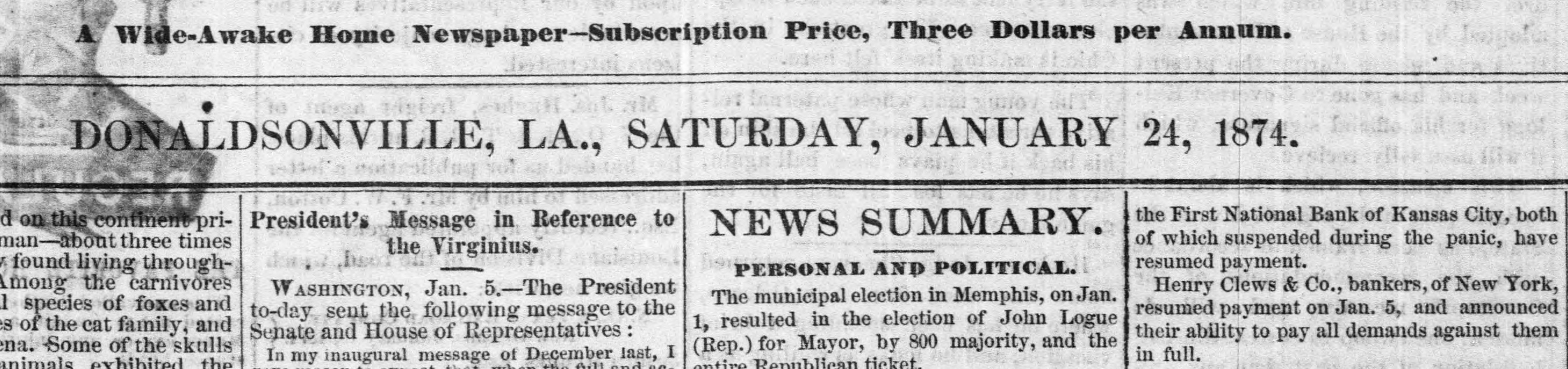
city treasury. SOUTH. The municipal election in Memphis, on Jan. 1. resulted in the election of John Logue (Rep.) for Mayor, by 800 majority, and the entire Republican ticket. The Texas Pacific Railroad was completed to Texarkana, the proposed junction with the Cairo and Fulton road, on Dec. 29, and it was announced that regular trains would commence running at once. The First National Bank of Memphis and the First National Bank of Kansas City, both of which suspended during the panic, have resumed payment. The Louisiana Legislature convened on Jan. 5. Gov. Kellogg in his message states that the total debt of the State is $24,283,336,


Article from The Donaldsonville Chief, January 24, 1874

Click image to open full size in new tab

Article Text

A Wide-Awake Home Newspaper-Subscription Price, Three Dollars per Annum. DONALDSONVILLE, LA., SATURDAY, JANUARY 24, 1874. the First National Bank of Kansas City, both d on this continent priPresident's Message in Reference to NEWS SUMMARY. man-about three times of which suspended during the panic, have the Virginius. resumed payment. V found living throughPERSONAL AND POLITICAL. Among the carnivores Henry Clews & Co., bankers, of New York, W ASHINGTON, Jan. 5.-The President The municipal election in Memphis, on Jan. 1 species of foxes and resumed payment on Jan. 5, and announced to-day. sent the following message to the 1, resulted in the election of John Logue S of the cat family, and Senate and House of Representatives: their ability to pay all demands against them ena. Some of the skulls (Rep.) for Mayor, by 800 majority, and the in full. In my inaugural message of December last, I animals exhibited the that when the fill and 00 antire Republican ticket.


Article from The Saline County Journal, January 21, 1875

Click image to open full size in new tab

Article Text

a his practically settled all question as the speedy re opening of the First On the 12th of December the through a committee consisting of Dively, Foster and Buttene, re to the call by the assurance that tie basis of bank the would resume increase of expital to $500,000 by the ing In $250,000 cash, thus relieving strengthening it, 80 that when onet it could push out again into active into and vigorous business. With this was submitted the report of Spee Bank Examiner Talmadge, who was here by the Comptroller of the Cur especially to examine int , the ex condition of the bank. Mr. Tal ége's report was indeed a marked opliment to the bank management, be fficially declared the assets more sufficient to pay all liabilities and its capital wholly unimpaired a happy New year present to the and country at large, the Bank, on 1st. 1874, flietally announced formal reopening of the Bank on the lowing Monday, the 5th. Every dol of the addi ional $250,000 had been oseribed, and with the approval and congratulations of Comptroller of John J. Knox, the Bank re business. The fifth of January was thus made a of general rejoičing throughout the and confidence once more freely commerce rapidly assumed its Mettled condition. On Friday, Janu 16th, 74, the First National publish first statement ur der the new or of 11 ings, a statement by the way spoke mest emphatically of the undertal vitality of the institution. total resources of $1 347.824 11. cash means were $232,164.17 and deposits $622 710 17. In addition to the bank had $280,000 asse N on representing the old surplus. have thus run over the bistory of panie as it particulary affected the National. thinking it most timely the opening of the new year. " more conclusively than could of compliment in general terms gallant manner in which the noble itution weathered the fearful gale wreeked many older ones. From day the First National re-opened, old success has Leen e en more than dicated. The trial by worse than through which it passed endeared than estranged friends as is un ivocally demonstrated by the follow statement of business done during : pasopaisn! year 500.000.00 Stock 00 000 18 Deposits for the year y deposit for the year 1408 Exchange amazingly large are these figures one has to read them over TWO or times to ed%prehend their extent, even then fails to realize to the The sum of forty-four millions hundred and twenty-one thousand hundred and seventy-two dollars nine cents in deposits, and of seven million eight hundred and twenty eighthundred and sixty dollars cohange. It is simply beyond the of words to convey a proper real of so vast a business. and We the figures of January 14. 1875, the announcement of January 1874, as to the resumption of busi leaving it to the public to decide whether or not every pledge then has been fulfilled to the very letconclusion we have to say that there never was a banker to whom any community ever felt kindly and warmly than the peoKansas City do towards Mr. How. Holden. hile from his exten business connection he has in the nature of things been brought in to men and measures that have created jentonsies and hard yet we feel safe in saying that in his position could have made triends and fewer enemies than he


Article from Kansas City Journal, February 1, 1925

Click image to open full size in new tab

Article Text

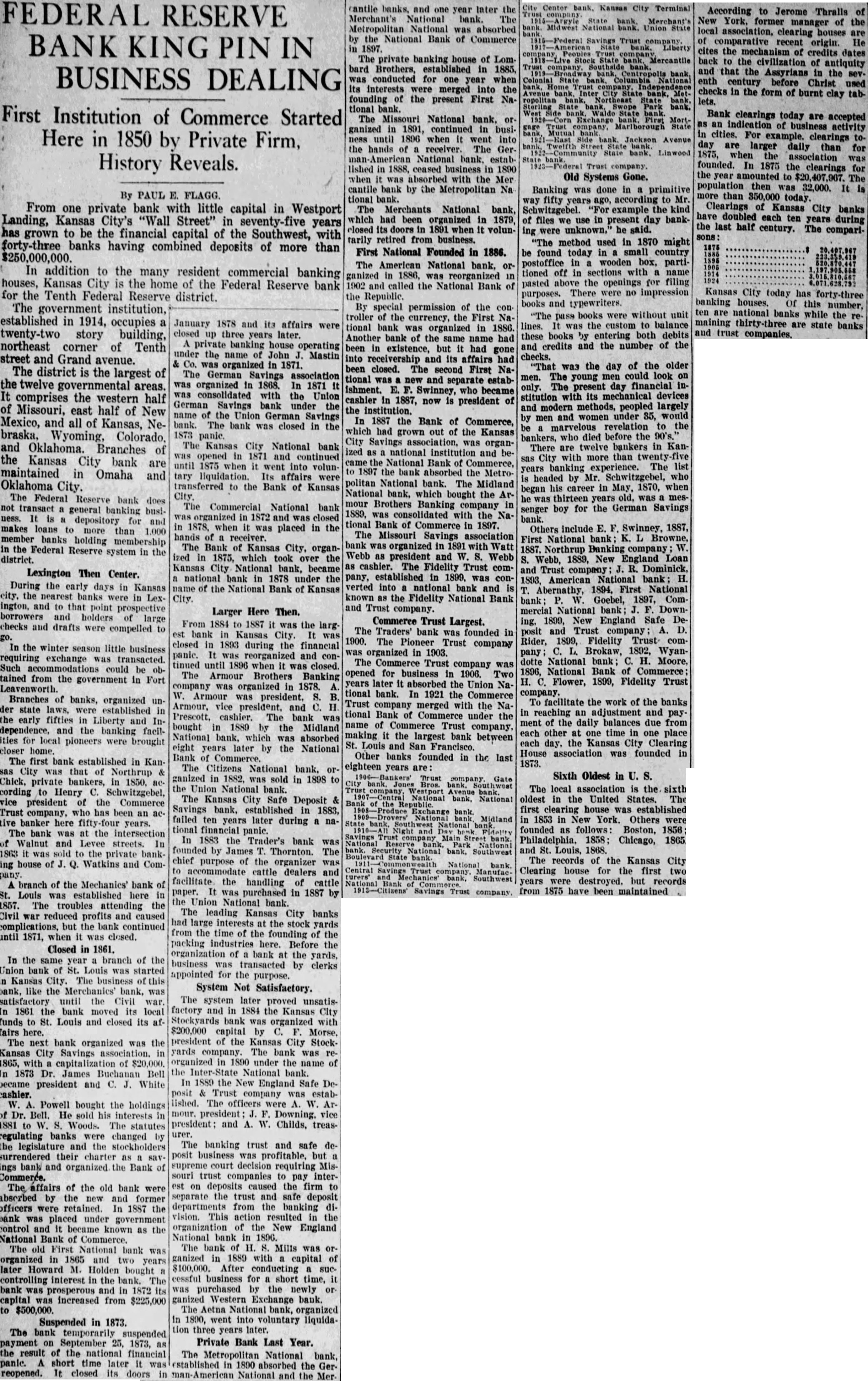
cantile banks. and one year later the FEDERAL RESERVE Merchant's National bank. The Metropolitan National was absorbed by the National Bank of Commerce BANK KING PIN IN in 1897. The private banking house of Lombard Brothers, established in 1885, BUSINESS DEALING was conducted for one year when its interests were merged into the tional bank. First Institution of Commerce Started The Missouri National bank. organized in 1891, continued in busiHere in 1850 by Private Firm, ness until 1896 when it went into the hands of a receiver. The German- American National bank, estabHistory Reveals. lished in 1888, ceased business in 1890 By PAUL E. FLAGG. tional bank. From one private bank with little capital in Westport The Merchants National bank, Landing, Kansas City's "Wall Street" in seventy-five years which had been organized in 1879, closed its doors in 1891 when it volunhas grown to be the financial capital of the Southwest, with tarily retired from business. forty-three banks having combined deposits of more than First National Founded in 1886. $250,000,000. The American National bank, or In addition to the many resident commercial banking ganized in 1886, was reorganized in houses, Kansas City is the home of the Federal Reserve bank 1902 and called the National Bank of for the Tenth Federal Reserve district. the Republic. The government institution, By special permission of the con- established in 1914, occupies a twenty-two story building, northeast corner of Tenth street and Grand avenue. The district is the largest of the twelve governmental areas. It comprises the western half of Missouri, east half of New Mexico, and all of Kansas, Nebraska. Wyoming, Colorado. and Oklahoma. Branches of the Kansas City bank are maintained in Omaha and Oklahoma City. The Federal Reserve bank does not transact a general banking business. It is a depository for and makes loans to more than 1.000 member banks holding membership in the Federal Reserve system in the district. Lexington Then Center. During the early days in Kansas city, the nearest banks were in Lexington, and to that point prospective borrowers and holders of large checks and drafts were compelled to go. In the winter season little business requiring exchange was transacted. Such accommodations could be obtained from the government in Fort Leavenworth. Branches of banks, organized under state laws, were established in the early fifties in Liberty and Independence, and the banking facilities for local pioneers were brought closer home. The first bank established in Kansas City was that of Northrup & Chick, private bankers, in 1850. according to Henry C. Schwitzgebel, vice president of the Commerce Trust company, who has been an active banker here fifty-four years. The bank was at the intersection of Walnut and Levee streets. In 1863 it was sold to the private banking house of J. Q. Watkins and Company. A branch of the Mechanics' bank of St. Louis was established here in 1857. The troubles attending the Civil war reduced profits and caused complications, but the bank continued until 1871, when it was closed. Closed in 1861. In the same year a branch of the Union bank of St. Louis was started in Kansas City. The business of this bank, like the Merchanics' bank, was satisfactory until the Civil war. In 1861 the bank moved its local funds to St. Louis and closed its affairs here. The next bank organized was the Kansas City Savings association. in 1865, with capitalization of $20,000. In 1873 Dr. James Buchanan Bell became president and C. J. White cashier. W. A. Powell bought the holdings of Dr. Bell. He sold his interests in 1881 to W. S. Woods. The statutes regulating banks were changed by the legislature and the stockholders surrendered their charter as a savings bank and organized the Bank of Commerce. The affairs of the old bank were abscrbed by the new and former officers were retained. In 1887 the bank was placed under government control and it became known as the National Bank of Commerce. The old First National bank was organized in 1865 and two years later Howard M. Holden bought a controlling interest in the bank. The bank was prosperous and in 1872 its capital was increased from $225,000 to $500,000. Suspended in 1873. The bank temporarily suspended payment on September 25. 1873, as the result of the national financial panic. A short time later it was reopened. It closed its doors January 1878 and its affairs were closed up three years later. A private banking house operating under the name of John J. Mastin & Co. was organized in 1871. The German Savings association was organized in 1868. In 1871 it was consolidated with the Union German Savings bank under the name of the Union German Savings bank. The bank was closed in the 1873 The Kansas City National bank was opened in 1871 and continued until 1875 when it went into voluntary liquidation. Its affairs were transferred to the Bank of Kansas The Commercial National bank was organized in 1872 and was closed in 1878, when it was placed in the hands of a receiver. The Bank of Kansas City, organized in 1875, which took over the Kansas City National bank, became a national bank in 1878 under the name of the National Bank of Kansas City. Larger Here Then. From 1884 to 1887 it was the largest bank in Kansas City. It was closed in 1893 during the financial panic. It was reorganized and continued until 1896 when it was closed. The Armour Brothers Banking company was organized in 1878. A. W. Armour was president, S. B. Armour, vice president, and C. H. Prescott, cashier. The bank was bought in 1889 by the Midland National bank, which was absorbed eight years later by the National Bank of Commerce. The Citizens National bank. organized in 1882. was sold in 1898 to the Union National bank. The Kansas City Safe Deposit & Savings bank, established in 1883, failed ten years later during a national financial panic. In 1883 the Trader's bank was founded by James T. Thornton. The chief purpose of the organizer was to accommodate cattle dealers and facilitate the handling of cattle paper. It was purchased in 1887 by the Union National bank. The leading Kansas City banks had large interests at the stock yards from the time of the founding of the packing industries here. Before the organization of a bank at the yards, business was transacted by clerks appointed for the purpose. System Not Satisfactory. The system later proved unsatisfactory and in 1884 the Kansas City Stockyards bank was organized with $200,000 capital by C. F. Morse. president of the Kansas City Stockyards company. The bank was reorganized in 1890 under the name of the Inter-State National bank. In 1889 the New England Safe Deposit & Trust company was established. The officers were A. W. Armour. president; J. F. Downing, vice president: and A. W. Childs, treasurer. The banking trust and safe deposit business was profitable. but a supreme court decision requiring Missouri trust companies to pay interest on deposits caused the firm to separate the trust and safe deposit departments from the banking division. This action resulted in the organization of the New England National bank in 1896. The bank of H. S. Mills was organized in 1889 with a capital of $100,000. After conducting successful business for a short time, it was purchased by the newly or ganized Western Exchange bank. The Aetna National bank, organized in 1890, went into voluntary liquidation three years later. Private Bank Last Year. The Metropolitan National bank, established in 1890 absorbed the Gerin man-American National and the Mer- founding of the present First Nawhen it was absorbed with the Mer cantile bank by the Metropolitan Na troller of the currency, the First National bank was organized in 1886. Another bank of the same name had been in existence, but it had gone into receivership and its affairs had been closed. The second First National was new and separate estabishment. E. F. Swinney, who became cashier in 1887, now is president of the institution. In 1887 the Bank of Commerce, which had grown out of the Kansas City Savings association, was organized as a national institution and became the National Bank of Commerce, to 1897 the bank absorbed the Metropolitan National bank. The Midland National bank, which bought the Armour Brothers Banking company in 1889, was consolidated with the National Bank of Commerce in 1897. The Missouri Savings association bank was organized in 1891 with Watt Webb as president and W. S. Webb as cashier. The Fidelity Trust company, established in 1899, was converted into a national bank and is known as the Fidelity National Bank and Trust company. Commerce Trust Largest. The Traders' bank was founded in 1900. The Pioneer Trust company was organized in 1903. The Commerce Trust company was opened for business in 1906. Two years later it absorbed the Union National bank. In 1921 the Commerce Trust company merged with the National Bank of Commerce under the name of Commerce Trust company, making it the largest bank between St. Louis and San Francisco. Other banks founded in the last eighteen years are: Trust company Gate City bank, Jones Bros. bank. Trust company, Westport Avenue bank. Bank National bank, National the Produce Exchange bank. -Drovers' National bank Midland State bank, National bank Savings Trust company Main Street bank National Reserve bank, Park National bank. Security National bank, Southwest Boulevard State bank. National bank. Central Savings Trust ManufacNational and Bank Mechanics' bank, Southwest 1913-Citizens' Savings Trust company. City Center bank, Kansas City Terminal Trust company State bank. Merchant's bank. Midwest National bank, Union State Savings Trust company. American State bank. Liberty Peoples Stock Trust State bank. Mercantile Trust company, Southside bank, bank. Colonial State bank. Columbia Centropolis National bank, bank, Home Trust Independence Avenue bank. Inter City State bank, Metropolitan State bank, Northeast Swope State Park bank, bank, Waldo 1920-Corn Side Exchange bank. State First Mortsage Trust Mutual company, Marlborough State bank 1921-East Side bank. Jackson Avenue State Twelfth -Community Street State bank, bank. Linwood 1923-Federal bank Trust company. Old Systems Gone. Banking was done in a primitive way fifty years ago, according to Mr. Schwitzgebel. "For example the kind of files we use in present day banking were unknown, he said. "The method used in 1870 might be found today in small country postoffice in wooden box, partitioned off in sections with a name pasted above the openings for filing purposes. There were no impression books and typewriters. "The pass books were without unit lines. It was the custom to balance these books by entering both debits and credits and the number of the checks. "That was the day of the older men. The young men could look on only. The present day financial institution with its mechanical devices and modern methods, peopled largely by men and women under 85, would be marvelous revelation to the bankers, who died before the 90's. There are twelve bankers in Kansas City with more than twenty-f years banking experience. The list is headed by Mr. Schwitzgebel, who began his career in May, 1870, when he was thirteen years old, was a messenger boy for the German Savings bank. Others include E. F. Swinney, 1887, First National bank; K. L Browne, 1887, Northrup Banking company W. S. Webb, 1889, New England Loan and Trust company J. R. Dominick, 1893, American National bank: H. T. Abernathy, 1894, First National bank; W. Goebel, 1897, Commercial National bank; J. F. Downing. 1899, New England Safe Deposit and Trust company A. D. Rider, 1899, Fidelity Trust company; C. L. Brokaw, 1892, Wyandotte National bank; C. H. Moore, 1896, National Bank of Commerce: H. C. Flower, 1899, Fidelity Trust company. To facilitate the work of the banks in reaching an adjustment and payment of the daily balances due from each other at one time in one place each day. the Kansas City Clearing House association was founded in 1873. Sixth Oldest in U. S. The local association is the sixth oldest in the United States. The first clearing house was established in 1853 in New York. Others were founded as follows: Boston, 1856: Philadelphia. 1858; Chicago, 1865. and St. Louis, 1868. The records of the Kansas City Clearing house for the first two years destroyed. but records from 1875 have been maintained According to Jerome Thralls of New York, former manager of the local association, clearing houses are of comparative recent origin. He cites the mechanism of credits dates back to the civilization of antiquity and that the Assyrians in the seventh century before Christ used checks in the form of burnt clay tablets. Bank clearings today are accepted as an indication of business activity in cities. For example. clearings today are larger daily than for 1875, when the association was founded. In 1875 the clearings for the year amounted to 0,407,967. The population then was 32,000. It is more than 350,000 today. Clearings of Kansas City banks have doubled each ten years during the last half century. The comparisons: 1924 Kansas City today has forty-three banking houses. Of this number, ten are national banks while the remaining thirty-three are state banks and trust companies.