Iowa Savings Bank (Hartley, IA)

Episode Information

Episode UID
1663249691434
Episode Type
Suspension โ†’ Closure
Bank Type
savings
Bank ID
166324969 hash
Start Date
June 27, 1919
Location
Hartley, Iowa (43.180, -95.477)

Metadata

Model
gpt-5-mini (chosen from majority vote of a three-model LLM ensemble)
Short Digest
6cc548a23c5a59bc

Response Measures

None

Description

Cashier/vice president drowned shortly before closure; inspectors cite unwise investments.

Events (3)

1. June 27, 1919 Suspension
Cause
Bank Specific Adverse Info
Cause Details
Inspectors reported unwise investments and 'tangled conditions' in the institution.
Newspaper Excerpt
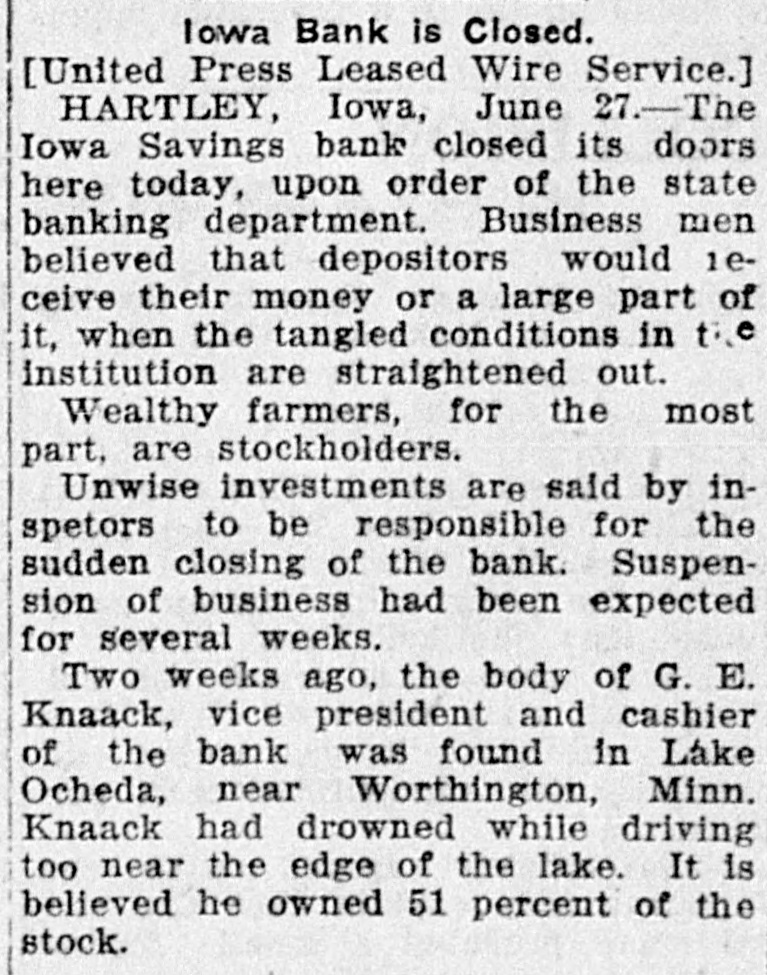
The Iowa Savings bank closed its doors here today, upon order of the state banking department.
Source
newspapers
2. June 30, 1919 Receivership
Newspaper Excerpt
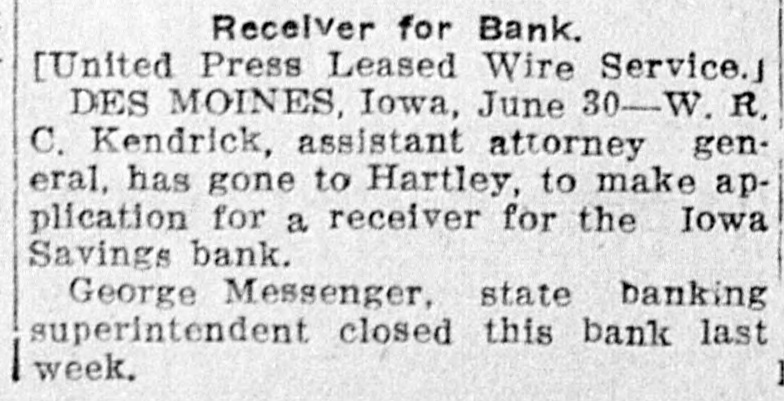
W. R. C. Kendrick, assistant attorney general, has gone to Hartley, to make application for a receiver for the Iowa Savings bank.
Source
newspapers
3. July 19, 1919 Other
Newspaper Excerpt
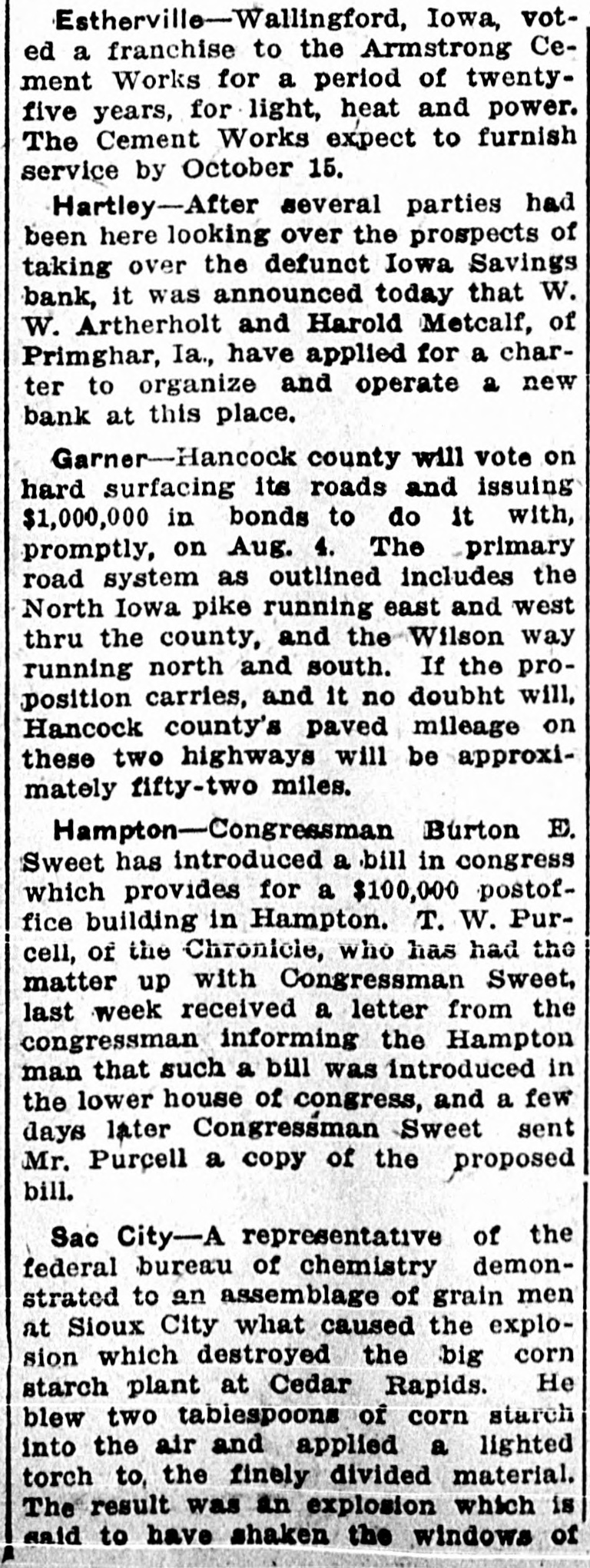
Several parties had been here looking over the prospects of taking over the defunct Iowa Savings bank; applicants have applied for a charter to organize and operate a new bank at this place.
Source
newspapers

Newspaper Articles (3)

Article from The Daily Gate City and Constitution-Democrat, June 27, 1919

Click image to open full size in new tab

Article Text

Iowa Bank is Closed. [United Press Leased Wire Service.] HARTLEY, Iowa, June 27.-The Iowa Savings bank closed its doors here today, upon order of the state banking department. Business men believed that depositors would 1eceive their money or a large part of it, when the tangled conditions in tie institution are straightened out. Wealthy farmers, for the most part, are stockholders. Unwise investments are said by inspetors to be responsible for the sudden closing of the bank. Suspension of business had been expected for several weeks. Two weeks ago, the body of G. E. Knaack, vice president and cashier of the bank was found in Lake Ocheda, near Worthington, Minn. Knaack had drowned while driving too near the edge of the lake. It is believed he owned 51 percent of the stock.


Article from The Daily Gate City and Constitution-Democrat, June 30, 1919

Click image to open full size in new tab

Article Text

Receiver for Bank. [United Press Leased Wire Service.] DES MOINES, Iowa, June 30-W. R, C. Kendrick, assistant attorney general, has gone to Hartley, to make application for a receiver for the Iowa Savings bank. George Messenger, state banking superintendent closed this bank last week.


Article from Evening Times-Republican, July 19, 1919

Click image to open full size in new tab

Article Text

Estherville-Wallingford, Iowa, voted a franchise to the Armstrong Cement Works for a period of twentyfive years, for light, heat and power. The Cement Works expect to furnish service by October 15. Hartley-After several parties had been here looking over the prospects of taking over the defunct Iowa Savings bank, it was announced today that W. W. Artherholt and Harold Metcalf, of Primghar, Ia., have applied for a charter to organize and operate a new bank at this place. Garner-Hancock county will vote on hard surfacing its roads and issuing $1,000,000 in bonds to do it with, promptly, on Aug. 4. The primary road system as outlined includes the North Iowa pike running east and west thru the county, and the Wilson way running north and south. If the proposition carries, and it no doubht will, Hancock county's paved mileage on these two highways will be approximately fifty-two miles. Hampton-Congressman Burton E. Sweet has introduced a bill in congress which provides for a $100,000 postoffice building in Hampton. T. W. Purcell, of the Chronicle, who has had the matter up with Congressman Sweet, last week received a letter from the congressman informing the Hampton man that such a bill was introduced in the lower house of congress, and a few days later Congressman Sweet sent Mr. Purcell a copy of the proposed bill. Sac City-A representative of the federal bureau of chemistry demonstrated to an assemblage of grain men at Sioux City what caused the explosion which destroyed the big corn starch plant at Cedar Rapids. He blew two tablespoons of corn starch into the air and applied a lighted torch to, the finely divided material. The result was an explosion which is said to have shaken the windows of