The bank suspended on May 14, 1884, following a run triggered by the failure of Grant & Ward and rumors about President Seney; it resumed business on May 15-17, 1884.
Events (4)
1.May 14, 1884Run
Cause
Bank Specific Adverse Info
Cause Details
Attacks on and rumors regarding the speculative railroad and real estate interests of the bank's president, George I. Seney.
Measures
The paying teller shut his window and the bank suspended payment as a matter of necessity and precaution.
Newspaper Excerpt
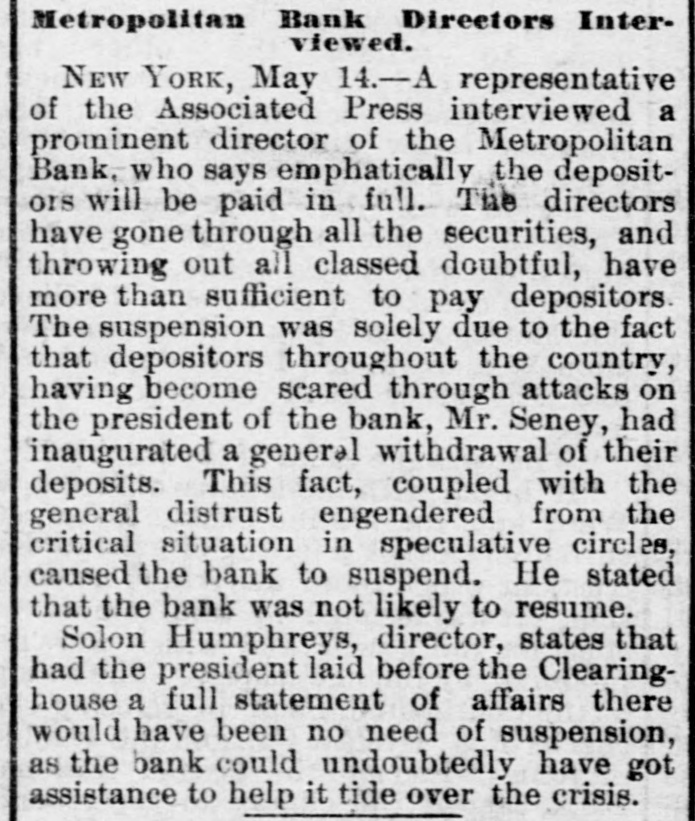
The suspension was solely due to the fact that depositors throughout the country, having become scared through attacks on the president of the bank, Mr. Seney, had inaugurated a general withdrawal of their deposits.
Source
newspapers
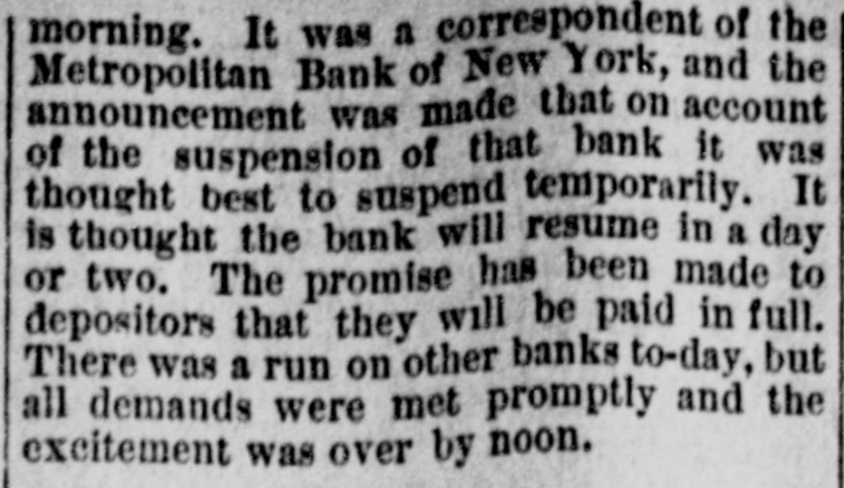
same day
2.May 14, 1884Suspension
Cause
Bank Specific Adverse Info
Cause Details
Heavy withdrawals by depositors following the failure of Grant & Ward and rumors about President Seney's solvency.
Newspaper Excerpt
the paying teller shut his window with a bang and announced that the Metropolitan bank had suspended payment as a matter of necessity and precaution.
Source
newspapers
+1 day
3.May 15, 1884Reopening
Newspaper Excerpt
At noon yesterday the Metropolitan bank resumed payment and thereby produced a very favorable impression on business.
Source
newspapers
+1 day
4.May 16, 1884Other
Newspaper Excerpt
President Seney, of the Metropolitan bank, has resigned, it is understood, upon the advice of the investigating committee of the clearing house
Source
newspapers
Newspaper Articles (24)
1.May 15, 1884Savannah Morning NewsSavannah, GA
Click image to open full size in new tab
Article Text
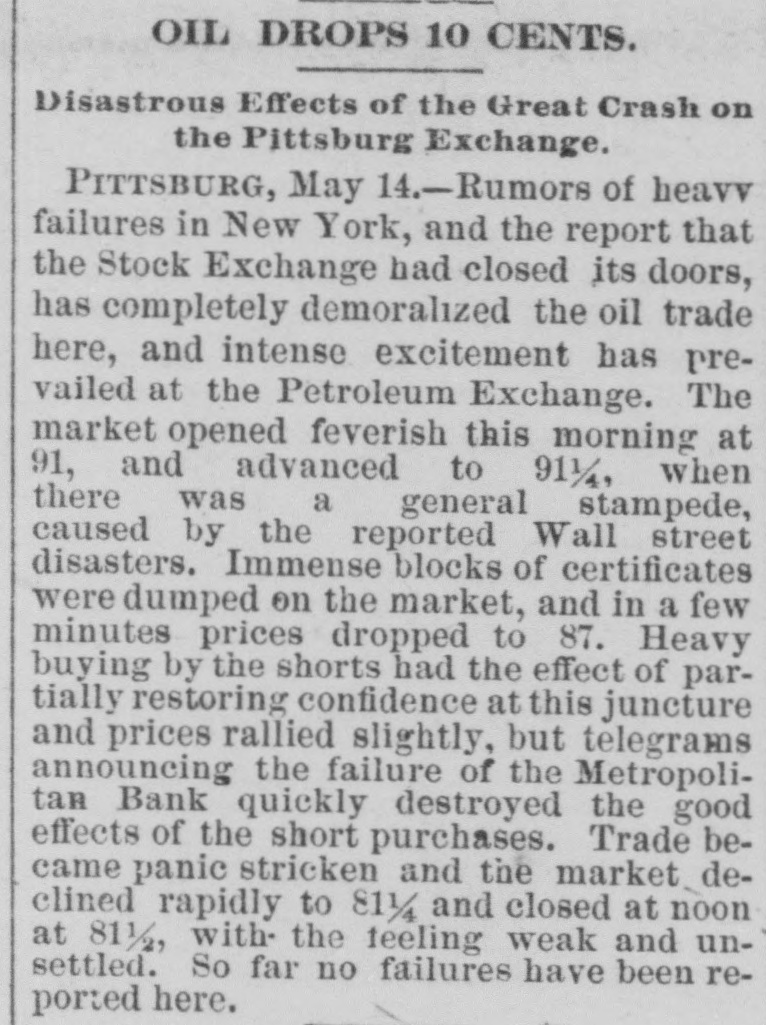
OIL DROPS 10 CENTS
Disastrous Effects of the Great Crash on the Pittsburg Exchange. PITTSBURG, May -Rumors of heavy failures in New York, and the report that the Stock Exchange had closed its doors, has completely demoralized the oil trade here, and intense excitement has prevailed at the Petroleum Exchange. The market opened feverish this morning at 91, and advanced to 911/4, when there was a general stampede, caused by the reported Wall street disasters. Immense blocks of certificates were dumped on the market, and in a few minutes prices dropped to 87. Heavy buying by the shorts had the effect of partially restoring confidence at this juncture and prices rallied slightly, but telegrams announcing the failure of the Metropolitan Bank quickly destroyed the good effects of the short purchases. Trade became panic stricken and the market declined rapidly to 811/4 and closed at noon at 811/2, with- the feeling weak and unsettled. So far no failures have been reported here.
NEW YORK, May 14.-A representative of the Associated Press interviewed a prominent director of the Metropolitan Bank, who says emphatically the depositors will be paid in full. The directors have gone through all the securities, and throwing out all classed doubtful, have more than sufficient to pay depositors. The suspension was solely due to the fact that depositors throughout the country, having become scared through attacks on the president of the bank, Mr. Seney, had inaugurated a general withdrawal of their deposits. This fact, coupled with the general distrust engendered from the critical situation in speculative circles, caused the bank to suspend. He stated that the bank was not likely to resume. Solon Humphreys, director, states that had the president laid before the Clearinghouse a full statement of affairs there would have been no need of suspension, as the bank could undoubtedly have got assistance to help it tide over the crisis.
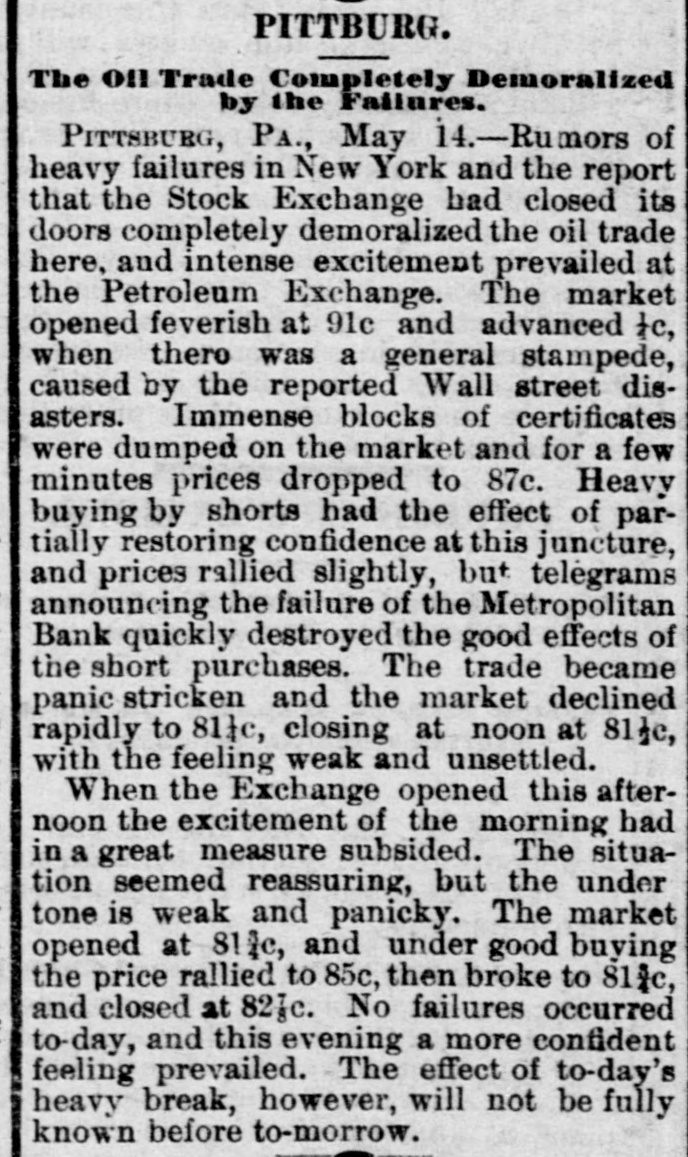
The on Trade Completely Demoralized by the Failures. PITTSBURG, PA., May 14.-Rumors of heavy failures in New York and the report that the Stock Exchange had closed its doors completely demoralized the oil trade here, and intense excitement prevailed at the Petroleum Exchange. The market opened feverish at 91c and advanced tc, when there was a general stampede, caused by the reported Wall street disasters. Immense blocks of certificates were dumped on the market and for a few minutes prices dropped to 87c. Heavy buying by shorts had the effect of partially restoring confidence at this juncture, and prices rallied slightly, but telégrams announcing the failure of the Metropolitan Bank quickly destroyed the good effects of the short purchases. The trade became panic stricken and the market declined rapidly to 811c, closing at noon at 81 1c, with the feeling weak and unsettled. When the Exchange opened this afternoon the excitement of the morning had in a great measure subsided. The situation seemed reassuring, but the under tone is weak and panicky. The market opened at 814c, and under good buying the price rallied to 85c, then broke to 811c, and closed at 821c. No failures occurred to-day, and this evening a more confident feeling prevailed. The effect of to-day's heavy break, however, will not be fully known before to-morrow.
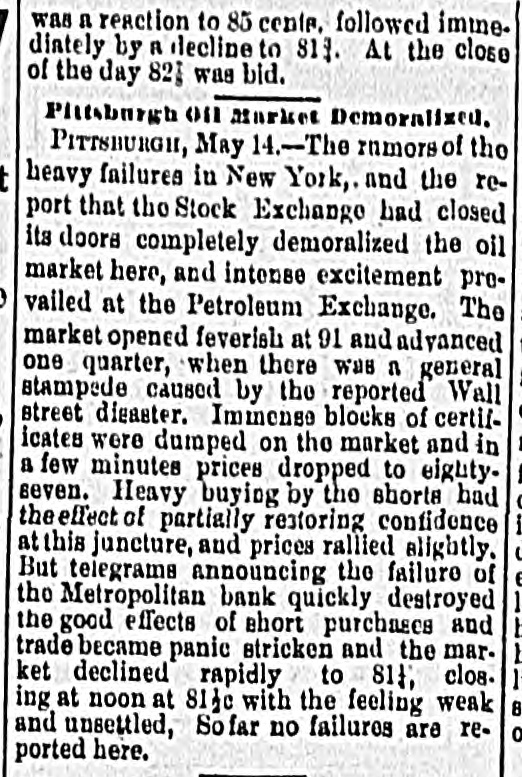
was a reaction to 85 cente. followed imme. diately by R decline to 813. At the close of the day 82g was bid. Pittsburgh on Market Demoralized. PITTSBURGH, May 14.-The rumors of the heavy failures in New York,. and the report that the Stock Exchange had closed its doors completely demoralized the oil market here, and intense excitement provailed at the Petroleum Exchange. The market opened feverish at 91 and advanced one quarter, when there was n general stampede caused by the reported Wall street dieaster. Immense blocks of certificates were dumped on the market and in a few minutes prices dropped to eighty. seven. Heavy buying by the shorts had the effect of partially restoring confidence at this juncture, and prices rallied alightly. But telegrams announcing the failure of the Metropolitan bank quickly destroyed the good effects of ehort purchases and trade became panic stricken and the mar. ket declined rapidly to 81}; clos. ing at noon at 811c with the feeling weak and unsettled, Sofar no failures are reported here.
5.May 15, 1884St. Paul Daily GlobeSaint Paul, MN
Click image to open full size in new tab
Article Text
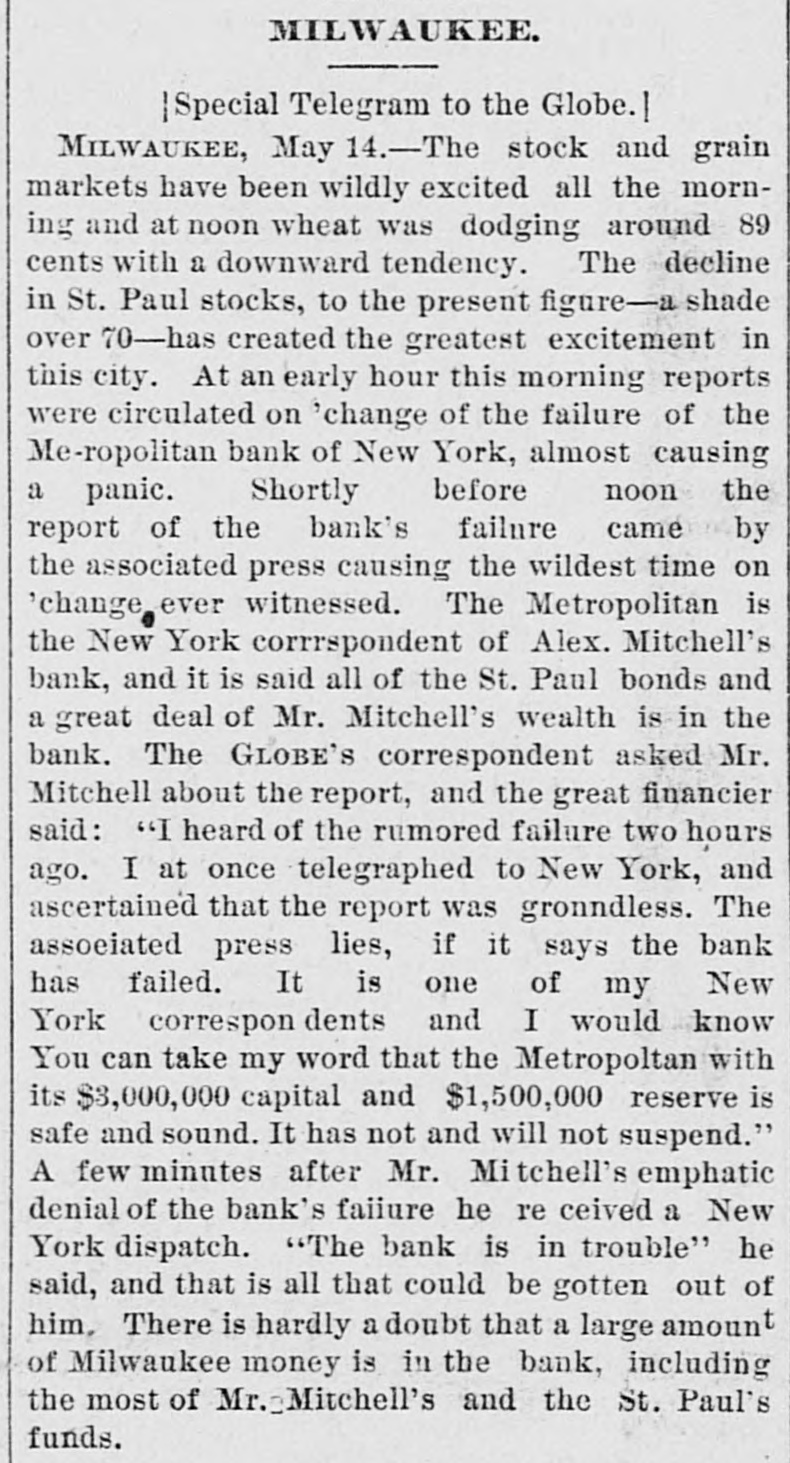
MILWAUKEE
Special Telegram to the Globe. I MILWAUKEE, May 14.-The stock and grain markets have been wildly excited all the morning and at noon wheat was dodging around 89 cents with a downward tendency. The decline in St. Paul stocks, to the present figure-a shade over 70-has created the greatest excitement in this city. At an early hour this morning reports were circulated on 'change of the failure of the Me-ropolitan bank of New York, almost causing before noon the a panic. Shortly report of the bank's failure came by the associated press causing the wildest time on 'change ever witnessed. The Metropolitan is the New York corrrspondent of Alex. Mitchell's bank, and it is said all of the St. Paul bonds and a great deal of Mr. Mitchell's wealth is in the bank. The GLOBE'S correspondent asked Mr. Mitchell about the report, and the great financier said: "I heard of the rumored failure two hours ago. I at once telegraphed to New York, and ascertained that the report was groundless. The associated press lies, if it says the bank has failed. It is one of my New York correspon dents and I would know You can take my word that the Metropoltan with its $3,000,000 capital and $1,500,000 reserve is safe and sound. It has not and will not suspend." A few minutes after Mr. Mitchell's emphatic denial of the bank's failure he re ceived a New York dispatch. "The bank is in trouble" he said, and that is all that could be gotten out of him. There is hardly a doubt that a large amount of Milwaukee money is in the bank, including the most of Mr. Mitchell's and the St. Paul's funds.
6.May 15, 1884The Indianapolis JournalIndianapolis, IN
Click image to open full size in new tab
Article Text
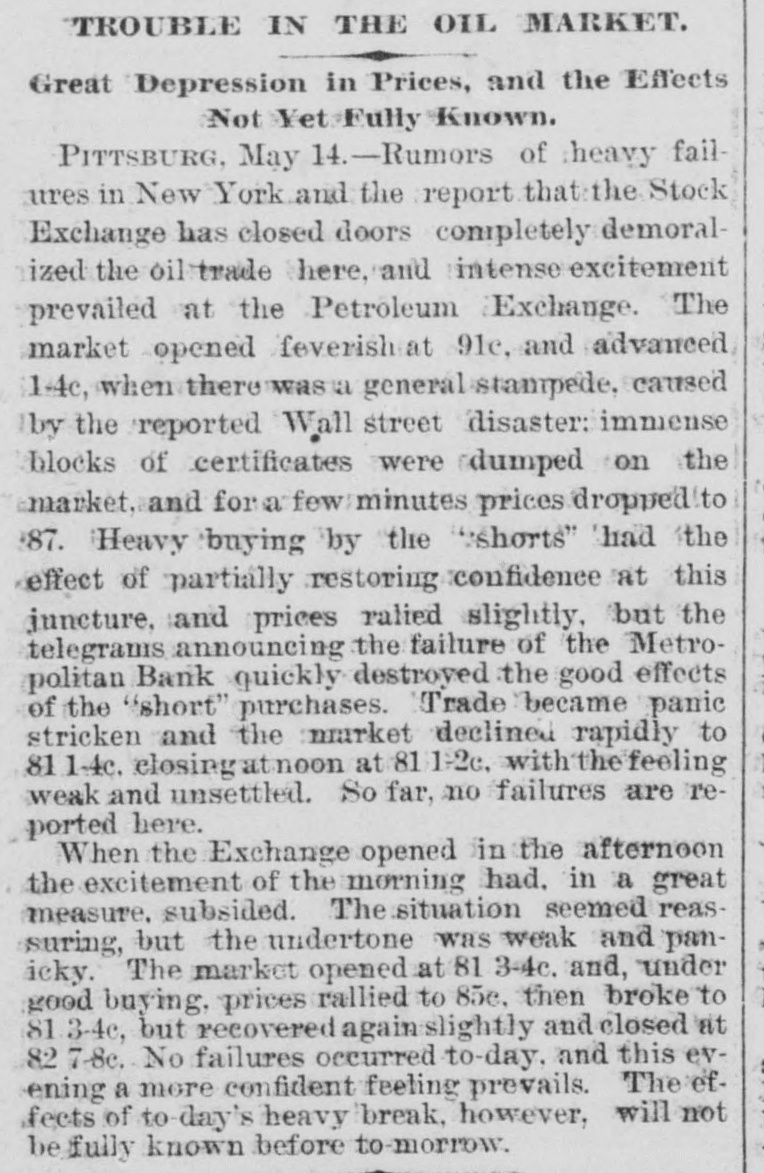
TROUBLE IN THE OIL MARKET
Great Depression in Prices, and the Effects Not Yet Fully Known. PITTSBURG, May 14.-Rumors of heavy failures in New York and the report that:the Stock Exchange has closed doors completely demoralized the oil trade here, and intense excitement prevailed at the Petroleum Exchange. The market opened feverish at 91c, and advanced 1-4c, when there was a general stampede, caused by the reported Wall street disaster: immense blocks of certificates were dumped on the market, and for a few minutes prices dropped to 87. Heavy buying by the "shorts" had the effect of partially restoring confidence at this juncture, and prices ralied slightly, but the telegrams announcing the failure of the Metropolitan Bank quickly destroyed the good effects of the "short" purchases. Trade became panic stricken and the nurket declined rapidly to 81 1-4c. closing at noon at 81/1-2c, with the feeling weak and unsettled. So far, no failures are reported here. When the Exchange opened in the afternoon the excitement of the morning had. in a great measure. subsided. The situation seemed reassuring, but the undertone was weak and panicky. The market opened at 81 3-4c. and, under good buying, prices rallied to 85e, then broke to 81 3-4c, but recovered again slightly and closed at 82 7-8c. No failures occurred to-day, and this evening a more confident feeling prevails. The effects of to-day's heavy break, however, will not be fully known before to-morrow.
7.May 15, 1884Weekly Chillicothe CrisisChillicothe, MO
Click image to open full size in new tab
Article Text
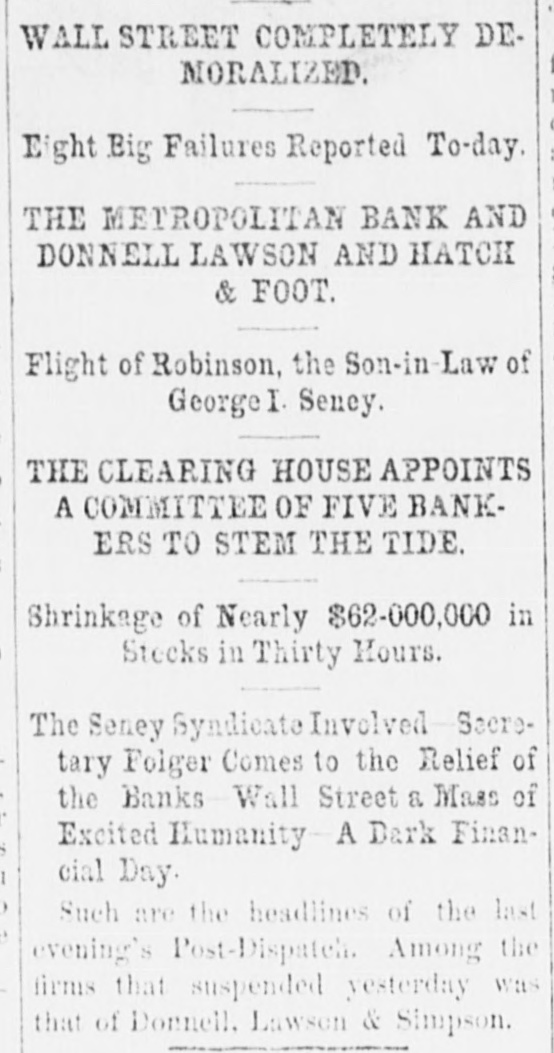
WALL STREET COMPLETELY DEMORALIZED
Eight Big Failures Reported To-day. THE METROPOLITAN BANK AND DONNELL LAWSON AND HATCH & FOOT. Flight of Robinson, the Son-in-Law of George I. Seney. THE CLEARING HOUSE APPOINTS A COMMITTEE OF FIVE BANKERS TO STEM THE TIDE. Shrinkage of Nearly $62-000,000 in Stocks in Thirty Hours. The Seney Syndicate Involved Secretary Folger Comes to the Relief of the Banks Wall Street & Mass of Excited Humanity - A Dark Financial Day. Such are the headlines of the last evening's Post-Disputch Among the firms that suspended yesterday was that of Donnell. Lawsen & Simpson.
8.May 15, 1884The Rock Island ArgusRock Island, IL
Click image to open full size in new tab
Article Text
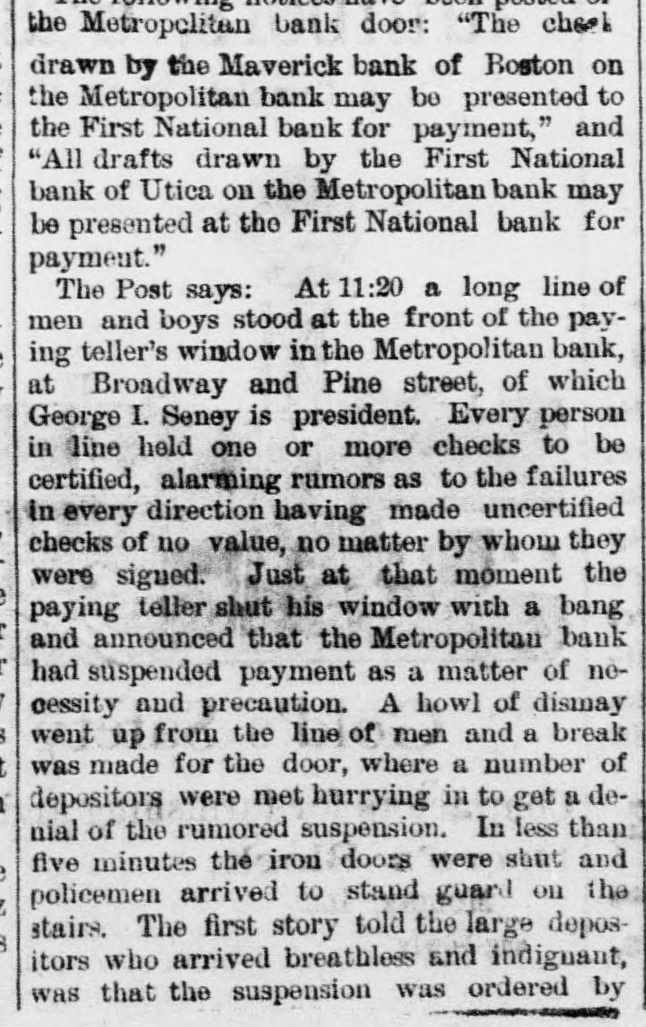
the Metropclitan bank door: "The cheel drawn by the Maverick bank of Boston on the Metropolitan bank may be presented to the First National bank for payment," and "All drafts drawn by the First National bank of Utica on the Metropolitan bank may be presented at the First National bank for payment."
The Post says: At 11:20 a long line of men and boys stood at the front of the pay- ing teller's window in the Metropolitan bank, at Broadway and Pine street, of which George I. Seney is president. Every person in line held one or more checks to be certified, alarming rumors as to the failures in every direction having made uncertified checks of no value, no matter by whom they were signed. Just at that moment the paying teller shut his window with a bang and announced that the Metropolitan bank had suspended payment as a matter of ne- cessity and precaution. A howl of dismay went up from the line of men and a break was made for the door, where a number of depositors were met hurrying in to get a de- nial of the rumored suspension. In less than five minutes the iron doors were shut and policemen arrived to stand guard on the stairs. The first story told the large depos- itors who arrived breathless and indignant, was that the suspension was ordered by
9.May 15, 1884Savannah Morning NewsSavannah, GA
Click image to open full size in new tab
Article Text
MARKETS BY TELEGRAPH
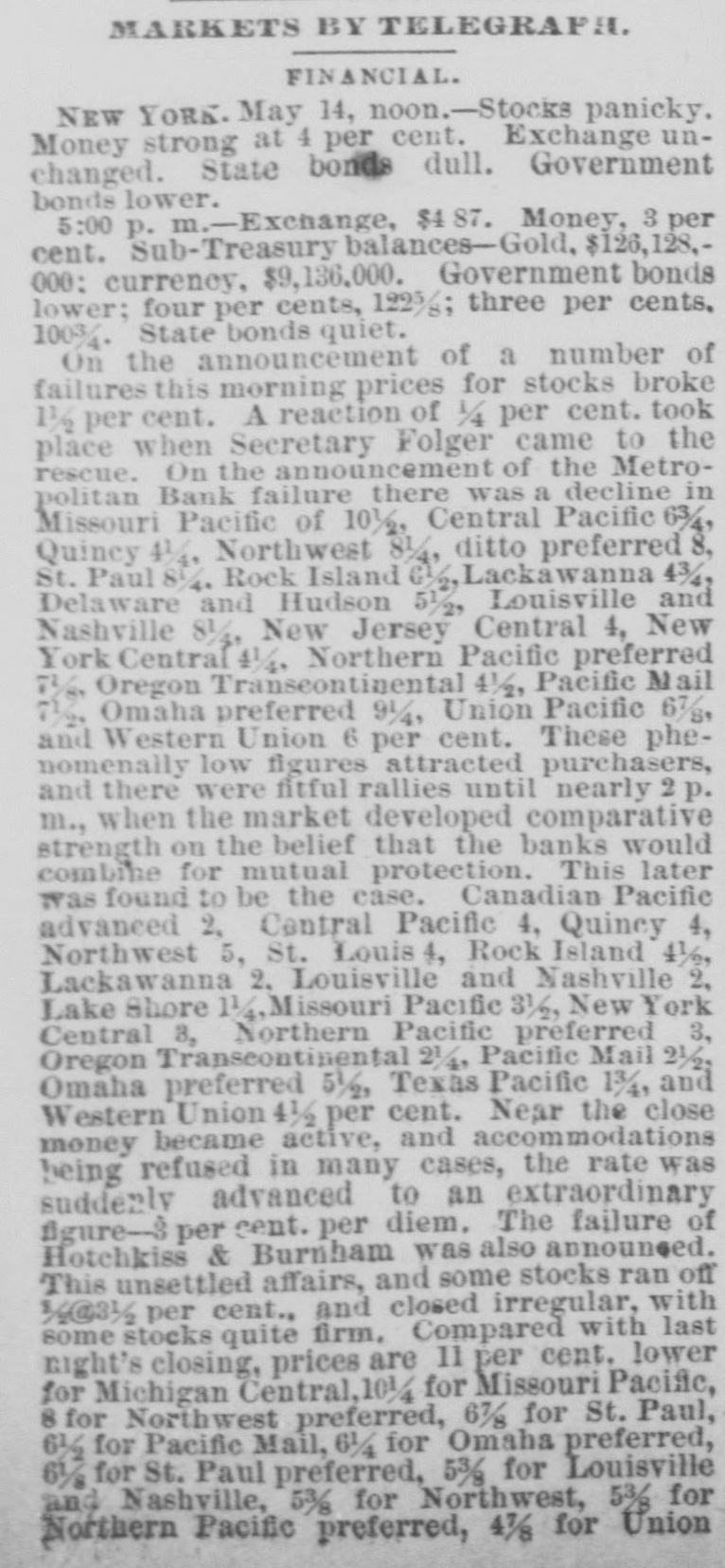
FINANCIAL. NEW YORK. May 14, noon.-Stocks panicky. Money strong at 4 per cent. Exchange unchanged. State bonds dull. Government bonds lower. 5:00 p. m.-Exchange, $487. Money, 3 per cent. Sub-Treasury balances-Gold, $126,128,000: currency, $9,136,000. Government bonds lower; four per cents, 122%; three per cents. 1003/4. State bonds quiet. On the announcement of a number of failures this morning prices for stocks broke 1½ per cent. A reaction of 1/4 per cent. took place when Secretary Folger came to the rescue. On the announcement of the Metropolitan Bank failure there was a decline in Missouri Pacific of 10½, Central Pacific 63/4, Quincy 414, Northwest 8½ ditto preferred 8, St. Paul 8½ Rock Island 6½, Lackawanna 43/4, Delaware and Hudson 51/29 Louisville and Nashville 8½ New Jersey Central 4, New York Central 41/4, Northern Pacific preferred 71/8, Oregon Transeontinental 4½ Pacific Mail 7½ Omaha preferred 91/4, Union Pacific 67/8, and Western Union 6 per cent. These phenomenally low figures attracted purchasers, and there were fitful rallies until nearly 2 p. m., when the market developed comparative strength on the belief that the banks would combine for mutual protection. This later was found to be the case. Canadian Pacific advanced 2, Central Pacific 4, Quincy 4, Northwest 5, St. Louis 4, Rock Island 41/2, Lackawanna 2. Louisville and Nashville 2, Lake Shore 11/4, Missouri Pacific 3½ New York Central 3, Northern Pacific preferred 3, Oregon Transcontinental 21/4, Pacific Mail 21/22 Omaha preferred 5½ Texas Pacific 13/4, and Western Union 4½ per cent. Near the close money became active, and accommodations being refused in many cases, the rate was suddenly advanced to an extraordinary figure-3 per cent. per diem, The failure of Hotchkiss & Burnham was also announced. This unsettled affairs, and some stocks ran off 1/2@3½ per cent., and closed irregular, with some stocks quite firm, Compared with last night's closing, prices are 11 per cent. lower for Michigan Central, for Missouri Pacific, 8 for Northwest preferred, 67/8 for St. Paul, 6½ for Pacific Mail, 6½ for Omaha preferred, 6½ for St. Paul preferred, 53/g for Louisville and Nashville, 53/8 for Northwest, 53/8 for Northern Pacific preferred, 47/8 for Union
10.May 15, 1884The Salt Lake HeraldSalt Lake City, UT
Click image to open full size in new tab
Article Text
GENERAL NEWS
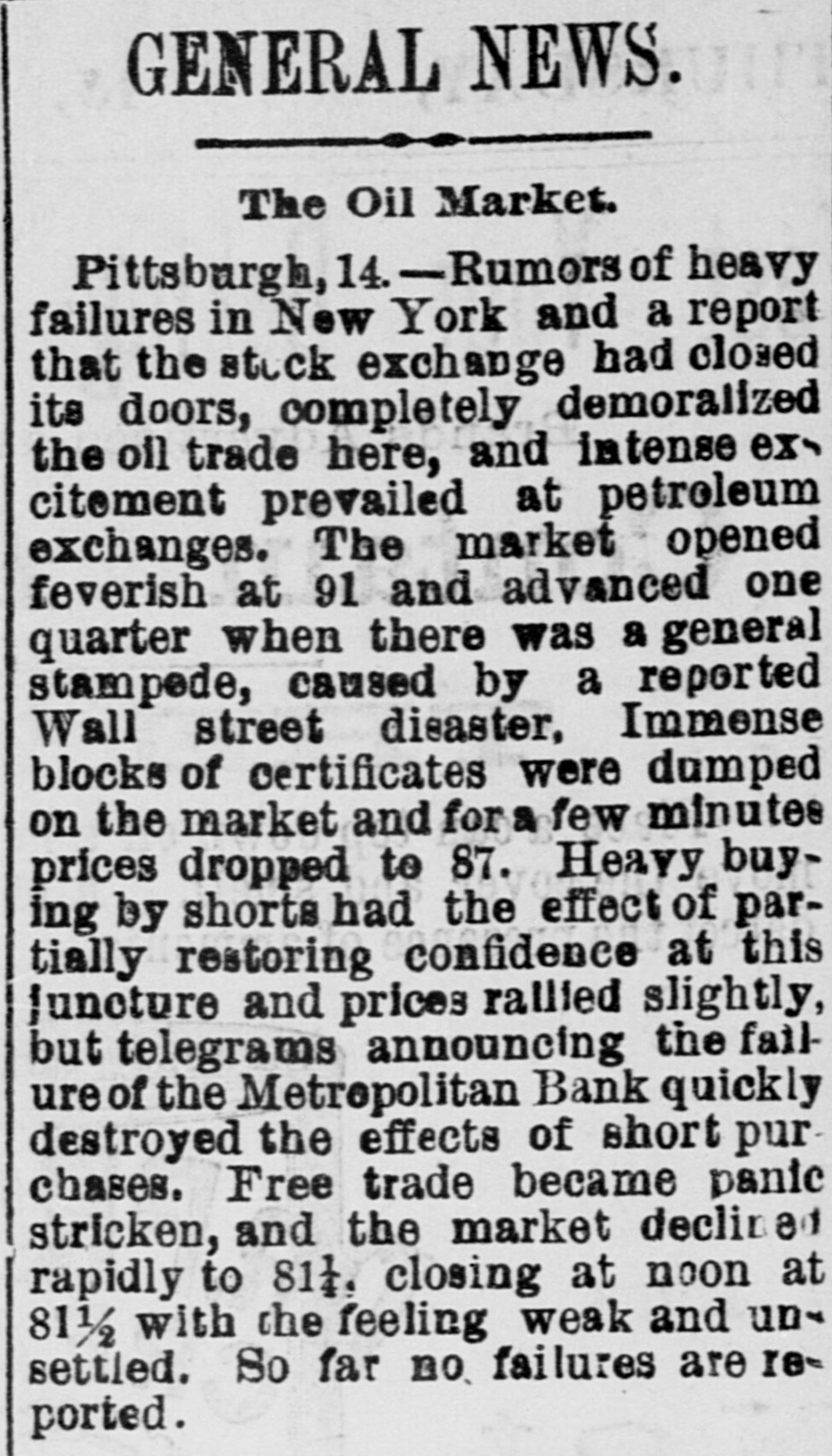
The Oil Market. Pittsburgh, 14.-Rumors of heavy failures in New York and a report that the stock exchange had closed its doors, completely demoralized the oil trade here, and intense excitement prevailed at petroleum exchanges. The market opened feverish at 91 and advanced one quarter when there was a general stampede, caused by a reported Wall street disaster, Immense blocks of certificates were dumped on the market and for a few minutes prices dropped to 87. Heavy buying by shorts had the effect of partially restoring confidence at this Juncture and prices railied slightly, but telegrams announcing the failureofthe Metropolitan Bank quickly destroyed the effects of short purchases. Free trade became panic stricken, and the market declin ad rapidly to 811, closing at noon at 811/2 with the feeling weak and unsettled. So far no. failures are re ported.
11.May 16, 1884The Daily EnterpriseLivingston, MT
Click image to open full size in new tab
Article Text
THE ECHOES OF THE PANIC
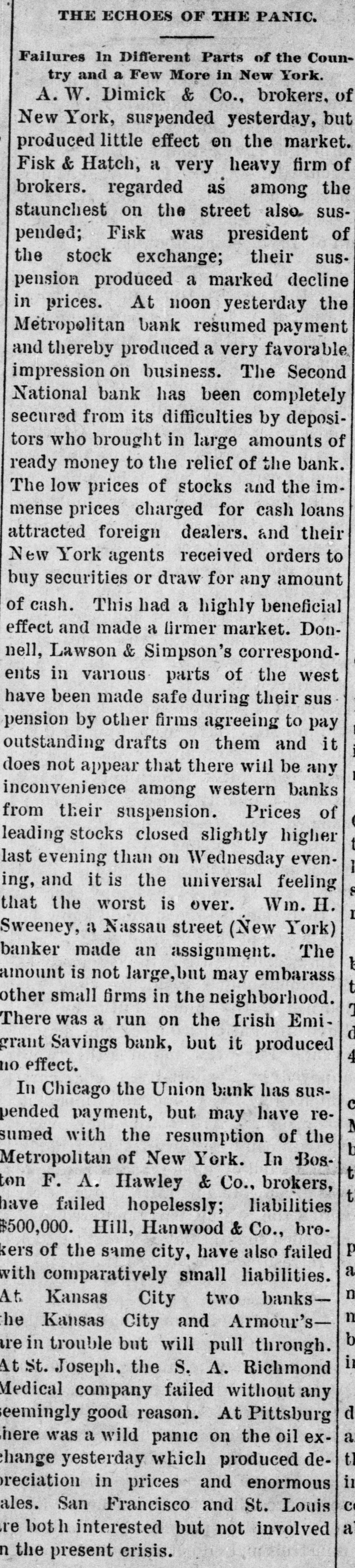
Failures In Different Parts of the Country and a Few More in New York. A. W. Dimick & Co., brokers, of New York, suspended yesterday, but produced little effect on the market. Fisk & Hatch, a very heavy firm of brokers. regarded as among the staunchest on the street also. suspended; Fisk was president of the stock exchange; their suspension produced a marked decline in prices. At noon yesterday the Metropolitan bank resumed payment and thereby produced a very favorable impression on business. The Second National bank has been completely secured from its difficulties by depositors who brought in large amounts of ready money to the relief of the bank. The low prices of stocks and the immense prices charged for cash loans attracted foreign dealers. and their New York agents received orders to buy securities or draw for any amount of cash. This had a highly beneficial effect and made a firmer market. Donnell, Lawson & Simpson's correspondents in various parts of the west have been made safe during their sus pension by other firms agreeing to pay outstanding drafts on them and it does not appear that there will be any inconvenience among western banks from their suspension. Prices of leading stocks closed slightly higher last evening than on Wednesday evening, and it is the universal feeling that the worst is over. Wm. H. I Sweeney, a Nassau street (New York) banker made an assignment. The 1 amount is not large, but may embarass t other small firms in the neighborhood. There was a run on the Irish Emigrant Savings bank, but it produced 4 no effect. In Chicago the Union bank has susc pended payment, but may have reN sumed with the resumption of the b Metropolitan of New York. In Bost ton F. A. Hawley & Co., brokers, t have failed hopelessly; liabilities $500,000. Hill, Hanwood & Co., brop kers of the same city, have also failed a with comparatively small liabilities. n At Kansas City two banksn the Kansas City and Armour'sb are in trouble but will pull through. i At St. Joseph. the S. A. Richmond Medical company failed without any d seemingly good reason. At Pittsburg a here was a wild panic on the oil ext change yesterday which produced dein reciation in prices and enormous C ales. San Francisco and St. Louis al re both interested but not involved n the present crisis.
12.May 16, 1884St. Paul Daily GlobeSaint Paul, MN
Click image to open full size in new tab
Article Text
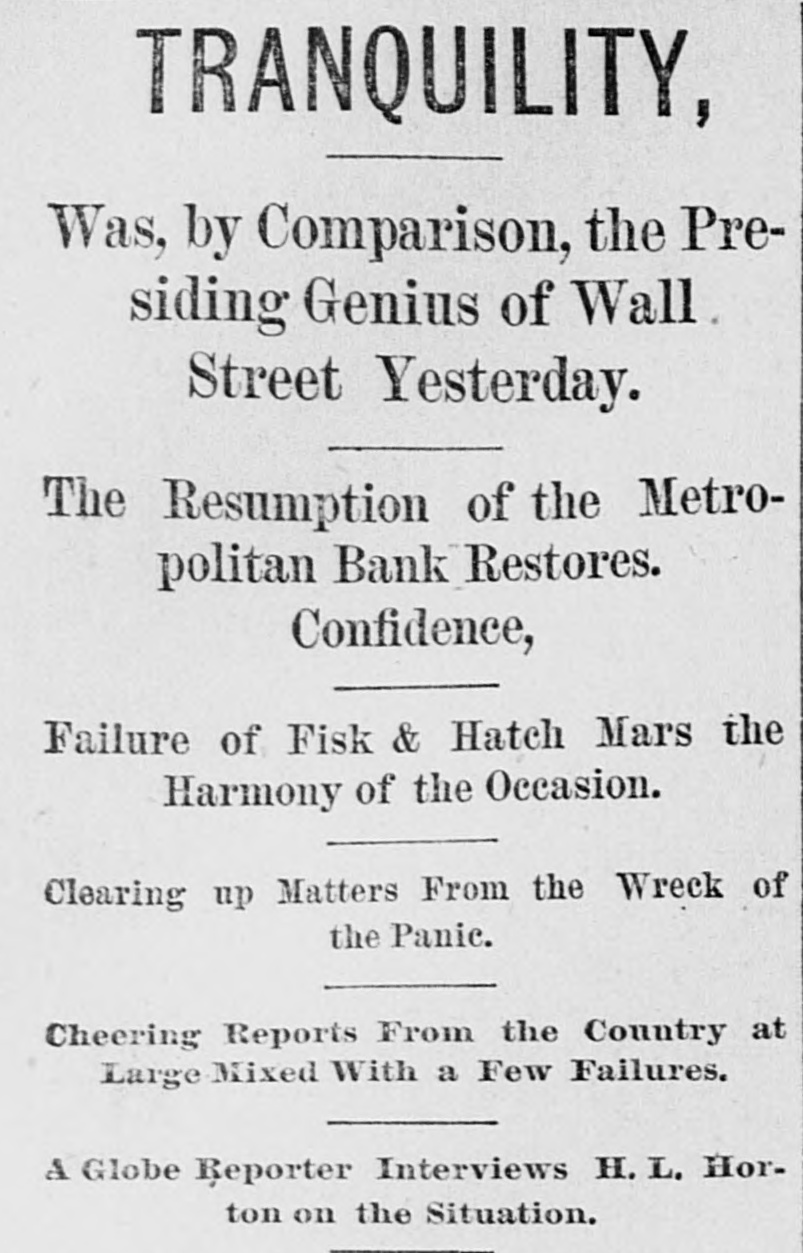
TRANQUILITY, Was, by Comparison, the Presiding Genius of Wall. Street Yesterday. The Resumption of the Metropolitan Bank Restores. Confidence, Failure of Fisk & Hatch Mars the Harmony of the Occasion. Clearing up Matters From the Wreck of the Panic. Cheering Reports From the Country at Large Mixed With a Few Failures. A Globe Reporter Interviews H. L. Horton on the Situation.
13.May 16, 1884The Daily DispatchRichmond, VA
Click image to open full size in new tab
Article Text
morning. It was a correspondent of the Metropolitan Bank of New York, and the announcement was made that on account of the suspension of that bank it was thought best to suspend temporarily. It is thought the bank will resume in a day or two. The promise has been made to depositors that they will be paid in full. There was a run on other banks to-day, but all demands were met promptly and the excitement was over by noon.
14.May 17, 1884St. Paul Daily GlobeSaint Paul, MN
Click image to open full size in new tab
Article Text
WHY FISK & HATCH FAILED
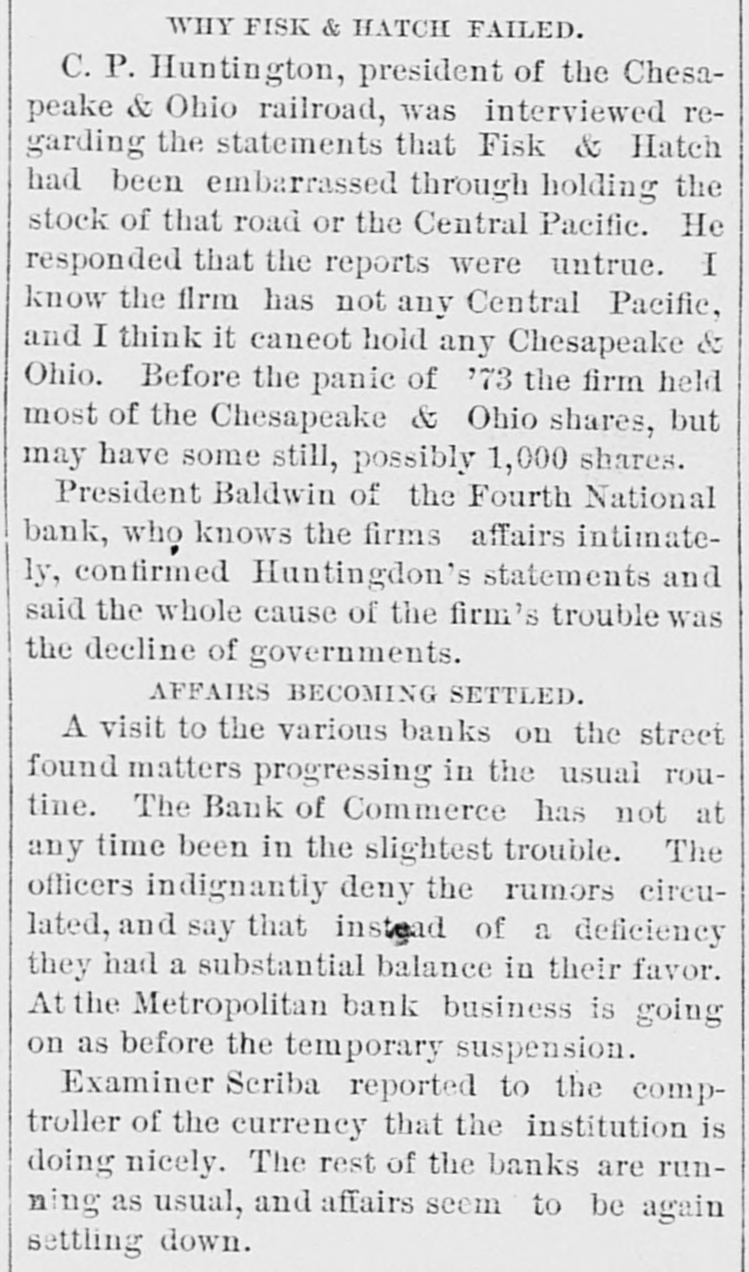
C. P. Huntington, president of the Chesapeake & Ohio railroad, was interviewed regarding the statements that Fisk & Hatch had been embarrassed through holding the stock of that road or the Central Pacific. He responded that the reports were untrue. I know the flrm has not any Central Pacific, and I think it caneot hold any Chesapeake & Ohio. Before the panic of '73 the firm held most of the Chesapeake & Ohio shares, but may have some still, possibly 1,000 shares. President Baldwin of the Fourth National bank, who knows the firms affairs intimately, confirmed Huntingdon's statements and said the whole cause of the firm's trouble was the decline of governments. AFFAIRS BECOMING SETTLED. A visit to the various banks on the street found matters progressing in the usual routine. The Bank of Commerce has not at any time been in the slightest trouble. The officers indignantly deny the rumors circulated, and say that instead of a deficiency they had a substantial balance in their favor. At the Metropolitan bank business is going on as before the temporary suspension. Examiner Scriba reported to the comptroller of the currency that the institution is doing nicely. The rest of the banks are running as usual, and affairs seem to be again settling down.
15.May 17, 1884The State JournalHarrisburg, PA
Click image to open full size in new tab
Article Text
THE BULLS AND THE BEARS
THE FORMER SEEMINGLY RECOVERING THEIR GROUND. Another Day of Excitement and Turmoil in the New York Stock Exchange-The Metropolitan Bank Paying OutAnxious Americans in LondonFisk & Hatch Suspend-&c.
16.May 17, 1884The Semi-Weekly MinerButte, MT
Click image to open full size in new tab
Article Text
NEW YORK AFFAIRS
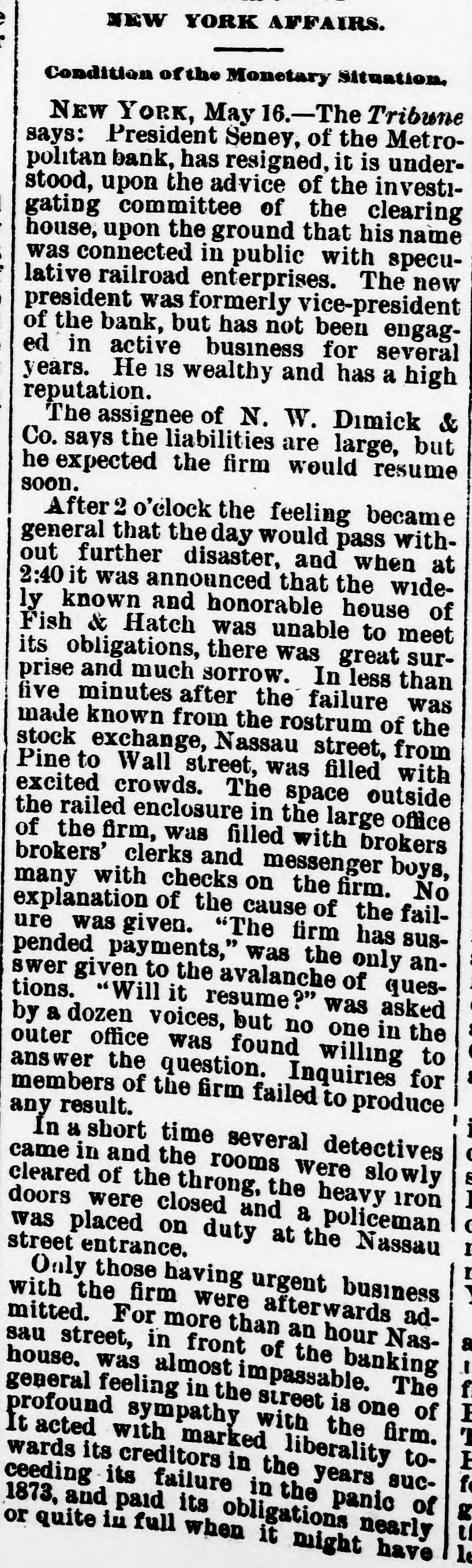
Condition of the Monetary Situation. NEW YORK, May 16.-The Tribune says: President Seney, of the Metropolitan bank, has resigned, it is understood, upon the advice of the investigating committee of the clearing house, upon the ground that his name was connected in public with speculative railroad enterprises. The new president was formerly vice-president of the bank, but has not been engaged in active business for several years. He is wealthy and has a high reputation. The assignee of N. W. Dimick & Co. says the liabilities are large, but he expected the firm would resume soon. After 2 o'clock the feeling became general that the day would pass without further disaster, and when at 2:40 it was announced that the widely known and honorable house of Fish & Hatch was unable to meet its obligations, there was great surprise and much sorrow. In less than five minutes after the failure was made known from the rostrum of the stock exchange, Nassau street, from Pine to Wall street, was filled with excited crowds. The space outside the railed enclosure in the large office of the firm, was filled with brokers brokers' clerks and messenger boys, many with checks on the firm. No explanation of the cause of the failure was given. "The firm has suspended payments," was the only answer given to the avalanche of questions. "Will it resume?" was asked by a dozen voices, but no one in the outer office was found willing to answer the question. Inquiries for members of the firm failed to produce any result. In a short time several detectives came in and the rooms were slowly cleared of the throng, the heavy iron doors were closed and a policeman 1 was placed on duty at the Nassau street entrance. Only those having urgent business with the firm were afterwards admitted. For more than an hour Nas8 sau street, in front of the banking house. was almost impassable. The 1 general feeling in the street is one of profound sympathy with the firm. It acted with marked liberality towards its creditors in the years succeeding its failure in the panic of I 1873, and paid its obligations nearly or quite in full when it might have I
17.May 17, 1884The Milan ExchangeMilan, TN
Click image to open full size in new tab
Article Text
mote it be
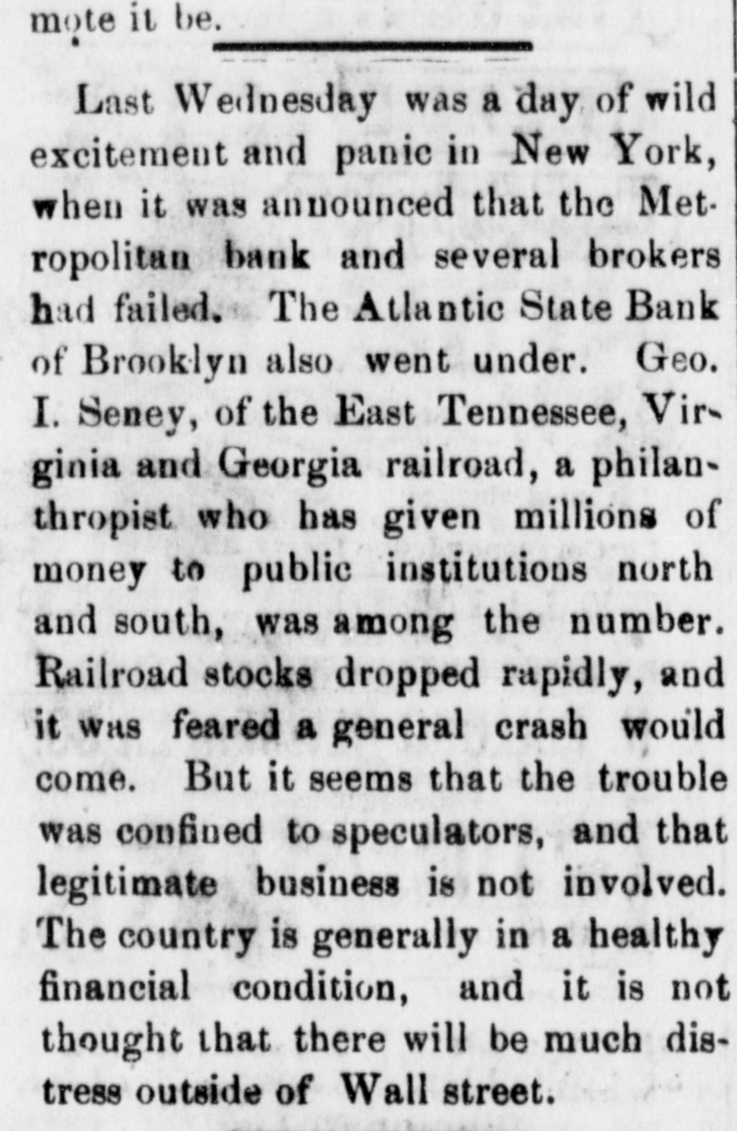
Last Wednesday was a day of wild excitement and panie in New York, when it was announced that the Metropolitan bank and several brokers had failed. The Atlantic State Bank of Brooklyn also went under. Geo. I. Seney, of the East Tennessee, Virginia and Georgia railroad, a philanthropist who has given millions of money to public institutions north and south, was among the number. Railroad stocks dropped rapidly, and it was feared a general crash would come. But it seems that the trouble was confined to speculators, and that legitimate business is not involved. The country is generally in a healthy financial condition, and it is not thought that there will be much distress outside of Wall street.
18.May 20, 1884Semi-Weekly South KentuckianHopkinsville, KY
Click image to open full size in new tab
Article Text
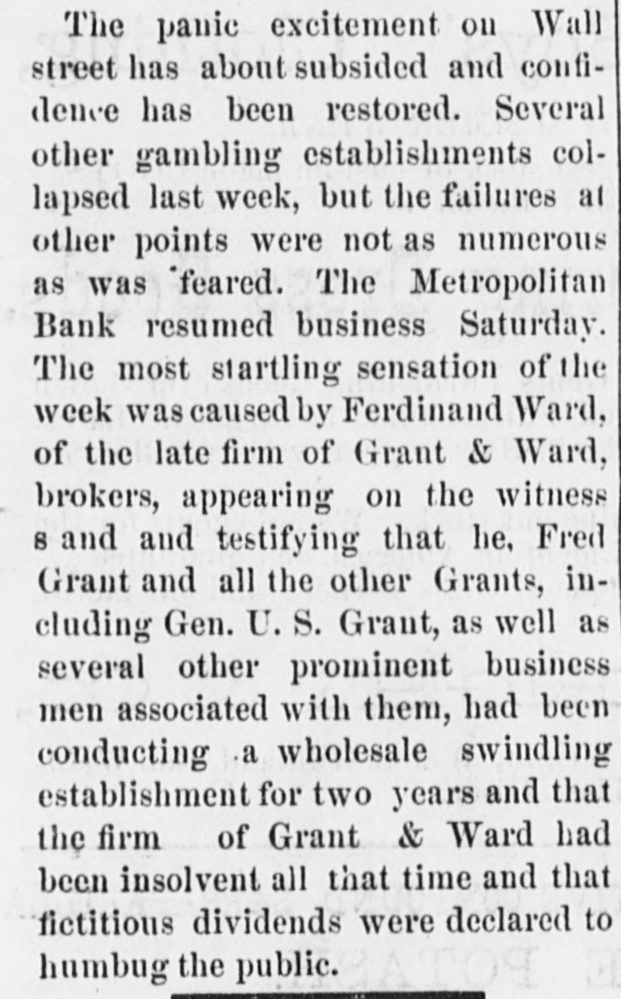
The panic excitement on Wall street has about subsided and confidence has been restored. Several other gambling establishments collapsed last week, but the failures at other points were not as numerous as was feared. The Metropolitan Bank resumed business Saturday.
The most startling sensation of the week was caused by Ferdinand Ward, of the late firm of Grant & Ward, brokers, appearing on the witness and testifying that he, Fred Grant and all the other Grants, including Gen. U. S. Grant, as well as several other prominent business men associated with them, had been conducting a wholesale swindling establishment for two years and that the firm of Grant & Ward had been insolvent all that time and that fictitious dividends were declared to humbug the public.
19.May 20, 1884The Indianapolis JournalIndianapolis, IN
Click image to open full size in new tab
Article Text
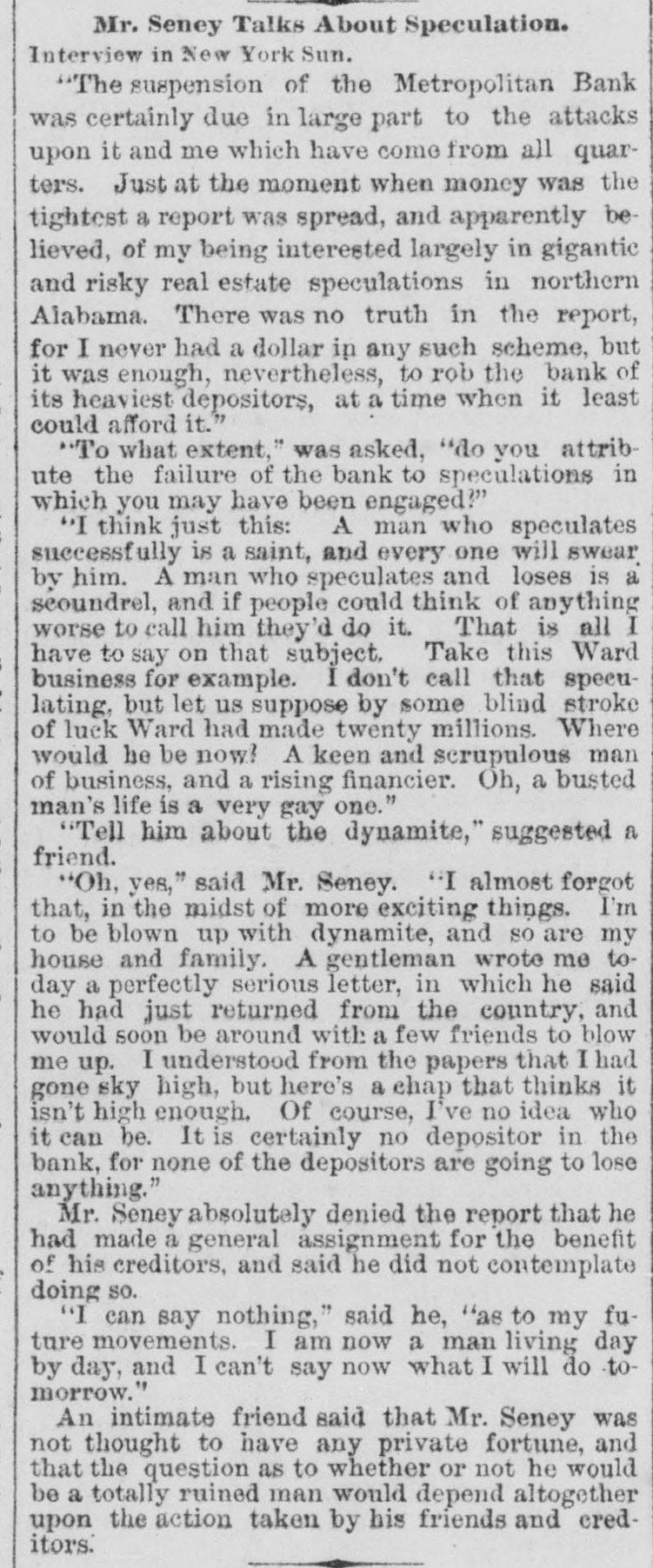
Mr. Seney Talks About Speculation. Interview in New York Sun.
"The suspension of the Metropolitan Bank was certainly due in large part to the attacks upon it and me which have come from all quarters. Just at the moment when money was the tightest a report was spread, and apparently believed, of my being interested largely in gigantic and risky real estate speculations in northern Alabama. There was no truth in the report, for I never had a dollar in any such scheme, but it was enough, nevertheless, to rob the bank of its heaviest depositors, at a time when it least could afford it."
"To what extent," was asked, "do you attribute the failure of the bank to speculations in which you may have been engaged?"
"I think just this: A man who speculates successfully is a saint, and every one will swear by him. A man who speculates and loses is a seoundrel, and if people could think of anything worse to call him they'd do it. That is all I have to say on that subject. Take this Ward business for example. I don't call that speculating, but let us suppose by some blind stroke of luck Ward had made twenty millions. Where would he be now? A keen and scrupulous man of business, and a rising financier. Oh, a busted man's life is a very gay one."
"Tell him about the dynamite," suggested a friend.
"Oh, yes," said Mr. Seney. "I almost forgot that, in the midst of more exciting things. I'm to be blown up with dynamite, and so are my house and family. A gentleman wrote me today a perfectly serious letter, in which he said he had just returned from the country, and would soon be around with a few friends to blow me up. I understood from the papers that I had gone sky high, but here's a chap that thinks it isn't high enough. Of course, I've no idea who it can be. It is certainly no depositor in the bank, for none of the depositors are going to lose anything."
Mr. Seney absolutely denied the report that he had made a general assignment for the benefit of his creditors, and said he did not contemplate doing so.
"I can say nothing," said he, "as to my future movements. I am now a man living day by day, and I can't say now what I will do tomorrow."
An intimate friend said that Mr. Seney was not thought to have any private fortune, and that the question as to whether or not he would be a totally ruined man would depend altogether upon the action taken by his friends and creditors.
20.May 21, 1884Mower County TranscriptAustin, Lansing, MN
Click image to open full size in new tab
Article Text
THE FINANCIAL CYCLONE.
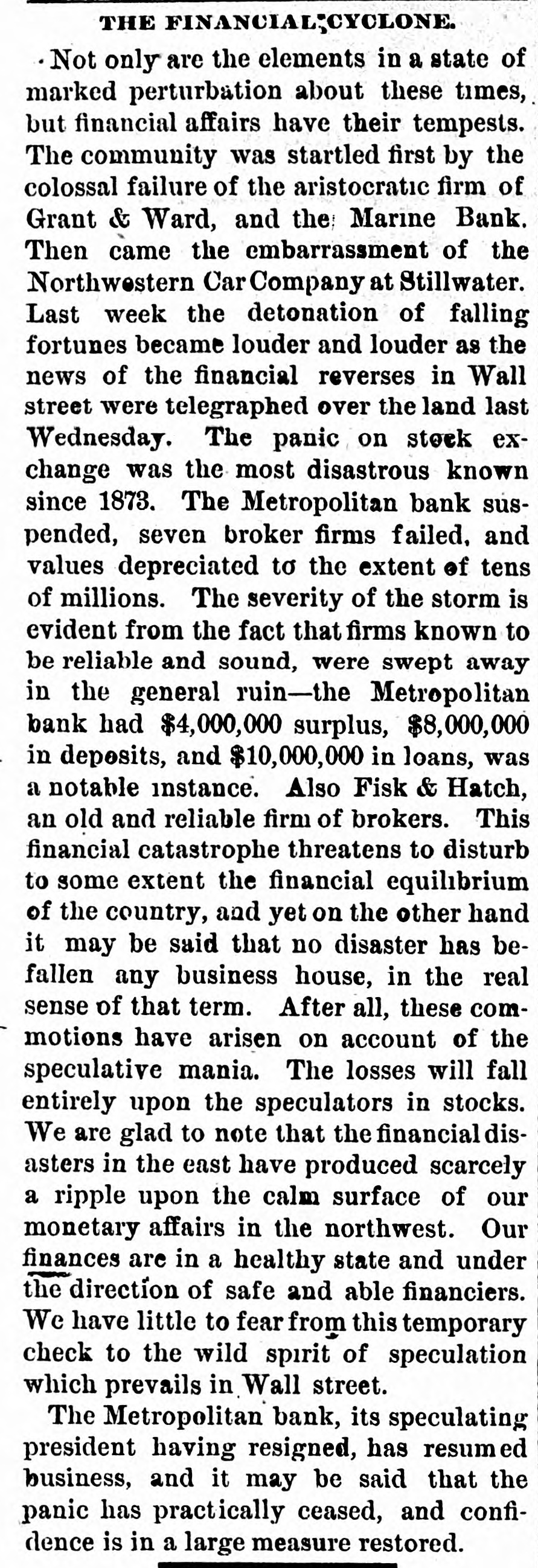
Not only are the elements in a state of marked perturbation about these times, but financial affairs have their tempests. The community was startled first by the colossal failure of the aristocratic firm of Grant & Ward, and the Marine Bank. Then came the embarrassment of the Northwestern Car Company at Stillwater. Last week the detonation of falling fortunes became louder and louder as the news of the financial reverses in Wall street were telegraphed over the land last Wednesday. The panic on stock exchange was the most disastrous known since 1873. The Metropolitan bank suspended, seven broker firms failed, and values depreciated to the extent of tens of millions. The severity of the storm is evident from the fact that firms known to be reliable and sound, were swept away in the general ruin—the Metropolitan bank had $4,000,000 surplus, $8,000,000 in deposits, and $10,000,000 in loans, was a notable instance. Also Fisk & Hatch, an old and reliable firm of brokers. This financial catastrophe threatens to disturb to some extent the financial equilibrium of the country, and yet on the other hand it may be said that no disaster has befallen any business house, in the real sense of that term. After all, these commotions have arisen on account of the speculative mania. The losses will fall entirely upon the speculators in stocks. We are glad to note that the financial disasters in the east have produced scarcely a ripple upon the calm surface of our monetary affairs in the northwest. Our finances are in a healthy state and under the direction of safe and able financiers. We have little to fear from this temporary check to the wild spirit of speculation which prevails in Wall street.
The Metropolitan bank, its speculating president having resigned, has resumed business, and it may be said that the panic has practically ceased, and confidence is in a large measure restored.
21.May 28, 1884The Salt Lake HeraldSalt Lake City, UT
Click image to open full size in new tab
Article Text
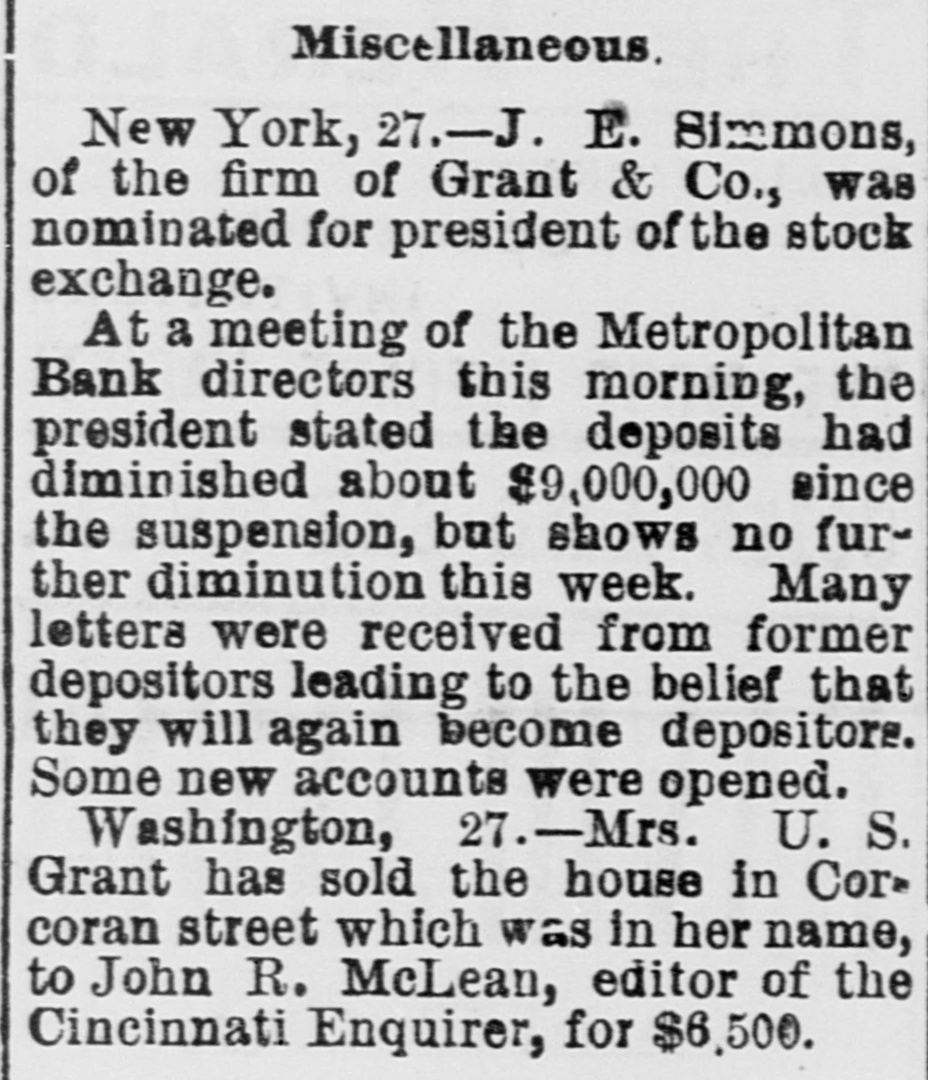
Miscellaneous
New York, 27.-J. E. Simmons, of the firm of Grant & Co., was nominated for president ofthe stock exchange. At a meeting of the Metropolitan Bank directors this morning, the president stated the deposits had diminished about $9,000,000 since the suspension, but shows no further diminution this week. Many letters were received from former depositors leading to the belief that they will again become depositors. Some new accounts were opened. Washington, 27.-Mrs. U. S. Grant has sold the house in Cor> coran street which was in her name, to John R. McLean, editor of the Cincinnati Enquirer, for $6,500.
22.August 2, 1884Savannah Morning NewsSavannah, GA
Click image to open full size in new tab
Article Text
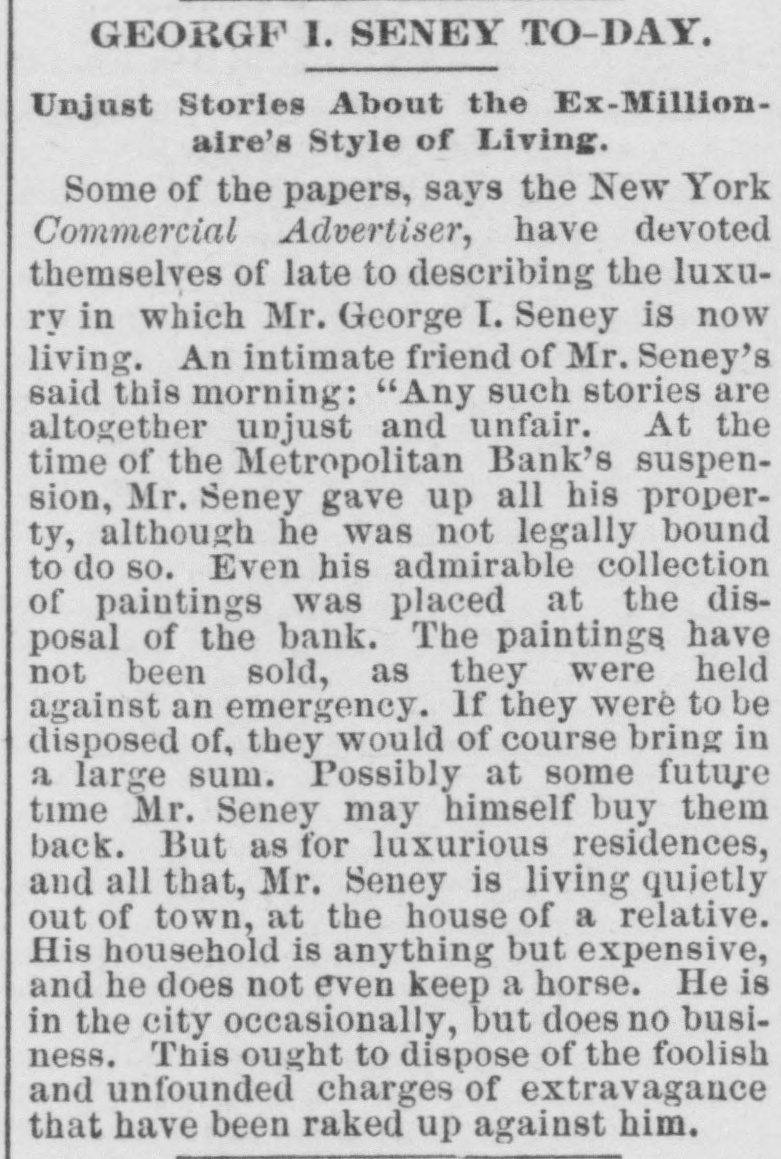
GEORGF I. SENEY TO-DAY.
Unjust Stories About the Ex-Millionaire's Style of Living.
Some of the papers, says the New York Commercial Advertiser, have devoted themselves of late to describing the luxury in which Mr. George I. Seney is now living. An intimate friend of Mr. Seney's said this morning: "Any such stories are altogether unjust and unfair. At the time of the Metropolitan Bank's suspension, Mr. Seney gave up all his property, although he was not legally bound to do so. Even his admirable collection of paintings was placed at the disposal of the bank. The paintings have not been sold, as they were held against an emergency. If they were to be disposed of, they would of course bring in a large sum. Possibly at some future time Mr. Seney may himself buy them back. But as for luxurious residences, and all that, Mr. Seney is living quietly out of town, at the house of a relative. His household is anything but expensive, and he does not even keep a horse. He is in the city occasionally, but does no business. This ought to dispose of the foolish and unfounded charges of extravagance that have been raked up against him.
23.March 16, 1885The Rock Island ArgusRock Island, IL
Click image to open full size in new tab
Article Text
Fine Art Collection for Sale
NEW YORK. March 10.-The fine art collection of George I. Seney, of Brooklyn, made up of 285 famous oil and water-color paintings, was placed on exhibition Tuesday, previous to being sold at auction by the New York clearing-house. The collection cost nearly $400,000. Mr. Seney was president of the Metropolitan bank when it went down in the wreck of May last, and to secure the bank for certain rather delicate loans made to him the collection was transferred to the receiver, who in turn gave ft to the clearing-house as collatoral for the bank's debts. The sale begins March 31.
24.March 18, 1885Morris TribuneMorris, MN
Click image to open full size in new tab
Article Text
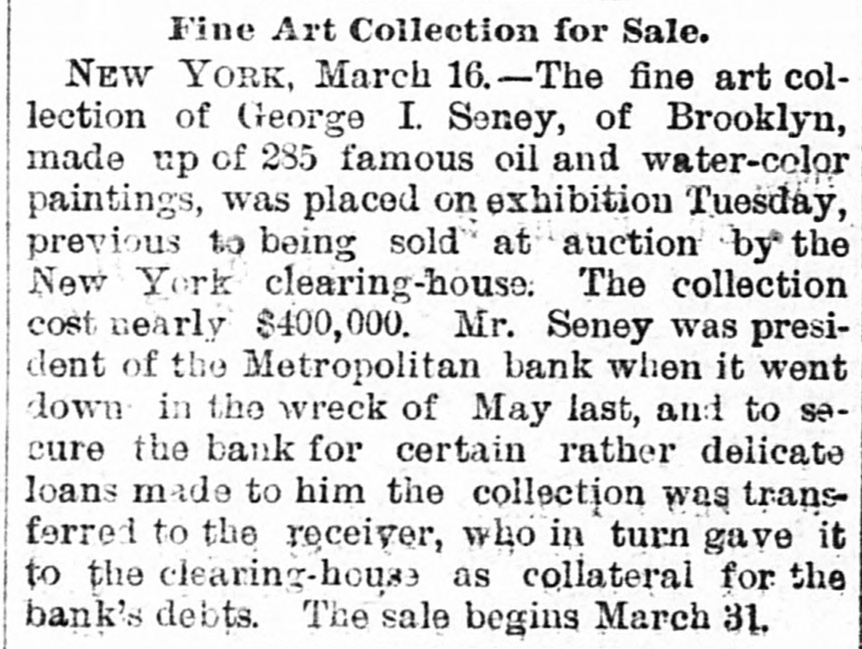
Fine Art Collection for Sale
NEW York, March 16.-The fine art collection of George I. Seney, of Brooklyn, made up of 285 famous oil and water-color paintings, was placed on exhibition Tuesday, previous to being sold at auction by the New York clearing-house. The collection cost nearly $400,000. Mr. Seney was president of the Metropolitan bank when it went down in the wreck of May last, and to secure the bank for certain rather delicate loans made to him the collection was transferred to the receiver, who in turn gave it to the clearing-house as collateral for the bank's debts. The sale begins March 31.
Bank runs are almost always and everywhere a deterioration of bank fundamentals.
But not for you.
You are the measure-zero exception: great fundamentals, solid bank, and yet the Diamond Dybvig fairy spread its rumor. Depositors woke up. Your collateral was not prepositioned. The Clearinghouse had it for you.
Do not pass Go. Do not collect $200. Go directly to jail… or worse.