Bank of Chester (Chester, SC)

Episode Information

Episode UID
1747183190697
Episode Type
Suspension → Closure
Bank Type
state
Bank ID
174718319 hash
Start Date
January 12, 1858
Location
Chester, South Carolina (34.705, -81.214)

Metadata

Model
gpt-5-mini (chosen from majority vote of a three-model LLM ensemble)
Short Digest
075d5538be62e86f

Response Measures

None

Description

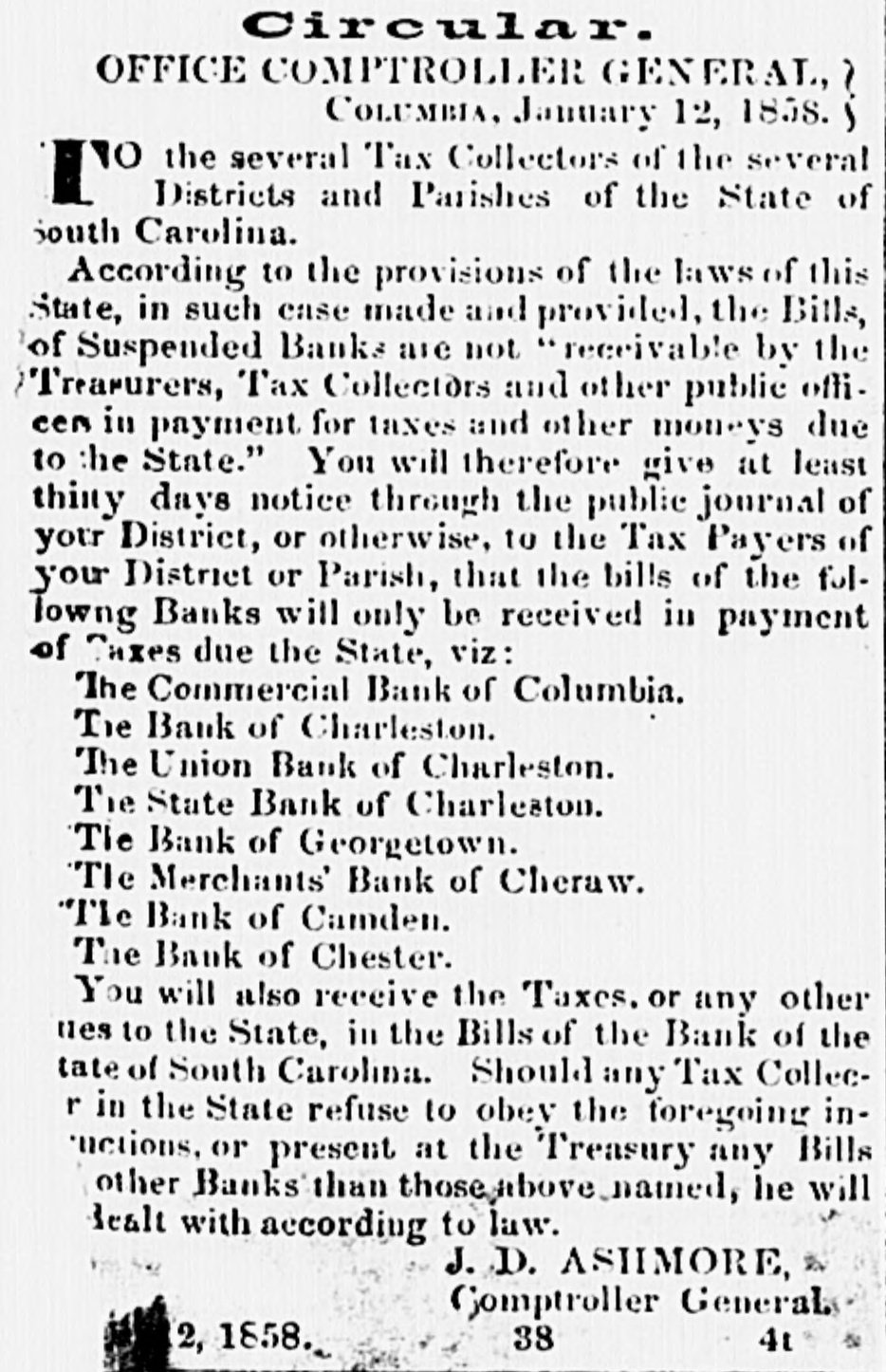
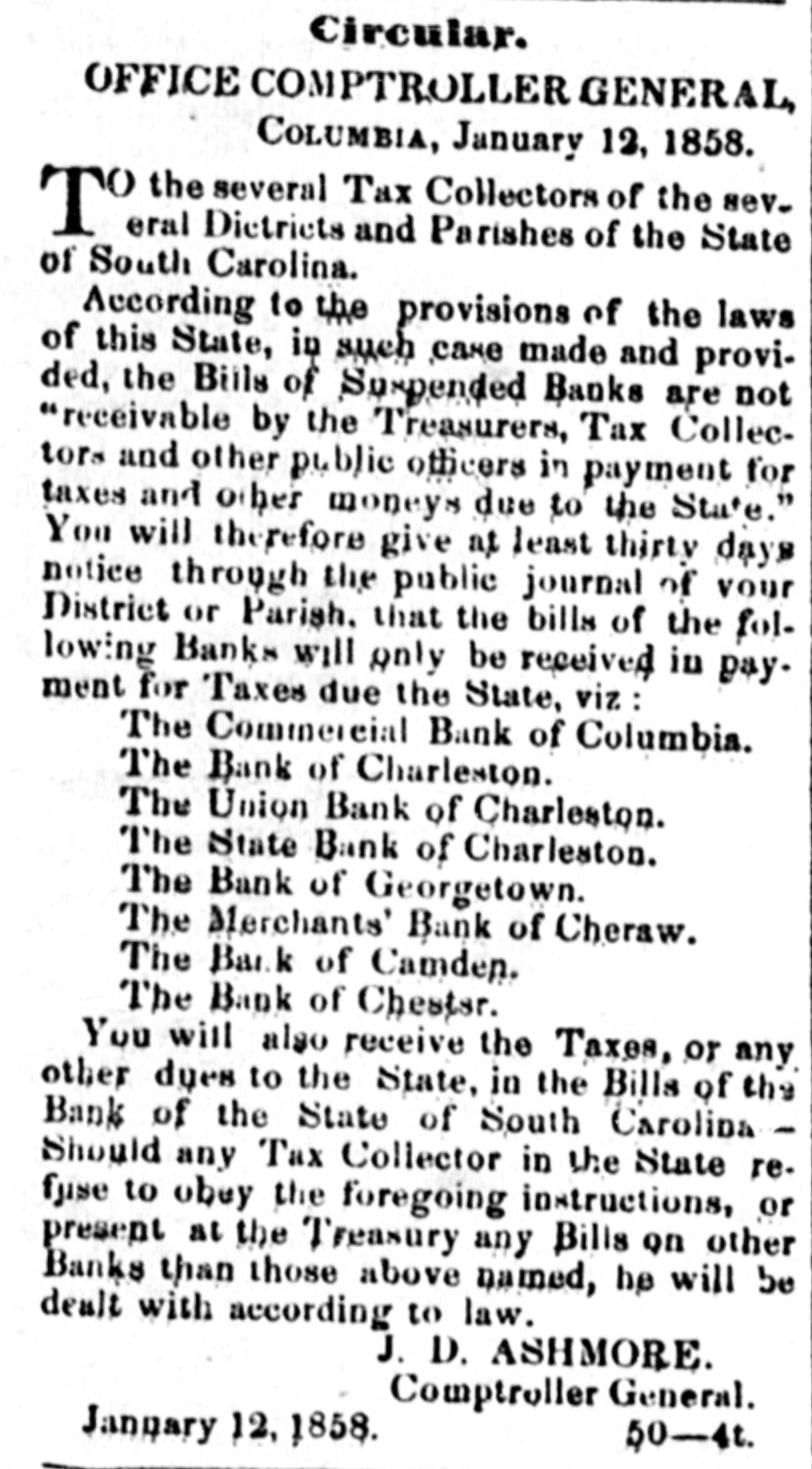
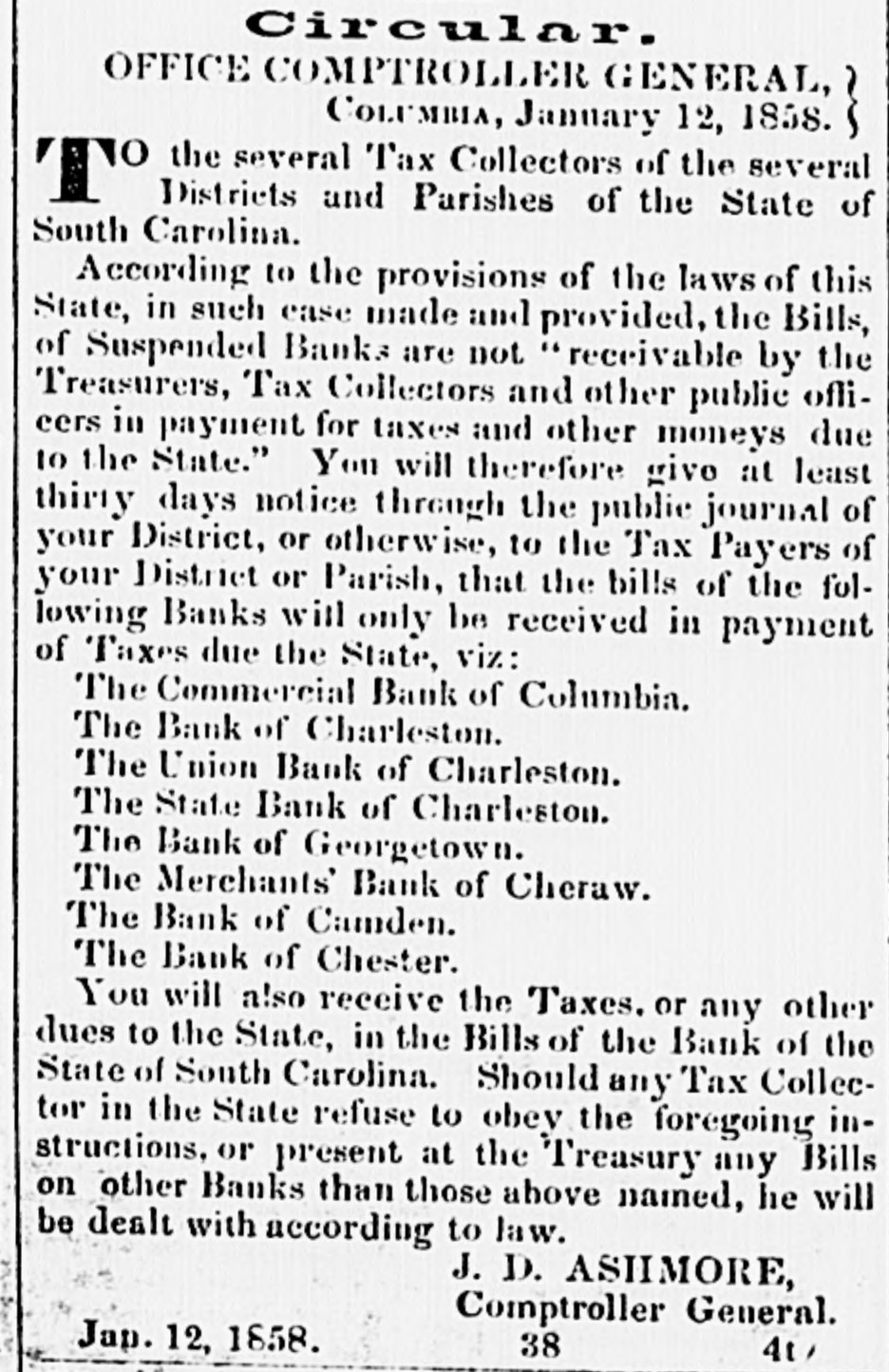
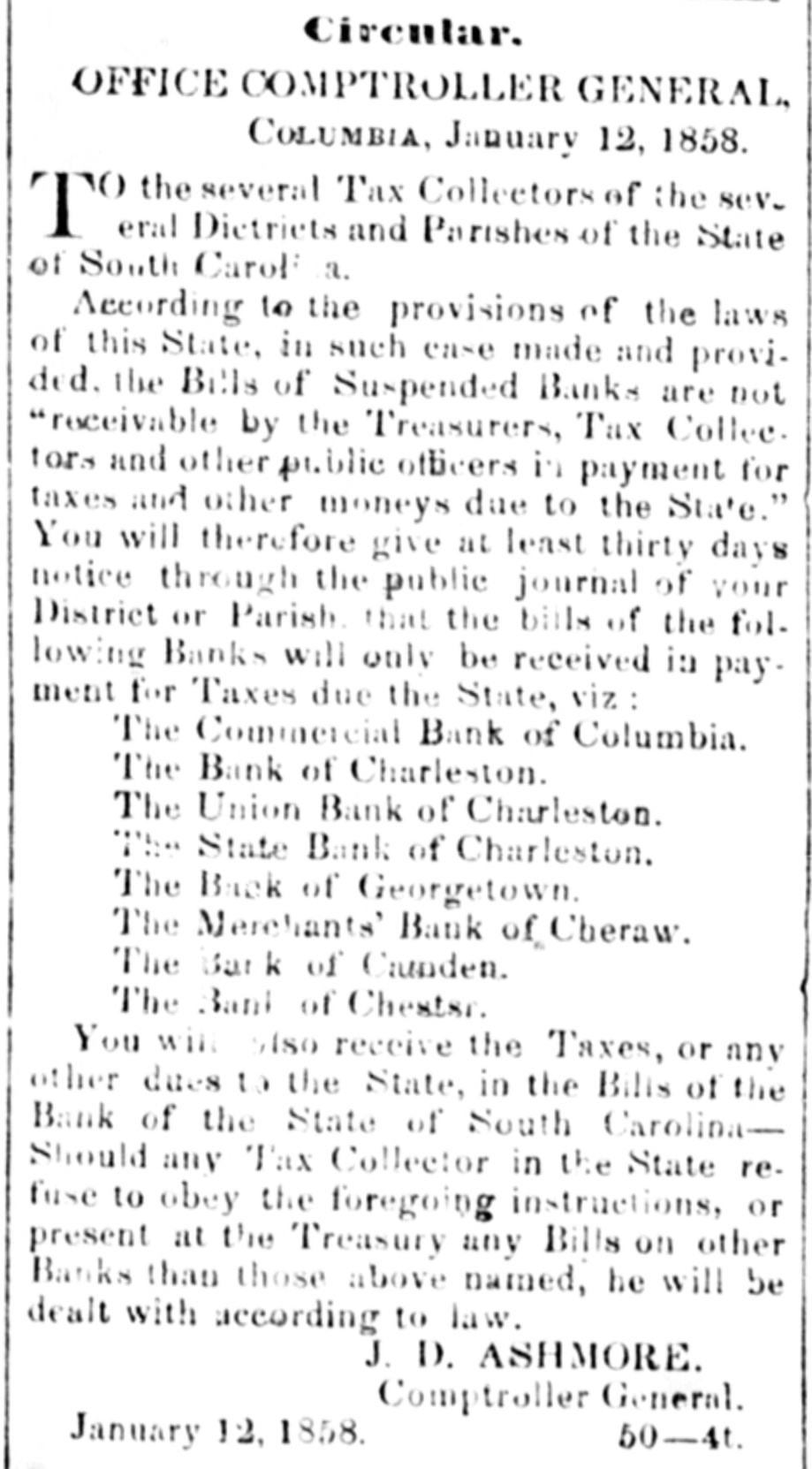
Bank listed among suspended banks by state comptroller (Jan 12, 1858) and later in 1871 reported in hands of receivers.

Events (2)

1. January 12, 1858 Suspension
Cause
Macro News
Cause Details
Part of the wider Panic of 1857 and statewide/specie-payment suspensions; banks in Charleston and elsewhere suspended specie payments and Bank of Chester's bills were treated as suspended by state authorities.
Newspaper Excerpt
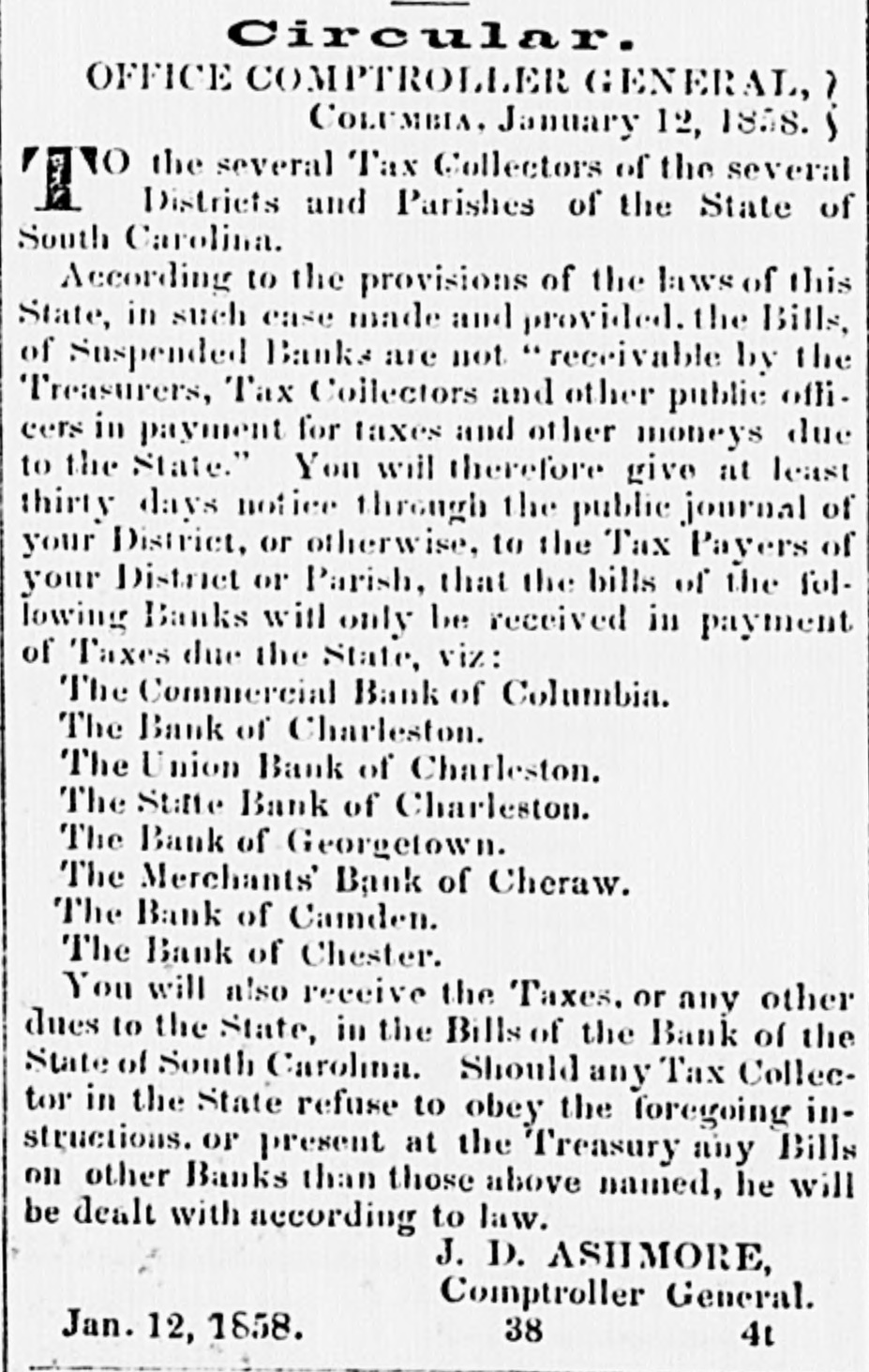
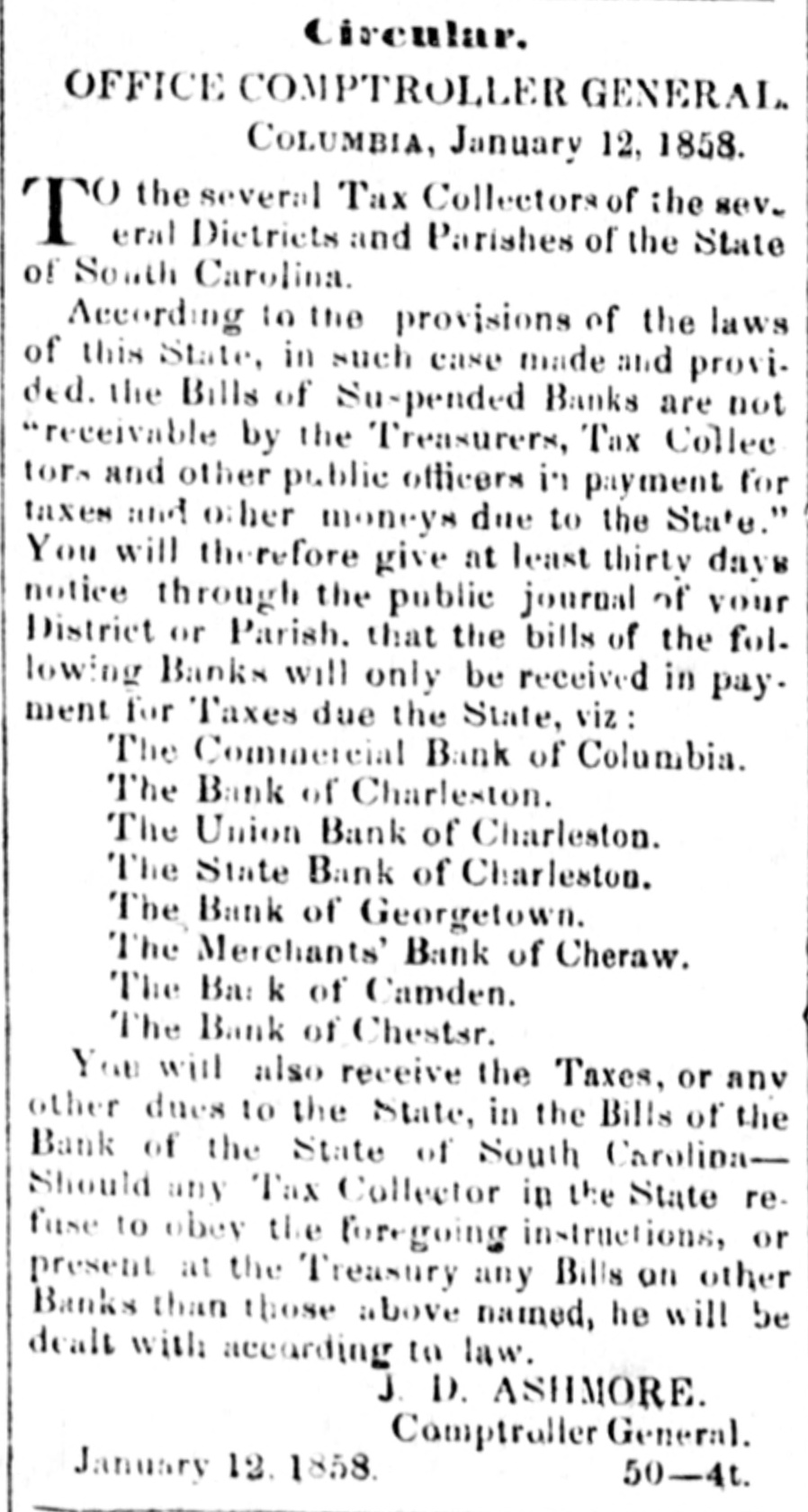
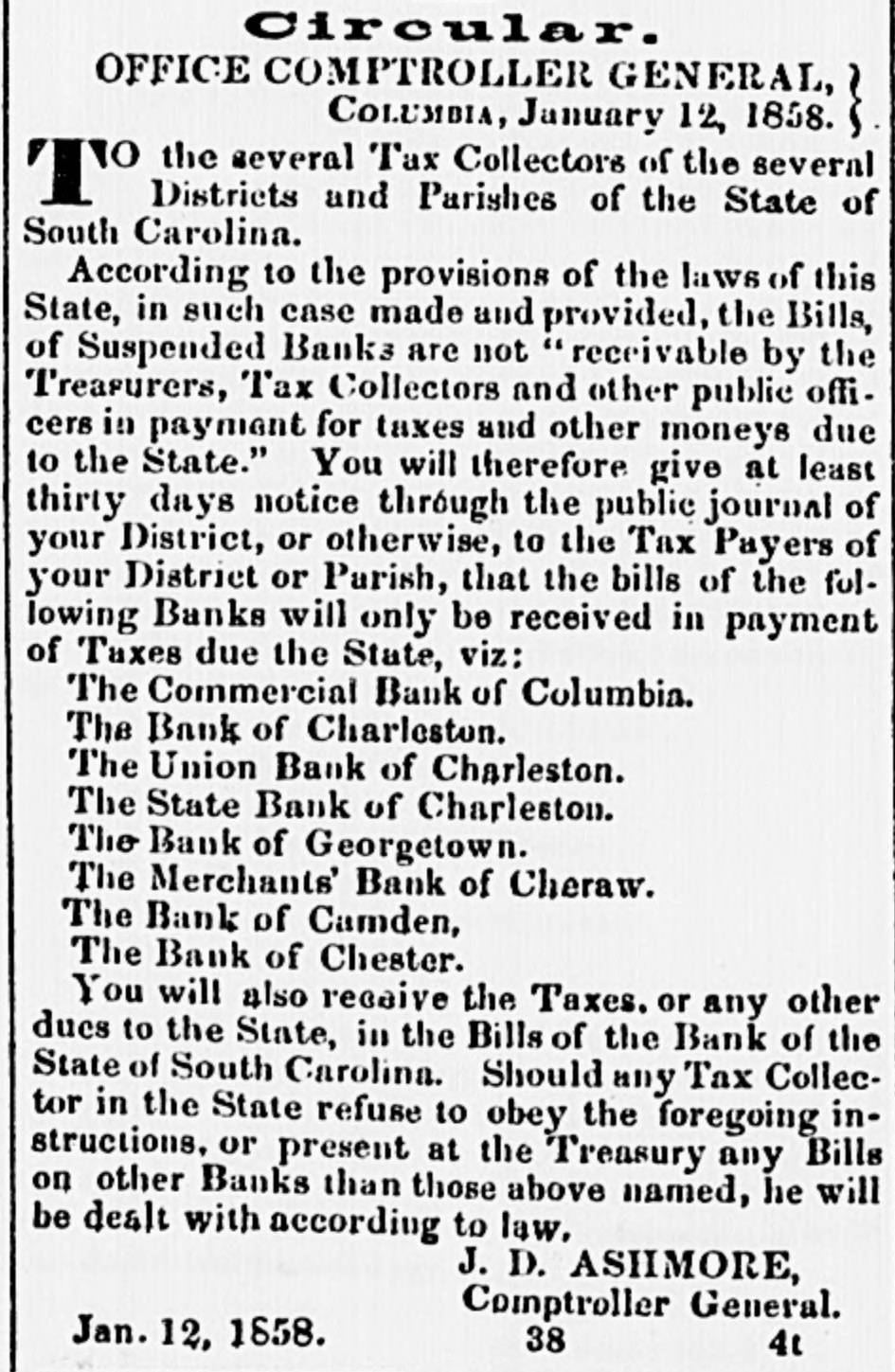
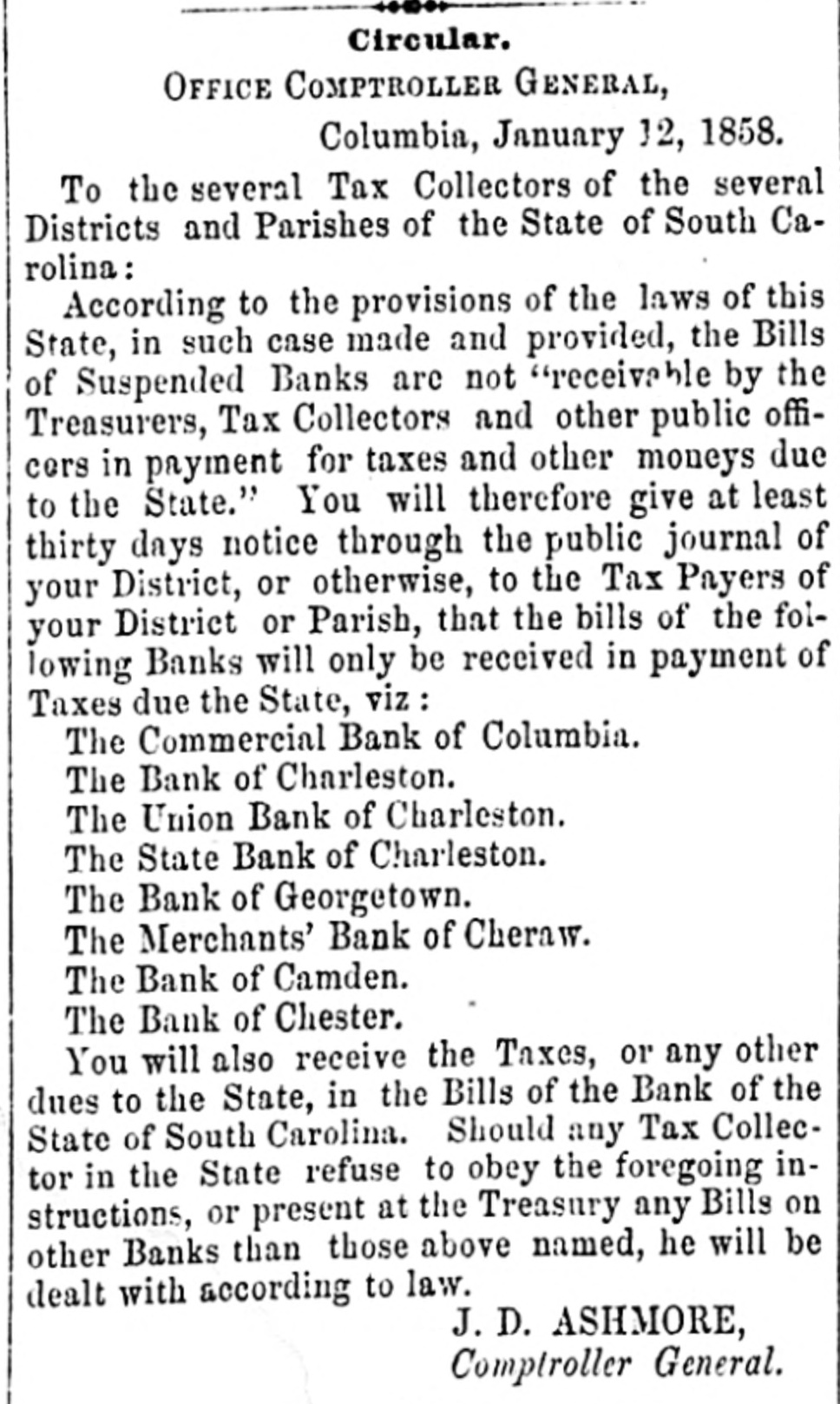
the bills of the following Banks will only be received in payment for Taxes due the State, viz: ... The Bank of Chester.
Source
newspapers
2. January 13, 1871 Receivership
Newspaper Excerpt
the following named are in the hands of receivers, &c., appointed ...: Bank of Chester;
Source
newspapers

Newspaper Articles (16)

Article from The Daily Dispatch, October 20, 1857

Click image to open full size in new tab

Article Text

The amount of money in the Treasury subject to draft is $12,806,831, a reduction from the previous week of upwards of $2,500,009, The receipts of the week amount to about $796,000. A dispatch, dated Boston, Oct 17th says The result of the Bank Directors' meeting to day authorizes an increase of loans to the Amount of about three millions, which will probably ease the pressure somewhat next week. In stocks prices are better, and more orders for investments were coming in. The N. Y. Commercial Advertiser, of Saturday evening, says: We do not find much change in the aspect of the street this morning. We think that things generally are working toward improvement. The embargo on trade isgradually waxing less severe. From the West we learn, in well informed quarters, that produce is being forwarded in large quantities. Parties with some means are on the spot making the necessary advances, and shipping it for the seaboard.Agents from some of our mercantile firms arealso receivingithe amounts due in grain,and forwarding it to the market, and will thus probably expedite materially a realization of a portion of the indebtedness to them. The Directors of the Bank of Chester, S. C., have published a card, pledging their private fortunes for the redemption of the Bank's bills. Their united property is estimated at $500,000 to $1,000,000. The Bank of Charleston, 8. C., has issued the following bulletin: This Bank will continue specie payments. All Bank Notes current in the city will be received in payment and on deposit, by this Bank, and depositors are requested to draw their checks payable in current funds. Checks on New York will be furnished at par for the Bills of this Bank. Depositors may, at their option. receive Certificates for Deposits now at their credit, bearing interest at the rate of seven per cent. per annum, redeemable in coin, at not less than three nor more than six months. For the protection of the public, this Bank will receive Current Funds for the payment of debts due the Bank. add for all Collection Paper received from other Banks, and will furnish similar funds only for payments to other Banks. This (says the Charleston Courier) represents practically and 8 tisfactorily the course and policy adopted by the Union Bank and the State Bank of this city-these being the three Banks that continue in the full exercise of their functions. NORTHERN MARKETS. NEW YORK, Oct. 19.-Flour has declined State $4.75@4 85; Ohio 15@5.75; Southern $5.50@5.85 Wheat sadvanced White 30@1.40. Corn dull andquotations nominal. Stocks generally higher. Virginia 6's 81. BALTIMORE, Oct. 19.-Flour firmer; Ohio and Howand street advanced 12 cents. Wheat active, at an advance of 5 to 10 cents: white $1.20@1.35, red $1.10 @1.15. Corn steady; white 64@68 cents, yellow 66(a) 70 cents. RICHMOND MARKETS, OCT. 19. There is little doing in our market. The revulsion has locked up things, and time will be necessavy for their release. We observe at last a slight movement in Flour for the North, on account of the millers-no sales having been made here as yet. The high price of Exchange en New York-now 8@10 per cent. premium-it appears, should stimulate shipments, as a means of making remittances. The money market is depressed, but has experienced considerable relief since the suspension, from the reception by the Banks of those Virginia Bank notes that they had for some time refused to take on deposit We think the pressure has reached its lowest point, and we may hope for a gradual restoration of contidence and of trade to its former activity and prosperity. TOBACCO-The receipts of Tobaccoare very small, also the breaks, for the last two days. There have been no hhds. offered for sale; also, some few parcels of new primings, with some few lots of Leaf The sales of hads. on Friday last, showed some little improvement in prices. We quote inferior Lugs at $1.50@5; good 25@5.75. Inferior Leaf $6.25@7; good $7.50@8.50@9.50; fine $10.50@12. No fine shipping in market. FLOUR.-No sales to quote. We note that there are some limited shipments on owners' Account to New York-the high price of Exchange affording inacements that will likely give a forward movement to Flour and produce generally. WHEAT.-There is no change in our quotations. but the market is ver! buoyant. Good to prime Red $1.15@1.20: do. White $1.25@1.30. CORN-Market steady at 85c. OATS-30@35c. per bushel. BACON.-There is no change in the Bacon market. The stock on hand is very light, and the little that arrives is stiff at former quotations: Shoulders 14½ 15c.; Sides 17½@18c.; Hams 16@18c., for plain and fancy-nominal, since there are hardly any in first hands. SUGARS-Have declined a little. We quote Cuba 8 to 9½c; Loaf 13@13½c.; Crush d and Pow dered 12 @12½c; C. Coffee He.; B. Coff 11½c; A; Coffee 12c Nochange in Coffee or any other article in the aro-
Article from The Western Democrat, October 20, 1857

Click image to open full size in new tab

Article Text

The Columbia Carolinian says: In relation to the suspension of the Bank of the State, which will cause no loss to any of its bill holders, the Charleston Courier very properly recommends: "As we have before stated. the notes of the Bank of the State are secure beyond all question. Having the whole credit and the power of taxation of the State to sustain them. they are better secured than the notes of those banks in New York and else where, which have deposited dollar for dollar in stocks to secure their redemption -those stocks have to be sold at the market depreciation in order to redeem the notes, so far as the proceeds will go. Having. then, the fullest confidence in the ultimate convertibility of these notes, we would recommend them to the community as a circulation which would answer all the local purposes of trade." The Peoples' Bank at Charleston, has also suspended. Also, the Bank of Hamburg, S. C. SAVANHAH, October 15.-A meeting of the Presidents of the banks in this city was held last night, at which it was unanimously recommended to suspend specie payments. In consequence of which all the banks suspended this morning. NEW YORK, October 18.-All the banks in this city suspended specie payment yesterday. Sterling exchange is quoted at 1111. The Augusta (Ga.) Banks refused last week to take the bills of the Exchange bank of Columbia, Planters' Bank of Fairfield, and Bank of Chester, S.C. The Chester Standard says that in order to make assurance doubly sure and place the bills of the Bank of Chester above the slightest semblance of cause for doubt, the board of Directors have come out in a card pledging their several private fortunes for the redemption of the bills of the said bank."


Article from Keowee Courier, October 24, 1857

Click image to open full size in new tab

Article Text

THE KEOWEE COURIER. The Money Panic. THE HERMITAGE.-Gov. Johnson, of TenPennings and Clippings. The condition of monetary affairs are no nessee, reports the purchase for the State of NEW ADVERTISEMENTS-There are a numbetter. The pressure, in fact, has become the Hermitage, and its tender to the Federal ber of new advertisements in our columns general, and many of our own banks have Government. In case the tender is not acIt is this week, to which the attention of the pubbeen forced to suspend specie payment. The cepted, the Governor recommends that the I am f lic is directed. Bank of Charleston, Union Bank, and the property be retained as a residence for the catego State Bank, in Charleston, and the CommerCorron.-This staple is only now bringing future Governors of the State. theref 12 cents por pound in Charleston. But a few cial Bank, in Columbia, the Bank of Chester, GETTING FRIGHTENED.-Gov. Fletcher, of torial = and the Bank of Newberry, continue to reweeks since it reached as high as 16 cents! Vermont, in his recent message to the Legisladeem their bills in gold and silver. The bills THERE'S AN EXAMPLE FOR You.-A numprogre ture expressed the fear that slavery would be of the suspended banks, however, continue ous, al ber of young ladies in Salem, Mass., having introduced into that State. The Boston Post to be taken as heretofore, and are thought to considered the state of the money market and somet] says that the Green Mountains which make be perfectly good. determined not to pay ten or twenty dollars stand up that State, are in winter white as snow, The extravagant speculation of the people, for a winter bonnet, have set about making that p but Gov. Fletcher is an evergreen. bonnets for themselves. suporinduced by the extraordinary expansion are co of our bank currency, has been the prime CHICAGO, Oct. 12 -A destructive fire broke NUMBER OF BANKS IN THE UNITED STATES. velope cause of the pressure, and inflated the price out yesterday morning in State street, desThe number of Banks in the Union, on Janmake of almost everything to an extent perfectly troying the entire block between Monroe and uary 1, 1857, was 1,255, with 143 branches. banner alarming. Revulsions, sometimes periodical, Adams streets. The buildings were mostly Their capital was $443,874,272; loans and are the fruits of such folly, and, disguise it those frame. The loss by the fire is estimated at discounts, $634,783,280; specie, $59,314,063; as we may, we are now in the midst of one, $125,000. there = circulation, $195,747,950; deposits, $212,705, founde whose pent up fury had best be reckoned by THE LAST OF Ir.-We have to announce an662. The amount of capital employed by distric the death-like inactivity and apathy that now other incident in the Burdell murder case, private banking establishments, without char of the prevail in business circles. which has furnished New York with an exters, was estimated at $118,086,000 man, I The recent monthly statement of the banks oitement that endured unprecedentedly long. worke to the Comptroller General is suggestive of THE LIFE OF NATIONS.-The natural life of Mrs. Canningham, who has been undergoing old ma future difficulty and trouble. The circulanations, as well as of individuals, has its fixtrial, failed to appear at Court on Tuesday, things tion of bills of all the banks of the State is ed course and term. It springs forth, grows and her counsel says he has no knowiedge of men., $7,105,170, and the specie in their vaults, for up, reaches its maturity, decays, perishes. her whereabouts. sician, the redemption of these bills, is set down at have a Con. PRESTON.-The friends of Col. Preston HORRIBLE TRAGEDY IN ARKANSAS.-The $999,3991 The times are pregnant with evils a WA will press his claims for the post of U.S. SenBastrop (Texas) Advertiser of the 23d ult. of almost every character, but none can effect should ator before the Legislature this winter. says that on the 14th, Mrs. IIill, a widow, rethe country SO seriously as the present alarmflag h siding near Berlin, Arkansas, and a negro ing condition of monetary affairs. it a lit BOSTON, Oct. 10.-A stranger stopping at


Article from Yorkville Enquirer, January 14, 1858

Click image to open full size in new tab

Article Text

Circular. OFFICE COMPTROLLER GENERAL, Columbia, January 12, 1858. To the several Tax Collectors of the several Districts and Parishes of the State of South Carolina: According to the provisions of the laws of this State, in such case made and provided, the Bills of Suspended Banks are not "receivable by the Treasurers, Tax Collectors and other public officors in payment for taxes and other moneys due to the State." You will therefore give at least thirty days notice through the public journal of your District, or otherwise, to the Tax Payers of your District or Parish, that the bills of the following Banks will only be received in payment of Taxes due the State, viz: The Commercial Bank of Columbia. The Bank of Charleston. The Union Bank of Charleston. The State Bank of Charleston. The Bank of Georgetown. The Merchants' Bank of Cheraw. The Bank of Camden. The Bank of Chester. You will also receive the Taxes, or any other dues to the State, in the Bills of the Bank of the State of South Carolina. Should any Tax Collector in the State refuse to obey the foregoing instructions, or present at the Treasury any Bills on other Banks than those above named, he will be dealt with according to law. J. D. ASHMORE, Comptroller General.


Article from The Abbeville Banner, January 21, 1858

Click image to open full size in new tab

Article Text

Circular. OFFICE COMPTROLLER GENERAL, ? COLUMBIA, January 12, 1858. 1 the several Tax Collectors of the several I'⁰ Districts and Parishes of the State of South Carolina. According to the provisions of the laws of this State, in such case made and provided, the Bitls, of Suspended Banks are not "receivable by the Treasurers, Tax Collectors and other public officen in payment for taxes and other moneys due to the State." You will therefore give at least thiny days notice through the public journal of your District, or otherwise, to the Tax Payers of your District or Parish, that the bills of the fullowng Banks will only be received in payment of Taxes due the State, viz: The Commercial Bank of Columbia. The Bank of Charleston. The Union Bank of Charleston. The State Bank of Charleston. Tie Bank of Georgetown. "Tle Merchants' Bank of Cheraw. "Tle Bank of Camden. The Bank of Chester. You will also receive the Taxes. or any other ues to the State, in the Bills of the Bank of the tate of South Carolina. Should any Tax Collecr in the State refuse to obev the foregoing inructions, or present at the Treasury any Bills other Banks than those above named, he will dealt with according to law. J.D. ASHMORE, Comptroller General 38 4t 2, 1858.


Article from The Lancaster Ledger, January 27, 1858

Click image to open full size in new tab

Article Text

Circular. OFFICE COMPTROLLER GENERAL COLUMBIA, January 12, 1858. T the several Tax Collectors of the sev. Dictricts and Parishes of the State of South Carolina. According to the provisions of the laws of this State, in such case made and provided, the Bills of Suspended Banks are not "receivable by the Treasurers, Tax Collectors and other public officers in payment for taxes and other moneys due to the State." You will therefore give at least thirty days notice through the public journal of your District or Parish. that the bills of the following Banks will only be received in payment for Taxes due the State, viz : The Commercial Bank of Columbia. The Bank of Charleston. The Union Bank of Charleston. The State Bank of Charleston. The Bank of Georgetown. The Merchants' Bank of Cheraw. The Bank of Camden. The Bank of Chester. You will also receive the Taxes, or any other dyes to the State, in the Bills of the Bank of the State of South Carolina Should any Tax Collector in the State refuse to obey the foregoing instructions, or present at the Treasury any Bills on other Banks than those above named, he will be dealt with according to law. J. D. ASHMORE. Comptroller General. January 12, 1858. 50-4t.


Article from The Abbeville Banner, January 28, 1858

Click image to open full size in new tab

Article Text

Circular. OFFICE COMPTROLLER GENERAL, 1 COLUMBIA, January 12, 1858. $ the several Tax Collectors of the several T° Districts and Parishes of the State of South Carolina. According to the provisions of the laws of this State, in such case made and provided, the Bills, of Suspended Banks are not "receivable by the Treasurers, Tax Collectors and other public offieers in payment for taxes and other moneys due to the State." You will therefore give at least thirty days notice through the public journal of your District, or otherwise, to the Tax Payers of your District or Parish, that the bills of the following Banks will only be received in payment of Taxes due the State, viz: The Commercial Bank of Columbia. The Bank of Charleston. The Union Bank of Charleston. The State Bank of Charleston. The Bank of Georgetown. The Merchants' Bank of Cheraw. The Bank of Camden. The Bank of Chester. You will also receive the Taxes. or any other dues to the State, in the Bills of the Bank of the State of South Carolina. Should any Tax Collector in the State refuse to obey the foregoing instructions, or present at the Treasury any Bills on other Banks than those above named, he will be dealt with according to law. J. D. ASHMORE, Comptroller General. Jap. 12, 1858. 38 4t,


Article from The Lancaster Ledger, February 3, 1858

Click image to open full size in new tab

Article Text

Circular. OFFICE COMPTROLLER GENERAL, COLUMBIA, January 12, 1858. T eral several Tax Collectors of the seve Dictricts and Parishes of the State of South Caroli a. According to the provisions of the laws of this State, in such case made and provided. the Bills of Suspended Banks are not "receivable by the Treasurers, Tax Collec. tors and other public officers in payment for taxes and other moneys due to the State." You will therefore give at least thirty days notice through the public journal of your District or Parish. that the bills of the following Banks will only be received in payment for Taxes due the State, viz : The Commercial Bank of Columbia. The Bank of Charleston. The Union Bank of Charleston. The State Bank of Charleston. The Back of Georgetown. The Merchants' Bank of Cheraw. The Bar k of Camden. The Bank of Chester. You will 51so receive the Taxes, or any other dues to the State, in the Bills of the Bank of the State of South CarolinaShould any Tax Collector in the State refuse to obey the foregoing instructions, or present at the Treasury any Bills on other Banks than those above named, he will be dealt with according to law. J. D. ASHMORE. Comptroller General. 50-4t. January 12, 1858.


Article from The Abbeville Banner, February 4, 1858

Click image to open full size in new tab

Article Text

Circular. OFFICE COMPTROLLER GENERAL, , COLUMBIA, January 12, 1858. i T the several Tax Collectors of the several Districts and Parishes of the State of South Carolina. According to the provisions of the laws of this State, in such case made and provided. the Bills, of Suspended Banks are not "receivable by the Treasurers, Tax Collectors and other public officers in payment for taxes and other moneys due to the State." You will therefore give at least thirty days notice through the public journal of your District, or otherwise, to the Tax Payers of your District or Parish, that the bills of the following Banks will only be received in payment of Taxes due the State, viz: The Commercial Bank of Columbia. The Bank of Charleston. The Union Bank of Charleston. The Staffe Bank of Charleston. The Bank of Georgetown. The Merchants' Bank of Cheraw. The Bank of Camden. The Bank of Chester. You will also receive the Taxes, or any other dues to the State, in the Bills of the Bank of the State of South Carolina. Should any Tax Collector in the State refuse to obey the foregoing instructions. OF present at the Treasury any Bills on other Banks than those above named, he will be dealt with according to law. J. D. ASHMORE, Comptroller General. 38 Jan. 12, 1858. 4t


Article from The Lancaster Ledger, February 10, 1858

Click image to open full size in new tab

Article Text

Circular. OFFICE COMPTROLLER GENERAL COLUMBIA, January 12, 1858. T the several Tax Collectors of the seve Dictricts and Parishes of the State of South Carolina. According to the provisions of the laws of this State, in such case made and provided. the Bills of Suspended Banks are not "receivable by the Treasurers, Tax Collec tors and other public officers in payment for taxes and other moneys due to the State." You will therefore give at least thirty davs notice through the public journal of your District or Parish. that the bills of the following Banks will only be received in pay. ment for Taxes due the State, viz: The Commercial Bank of Columbia. The Bank of Charleston. The Union Bank of Charleston. The State Bank of Charleston. The Bank of Georgetown. The Merchants' Bank of Cheraw. The Ba: k of Camden. The Bank of Chestsr. You will also receive the Taxes, or anv other dues to the State, in the Bills of the Bank of the State of South CarolinaShould any Tax Collector in the State refuse to obey the foregoing instructions, or present at the Treasury any Bills on other Banks than those above named, he will be dealt with according to law. J. D. ASHMORE. Comptraller General. January 12. 1858. 50-4t.


Article from The Abbeville Banner, February 11, 1858

Click image to open full size in new tab

Article Text

Circular. OFFICE COMPTROLLER GENERAL, 1 COLUMBIA, January 12, 1858. the several Tax Collectors of the several T° Districts and Parishes of the State of South Carolina. According to the provisions of the laws of this State, in such case made and provided, the Bills, of Suspended Banks are not "receivable by the Treasurers, Tax Collectors and other public officers in payment for taxes and other moneys due to the State." You will therefore give at least thirty days notice through the public journal of your District, or otherwise, to the Tax Payers of your District or Purish, that the bills of the fullowing Banks will only be received in payment of Taxes due the State, viz: The Commercial Bank of Columbia. The Bank of Charleston. The Union Bank of Charleston. The State Bank of Charleston. The Bank of Georgetown. The Merchants' Bank of Cheraw. The Bank of Camden, The Bank of Chester. You will also receive the Taxes. or any other dues to the State, in the Bills of the Bank of the State of South Carolina. Should any Tax Collector in the State refuse to obey the foregoing instructions, or present at the Treasury any Bills on other Banks than those above named, he will be dealt with according to law, J. D. ASHMORE, Comptroller General. Jan. 12, 1858. 38 4t


Article from Yorkville Enquirer, September 17, 1862

Click image to open full size in new tab

Article Text

near there-at Fairburn, Palmetto, and at London Herald says it be Newnan, The Grantsville. would States the salvation of the Northern if Europe would immediately forbid the continuance of the war. The Government, owing to its slimited transportation facilities, and the immense demand on them for military purposes, has found it necessary to forbid the passage of citizens over the Orange and Alexandria Rail Road.This is a great hardship upon the parents and relatives of the wounded of Manassas, but that it was a very necessary step requires but little reflection. Wouldhen-roosts be so often invaded, if the law requiring tickets from negroes selling chickens were enforced in a few instances On the 4th instant, receiver Lake sold, in Chester, at public auction, for cash, 73 shares Bank of Chester stock, at prices ranging from $30.25 to $31 per share. Price of original stock, $25.00 a share. It is stated in quarters whose information is entitled to be considered entirely trustworthy, that the Yankee Government has at length fully determined to arm, drill and discipline the blacks of the Department of the South. Comparisons aresaidto be "odorous. Writing of Pope, the Examiner says "Never did a cock that crowed so loud lose his comb so quickly." Maj. John M. Whilden, the first student of the York Military School, was killed in the late battle, while leading his charge for the fourth time against the enemy that had repulsed them thrice the last being successful, but costing his life. Col. John V. Moore, formerly editor of the Anderson True Carolinian, we regret to learn, has died of the wound received at the head of his regiment, at Manassas. He was a model gentleman, and a true patriot, having sealed his devotion to his principles with his blood. The Governor of Delaware has issued his proclamation postponing the draft in that State until the 25th of September, in consequence of the enrollment not having been completed. The Hon. D. F. Jamison, President for of the Convention, is nominated Governor, by a writer in the Guardian. So is Lieut. Col. Preston. We learn that the officer in charge of the Camp of Instruction, at Columbia, will shortly have a correct list of defaulters published, many errors having been made by the compiler from the returns. A Northern paper states that the rebel steamer Nashville has reached Savannah through Warsaw Sound, with a large cargo of powder and arms. Vigilance Committees have been formed in several of the interior towns in Georgia, to prevent the buying up and taking away the prime necessaries of life; and requiring that all foreignJew or Gentile, local or be to leave said towns. ers, required transient, The people of York, perhaps, will have to follow some such course, unless they wait to be starved out by the vagabond set who pay us weekly visits from Columbia and Charleston. One fellow has engaged nearly all the butter in the District, at a high price, which he will call for at stated times. We are pleased to learn that the late Gen. Gadberry was not a Yankee, as at first*published. We would also state that he has a nephew resident at Rock Hill, Mr. R. M. Kerr, now an officer in the army. The Convention struggles hard for a continued existence. Amidst its latest throes is a mercurial attempt to condemn the action of Mr. Davis and his Cabinet, which will not succeed, however. Every day the body continues in action but adds to its unpopularity with the people. Our candidates are not called on to express themselves, for their opinions are known to be a unit on the subject of its dissolution. Several of our wounded have returned home, but from a large number, even there whereabouts cannot be ascertained. We hope soon that mail facilities will be afforded to remedy the evil com plained of.


Article from The Daily Phoenix, January 13, 1871

Click image to open full size in new tab

Article Text

Company, amounting to $2,098,312.40, and those of the North-eastern Railroad Company, amounting to $92,000, are past due, the former having matured in 1868, the latter in 1869. None of them have as yet been paid, but no demand has been yet made on the State for payment, and the Comptroller presumes "that the companies by whom they were issued have made, or are about to make, satisfactory arrangements relative thereto." DEBIT AND CREDIT. -Statement No. 12 credits an additional indebtedness of the State of $2,642,103.48, which, when added to the railroad debt of $8,787,608.20, makes the total debt of the State $11,429,711.68. So it will be perceived that from Mr. Neagle's own report the debt of the State is over $11,000,000. The advocates of reform were, therefore, not far from wrong in their estimates of the State debt during the late canvass. BANKS AND CAPITAL. - Statement No. 14 comprises abstracts of the returns of Banks of the State, filed in this office, under the provisions of the enabling Acts of March, 1869. In accordance therewith, the following named Banks have, during the last fiscal year, resumed business, with the amount of capital placed opposite their names, respectively, viz: Bank of Charleston, $850,000; People's Bank of South Carolina, $250,080; Planters' and Mechanics' Bank, $100,000. The Bank of Newberry and the South-western Railroad Bank are redeeming their bills, but have not resumed business. The following named are in the hands of receivers, &c., appointed under the provisions of the above named Act, or orders of the Courts prior to the passage thereof: Bank of Camden; Bank of Chester; Commercial Bank of Columbia; Exchange Bank of Columbia; Bank of Hamburg; Bank of Georgetown; Merchants' Bank of South Carolina, Cheraw; Planters' Bank of Fairfield; State Bank of Charleston, and Bank of South Carolina. RAILROADS. -The abstracts of the various railroad reports contain some very valuable statistical information, from which we make a few brief extracts. The net earnings of the various roads are set down as follows: Spartanburg and Union Railroad, $14,502.03; Greenville and Columbia, none; North-eastern, $96,207.94; South Carolina, $258,728.55. Out of this $58,194 have been paid in dividends, leaving a surplus of $200,534.55. The total number of persons killed on all the roads are reported as nine; injured, nine. THE PENITENTIARY. -The report of the Superintendent and Directors of the Penitentiary ask for an appropriation of $30,000 for the erection of a permanent brick building for work shops. There are now in confinement 317 persons, of whom 310 are males, and 7 females. It would seem that the inmates are kept well employed, as appears from the following exhibit of the work done by them during the past year: In carpenter shop has been manufactured 85 wheel-barrows, 160-cell benches, 180 spittoons, 3 derrick frames, 1,272 hammer handles, 430 axe and pick helves, 13 mess tables, 36 quarry buckets, performed work in erecting machine shop extension, erecting the new sheds for the protection of stone-workers, built aqueduct wood work in mill-race, fitted up store-room and hospital, repaired boats, wagons, fences and buildings, to an aggregate amount of at least $3,000. In blacksmith shop has been made 878 balcony bearers, a vast number of stone-cutters, and other tools used in the various departments, to an aggregate amount of not less than $5,000. The weaving shop has produced 8,208 yards of cloth of various kinds and qualities, to a value of $3,616.60, which has been made up into garments in the tailor shop. During the year 281 persons have been received; of whom 205 have been pardoned, 23 discharged, 24 died, and 6 escaped. LUNATIC ASYLUM. - The expenses of this institution, as appears by the report of the Treasurer, amount to $58,507. Its assets are $43,471, and liabilities $14,978. The South having exhibited of late signs of revival, and a somewhat independent expression and exercise of opinion consequent thereupon, the Radicals deem it necessary to again put on the legislative screws. With this view a special message is being prepared for Gen. Grant by some legal romancer, exhibiting the usual desperate state of affairs, so constantly encountered in the columns of the Washington Chronicle and New York Tribune. This is to be followed by the appointment of a com-


Article from The Daily Phoenix, April 27, 1873

Click image to open full size in new tab

Article Text

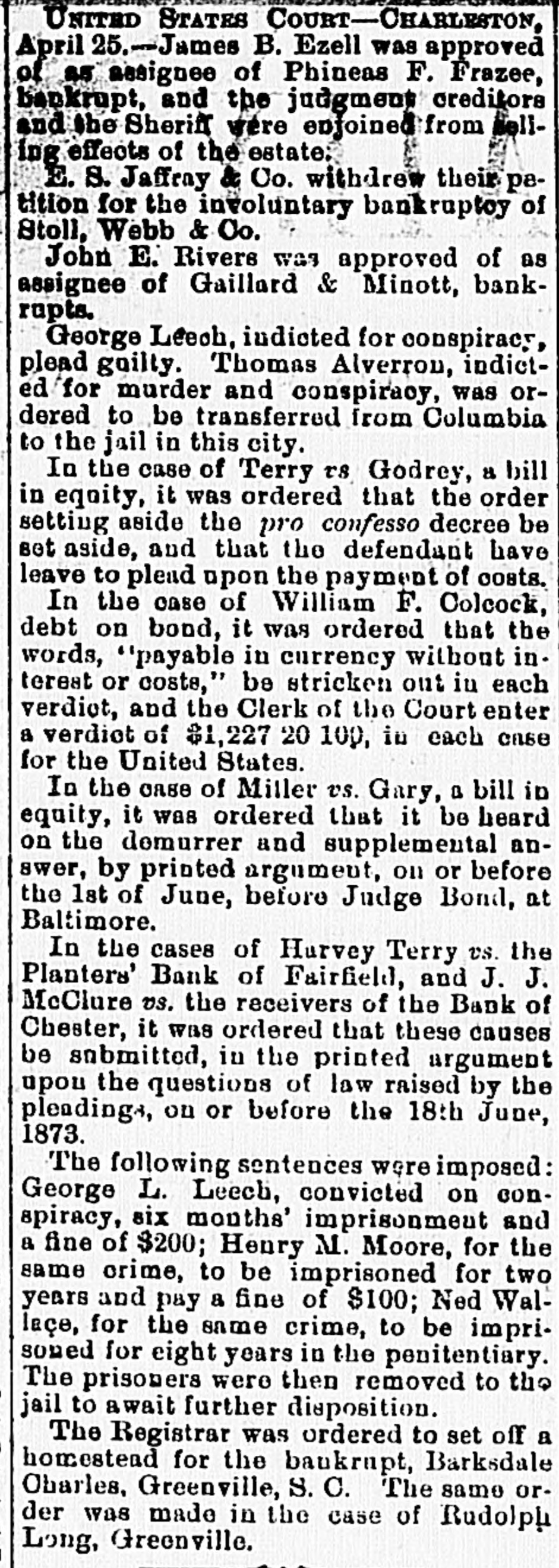
UNITED STATES COURT-CHARLESTON, April 25.-James B. Ezell was approved of as assignee of Phineas F. Frazee, bankrupt, and the judgment creditors and the Sheriff were enjoine&from Helling effects of the estate: E. S. Jaffray & Co. withdrew their petition for the involuntary bankruptoy of Stoll, Webb & Co. John E. Rivers was approved of as assignee of Gaillard & Minott, bankrupts. George Leech, indicted for conspiracy, plead gailty. Thomas Alverron, indicted for murder and conspiracy, was ordered to be transferred from Columbia to the jail in this city. In the case of Terry rs Godrey, a bill in equity, it was ordered that the order setting aside the pro confesso decree be set aside, and that the defendant have leave to plead upon the payment of costs. In the case of William F. Colcock, debt on bond, it was ordered that the words, "payable in currency without intereat or costs," be stricken out in each verdiot, and the Clerk of the Court enter a verdiot of $1,227 20 100, in each case for the United States. In the case of Miller vs. Gary, a bill in equity, it was ordered that it be heard on the domurrer and supplemental answer, by printed argument, on or before the 1st of June, before Judge Bond, at Baltimore. In the cases of Hurvey Terry vs. the Planters' Bank of Fairfield, and J. J. McClure vs. the receivers of the Bank of Chester, it was ordered that these causes be submitted, in the printed argument upon the questions of law raised by the pleadings, on or before the 18th June, 1873. The following sentences were imposed: George L. Leech, convicted on conspiracy, six months' imprisonment and a fine of $200; Henry M. Moore, for the same orime, to be imprisoned for two years and pay a fine of $100; Ned Wallaçe, for the same crime, to be imprisomed for eight years in the penitentiary. The prisoners were then removed to the jail to await further disposition. The Registrar was ordered to set off a homestead for the baukrupt, Barksdale Obarles, Greenville, S.C. The same order was made in the case of Rudolph Long, Greenville.


Article from Yorkville Enquirer, November 4, 1875

Click image to open full size in new tab

Article Text

his store, and tell him in a very positive man- ner that he must stop his nefarious business. If the injunction was not obeyed, to pay a sec- ond visit, and proceed at once to the good work of demolishing his store. This is the kind of treatment these rascals deserve. Revs. R. E. Cooper, J. S. White and T. W. Irwin, held a recent meeting at this place in reference to the work of sustentation in Bethel Presbytery. They also had under consideration the propriety and expediency of obtaining an evangelist for the Presbytery. No conclusion of a definite nature was ar- rived at in regard to the matter. The com- mittee, however, inclined to the opinion that the means at their disposal had best be devo- ted to the cause of sustentation. The condi- tion of Rev. Mr. James, of Union, who has recently been sold out of house and home by the sheriff, came up for consideration before the committee. Their warmest sympathies were expressed for this good man and faith- ful preacher, and I have no doubt an earnest effort will be made by the Presbytery, through their committee, to provide him a home. Harvey Terry, Esq., of Columbia, who in- vested, after the war, a large amount of mon- ey in the bills of the old Bank of Chester, has recently brought suit in the United States District Court against a large number of its stockholders. On Thursday the writs were served upon the stockholders living in our town. The summons reads as follows: "You are hereby strictly commanded, and firm- ly enjoined that, all manner of excuses being laid aside, you be and appear before the Judges of the Circuit Court of the United States for the District of South Carolina, at Charleston, on the first Monday of November next, twenty days after the service thereof; then and there true and per- fect answer to make upon your corporal oath on the Holy Evangelists, to all such matters as shall be objected against you in the bill of complaint of Harvey Terry against the Bank of Chester and John J. McLure, Receiver, et. al. And also that you do, on the rule's day next immediately after the day appointed and expressed, file, or cause to be filed, in the Registry of said Court, your plea, answer or demurrer, to the said bill of com- plaint." The fear that the plaintiff will recover judgment is causing some of the stockholders to tremble in their boots. Others regard the matter with perfect indifference. They snap their fingers at old Terry, and tell him to get his money if he can. The bills of the old Bank of Chester, which were bought up by the plaintiff at a mere song, will have proven a splendid investment if the Court orders their payment in full. It will certainly be a painful spectacle to men to see their property pass out of their hands for the purpose of re- deeming bills, which were overwhelmed with ruin by the results of a disastrous war. It is said that Mr. Terry is his own lawyer, but the probabilities favor the engineering of the whole affair by one of the Columbia lawyers. The defendants to the suit will be represented by very fine legal counsel. On Thursday, Mr. Marion Chisholm brought suit for damages before Trial Justice Sanders, against certain colored men for in- flicting such injuries upon his cow as to occa- sion its death. Gen. W. A. Walker and J. G. McAliley, Esq., were the lawyers employ- ed in the case the former representing the plaintiff and the latter the defendants. The charge brought against the defendants was established by the testimony. They, howev- er, endeavored to show that the cow came to her death by eating an undue quantity of peas; but a post mortem examination of the unfortunate cow revealing no sign of peas, caused this allegation to fall to the ground. The defendants, who were three in number, were sentenced by the Trial Justice to an im- prisonment of fifteen days in the county jail, or the payment of a fine of five dollars each, and the costs of the suit. The latter alterna- tive was complied with, and they were dis- charged. Dublin Walker and Henry Blake, charged with and convicted at the recent sitting of the Sessions Court of the crime of issuing a fraudulent school certificate, and sentenced to an imprisonment in the State penitentiary- the former for a period of twelve months, the latter for three months have been brought back to our county jail, and will serve out their respective sentences here. Governor Chamberlain was simply unable to stem the tide of solicitation that flowed with an irresis- tible force in favor of the prisoners. He had the desire to stand firm and do his duty by the State; but, unfortunately, he did not have a sufficient amount of that Andrew Jackson determination in his character to carry the commendable desire into execution. Judge T. J. Mackey, who played a prominent part in obtaining the removal of Walker and Blake from the penitentiary to this place, says there were some leading Republicans here who op- posed this removal, and that this opposition was occasioned by the fear that some disa- greeable disclosures might be made by the prisoners in the event of their serving their imprisonment here. These developments, he says, will be brought to the light of day in the course of a few months, and will produce a considerable sensation. Hurry on the de- velopments with all possible speed! The public desire to become acquainted with the names of the guilty parties, and with the character of their actions. With the exception of Saturday evening, religious services were held in the Presbyte- rian church on every evening during the past week. Rev. Dr. Plumer, of Columbia, con- ducted the exercises on Friday evening, se- lecting his text from the last chapter of Joshua, "Choose ye, this day, whom ye will serve." The sermon was a solemn and earn- est appeal to the unconverted to embrace the offers of salvation. Jonathan Thompson, of this county, made application, recently, to our Board of Coun- ty Commissioners, for pecuniary assistance.


Article from Yorkville Enquirer, November 1, 1877

Click image to open full size in new tab

Article Text

the case, to obtain a reëlection by the State Legislature. Gen. Butler would again be returned to the Senate, and his admission could not be refused. John A. Bradley, Sr., Esq., of our town, has recently published, in pamphlet form, a brief sketch of his own life. It is due to the prominence he once occupied in this county, and his host of friends, to state the prominent events narrated in this autobiographical sketch. At the age of nineteen he entered the Sheriff's office of Chester as Deputy of Colonel Daniel G. Cabeen, "at a salary of $250 per annum, furnishing my (his) own horse a great part of the time, and my (his) own board and lodging." In 1833 he was elected to the Sheriffalty, "more than doubling two opponents." In 1836 he was a member of the South Carolina delegation that attended the Louisville, Cincinnati and Charleston Railroad Convention, which assembled in Knoxville on the 4th of July of that year. In 1838, he was chosen one of the Representatives from Chester county in the State Legislature. In 1841 he was defeated for the Sheriffalty by Mr. W. A. Rosborough, deceased, by a majority of three. votes. This defeat he attributed to "the defection of a portion of the nullification party." In 1846 he was elected Secretary and Treasurer of the Charlotte and South Carolina Railroad Company, which position he held until 1854, when he resigned. In 1850 he was a delegate from South Carolina in the Nashville Convention. In 1853 he was elected Cashier of the Bank of Chester. This position he held until 1865, when the Bank suspended operations. In 1863 he was chosen LieutenantColonel of the Fifth Regiment, State troops, commanded by Col. J. H. Williams, of Newberry, and remained with this regiment for six months, which was the time of their enlistment. He has been engaged for the greater portion of the time since the war in the