First National Bank (Cheyenne, WY)

Episode Information

Episode UID
180001495
Episode Type
Suspension β†’ Closure
Bank Type
national
Bank ID
18000 national
Charter Number
1800
Start Date
July 9, 1924
Location
Cheyenne, Wyoming (41.140, -104.820)

Metadata

Model
gpt-5-mini (chosen from majority vote of a three-model LLM ensemble)
Short Digest
e0290a5708e60e8f

Response Measures

None

Receivership Details

Depositor recovery rate
57.9%
Date receivership started
1924-07-09
Date receivership terminated
1931-11-02
OCC cause of failure
Economic conditions
Share of assets assessed as good
45.1%
Share of assets assessed as doubtful
45.5%
Share of assets assessed as worthless
9.4%

Events (4)

1. March 7, 1871 Chartered
Source
historical_nic
2. July 9, 1924 Receivership
Source
historical_nic
3. July 9, 1924 Receivership
Newspaper Excerpt
The First National bank here failed to open this morning... was closed by order of the board of directors and was in the hands of the national bank examiners.
Source
newspapers
4. July 9, 1924 Suspension
Cause
Government Action
Cause Details
Closed by order of its board and placed in the hands of national bank examiners; cited extraordinary depreciation in cattle and land values, excessive taxation, and support extended to smaller state banks.
Newspaper Excerpt
The First National bank here failed to open this morning. A posted notice stated that the bank was closed by order of the board of directors and was in the hands of the national bank examiners.
Source
newspapers

Newspaper Articles (15)

Article from The Muscatine Journal, July 9, 1924

Click image to open full size in new tab

Article Text

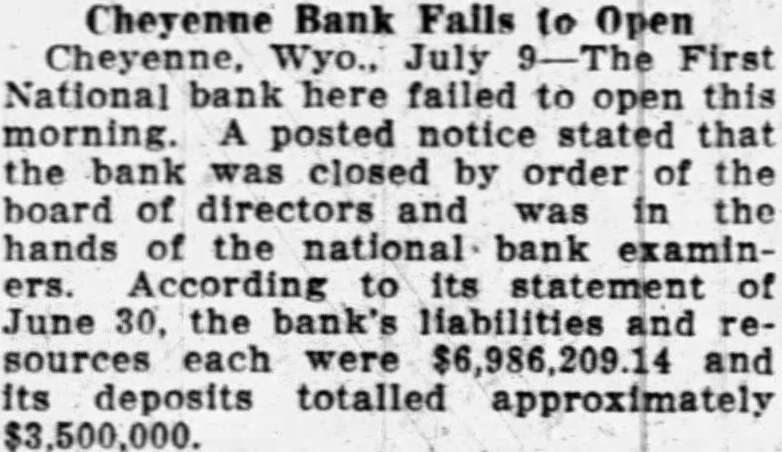
Cheyenne Bank Fails to Open Cheyenne, Wyo., July 9β€”The First National bank here failed to open this morning. A posted notice stated that the bank was closed by order of the board of directors and was in the hands of the national bank examiners. According to its statement of June 30, the bank's liabilities and resources each were $6,986,209.14 and its deposits totalled approximately $3,500,000.


Article from Rawlins Republican, July 10, 1924

Click image to open full size in new tab

Article Text

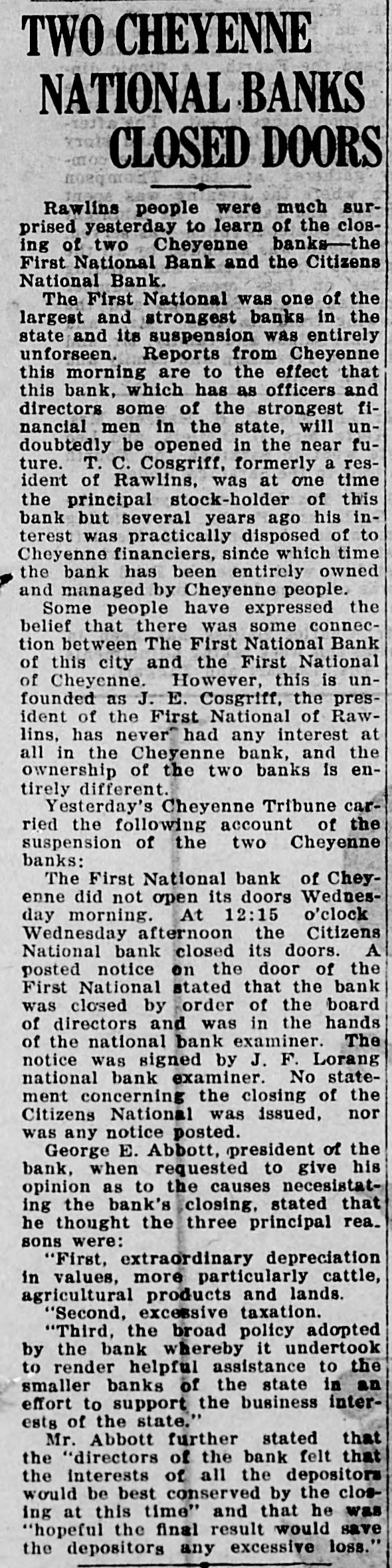
TWO CHEYENNE NATIONAL BANKS CLOSED DOORS Rawlins people were much surprised yesterday to learn of the closing of two Cheyenne banks-the First National Bank and the Citizens National Bank. The First National was one of the largest and strongest banks in the state and its suspension was entirely unforseen. Reports from Cheyenne this morning are to the effect that this bank, which has as officers and directors some of the strongest financial men in the state, will undoubtedly be opened in the near future. T. C. Cosgriff, formerly a resident of Rawlins, was at one time the principal stock-holder of this bank but several years ago his interest was practically disposed of to Cheyenne financiers, since which time the bank has been entirely owned and managed by Cheyenne people. Some people have expressed the belief that there was some connection between The First National Bank of this city and the First National of Cheyenne. However, this is unfounded as J. E. Cosgriff, the president of the First National of Rawlins, has never had any interest at all in the Cheyenne bank, and the ownership of the two banks is entirely different. Yesterday's Cheyenne Tribune carried the following account of the suspension of the two Cheyenne banks: The First National bank of Cheyenne did not open its doors Wednesday morning. At 12:15 o'clock Wednesday afternoon the Citizens National bank closed its doors. A posted notice on the door of the First National stated that the bank was closed by order of the board of directors and was in the hands of the national bank examiner. The notice was signed by J. F. Lorang national bank examiner. No statement concerning the closing of the Citizens National was issued, nor was any notice posted. George E. Abbott, president of the bank, when requested to give his opinion as to the causes necesistating the bank's closing, stated that he thought the three principal rea. sons were: "First, extraordinary depreciation in values, more particularly cattle, agricultural products and lands. "Second, excessive taxation. "Third, the broad policy adopted by the bank whereby it undertook to render helpful assistance to the smaller banks of the state in an effort to support the business interests of the state." Mr. Abbott further stated that the "directors of the bank felt that the interests of all the depositors would be best conserved by the closing at this time" and that he was "hopeful the final result would save the depositors any excessive loss."


Article from The Daily Worker, July 14, 1924

Click image to open full size in new tab

Article Text

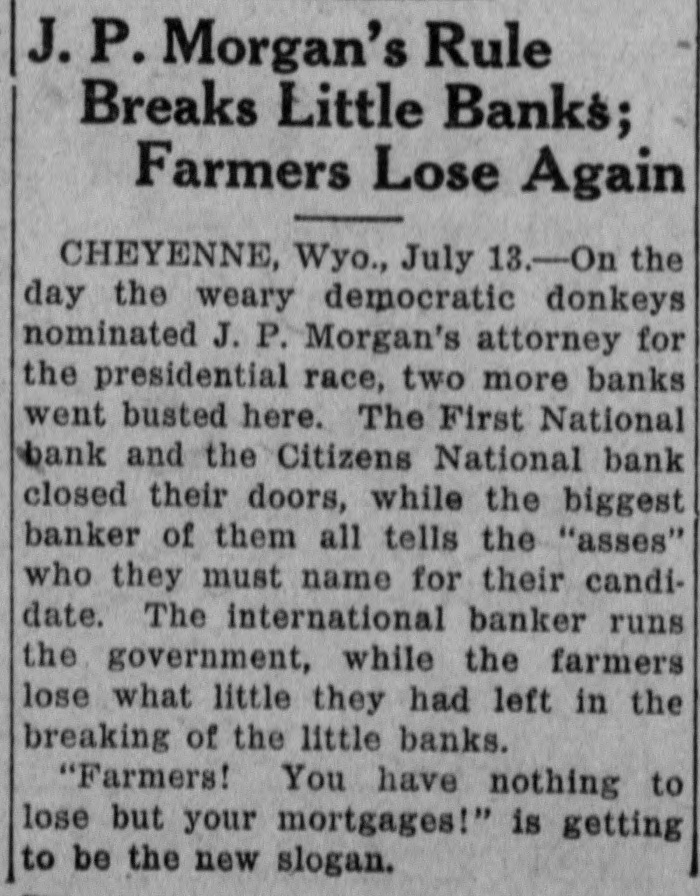
J. P. Morgan's Rule Breaks Little Banks; Farmers Lose Again CHEYENNE, Wyo., July 13.-On the day the weary democratic donkeys nominated J. P. Morgan's attorney for the presidential race, two more banks went busted here. The First National bank and the Citizens National bank closed their doors, while the biggest banker of them all tells the "asses" who they must name for their candidate. The international banker runs the government, while the farmers lose what little they had left in the breaking of the little banks. "Farmers! You have nothing to lose but your mortgages!" is getting to be the new slogan.


Article from Park County Herald, July 16, 1924

Click image to open full size in new tab

Article Text

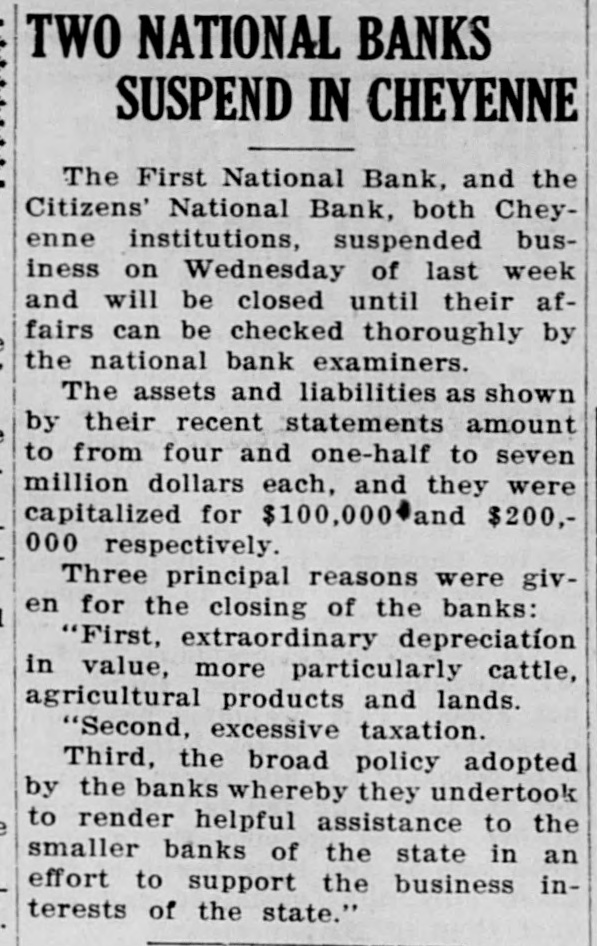
TWO NATIONAL BANKS SUSPEND IN CHEYENNE The First National Bank, and the Citizens' National Bank, both Cheyenne institutions, suspended business on Wednesday of last week and will be closed until their affairs can be checked thoroughly by the national bank examiners. The assets and liabilities as shown by their recent statements amount to from four and one-half to seven million dollars each, and they were capitalized for $100,000 and $200,000 respectively. Three principal reasons were given for the closing of the banks: "First, extraordinary depreciation in value, more particularly cattle, agricultural products and lands. "Second, excessive taxation. Third, the broad policy adopted by the banks whereby they undertook to render helpful assistance to the smaller banks of the state in an effort to support the business interests of the state."


Article from Rich Hill Mining Review, July 17, 1924

Click image to open full size in new tab

Article Text

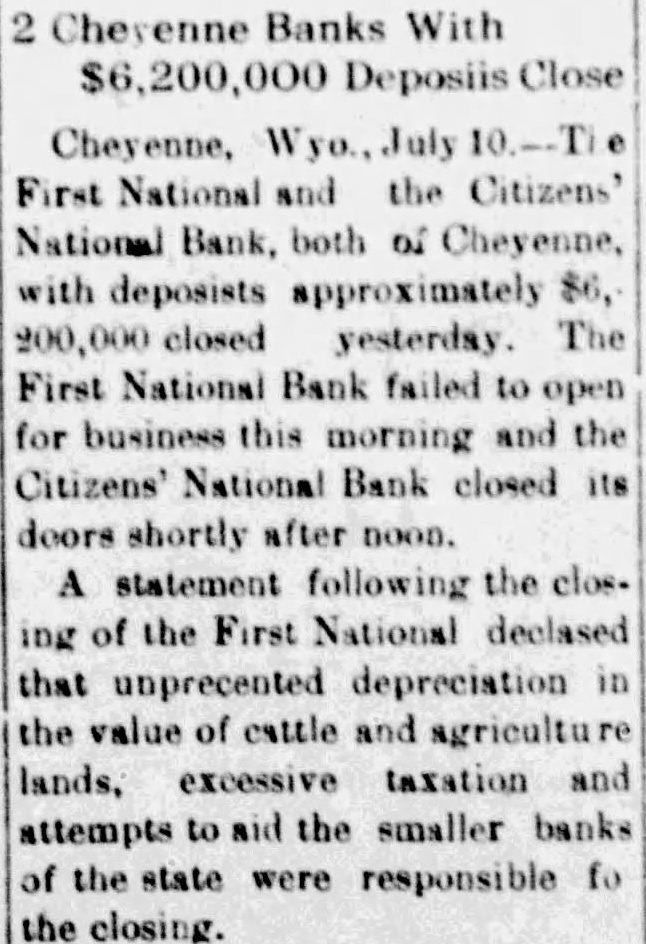
2 Cheyenne Banks With $6,200,000 Deposits Close Cheyenne, Wyo., July 10.β€”The First National and the Citizens' National Bank, both of Cheyenne, with deposits approximately $6,200,000 closed yesterday. The First National Bank failed to open for business this morning and the Citizens' National Bank closed its doors shortly after noon. A statement following the closing of the First National declared that unprecented depreciation in the value of cattle and agriculture lands, excessive taxation and attempts to aid the smaller banks of the state were responsible for the closing.


Article from The Great Falls Leader, July 20, 1924

Click image to open full size in new tab

Article Text

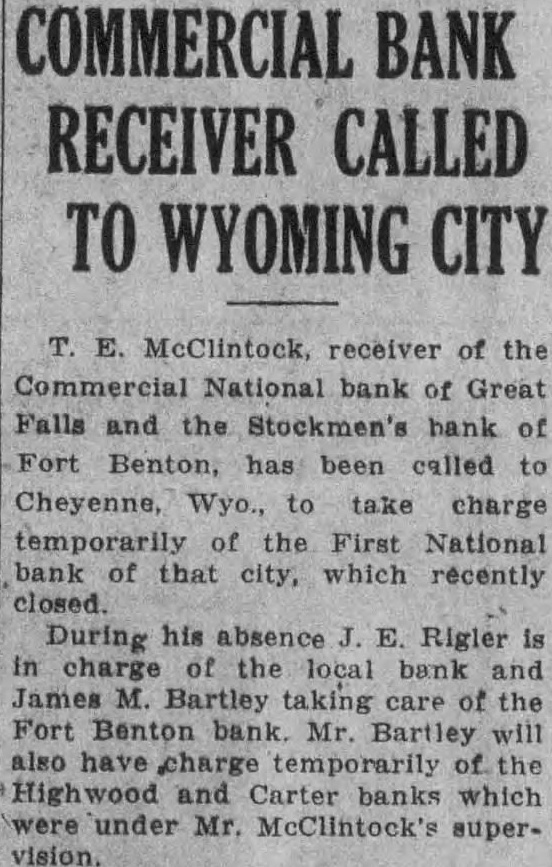
COMMERCIAL BANK RECEIVER CALLED TO WYOMING CITY T. E. McClintock, receiver of the Commercial National bank of Great Falls and the Stockmen's bank of Fort Benton, has been called to Cheyenne, Wyo., to take charge temporarily of the First National bank of that city, which recently closed. During his absence J. E. Rigler is in charge of the local bank and James M. Bartley taking care of the Fort Benton bank. Mr. Bartley will also have charge temporarily of the Highwood and Carter banks which were under Mr. McClintock's supervision.


Article from The News Letter, July 24, 1924

Click image to open full size in new tab

Article Text

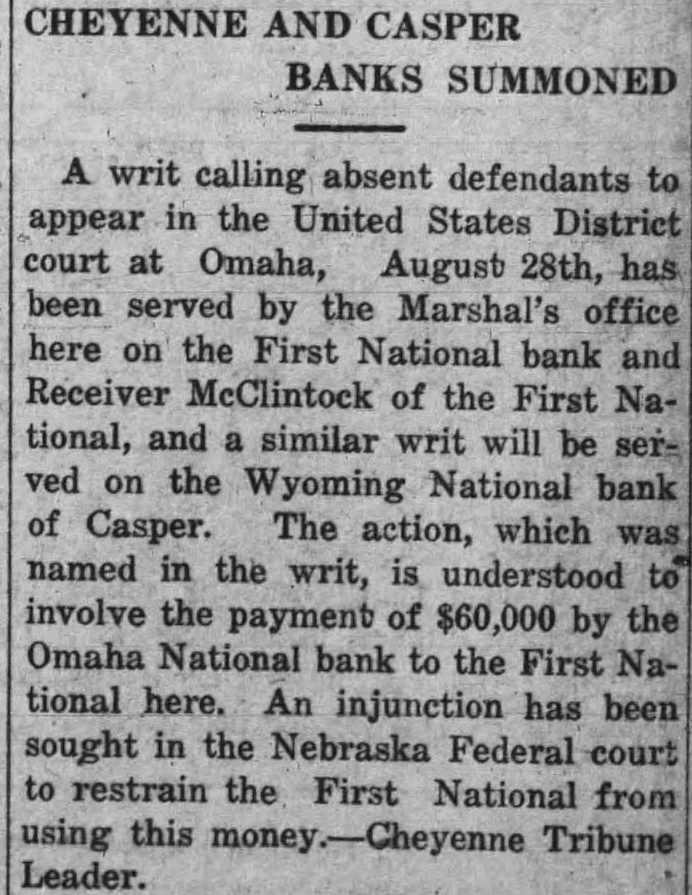
CHEYENNE AND CASPER BANKS SUMMONED A writ calling absent defendants to appear in the United States District court at Omaha, August 28th, has been served by the Marshal's office here on the First National bank and Receiver McClintock of the First National, and a similar writ will be served on the Wyoming National bank of Casper. The action, which was named in the writ, is understood to involve the payment of $60,000 by the Omaha National bank to the First National here. An injunction has been sought in the Nebraska Federal court to restrain the First National from using this money.β€”Cheyenne Tribune Leader.


Article from Casper Daily Tribune, February 27, 1925

Click image to open full size in new tab

Article Text

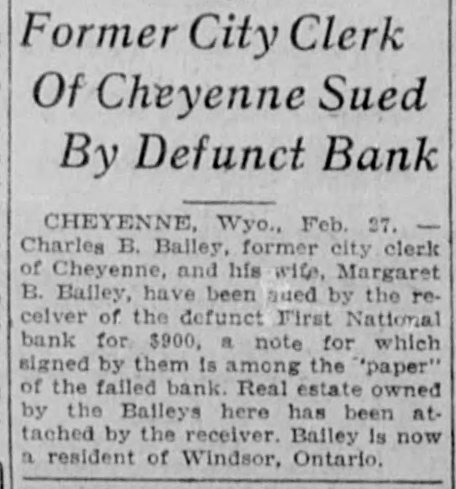
Former City Clerk Of Cheyenne Sued By Defunct Bank CHEYENNE, Wyo., Feb. 37. Name Charles B. Balley, former city clerk of Cheyenne, and his wite, Margaret B. Bailey, have been aued by the recelver of the defunct First National bank for $900, a note for which signed by them Is among the "paper" of the failed bank. Real estate owned by the Baileys here has been attached by the receiver. Bailey Is now a resident of Windsor, Ontario.


Article from The Daily Missoulian, November 8, 1925

Click image to open full size in new tab

Article Text

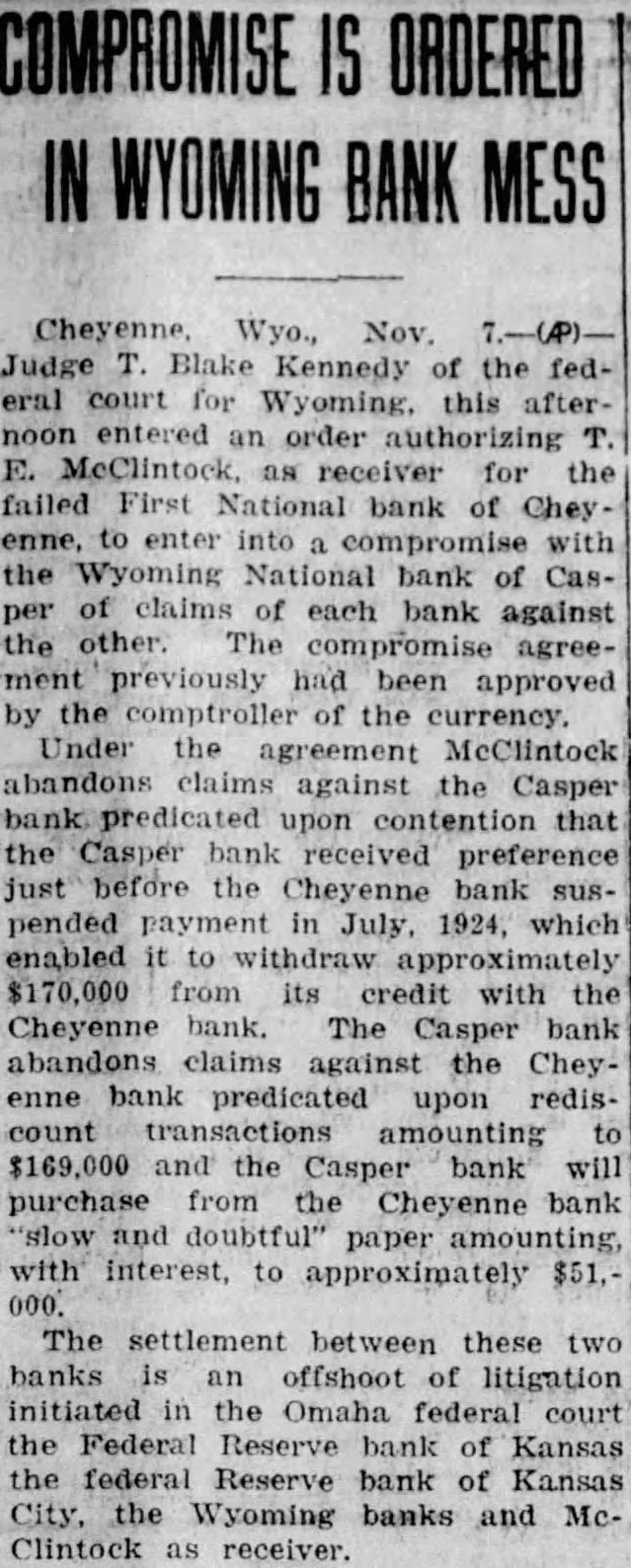
COMPROMISE IS ORDERED IN WYOMING BANK MESS Cheyenne, Wyo., Nov. 7.-(P)Judge T. Blake Kennedy of the federal court for Wyoming. this afternoon entered an order authorizing T. E. McClintock. as receiver for the failed First National bank of Chey enne, to enter into a compromise with the Wyoming National bank of Casper of claims of each bank against the other. The compromise agreement previously had been approved by the comptroller of the currency. Under the agreement McClintock abandons claims against the Casper bank predicated upon contention that the Casper bank received preference just before the Cheyenne bank suspended payment in July, 1924, which enabled it to withdraw approximately $170,000 from its credit with the Cheyenne bank. The Casper bank abandons claims against the Cheyenne bank predicated upon rediscount transactions amounting to $169,000 and the Casper bank will purchase from the Cheyenne bank "slow and doubtful" paper amounting, with interest, to approximately $51, 000. The settlement between these two banks is an offshoot of litigation initiated in the Omaha federal court the Federal Reserve bank of Kansas the federal Reserve bank of Kansas City, the Wyoming banks and McClintock as receiver.


Article from Casper Star-Tribune, June 23, 1926

Click image to open full size in new tab

Article Text

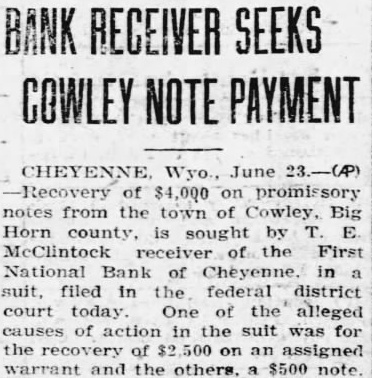
BANK RECEIVER SEEKS COWLEY NOTE PAYMENT -Recovery of $4,000 on promissory notes from the town of Cowley, Big Horn county. is sought by E. McClintock the First National Bank of Cheyenne. in suit, filed in the federal district court today. One of the alleged causes of action in the suit was for the recovery of on an assigned warrant and the others. $500 note.


Article from The Billings Gazette, December 10, 1926

Click image to open full size in new tab

Article Text

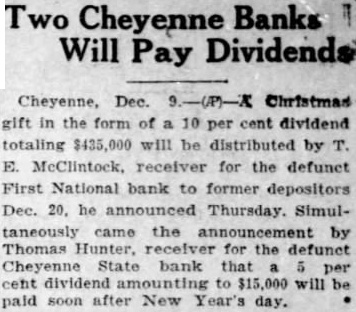
Two Cheyenne Banks Will Pay Dividends Cheyenne, Dec. Christmas gift in the form of per cent dividend totaling $435,000 will be distributed by T. E. McClintock, receiver for the defunct First National bank to former depositors Dec. 20. he announced Thursday. Simultaneously came the announcement by Thomas Hunter, receiver for the defunct Cheyenne State bank that cent dividend amounting to $15,000 will be paid soon after New Year's day.


Article from Casper Star-Tribune, December 22, 1927

Click image to open full size in new tab

Article Text

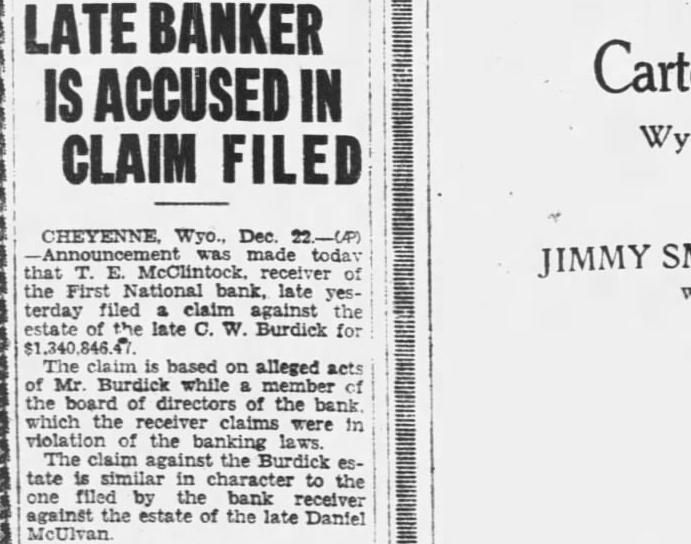
LATE BANKER IS ACCUSED IN CLAIM FILED CHEYENNE, Wyo., Dec. 22-(P) was made today that T. E. McClintock. receiver of the First National bank, late yesterday filed a claim against the estate of the late C. W. Burdick for The claim is based on alleged acts of Mr. Burdick while of the board of directors of the bank which the receiver claims were in violation of the banking laws. The claim against the Burdick estate is similar in character to the one filed by the bank receiver against the estate of the late Daniel


Article from Casper Star-Tribune, December 25, 1927

Click image to open full size in new tab

Article Text

Reciever for Bank Files Claim Against Estate of Director CHEYENNE, Wyo., Dec. 24.T. E. McClintock, receiver of the First National bank, has filed a claim against the estate of the late C. W Burdick for $1,340,846.47 The claim is based on alleged acts of Mr. Burdick while a member of the board of directors of the bank which the receiver claims were in violation of the banking laws. In the claim it is alleged that losses were sustained by the First National bank through loans which the deceased "as director negligently made or allowed to be made, or permitted agents and servants of the bank to make in violation of the law The receiver further alleges that the "deceased in failing to perform duties as required by law permitted the bank to become liable in execess of its legal limit.' He also alleges that loans were made "with insufficient security, and to irresponsible parties in excessive amounts and that due care was not taken to liquidate the loans or preserve the security." A number of specific items are listed with the general claim. The claim against the Burdick estate is similar in character to one filed by the bank receiver against the estate of the late Daniel McUlvan.


Article from Casper Star-Tribune, December 18, 1928

Click image to open full size in new tab

Article Text

BANK RECEIVER LOSES ACTION Richardson Interests Win Court Suit CHEYENNE, Wyo., Dec. 18.-A verdict for the defendants was returned in the United States court by the jury in the suit of T. E. MeClintock, as received of the First National bank, against the Richardson Brothers company, the Richardson Trust association and Warren Richardson. So completely did the bank recase that it was not necessary for the defendants to introduce word of testimony. Judge T. Blake Kennedy, presiding. directed the jury to return verdict against McClintock upon the showing that the plaintiff's side, itself, had made. MeClintock, as receiver. alleged in his action against the Richardsons that on the day before the First National bank failed the Richardsons had purchased two notes held by the bank. withdrawing for the purpose of paying for these notes the sum of $15,575 which they had on deposit in the bank. He alleged, further, that this transaction was to enable the Richardsons to avoid of the failure of the bank, of the imminency of which, he alleged, they were aware. Evidence in support of the receiver's contention developed that the Richardsons had bought nothing from the bank, but that they had bought from the makers of two notes held by the bank, from the two notes held by the bank the collateral securing these notes, paying $15,500 therefore, with the effect that the makers of the notes had been able to pay the bank in full. The collateral for which the Richardsons paid full value. it was developed, was not at the time worth 50 cents on the dolItar. The transaction which the receiver claimed was inimical to the bank, therefore, was shown as one favorable to the bank. The evidence further showed that the Richardson family had $14,502.24 on deposit in the First National bank at the time at which McClintock alleged the Richardsons were aware that the bank was about to fail. that they did not withdraw a dollar of this deposit and that this $14,502.24 was on deposit when the bank closed its doors. It further was shown by the attorneys for McClintock that Clarence B. Richardson, at a meeting held by the directors and other officers of the First National bank prior to its failure, offered $50,000


Article from Casper Star-Tribune, March 5, 1929

Click image to open full size in new tab

Article Text

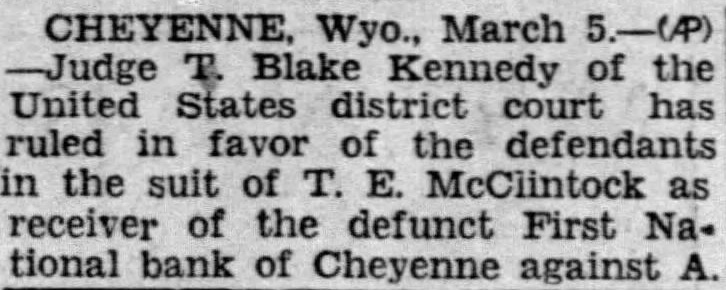
CHEYENNE, Wyo., March 5.β€”(AP)β€”Judge T. Blake Kennedy of the United States district court has ruled in favor of the defendants in the suit of T. E. McClintock as receiver of the defunct First National bank of Cheyenne against A.