Wasmansdorff & Heinemann (Chicago, IL)

Episode Information

Episode UID
1825531091164
Episode Type
Suspension β†’ Closure
Bank Type
private
Bank ID
182553109 hash
Start Date
December 21, 1896
Location
Chicago, Illinois (41.850, -87.650)

Metadata

Model
gpt-5-mini (chosen from majority vote of a three-model LLM ensemble)
Short Digest
5c81f7d8d48f9dfb

Response Measures

None

Events (2)

1. December 21, 1896 Suspension
Cause
Local Banks
Cause Details
Closed as a result of the suspension/failure of the National Bank of Illinois and clearing house refusal to continue clearing privileges
Newspaper Excerpt
The banking firm of Wasmansdorff & Heinemann is announced to be in the hands of the Security Title & Trust Co.
Source
newspapers
2. December 22, 1896 Receivership
Newspaper Excerpt
Judge Freeman has appointed the Security Title & Trust company receiver for E. S. Dreyer & Co. and Wasmansdorff & Heinemann.
Source
newspapers

Newspaper Articles (21)

Article from Rock Island Argus, December 21, 1896

Click image to open full size in new tab

Article Text

A FINANCIAL CRASH. The National Bank of Illinois Closes Its Doors. IN SENSATION CHICAGO. Institution With Assets of Nearly $15,000,000. Other Houses Follow SuitCuba up Again. Chicago, Dec. 21.--The National Bank of Illinois, one of the oldest and best known banking institutions in the city,with assets between $12,000,000 and $15,000,000, closed its doors today. The action was decided on at a meeting of the directors last night after the bank suspended. Of 16 banks that cleared through the National Bank of Iliinois, two closed their doors as a result of the suspension of that institution. They are Dreyer & Co. and Wasmansdorff & Heinemann. These two institutions are mortgage and loan banks and savings societies. Their failure is not expected to affect any business houses. The assets of Dreyer & Co. are $1,600,000 the liabilities $1,200,000. Wasmansdorf's assets are $650,000; liabilities $400,000. The Security Title & Trust company was appointed receiver for both. It was stated a loan of $2,400,000 was made to the Calumet Street Railroad company. Heavy loans on real estate were also made. It is thought probable the depositors will not suffer. The suspension had little effect either in the wheat pit or on the stock exchange. Comptroller Eckels Talks. Washington, Dec. 21. - Comp. troller Eckels has been advised that the Chicago clearing house has assumed to pay 75 per cent of all proved claims of the National Bank of Illinois, of Chicago. John C. McKeen was appointed receiver. At the last report-Nov. 10-the bank had a capital of $1,000,000, a surplus of $1,000,000, undivided profits of $150,000, the total assets. including bonds, being $15,046,992. The liabilities are about $11.000.000. While it is feared serious results may follow, the comptroller will do all iu his power to relieve the strain on the dependent banks and avert unnecessary panic. Comptroller Eckels has given out a statement concerning the failure of the National Bank of Illinois in the course of which he says: "The failure is due to the injurious, reckless and imprudent methods followed by the officers not checked by the direc. tors, though their attention has been individually called to the same, and over their individual signatures they had promised to remedy the weak points in the bank's condition. The largest source of failure of the bank's holdings was the Calumet Electric street railway stock, the full amount of which cannot now be stated, for it is discovered that part of such holdings were not made appear on the books. but concealed in another ac. count."

Article from Alexandria Gazette, December 21, 1896

Click image to open full size in new tab

Article Text

TO-DAY'S TELEGRAPHIC NEWS Failure of a Well Known Bank. CHICAGO, Dec. 21.-The National Bank of Illinois, one of the oldest and best known banking institutions in the city, with assets amounting to nearly $15,000,000, did not open its doors this morning. This action was decided upon by the directors last night, after the bank had been suspended from the clearing house association. The causes of the suspension, as given by the clearing house committee, are "unwarrantable and injudicious loans," through which "the capital and surplus of said bank is seriously imperiled, if not absolutely lost." At the last statement of the bank its capital was shown to be $1,000,000, with a surplus of $1,000,000 and undivided assets of over $300,000. It is thought probable that none of the depositors will suffer great loss by the suspension. CHICAGO, Dec. 21.-The banking firm of Wasmansdorff & Heinemann is announced to be in the hands of the Security Title & Trust Co. Judge Freeman has appointed the Security Title & Trust Company receiver for E. S. Dreyer & Company and Wasmansdorff and Heinemann.


Article from The Wilmington Daily Republican, December 22, 1896

Click image to open full size in new tab

Article Text

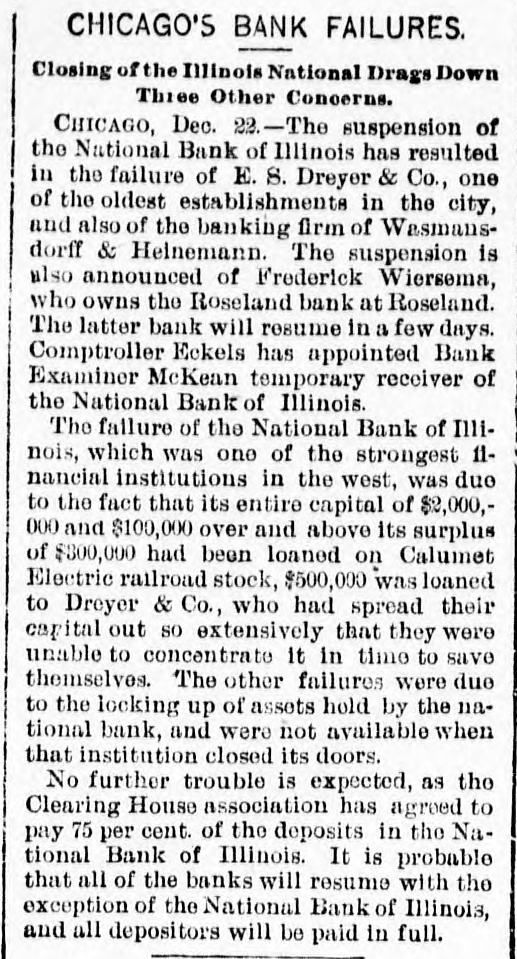
CHICAGO'S BANK FAILURES. Closing of the Illinois National Drags Down Three Other Concerns. CHICAGO, Dec. 22. - The suspension of the National Bank of Illinois has resulted in the failure of E. S. Dreyer & Co., one of the oldest establishments in the city, and also of the banking firm of Wasmansdorff & Heinemann. The suspension is also announced of Frederick Wiersema, who owns the Roseland bank at Roseland. The latter bank will resume in a few days. Comptroller Eckels has appointed Bank Examiner McKean temporary receiver of the National Bank of Illinois. The failure of the National Bank of Illinois, which was one of the strongest 11nancial institutions in the west, was due to the fact that its entire capital of $2,000,000 and $100,000 over and above its surplus of $300,000 had been loaned on Calumet Electric railroad stock, $500,000 was loaned to Dreyer & Co., who had spread their capital out SO extensively that they were unable to concentrate it in time to save themselves. The other failures were due to the locking up of assets hold by the national bank, and were not available when that institution closed its doors. No further trouble is expected, as the Clearing House association has agreed to pay 75 per cent. of the deposits in the National Bank of Illinois. It is probable that all of the banks will resume with the exception of the National Bank of Illinois, and all depositors will be paid in full.


Article from The Saint Paul Globe, December 22, 1896

Click image to open full size in new tab

Article Text

ILLINOIS NATIONAL'S DOORS CLOSED AS A RESULT OF LOOSE MANAGEMENT. RELIEF FOR DEPOSITORS. CLEARING HOUSE WILL ADVANCE SEVENTY-FIVE PER CENT ON CLAIMS TEMPORARY RECEIVER APPOINTED Creditors Will Receive a Large Dividend Within Thirty DaysNo Panic Precipitated CHICAGO, Dec. 21.-The National Bank of Illinois closed its doors today. This action was decided upon at a meeting of the directors of the bank last night, after the bank had been suspended from the clearing house of Chicago, at,a meeting of the clearing house committee held earlier in the day. The causes of the suspension, as given in the resolutions adopted by the clearing house committee, are "unwarrantable and injudicious loans through which the capital and surplus of said bank is seriously imperiled if not absolutely lost." The statement was made that a loan of about $2,400,000 to the Calumet Street Railroad company, of which J. W. Farson, of Farson, Leach & Co., is president, had caused the National Bank of Illinois to suspend. Mr. Farson declined to make a statement on that subject, but stated that the failure would not affect the Calumet road. Heavy loans on real estate are also said to have been made. The last statement of the bank showed deposits $12,175,766; loans $9,199,642; cash resources, $4,983,202. A director of the bank stated that the loan made to the Calumet electric street railway, $2,400,000, was without the knowledge of the directors. The efforts made to dispose of the Calumet stock held as security for the loan drew attention to it and brought about the investigation which resulted in the bank's suspension. Of the sixteen banks which cleared through the National Bank of Illinois, two closed their doors as a result of the closing of that institution. They are E. S. Dreyer & Co. and Wasmansdorff & Heinemann. These two institutions are mortgage loan banks and savings societies in a small way, and their failure is not expected to affect business. The assets of E. S. Dreyer & Co. are given at $1,600,000, with liabilities of $1,200,000. The figures for Wasmansdorff & Heinemann are approximately. Assets, $650,000; liabilities, $400,000. The Security Title and Trust company was appointed receiver for both firms. Six banks have made arrangements to clear through other banks, and the balance of the sixteen are making similiar arrangements as fast as possible. Neither the bank examiner nor any officer of the National Bank of Illinois will make any statement at present. The principal source of trouble of the National Bank of Illinois was a loan of $2,400,000 to the Calumet Electric Railway company. This, with three or four over-loans, threatened such severe losses that the clearing house committee saw no way but to suspend the bank. The loss in liquidations will be small, if any, to depositors. It is not probable that the bank will resume business. At a meeting of the clearing house banks held after the close of business this afternoon, all the banks were represented, and upon recommendation of the clearing house committee which had made a thorough examination of


Article from The Salt Lake Herald, December 22, 1896

Click image to open full size in new tab

Article Text

Chicago, Dec. 21.-The closing of an institution which was considered to be the second strongest national bank in Chicago, quickly followed by the failure of three private banking houses which did business with it, caused a flurry of excitement in financial circles today, and led to runs on several banks by timid depositors. A flood of rumors relative to other banks and business firms added to the intense nervousness which pervaded all classes of people long after banking hours and the close of the courts. OTHERS GO DOWN. The banks which were closed follow: National Bank of Illinois, capital $1,000,000; liabilities, $11,000,000. E. S. Dreyer & Co., bankers, mortgage brokers and real estate dealersliabilities, $1,300,000; estimated value of assets, $1,650,000. Wasmansdorff & Heinenmann, bankers and mortgage brokers-liabilities, $416,000; estimated value of assets, $550,000. Roseland Savings bank, Roselin, III.Small capital and assets estimated to equal liabilities. All the private banks which closed their doors cleared through the National Bank of Illinois, and the big crash compelled their suspension to conserve their assets and protect creditors. The two private city banks went into liquidation through receivership proceedings in the courts. REASSURING ACTION. Reassuring action was taken at a largely attended meeting of the clearing house association, which was held after banking hours this afternoon. The following resolution, offered by exComptroller of the Currency E. S. Lacey, president of the Bankers' National bank, was unanimously adopted: "That the clearing house committee, after calling to their aid such other persons as they mav desire, be requested to formulate a plan which will enable the creditors of the National Bank of Illinois to avail themselves of the offer of the associated banks to make advances by way of loans to said creditors to the amount of 75 per cent upon properly proven claims." The chairman of the clearing house committee stated that the readiness of bankers to do this was SO evident that it was not probable any formal organization to accomplish the object set forth in the resolution would be necessary, although the committee appointed will give prompt attention to the duty imposed on them. EXAMINER NAMED. William F. Drummer, president of the association and vice president of the Northwestern National bank, read the following telegram, which he had received from Comstroller of the Currency Eckels, dated Washington: "I have appointed Bank Examiner McKeon temporary receiver of the National Bank of Illinois, and instructed him to publish notice to creditors to prove claims. He imforms me that the clearing house committee will advance 75 per cent on evidence of claims. Notice will be published at once, and if claims are proven immediately, I shall, within 30 days, be able to pay a very considerable dividend. I appreciate the action of the clearing house in offering to advance on such certificates." The decisions of the clearing house committee to refuse clearing privileges to the National Bank of Illinois, and also to refuse funds by which the bank could have gone into voluntary liquidation, was chiefly due to the astounding discovery that the bank had loaned $2,400,000 to the Calumet Electric Street Railroad company on its bonds as sole security. This loan exceeded the bank's capital and surplus. Another account which caused the bankers to hesitate was stated to be near $500,000, the debtor being E. S. Dreyer @ Co. Robert Berger, the only partner of Mr. Dreyer, is a son-in-law of George Schneider, president of the failed national bank. There were two other big loans which were considered poor collateral. NECESSARY SEQUEL. The necesary sequel to this refusal to lend aid or to continue clearing privileges was that the big national bank on Dearborn street failed to open its doors this morning for public business. This was anticipated by the action of the clearing house committee, but there was a small knot of anxious depositors waiting on the marble steps of the entrance when the big iron screen in front of the doors was rolled up at 9 o'clock to admit several clerks. At 9:30 o'clock, a card was hung on the grill work, reading as follows: "This bank is in the hands of a national bank examiner. By order of the comptroller of the currency.' This cheerless announcement for depositors was quickly followed by the posting of notices that certain private banks and business firms would clear through other banks, or pay checks which had been given Saturday on the suspended institution. The following private and other banks made their clearance through the Illinois National: E. S. Dreyer & Co.; Farson, Leach & Co.: Garden City Banking and Trust company; Greenbaum Sons; E. R. Haas & Co.; International bank; Leopold Mayer & Co.; Oakland bank: Oak Park State bank; Roseland Savings bank; W. G. Stoughton & Co.: Wasmansdorff & Heinemann; West Side bank; Siegel, Cooper & Co.'s bank: Adams Epress company's bank: cashier checks on Drovers' bank


Article from The Mena Weekly Star, December 23, 1896

Click image to open full size in new tab

Article Text

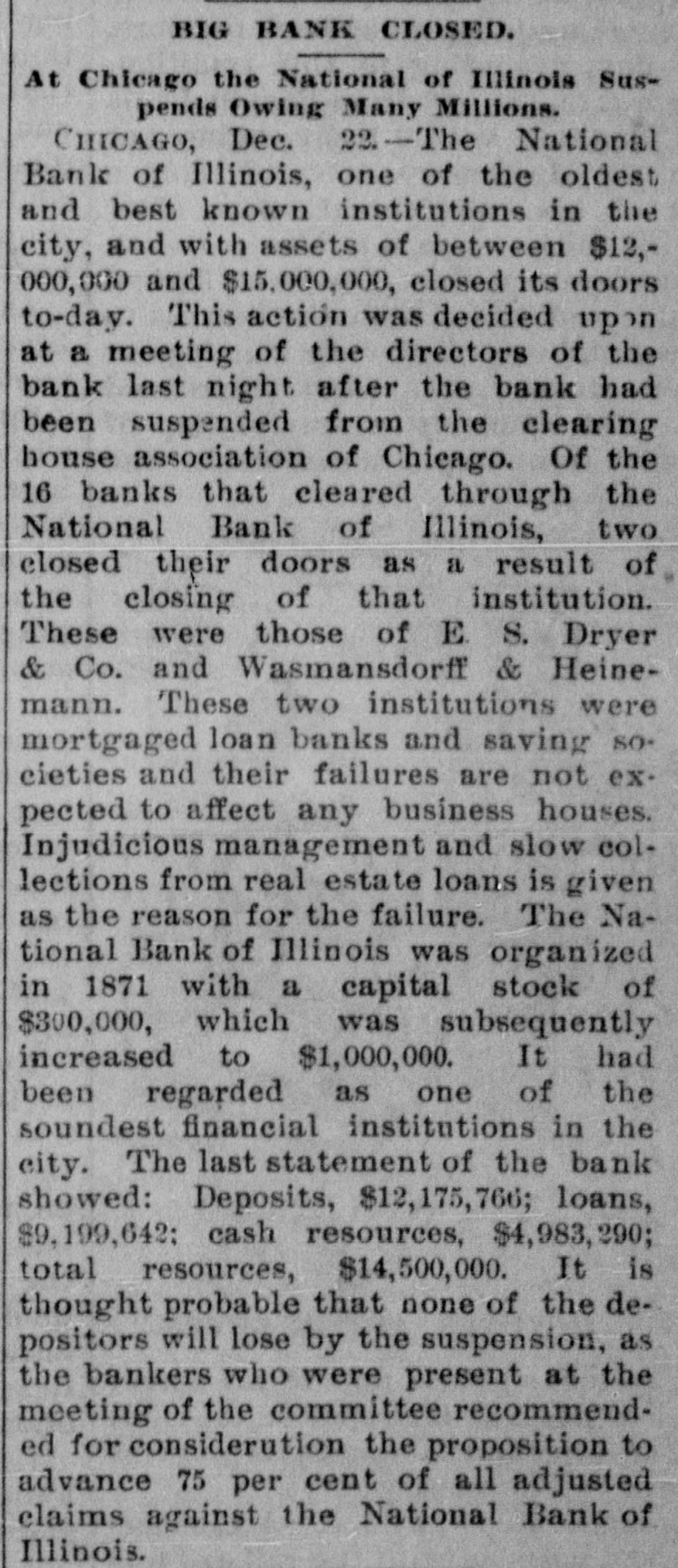
BIG BANK CLOSED. At Chicago the National of Illinois Suspends Owing Many Millions. CHICAGO, Dec. 22.-The National Bank of Illinois, one of the oldest and best known institutions in the city, and with assets of between $12,000,000 and $15,000,000, closed its doors to-day. This actiΓ³n was decided upon at a meeting of the directors of the bank last night after the bank had been suspended from the clearing house association of Chicago. Of the 16 banks that cleared through the National Bank of Illinois, two closed their doors as a result of the closing of that institution. These were those of E. S. Dryer & Co. and Wasmansdorff & Heinemann. These two institutions were mortgaged loan banks and saving societies and their failures are not expected to affect any business houses. Injudicious management and slow collections from real estate loans is given as the reason for the failure. The National Bank of Illinois was organized in 1871 with a capital stock of $300,000, which was subsequently increased to $1,000,000. It had been regarded as one of the soundest financial institutions in the city. The last statement of the bank showed: Deposits, $12,175,766; loans, $9,199,642: cash resources, $4,983,290; total resources, $14,500,000. It is thought probable that none of the depositors will lose by the suspension, as the bankers who were present at the meeting of the committee recommended for considerution the proposition to advance 75 per cent of all adjusted claims against the National Bank of Illinois.


Article from Wood County Reporter, December 24, 1896

Click image to open full size in new tab

Article Text

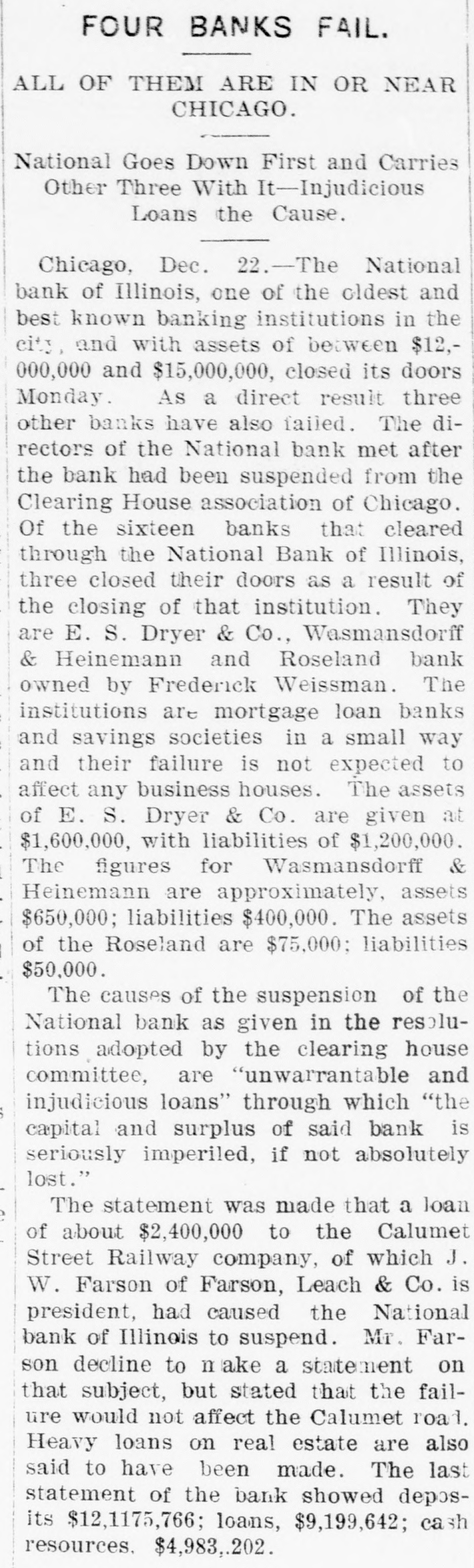
FOUR BANKS FAIL. ALL OF THEM ARE IN OR NEAR CHICAGO. National Goes Down First and Carries Other Three With It-Injudicious Loans the Cause. Chicago, Dec. 22.-The National bank of Illinois, one of the oldest and best known banking institutions in the city, and with assets of between $12,000,000 and $15,000,000, closed its doors Monday. As a direct result three other banks have also failed. The directors of the National bank met after the bank had been suspended from the Clearing House association of Chicago. Of the sixteen banks that cleared through the National Bank of Illinois, three closed their doors as a result of the closing of that institution. They are E. S. Dryer & Co., Wasmansdorff & Heinemann and Roseland bank owned by Frederick Weissman. The institutions are mortgage loan banks and savings societies in a small way and their failure is not expected to affect any business houses. The assets of E. S. Dryer & Co. are given at $1,600,000, with liabilities of $1,200,000. The figures for Wasmansdorff & Heinemann are approximately, assets $650,000; liabilities $400,000. The assets of the Roseland are $75,000; liabilities $50,000. The causes of the suspension of the National bank as given in the resolutions adopted by the clearing house committee, are "unwarrantable and injudicious loans" through which "the capital and surplus of said bank is seriously imperiled, if not absolutely lost." The statement was made that a loan of about $2,400,000 to the Calumet Street Railway company, of which J. W. Farson of Farson, Leach & Co. is president, had caused the National bank of Illinois to suspend. Mr. Farson decline to n ake a statement on that subject, but stated that the failure would not affect the Calumet road. Heavy loans on real estate are also said to have been made. The last statement of the bank showed deposits $12,1175,766; loans, $9,199,642; cash resources. $4,983,.202.


Article from River Falls Journal, December 24, 1896

Click image to open full size in new tab

Article Text

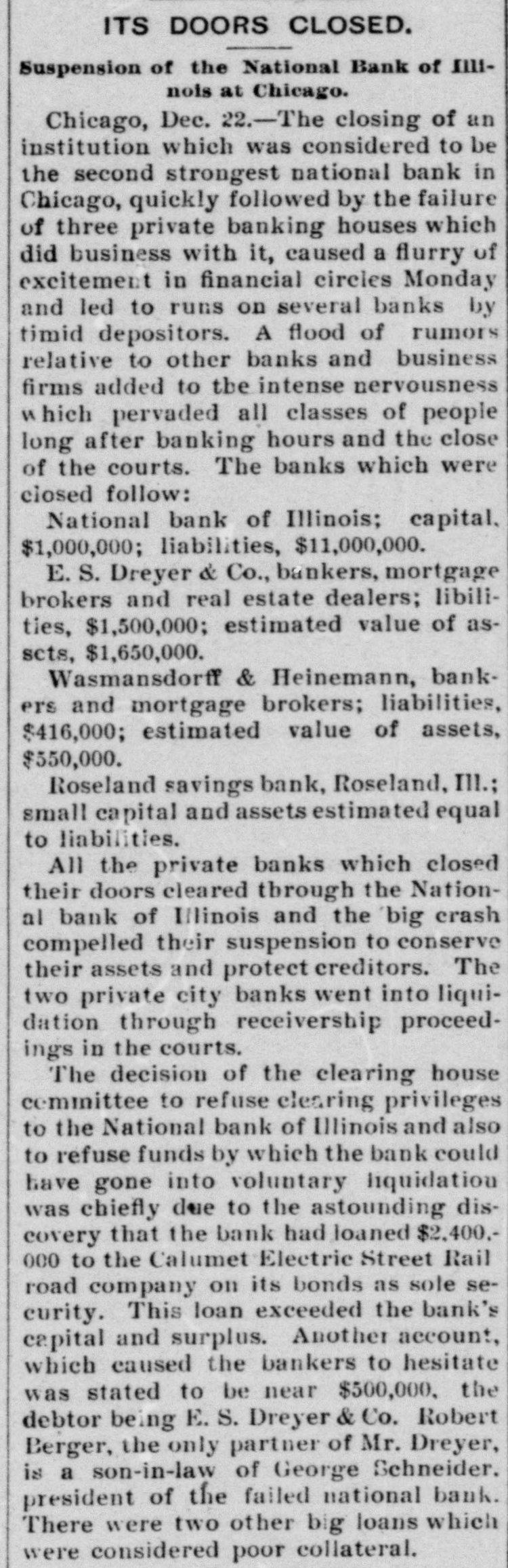
ITS DOORS CLOSED. Suspension of the National Bank of IIIInois at Chicago. Chicago, Dec. 22.-The closing of an institution which was considered to be the second strongest national bank in Chicago, quickly followed by the failure of three private banking houses which did business with it, caused a flurry of excitement in financial circles Monday and led to runs on several banks by timid depositors. A flood of rumors relative to other banks and business firms added to the intense nervousness which pervaded all classes of people long after banking hours and the close of the courts. The banks which were closed follow: National bank of Illinois; capital, $1,000,000; liabilities, $11,000,000. E.S. Dreyer & Co., bankers, mortgage brokers and real estate dealers; libilities, $1,500,000; estimated value of assets, $1,650,000. Wasmansdorff & Heinemann, bankers and mortgage brokers; liabilities, $416,000; estimated value of assets, $550,000. Roseland savings bank, Roseland, Ill.; small capital and assets estimated equal to liabilities. All the private banks which closed their doors cleared through the National bank of Illinois and the big crash compelled their suspension to conserve their assets and protect creditors. The two private city banks went into liquidation through receivership proceedings in the courts. The decision of the clearing house committee to refuse clearing privileges to the National bank of Illinois and also to refuse funds by which the bank could have gone into voluntary liquidation was chiefly due to the astounding discovery that the bank had loaned $2,400.000 to the Calumet Electric Street Rail road company on its bonds as sole security. This loan exceeded the bank's capital and surplus. Another account, which caused the bankers to hesitate was stated to be near $500,000, the debtor being E.S. Dreyer & Co. Robert Berger, the only partner of Mr. Dreyer, is a son-in-law of George Schneider. president of the failed national bank. There were two other big loans which were considered poor collateral.


Article from Mineral Point Tribune, December 24, 1896

Click image to open full size in new tab

Article Text

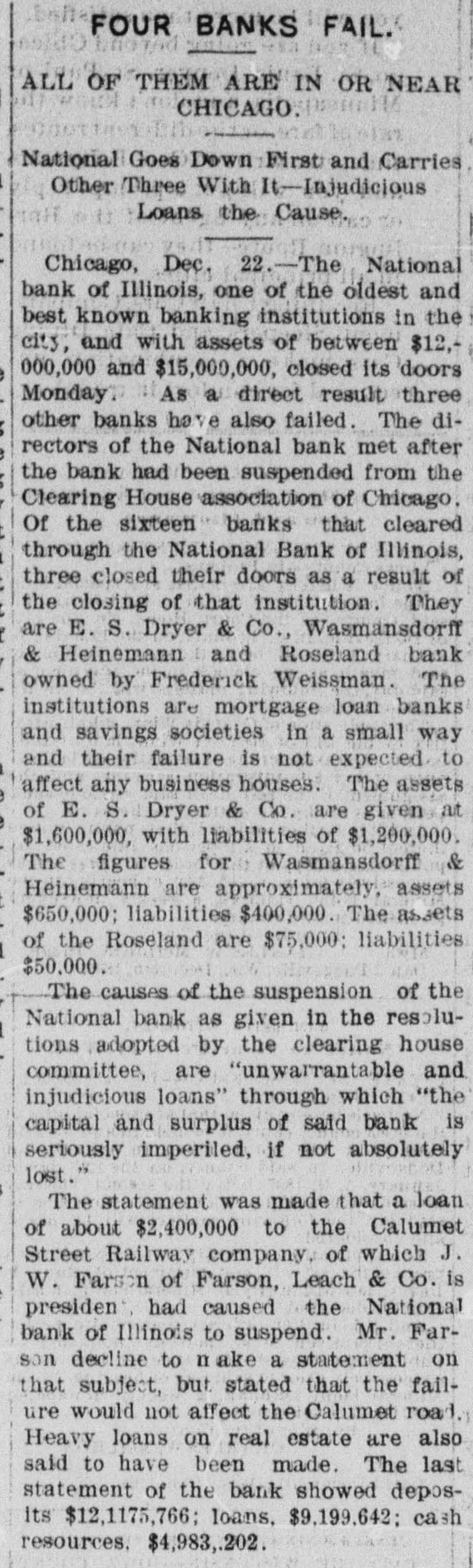
FOUR BANKS FAIL. ALL OF THEM ARE IN OR NEAR CHICAGO. National Goes Down First and Carries Other Three With It-Injudicious Loans the Cause Chicago, Dec. 22.-The National bank of Illinois, one of the oldest and best known banking institutions in the city; and with assets of between $12,000,000 and $15,000,000, closed its doors Monday. As a direct result three other banks have also failed. The directors of the National bank met after the bank had been suspended from the Clearing House association of Chicago. Of the sixteen banks that cleared through the National Bank of Illinois, three closed their doors as a result of the closing of that institution. They are E. S. Dryer & Co., Wasmansdorff & Heinemann and Roseland bank owned by Frederick Weissman. The institutions are mortgage loan banks and savings societies in a small way and their failure is not expected to affect any business houses. The assets of E. S. Dryer & Co. are given at $1,600,000, with liabilities of $1,200,000. The figures for Wasmansdorff & Heinemann are approximately, assets $650,000; liabilities $400,000 The assets of the Roseland are $75,000: liabilities $50,000. The causes of the suspension of the National bank as given in the resolutions adopted by the clearing house committee, are "unwarrantable and injudicious loans" through which "the capital and surplus of said bank is seriously imperiled, if not absolutely lost." The statement was made that a loan of about $2,400,000 to the Calumet Street Railway company, of which J. W. Farson of Farson, Leach & Co. is presiden had caused the National bank of Illinois to suspend. Mr. Farson decline to n ake a statement on that subject, but stated that the failure would not affect the Calumet road Heavy loans on real estate are also said to have been made. The last statement of the bank showed deposits $12,1175,766; loans, $9,199,642; cash resources. $4,983,.202.


Article from The Iola Register, December 25, 1896

Click image to open full size in new tab

Article Text

GENERAL NEWS. FOUR men were killed by a boiler explosion at a sawmill at Bayou Darbonne, near Farmersville, La. TOMMY RYAN, of Syracuse, won the fightfrom Billy McCarthy, of Australia, in seven rounds before the Empire Athletic club at New York on the 21st. Ryan weighed 145 and McCarthy 152 pounds. AN explosion occurred in a confectionery manufactory at Casino, Italy, on the 21st which killed seven people. THE banking house of E. S. Dreyer & Co., one of the oldest in Chicago, closed its doors on the 21st. The banking firm of Wasmansdorff & Heinemann, of the same city, also went into the hands of a receiver. S. D. HUDSON died recently at Burlington, Ia., aged 80. He practically organized the whig party in Iowa when it was a territory. SOME "speak-easy" whisky did some awful work in the Benwood oil field in Monroe county, O., on the 19th. So far as can be ascertained 16 men imbibed of it and three have died, another was dying, three more had gone crazv and nine others were dangerously sick. ONE of the powder houses of the Winehester Repeating Arms Co. at New Haven. Conn., was blown to pieces by an explosion. Fortunately no one was injured. EL HARALDO, a Spanish newspaper at Madrid, asserted that the minister of war was preparing numerous pamphlets on the georraphy, topography and military condition of the United States to distribute to the chief officers of the Spanish army. SEVERAL bombs, secretly manufactured by a druggist at Rome, exploded on the night of the 19th shattering two stories of his house and killing five persons and injuring six others. A FIRE at Brooklyn on the 18th damaged the car house of the Nassau Electric railroad and partially burned 15 electric cars. THE Missouri congressmen have received notices from the secretary of agriculture that their allotments of seed for this year are ready for their disposal. FIVE miners were instantly killed in the Virginius shaft at Ouray, Col., on the 18th. They were repairing timbers, when the cage fell,carrying them with it to the 1,400 feet level. FIVE persons were recently drowned in the neighborhood of St. Johns, Que., through going on weak ice. FAILURES for the week ended the 18th (Dun's report) were 367 in the United States, against 377 last year, and 47 in Canada, against 32 last year. GEORGE E. LEMON died at Coronado Beach, Cal. He was publisher of the National Tribune at Washington, a pa. per devoted to the interests of pensioners. THE national convention of the United Mine Workers has been called to meet at Columbus, 0., on January 12. 1897. THE Galveston (Tex.) county courthouse was recently partly destroyed by fire, but it was believed that the records were saved. A WRECK occurred on the B. & O. Southwestern railroad at Hamden, 0., on the 18th and a postal clerk was killed outright and the conductor, fireman and another postal clerk were fatally injured. Some passengers were also reported killed and injured. The train ran into some cattle and several cars were derailed,


Article from The Kimball Graphic, December 26, 1896

Click image to open full size in new tab

Article Text

Receivers Appointed. Chicago, Dec. 22.-Judge Freeman has appointed the Security Title and Trust company receiver for E. S. Dreyer & Co., and Wasmansdorff & Heinemann. The receiver for Dreyer & Co. was appointed on a bill filed by E. S. Dreyer in the superior court this morning asking for a dissolution of the partnership and a distribution of the assets. Robert Berger was made defendant.


Article from The Diamond Drill, December 26, 1896

Click image to open full size in new tab

Article Text

ITS DOORS CLOSED. Suspension of the National Bank of minois at Chicago. Chicago, Dec. 22.-The closing of an institution which was considered to be the second strongest national bank in Chicago, quickly followed by the failure of three private banking houses which did business with it, caused a flurry of excitement in financial circles Monday and led to runs on several banks by timid depositors. A flood of rumors relative to other banks and business firms added to the intense nervousness hich pervaded all classes of people long after banking hours and the close of the courts. The banks which were closed follow: National bank of Illinois; capital, $1,000,000; liabilities, $11,000,000. E. S. Dreyer & Co., bankers, mortgage brokers and real estate dealers; libilities, $1,500,000; estimated value of assets, $1,650,000. Wasmansdorff & Heinemann, bankers and mortgage brokers; liabilities, $416,000; estimated value of assets, $550,000. Roseland savings bank, Roseland, Ill.; small capital and assets estimated equal to liabilities. All the private banks which closed their doors cleared through the National bank of Illinois and the big crash compelled their suspension to conserve their assets and protect creditors. The two private city banks went into liquidation through receivership proceedings in the courts. The decision of the clearing house committee to refuse clearing privileges to the National bank of Illinois and also to refuse funds by which the bank could have gone into voluntary liquidation was chiefly due to the astounding discovery that the bank had loaned $2,400,000 to the Calumet Electric Street Railroad company on its bonds as sole security. This loan exceeded the bank's capital and surplus. Another account, which caused the bankers to hesitate was stated to be near $500,000, the debtor being E. S. Dreyer & Co. Robert Berger, the only partner of Mr. Dreyer, is a son-in-law of George Schneider, president of the failed national bank. There were two other big loans which were considered poor collateral.


Article from The Indianapolis Journal, December 28, 1896

Click image to open full size in new tab

Article Text

His House Forced to Close Last Week When the National of Illinois Shut Its Doors. ATLAS BANK TO LIQUIDATE ANOTHER CHICAGO NATIONAL CONCERN TO QUIT BUSINESS. Clearing House Agrees to Advance About $600,000 to Pay Depositors in Full at Once. CHICAGO, Dec. 27.-Suffering from depression, caused by financial reverses, Otto Wasmansdorff, a well-known banker of this city, to-day fired a bullet into his brain and died almost instantly. Banker Wasmansdorff killed himself in a front hall bedroom. at his home. on Cleveland avenue, at 11 o'clock this morning. His sons, William G. and Otto, jr., who were in the parlor beneath their father's bedroom, heard the report of the revolver and rushed upstairs. Running into the room the horrified sons beheld their father lying on the bed, dying, a revolver lying at his side. He had shot himself in the right temple, and a tiny stream of blood was flowing down his check. Everything in the room was in perfect order. The deed apparently had been deliberately planned. Mr. Wasmansdorff was a member of the private banking firm of Wasmansdorff & Heinemann, which failed a week ago as a result of the failure of the National Bank of Illinois. The failure of his bank had a crushing effect on Mr. Wasmansdorff, and also seriously affected his wife, who is ill. The banker, for several days was unable to eat or sleep. The criticism of unforunate depositors weighed him down and he was in a constant troubled state of mind. This morning the banker appeared brighter and less troubled in mind than on any other day since the financial crash that ruined him. After breakfast with his family, with whom he chatted pleasantly, he glanced over the morning papers. He then engaged in a frolic with his little granddaughter, after which he retired to his room. Fifteen monutes later the fatal shot was heard by the two sons. The young men were overcome with grief and said they never had the slightest suspicion that their father contemplated such an act. Mrs. Wasmansdorff was prostrated by the shock. At the time of the failure the assets of Mr. Wasmansdorff's bank were given at $550,000 and the liabilities at $415,000. Mr. Wasmansdorff had been a banker in this city for more than a quarter of a century, and during all that time he was a member of the firm which went down in the crash last Monday. He was of a retiring and unobtrusive nature and was known in the business community as a conservative and honest man. He was about fifty-five years old.


Article from The Manning Times, December 30, 1896

Click image to open full size in new tab

Article Text

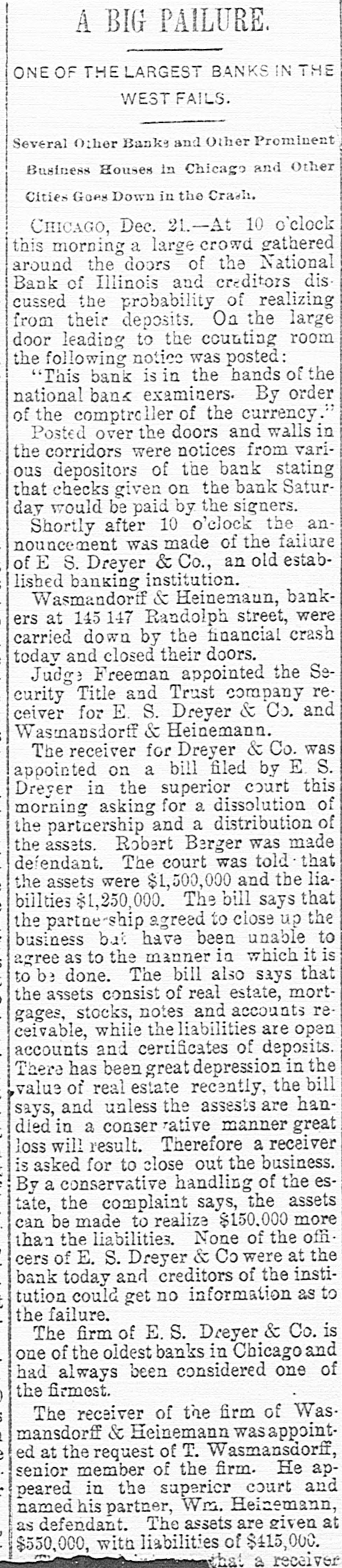
A BIG PAILURE. ONE OF THE LARGEST BANKS IN THE WEST FAILS. Several Other Banks and Other Prominent Business Houses in Chicago and Other Cities Goes Down in the Crash. CHICAGO, Dec. 21.-At 10 o'clock this morning a large crowd gathered around the doors of the National Bank of Illinois and creditors dis cussed the probability of realizing from their deposits. On the large door leading to the counting room the following notice was posted: "This bank is in the hands of the national bank examiners. By order of the comptroller of the currency Posted over the doors and walls in the corridors were notices from various depositors of the bank stating that checks given on the bank Saturday would be paid by the signers. Shortly after 10 o'clock the announcement was made of the failure of E S. Dreyer & Co., an old established banking institution. Wasmandorff & Heinemaun, bankers at 145 147 Randolph street, were carried down by the financial crash today and closed their doors. Judge Freeman appointed the Security Title and Trust company receiver for E. S. Dreyer & Co. and Wasmansdorff & Heinemann. The receiver for Dreyer & Co. was appointed on a bill filed by E. S. Dreyer in the superior court this morning asking for a dissolution of the partnership and a distribution of the assets. Robert Berger was made defendant. The court was told that the assets were $1,500,000 and the liabillties $1,250,000. The bill says that the partnership agreed to close up the business but have been unable to agree as to the manner in which it is to be done. The bill also says that the assets consist of real estate, mortgages, stocks, notes and accounts receivable, while the liabilities are open accounts and certificates of deposits. There has been great depression in the value of real estate recently, the bill says, and unless the assests are handied in a conser rative manner great loss will result. Therefore a receiver is asked for to close out the business. a conservative esthe says, tate, By complaint handling the of the assets can be made to realize $150,000 more than the liabilities. None of the officers of E. S. Dreyer & Co were at the bank today and creditors of the institution could get no information as to the failure. The firm of E.S. Dreyer & Co. is one of the oldest banks in Chicago and had always been considered one of the firmest. The receiver of the firm of Was mansdorff & Heinemann wasappointed at the request of T. Wasmansdorff, senior member of the firm. He appeared in the superior court and named his partner, Wm. Heinemann, as defendant. The assets are given at $550,000, with liabilities of $415,000. a receiver


Article from River Falls Journal, December 31, 1896

Click image to open full size in new tab

Article Text

In a drunken quarrel at Hinton, W. Va., John Legge and his brother Richard were killed by William Moore. Flames destroyed most of the business portion of the town of Miami, Fla. At Dallas, Tex., the Security Mortgage & Trust company, a financial concern. failed for $2,000,000. Albert Livingston, Ephraim Saunter and Abram Page are dead, and several other young men badly injured as sult of a free-for-all fight at Snow Hill, Ala. The firm of Norton & Co., for years millers and grain dealers in Chicago, failed for $500,000. The state of Kansas is entitled to ten votes in the electoral college, but it is likely that she will cast but nine, as one of the electors is a deserter from the union army, and therefore not qualified to serve. A. B. Robbins, aged 80 years, pastor of the First Congregational church of Muscatine, Ia., for 53 years, died of heart failure. At the age of 67 years Charles W. Hoffman, LL. D., librarian of the United States supreme court from 1873 to 1893, died at his home in Frederick, Md. In San Francisco the remains of Kate Field were cremated and the ashes sent east for int erment. In Chicago the Atlas national bank has gone into voluntary liquidation. All depositors will be paid in full. In a fit of despondency Otto Wasmansdorff, senior partner in the collapsed bank of Wasmansdorff & Heinemann, of Chicago, killed himself by shooting. N. Near 1118 Y., son, Frank, nine years old, and Minerva Robbins, a hired girl, were drowned by the capsizing of a boat. At Batavia, Ill., William M. & Van Nortwick, bankers and manufacturers, made an assignment with liabilities of $2,000,000. For no cause known Frank E. Clark, for 18 years editor of the Grayville (III.) Independent, committed suicide by taking poison. In Minneapolis the Scandia bank suspended payments with liabilities of $300,000. A colored youth named Will Robinson, who killed his sweetheart in a church in Pike county, Mo., was taken to the penitentiary for 102 years. At Independence, Mo., the McCoy Banking company went into voluntary liquidation with liabilities of $125,000. The doors of the Bank of Superior at Superior, Wis., were closed, with liabilities of $100,000. Gregor Kirchbaum and his wife were burned to death in their home at Johnston, R. I., by the explosion of a lamp. In Chicago 1,000 saloon keepers have been compelled during the last three months to retire from business because of hard times. Iowa celebrated its fiftieth anniversary as a state.


Article from The Austin Weekly Statesman, December 31, 1896

Click image to open full size in new tab

Article Text

THE ATLAS BANK OF CHICAGO DECIDES TO GO OUT OF THE BUSINESS. CLEARING HOUSE TO PAY DEPOSITS On Demand-Comptroller Eckels Advised the Move-Directors of the Bank of Minnesota Are Taking Steps to Reorganize. Chicago, Dec. 27.-Suffering from depression caused by financial reverses, Otto Wasmansdorff, a well known banker of this city, today fired a bullet into his brain and died almost instantly. Banker Wasmansdorff killed himself in a bedroom at his home on Cleveland avenue at 11 o'clock this morning. His sons, William G. and Otto, Jr., who were in the parlor beneath their father's bedroom, heard the report of the revolver and rushed up stairs. Running into the room the horrified sons beheld their father lying on the bed, dying, a revolver lying at his side. He had shot himself in the right temple and a thin stream of blood was flowing down his cheek. Everything in the room was in perfect order. The deed apparently had been deliberately planned. Mr. Wasmansdorff was a member of the private banking firm of Wasmansdorff & Heinemann, which failed a week ago as a result of the failure of the National Bank of Illinois. The failure of his bank had a crushing effect on Mr. Wasmansdorff and seriously affected his wife, who is ill. The banker for several days was unable to eat or sleep. The criticsm of unfortunate depositors worried him much and he was in a constantly troubled state of mind. This morning the banker appeared brighter and less troubled in mind than upon any other day since the financial crash that ruined him. After he breakfasted with his family, with whom he chatted pleasantly, he glanced over the morning papers. He then engaged in a frolic with his little granddaughter, after which he retired to his room. Fifteen minutes later the fatal shot was heard by the two sons. The young men were overcome with grief and said they never had the slightest suspicion that their father contemplated such an act. Mrs. Wasmansdorff was prostrated by the shock. At the time of the failure the assets of Mr. Wasmansdorff's bank were given at $550,000 and the liabilities at $415,000. Mr. Wasmansdorff had been 0 banker


Article from The Worthington Advance, December 31, 1896

Click image to open full size in new tab

Article Text

MANY FAILURES. Several Banking Concerns Go to the Wall -A Receiver for Norton & Co. St. Paul, Minn., Dec. 24.-The machinery for closing up the business of the Bank of Minnesota was set in motion Wednesday afternoon by Judge Otis in the appointment of William H. Lightner and Frank A. Seymour, cashier of the Merchants national bank, its receivers. M. D. Kenyon, public examiner, in his petition to the court, stated that the assets of the bank were $281,000 in real estate, $45,000 in cash and $1,675,000 in loans and discounts. Some surprise was expressed over the last item, as when the bank's last statement, October 6, was made, the loans and discounts were given as $2,300,000. The public examiner has evidently given these at what he regards their actual value. The bank is indebted to depositors in the sum of $2,341,000, and its liabilities over all assets are $340,000. As the capital stock is $600,000 and every stockholder liable to twice the amount of his stock, it is pretty certain that every depositor will be paid nearly dollar for dollar. The bank's capital was $50,000 and surplus $50,000. The cash on hand was $22,000, and all but $2,000 of this was tied up in outside failures. The city of Superior and board of education have nearly $14,000 in the bank, about half of which was deposited within the last few days. Ira Burhans is president and C. H. Nichols cashier. The bank was a depositor in the National Bank of Illinois at Chicago. Lewiston, Me., Dec. 24.-The American Banking and Trust company, of Auburn, chartered in 1886, has closed its doors and has asked the court for the appointment of a receiver. The deposits are not large and the bank officials say there are assets enough to pay depositors in full as soon as the assets can be turned into cash. The deposits and bills payable amount to $54,403. and assets nominally $130,743. Chicago, Dec. 28.-Otto Wasmansdorff, of the banking firm of Wasmansdorff & Heinemann, which failed here last Monday as a result of the collapse of the National Bank of Illinois, committed suicide at his home, 549 Cleveland avenue, Sunday morning by shooting himself in the right temple with a revolver. The constant worry and mental anxiety of the past week consequent upon the failure is believed to have been the cause. He had scarcely slept during that time, and although it is generally believed that the bank will discharge its obligations in full Mr. Wasmansdorff saw that his standing in financial circles had been imperiled. Chicago, Dec. 28.-The Atlas national bank of Chicago has decided to retire from business, and the clearing house committee, at a special meeting Sunday night decided that the associated banks of the city would advance the amount needed to pay its depositors in full. The amount required is in the neighborhood of $600,000. The bank will not receive any deposits from date. Checks on it will be settled through the clearing house as usual. The meeting was held at the home of Isaac G. Lombard, a member of the committee, about 11 o'clock Sunday night. The officers of the Atlas national are: President. W. C. D. Grannis; vice president, C. B. Farwell; cashier, S. W. Stone; assistant cashier, W. S. Tillotson. Chicago, Dec. 28.-Norton & Co., of Chicago and Lockport, III., millers and grain dealers, went into the hands of a receiver late Saturday afternoon. The affairs of the firm were in such shape that it was impossible to learn definitely what the assets and liabilities are. It was represented that the assets might approach $500,000, and it was stated that the liabilities were considerably under that figure. Norton & Co. have been known for 40 years through their operation of the Lockport mills. They added other enterprises to their early business, and in addition to their flouring mill they have grain elevators and an electric light plant at Lockport. They have also a large grocery store at Romeo, on the Illinois & Michigan canal, and in Chicago a large flouring establishment. The company also owns a paper mill at Niagara Falls and is largely interested in the water and electric power scheme at the falls. They have done a private banking business of enormous proportions in Lockport, and nearly half of the Lockport populace is directly interested through deposits. The business integrity of the company has never been questioned here, and the failure is a gloomy surprise. However, assurance is given that the embarrassment is only temporary. The company was caught deep by the the National TU!


Article from The Penn's Grove Record, January 1, 1897

Click image to open full size in new tab

Article Text

Suicide of a Banker. Otto Wasmansdorff, senior partner in the banking firm of Wasmansdorff & Heinemann, committed suicide in his home in Chicago, III. The bank was forced to suspend on nccount of the failure of the National Bank of Illinois.


Article from The Columbia Herald, January 1, 1897

Click image to open full size in new tab

Article Text

GENERAL NEWS. The Columbus & Hocking Coal and Iron Company, of Columbus, O., has been placed in the hands of a receiver. The Security Mortgage & Trust Company, of Dallas, Texas, has made application for a receiver. The liabilities are $2,000,000, and the assets are estimated at $1,000,000. The failure was caused by unprofitable real estate loans and investments. Otta Wasmansdorff, of the banking firm of Wasmansdorff & Heinemann, which failed at Chicago last week as a result of the collapse of the National Bank of Illinois, committed suicide last Saturday morning by shooting himself in the right temple with a revolver. The constant worry and anxiety for the past week, consequent upon the failure, is believed to have been the cause. Six men lost their lives in a mine explosion at Princeton, Ind., last Saturday. The Atlas National Bank, of Chicago, has decided to retire from business, and the associated banks of the city will advance the amount needed to pay its depositors in full; about $900,000 will be required. Bank Examiner McDonald has taken charge of the Merchants' and Plantors' Bank, at Bryan, Texas, which failed to open its doors on Wednesday of last week.


Article from Mineral Point Tribune, January 7, 1897

Click image to open full size in new tab

Article Text

winnam of one of the Kansas electors, W. H. Linton, who is alleged to be disqualified because he deserted from the army. The Laconia car works, at Laconia, N. H., was petitioned into an involuntary insolvency. The total liabilities are placed at $617,000 and the assets at $407,000. James R. Francisco, who operated the famous John Bullengine on the Camden and Amboy railroad, in 1836, died at: Fremont, O., aged eighty-one years. It is said that the failure of the Security Mortgage and Trust company of Dallas, Texas, will cause a loss of $1,500,000 to eastern and foreign capitalists. New York-The board of estimates inserted in the budget for 1897 the sum of $70,000 for ceremonies attending the dedication of the Grant monument. Baltimore-The ninth annual meeting of the American Economic association will begin at Johns Hopkins university and will continue until Thursday. Washington-The large furniture house of Julius Lansburg, on New York avenue, was burned; loss on building, stock and adjacent struetures, $200,000. John McCord of Oberlin, Ohio, died in the Grand Central railway station in New York, of heart disease. He was returning home from a visit to relatives at New Haven, Conn. Comptroller Eckels in an interview says the recent bank failures have been due largely to local causes and that the general condition of the national banks is excellent. District Attorney Olcott of New York has written a letter to the aittorney general asking his advice as to whether the deputies in his office are subject to civil service. Mrs. Ella Eager, wife of a locomotive engineer, committed suicide at New Haven, Conn., by throwing herself in front of her husband's locomotive. The couple had quarreled. Total appropriations for the various branches of the New York city government of New York for 1897 foot up close to $50,000,000, a larger sum than ever was granted before. Topeka, Kan.-General Buckner sent a cask of whisky and $50 to Dudley town for a Christmas present. It was the only township in the union carried by Palmer and Buckner. Otto Wasmansdorff, senior partner in the Chicago banking firm of Wasmansdorff & Heinemann, which suspended as a result of the failure of the National bank' of Illinois, committed suicide. It is reported that Charles T. Yerkes, the Chicago street railway magnate, will make his home in New York and will have two of his Chicago stocks listed on the New York exchange. H. C. Henry, the millionaire contractor, has confirmed the report that he had secured the contract to build the approaches to the Great Northern railroad tunnel through the Cascade mountains. Judge Myers, at Oskaloosa, Kan., dismissed the receivership case of the Atohison, Topeka and Santa Fe Railroad company, holding that the alien land law of Kansas is not applicable to railroads. Van Nortwick Bros., bankers at Batavia, III., and holders of large property interests in several states, made an assignment, as a result of the liquidation of the Atlas National Bank of Chicago. Chicago-Mrs. Mary Logan Tucker of Wisconsin and her son have been left a fortune by Captain Lemon of Washington. They are the wife and son of Major Tucker, who is now stationed at St. Paul. San Francisco-Information has been received announcing the death at San Salvador of Dr. Albert Sanchez, director of the meteorological and astronomical observatory of the state of San Salvador. A letter received at the state department in Washington from a high authority in the Turkish government indicates that Emperor William of Germany and the sultan have formed an alliance. After W. J. Bryan's Atlanta lecture Mr. McBee, his financial backer, offored to fulfil the contract and pay the lecturer $10,000 to bind the contract. Mr. Bryan refused It, and Mr. McBee did not press it. Governor Morton has appointed Col. Ashley W. Cole, his private sec-


Article from Wood County Reporter, January 7, 1897

Click image to open full size in new tab

Article Text

# NEWS BRIEFS It is said that the failure of the Security Mortgage and Trust company of Dallas, Texas, will cause a loss of $1,500,000 to eastern and foreign capitalists. New York-The board of estimates inserted in the budget for 1897 the sum of $70,000 for ceremonies attending the dedication of the Grant monument. Baltimore The ninth annual meeting of the American Economic association will begin at Johns Hopkins university and will continue until Thursday. Washington-The large furniture house of Julius Lansburg, on New York avenue, was burned; loss on building, stock and adjacent structures, $200,000. John McCord of Oberlin, Ohio, died in the Grand Central railway station in New York, of heart disease. He was returning home from a visit to relatives at New Haven, Conn. Comptroller Eckels in an interview says the recent bank failures have been due largely to local causes and that the general condition of the national banks is excellent. District Attorney Olcott of New York has written a letter to the attorney general asking his advice as to whether the deputies in his office are subject to civil service. Mrs. Ella Eager, wife of a locomotive engineer, committed suicide at New Haven, Conn., by throwing herself in front of her husband's locomotive. The couple had quarreled. Total appropriations for the various branches of the New York city government of New York for 1897 foot up close to $50,000,000, a larger sum than ever was granted before. Topeka, Kan. General Buckner sent a cask of whisky and $50 to Dudley town for a Christmas present. It was the only township in the union carried by Palmer and Buckner. Otto Wasmansdorff, senior partner in the Chicago banking firm of Wasmansdorff & Heinemann, which suspended as a result of the failure of the National bank of Illinois, committed suicide. It is reported that Charles T. Yerkes, the Chicago street railway magnate, will make his home in New York and will have two of his Chicago stocks listed on the New York exchange. H. C. Henry, the millionaire contractor, has confirmed the report that he had secured the contract to build the approaches to the Great Northern railroad tunnel through the Cascade mountains. Judge Myers, at Oskaloosa, Kan., dismissed the receivership case of the Atchison, Topeka and Santa Fe Railroad company, holding that the alien land law of Kansas is not applicable to railroads. Van Nortwick Bros., bankers at Batavia, Ill., and holders of large property interests in several states, made an assignment, as a result of the liquidation of the Atlas National Bank of Chicago. Chicago-Mrs. Mary Logan Tucker of Wisconsin and her son have been left a fortune by Captain Lemon of Washington. They are the wife and son of Major Tucker, who is now stationed at St. Paul. San Francisco Information has been received announcing the death at San Salvador of Dr. Albert Sanchez, director of the meteorological and astronomical observatory of the state of San Salvador. A letter received at the state department in Washington from a high authority in the Turkish government indicates that Emperor William of Germany and the sultan have formed an alliance. After W. J. Bryan's Atlanta lecture Mr. McBee, his financial backer, offered to fulfil the contract and pay the lecturer $10,000 to bind the contract. Mr. Bryan refused it, and Mr. McBee did not press it. Governor Morton has appointed Col. Ashley W. Cole, his private secretary, a member of the state railroad commission. The salary is $8,000 per year. Colonel Cole was a former New York newspaper man. President-elect McKinley, in a talk with Senator Wolcott of Colorado told Mr. Wolcott that he was earnestly in favor of carrying out the republican platform's pledge of attempting to bring about international bimetallism. Announcement has been made that the Erie Railroad company has completed arrangements for the elevation of its tracks through Jersey City. The work, which is to cost $1,000,000, will be completed in about two years. Washington On the question of general arbitration between the United States and Great Britain, Mr. Olney and Sir Julian have made the final draft of the treaty and it is in the hands of Lord Salisbury awaiting his approval. V. J. Rothschild of the St. Paul Winter Carnival association has been authorized by the executive committee to announce that owing to the mild weather the association has been forced to abandon its plans for an ice palace this season. Samuel H. Kerfoot, one of the pioneers in the real estate business in Chicago, died of heart disease. He