Howes & Macy (New York, NY)

Episode Information

Episode UID
1845932790885
Episode Type
Run โ†’ Suspension โ†’ Closure
Bank Type
private
Bank ID
184593279 hash
Start Date
September 25, 1873
Location
New York, New York (40.714, -74.006)

Metadata

Model
gpt-5-mini (chosen from majority vote of a three-model LLM ensemble)
Short Digest
9b143ffaca60c24e

Response Measures

None

Description

Firm suspended after a heavy run triggered by street rumors; briefly proposed/partially resumed but later entered bankruptcy/receivership.

Events (4)

1. September 25, 1873 Run
Cause
Rumor Or Misinformation
Cause Details
False reports of the firm's failure circulated on the street, precipitating heavy withdrawals exhausting cash balances.
Measures
Posted notice suspending payment; accepted special deposits in trust for new accounts; pledged pro rata payments as assets realized.
Newspaper Excerpt
the false reports of the firm's failure...had precipitated a run upon them, yesterday morning, for which they were not prepared.
Source
newspapers
2. September 25, 1873 Suspension
Cause
Rumor Or Misinformation
Cause Details
Exhausted cash at correspondent bank after heavy run driven by rumors; suspended payments temporarily.
Newspaper Excerpt
they decided to suspend, and a notice was pasted ... announcing that they had 'concluded to pay no more checks at present.'
Source
newspapers
3. September 28, 1873 Reopening
Newspaper Excerpt
Howes & Macy have practically resumed already. ... They propose to continue their business as usual by receiving special deposits in trust to new accounts ... pay pro rata installments as assets are realized.
Source
newspapers
4. December 8, 1873 Receivership
Newspaper Excerpt
A petition was filed to-day in the Court of Bankruptcy, that Howes & Macy, the banking firm which failed during the early part of the panic, be declared bankrupt.
Source
newspapers

Newspaper Articles (23)

Article from New-York Tribune, September 25, 1873

Click image to open full size in new tab

Article Text

SUSPENSION OF HOWES & MACY. THE STRINGENCY OF THE MONEY MARKET AND AN UNWILLINGNESS TO SACRIFICE SECURITIES THE CAUSES-AN EARLY RESUMPTION PROMISED. On Tuesday afternoon Mr. Howes, of Howes & Macy, assured a TRIBUNE reporter that the house was an "old fogy" concern, and could not by any possibility fail. Yet the business day was not an hour old yesterday before the news flew from mouth to mouth that Howes & Macy had suspended. Idle brokers who had been standing listlessly about with their hands in their pockets hurried toward the offices of the firm to seek a confirmation of the report, but their interest in its truth or falsity seemed to be limited to mere curiosity. In the language of the street, the suspension had been discounted" since Tuesday afternoon, and, beyond increasing the general feverishness, was productive of no excitement whatever. The concern carried on business as usual under a very heavy run until 11 o'clock, when, having exhausted their cash balance at the Leather Manufacturers' Bank, through which they cleared, they decided to suspend, and a notice was pasted upon the glass fronting the cashier's desk announcing that they had "concluded to pay no more checks at present." =A TRIBUNE reporter immediately sought out Mr. Macy, and asked him the reasons for the suspension. He answered that the tightness of the money market had made such a step advisable. He added: "We have unlimited securities. but we can't turn them into cash at present. Our suspension 18 only temporary. As soon as matters on the street take their course we shall resume business. We can pay dollar for dollar, and more if necessary. None of our depositors will lose a cent. In fact, we have been compelled to do this to secure their interests." The reporter expressed his surprise that the suspension should have followed so quickly upon the heels of Mr. Howes's assurances of the firm's soundness. Mr. Macy answered sharply that at the time of the interview alluded to he had no anticipation that they would be compelled to resort to extreme measures, but that the false reports of the firm's failure. circulated on the street, on Tuesday afternoon, had precipitated a run upon them, yesterday morning, for which they were not prepared. This run was the immediate cause of the suspension. In answer to a question as to the amount they had paid out during the panic, Mr. Macy said that he could not tell just then; nor could he furnish any statement regarding the standing of the firm until the books should have undergone a thorough examination, which was then in progress. Later in the day, the reporter had a more satisfactory interview with Mr. Howes, in which the fact was elicited that the firm had been paying out between $50,000 and $100,000 a day since Jay Cooke & Co.'s failure. They continued to pay out funds as fast as called for until their cash balance became exhausted, and then they stopped. Mr. Howes said that they had not borrowed a dollar, and did not intend to borrow one. "We have plenty of the very best of securities," he added, "but we do not purpose to sacrifice them at the prices now current. The fact of the matter 18 that a general suspension of the large banking institutions has become a necessity, and the sooner it takes place the better. The small houses can afford to hold out, perhaps, but the larger ones must suspend or go under. People who bring their money to us, and expect to get 3 per cent interest, must not think that we put it into a corner to look at. No, weinvest it, and we cannot convert our investments on the jump without great damage to ourselves. At any rate, we don't purpose to be the authors of our own ruin; so our depositors will have to wait." Mr. Howes said that the depositors of the firm were about equally divided between tbe city and the country. He could not say positively that the suspension would not affect one or two ont-of-town houses. While the reporter was conversing with Mr. Howes several persons entered to make deposits, notably Deputy Sheriff Judson Jarvis, who handed in a certified check for $5,000. Mr. Jarvis expressed the utmost confidence in the stability of the firm
Article from Evening Star, September 25, 1873

Click image to open full size in new tab

Article Text

TELEGRAMS TO THE STAR This Afternoon's Dispatches. Associated Press Reports. LIGHT AT LAST! THE PANIC OVER THE FUTURE COURSE OF JAY COOKE & CO. What Howes & Macy Say. The New York Stock Market Still Closed END OF THE PANIC. NEW YORK. Sept. 25.-The morning journals take a very hopeful view of the financial situaLion this morning, and it is the general impression that the panic is over. WHAT JAY COOKE AND CO. W LL DO. NEW YORK, Sept. 23.-The members of the Jay Cooke firm meet daily, and have decided not to sacrifice their securities in order to meet obligations, but wait the restoration of public confidence. WHAT HOWES AND MACY SAY. NEW YORK, Sept. 25.-Mr. Howes, of Howes & Macy, said yesterday that they had been paying out between $50,000 and $100,000 a day since the suspension of Jay Cooke & Co. They continued to pay out funds as fast as called for, until their cash balance was exhausted, and they stopped. They had not borrowed a dollar and did not intend to borrow Wehave the best of securities, but do not propose to sacrifice them at current rates. The depositors of the firm are about evenly divided between the city and country. The cashier of the bank through which Howes & Macy cleared says they have not attempted to overdraw their account, but, on the contrary, have a balance there. The list of their correspondents embraces eleven national and state bankers and 140 private tinancial institutions. THE STOCK EXCHANGE STILL CLOSED. NEW YORK, Sept. 25, 10.30.-The governing committee of the stock exchange decided not to open the board to-day. NO MORE BOND PURCHASES. Notice is posted at the sub-treasury "that purchases of bonds at this office are for the present suspended." In answer to inquiries, the sub-treasurer states that he cannot say whether any purchases will be made to-day until ladvised from Washington. WALL STREET IN ITS NORMAL STATE. NEW YOKK, Sept. 25, 11a m. Wall street has resumed FOR ething like its normal appearance. The panic is rapidly subsiding. There have been rumors of suspensions this morning, but there is ne truth in them. The stock exchange being closed, a pretty active business for cash is being transacted in the street. A W SHINGTON SPECIAL says Secretary Richardsondeclines to anticipate the 1874 bonds which come due in December and January, THE STOCK MARKET. NEW YORK, Sep. 25. 11.15 a. m -Affairs on the street continue quiet. The market mostly confines itself to bids and offers, transactions being few and far between, 80 far this morning that no sales are reported. The quotations are Central bid, 89; offered, 90% Union Pacific, 19a 19% Lake Shore, 74a76; Ohio and Mississippi, 27a29; Pacific Mail, 28a30; North Western, 39a 40: Rock Island, 86 blank: Western Union, 58a 59: Harlem. 102%a105; Wabash. 39all: Hannibal & St. Joseph, 21 blank; C.C. I. C., 29 blank. THE GOVERNMENT GOLD SALES advertised by the government will not take place to-day. THE BANKS AND BROKERS keenly complain of unfounded statements, and often malicious, sent out from the city by irresponsible parties, which not only do great personal injury, but add fuel to the excitement. ALL STOCKS ADVERTISED FOR SALE at auction to-day have been withdrawn. Three thousand of prime sterling sold at 105. THE GOLD MARKET. NEW YORK, Sept. 25, 12:25 opened firm at 111% owing to the advance in the Bank of England rate to 4 per cent., but afterwards declined to 11%, and still later rallied to 11 1/2. The rates paid for carrying ranged from 4 to per cent. Foreign exchange has been fixed at 106 for 60 day bills, and 107 for sight, by leading bankers, but the actual business is at lower prices.


Article from Wilmington Daily Gazette, September 25, 1873

Click image to open full size in new tab

Article Text

The Financial Situation, There was generally a calmer feeling, in financial circles Wednesday, and the loan certifica'e policy adopted by the banks in Philadelphia and other cities inspired hopes of a speedy progress towards recovery from the panic. The New York Stock Exchange will remain closed until further notice. Two suspensions were reported Wednesday in New York-Howes & Macy, and Brown & Watson, gold brokers. The suspensions reported elsewhere were Brown, Lancaster & Co., at Baltimore; Brown & Gray, at Willkesbarre; and the Dollar Saving Bank, and Isaace, Taylor & Williams, at Richmond, Virginia. The policy of suspending the payment of currency by the banks, except in small amounts, has been adopted in Baltimore and Richmond. In Chicago and Cincinnati the financial condition is reported sound. Not a single case of failure or embarrassment is reported in mercantile circles anywhere.


Article from The Daily Phoenix, September 25, 1873

Click image to open full size in new tab

Article Text

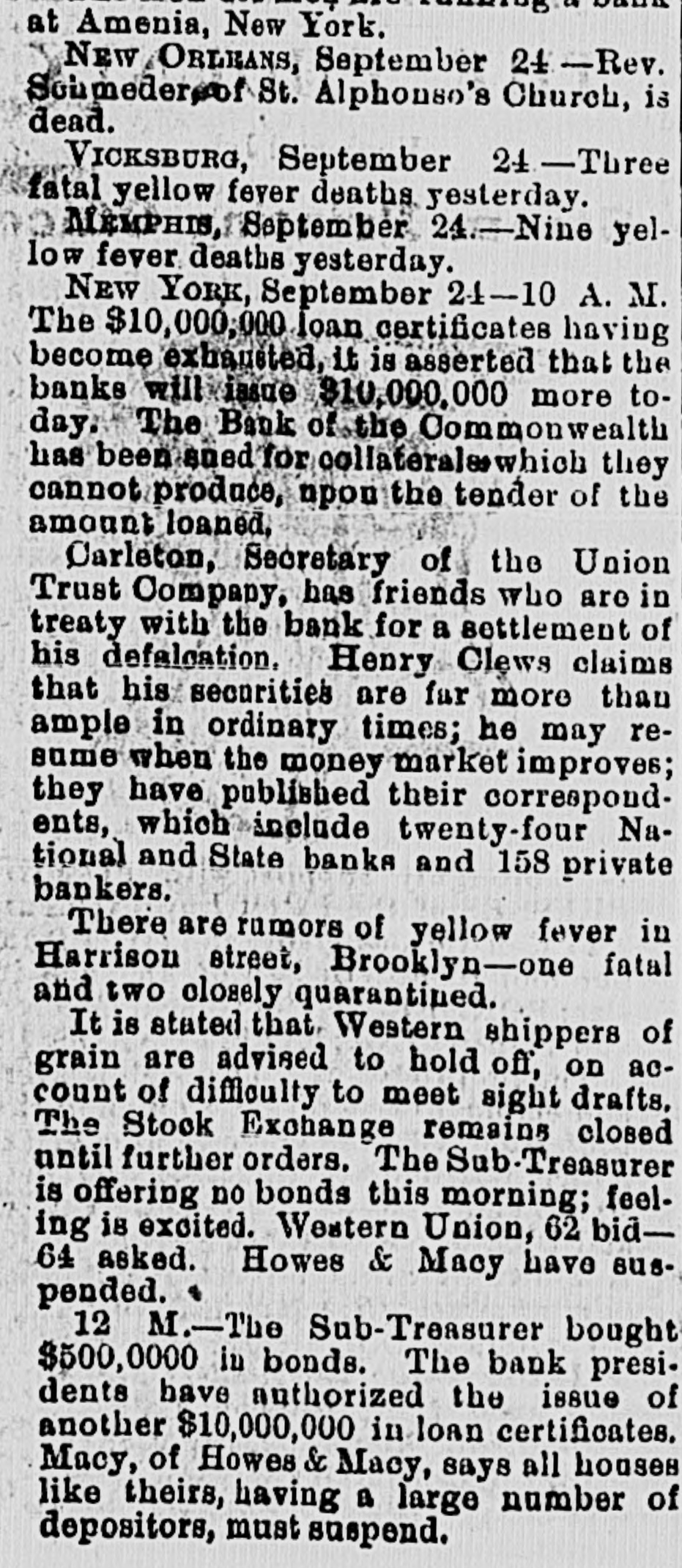
at Amenia, New York. NEW ORLEANS, September 24 - Rev. Soumedersof St. Alphonso's Church, is dead. VICKSBURG, September 24 Three fatal yellow fever deaths yesterday. MEMPHIS, September 24.-Nine yellow fever deaths yesterday. NEW YORK, September 21-10 A. M. The $10,000,000 loan certificates having become exhausted, it is asserted that the banks will issue 310,000,000 more today. The Bank of the Com m on wealth has been sued for collaterales which they cannot produce, upon the tender of the amount loaned, Carleton, Secretary of the Union Trust Company, has friends who are in treaty with the bank for a settlement of his defaloation. Henry Clews claims that his securities are far more than ample in ordinary times; he may resame when the money market improves; they have published their correspondents, which include twenty-four National and State banks and 158 private bankers. There are rumors of yellow fever in Harrison street, Brooklyn-one fatal and two closely quarantined. It is stated that, Western shippers of grain are advised to hold off, on account of difficulty to meet sight drafts, The Stook Exohange remains closed until further orders. The Sub Treasurer is offering no bonds this morning; feeling is excited. Western Union, 62 bid64 asked. Howes & Macy have suspended. q 12 M.-The Sub-Treasurer bought $500,0000 in bonds. The bank presidents have authorized the issue of another $10,000,000 in loan certificates. Macy, of Howes & Macy, says all houses like theirs, having a large number of depositors, must suspend.


Article from The Kenosha Telegraph, September 25, 1873

Click image to open full size in new tab

Article Text

solved that the rule requiring a notice of time be adhered to. Adherence to the rule checked but did not stop the run. Monday and Tuesday till in the afternoon it seemed that confidence was being restored. In the afternoon of Tue-day the large banking house of Henry Clews & Co suspended. This suspension was considered a relief by some of the banks which had to carry the company but it revived the excitement, said to be nearly or quite as great as that following the suspension of Jay Cooke & Co. with the difference of the Stock Exchange remaining closed. The Bank Presiden's met and resolved upon issuing $10,000,000 temporary loan certificates, making a common fund for all the banks to draw upon and resolved to stand by one another The Gold Ex change Bank returned many statements handed in to it as a clearing house for the Gold Exchange thus checking further exciting speculation. Wednesday Howes & Macy of New York and Ciews, Habecht & Co. or Lon. don suspended. Cook McCollough & Co of London have not suspended but refuse the checks of Jay Co k & Co. The $10,000,000 loan certificates being all taken out the Associated Banks of New York resolved to issue $10,000,000 more and to pay these out in place of currency. The Stock Exchange is not yet opened. Confidence is being restored in New York. Some failures reported in Pennsylvania, Maryland and Virginia. No failures west of these states. The panic ig generally subsiding and the country safe.


Article from Chicago Daily Tribune, September 25, 1873

Click image to open full size in new tab

Article Text

over e cash basis. (To the Associated Press.] A BETTER FEELING. New YORK, Sept. 24.-The feeling in monetary circles this morning was slightly better than last evening, after the suspension of Henry Clows & Co. was announced. The closing of this eminent house to some extent destroyed the feeling of confidence observable yesterday morning, and when the announcement of the suspension of HOWES & MACY was made the uneasy feeling was intensified. Mr. Macy said the firm had suspended because of heavy drafts made upon it within the last few days, but declined to state the amount which had been withdrawn. The securities held by the house were ample, he belioved, to protect all depositors, but he declined to say anything else in regard to their character. He also declined to make any statement in regard to assota and liabilities. When questioned aa to the probability of resumption, he said that he was unable to speak of that at present. Mr. Howes was almost equally reticont. He said that the house had UNDERGONE A HEAVY RUN, and its demand loans could not be collected fast enough to furnish it with sufficient cash to meet such a drain. All their securities were good and negotiable when there was a market, but be would say nothing further in regard to their character, He thought that no depositors would lose. The firm had had no trouble with any bank, and had not borrowed a cent. He declined to say how large an amount of deposits had recently been withdrawn, No banking institution, in his opinion, could possibly contique business: at present, if there was & run upon it. A meeting of the OLEARING-NOURE ASSOCIATION was held at the Merchants' National Bank to-day. Mr. Vermilye, President of the Merchants' Bank, preaided. The Chairman of the Loan Committee reported that $10,000,000 of loan certificates, authorized to be issued to the associated banks, had been all taken out, whereupon 11 WAS resolved that an addi-


Article from New-York Tribune, September 27, 1873

Click image to open full size in new tab

Article Text

THE FALLEN HOUSES. THE BANK OF THE COMMONWEALTH. The Directors of the Bank of the Commonwealth have held a meeting to take into consideration the condition of the bank and the possibility of resumption. It was resolved to employ counsel to represent the bank and look after its interests in the courts. Edward Haight & Co. have paid up one half of their overdraft on the bank, and have promised to make good the remainder. The Directors say that no one of their number is indebted to the bank, but, on the contrary, the bank is largely indebted to them. The following letter is written by an extensive importer, and one of the Directors: The Bank of the Commonwealth has been unwisely and precipitately put into the hands of a receiver, without any knowledge of or consultation with the Directors, and before the Bank Examiner could possibly know whether it was insolvent or not. It is now believed that the overdrafts of Edward Haight & Co., which was the principal cause of its suspension, will be paid in full, one-half of the amount having already been secured. If so, then the bank, if judiciously managed. can pay all its liabilities, and have its stock nearly if not quite intact; but if wound up by a receiver, both may be jeopardized. The Directors have taken steps to bring the matter before the Court, and it will be for the interest of the depositors and stockholders at once to see that their interest is protected. Henry Clews & Co. have issuedia circular to their depositors and correspondents, in which they announce that they purpose to continue their business by receiving special deposits in trust for new accounts, pledged only to payments drawn against such accounts, and that they will collect and realize upon loans, securities, and other assets, as fast as possible. Messrs. Howes & Macy are adjusting matters as rapidly as possible, and hope to resume business in a few days. They have notified to their depositors that it is their intention to continue operations as usual, by receiving special deposits in trust to new accounts, pledging themselves to use those deposits only in payment of their customers' respective checks against new accounts; and as fast as the firm can collect and realize from their loans and securities they will pay pro rata installments on their present indebtedness to their depositors until the whole shall be liquidated, the same drawing the usual rate of interest until paid. The banking-house of Jay Cooke & Co. is still busily engaged upon the statement of its condition, but will probably have nothing to report before Monday. Fisk & Hatch say that their books are perfectly kept, and all accounts can be quickly and readily understood, and as soon as there is anything of general interest to communicate it will be presented to the public, and this information is promised at an early date. and may possibly occur simultaneously with or be preceded by a resumption of payment. Everything is represented as in good condition, the assets 80 greatly exceeding the liabilities as to promise a large surplus at the final settlement.


Article from New-York Tribune, September 27, 1873

Click image to open full size in new tab

Article Text

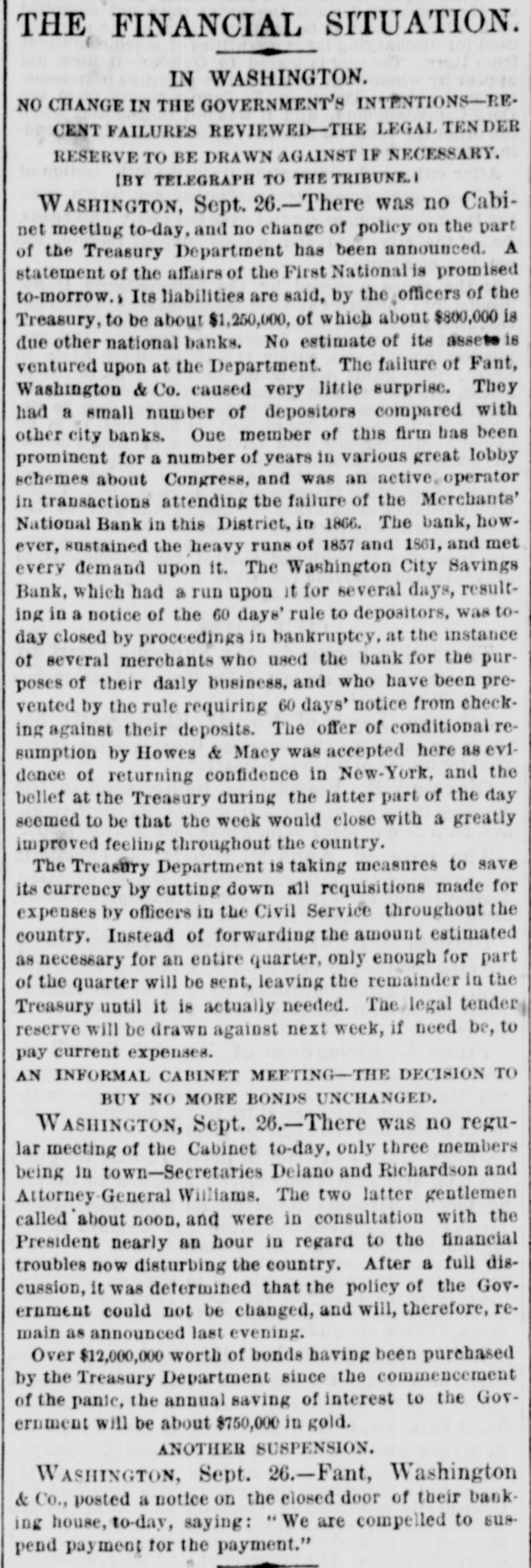
THE FINANCIAL SITUATION. IN WASHINGTON. NO CHANGE IN THE GOVERNMENT'S INTENTIONS-RECENT FAILURES REVIEWED-THE LEGAL TENDER RESERVE TO BE DRAWN AGAINST IF NECESSARY. (BY TELEGRAPH TO THE TRIBUNE.I WASHINGTON, Sept. 26.-There was no Cabinet meeting to-day, and no change of policy on the part of the Treasury Department has been announced. A statement of the affairs of the First National is promised to-morrow., Its liabilities are said, by the officers of the Treasury, to be about $1,250,000, of which about $800,000 is due other national banks. No estimate of its assets is ventured upon at the Department. The failure of Fant, Washington & Co. caused very little surprise. They had a small number of depositors compared with other city banks. One member of this firm has been prominent for a number of years in various great lobby schemes about Congress, and was an active. operator in transactions attending the failure of the Merchants' National Bank in this District, in 1866. The bank, however, sustained the heavy runs of 1857 and 1861, and met every demand upon it. The Washington City Savings Bank, which had a run upon it for several days, resulting in a notice of the 60 days' rule to depositors, was today closed by proceedings in bankruptcy, at the instance of several merchants who used the bank for the purposes of their daily business, and who have been prevented by the rule requiring 60 days' notice from checking against their deposits. The offer of conditional resumption by Howes & Macy was accepted here as evidence of returning confidence in New-York, and the belief at the Treasury during the latter part of the day seemed to be that the week would close with a greatly improved feeling throughout the country. The Treasury Department is taking measures to save its currency by cutting down all requisitions made for expenses by officers in the Civil Service throughout the country. Instead of forwarding the amount estimated as necessary for an entire quarter, only enough for part of the quarter will be sent, leaving the remainder in the Treasury until it is actually needed. The legal tender reserve will be drawn against next week, if need be, to pay current expenses. AN INFORMAL CABINET MEETING-THE DECISION TO BUY NO MORE BONDS UNCHANGED. WASHINGTON, Sept. 26.-There was no regular meeting of the Cabinet to-day, only three members being in town-Secretaries Delano and Richardson and Attorney-General Williams. The two latter gentlemen called about noon, and were in consultation with the President nearly an hour in regard to the financial troubles now disturbing the country. After a full discussion, it was determined that the policy of the Government could not be changed, and will, therefore, remain as announced last evening. Over $12,000,000 worth of bonds having been purchased by the Treasury Department since the commencement of the panic, the annual saving of interest to the Government will be about $750,000 in gold. ANOTHER SUSPENSION. WASHINGTON, Sept. 26.-Fant, Washington & Co., posted a notice on the closed door of their banking house, to-day, saying: "We are compelled to suspend payment for the payment."


Article from Nashville Union and American, September 27, 1873

Click image to open full size in new tab

Article Text

Banks have Currency to meet Payrolls, Salaries, etc. A Terrific Drain of at Least Three Million a Day. -Is the Country Los. ing Confidence in New York? NEW YORK, Sept 26 The city is being drained of money at a pretty lively rate. Since Saturday last the out going moneys through the Adams Express have been about $1,500,000 daily, while that coming, exclusive of whst went to the Treasury amounted to about six hundred thousand The United States Company have been send ing out $700,000 to $800,000 a day for several days past, while the receipts through that medium are very small. The National Express Company is carrying away an amount about three times as large as usual at this season of the year, and the American Express Company is doing likewise. Our Real President. Senator Morton, being taked to give his opinion as to the present financial panic, said his convictio was that the worst was over: "I do not expect the affair to subside of once, he added, "but my feeling is entirely hopeful.' Referring to the sugges tion that the government ought to come to the rescue, he said: "The government will do all it can, but it must remain inside of the law.' 10 A. M. Yesterday. The Governing Committee of the Stock Exchange have decided to keep it closed for the present, and to give 24 hours notice before its opening. Gold opened at 111 Propose to Take a Fresh Start. Howes & Macy have issued a circular to their depositors, saying: We propose to continue our business as usual by receiving special deposits in trust to new accounts pledging ourselves to use those deposits only in the payment of your respective checks against the new accounts, and as fast as we can collect and real'ze from our loans and securit to pay your pro rata installments on our present indebtedness until the whole shall be liquidated, the same drawing the usual rate of interest until paid. If this plan meets your approbation and you will go hand in hand with us in this extraordinary emergency, the business can go on at once without further interruption, which we are confident will be for the highest advantage of all concerned A Hitch in Clearing the Gold Board Several parties are short of gold and refuse to pay half per cent for borrowing, consequently there is a hitch in the clearance of gold at the gold exchange bank is 1141 The Gutter Snipes peded by the Police. Wall street was much less excited to-day. The crowd of bankers which have hitherto blocked up Broad street in front of the Stock Exchange was much less this morning, owing to the energetic action of the captain of the second precinct, who directed his men to disperse all groups which threat ened with sidewalk interfere traffic. to The brokers were by this means driven in the road, but they fared DO better here. The police trucks to be driven through the crowd, so comp elled the brokers to scatter in all directions. Driven from Broad street, some of the most inver erate speculators and curbstone brokers adjourned to the Gold Exch ange court and held high carnival there for about 15 minutes, when the sergeant of the police, with half dozen men, drove them helter skelter from their refuge. Ambiguous Confidence. The general feeling among the brokers appears to be more hopeful than on previous days, although there are, of course, many who persist in regarding the situation in its worst aspect. The tone of general conversation is, however, more cheerful than it has bitherio been, and there is an evident tendency to hope for the best, although not denied there is still cause for anxiety. to Since the appointment of the committee affect clearances, large numbers of private settlements have been mace by brokers who prefer settling between themselves to having their business brought before the committee. The governing committee will meet at half past 10 A. M. to-morrow. How the Banks Don't Understand Certificates Loan EX A member of the Governing Committee of Stock Exchange said this morning that many bank officers had expressed willing ness to extend the time of calling in loans from members of the Exchange for ten days after the Exchange re e-opens, but that an equal misapprebension seemed to exist among them, in reference to the position of the Stock Exchange Committee for guaranteeing certified checks. They simply desire that the banks refuse to give anything but certified checks. They shall receive certified checks as cash, maining at liberty to make any reserva ion they please as to the method of certifying, including rule that no bank sh di certify a check unless the money is on deposit The First Failure in Legitimate Trade The first failure at tte Produce Exch: is reported. A very respecta ble, though not of the largest houses, whose credit has hitherto been first class, has been forced to succumb in consequence of the trouble in the exporttrade. Night Reports Fisk and Hatch. Mr. Harvey Fisk, of Fisk & Hatch, states that the house has its statements completed, and that the next news from them will be the resumption of payments; their depositors are willing to assist in setting the wheels again in motion, and their securities are ready for realization as soon as there is a chance to use them H. Co. & Clewes Clewes & Co. issue a circular in which they say "We propose to continue our busiheretofore by receiving special deposits in trust for new accounts, claimed only to payments drawn against new accounts. and shall collect and realize upon ou loan and other assets as fast as possible, and make payments 28 prompt as they shall be realized until the entire amount shall be liquidated, interest being paid as hertofore. The numerous friends and depositors in this city approve entirely of the p'an, and have already signified their readiness to continue their deposits and business as proposed. Review of the Day The general feeling in financial circles is decidedly improved. The day's receipts close with some in the belief the bottom has been reached here, and there is fair prospect that when the stock exceange opens there will be little left to arrange in the way of settlements between bankers. so that there will be no new fail ures to announce. The cards from bank ing houses also inspire confidence and will bring some money into the street as well as assistance to generel bu iness, while it wil llexpedite the re arrangement of finan cial matters and aid in the prompt payment of old indebtedness when suspended houses will resume Courts Investigation President Vermilye of the Merchants


Article from New-York Tribune, September 29, 1873

Click image to open full size in new tab

Article Text

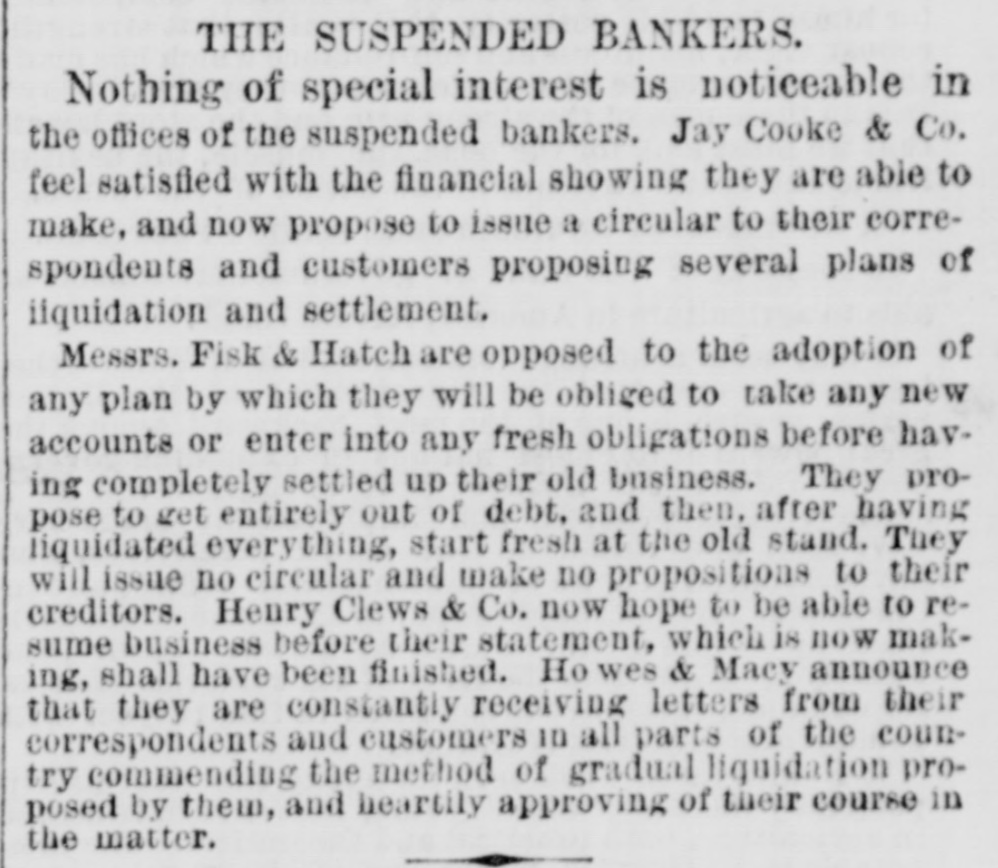
THE SUSPENDED BANKERS. Nothing of special interest is noticeable in the offices of the suspended bankers. Jay Cooke & Co. feel satisfied with the financial showing they are able to make, and now propose to issue a circular to their correspondents and customers proposing several plans of liquidation and settlement. Messrs. Fisk & Hatch are opposed to the adoption of any plan by which they will be obliged to take any new accounts or enter into any fresh obligations before having completely settled up their old business. They propose to get entirely out of debt. and then, after having liquidated everything, start fresh at the old stand. They will issue no circular and make no propositions to their creditors. Henry Clews & Co. now hope to be able to resume business before their statement, which is now making, shall have been finished. Ho wes & Macy announce that they are constantly receiving letters from their correspondents and customers 10 all parts of the country commending the method of gradual liquidation proposed by them, and heartily approving of their course in the matter.


Article from Chicago Daily Tribune, September 29, 1873

Click image to open full size in new tab

Article Text

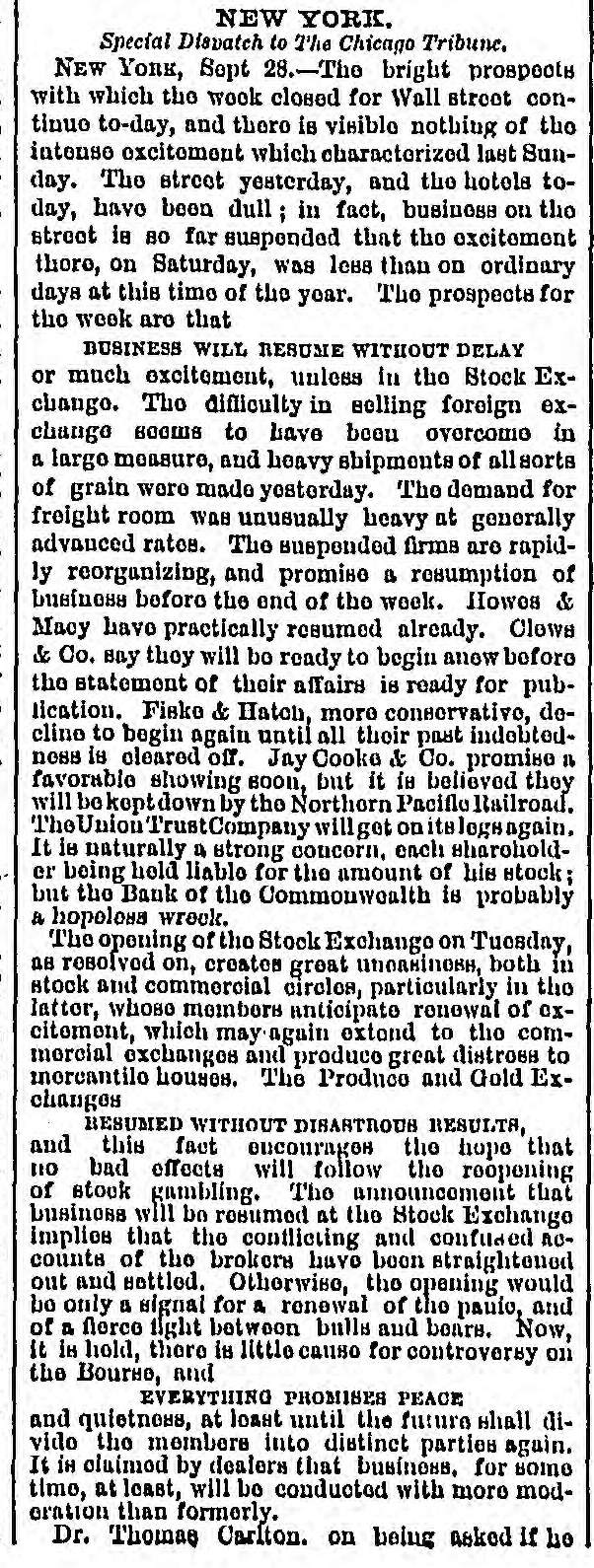
NEW YORK. Special Disvatch to The Chicago Tribune, NEW YORK, Sept 28.-The bright prospects with which the wook closed for Wall street continuo to-day, and there is visible nothing of the intense excitement which characterized last Sunday. The street yesterday, and the hotels today, have been dull in fact, business on tho street le 80 far suspended that the excitement thore, on Saturday, was less than on ordinary days at this time of the year. The prospects for tho week are that BUSINESS WILL RESUME WITHOUT DELAY or much excitement, unless in the Stock Exchango. Tho difficulty in selling foreign exchange Becms to have been overcomo in a large measure, and heavy shipments of allsorts of grain were made yesterday. The demand for freight room WAS unusually heavy at generally advanced rates. The suspended firms are rapidly reorganizing, and promise a resumption of business before the end of the week. Howes & Macy have practically resumed already. Clows & Co. say they will bo ready to begin anow before the statement of their affairs is ready for publication. Fisko & Hatch, more conservativo, declino to begin again until all their past indebtedness is cleared off. Jay Cooke & Co. promise n favorable showing soon, but it is believed they will be kept down by the Northorn Paciflo Railroad. The Union Trust Company will get on italegengain. It is naturally a strong concern, each sharoholder being hold liablo for the amount of his stock; but the Bank of the Commonwoulth is probably a hopeless wreck. The opening of the Stock Exchange on Tuesday, BB resolved on, creates great unoasinoss, both in stock and commercial circles, particularly in the latter, whose members anticipate renowal of excitement, which may again extend to the commoreial exchanges and produce great distross to morcantilo houses. The Produce and Gold Exchanges RESUMED WITHOUT DISARTROUS RESULTA, and this fact encourages the hope that 110 bad effects will follow the roopening of stock gambling. The announcement that business will be resumed at the Stock Exchange implies that the conflicting and confused nocounts of the brokers have boon straightened out and settled. Otherwise, the opening would be only a signal for & renewal of the pauio, and of a fierce light between bulls and boars. Now, it is hold, there is little cause for controversy on the Bourne, and EVERYTHING PROMISES PEACE and quietness, at loast until the futuro shall divido the members into distinct parties again. It in claimod by dealers that business, for some time, at least, will be conducted with more modoration than formerly. Dr. Thomas Carlton. on being asked if he


Article from The Fairfield Herald, October 1, 1873

Click image to open full size in new tab

Article Text

News Items. CAIRO, September 28.-An unand two on by known reaching woman Columbus, drowned Kentucky, children, while the Mobile road, were attempting to jump aboard the doparting steamer. PHICADELPHIA, September 28.The bank presidents assured the stook brokers that they will do nothing to cause a decline of sceuriti at the st. ok board, until the bondholders are earing for themselves. Meanwhile the products of the country will rotat the depots. Washington, September 28. United States Coupons, maturing Novembr 1st, will be paid on and af ter Monday, September 29th, upon a rebate of interest at the rate of six per cent. per annum. a The banks and bankers held meeting to-night aud confirmed the action of last night. A committee of six was appointed, who will certify the checks of each. The bank holding aloof are the Bank of Washington, Bank of the Republic, Farmers' & Mechanics' Bank, of Georgetown, and Riggs." The members of the com. bination are confident that the above banks will be forced into a compromise before Monday night. CHARLESTON, September 28.-A better feeling prevailed at the close of business Saturday. The national banks having received a larger amount of greenbacks on deposit than they paid out in checks, no suspension has occurred beyond those announced on Friday. NEW YORK, Sept. 25.-The panic is the But the seriously affooting aggregate dry goods sales for are far in those of last are now business, the season only purchasing year. Country advance what bayers they of for actual the any require trade, depressing necessities purchase becomes of of their stocks until money more The mer determined to by large chants plenty. have Dry Goods stand eachother during the crisis. The day in Wall Street and in business circles generally, closed quiet. The Loan Committee Clearing House issued to-day 4,000,000 more certificates, making 17,000,000 thus for issued. Howes & Macy will resume busi. ndas immediately. The feeling on Wall Street is generally improved less excitement than any day since the panio commeneed. Richardson's action in stopping the purchase of bonds and refusing to anticipate the 5 per cent due January 1st 1874, meets with little approval. The Stock Exchange will probably remain closed until Monday. The foreign news is more discour aging than it has been since the panie began. Foreign banks which do heavy exchange business are seriously affeeted. The gold loan was very quiet today. The banks are cashing small checks, and certifying large oues. The bankers invited Secreary Rich ardson to visit the city and examine into the condition of affairs. He declined. Did not have time to go. The banking h uses are quiet, but apprehensions of suspensions are still felt. The deadlock in foreign exchange continues, and may be productive of serious trouble. The banks are gaining in deposits, which is an encouaging sign. RICHMOND, Sept. 25.-Messrs. Lancaster & bankers, and stock bankis the are feel that as far as ers, Many satisfied persons Co., only suspension depositing. National to-day All and State Banks are concerned, the erisis is over. To-day the Presidents of the several banks hold a meeting and determined to adopt the plan of the Baltimore banks, and issue clearance certificates, as the most effective means of sustaining each other in the present crisis. DANVILLE, Sept. 25.--All the barks suspended to-day as a precautionary measure. Very little excitement exists here. LYNCHBURG, Sept. 25.-Tho - banks hereare still undistubed. There is no run as in other places. The great. est confidence is manifested by do positors in the safety of their funds. NORLOLK, Sept. 25.-Financial matters still remain quiet. No citcment. PETERSBURG, Sept. 25.-No suspensions. Matters look much brighter. The excitement has subsided. NEW YORK, Sept. 23.-The rumorwa started at 2:30 this evening hat Henry Clews & Co., had suspended payment. This rumor was too soon verified. A large crowd collect. their banking house. had on almost since ed house immense before run continued the beginning their An of the panic, but had increased rather


Article from Marshall County Republican, October 9, 1873

Click image to open full size in new tab

Article Text

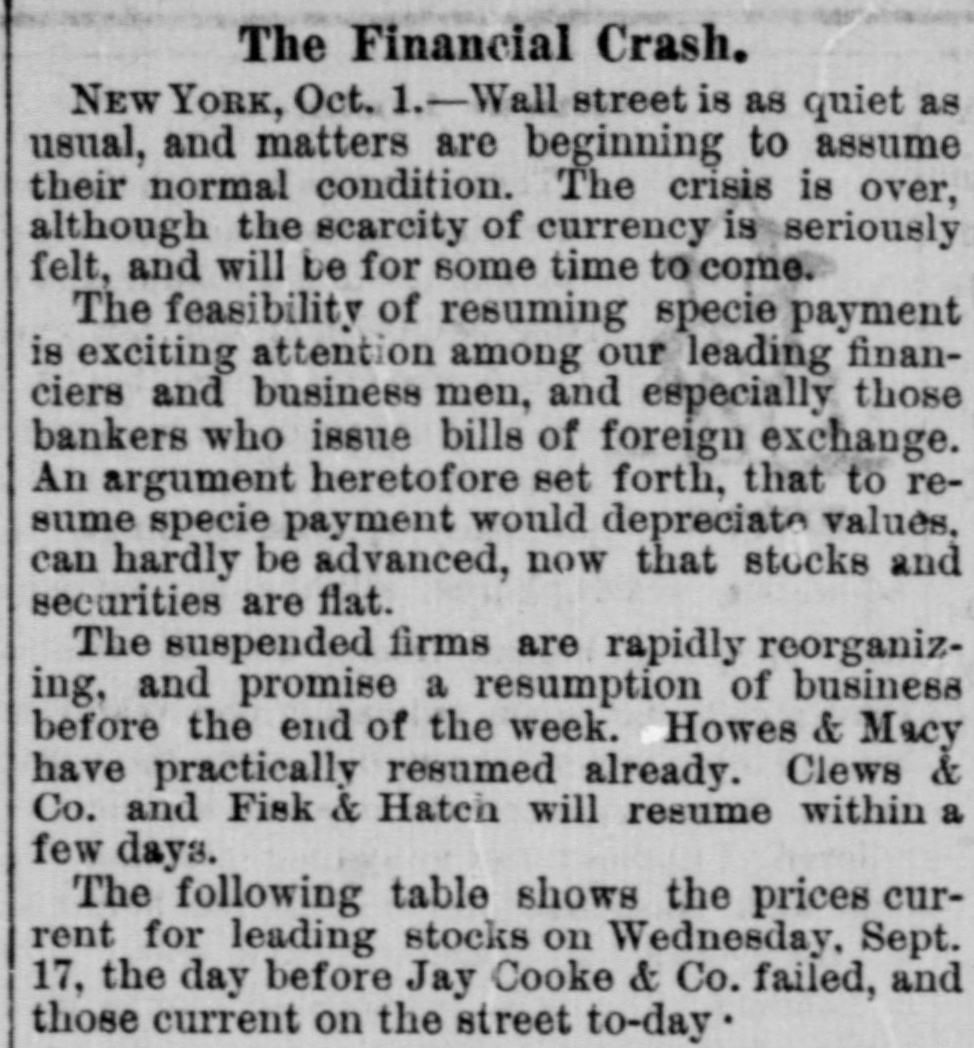
The Financial Crash. NEW YORK, Oct. 1.-Wall street is as quiet as usual, and matters are beginning to assume their normal condition. The crisis is over, although the scarcity of currency is seriously felt, and will be for some time to come. The feasibility of resuming specie payment is exciting attention among our leading financiers and business men, and especially those bankers who issue bills of foreign exchange. An argument heretofore set forth, that to resume specie payment would depreciate values, can hardly be advanced, now that stocks and securities are flat. The suspended firms are rapidly reorganizing, and promise a resumption of business before the end of the week. Howes & Macy have practically resumed already. Clews & Co. and Fisk & Hatch will resume within a few days. The following table shows the prices current for leading stocks on Wednesday, Sept. 17, the day before Jay Cooke & Co. failed, and those current on the street to-day


Article from Public Ledger, October 20, 1873

Click image to open full size in new tab

Article Text

A Luckless Depositor. New York Cor. of the Chicago Tribune.] A prominent lawyer, who had kept a large deposit for some time in the Broadway Bank, drew it out and placed it in the Atlantic Bank. When the Broadway failed, last winter, he felicitated himself upon the change he had made. Early in the spring he took his money from the Atlantic, and put it in the Union Trust Company. Soon after, the Atlantic closed its doors, and he was delighted to think how lucky he had been in not leaving his funds in its custody. Last week the run began on the Union Trust, and he hurried to the bank, and, by three hours of excitement, anxiety and crowding, he carried eff his balance, and ledged it with Howes & Macy. There he felt confident it would be safe, and was comfounded on learning that they had also suspended. He is now of opinion that it was his destiny to have his money in some failing banking-house, and that, if he had changed it a hundred times, the ultimate result would have been the same.


Article from Chicago Daily Tribune, November 29, 1873

Click image to open full size in new tab

Article Text

NEW YORK. Special Dispatch to The Chicago Tribune. THE BUIT AGAINST DANIEL DREW. NEW YORK, Nov. 28.-Counsel for Ernst H. Biedermann and Jacob Rubino, who, as I tolgraphed you on Sunday last, have begun suit against Daniel Drow, Stophen H. Alden, and Eugeno N. Robinson for the recovery of $1,000,000, which the plaintiffs claim they were swindled out of by defondants, have served a demand on Robinson and Alden that they must make affidavit covering Canton stock transactions. Robinson and Aldon have refused through their counsel to comply with this domand. It is understood that an order will soon be obtained from the Court for their examination regarding the matter. THE UNION TRUST COMPANY. In the case of Augustus W. Kelley against the Union Trust Company, Judge Fancher appointed to-day W. P. Dixon reforce, to state and pass the accounts of Edward B. Wesley, Receiver of the Trust Company, and ordered him speedily to report thereon. The Court also appointed A. R. Lawrence referee, to report to the Court what amount should be allowed Wesley for services as Receiver of the Company. The Trust Company will resume business next Monday, as was docided by the Directors at their last meeting. One of the officers of the Company said to-day that ample preparations had been made to meet any demands which might be made by depositors, and that the institution was in a thoroughly safe condition. HOWES & MACY. A meeting of the creditors of Howes & Macy, one of the banking firms which failed during the panic, was held hero this evening. Thore were about fifty of the 1,100 creditors present, representing $500,000. Many plans by which it was hoped the firm might be able to resumo business were proposed, but only to be rejected. After more or less discussion. it was finally agreed by those present that the firm should resume business at once, and pay 40 por cent on their debts on the 1st of January 10 por cont on the 1st of March, 1874; and 15 por cent on the 1st of January, 1875, making a total of 65 por cont, without interest. Before this plan can be carried out. however, the consent of the remaining 1,000 creditors must be obtained, and this is thought to be impossible. Therefore, it seems inovitable that they must eventually go into bankruptoy. THE SECRETARY OF THE TREASURY spent a fow hours in this city to-day. It is rumored that he came to and did consult with prominent New York bankers regarding the finan088 of the nation, in order to be better able to make a comprehensive report on the subject to the President, for the latter's use in his mossage to Congress. [To the Associated Press.] REGULAR MONETARY REPORT. NEW YORK, Nov. 28.-Money in active demand at 7 per cont currency to 7 gold. Storling work at 7% for GO-day. and 8% for eight. Customs receipts, $304,000. GOLD closed at 109%, after selling at 1003/@109% LOANS were at 6@7, 7 gold, and 1-82 for carrying, and flat for borrowing. The Assistant Treasurer disbursed $227,000. The clearings were $45,000,000. Governments W010 firm.; State bonds quiet. STOCKS were generally strong from the opening until about midday, with all advance in prices ranging from 14 to 14/1 por cent. The improvement WAS afterwards lost in many cases, but, after the BOCond call, buoyancy was again the foature of the market. During the last hour of business depression prevailed, andsome stocks declined to the lowest point of the day, the market leaving off feverlsh in tono. The volume of business was large, and dealings excited throughout the day. The advance in gold and dapression in stocks late in the day was caused by reports that Minintor Sickles had left Madrid, that there was increased activity in the uavy-yards, and vague runiors of failures which could not be authentiented. The stock salos between 10 and 3 o'clock amounted to 101,000 shares. of which 44,000 were Western Uhion, 27,000 Union Pacific, 12, 100 Wabash, 10,000 Ohios, 15,000 New York Contral, 8,800 St. Paul, 15,800 Lake Shore, 12,400 Northwestern, 8,500 Rock Island, and 8,500 Columbus, Chicago & Indiana Contral.


Article from Chicago Daily Tribune, December 9, 1873

Click image to open full size in new tab

Article Text

# Bankruptcy Proceedings in New York. Special Dispatch to The Chicago Tribune. NEW YORK, Dec. 8.-The bankruptcy proceed- ings against George Bird Grinnell & Co. were ordered discontinued to-day by Judge Blatch- ford, sitting in the United States District Court, in view of the fact that the firm has made ar- rangements to settle with their creditors. HOWER & MACY. A petition was filed to-day in the Court of Bankruptcy, that Howes & Macy, the banking firm which failed during the early part of the panic, be declared bankrupt.


Article from Helena Weekly Herald, February 12, 1874

Click image to open full size in new tab

Article Text

Small Capital-arge Prefits. The bankers who failed in New York during the panic are now recovering as rapidly and as easily as their hopeful announcements, a few weeks ago, predicted. It is interesting to know that in the Jav Cooke bankruptcy case the Presiding Judge instructed the Receiver that if the bankrupts have paid out money or transferred property for cost of living or family expenses," it shall be held to strict account against them. The case of Howes & Macy also proved that it is by no means as trifling a thing to fail, and so slight an acrobatic feat to recover, as Wall street brokers once thought it to be. At a meeting of their creditors, a few days ago, it was ascertained that the firm liabilities were $287,000 in excess of their assets, and the previous business of the firm was so closely examined as to reveal that, instead of a banking house, with capital proportioned to its line of deposits, Mr. Macy had furnished $50,000, and that had constituted the whole capital of the concern. From that amount of capital their books showed that Mr. Howes had drawn out of the concern $40,000 a year for ten years, and that Mr. Macy had drawn, during the same time $257,000, making $467,000 drawn by the firm, and with $700,000 paid as interest to depositors, $1,167,000 drawn in ten years out of a busines done upon $50,000 capital.


Article from Memphis Daily Appeal, July 23, 1875

Click image to open full size in new tab

Article Text

NEW YORK ITEMS. Tweed's Case-Cowardly Attack on a Woman-Death - of Charles A. Macy -Gold Sales-Six Months Losses by Fire, Etc. New York, July 22 - -Notice of ap* peal by the people to the general term of the supreme court from the decision of Justice Donohoe, in favor of William M. Tweed, in :the six million dollars civil suit, was served upon the defendant's lawyers yesterday and was duly acknowledged by them. A Carbondale (Penn) dispatch states that on Monday night John Jordon, a rejected lover of Miss Coyne, with some drunken roughs, attacked the cottage of her mother. Mrs. Coyne fired into the crowd, fatally wounding Jordon. Then handing the revolver to her son, it was accidentally discbarged, fatally wounding her daughter. Charles A. Macy, of the banking firm of Howes & Macy, which failed during the paniext 1873, died yesterday at his residence in this city. The assistant-treasurer to-day awarded one million of gold, at from 112.25 to 112.80 The entire amount bid for was $36,665,000, the lowest being 112.25, and the highest 112 80. A summary of the losses of fire insurance companies for the first six months of this year, shows that they aggregate more than the entire losses for 1874. The losses this year have fallen, not upon great cities, but chiefly upon country towns. On property destroyed, in which insurance companies have paid about twenty-six million dollars. The French musical societies of this city, contemplate holding a grand concert for the benefit of the sufferers of the floods in France. Tammany hall will be offered free for the purpose. The French committee of relief have six thousand and fifty dollars on hand, which will be immediately forwarded.


Article from The Cheyenne Daily Leader, July 23, 1875

Click image to open full size in new tab

Article Text

NIGHT REP ORT. Rev. Mr. Hinman Wants the Black Hills Cleared of Miners. The Secretary of the Interior Tries to Pacify the Sioux. The Elcho Challenge Match is Won by the Irish Team. Democratic State Convention in Maryland. New York, July 22.-Notice of appeal by the People to the general term of the Supreme Court, from the decision of Justice Donahue, in favor of Wm. M. Tweed in the $6,000,000 civil suit, was served upon the defendant's lawyers yesterday, and duly acknowledged by them. Chas. A. Macy, of the banking firm of Howe's & Macy, which failed during the panic of 1873, died yesterday at his residence in this city. The Assistant Treasurer to-day opened bids for a million of gold. The entire amount was bid for at 112,80. A summary of the losses of the Fire Insurance Companies, for the first six months of this year, shows they aggregate more than the entire losses for 1874. The losses this year have fallen not upon the great cities, but chiefly upon the country towns. The insurance companies have paid about 26 million of dollars for losses in these towns.


Article from Alexandria Gazette, July 23, 1875

Click image to open full size in new tab

Article Text

# NEWS OF THE DAY "To show the very age and body of the Times." In the swimming match at Chester, Pa., yesterday, between Coyle and Johnson for the championship of the world, the latter won, swimming ten and a half miles in three hours and ten minutes. Johnson was quite fresh when he left the water, while Coyle was taken on board the boat in an apparently lifeless condition, and last night grave fears were entertained for his life. A sanguinary political conflict is raging in the Cherokee Nation between the Ross and Downing factions. A fight occurred on the 18th instant at Skin Bayou, in which three men were killed, one of them receiving no less than one hundred and three wounds. On the night following about thirty men of each faction had another fight, but none of tha particulars have been received. Some fifteen or twenty persons were seriously, and some fatally, burned yesterday at Newark, Ohio, by the premature explosion of coal oil, which took fire from a wooden building which had been erected in the town for the purpose of testing a new fire extinguisher, and which had been saturated with the explosive material. Among those burned was the Mayor of the town. Information has been received at the Department of State to the effect that a circular has been issued by the Spanish Government, with a view to the rigorous enforcement of the existing laws of that country requiring the exhibition of passports by persons entering and leaving Spain. The floods in England continue and cause much damage to property. At Burton-on-Trent a part of the town is impassable and the water is still rising. The Great Eastern Railway, between St. Ives and Saveseye, a distance of over three miles, is submerged, and traffic is stopped. A meeting of the National Race Course Association was held at Washington last night, at which it was stated that $40,000 had been pledged for the purchase of suitable grounds. It is proposed to revive the old National Course. The convention of Southern railroad officials met in Atlanta, Ga., yesterday. There was a large attendance. The subject of pooling freights has not been settled so far as South Carolina railroads are concerned. Messrs. Fletcher, Faulkner and Harris, members of the Indian Special Commission, left New York last evening for Red Cloud Agency, to commence their investigation into Indian frauds. The next meeting of the Presbyterian Council will be held in Edinburgh in the summer of 1876, and the succeeding one in the United States. The health officer at Key West, Fla., says that the yellow fever epidemic has about expended its force there. No new decided cases have occurred in about five days. The Democratic Convention of the first Mississippi District has renominated L. Q. C. Lamar by acclamation as candidate for Congress. Gen. Jos. E. Johnston, of Georgia, has been elected President of the Arkansas Industrial University. The Cotton Exchange Convention at Greenbrier White Sulphur Springs, yesterday, adopted a constitution and by-laws. Chas. A. Macy, of the banking firm of Howes & Macy, New York, which failed in the last panic, died in that city Wednesday. Hard money, free trade and home rule are the three cardinal principles in the platform of the Maryland Conservative Democratic party. The French Assembly, yesterday, by a vote of 470 to 155, agreed to adjourn from the 4th of August to the 4th of November. The Boston Herald states that the clothing house of George H. Lane & Co., in that city, has suspended.


Article from The New York Herald, January 1, 1876

Click image to open full size in new tab

Article Text

BUSINESS FAILURES. Messrs. Priest, Fuller & Lawrence, importers, of No. 15 Maiden lane, who recently assigned to W. L. Headley, owe $19,852 82; nominal assets, $8,565 87; actual value, $7,731 47. Assignments have been made by George C. & William G. Angell to W. B. Sofield; by Emma Bartlett, dealer in harness, of No. 62 Warren street, to Josiah Fletcher, and by J. R. Hitchcock & Co., importers, of No. 38 Beaver street, to De L'Orme Knowlton. The individual creditors of Reuben W. Howes, of the late firm of Howes & Macy, bankers, held a meeting yesterday before Register Dayton, at No. 322 Broadway. The assignee, Nelson J. Tappan, presented his report, and a dividend of five per cent was declared, making sixty per cent in all. The estate of Charles A. Macy paid 100 per cent, and another dividend of about ten per cent will be paid to the creditors of the firm, fifty five per cent having been previously paid. There are about 900 creditors. A meeting of the creditors of Charles G. Wilson. clocks, No. 69 Nassau street, was held at the office of Henry W. Allen, Register in Bankruptcy, No. 152 Broadway. A number of claims were proved and Charies M. Gould was elected assignee. The liabilities are about $30,000. Among the principal creditors are the follow. ing:-Charles Clark, $3,202; Bridgeport Brass Company, $1,210; W. L. Gilbert, $1,198; Mathew Wilkes, $1,128; Ansonia Brass and Copper Company, $9,043. The creditors of Patrick D. Casey, liquors, met yesterday at the office of Isaac Dayton, Register in Bankruptey, No. 322 Broadway, and, on the report of the assignee, George Gallager, a dividend of eight per cent was declared. At a meeting of the creditors of Isaac C. Schafer, gyrups, No. 76 Cortlandt street, Mr. David Wagstaff, of No. 78 Cortiandt street, was chosen assignee in bank. ruptcy.


Article from The New York Herald, May 28, 1876

Click image to open full size in new tab

Article Text

CAREFUL FINANCIERING. WHAT THE RECEIVER OF HOWES & MACY'N BANK DISCOVERED-A LAWYER DEPOSITS $3,000 AND DRAWS $30,000. The receiver appointed to close up the affairs of Howes & Macy, the Wall street bankers, has just dis. covered one of the most remarkable and costly blunders ever chronicled. It appears that E. Y. Bell, well known politician and lawyer, residing at Yon. kers, kept an account with this firm. He obtained a judgment in a lawsuit to the amount of $3,000 and do. posited the money. He drew against it in small sums, aggregating about $2,000. Wishing to know the exact balance he had in b.nk he inquired one day of the cashier. The books were examined, and the cashier told him he had yet $27,000 to his credit. The clerk had made a mistake of $27,000, and entered the deposit as $30,000 instead of $3,000. Mr. Bell walked quietly out, and in a few days drew cheeks upon the bank to the extent of $25,000. These were paid. With this money Mr. Bell purchased a handsome restdence at Yonkers and a horse and carriage, much ta the surprise of the good people of that town, who had generally regarded Yeke" as an impecunious lawyer. The affairs of Howes & Macy seem to have been in a very much muddled condition, and a great many creditors refused to settle. A receiver was appointed to look after the assets, and suits were brought by SOVeral creditors against the firm which are yet pending in the courts. The receiver procured an expert and set him AT WORK UPON THE BOOKS. There was a great deficiency which puzzled him and all parties concerned, but the trouble was solved by the discovery of Bell's deposit slip. The wily lawyer heard of the engagement of the expert and the close examination of the accounts and he at once sold out his claim against the firm to a third party. The exposure came and Bell was notilled. Mr. Howes living at Youkers the affair became known to Bell's friends and the lawyer found Yonkers a disagreeable place. The legal fraternity took measures to exclude him from their society, and his friends cut him. Hearing that proceedings were about to be taken by the receiver to recover the money Beil sold his house, gathered together all his available assets and departed for Colorado. This little "error" has naturally aroused the iro of the creditors, who seem to think that the affairs of the banking house were very loosely conducted. Mr. Macy gave up everything he had to his creditors, but his partner did not. The question now arises what can be done with Mr. Bell, even if he can be found, to make him refund the money.


Article from New-York Tribune, February 29, 1884

Click image to open full size in new tab

Article Text

SUSPENSION OF HOWES & CO. The suspension of Howes & Co., bankers and stock brokers at No. 11 Wall-st., was announced yesterday. The outstanding contracts at the Stock Exchange had been settled, and H. H Landon, who represented the firm at the board, had given notice of his withdrawal from the copartnership. The failure was not generally known until late in the afternoon. It was said at the firm's office that no statement of the liabilities and assets could be made yesterday. It is believed that the liabilities are small and due mainly to customers who had deposited money with the house. Reuben W. Howes, the senior partner, began the wholesale shoe business in this city about forty years ago. In 1863 he started in the banking business as one of the firm of Howes & Macy, and in January, 1871, he retired from the shoe business. The panic of 1873 caused such large losses to Howes & Macy that they were compelled to suspend, with liabilities of $1,213,939. Their efforts to effect a settlement with their creditors were unsuccessful, and in December, 1873, an involuntary petition in bankruptoy was filed against them. Pending a settlement of the affairs of the firm, a new concern was started by Mrs. Melissa Howes, wife of R. W. Howes, and their son, L. T. Howes, under the firm name of Howes & Co. Mrs. Howes retired from the firm in May, 1877, and her husband, who had received a discharge in bankruptcy, became a member of it.