Article Text
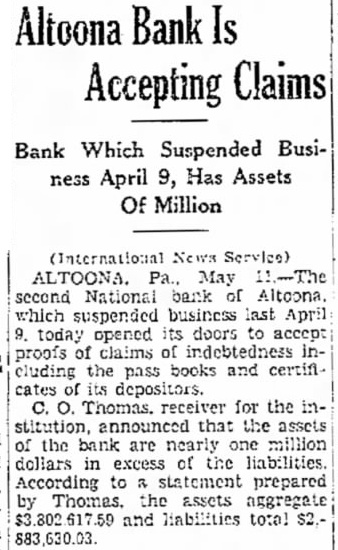
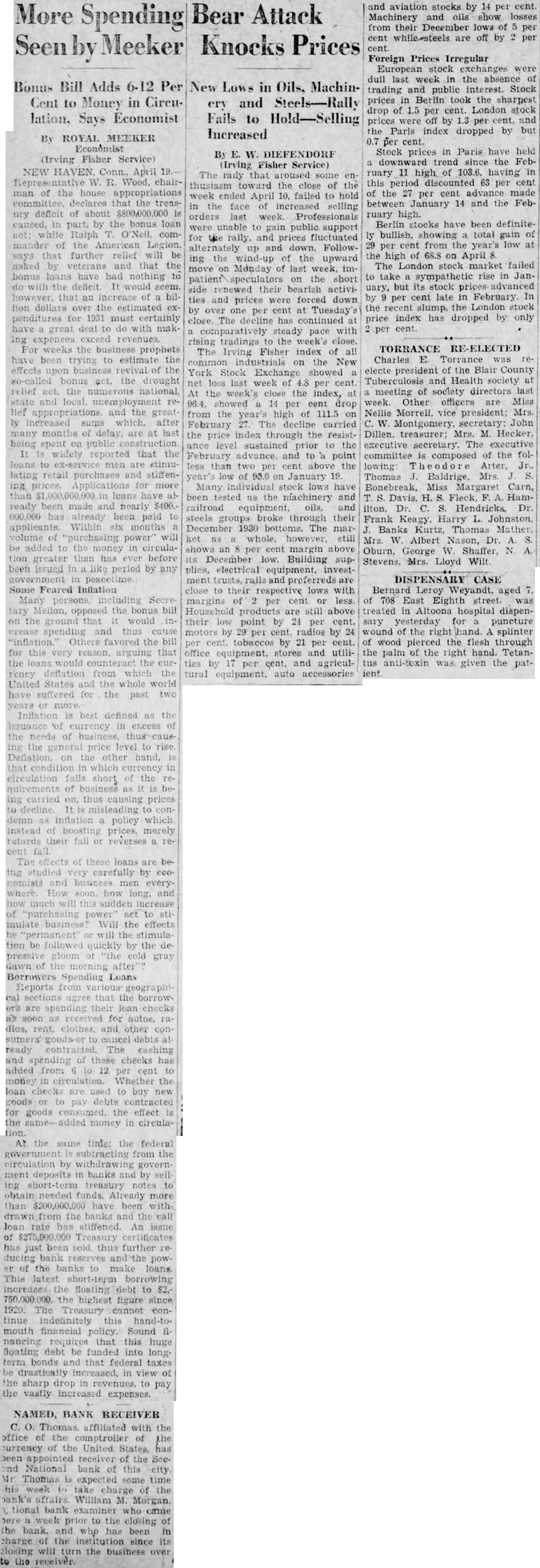
Bear Attack More Spending Knocks Prices Seen by Meeker Bonus Bill Adds 6-12 Per Cent to Money in Circulation. Says Economist By ROYAL MEEKER Economist (Irving Fisher Service) NEW HAVEN. Conn., April 19 Representative W. R. Wood, chairman of the house appropriations committee, declares that the treasury deficit of about $800,000,000 is caused, in part. by the bonus loan act: while Ralph T. Neil. commander of the American Legion, says that further relief will be asked by veterans and that the bonus loans have had nothing to do with the deficit would seem. however. that an increase of a billion dollars over the estimated expenditures for 1931 must certainly have great deal to do with making expenses exceed revenues. For weeks the business prophets have been trying to estimate the effects business revival of the so-called bonus act, the drought relief act the national, state and local. unemployment relief appropriations. and the greatly increased sums which, after many months of delay are at last being spent on public It widely reported that the loans to men are stimulating retail purchases and stiffening prices. Applications for more than $1,000,000,000 in loans have at ready been made and nearly $400.000,000 has already been paid to applicants Within six months volume of "purchasing power" will be added to the money in circulation greater than has ever before been issued in like period by any government in peacetime Some Feared Inflation Many persons, including Secretary Mellon, opposed the bonus bill on the ground that would increase spending and thus cause "inflation." Others favored the bill for this very reason. arguing that the loans would counteract the currency deflation from which the United States and the whole world have suffered for the past two years or more Inflation is best defined as the Issuance 'of currency in excess of the needs of business, thus causIng the general price level to rise Deflation on the other hand, that condition in which currency in circulation falls short of the requirements of business as it is being carried on, thus causing prices to decline It misleading to condemn inflation policy which instead of boosting prices, merely retards their fall or reverses a recent The of these loans are being studied very carefully by economists and business men everywhere How how long. and how much will this sudden of 'purchasing power act to stimulate business Will the effects be or will the stimulation be followed quickly by the depressive gloom of cold gray dawn of the after"? morning Borrowers Spending Loans Reports from geographi cal agree that the borrow. ers are their loan checks as soon as received for autos, radios, rent. clothes. and other conready contracted. The cashing and spending of these checks has added from to 12 per cent to money in Whether the loan checks are used to buy new goods or to pay debts for goods the effect is the same- added money in circula- At the same time: the federal government subtracting from the circulation by withdrawing government deposits in banks and by selling short-term treasury notes to obtain needed Already more than $200,000.000 have been withdrawn from the banks and the call loan rate has stiffened. An issue of $275,000,000 Treasury certificates has just been sold. thus further reducing bank reserves and the pow. er of the banks to make loans. This latest short-term borrowing increases the floating debt to $2,750,000,000 the highest figure since 1920. The Treasury cannot continue indefinitely this hand-tomouth financial policy. Sound flnancing requires that this huge floating debt be funded into longterm bonds and that federal taxes be drastically increased, in view of the sharp drop in revenues. to pay the vastly increased expenses. NAMED, BANK RECEIVER C. O. Thomas. affiliated with the office of the comptroller of the currency of the United States, has been appointed receiver of the Seeand National bank of this city Mr. Thomas is expected some time his week to take charge of the bank's affairs William M. Morgan tional bank examiner who came here week prior to the closing of the bank. and who has been in charge of the institution since its closing will turn the business over to the receiver. New Lows in Oils, Machinery and Steels-Rally Fails to Hold-Selling Increased By E. W. DIEFENDORF (Irving Fisher Service) The raily that aroused some enthusiasm toward the close of the week ended April 10. failed to hold in the face of selling orders last week. Professionals were unable to gain public support for the rally. and prices fluctuated alternately up and down. Following the wind-up of the upward move on Monday of last week, impatient speculators on the short side their bearish activities and prices were forced down by over one per cent at Tuesday' close. The decline has continued at comparatively steady pace with rising tradings the week's close. The Irving Fisher index of all common industrials on the New York Stock Exchange showed net loss last week of 4.8 per cent At the week's close the index, at 96.4. showed 14 per cent drop from the year's high of 111.5 on February 27. The decline carried the price index through the resistance level sustained prior to the February advance. and to a point less than two per cent above the year's low of 95.0 on January 19. Many stock lows have been tested as the machinery and railroad equipment, oils, and steels groups broke through their December 1930 bottoms. The market as whole. however still shows an per cent margin above its December low. Building supplies, electrical equipment, investment trusts, rails and preferreds are close to their respective lows with margins of 2 per cent or less Household products are still above their low point by 24 per cent. motors by 29 per cent radios by 24 per cent. tobaccos by 21 per cent. office equipment, stores and utilities by 17 per cent. and agricultural equipment, auto accessories and aviation stocks by 14 per cent. Machinery and oils show losses from their December lows of per cent while steels are off by 2 per Foreign Prices Irregular European stock exchanges were dull last week in the absence of trading and public interest. Stock prices in Berlin took the sharpest drop of 1.5 per cent. London stock prices were off by 1.3 per cent and the Paris index dropped by but 0.7 per cent. Stock prices in Paris have held downward trend since the February 11 high of 103.6. having in this 63 per cent of the 27 per cent made between January 14 and the February high. Berlin stocks have been definitely bullish, showing total gain of 29 per cent from the year's low at the high 68.8 on April The London stock failed to take sympathetic rise in January, but its stock prices advanced by per cent late in February In the recent slump. the London stock price index has dropped by only per cent. TORRANCE RE-ELECTED Charles E. Torrance was reelecte president of the Blair County Tuberculosis and Health society at a meeting of society directors last week Other officers Miss Nellie Morrell. vice president; Mrs. C. W Montgomery, secretary: John Dillen. treasurer; Mrs. M. Hecker, executive secretary The executive committee is composed of the following: Theodore Arter, Jr., Thomas J. Baldrige, Mrs. S. Bonebreak, Miss Margaret Carn, S. Davis, H. S. Fleck, A. Hamilton. S. Hendricks, Dr Frank Keagy Harry L. Johnston J. Banks Kurtz, Thomas Mather Mrs. W. Albert Nason, Dr. A. S. Oburn, George W Shaffer, N. A. Stevens. Mrs. Lloyd Wilt. DISPENSARY CASE Bernard Leroy Weyandt, aged 7. of 708 East Eighth street. was treated in Altoona hospital dispensary yesterday for puncture wound of the right hand. A splinter of wood pierced the flesh through the palm of the right hand. Tetantus anti-toxin was given the patient.