19108. Mutual Banking, Surety, Trust and Safe Deposit Company (Philadelphia, PA)

Bank Information

Episode Type
Suspension โ†’ Closure
Bank Type
state
Start Date
April 2, 1892
Location
Philadelphia, Pennsylvania (39.952, -75.164)

Metadata

Model
gpt-5-mini
Short Digest
c4722a87

Response Measures

None

Description

The bank was first suspended/closed by the state bank examiner in April 1892 for impaired capital, later rehabilitated with Iron Hall funds and permitted to resume, then on Aug 16-17, 1892 the directors made an assignment / failed to open doors (effectively a suspension leading to assignment and eventual receivership). There is no clear mention of a depositor run; causes center on impaired capital, padded Iron Hall accounts, and litigation over Iron Hall funds. Dates drawn from newspaper reports; the exact date of any appointed receiver for the bank is not consistently reported in these excerpts.

Events (5)

1. April 2, 1892 Suspension
Cause
Bank Specific Adverse Info
Cause Details
State bank examiner found impairment of capital; examiner ordered closure and applied for a receiver due to alleged insolvency.
Newspaper Excerpt
Shortly before noon today the state bank examiner suspended the business of the Mutual Banking, Surety, Trust and Safe Deposit company, at 1317 Arch street, pending an investigation of its affairs.
Source
newspapers
2. August 16, 1892 Reopening
Newspaper Excerpt
Not until the finances of the concern were rehabilitated, by the transfer to its coffers of $170,000 of Iron Hall money, was it permitted to resume operations. The Mutual ... was closed several months ago by Superintendent of Banking Krumbhaar. He discovered that its capital was impaired. The capital was made up and business was resumed.
Source
newspapers
3. August 16, 1892 Suspension
Cause
Bank Specific Adverse Info
Cause Details
Assignment/suspension precipitated by litigation and claims related to large Iron Hall deposits (allegations of padded accounts, claims that large sums of the order's funds were locked up and the bank was surety for officers); directors made assignment to keep assets in Philadelphia and protect creditors.
Newspaper Excerpt
The Mutual Banking, Surety, Trust and Safe Deposit Company ... failed to open its doors this morning. The directors of the bank had made an assignment for the benefit of the stockholders and depositors to A. E. Stockwell of this city, attorney for the bank.
Source
newspapers
4. * Other
Newspaper Excerpt
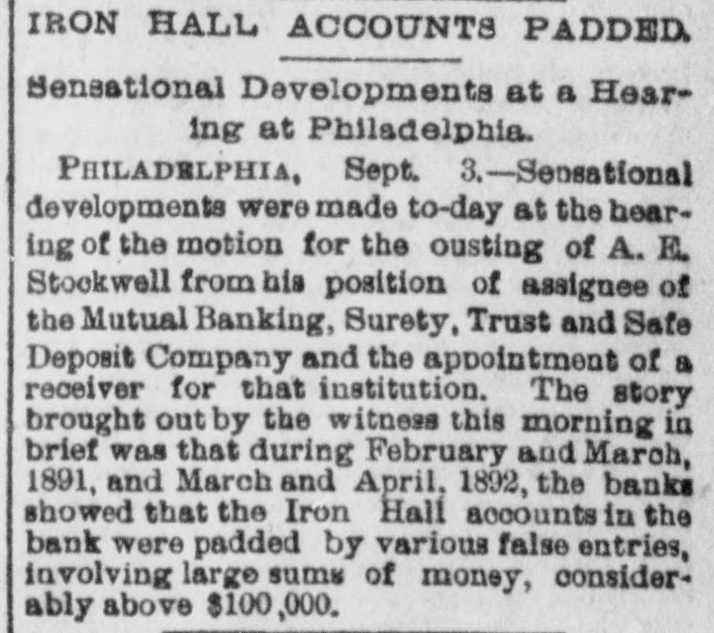
A. E. Stockwell, assignee for the Mutual Banking ... made a motion ... that the assignment of the company to Mr Stockwell ... be confirmed and approved. Objection was made that Stockwell should be ousted and a receiver appointed for the banking company. Sensational developments: books showed Iron Hall accounts padded by false entries involving large sums above $100,000. Arrests of Stockwell and cashier Hayes on charges of conspiracy to defraud and converting large sums were reported later; receiver matters proceeded in court thereafter.
Source
newspapers
5. * Receivership
Newspaper Excerpt
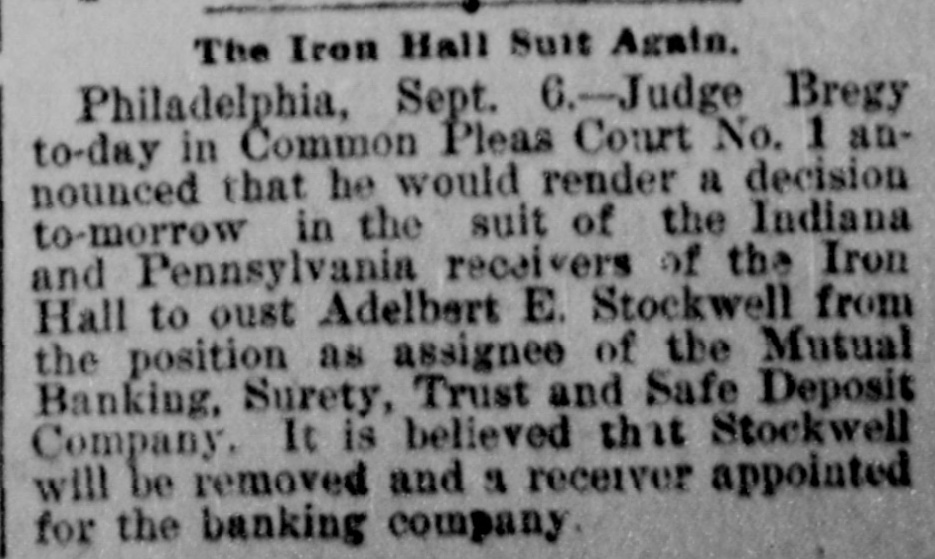
It is believed that Stockwell will be removed and a receiver appointed for the banking company. (reports from Sept. 6โ€“Sept. 7 indicate the court was likely to appoint a receiver).
Source
newspapers

Newspaper Articles (17)

Article from The Wichita Daily Eagle, April 3, 1892

Click image to open full size in new tab

Article Text

FAILURES. PHILADELPHIA, April 2-Shortly before noon today the state bank examiner BUS+ pended the business of the Mutual Banking, Surety, Trust and Safe Deposit com+ pany, at 1317 Arch street, pending an investigation of its affairs. The company's officers refuse information as to the nature of the troubles. The capital of the con. cern is $1,000,000, with $100,000 paid in. The president is D. H. Pancoast. CLEVELAND, Ohio, April 2-Rumors that the failure of the Painesville bank had weakened the Citizen's Savings bank at Akron caused a run on the latter last night and today. The depositors made a rush for their money. After $125,000 had been paid out the bank decided to suspend payment on interest bearing deposits for thirty days. This is due to a lack of currency. The bank is said to be perfectly sound, and not a single business man in Akron Grew out a cent of his deposits.


Article from The Indianapolis Journal, August 3, 1892

Click image to open full size in new tab

Article Text

Order's Funds There Garisheed by Local Litigation, and the Pennsylvania Bank Examiner Appears on the Scene. Somerby Talks Freely, and Declares that a Receiver Is Uncalled For. Says the Order Is Perfectly Sound and the Bank Solvent-Large Deposit There-Meeting of the Executive Board To-Day. IRON HALL IMBROGLIO. Philadelphia Bank the Main Cause of the Trouble-Mr. Somerby's Declarations. Yesterday's developments in the Iron Hall matter demonstrate pretty clearly that the Mutual Banking, Surety, Trust and Safe Deposit Company, the Philadelphia banking concern with which Supreme Justice Somerby and Supreme Trustee Hays are connected, 18 the real milk in the cocoanut. It also looks from the outside as though the receivership suit was the result of a plan previously discussed between members of the order here and in Philadelphia. It was followed yesterday by a suit brought by a trustee of a local branch in Philadelphia against himself and others, involving garnishment of the order's funds in the Philadelphia bank. At the same time Bank Examiner Krumbhaar appeared in Philadelphia in answer to telegraphic requests from both Indianapolis and Philadelphia, asking him to make an examination of the bank, and it is probable that he will proceed to do so. A meeting of the executive board of the order will be held to-day, most of the members having arrived last night, and one result of this meeting will be an address to the members, which will probably contain a statement of the financial status of the order. In the meantime Supreme Justice . Somerby, who was "at home" to callers at the offices of the order yesterday, makes the reassuring declaration that the order is as sound as a dollar, and that the Philadelphia bank, where he admits the order has large deposits, is entirely solvent. As to the personal charges against himself, he prefers that the court's decision should answer them.


Article from Evening Journal, August 16, 1892

Click image to open full size in new tab

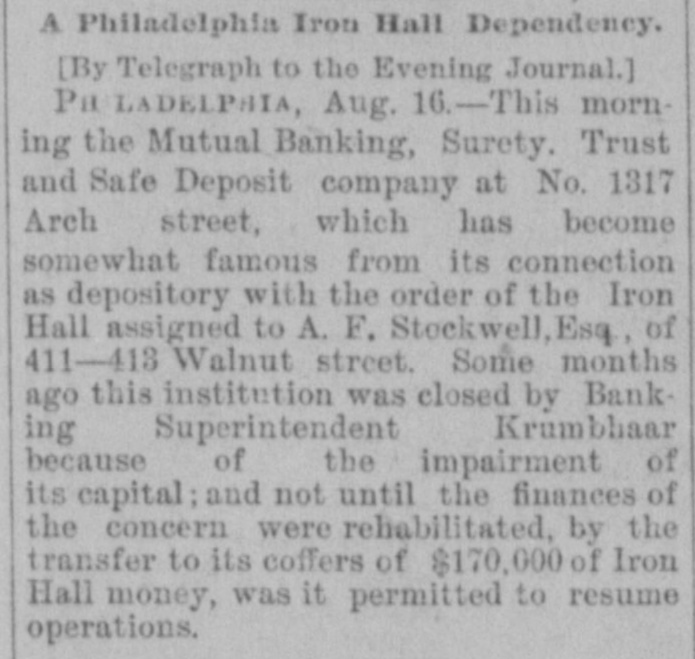
Article Text

A Philadelphia Iron Hall Dependency. [By Telegraph to the Evening Journal.] Pa LADELPHIA, Aug. 16.-This morning the Mutual Banking, Surety. Trust and Safe Deposit company at No. 1317 Arch street, which has become somewhat famous from its connection as depository with the order of the Iron Hall assigned to A. F. Stockwell, Esq., of 411-418 Walnut street. Some months ago this institution was closed by Bank Krumbhaar Superintendent ing because of the impairment of its capital; and not until the finances of the concern were rehabilitated, by the transfer to its coffers of $170,000 of Iron Hall money, was it permitted to resume operations.


Article from The Wilmington Daily Republican, August 17, 1892

Click image to open full size in new tab

Article Text

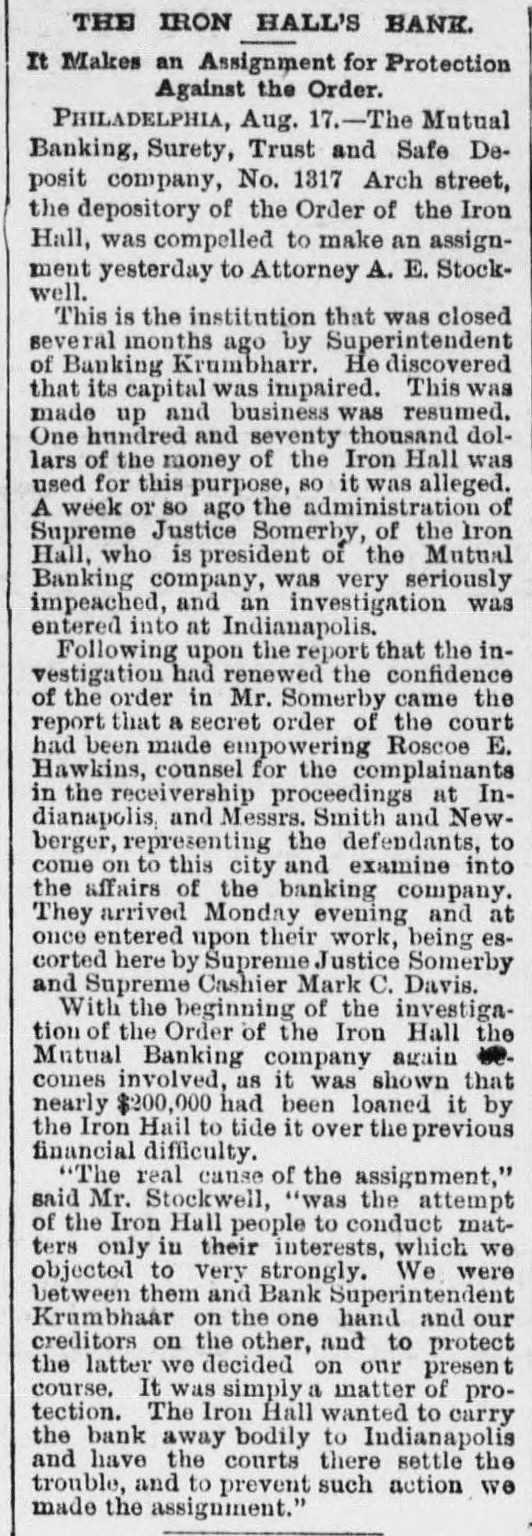
THE IRON HALL'S BANK. It Makes an Assignment for Protection Against the Order. PHILADELPHIA, Aug. 17.-The Mutual Banking, Surety, Trust and Safe Deposit company, No. 1317 Arch street, the depository of the Order of the Iron Hall, was compelled to make an assignment yesterday to Attorney A. E. Stockwell. This is the institution that was closed several months ago by Superintendent of Banking Krumbharr. He discovered that its capital was impaired. This was made up and business was resumed. One hundred and seventy thousand dollars of the money of the Iron Hall was used for this purpose, so it was alleged. A week or so ago the administration of Supreme Justice Somerby, of the Iron Hall, who is president of the Mutual Banking company, was very seriously impeached, and an investigation was entered into at Indianapolis. Following upon the report that the investigation had renewed the confidence of the order in Mr. Somerby came the report that a secret order of the court had been made empowering Roscoe E. Hawkins, counsel for the complainants in the receivership proceedings at Indianapolis, and Messrs. Smith and Newberger, representing the defendants, to come on to this city and examine into the affairs of the banking company. They arrived Monday evening and at once entered upon their work, being escorted here by Supreme Justice Somerby and Supreme Cashier Mark C. Davis. With the beginning of the investigation of the Order of the Iron Hall the Mutual Banking company again n. comes involved, as it was shown that nearly $200,000 had been loaned it by the Iron Hail to tide it over the previous financial difficulty. "The real cause of the assignment," said Mr. Stockwell, "was the attempt of the Iron Hall people to conduct matters only in their interests, which we objected to very strongly. We were between them and Bank Superintendent Krumbhaar on the one hand and our creditors on the other, and to protect the latter we decided on our present course. It was simply a matter of protection. The Iron Hall wanted to carry the bank away bodily to Indianapolis and have the courts there settle the trouble, and to prevent such action we made the assignment."


Article from The Morning News, August 17, 1892

Click image to open full size in new tab

Article Text

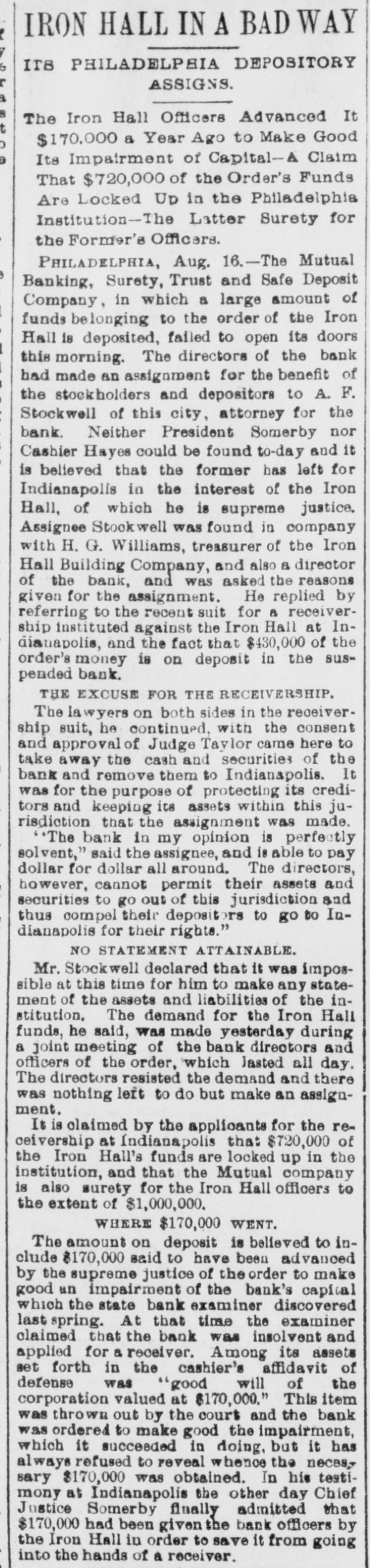
IRON HALL IN A BAD WAY ITS PHILADELPSIA DEPOSITORY ASSIGNS. The Iron Hall Officers Advanced It $170,000 a Year Ago to Make Good Its Impairment of Capital-A Claim That $720,000 of the Order's Funds Are Locked Up in the Philadelphia Institution-The Latter Surety for the Former's Officers. PHILADELPHIA, Aug. 16.-The Mutual Banking, Surety, Trust and Safe Deposit Company, in which a large amount of funds belonging to the order of the Iron Hall is deposited, failed to open its doors this morning. The directors of the bank had made an assignment for the benefit of the stockholders and depositors to A. F. Stockwell of this city, attorney for the bank. Neither President Somerby nor Cashier Hayes could be found to-day and it is believed that the former has left for Indianapolis in the interest of the Iron Hall, of which he is supreme justice. Assignee Stockwell was found in company with H. G. Williams, treasurer of the Iron Hall Building Company, and also a director of the bank, and was asked the reasons given for the assignment. He replied by referring to the recent suit for a receivership instituted against the Iron Hall at Indianapolis, and the fact that $430,000 of the order's money is on deposit in the suspended bank. THE EXCUSE FOR THE RECEIVERSHIP. The lawyers on both sides in the receivership suit, he continued, with the consent and approval of Judge Taylor came here to take away the cash and securities of the bank and remove them to Indianapolis. It was for the purpose of protecting its creditors and keeping its assets within this jurisdiction that the assignment was made. The bank in my opinion is perfectly solvent," said the assignee, and is able to pay dollar for dollar all around. The directors, however, cannot permit their assets and securities to go out of this jurisdiction and thus compel their depositors to go to Indianapolis for their rights." NO STATEMENT ATTAINABLE. Mr. Stockwell declared that it was impossible at this time for him to make any statement of the assets and liabilities of the institution. The demand for the Iron Hall funds, he said, was made yesterday during a joint meeting of the bank directors and officers of the order, which Jasted all day. The directors resisted the demand and there was nothing left to do but make an assignment. It is claimed by the applicants for the receivership at Indianapolis that $720,000 of the Iron Hall's funds are locked up in the institution, and that the Mutual company is also surety for the Iron Hall officers to the extent of $1,000,000. WHERE $170,000 WENT. The amount on deposit is believed to include $170,000 said to have been advanced by the supreme justice of the order to make good an impairment of the bank's capital which the state bank examiner discovered last spring. At that time the examiner claimed that the bank was insolvent and applied for a receiver. Among its assets set forth in the cashier's affidavit of defense was "good will of the corporation valued at $170,000." This item was thrown out by the court and the bank was ordered to make good the impairment, which it succeeded in doing, but it has always refused to reveal whence the neces, sary $170,000 was obtained. In his testimony at Indianapolis the other day Chief Justice Somerby finally admitted that $170,000 had been given the bank officers by the Iron Hall in order to save it from going into the hands of a receiver.


Article from New-York Tribune, August 17, 1892

Click image to open full size in new tab

Article Text

IRON HALL FUNDS LOCKED UP. THE MUTUAL BANKING COMPANY OF PHILA DELPHIA ASSIGNS. THE BANK SAID TO BE SOLVENT AND THE MEASURE TO PREVENT WITHDRAWAL OF THE MONEY. Philadelphia. Aug. 16.-The Mutual Banking, Surety, Trust and Safe Deposit Company. in which a large amount of funds belonging to the Order of the Iron Hall are deposited, failed to open its doors this mornIng. Inquiry developed the fact that the directors of the bank had made an assignment for the benefit of the stockholders and depositors to A. E. Stockwell, of this city, attorney of the bank. Neither President Somerby nor Coshier Hayes could be found to-day, and It is believed that the former has gone to Indianapolis in the interests of the Iron Hall, of which he IS Supreme Justice. The assignee. Mr. Stockwell, was found in company with 11. G. Williams, treasurer of the Iron Hall Building Company, and also director of the bank, and was asked the reasons given for the assignment. He replied by referring to the recent suit for a receivership Instituted against the Iron Hall at Indianapolis, and the fact that $430,000 of the Order's money is on deposit in the bank. The lawyers on both sides In the receivership sult," be continued, "with the consent and approval of Judge Taylor, came here to take away the cash and securities of the bank, and remove them to Indianapolis. It was for the purpose of protecting Its creditors and keeping its assets within this jursdiction that the assignment was made. The bank, in my opinion. is perfectly solvent," said the assignee, "and is able to pay dollar for dollar all around. The directors, however, cannot permit their assests and securittes to get out of this jurisdiction. and thus compel their depositors to go to Indianapolis for their rights." Mr. Stockwell declared that it was impossible at this time for him to make any statement of the assets and liabilities of the institution. The demand for the Iron Hall funds, he said. was made yesterday during the joint meeting of the bank directors and officers of the order which lasted all day. The di. rectors resisted the demand. and there was nothing left 10 do but make an assignment. It Is contended by applicants for the receivership at Indianapolis that $720,000 of the Iron Hall's funds are locked up in the institution, and that the Mutual Company "is also surety for the Iron Hall officers to the extent of $1,000,000. The amount on deposit is believed to include $170,000 sald to have been advanced by the Supreme Justice of the order to make good an impairment of the bank's capital. which the At State Bank Examiner discovered last spring. that time the examiner asserted That the bank was insolvent and applied for a receiver. Among its assets set forth in the cashier's affidavit of defence was the "goodwill of the corporation. valued at $170,000." This item was thrown out by the court. and the bank was ordered to make good the impair ment, which It succeeded in doing, but has always refused to reveal whence the necessary $170,000 was obtained. In his testimony at Indianapolls the other day Chief Justice Somerby finally admitted that the $170,000 had been given to the bank by the officers of the Iron Hall in order to save It from going into the hands of a receiver. The cash on hand, etc., is thought to be to a large extent the $170,000 given by the Iron Hall. which went to make up the $168,950 capital stock paid in. Of the deposits subject to check, amounting to $492,855 37, the bulk is Iron Hall money, and the rest, It is said, is mainly funds of the other fraternal orders. The special deposits, $80,700 63, are, it is explained, deposits for a special purpose." In addition to the Iron Hall funds on deposit in the institution there is also locked np $40,000 belong ing to the Advance Beneficial Order. one of the short-term organizations which went down In the gen. eral crash of such schemes about a year ago. The Advance Order also made an assignment to A. E. Stockwell, who deposited the funds of the Advance Order in the bank, of which he was counsel and is now assignee. A few weeks ago pressure was brought on Stockwell to remove the funds of the defanet bene ficial society from the Mutual Bank, but he refused, declaring the institution was perfectly solvent. Stockwell was elected on August 3 a trustee of the Iron Hall Building Company. Charles H. Krumbhaar. State Superintendent of Banking, said this afternoon in relation to the Mutual Banking Company that as the bank had assigned It had now passed out of his eredsice jurisdiction. of He counsel had been
Article from Pittsburg Dispatch, August 17, 1892

Click image to open full size in new tab

Article Text

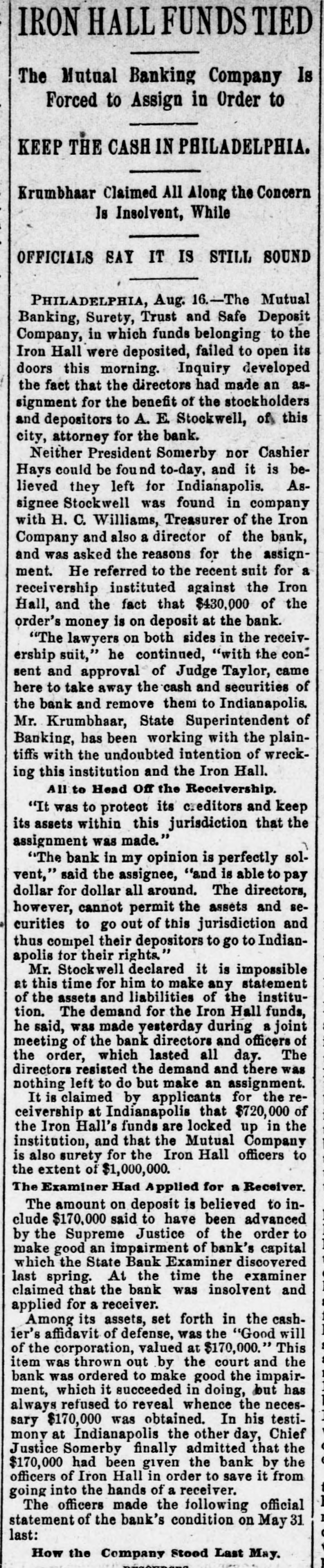
IRON HALL FUNDS TIED The Mutual Banking Company Is Forced to Assign in Order to KEEP THE CASH IN PHILADELPHIA. Krumbhaar Claimed All Along the Concern Is Insolvent, While OFFICIALS SAY IT IS STILL SOUND PHILADELPHIA, Aug. 16.-The Mutual Banking, Surety, Trust and Safe Deposit Company, in which funds belonging to the Iron Hall were deposited, failed to open its doors this morning. Inquiry developed the fact that the directors had made an assignment for the benefit of the stockholders and depositors to A. E. Stockwell, of this city, attorney for the bank. Neither President Somerby nor Cashier Hays could be fou to-day, and it is believed they left for Indianapolis. Assignee Stockwell was found in company with H. C. Williams, Treasurer of the Iron Company and also a director of the bank, and was asked the reasons for the assignment. He referred to the recent suit for a receivership instituted against the Iron Hall, and the fact that $430,000 of the order's money is on deposit at the bank. "The lawyers on both sides in the receivership suit," he continued, "with the consent and approval of Judge Taylor, came here to take away the cash and securities of the bank and remove them to Indianapolis. Mr. Krumbhaar, State Superintendent of Banking, has been working with the plaintiffs with the undoubted intention of wrecking this institution and the Iron Hall. All to Head Off the Receivership. "It was to protect its creditors and keep its assets within this jurisdiction that the assignment was made." "The bank in my opinion is perfectly solvent," said the assignee, "and is able to pay dollar for dollar all around. The directors, however, cannot permit the assets and securities to go out of this jurisdiction and thus compel their depositors to go to Indianapolis for their rights' Mr. Stockwell declared it is impossible at this time for him to make any statement of the assets and liabilities of the institution. The demand for the Iron Hall funds, he said, was made yesterday during a joint meeting of the bank directors and officers of the order, which lasted all day. The directors resisted the demand and there was nothing left to do but make an assignment. It is claimed by applicants for the receivership at Indianapolis that $720,000 of the Iron Hall's funds are locked up in the institution, and that the Mutual Company is also surety for the Iron Hall officers to the extent of $1,000,000. The Examiner Had Applied for a Receiver. The amount on deposit is believed to include $170,000 said to have been advanced by the Supreme Justice of the order to make good an impairment of bank's capital which the State Bank Examiner discovered last spring. At the time the examiner claimed that the bank was insolvent and applied for a receiver. Among its assets, set forth in the cashier's affidavit of defense, was the "Good will of the corporation, valued at $170,000.' This item was thrown out by the court and the bank was ordered to make good the impairment, which it succeeded in doing, but has always refused to reveal whence the necessary $170,000 was obtained. In his testimony at Indianapolis the other day, Chief Justice Somerby finally admitted that the $170,000 had been given the bank by the officers of Iron Hall in order to save it from going into the hands of a receiver. The officers made the following official statement of the bank's condition on May 31 last: How the Company Stood Last May.


Article from New-York Tribune, August 18, 1892

Click image to open full size in new tab

Article Text

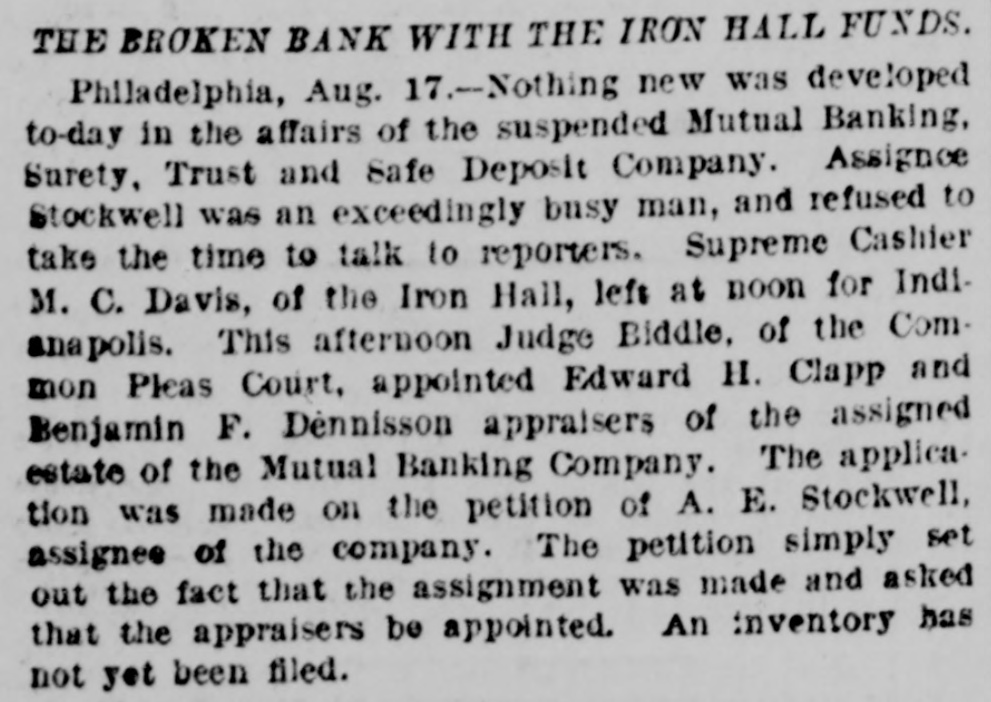
THE BROKEN BANK WITH THE IRON HALL FUNDS. Philadelphia, Aug. 17.-Nothing new was developed to-day in the affairs of the suspended Mutual Banking, Surety, Trust and Safe Deposit Company. Assignee Stockwell was an exceedingly busy man, and refused to take the time to talk to reporters. Supreme Cashier M. C. Davis, of the Iron Hall, left at noon for Indianapolis. This afternoon Judge Biddle, of the Common Pleas Court, appointed Edward H. Clapp and Benjamin F. Dennisson appraisers of the assigned estate of the Mutual Banking Company. The application was made on the petition of A. E. Stockwell, assignee of the company. The petition simply set out the fact that the assignment was made and asked that the appraisers be appointed. An inventory has not yet been filed.


Article from Pittsburg Dispatch, August 18, 1892

Click image to open full size in new tab

Article Text

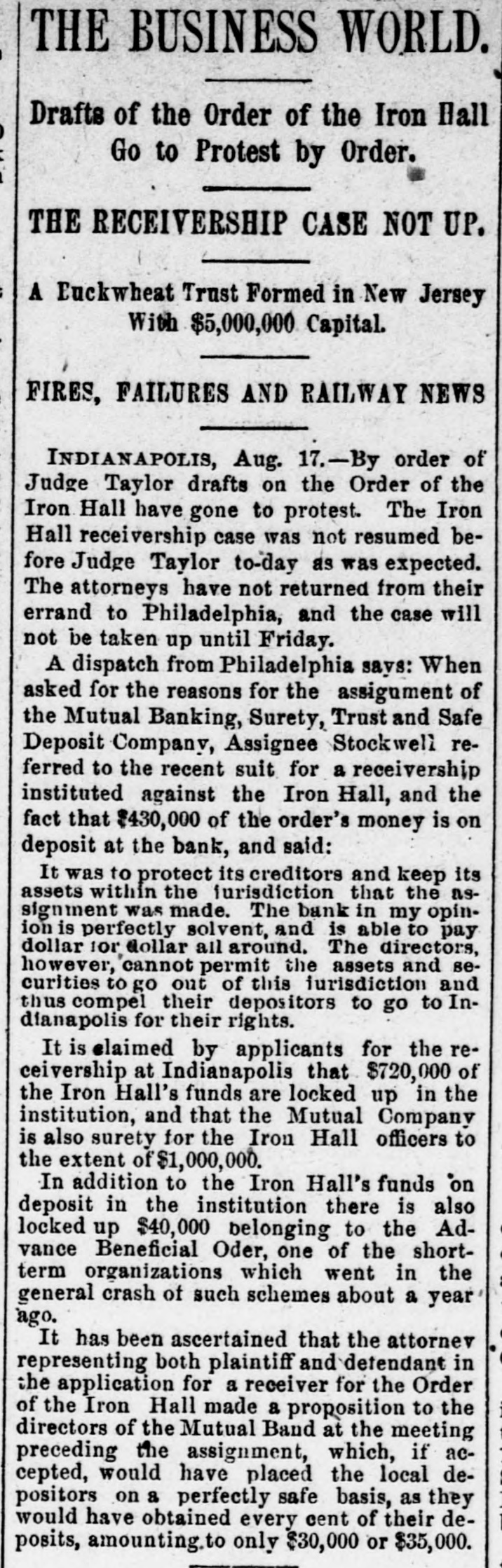
THE BUSINESS WORLD. Drafts of the Order of the Iron Ball Go to Protest by Order. THE RECEIVERSHIP CASE NOT UP. A Euckwheat Trust Formed in New Jersey With $5,000,000 Capital. FIRES, FAILURES AND RAILWAY NEWS INDIANAPOLIS, Aug. 17.-By order of Judge Taylor drafts on the Order of the Iron Hall have gone to protest. The Iron Hall receivership case was not resumed before Judge Taylor to-day as was expected. The attorneys have not returned from their errand to Philadelphia, and the case will not be taken up until Friday. A dispatch from Philadelphia says: When asked for the reasons for the assignment of the Mutual Banking, Surety, Trust and Safe Deposit Company, Assignee Stockwell referred to the recent suit for a receivership instituted against the Iron Hall, and the fact that $430,000 of the order's money is on deposit at the bank, and said: It was to protect its creditors and keep its assets within the jurisdiction that the assignment was made. The bank in my opinion is perfectly solvent, and is able to pay dollar for dollar all around. The directors, however, cannot permit the assets and securities to go out of this jurisdiction and thus compel their depositors to go to Indianapolis for their rights. It is claimed by applicants for the receivership at Indianapolis that $720,000 of the Iron Hall's funds are locked up in the institution, and that the Mutual Company is also surety for the Iron Hall officers to the extent of $1,000,000. In addition to the Iron Hall's funds on deposit in the institution there is also locked up $40,000 belonging to the Advance Beneficial Oder, one of the shortterm organizations which went in the general crash of such schemes about a year ago. It has been ascertained that the attornev representing both plaintiff and detendant in the application for a receiver for the Order of the Iron Hall made a proposition to the directors of the Mutual Band at the meeting preceding the assignment, which, if accepted, would have placed the local depositors on a perfectly safe basis, as they would have obtained every cent of their deposits, amounting. to only $30,000 or $35,000.


Article from The Goodland Republic, August 19, 1892

Click image to open full size in new tab

Article Text

BAD FOR IRON HALL. The Bank in Which Its Funds are Deposited Suspends. Philadelphia, Aug. 17.-The Mutual Banking, Surety, Trust and Safe Deposit company, of which Supreme Justice Somerby is president and in which Iron Hall funds are deposited, assigned to-day. H. G. Williams, treasurer of the Iron Hall building company and a director of the bank was asked the reason for the assignment. He replied by referring to the recent suit for receivership instituted against the Iron Hall at Indianapolis, and the fact that $430,000 of the order's money was on deposit in the bank. It is claimed by applicants for the receivership at Indianapolis that $825,000 of the Iron Hall's funds are locked upin the institution and that the Mutual company is also surety for the Iron Hall officers to the extent of $1,000,000. The amount of deposit is believed to include $1,700,000 said to have been advanced by the chief justice of the order to make good an impairment of the bank's capital which the state bank examiner discovered last spring.


Article from The Sedalia Weekly Bazoo, August 23, 1892

Click image to open full size in new tab

Article Text

BAD FOR IRON HALL. The Bank in Which Its Funds are Deposited Suspends. Philadelphia, Aug. 17.-The Mutual Banking, Surety, Trust and Safe Deposit company, of which Supreme Justice Somerby is president and in which Iron Hall funds are deposited, assigned to-day. H. G. Williams, treasurer of the Iron Hall building company and a director of the bank was asked the reason for the assignment. He replied by referring to the recent suit for receivership instituted against the Iron Hall at Indianapolis, and the fact that $430,000 of the order's money was on deposit in the bank. It is claimed by applicants for the receivership at Indianapolis that $825,000 of the Iron Hall's funds are locked up in the institution and that the Mutual company is also surety for the Iron Hall officers to the extent of $1,000,000. The amount of deposit is believed to include $1,700,000 said to have been advanced by the chief justice of the order to make good an impairment of the bank's capital which the state bank examiner discovered last spring. The officers made the following official statement of the bank's condition on May 31, last:


Article from Pittsburg Dispatch, August 31, 1892

Click image to open full size in new tab

Article Text

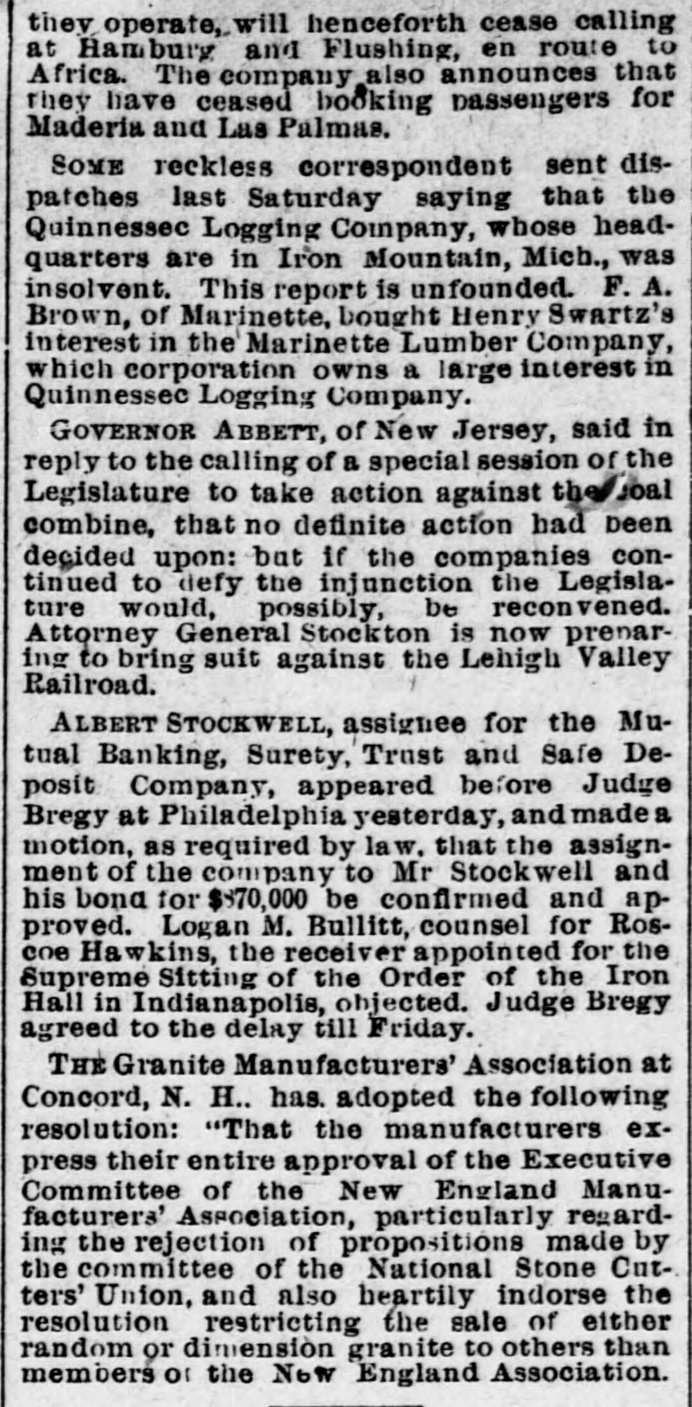
they operate, will henceforth cease calling at Hamburg and Flushing, en route to Africa. The company also announces that they have ceased booking passengers for Maderia and Las Palmas. SOME reckless correspondent sent dispatches last Saturday saying that the Quinnessec Logging Company, whose headquarters are in Iron Mountain, Mich., was insolvent. This report is unfounded. F. A. Brown, of Marinette, bought Henry Swartz's interest in the Marinette Lumber Company, which corporation owns a large interest in Quinnessec Logging Company. GOVERNOR ABBETT, of New Jersey, said in reply to the calling of a special session of the Legislature to take action against the Joal combine, that no definite action had been decided upon: but if the companies continued to defy the injunction the Legislature would, possibly, be reconvened. Attorney General Stockton is now preparing to bring suit against the Lehigh Valley Railroad. ALBERT STOCKWELL, assignee for the Mutual Banking, Surety, Trust and Safe Deposit Company, appeared before Judge Bregy at Philadelphia yesterday, and made a motion, as required by law, that the assignment of the company to Mr Stockwell and his bona for $870,000 be confirmed and approved. Logan M. Bullitt, counsel for Roscoe Hawkins, the receiver appointed for the Supreme Sitting of the Order of the Iron Hall in Indianapolis, objected. Judge Bregy agreed to the delay till Friday. THE Granite Manufacturers' Association at Concord, N. H.. has. adopted the following resolution: "That the manufacturers express their entire approval of the Executive Committee of the New England Manufacturers' Association, particularly regarding the rejection of propositions made by the committee of the National Stone Cutters' Union, and also heartily indorse the resolution restricting the sale of either random or dimension granite to others than members 01 the Now England Association.


Article from The Morning News, September 4, 1892

Click image to open full size in new tab

Article Text

IRON HALL ACCOUNTS PADDED. Sensational Developments at a Hearing at Philadelphia. PHILADELPHIA, Sept. 3.-Sensational developments weremade to-day at the hearing of the motion for the ousting of A. E. Stockwell from his position of assignee of the Mutual Banking, Surety, Trust and Safe Deposit Company and the appointment of a receiver for that institution. The story brought out by the witness this morning in brief was that during February and March, 1891, and March and April, 1892, the banks showed that the Iron Hall accounts in the bank were padded by various false entries, involving large sums of money, considerably above $100,000.


Article from The Portland Daily Press, September 5, 1892

Click image to open full size in new tab

Article Text

Padded the Accounts.| PHILADELPHIA, September 3.-Sensational developments were made this morning at the hearing of the motion for the ousting of A. E. Stockwell from his position of assignee of the Mutual Banking, Surety, Trustand Safe Deposit Com: pany and the appointment of a receiver for that institution. The story brought out by the witnesses this morning is, in brief, that during February and March, 1891, and March and April, 1892, the books showed that the Iron Hall accounts in the bank were padded by various false entries, involving large sums of money, considerably above $100,000.


Article from The Times, September 7, 1892

Click image to open full size in new tab

Article Text

The Iron Hall Suit Again. Philadelphia, Sept. 6.-Judge Bregy to-day in Common Pleas Court No. 1 announced that he would render a decision to-morrow in the suit of the Indiana and Pennsylvania receivers of the Iron Hall to oust Adelbert E. Stockwell from the position as assignee of the Mutual Banking, Surety, Trust and Safe Deposit Company. It is believed that Stockwell will be removed and a receiver appointed for the banking company.


Article from Delaware Gazette and State Journal, September 22, 1892

Click image to open full size in new tab

Article Text

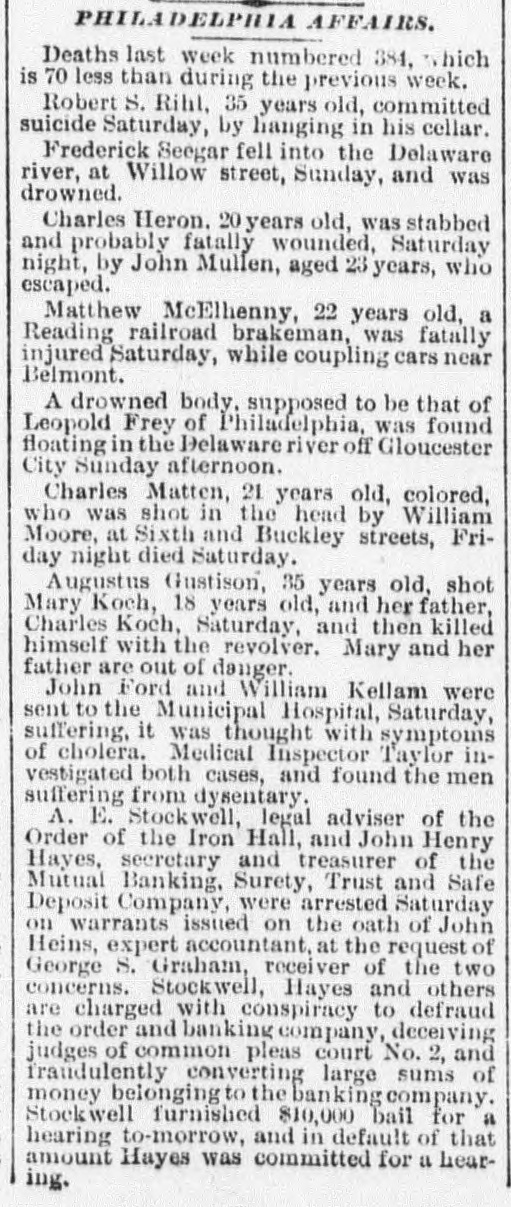
PHILADELPHIA AFFAIRS. Deaths last week numbered 384, which is 70 less than during the previous week. Robert S. Rihl, 35 years old, committed suicide Saturday, by hanging in his cellar. Frederick Seegar fell into the Delaware river, at Willow street, Sunday, and was drowned. Charles Heron. 20 years old, was stabbed and probably fatally wounded, Saturday night, by John Mullen, aged 23 years, who escaped. Matthew McElhenny, 22 years old, a Reading railroad brakeman, was fatally injured Saturday, while coupling cars near Belmont. A drowned body. supposed to be that of Leopold Frey of Philadelphia, was found floating in the Delaware river off Gloucester City Sunday afternoon. Charles Matten, 21 years old, colored, who was shot in the head by William Moore, at Sixth and Buckley streets, Friday night died Saturday. Augustus Gustison, 35 years old, shot Mary Koch, 18 years old, and her father, Charles Koch, Saturday, and then killed himself with the revolver. Mary and her father are out of danger. John Ford and William Kellam were sent to the Municipal Hospital, Saturday, suffering, it was thought with symptoms of cholera. Medical Inspector Taylor investigated both cases, and found the men suffering from dysentary. A. E. Stockwell, legal adviser of the Order of the Iron Hall, and John Henry Hayes, secretary and treasurer of the Mutual Banking, Surety, Trust and Safe Deposit Company, were arrested Saturday on warrants issued on the oath of John Heins, expert accountant, at the request of George S. Graham, receiver of the two concerns. Stockwell, Hayes and others are charged with conspiracy to defraud the order and banking company, deceiving judges of common pleas court No. 2, and fraudulently converting large sums of money belonging to the banking company. Stockwell furnished $10,000 bail for a hearing to-morrow, and in default of that amount Hayes was committed for a hearing.


Article from Evening Star, October 24, 1893

Click image to open full size in new tab

Article Text

IRON HALL FINANCES. Report of George S. Graham, Receiver, Filed in Court. PHILADELPHIA, Oct. 24.-George S. Graham, appointed receiver for Pennsylvania of the Order of the Iron Hall August 26, 1892, has filed his first account in court. Apart from the securities on hand the receiver has collected $141,483 and disbursed for expenses $10,411, leaving a cash balance of $131,072. Complete collections have been made from 105 branches. Five branches made return to Receiver Failey at Indianapolis prior to the appointment of Receiver Graham, and four branches made return to the cashier of the order at Indianapolis, and as they had left their reserve fund in the cashier's hands there was nothing to collect from them here. Thirteen branches have not paid over anything to the receiver and bills in equity have been filed against them. The work of Mr. Graham was complicated by the attempt of Receiver Failey to force Pennsylvania branches to make payment to him. It is not possible to determine what rate of dividend will be paid until the exact membership of the order in this state is ascertained. In addition to the cash in hand and the unconverted securities, a dividend will be recovered from the Mutual Banking, Surety, Trust and Safe Deposit Company, the official depositary of the order in this city, which failed immediately after the Iron Hall collapse. The fund will be distributed among members in good standing at the time of the appointment of the receiver, without regard to whether they have since joined any new order. Mr. Graham intends to combat any effort to secure a transfer of the funds in his possession to Indianapolis for distribution through the receiver there. No member of a branch failing to make return will be recognized by the court in the distribution, the receiver says. Receiver Graham does not include in his account $400,000 deposited in the Mutual Bank by the supreme sitting of the order and $175,000 used by the officers of Iron Hall to secure the bank from failure at the time the state superintendent of banking ordered its capital. doors closed because of impairment of The various local branches had $51,180 on deposit failed. with the Mutual Bank at the time it