First National Bank (Wichita, KS)

Episode Information

Episode UID
191300885
Episode Type
Run โ†’ Suspension โ†’ Closure
Bank Type
national
Bank ID
19130 national
Charter Number
1913
Start Date
September 29, 1873
Location
Wichita, Kansas (37.692, -97.338)

Metadata

Model
gemini-3-flash-preview (chosen from majority vote of a three-model LLM ensemble)
Short Digest
6eceb5831880c614

Response Measures

Public signal of financial health

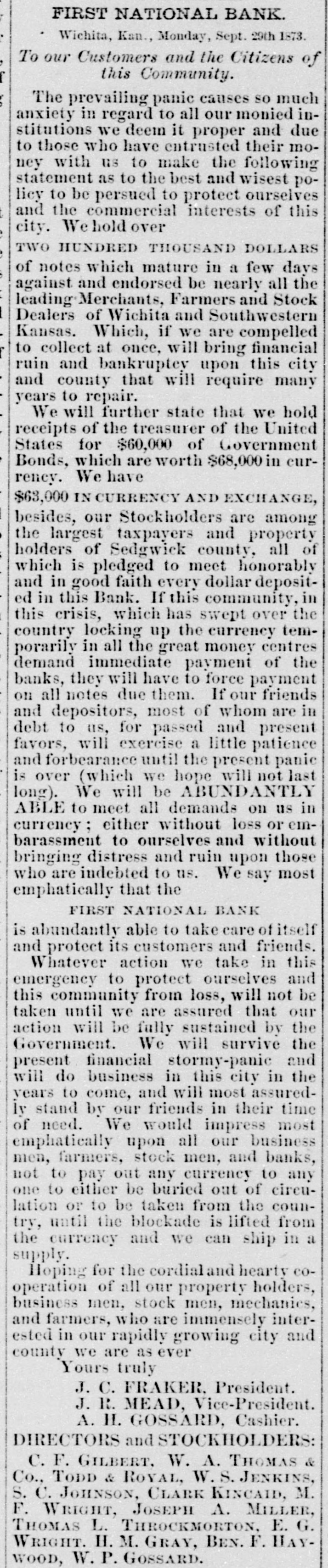
Other: The bank published a public appeal/manifesto in the newspaper detailing its assets (currency, exchange, and government bonds) and the personal wealth of its stockholders to reassure the community and discourage withdrawals during the panic.

Receivership Details

Depositor recovery rate
70.0%
Date receivership started
1876-09-23
Date receivership terminated
1880-07-14
OCC cause of failure
Fraud
Share of assets assessed as good
40.8%
Share of assets assessed as doubtful
12.7%
Share of assets assessed as worthless
46.5%

Description

The bank experienced a run during the 1873 panic but survived; it later failed in 1876 due to insolvency and the flight of its president.

Events (6)

1. January 2, 1872 Chartered
Source
historical_nic
2. September 29, 1873 Run
Cause
Macro News
Cause Details
The Panic of 1873 caused widespread anxiety and withdrawal demands.
Measures
The bank issued a public appeal for patience and forbearance to avoid forced liquidation of local loans.
Newspaper Excerpt
The prevailing panic causes so much anxiety in regard to all our monied institutions... If this community... demand immediate payment of the banks, they will have to force payment on all notes due them.
Source
newspapers
3. August 31, 1876 Suspension
Cause
Bank Specific Adverse Info
Cause Details
Criminal mismanagement and insolvency involving worthless Texas cattle paper and the eventual flight of President J.C. Fraker.
Newspaper Excerpt
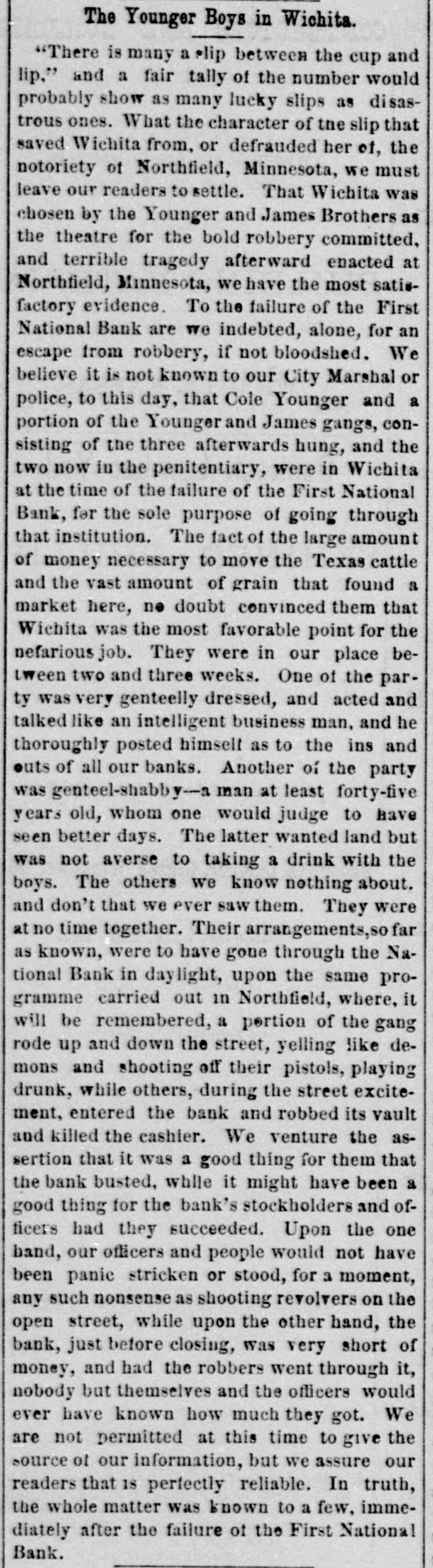
To the failure of the First National Bank are we indebted, alone, for an escape from robbery... the bank busted
Source
newspapers
4. September 23, 1876 Receivership
Source
historical_nic
5. September 23, 1876 Receivership
Newspaper Excerpt
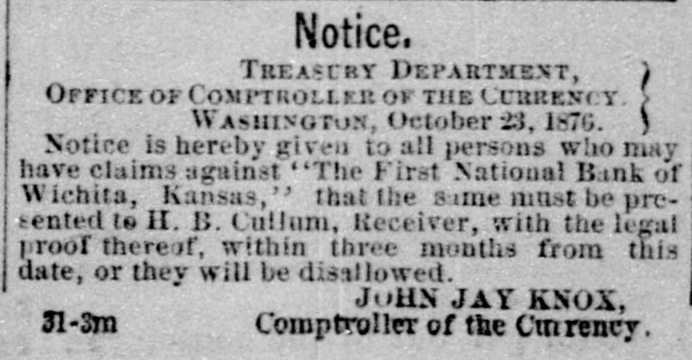
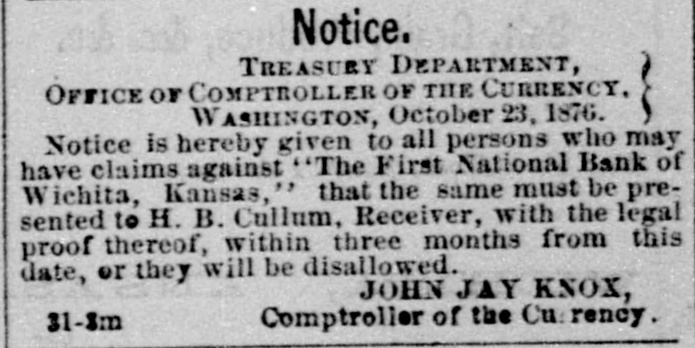
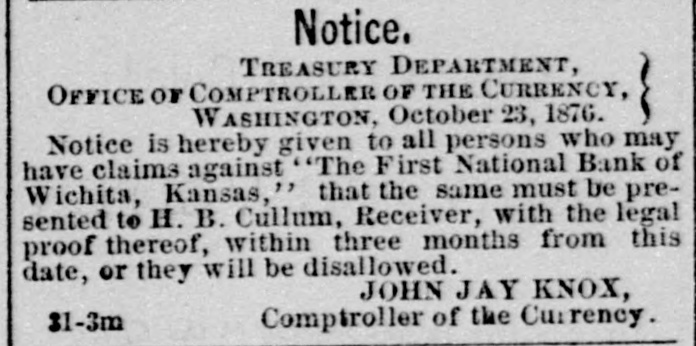
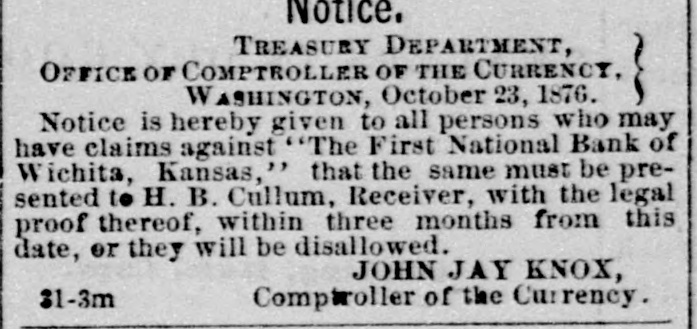
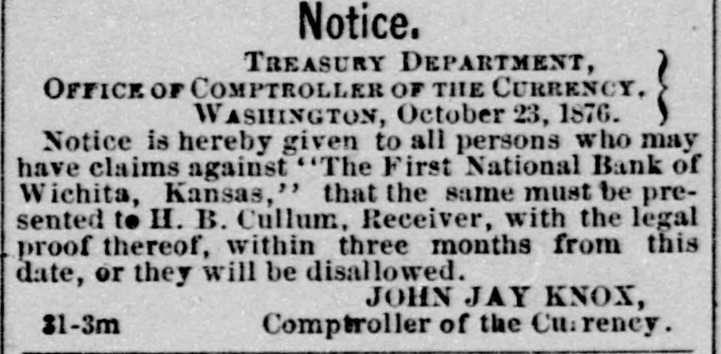
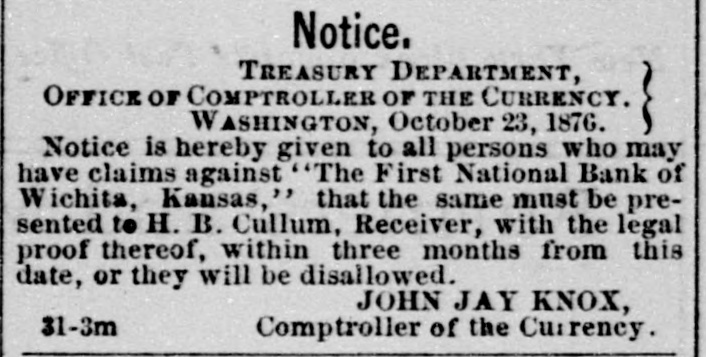
Notice is hereby given to all persons who may have claims against 'The First National Bank of Wichita, Kansas,' that the same must be presented to H. B. Cullum, Receiver
Source
newspapers
6. April 26, 1877 Other
Newspaper Excerpt
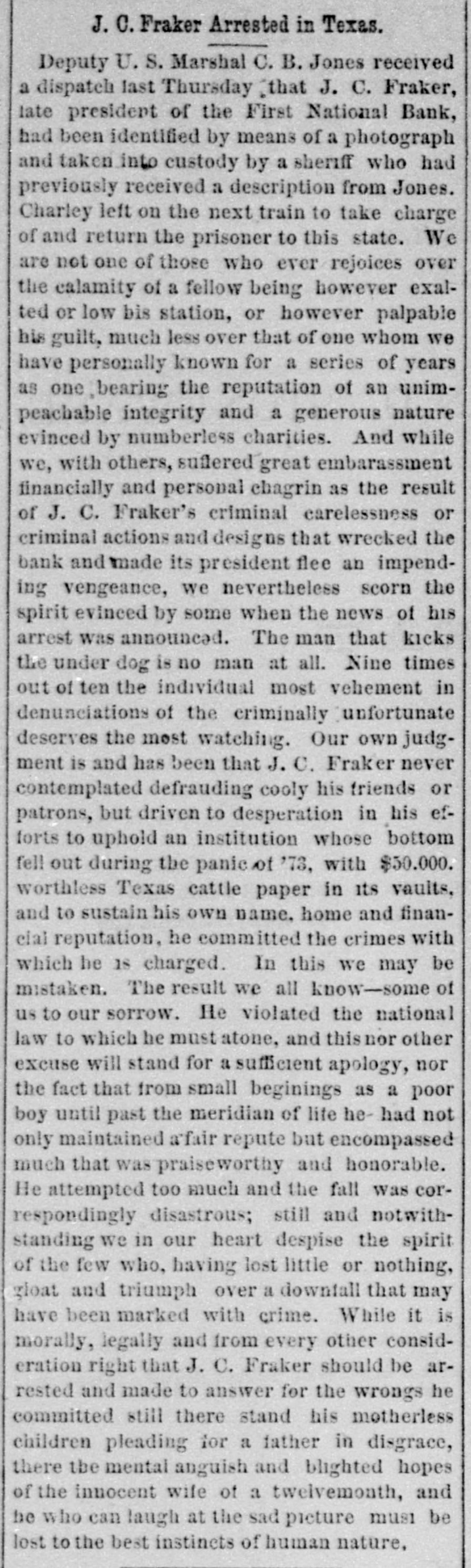
J. C. Fraker, late president of the First National Bank, had been identified by means of a photograph and taken into custody by a sheriff
Source
newspapers

Newspaper Articles (17)

Article from The Wichita City Eagle, October 2, 1873

Click image to open full size in new tab

Article Text

FIRST NATIONAL BANK. Wichita, Kan., Monday, Sept. 29th 1873. To our Customers and the Citizens of this Community. The prevailing panic causes so much anxiety in regard to all our monied institutions we deem it proper and due to those who have entrusted their money with us to make the following statement as to the best and wisest policy to be persued to protect ourselves and the commercial interests of this city. We hold over TWO HUNDRED THOUSAND DOLLARS of notes which mature in a few days against and endorsed be nearly all the leading Merchants, Farmers and Stock Dealers of Wichita and Southwestern Kansas. Which, if we are compelled to collect at once, will bring financial ruin and bankruptey upon this city and county that will require many years to repair. We will further state that we hold receipts of the treasurer of the United States for $60,000 of Government Bonds, which are worth $68,000 in curreney. We have $63,000 IN CURRENCY AND EXCHANGE, besides, our Stockholders are among the largest taxpayers and property holders of Sedgwick county, all of which is pledged to meet honorably and in good faith every dollar deposited in this Bank. If this community, in this crisis, which has swept over the country locking up the currency temporarily in all the great money centres demand immediate payment of the banks, they will have to force payment on all notes due them. If our friends and depositors, most of whom are in debt to us, for passed and present favors, will exercise a little patience and forbearance until the present panic is over (which we hope will not last long). We will be ABUNDANTLY ABLE to meet all demands on us in currency; either without loss or embarassment to ourselves and without bringing distress and ruin upon those who are indebted to us. We say most emphatically that the FIRST NATIONAL BANK is abundantly able to take care of itself and protect its customers and friends. Whatever action we take in this emergency to protect ourselves and this community from loss, will not be taken until we are assured that our action will be fully sustained by the Government. We will survive the present financial stormy-panic and will do business in this city in the years to come, and will most assuredly stand by our friends in their time of need. We would impress most emphatically upon all our business men, farmers, stock men, and banks, not to pay out any currency to any one to either be buried out of circulation OF to be taken from the country, until the blockade is lifted from the currency and we can ship in a supply. Hoping for the cordial and hearty cooperation of all our property holders, business men, stock men, mechanics, and farmers, who are immensely interested in our rapidly growing city and county we are as ever Yours truly J. C. FRAKER, President. J. R. MEAD, Vice-President. A. H. GOSSARD, Cashier. DIRECTORS and STOCKHOLDERS: C. F. GILBERT, W. A. THOMAS & Co., TODD & ROYAL, W. S. JENKINS, S. C. JOHNSON, CLARK KINCAID, M. F. WRIGHT, JOSEPH A. MILLER, THOMAS L. THROCKMORTON, E.G. WRIGHT. H. M. GRAY, BEN. F. HayWOOD, W.P. GOSSARD.


Article from The Wichita City Eagle, November 16, 1876

Click image to open full size in new tab

Article Text

Notice. TREASURY DEPARTMENT, OFFICE OF COMPTROLLER OF THE CURRENCY WASHINGTON, October 23, 1876. Notice is hereby given to all persons who may have claims against "The First National Bank of Wichita, Kansas," that the same must be presented to H. B. Cullum, Receiver, with the legal proof thereof, within three months from this date, or they will be disallowed. JOHN JAY KNOX, 31-3m Comptroller of the Currency.


Article from The Wichita City Eagle, November 30, 1876

Click image to open full size in new tab

Article Text

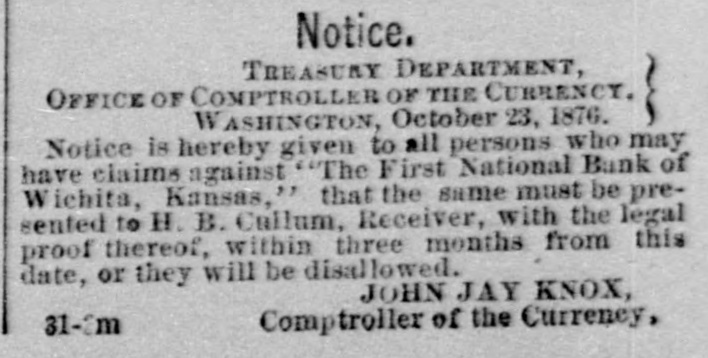
Notice. TREASURY DEPARTMENT, OFFICE OF COMPTROLLER OF THE CURRENCY. WASHINGTON, October 23, 1876. Notice is hereby given to all persons who may have claims against The First National Bank of Wichita, Kansas," that the same must be presented to H. B. Cullum, Receiver, with the legal proof thereof, within three months from this date, or they will be disallowed. JOHN JAY KNOX, 31-8m Comptroller of the Currency.


Article from The Wichita City Eagle, December 21, 1876

Click image to open full size in new tab

Article Text

# The Younger Boys in Wichita. "There is many a slip between the cup and lip," and a fair tally of the number would probably show as many lucky slips as disastrous ones. What the character of the slip that saved Wichita from, or defrauded her of, the notoriety of Northfield, Minnesota, we must leave our readers to settle. That Wichita was chosen by the Younger and James Brothers as the theatre for the bold robbery committed, and terrible tragedy afterward enacted at Northfield, Minnesota, we have the most satisfactory evidence. To the failure of the First National Bank are we indebted, alone, for an escape from robbery, if not bloodshed. We believe it is not known to our City Marshal or police, to this day, that Cole Younger and a portion of the Younger and James gangs, consisting of the three afterwards hung, and the two now in the penitentiary, were in Wichita at the time of the failure of the First National Bank, for the sole purpose of going through that institution. The fact of the large amount of money necessary to move the Texas cattle and the vast amount of grain that found a market here, no doubt convinced them that Wichita was the most favorable point for the nefarious job. They were in our place between two and three weeks. One of the party was very genteelly dressed, and acted and talked like an intelligent business man, and he thoroughly posted himself as to the ins and outs of all our banks. Another of the party was genteel-shabby--a man at least forty-five years old, whom one would judge to have seen better days. The latter wanted land but was not averse to taking a drink with the boys. The others we know nothing about. and don't that we ever saw them. They were at no time together. Their arrangements, so far as known, were to have gone through the National Bank in daylight, upon the same programme carried out in Northfield, where, it will be remembered, a portion of the gang rode up and down the street, yelling like demons and shooting off their pistols, playing drunk, while others, during the street excitement, entered the bank and robbed its vault and killed the cashier. We venture the assertion that it was a good thing for them that the bank busted, while it might have been a good thing for the bank's stockholders and officers had they succeeded. Upon the one hand, our officers and people would not have been panic stricken or stood, for a moment, any such nonsense as shooting revolvers on the open street, while upon the other hand, the bank, just before closing, was very short of money, and had the robbers went through it, nobody but themselves and the officers would ever have known how much they got. We are not permitted at this time to give the source of our information, but we assure our readers that is perfectly reliable. In truth, the whole matter was known to a few, immediately after the failure of the First National Bank.


Article from The Wichita City Eagle, December 28, 1876

Click image to open full size in new tab

Article Text

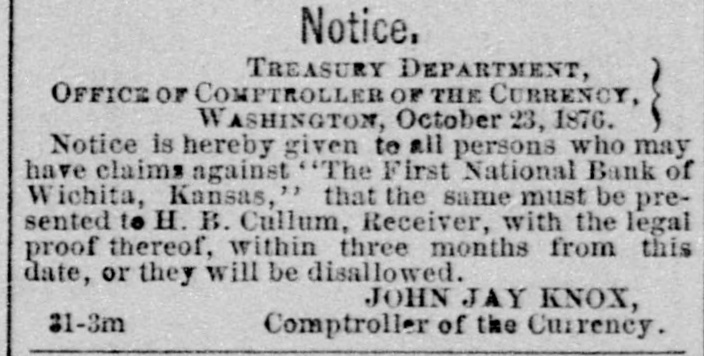
Notice. TREASURY DEPARTMENT, OFFICE OF COMPTROLLER OF THE CURRENCY. WASHINGTON, October 23, 1876. Notice is hereby given to all persons who may have claims against "The First National Bank of Wichita, Kansas," that the same must be presented to H. B. Cullum, Receiver, with the legal proof thereof, within three months from this date, or they will be disallowed. JOHN JAY KNOX, 31-3m Comptroller of the Currency.


Article from The Wichita City Eagle, January 18, 1877

Click image to open full size in new tab

Article Text

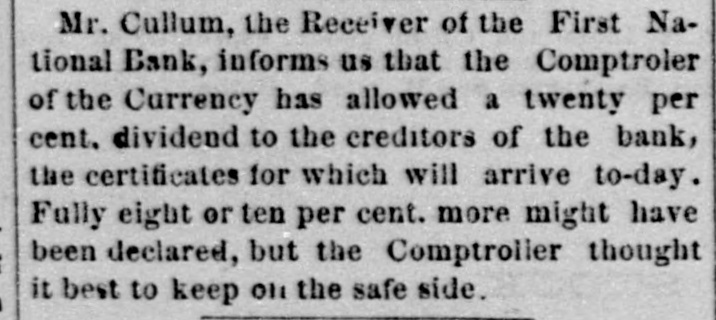
Mr. Cullum, the Receiver of the First National Bank, informs us that the Comptroler of the Currency has allowed a twenty per cent. dividend to the creditors of the bank, the certificates for which will arrive to-day. Fully eight or ten per cent. more might have been declared, but the Comptroller thought it best to keep on the safe side.


Article from The Emporia News, January 26, 1877

Click image to open full size in new tab

Article Text

A SAD FATE. Word reached town the other day that J. C. Fraker, late president of the defanet lit first national bank of Wichita, had out." He had been watched ever since the failure of the institution, but finally made his escape. It is intimated that his whereabouts are known, but it is not stated whether steps will be taken to of capture him or not. The worst feature this business is that it has been reported by some ever since the bank collapsed dis that Mr. Fraker had been guilty of the honest action in connection with management of the bank, and his running feel tends rather to augment this and away than otherwise. Had he stood ing faced the music till all its affairs were investigated and settied, and come out be with a clean character, which would worth more to him than all the money he ever saw, his friends would have rejoiced and stood by him to the last. But it now generally conceded that his course will not bear day-light. We regret the late of this man. He came to Emporia as a Methodist preacher in 1850. ne was active and earnest, and became popular and trusted by all who knew him. It was by his efforts that money was raised to erect the Methodist church in this city. He afterwards quit preaching and opened a carpenter shop. Soon he became a candidate for county treasurer. and was twice elected to the office. He also entered into other branches of business, after his election. He believed in having several "irons in the fire" at once. He had great energy. but in was known to be careless and slouchy his business affairs. But those who knew him well had unlimited confidence in his honesty. He was one of those men whom many trusted soft as not to take receipts to for money paid him. They did this tLeir sorrow, as some of them afterwards found out. But they believed him care- wild less rather than dishonest. He got and bought everything. One month he would be reported worth $50,000, and the next penniless. He was a regular Col. in Mulbery Sellers. He saw millions everything, and especially in a bunch of old Texas steers, or a second hand stock of dry goods. Before leaving here, his three or four years' administration as treasurer was thoroughly overbauled, by three different commissioners. Neither head nor tail, beginning or ending, could be made from 8 his books. Finally some sort of a compromise was adopted, and he was receipted to in full. We think he went from here to Elderado. Then Wichita began to offer openings for men of a speculative turn, men of financial genius and expansive views like Fraker. It is but proper to say, though, that before leaving here, the confidence of many of his old friends t had been badly shaken, by his change from devout spiritual life to overreaching worldly-mindedness, and by a few rather We I scaly tricks he had been caught in. heard from Wichita that Fraker was to a national bank there. There was on the faces of those a knowing wink went open broad him, and grin who 'round, knew which said " you'll hear from him before It e long." These prognosticated truly. has been stated that he actually went into the bank with $1,200 of borrowed money. He had got to that point in finances, where men said, "he is sharp." This d and $1,200 was sufficient in a new counand many a bank has probably been t try, established on even smaller capital and cheek. There was an awful business in the new town, and the bank flourished. There were believed to be some financialsound me in the , concern and some n that ly were honest. The new bank had big run. and even in '73 was propped al- up and carried over the troubled sea, though jostled rather roughly against the e rocks. But the concern was always believed to be unstable, and warnings were is now and then thrown out. The story e told. It went down, and carried many trasted friends of the ex-Reverend presii. dent into ruin. Among the rest were several ministers, who had trusted their to Fraker's honesty. But the saddest h part of the story is Fraker's downfall 1from the high esteem in which he was He formerly held by all who knew him. t. risked all in grasping for money, and the of blackness ot ruin now overshadows him, n and will follow him to that bourne from as which no traveler returns. His reputation was priceless. He squandered It for of pottage. There is a lesson in Fraker's brief career.


Article from The Wichita City Eagle, March 1, 1877

Click image to open full size in new tab

Article Text

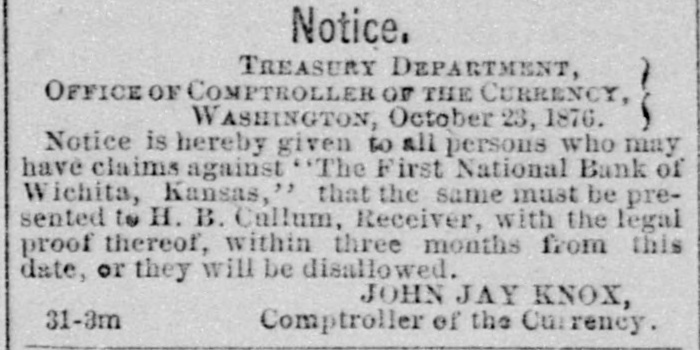
Notice. TREASURY DEPARTMENT, OFFICE OF COMPTROLLER OF THE CURRENCY, WASHINGTON, October 23, 1876. Notice is hereby given to all persons who may have claims against "The First National Bank of Wichita, Kansas," that the same must be presented to H. B. Cullum, Receiver, with the legal proof thereof, within three months from this date, or they will be disallowed. JOHN JAY KNOX, 31-3m Comptroller of the Currency.


Article from The Wichita City Eagle, March 8, 1877

Click image to open full size in new tab

Article Text

Notice. TREASURY DEPARTMENT, OFFICE OF COMPTROLLER OF THE CURRENCY, WASHINGTON, October 23, 1876. Notice is hereby given to all persons who may have claims against The First National Bank of Wichita, Kansas," that the same must be presented to H. B. Cullum, Receiver, with the legal proof thereof, within three months from this date, or they will be disallowed. JOHN JAY KNOX, 31-3m Comptroller of the Currency.


Article from The Wichita City Eagle, March 15, 1877

Click image to open full size in new tab

Article Text

Notice. TREASURY DEPARTMENT, OFFICE OF COMPTROLLER OF THE CURRENCY. WASHINGTON, October 23, 1876. Notice is hereby given to all persons who may have claims against "The First National Bank of Wichita, Kansas," that the same must be presented to H. B. Cullum, Receiver, with the legal proof thereof, within three months from this date, or they will be disallowed. JOHN JAY KNOX, Comptroller of the Currency, 31-3m


Article from The Wichita City Eagle, April 5, 1877

Click image to open full size in new tab

Article Text

Notice. TREASURY DEPARTMENT, OFFICE OF COMPTROLLER OF THE CURRENCY, WASHINGTON, October 23, 1876. Notice is hereby given to all persons who may have claims against 'The First National Bank of Wichita, Kansas," that the same must be presented to H. B. Callum, Receiver, with the legal proof thereof, within three months from this date, or they will be disaHowed. JOHN JAY KNOX, 31-3m Comptroller of the Currency.


Article from The Wichita City Eagle, May 3, 1877

Click image to open full size in new tab

Article Text

J. C. Fraker Arrested in Texas. Deputy U. S. Marshal C. B. Jones received a dispatch last Thursday (that J. C. Fraker, late president of the First National Bank, had been identified by means of a photograph and taken into custody by a sheriff who had previously received a description from Jones. Charley left on the next train to take charge of and return the prisoner to this state. We are not one of those who ever rejoices over the calamity of a fellow being however exalted or low bis station, or however palpable his guilt, much less over that of one whom we have personally known for a series of years as one, bearing the reputation of an unimpeachable integrity and a generous nature evinced by numberless charities. And while we, with others, suffered great embarassment financially and personal chagrin as the result of J. C. Fraker's criminal carelessness or criminal actions and designs that wrecked the bank and made its president flee an impending vengeance, we nevertheless scorn the spirit evinced by some when the news of his arrest was announced. The man that kicks the under dog is no man at all. Nine times out of ten the individual most vehement in denunciations of the criminally unfortunate deserves the most watching. Our own judgment is and has been that J.C. Fraker never contemplated defrauding cooly his friends or patrons, but driven to desperation in his efforts to uphold an institution whose bottom fell out during the panic ot '73, with $50.000. worthless Texas cattle paper in its vaults, and to sustain his own name, home and financial reputation. he committed the crimes with which he 18 charged. In this we may be mistaken. The result we all know-some of us to our sorrow. He violated the national law to which he must atone, and this nor other excuse will stand for a sufficient apology, nor the fact that from small beginings as a poor boy until past the meridian of lite he- had not only maintained affair repute but encompassed much that was praiseworthy and honorable. He attempted too much and the fall was correspondingly disastrous; still and notwithstanding we in our heart despise the spirit of the few who, having lost little or nothing, gloat and triumph over a downfall that may have been marked with crime. While it is morally, legally and from every other consideration right that J. C. Fraker should be arrested and made to answer for the wrongs he committed still there stand his motherless children pleading for a father in disgrace, there the mental anguish and blighted hopes of the innocent wife of a twelvemonth, and he who can laugh at the sad picture must be lost to the best instincts of human nature.


Article from The Wichita City Eagle, May 10, 1877

Click image to open full size in new tab

Article Text

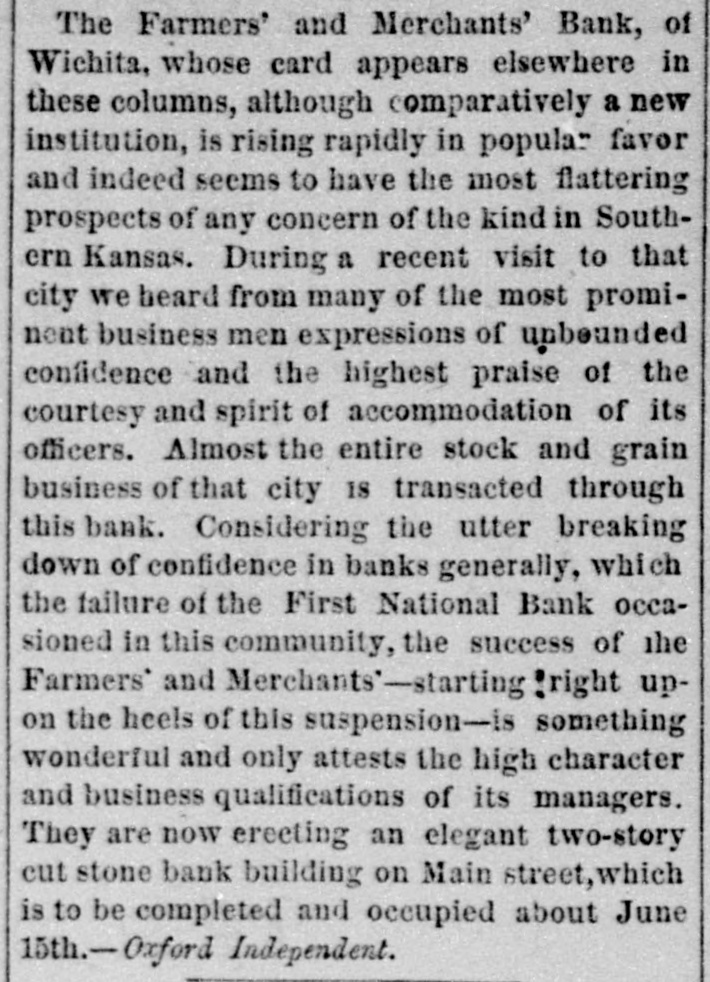
The Farmers' and Merchants' Bank, of Wichita, whose card appears elsewhere in these columns, although comparatively a new institution, is rising rapidly in popular favor and indeed seems to have the most flattering prospects of any concern of the kind in Southern Kansas. During a recent visit to that city we heard from many of the most prominent business men expressions of unbounded confidence and the highest praise of the courtesy and spirit of accommodation of its officers. Almost the entire stock and grain business of that city 18 transacted through this bank. Considering the utter breaking down of confidence in banks generally, which the failure of the First National Bank occasioned in this community, the success of the Farmers' and Merchants'-starting:"right upon the heels of this suspension-is something wonderful and only attests the high character and business qualifications of its managers. They are now ereeting an elegant two-story cut stone bank building on Main street, which is to be completed and occupied about June 15th.-Oxford Independent.


Article from The Wichita City Eagle, November 15, 1877

Click image to open full size in new tab

Article Text

A third dividend of ten per cent. will be paid to creditors of the First National Bank. of Wichita, Kansas, on presentation of certificate at the office of H. B. Cullum, Receiver, over Finlay Ross' furniture, corner Main and First streets.


Article from The Wichita City Eagle, January 9, 1879

Click image to open full size in new tab

Article Text

The answer to the question of "How are your banks for solidity and soundness?" tells the whole story of any community's prosperity or failure. Wichita never experienced but one bank failure, and that was directly traceable to the panic that swept from existence thousands of such institutions. The building of the First National, which cost, exclusive of fixtures, $12,000, is now owned by the county and occupied by her officers, a cut of which will be found elsewhere. ### THE FIRST ARKANSAS VALLEY BANK The oldest monetary institution in this valley, was established by W. C. Woodman, Esq., in 1870, in connection with his son, W. S. Woodman. Mr. Woodman, as a financier and successful commercial man, enjoys more than a local reputation, having by his able articles and essays done no little in molding the financial policy of the Government during the rebellion and having since addressed the Congress and boards of trade of many cities upon that subject. His institution here has done an immense business in foreign and domestic loans, involving vast real estate operations, only second to those of railroads in the west. In addition to the banking business proper, he is the owner of a very large amount of real estate in both city and county, having built, among others, the finest store or commercial room west of the Missouri river, which adjoins his bank on Main street. His home, "Lake Side," on the bank of the Little river, north of town, is a romantic spot, a picture of which will be found elsewhere. Mr. W. is a thorough, energetic and wide-awake business man, possessing, in addition, large social qualities whihe secure him an unmeasured influence. W. S. Woodman, the cashier of the Valley Bank, is a gentleman of fine culture and an artist. Wallace T. Woodman, another son, is the bookkeeper whose pleasant home is situated in the southern part of the city. ### THE WICHITA SAVINGS BANK The WICHITA SAVINGS BANK was established in the spring of '72, since which time it has occupied the corner building of the Eagle Block, and with the EAGLE, which was established the same month, has sailed through every storm, and it is conceded to be one of the soundest and strongest banks in the west, with an unlimited credit in all the large commercial cities. The men that took the helm at the start still holds it, and Mr. Sol H. Kohn, its president, has demonstrated that as a financial expert he has few equals. So far as the directory, or patrons, or the world knows he has never made a single mistake or erred in judgment. The panic of '73 and the one of last year did not create a ripple in the affairs of the Wichita Savings Bank. The confidence of the people has been so great ir its management, and the consequent deposits so large that no interest has been allowed on deposits for nearly a year. Mr. A. A. Hyde, the cashier, was originally from Massachusetts. He is Mr. Kohn's equal in many respects. As a judge of securities, his acceptance or rejection of paper settles many a business man's credit. Mr. Hyde paid the first cheak that ever passed over the Savings' counter, and if he should fail to be in his place for a single day it would be the town talk. Large brained and generous of soul the hundred thousand capital stock nor the greater sum of average deposits will ever suffer so long as he fills his present place. The other attaches of the bank are H. T. Kramer and C. A. Walker bookkeepers. Board of directors, Charles Schattner, Samuel Levy, Moris Kohn, M. W. Levy, A. A. Hyde and Sol H. Kohn. ### THE FARMERS' AND MERCHANTS' BANK The FARMERS' AND MERCHANTS' BANK, the youngest institution of the character in the city, was established by H. W. Lewis in 1876, as a private bank, but the following year its capital was increased to $100,000 and it was incorporated as a State institution, under charter, with a fuli set of officers and a board of directors. The banking house situated on Main street, is of solid cut stone from the heavy projecting cornice and artistic window and door frames to foundation sills, a picture of which heads this article. Colonel Lewis, the president of the Farmers' and Merchants' was formerly of Tiffin, Ohio, and when he came to Wichita did not depend upon organizing men of capital, but brought of his own abundant means sufficient to put his bank on the firmest of foundations. From the first hour of its incorporation it has moved along without a reverse, increasing in business and reaching out in its influence until its stability has become a recognized fact throughout this section. As a business man Colonel Lewis is cool and sagacious, possessing indomitable energy and all those elements that mean success, when combined in their possessor. Mr. George C. Strong, the cashier of the above growing institution, is a young man of fine business qualifications and splendid social parts, consequently is very popular-deservedly so his many friends will aver. The directors of the above bank number many of our best men, as Amos L. Houck, Thomas H. Lynch, W. S. Corbett, George C. Strong and H. W. Lewis.


Article from The Wichita City Eagle, November 20, 1879

Click image to open full size in new tab

Article Text

First National Bank. By order of the Comptroller of Curency, I will close out the remaining assets belonging to the First National Bank of Wichita, Kansas, consisting of Occidental Hotel, notes, overdrafts, judgments etc. Circulars describing said assets in full can be had atmy office in Wichita Kansas. 34-3t WM. C. LITTLE, Receiver.


Article from The Augusta Daily Gazette, January 26, 1923

Click image to open full size in new tab

Article Text

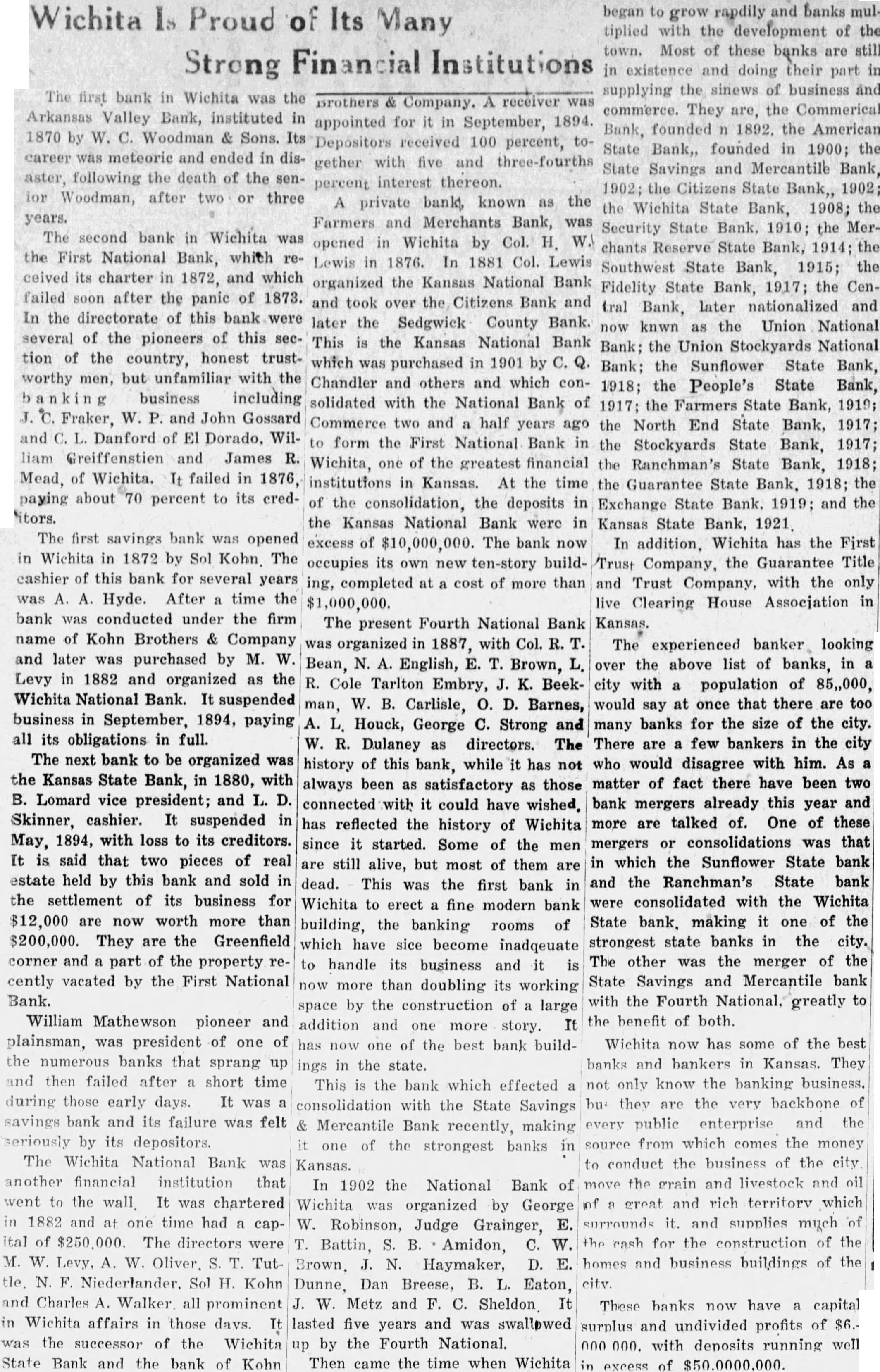
Wichita Is Proud of Its Many Strong Financial Institutions The first bank in Wichita was the Arkansas Valley Bank, instituted in 1870 by W. C. Woodman & Sons. Its career was meteoric and ended in disaster, following the death of the senior Woodman, after two or three years. The second bank in Wichita was the First National Bank, which received its charter in 1872, and which failed soon after the panic of 1873. In the directorate of this bank were several of the pioneers of this section of the country, honest trustworthy men, but unfamiliar with the banking business including J. C. Fraker, W. P. and John Gossard and C. L. Danford of El Dorado, William Greiffenstien and James R. Mead, of Wichita. It failed in 1876, paying about 70 percent to its creditors. The first savings bank was opened in Wichita in 1872 by Sol Kohn. The cashier of this bank for several years was A. A. Hyde. After a time the bank was conducted under the firm name of Kohn Brothers & Company and later was purchased by M. W. Levy in 1882 and organized as the Wichita National Bank. It suspended business in September, 1894, paying all its obligations in full. The next bank to be organized was the Kansas State Bank, in 1880, with B. Lomard vice president; and L. D. Skinner, cashier. It suspended in May, 1894, with loss to its creditors. It is said that two pieces of real estate held by this bank and sold in the settlement of its business for $12,000 are now worth more than $200,000. They are the Greenfield corner and a part of the property recently vacated by the First National Bank. William Mathewson pioneer and plainsman, was president of one of the numerous banks that sprang up and then failed after a short time during those early days. It was a savings bank and its failure was felt seriously by its depositors. The Wichita National Bank was another financial institution that went to the wall. It was chartered in 1882 and at one time had a capital of $250,000. The directors were M. W. Levy, A. W. Oliver, S. T. Tuttle, N. F. Niederlander, Sol H. Kohn and Charles A. Walker, all prominent in Wichita affairs in those days. It was the successor of the Wichita State Bank and the bank of Kohn brothers & Company. A receiver was appointed for it in September, 1894. Depositors received 100 percent, together with five and three-fourths percent interest thereon. A private bank, known as the Farmers and Merchants Bank, was opened in Wichita by Col. H. W. Lewis in 1876. In 1881 Col. Lewis organized the Kansas National Bank and took over the Citizens Bank and later the Sedgwick County Bank. This is the Kansas National Bank which was purchased in 1901 by C. Q. Chandler and others and which consolidated with the National Bank of Commerce two and a half years ago to form the First National Bank in Wichita, one of the greatest financial institutions in Kansas. At the time of the consolidation, the deposits in the Kansas National Bank were in excess of $10,000,000. The bank now occupies its own new ten-story building, completed at a cost of more than $1,000,000. The present Fourth National Bank was organized in 1887, with Col. R. T. Bean, N. A. English, E. T. Brown, L. R. Cole Tarlton Embry, J. K. Beekman, W. B. Carlisle, O. D. Barnes, A. L. Houck, George C. Strong and W. R. Dulaney as directors. The history of this bank, while it has not always been as satisfactory as those connected with it could have wished, has reflected the history of Wichita since it started. Some of the men are still alive, but most of them are dead. This was the first bank in Wichita to erect a fine modern bank building, the banking rooms of which have since become inadequate to handle its business and it is now more than doubling its working space by the construction of a large addition and one more story. It has now one of the best bank buildings in the state. This is the bank which effected a consolidation with the State Savings & Mercantile Bank recently, making it one of the strongest banks in Kansas. In 1902 the National Bank of Wichita was organized by George W. Robinson, Judge Grainger, E. T. Battin, S. B. Amidon, C. W. Brown, J. N. Haymaker, D. E. Dunne, Dan Breese, B. L. Eaton, J. W. Metz and F. C. Sheldon. It lasted five years and was swallowed up by the Fourth National. Then came the time when Wichita began to grow rapidly and banks multiplied with the development of the town. Most of these banks are still in existence and doing their part in supplying the sinews of business and commerce. They are, the Commerical Bank, founded in 1892, the American State Bank, founded in 1900; the State Savings and Mercantile Bank, 1902; the Citizens State Bank, 1902; the Wichita State Bank, 1908; the Security State Bank, 1910; the Merchants Reserve State Bank, 1914; the Southwest State Bank, 1915; the Fidelity State Bank, 1917; the Central Bank, later nationalized and now known as the Union National Bank; the Union Stockyards National Bank; the Sunflower State Bank, 1918; the People's State Bank, 1917; the Farmers State Bank, 1919; the North End State Bank, 1917; the Stockyards State Bank, 1917; the Ranchman's State Bank, 1918; the Guarantee State Bank, 1918; the Exchange State Bank, 1919; and the Kansas State Bank, 1921. In addition, Wichita has the First Trust Company, the Guarantee Title and Trust Company, with the only live Clearing House Association in Kansas. The experienced banker looking over the above list of banks, in a city with a population of 85,000, would say at once that there are too many banks for the size of the city. There are a few bankers in the city who would disagree with him. As a matter of fact there have been two bank mergers already this year and more are talked of. One of these mergers or consolidations was that in which the Sunflower State bank and the Ranchman's State bank were consolidated with the Wichita State bank, making it one of the strongest state banks in the city. The other was the merger of the State Savings and Mercantile bank with the Fourth National, greatly to the benefit of both. Wichita now has some of the best banks and bankers in Kansas. They not only know the banking business, but they are the very backbone of every public enterprise and the source from which comes the money to conduct the business of the city, move the grain and livestock and oil of a great and rich territory which surrounds it, and supplies much of the cash for the construction of the homes and business buildings of the city. These banks now have a capital surplus and undivided profits of $6,000,000, with deposits running well in excess of $50,000,000.