Article Text
Bank Closed
WASHINGTON, D. C.. November 16. -The comptroller of currency has closed the First national bank of Emporia, Kan., and appointed Chas. J. Jobes receiver.
Click image to open full size in new tab
WASHINGTON, D. C.. November 16. -The comptroller of currency has closed the First national bank of Emporia, Kan., and appointed Chas. J. Jobes receiver.

Click image to open full size in new tab
THE BANK'S CAPITAL Was Largely Tied Up in Outside Enterprise. Many Emporia People Will Suffor Loss. Stated That Cross Carried From $40,000 to $75,000 Insurance Emporia, Nov. 17.-The bank failure, heels, and the tragedy following on its have naturally created great excitement the in this community. The topics street are corones discussed on the only in the stores and everywhere where ners, two or more are together. The general feeling has quieted down of today following the startling news great yesterday. There is, of course, of anxiety, but nothing whatever a violent nature is in evidence. The depositors hope to get everything full, although they realize it may and take in some time. Receiver Jobes Vice President Martindale are emphatic in their statements that the depositors, reand probably the stockholders will will their money, although there bank cover be delay before the assets of the may On be May realized 9. C. upon. S. Jobes, the National First examiner, first examined the bank bank National bank and reported the as to the government at Washington insolvent. In July another examination was made by A. H. Foreman, a special ex- afaminer from St. Louis. The bank's Mr. fairs were still complicated and Foreman gave them. through authority from the comptroller of the currency, imuntil November 1st to restore the pairment of the capital stock. The sur- bank plus and undivided profits of the have amounted to about $100,000. The capital stock of the institution is not impaired until the surplus and undivided profits are consumed. The capital stock was thus impaired seriously The bank failed to do what the government required by November 1st and the failure resulted. The Cross estate together with William Martindale, owned $60,000 of the stock. The remaining $40,000 is held by various persons in small amounts. One of the largest stockholders is Dr. J. A. Moore, who has 30 shares, or $3,000, and J. W. Johnson of Hamilton, Greenwood county, who owns nearly the same amount. The remainder is divided up into still smaller amounts among R. D. Thomas, H. H. White and D. M. Davis. Among the depositors are: Mrs. J. Eckdall, $100: W. R. Irwin, $100: J. A. J. Moore, $400: Haines Brothers, $600; S. Kenny, $2,500; John Henning, $2,500; J. W. Leifred, $1,200; the Ladies' Lecture Course association, $1,000; Miss Maynard, school teacher, $2,000; J. Morris, This cattle man man, lost $8,000. $8,000 in cash here. He sold cattle yesterday in Kansas City to the amount of $4,000. Suspicious information which he secured led Mr. Morris to wire Kansas City instructing them not to place the $4,000 to the credit of the First National bank of Emporia. He thus saved himself this amount. Others followed his example. Owing to the presence of the bank commissioner here for several days a number of depositors were suspicious and drawing out saved themselves in varous sums. A number of them not caring to excite suspicion drew out all of their money excepting small balances of $15 or $20. Many of them, however, had so much confidence in the Cross institution that they refused to protect themselves after they were warned that the bank was in a dangerous condition. There is an expression current in this community "as good as the Cross bank." It is used often by old time farmers in referring to the credit of men with whom they do business and the famers themselves by the failure of this bank will become the heaviest losers. The failure will reach a number of business institutions here in a small way because of the amount of notes and paper held as liens on implements, farming tools, etc. While no failures among the business people of this city are anticipated by reason of the bank closing, the closing of the bank will tie up a considerable amount of money The failure of the bank is assigned to two causes. First, possession of bad and real estate not ready sal because a able. paper Second, large amount of money belonging to the bank is said to be have been misdirected. The general accepted theory here of the suicide of Charles Cross is that aside from the humiliation, he took his own life to escape prosecution and possibly a term in the penitentiary. It is under stood that Mr. Cross invested in live stock interests money of the bank and of the Cross estate without intending to viclate any law yet in such a manner that the law has really been violated. A large amount of what bankers call accommodation paper has been used. For instance one loan of $10,000 to H. Leibfred and an additional amount to the same person loaned was made proswithout any apparent security or pect of recovery. The fact that Leibfred was interested in this way was developed at the recent trial in which he sought to gain from Mr. Cross the possession of an interest in Sunny Slope farm and to cause a receivership. Cross and the Cross owe C.S. supposed estate the bank $60,000. In this is to
Click image to open full size in new tab
Not Aware of the Bank's Bad Condition-His Big Life Insurance. Emporia, Nov. 17.- - The streets were crowded today with depositors of the closed First National bank, whose president, Charles S. Cross, yesterday took his life soon after that institution was taken charge of by a receiver. Many of the depositors had come in from the country. There was little or no excitement however, the tragic suicide of President Cross engrossing the most of the conversation. The coroner's jury today rendered a verdict in accordance with the facts. The inquiry developed facts that would indicate that the collapse of the bank came as a surprise to President Cross and that the resolution to take his life was formed and carried out within an hour. Cross carried from $60,000 to $70,000 life insurance. Some anxiety is expressed as to the effect the failure may have on the Eureka bank and the Burlington National bank of which Wm. Martindale of the failed First National bank is president.

Click image to open full size in new tab
But the bankers here were prepared. had been anticipating a crisis in They the affairs of the First National and their vaults were filled with thousands of dollars for emergencies. Nearly $150,000 reached Emporia on yesterday's early trains and it was in the three banks, the managers ready for any sort a of run which might be made, but the money was not needed. Early in the morning the subject of a run on the other banks was discussed. At 9 o'clock, the hour for opening the banks, business men stood at the front doors of their stores to see if a crowd lined up in front of the remaining The banks banks. No one came. opened and began the day's business. Still no one came to demand his or her money. The hours dragged on until closing time, 3 m. and not one depos itor had asked for his balance in cash. When the banks figured up their accounts at the close of business it was found that the three of them had increased the amount of their deposits over $100,000 during the day. The piles of money in the vaults were lying untouched while the people seemed determined to assert their faith in the remaining banks by depositing liberally. The flurry caused by the failure has passed. It is now impossible for those interested to ascertain anything about the condition of the bank and Comptroller Dawes has instructed Receiver Charles S. Jobes to give no information to creditors, depositors, stockholders or men newspaper The public is now discussing the affairs of the Cross family. .The question whether the family is ruined is now uppermost. Some conservative business men think the Cross family, Martindale and some of the stockholders will not recover from the losses. Mrs. H. C. Cross thinks the Sunny Slope farm is in her name, but those familiar with the condition of the bank and its affairs say that the ranch is in the name of the dead president. If it should be in the name of Mrs. H. C. Cross it will be saved as she does not own a dollar's worth of the bank stock. In this way she would escape liability in every particular. But the property has not been partitioned and unless the ranch is in Mrs. Cross' name, it will be seized as a part of the assets of the bank and will be applied to settlement of the affairs of the institution. The heaviest individual loser among the depositors is Joseph Stotler who is caught for $20,000. Public sympathy is with Stotler more than with any other person who lost money, because several years ago he saved the bank from ruin by permitting it to use about $50,000 which he had on deposit. This came about in a strange way. Stotler lives in the country several miles from Emporia He was at work one day when D. W. Holderman, now dead, and Charlie Cross drove up to his place in a buggy. They asked him about his money and inquired if he intended to use it within a few days. Stotthe ler said he thought not. Then, story goes, Dan Holderman said to him: "Stotler, the bank is in a close place and it will fail if you draw out your money. If you leave it there for a few days we will pull through, but if it comes out we are ruined. Stotler was at first very much alarmed and said he did not want to take chances on losing the money Notes and securities were exhibited by Cross and Holderman and Stotler was convinced that the help he could give them would save the bank. He did SO and the calamity which Cross and Holderman admitted was impending, was averted. Now Stotler loses a small fortune. The condition of the bank which has been known to other bankers here for nearly a year has escaped the bank examiners, apparently, because Cross has shown them such a good time that they did not go into the bank's affairs with as much care as should have been exercised. The present examiner, according to the testimony of the Emporia bankers. is a man eminently qualified for the position which he holds. It was the first examination Mr. Jobes made after his appointment by President McKinley and he soon discovered the condition of the bank. despite the efforts of Mr. Cross to divert his attention in other directions. Cross insisted that Jobes should not confine himself so closely at work in the bank, but Mr. Jobes declined the invitations to go hunting, to Sunny Slope and to dinner parties and applied himself to digging into the bank's accounts. How well he succeeded will be reported to the comptroller of the currency but not to the people, it is a secret of the government of the as United tSates and is being guarded closely. One of the most serious things reflecting on Vice President and Director Martindale is the assertion that he signed a doctored statement of the bank Sunday the very weak and fraudulent on idea of deceiving the public and in case of discovery to avoid the charge of deceit by saying the state. ment was made on Sunday and not binding. The bank was ordered closed and this official action took place under dramatic circumstances. Mr Jobes was ordered to close the bank. He was armed with the telegram instructing him to take such action. It was delivered to him at 12:01 Wednesday afternoon. He walked from the hotel to the bank and inquired for Mr. Cross who was not in. Soon Cross came in and at the suggestion of Mr. Jobes went to the private office in the bank. The cipher authority in the telegram was translated by Mr. Jobes for Mr. Cross while the latter was standing up by his desk. He staggered, but backward, then sank into his chair, immediately straightened himself up tremor in his voice: and said, without a send for Mr Martindale? cannot 'May wait to close the bank. Mr. must It must be done at once. Cross. officially and with promptness, perform, order, but according to this assure my duty, you that it is extremely painful to Wait until Martindale comes," said Cross. 'Mr. Cross, that is impossible." "I'll telephone Martindale, anyhow," did so. he said Mr. Cross. and you want to tell "Now, Mr. Cross. do stop men to close up the bank and inwork. the or do you want me to do that?" quired Mr. Jobes you like," was the reply. "Just "No." as replied Mr. Jobes, "that shall be done as you say." from his chair and walked a few Cross feet arose to where Mr. Jobes was standing.
Click image to open full size in new tab
SUICIDE ON SHORT NOTICE Dramatic End of President Cross Creates Continued Excitement in Kansas Town. EMPORIA. Kan., Nov. 17.-The streets were crowded today with depositors of the closed First National bank, whose president, Charles S. Cross, yesterday took his life soon after that Institution was taken charge of by a receiver. Many of the depositors had come in from the country. There was little or no excitement, however, the tragic suicide of President Cross engrossing the most of the conversation. The coroner's jury today rendered a verdict in accordance with the facts. The inquiry developed facts that would indicate the collapse of the bank came as a surprise to President Cross, and that the resolution to take his life was formed and carried out within an hour. Cross carried $60,000 to $70,000 life insurance. KANSAS CITY, Nov. 17.-A special to the Star from Emporia, Kan., says: The failed First National bank will not resume business. The assets left by President Cross is the Sunnyslope stock farm, worth probably $150,000 at forced sale.
Click image to open full size in new tab
TOPEKA, Kan., Nov. 18.-As the result of the failure of the First National bank at Emporia, State Bank Examiner Briedenthal has directed the State bank at Madison, Kan., to suspend.
Click image to open full size in new tab
Charles 8. Cross, president of the First National bank of Emporia, which was closed Wednesday, and who shot himself. presumably on that account, 19 well known to many ex Emporis people residing in Las Vegas and vieinity, says the Optie. "Charley" Cross has always been looked on as one of the safest and best young financiers in the state of Kansas. While he was never burdened with the eogno. men of "Honest Charley," yet every man, woman and child in Emporia swore by him and would have trusted him with their last cent. His, father, the late H. C. Cross, who founded the bank. was appointed receiver of the then almost bankrupt Missouri, Kansas & Texas railway along in the early nineties, and managed it 80 well that in a few years it was in first class condition and making money. Charles was the owner of "Sunny
Click image to open full size in new tab
Kansas City, Nov. 19.-A special to the Star from Emporia, Kan., says: There is a rumor on the streets today regarding the failed First National bank that several days before he killed himself, President Charles S. Cross wrote out a full confession of his shortage to the bank and left it with a friend. It is said that the confession exonerates Vice President Martindale and Cashier Davis. Friends of Cross deny the existence of any such letter.
Click image to open full size in new tab
JOBES DEFENSE Comptroller Dawes Replies to Local Criticisms. BOOKS GF CROSS' BANK Doctored and Thousands of Dollars Loaned Illegally. Washington, D. C., Nov. 21.-In view of statements in the local prese criticising Bank Examiner Jobes in connection with the closing of the First National bank, of Emperia, Kan., Comptroller Dawes today made a statement of the condition of the bank which led to the closing if its doors. The comptroller states that not only is the bank insolvent, but that the books were falsified to the extent of over $65,000, and hat as the examination proceeds the ocnditions of the bank seems to be worse. The amount loaned in violation of law to the officers of the institution is in the neighborhood of $155,000. Emporia, Kan. Nov. 21.-Bank Examiner Charles C. Jobes of Wichita has been appointed receiver of the First National bank. It is now thought the depositors will realize 50 to 80 per cent in small dividends, extending over a period of probably two years.
Click image to open full size in new tab
Emporia Institution Insolvent and Books Were Falsified. Washington, Nov. 21.-In view of statements in the local press criticising Bank Examiner Jobes in connection with the closing of the First National bank of Emporia, Kan., Comptroller Dawes today made a statement of the condition of the bank which led to the closing of its doors. The comptroller stated that not only is the bank insolvent, but that the books were falsified to the extent of $65,000, and that as the examination proceeds the condition of the bank seems to be worse. The amount loaned in violation of law by officers of the institution is in the neighborhood of $155,000. Emporia, Kan., Nov. 21.-Bank Examiner Charles S. Jobes of Wichita has been appointed receiver of the First National bank. It is now thought the depositors will realize 50 to 80 per cent in small dividends, extending over a period of two years.
Click image to open full size in new tab
and lead the party to victory. If not there will be plenty of time to discuss men, who are now available, afterward. Let the people rest for a while. The people will have to come after their "message of hope" judging from the following from the Wellington Voice: "When Governor Stanley was in Wellington Monday evening he had his supper at the Arlington sent up to his room. Now that the election is over it will not be expected, of course, that he will stay "down among the people." Senator Harris' seat in the State Senate this winter will be filled by James C. Stone. He was elected in 1897 and is the Leavenworth county man who has been putting up such a remarkable fight to secure the L. T. & S. W. right-of-way through his farm. If he proves to be as good a political fighter he will win a place for himself in the Senate without difficulty. Labette county is a little slow in the matter of filing on political claims. It only has ten candidates for appointments under the new Republican administration. But if this proportion is kept up it means that there are only about 1,000 applicants in the State. By January 1 this will be increased fifteen fold thereby bringing the number up to majority received by Stanley. The fellow who bobs up and swears at the central committee every time anything goes wrong has not yet been heard from. He will be around declaring that Riddle defeated the whole ticket before long. The average committeemen have a little personal pride and do the best they can to make a good showing. They fail some times but it is never a case of lack of desire to accomplish results. At Emporia there have been two Republican factions for years. They were both strong and influential and always at war with each other. The two leading banks were the headquarters and inspiration of each. Without the banks behind them their influence would have been seriously impaired. How will it be when Mr. Gage's big national bank and its branches are in operation? Will the banker and the people who are not in the syndicate have any place on the map at all? The failure of the First National at Emporia indicates either that national bank examinations are worthless or that the Emporia Republican's charges of political scheming are true. If the last statement showing $100,000 unimpaired capital and $100,000 undivided profits was correct then the institution was solvent and there was no occasion for closing and if incorrect the examiners are at fault for allowing the bank to run. Ordinary horse sense would have dictated that, if the bank will pay out as the comptroller of the currency says it will, it should have been given time until Mr. Cross' big Hereford sale occurred when enough undoubtedly would have been realized to have helped out materially. If the bank's assets at forced sale pay out in full then in the ordinary course of events they would have done 25 per cent. better. If the assets are realized on as expected then the bank was never insolvent. There may be more politics in this affair than was at first anticipated as this bank was the headquarters for the anti-Leland-Lambert faction.
Click image to open full size in new tab
Kansac City, Mo., Nov. 17.-A dispatch to the Journal from Washington says: Comptroller of the Currency Dawes to-day received word from C. S. Jones, bank examiner and temporary receiver of the First National Bank of Emporia, Kansas, that the amount of President Cross' defalcation would reach $65,000. It has been learned also that Cross loaned his own firm $150,000 of the bank's funds, and probably the greater part of this will be lost. Comptroller Dawes has ordered the examination of all Kansas banks which had any dealings with the First National of Emporia. Kansas City, Mo., Nov. 17.-A special to the Star from Emporia. Kan., says: The failed First National Bank will not resume business. The assets left by President Cross are the Sunny Slope stock farm, and cattle, worth probably $150,000 at forced sale.
Click image to open full size in new tab
ANOTHER ONE QUITS. TOPEKA, Kas., Nov. 16.-As a result of the failure of the First National bank at Emporia, State Bank Commissioner Breidenthal tonight directed the State bank at Madison, Kas., to suspend business. According to its last report the Madison bank had $39,000 in the First National at Emporia. It is not thought that any other banks will be involved.
Click image to open full size in new tab
' The New York Sun occasionally shines with its old time lustre, as witness the following: "News comes from Emporia, KanBas, that the president of the First National Bank of that city has committed suicide after wrecking the bank 80 badly that not only are its capital and surplus gone. but the depositors will get little or nothing of the $500,000 owing them. As a consequence of this failure, the neighboring Madison bank has been obliged to close its doors. "Only a few weeks ago the Trades. men's National Bank of this city, which the Controller of the Currency supposed was perfectly sound, was examined by a committee of the Clearing House and found to be in solvent. Its depositors have not yet been paid a cent. and its stockhold. ers will probably lose the greater part of the money they have invested in its stocks. "When the Chestnut Street Nation al Bank of Philadelphia failed, a year ago, the discovery was made that it had been insolvent for over a year, and the Comptroller of the Currency knew it. Still, the bank was permitted to continue doing business and to receive deposits, because, as the Comptroller declared, closing its doors might have caused runa on other Philadelphia banks and lead to a panic. "These are but specimens of occur. rences which happen every few days. The failures of national banks are so frequent that they excite no comment and interest nobody but the sufferers by them. As a protection to bank creditore the Government manage. ment of banks is A delusion, and 80 would be its protection of bank note holders, If the notes were not secured by bonds. "Yet, the bankers and the eo-called currency reformers want the govern. ment to 'go out of the banking busi. ness," by turning over the function of issuing circulating notes exclusively to the banks. and let the people look
Click image to open full size in new tab
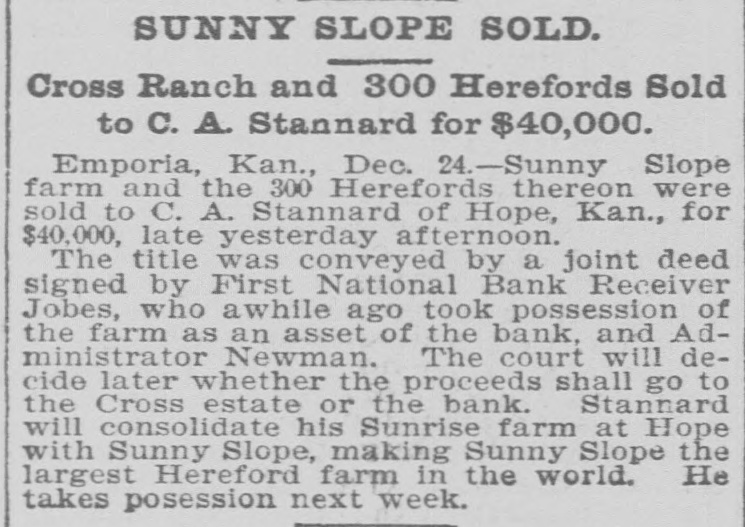
Cross Ranch and 300 Herefords Sold to C. A. Stannard for $40,000.
Emporia, Kan., Dec. 24.-Sunny Slope farm and the 300 Herefords thereon were sold to C. A. Stannard of Hope, Kan., for $40,000, late yesterday afternoon. The title was conveyed by a joint deed signed by First National Bank Receiver Jobes, who awhile ago took possession of the farm as an asset of the bank, and Ad- ministrator Newman. The court will de- cide later whether the proceeds shall go to the Cross estate or the bank. Stannard will consolidate his Sunrise farm at Hope with Sunny Slope, making Sunny Slope the largest Hereford farm in the world. He takes posession next week.
Click image to open full size in new tab
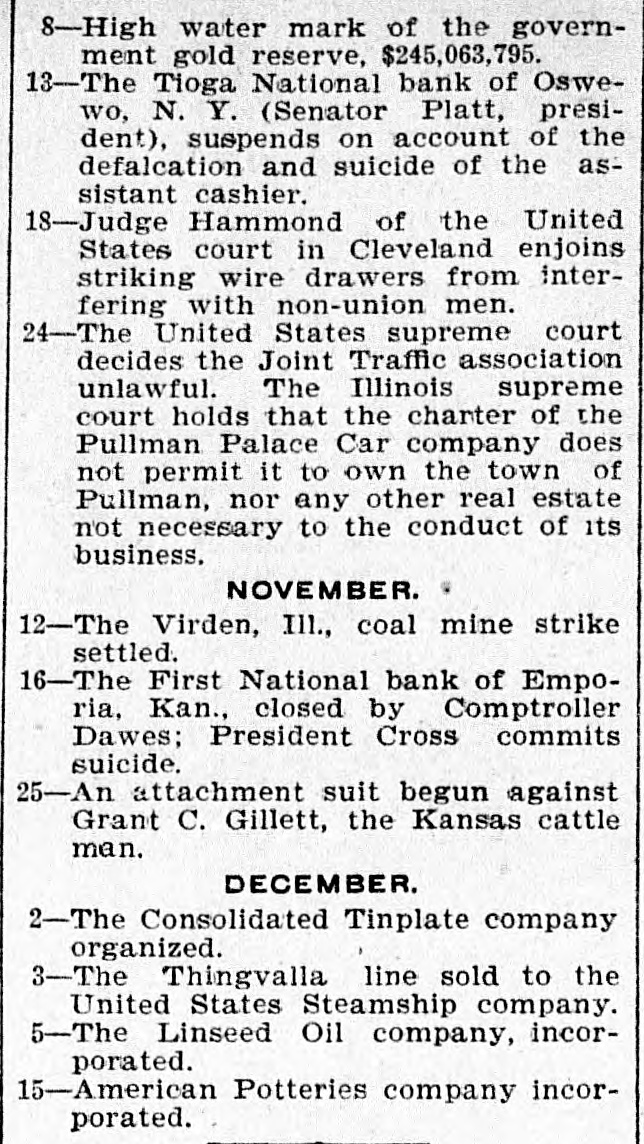
8-High water mark of the government gold reserve, $245,063,795. 13-The Tioga National bank of Oswewo, N. Y. (Senator Platt, president), suspends on account of the defalcation and suicide of the assistant cashier. 18-Judge Hammond of the United States court in Cleveland enjoins striking wire drawers from interfering with non-union men. 24-The United States supreme court decides the Joint Traffic association unlawful. The Illinois supreme court holds that the charter of the Pullman Palace Car company does not permit it to own the town of Pullman, nor any other real estate not necessary to the conduct of its business. NOVEMBER. -The Virden, III., coal mine strike settled. 16-The First National bank of Emporia, Kan., closed by Comptroller Dawes; President Cross commits suicide. 25-An attachment suit begun against Grant C. Gillett, the Kansas cattle man. DECEMBER. 2-The Consolidated Tinplate company organized. 3-The Thingvalla line sold to the United States Steamship company. 5-The Linseed Oil company, incorporated. 15-American Potteries company incorporated.
Click image to open full size in new tab
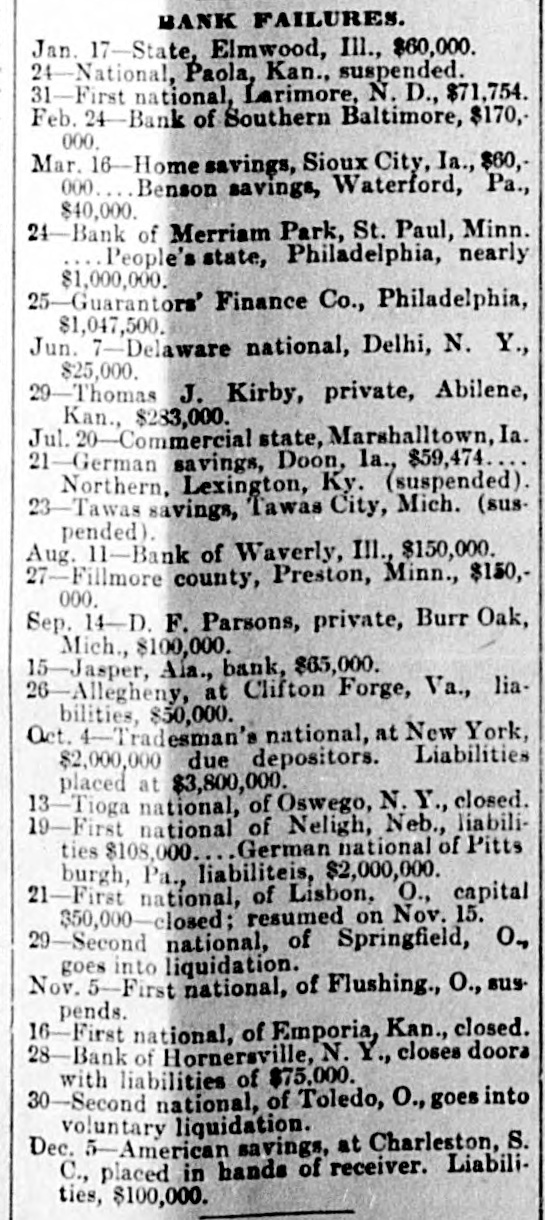
Jan. 17-State, Elmwood, III., $60,000. 24 -National, Paola, Kan., suspended. 31 - First national, Larimore, N. D., $71,754. Feb. 24-Bank of Southern Baltimore, $170, 000. Mar. 16-Home savings, Sioux City, Ia., $60, 000 Benson savings, Waterford, Pa., $40,000. 24-Bank of Merriam Park, St. Paul, Minn. People's state, Philadelphia, nearly $1,000,000. 25-Guarantors' Finance Co., Philadelphia, $1,047,500. Jun. 7-Delaware national, Delhi, N. Y., $25,000. 29-Thomas J. Kirby, private, Abilene, Kan., $283,000. Jul. .20-Commercial state, Marshalltown, Ia. 21-German savings, Doon, 1a., $59,474 Northern, Lexington, Ky. (suspended) 23-Tawas savings, Tawas City, Mich. (sus pended) Aug. 11-Bank of Waverly, III., $150,000. 27 -Fillmore county, Preston, Minn., $150,000. Sep. 14-D. F. Parsons, private, Burr Oak, Mich., $100,000. 15-Jasper, Aia., bank, $65,000. 26-Allegheny, at Clifton Forge, Va., lia bilities, $50,000. Oct. 4-Tradesman's national, at New York, $2,000,000 due depositors. Liabilities placed at $3,800,000. 13-Tioga national, of Oswego, N. Y., closed. 19-First national of Neligh, Neb., liabiliGerman national of Pitts ties $108,000 burgh, Pa., liabiliteis, $2,000,000. 21-First national, of Lisbon. O., capital 350,000-closed; resumed on Nov. 15. 29-Second national, of Springfield, 0, goes into liquidation. Nov. 5-First national, of Flushing., O., suy. pends. 16-First national, of Emporia, Kan., closed. 28-Bank of Hornersville, N. Y., closes doora with liabilities of $75,000. 30-Second national, of Toledo, O., goes into voluntary liquidation. Dec. 5-American savings, at Charleston, S. C., placed in hands of receiver. Liabilities, $100,000.
Click image to open full size in new tab
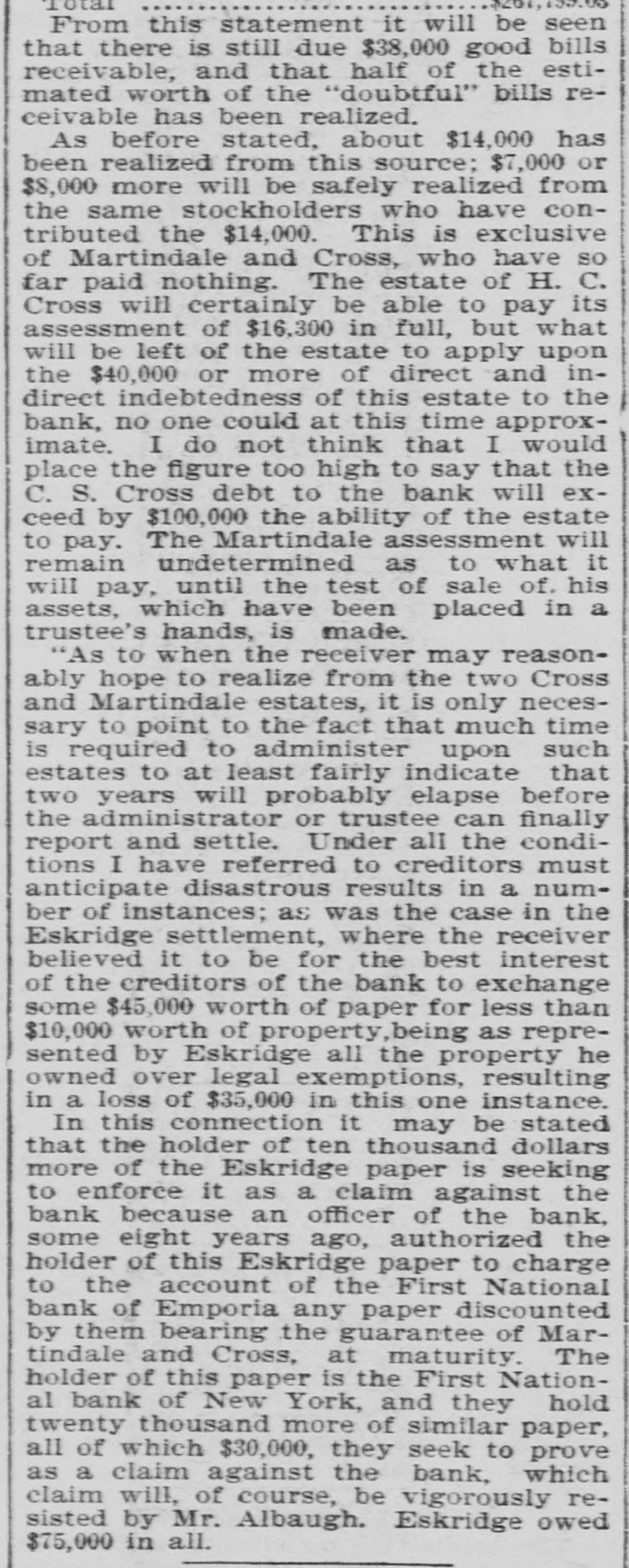
From this statement it will be seen that there is still due $38,000 good bills receivable, and that half of the estimated worth of the "doubtful" bills receivable has been realized.
As before stated, about $14,000 has been realized from this source; $7,000 or $8,000 more will be safely realized from the same stockholders who have contributed the $14,000. This is exclusive of Martindale and Cross, who have so far paid nothing. The estate of H. C. Cross will certainly be able to pay its assessment of $16,300 in full, but what will be left of the estate to apply upon the $40,000 or more of direct and indirect indebtedness of this estate to the bank, no one could at this time approximate. I do not think that I would place the figure too high to say that the C. S. Cross debt to the bank will exceed by $100,000 the ability of the estate to pay. The Martindale assessment will remain undetermined as to what it will pay, until the test of sale of his assets, which have been placed in a trustee's hands, is made.
"As to when the receiver may reasonably hope to realize from the two Cross and Martindale estates, it is only necessary to point to the fact that much time is required to administer upon such estates to at least fairly indicate that two years will probably elapse before the administrator or trustee can finally report and settle. Under all the conditions I have referred to creditors must anticipate disastrous results in a number of instances; as was the case in the Eskridge settlement, where the receiver believed it to be for the best interest of the creditors of the bank to exchange some $45,000 worth of paper for less than $10,000 worth of property, being as represented by Eskridge all the property he owned over legal exemptions, resulting in a loss of $35,000 in this one instance.
In this connection it may be stated that the holder of ten thousand dollars more of the Eskridge paper is seeking to enforce it as a claim against the bank because an officer of the bank, some eight years ago, authorized the holder of this Eskridge paper to charge to the account of the First National bank of Emporia any paper discounted by them bearing the guarantee of Martindale and Cross, at maturity. The holder of this paper is the First National bank of New York, and they hold twenty thousand more of similar paper, all of which $30,000, they seek to prove as a claim against the bank, which claim will, of course, be vigorously resisted by Mr. Albaugh. Eskridge owed $75,000 in all.

Click image to open full size in new tab
Tuesday. Henry B. Cooper has been sworn in as attorney general for Hawaii. John D. Rockefeller is to give Dennison university of Granville, O., $100,000. Today's statement of the condition of the treasury shows: Available cash balance, $282,000,686; gold reserve, $242,802,766. The reception given Secretary Alger at Havana on his arrival was attended by a large corps of American and Cuban officers. The failure of congress to pass legislation for Hawaii has caused the loading of an immense number of vessels with sugar for the United States. Among supplies upon which bids are received at the New York navy yard are 60,000 pounds of canned corned beef and 50,000 pounds of canned roast beef. The Inao-Egyptian Compress company is the latest thing on trusts from New Jersey. It will control the manufacture of cotton compresses. Capital, $15,000,000. A return issued at London shows that the total year's revenue for the United Kingdom was £117,857,353, a net increase of £1,841,039. Last quarter's revenue was £39,516,885. Health Commissioner Fritzsche of Rochester, N. Y., reports that beef cut in small pieces and packed in barrels is being shipped into Rochester for sausage beef. An inspection will be made. The annual meeting of the American Bell Telephone company was held in Boston. No change was made in the list of directors. Secretary Charles Hubbard and Treasurer W. R. Dover were re-elected. The annual report of the treasurer showed the earnings for 1898 to have been $5,548,701, as against $5,130,844 for 1897. The will of Joseph Medill, late editor on the Tribune, was filed in the probate court of Chicago. The estate, which is estimated at about $2,000,000 net, is bequeathed in equal shares to his two daughters, Mrs. Robert W. Patterson and Mrs. Robert S. McCormick. The Tribune stock is left in trust to Robert W. Patterson, Robert S. McCormick and William G. Beale, who are given full power to vote and manage or sell as the majority may decide.
Wednesday. Secretary Alger has gone to Cienfuegos from Havana. Allentown, Pa., rolling mills will make a slight increase in wages April 1. The Indiana supreme court holds that if a man marries a woman who owes him the debt is cancelled. It is reported that Myron T. Herrick has been offered the presidency of the Wheeling & Lake Erie, when it is reorganized, but declines. Funeral services were held at Chicago over the remains of the late Bishop Dugan, who died at St. Louis. Interment was in Calvary cemetery. Commander J. M. Forsythe has been assigned to the command of the Baltimore, now on the Manila station, vice Captain Dyer, who has been invalided home. Suit has been brought against William Martindale, Emporia, Kas., for $166,000, claims growing out of the failure of the First National bank of Emporia. Surgeon General Sternberg received mail reports from Manila concerning hospital and medical affairs there. In the main they dealt with routine matters and showed satisfactory conditions prevailing. Captain William J. Watson of the Twentieth Kansas regiment, injured at Malolos, enlisted at his home in Pittsburg, Kan., under the original call for troops. He went in as a first lieutenant in Company D and was afterward promoted to be captain of Company E. He is 26 years of age, a lawyer by profession and a graduate of the law department of the State university. His nearest relative is A. M. Wilson of Pittsburg. A Filipino commissioner to negotiate for the release of the Spanish prisoners in the hands of the Filipinos arrived in Madrid. The cabinet has decided to sell the transports Rapido, Meteoro and Patriota. The six additional mountain guns asked for by General Otis a short time ago are now on their way to Manila. These guns are two-pounders, and can be taken anywhere that mules or men can go. General Otis had eight of these guns, besides four guns of the Astor battery. The latter, however, are twelve-pounders and much heavier to handle.
Click image to open full size in new tab
M. Davis, the cashier of the defunct First National bank at Emporia, who disappeared recently, has been located and that his arrest will occur in the next twenty-four hours. Dr. Davis' relatives in Emporia are all anxious for him to come back and stand trial. He has wealthy and influential relatives in Emporia who are trying in every possible way to locate Davis and bring him back. It is believed that he left in a panic and will return voluntarily soon if he is not apprehended.
Click image to open full size in new tab
The Cross Bank to Make Another Payment on May 22. Emporia, May 20.-Word has been received by Receiver Albaugh, of the First National bank, from the comptroller of the currency at Washington that the checks for the 10 per cent dividend have been sent and they are expected here every day. Mr. Albaugh stated today that the bank would open up Monday morning, May 22, fully prepared to pay the 10 per cent dividend.

Click image to open full size in new tab
Sensational Testimony Being Developed at Emporia.
Emporia, June 26.-Sensational testimony is being developed in the examination of witnesses in the suit of the Fourth National bank of St. Louis and the First National bank of New York against the defunct Cross bank (the First National of Emporia), now on trial.
Carl Nation, a cattle man testified that he had formed a partnership with H. C. Cross in the cattle business in early days, that this partnership had been carried on for years and up to the time that H. C. Cross was appointed receiver of the M. K. & T. railway. At that time H. C. Cross' son, C. S. Cross, had taken up the business where his father had dropped it and carried it on up to the time of the bank and the suicide of C. S. Cross. Nation testified that he had signed notes for the bank any time that he was called on to do it, sometimes making them out blank and leaving them to be filled in. That the business had been carried on exclusive-ly between himself and the Crosses, and that he had been cautioned several times to not let William Martindale know about the signing of notes and to keep the partnership to himself. He testified that he had, with the Crosses as partners, lost money in deals to the amount of $42,000.
When Mr. Nation testified that he was not to let Martindale know of the partnership and dealings of himself and Cross, notes were offered in evidence which showed in Nation's hand writing that he had made them payable to Martindale & Cross, and that they were signed so on the back. Mr. Nation when asked to state as near as possible the amount that he had signed notes for and given to the bank, replied that it was impossible, that an employe of the bank had told him that he had signed notes enough to build the entire Nicaraguan canal. When asked to make the statement as nearly as possible in dollars he could not, saying that he only knew that it ran into the hundreds of thousands of dollars. His testimony showed that on one day he had signed notes which amounted to $40,000, the notes being for $10,000 each. Two of them were legitimate and two were accommodation notes.
To prove that a Cross-Martindale partnership did not exist, Martindale's attorneys put Mr. Eskridge on the stand and he swore that he had signed notes at Mr. Cross' request, and that he paid no attention to the amounts on the notes. He swore that Mr. Martindale had no connection whatever with the partnership, and that Martindale never asked him to sign the notes. At this it looked rather blue for the bank. But Lambert, attorney for the bank, took hold of Eskridge and afterwards went into the ownership of the Republican newspaper. Eskridge swore that Martindale had no connection whatever with it and that he could remember nothing whatever of the connection of Martindale with it, save a kind of a hint that Cross once gave him that Martindale might be in some remote way interested in the matter. This he swore to and stuck to it. Then Lambert sprang a sensation. It was a contract drawn up in Eskridge's own handwriting, which expressly formed a "co-portnership" between Martindale, Cross, Eskridge and L. Severy for the ownership of the "Emporia Daily Republican." The agreement was signed by each one of the above named parties. It expressly stipulated that the agreement should be kept secret.
The contract of co-partnership showed on the back of it that over $32,000 had been paid into the partnership to start the paper, and Lambert asked Eskridge if this wasn't the foundation of the debt manifested by the Eskridge notes. Eskridge said he did not know. It is claimed by Receiver Albaugh that the bank books show that at the time Eskridge and Severy and Martindale and Cross put $32,000 in the Republican they borrowed that amount from the bank, which was never paid nor any part of it. Thus the debt, which afterward amounted into $75,000, was founded and in sustaining the newspaper it grew. Lambert asked Eskridge just how much he really owed the bank and he said he didn't know, that he never noticed. Then Lambert asked Esk-rideg to give a guess at what he actually owed in straight, bonafide transactions and he replied that it was not over $20,000. He said he didn't know how the debt was formed. He said it just grew up in a night. He didn't know where the money went, nor could he tell anywhere near what he owned or if he ever got the $32,000 paid in to start the Republican. He wouldn't swear that it was not paid in, but said he could tell what became of it, if it was paid in. He said the contract had never been in force any more than the charter under which it was organized. But he said it had never been officially and legally dissolved to his recollection.
Click image to open full size in new tab
CLAIMS $37,000. Madison Bank Trying to Collect That Sum From Receiver Albaugh. Next week in the federal court before Judge Hook will be tried one of the suits growing out of the failure of the First National bank at Emporia. In this case the Madison bank is the plaintiff and brings suit against Receiver Morton Albaugh to recover $37,000, the amount which the books of the Madison bank show was due from the Emporia bank at the time of the collapse. According to the accounts of the First National bank there was due at the time of the failure to the Madison bank $20,000. Receiver Albaugh concedes this obligation but has declined to settle on the basis claimed by the accounts of the Madison bank. This made a difference of $17,000 in the accounts but the Madison bank declined to settle and sued the receiver.
Click image to open full size in new tab
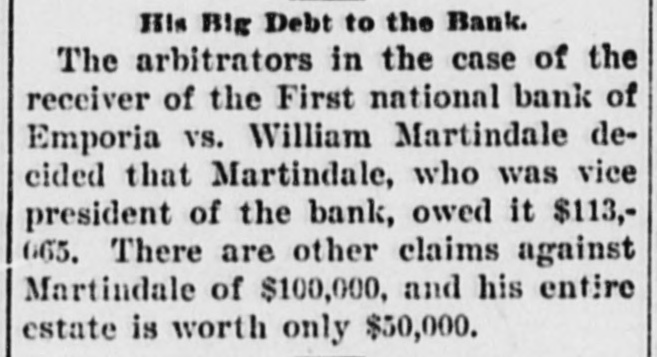
The arbitrators in the case of the receiver of the First national bank of Emporia vs. William Martindale decided that Martindale, who was vice-president of the bank, owed it $113,065. There are other claims against Martindale of $100,000, and his entire estate is worth only $50,000.
Click image to open full size in new tab
The arbitrators in the case of the receiver of the First national bank of Emporia vs. William Martindale decided that Martindale, who was vice president of the bank, owed it $113,665. There are other claims against Martindale of $100,000, and his entire estate is worth only $50,000.