Article Text
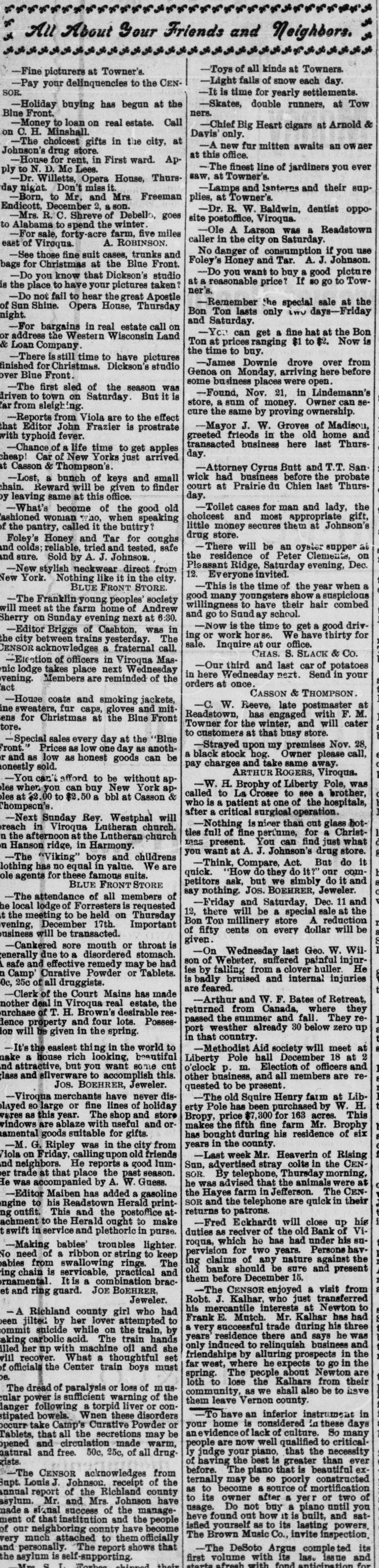
About Your Friends and Neighbors. Toys of all kinds at Towners. Fine picturers at Towner's Light falls of snow each day. Pay your delinquencies to the CENSOR It is time for yearly settlements. Skates, double runners, at Tow -Holiday buying has begun at the ners Blue Front. Money to loan on real estate. Call Chief Big Heart cigars at Arnold & on C.H. Minshall Davis'only. -The choicest gifts in the city, at new fur mitten awaits an ow ner Johnson's drug store. at this office. House for rent, in First ward. Apply to N. D. Mc Lees. The finest line of jardiners you ever saw, at Towner's. Dr Willetts, Opera House, Thursday night. Don't miss -Lamps and lanterns and their supplies, at Towner's. Born. to Mr. and Mrs. Freeman Endicott. December 2. son. -Dr. R. W. Baldwin, dentist oppogoes -Mrs. R. C. Shreve of Debell site postoffice, Viroqua. to Alabama to spend the winter -Ole A Larson was a Readstown For sale, farm, five miles A. ROBINSON. caller in the city on Saturday. east of Viroqua. No danger of consumption if you use -See those fine suit cases, trunks and Foley's Honey and Tar. A. J. Johnson. bags for Christmas at the Blue Front. Do you want to buy a good picture -Do you know that Dickson's studio at a reasonable price? If so go to Towis the place to have your pictures taken ner's, -Do not fail to hear the great Apostle -Remember the special sale at the of Sun Shine. Opera House, Thursday night. Bon Ton lasts only LWU days-Friday and Saturday. For bargains in real estate call on -You can get a fine hat at the Bon or address the Western Wisconsin Land Ton at ranging $1 to $2. Now is & Loan Company the time to buy. -There s still time to have pictures -James Downie drove over from finished for Christmas. Dickson's studio Genoa on Monday, arriving here before over Blue Front some business places were open. -The first sled of the season was -Found, Nov. 21, in Lindemann's driven to town on Saturday. But it is store, a sum of money. Owner from sleighing. cure the same by proving ownership. -Reports from Viola are to the effect Mayor J. W. Groves of Madison, that Editor John Frazier is prostrate with typhoid fever. greeted frieods in the old home and transacted business here last ThursChance of a life time to get apples day. cheap! Car of New Yorks just arrived at Casson & Thompson's. Attorney Cyrus Butt and T.T. San -Lost, & bunch of keys and small wick had business before the probate court at Prairie du Chien last Thurschain. Reward will be given to finder day. by leaving same at this office. Toilet cases for man and lady, the -What's become of the good old choicest and most appropriate gift, ashioned woman who, when speaking little money secures them at Johnson's of the pantry, called it the buttry? drug store. Foley's Honey and Tar for coughs There will be an oyster supper at and colds; reliable, tried and tested, safe the residence of Peter Clements. on and sure. Sold by A. J. Johnson. Pla asant Ridge, Saturday evening, Dec. 12. -New stylish neckwear direct from Everyone invited. New York. Nothing like it in the city. BLUE FRONT STORE. -This is the time of the year when a good many youngsters show suspicious -The Franklin young peoples' society lingness to have their hair combed will meet at the farm home of Andrew and go to Sunda school. Sherry on Sunday evening next at 6:30. -Now is the time to get a good driv-Editor Briggs of Cashton, was in ing or work We have thirty for the city between trains yesterday. The sale. Inquire at our office. CENSOR acknowle a fraternal call. CHAS. S. SLACK & Co. -Election of officers in Viroqua Mas-Our third and last car of potatoes nic lodge takes place next Wednesday in here Wednesday next. Send in your ovening. Members are reminded of the orders at once act CASSON & THOMPSON -House coats and smoking jackets, C. W. Reeve, late postmaster at line sweaters, fur caps, gloves and mit Readstown has engaged with M. ens for Christmas at the Blue Front tore. Towner for the winter, and will cater to customers at that busy store. -Special sales every day at the 'Blue Strayed upon my premises Nov. 28. Front." Prices as low one day as anotha black stock hog. Owner please call, and as low as honest goods can be honestly sold. pay charges take same away. ARTHUR ROGERS, Viroqua. -You can't afford to be without apW. H. Brophy of Liberty Pole, was les when you can buy New York apcalled to La Crosse to see a brother, les at $2.00 to $2.50 bbl at Casson & Thompson's who is a patient at one of the hospitals, after a critical surgical operation. -Next Sunday Rey. Westphal will Nothing nicer than cut glass bot reach in Viroqua Lutheran church. tles full of fine pertume, for a Christn the afternoon the Lutheran church mas present. You can find just what n Hanson ridge, in Harmony. you want at A. J. Johnson's drug store. -The "Viking' boys and childrens -Think, Compare, Act. But do it lothing has no equal in value. We quick. "How do they do it?' our comole agents for these famous suits. petitors ask, but we simbly do it and BLUE FRONT STORE y nothing. Jos. BOEHRER, Jeweler. The attendance of all members of -Friday and Saturday, Dec. 11 and he local lodge of Forresters is requested 12, there will be a special sale at the t the meeting to be held on Thursday Bon Ton millinery store A reduction ovening, December 17th. Important of fifty cents on every dollar will be usiness will be transacted. given. -Cankered sore mouth or throat is -On Wednesday last Geo. W. Wilgenerally due to a disordered stomach. son of Webster, suffered painful injursafe and effective remedy may be had ies by falling from a clover huller. He n Camp' Curative Powder or Tablets. is badly bruised and internal injuries Oc, 25c of all druggists. feared. -Clerk of the Court Mains has made Arthur and W. F. Bates of Retreat. nother deal in Viroqua real estate, the returned from Canada where they purchase of T. H. Brown's desirable respassed the summer and fall. They redence property and four lots. Possesport weather already 30 below zero up ion will be given in the spring. in that country. It's the easiest thing in the world Methodist Aid society will meet at make a house rich looking, beautiful Liberty Pole hall December 18 at : nd attractive, but you want some cut o'clock p. m. Election of officers and lass and silverware to accomplish this. other business, and all members are reJos. BOEHRER, Jeweler. quested to be present -The old Squire Henry farm at Lib -Viroqua merchants have never diserty Pole has been purchased by W. H. played so large or fine lines of holiday Bropy, price $7,300 for 163 acres. This vares as this year. The shop and store windows are ablaze with useful and ormakes the fifth fine farm Mr. Brophy has bought during his residence of six amental goods suitable for gifts. years in the county. -M. G. Ripley was in the city from iola on Friday, friends -Last week Mr. Heaverin of Rising nd neighbors. He reports a good lumSun, advertised stray colts in the CENer trade that place the past season. SOR. By telephone, Thursday morning. He was accompanied by A. W. Guess. he was advised that the animals were the Hayes farm in Jefferson. The CEN-Editor Maiben has added a gasoline SOR and the telephone are quick in their ngine to his Readstown Herald printreturns to patrons. ng outfit. This and the postoffice at -Fred Eckhardt will close up hig achment to the Herald ought to make duties as reciver of the old Bank of Vit swift service and plethoric in purse. roqua, which he has had under his -Making babies' troubles lighter pervision for two years. Persons hav No need of a ribbon or string to keep ing claims of any nature against the babies from swallowing rings. old bank should be sure and present ing chain is servicable. practical The and them before December 15. rnamental It is a combination brac-The CENSOR enjoyed a visit from et and ring guard. JOE BOEHRER, Jeweler. Robt. J. Kalhar, who just transferred his mercantile interests at Newton to A Richland county girl who had Frank E. Mutch. Mr. Kalhar has had been jilted by her lover attempted to a very successful trade during his three commit snicide while on the train, by years residence there and says he was taking carbolic acid. The train hands only induced to relinquish business and illed her up with machine oil and she friendships by alluring prospects in the will recover. What a thoughtful set r west, where he expects to go the of officials the Center train boys must be. spring. The people about Newton are loth to lose the Kalhars from their The dread of paralysis or loss of us. community, as we shall also be to have ular power is sufficient warning of the them leave Vernon county. danger following 8 torpid liver or conhave an inferior instrument in stipated bowels. Wnen these disorders your home is considered in these days occurr take Camp's Curative Powder or anevidence of lack of culture. So many Tablets, that all the secretions may be people are now well qualified to critical opened and circulation made warm, ly judge your piano, that the necessity gists. natural and free. 50c, 25c, of all drug of having the best is greater than ever before. The piano that is beautiful ex-The CENSOR acknowledges from ternally may be so poorly constructed Supt. Louis J Johnson, receipt of the as to become a source of mortification annual report of the Richland county to its owner after & year or two of asylum. Mr. and Mrs. Johnson have usage. Do not buy a piano until you is it how and found heve built, made a signal success of the management of that institution and the people isfied yourself its lasting powers satof our neighboring county have become The Brown Music Co., invite inspection. very much attached to them officially and personally. The report shows that -The DeSoto Argus comple the asylum is self -supporting. first volume with its las, issue and its starts with fond