Washington Bank & Trust Company (Indianapolis, IN)

Episode Information

Episode UID
20006371570
Episode Type
Run โ†’ Suspension โ†’ Closure
Bank Type
trust
Bank ID
2000637 routing
Routing Number
20-0063
Start Date
October 27, 1930
Location
Indianapolis, Indiana (39.768, -86.158)

Metadata

Model
gpt-5-mini (chosen from majority vote of a three-model LLM ensemble)
Short Digest
a7fa5c8b1c8e565f

Response Measures

None

Description

Directors voted voluntary liquidation and placed affairs with state banking department; receivership followed.

Events (3)

1. October 27, 1930 Run
Cause
Local Banks
Cause Details
Heavy withdrawals (panic) that followed recent local bank closures and runs, depleting cash on hand.
Measures
Directors canvassed situation and voluntarily voted to place the bank in hands of state banking department to effect liquidation.
Newspaper Excerpt
the heavy withdrawal of deposits during the day ... heavy withdraws Monday caused the closing
Source
newspapers
2. October 28, 1930 Suspension
Cause
Government Action
Cause Details
Directors voted to go into voluntary liquidation and asked state banking department to take charge following heavy withdrawals.
Newspaper Excerpt
closed the institution's doors this morning and voluntarily placed its affairs in the hands of Luther F. Symons, state bank commissioner.
Source
newspapers
3. November 6, 1930 Receivership
Newspaper Excerpt
Suits by the state banking department for appointment of receivers for the Washington Bank and Trust Company ... were filed Wednesday in Marion circuit court.
Source
newspapers

Newspaper Articles (23)

Article from The Indianapolis Times, October 28, 1930

Click image to open full size in new tab

Article Text

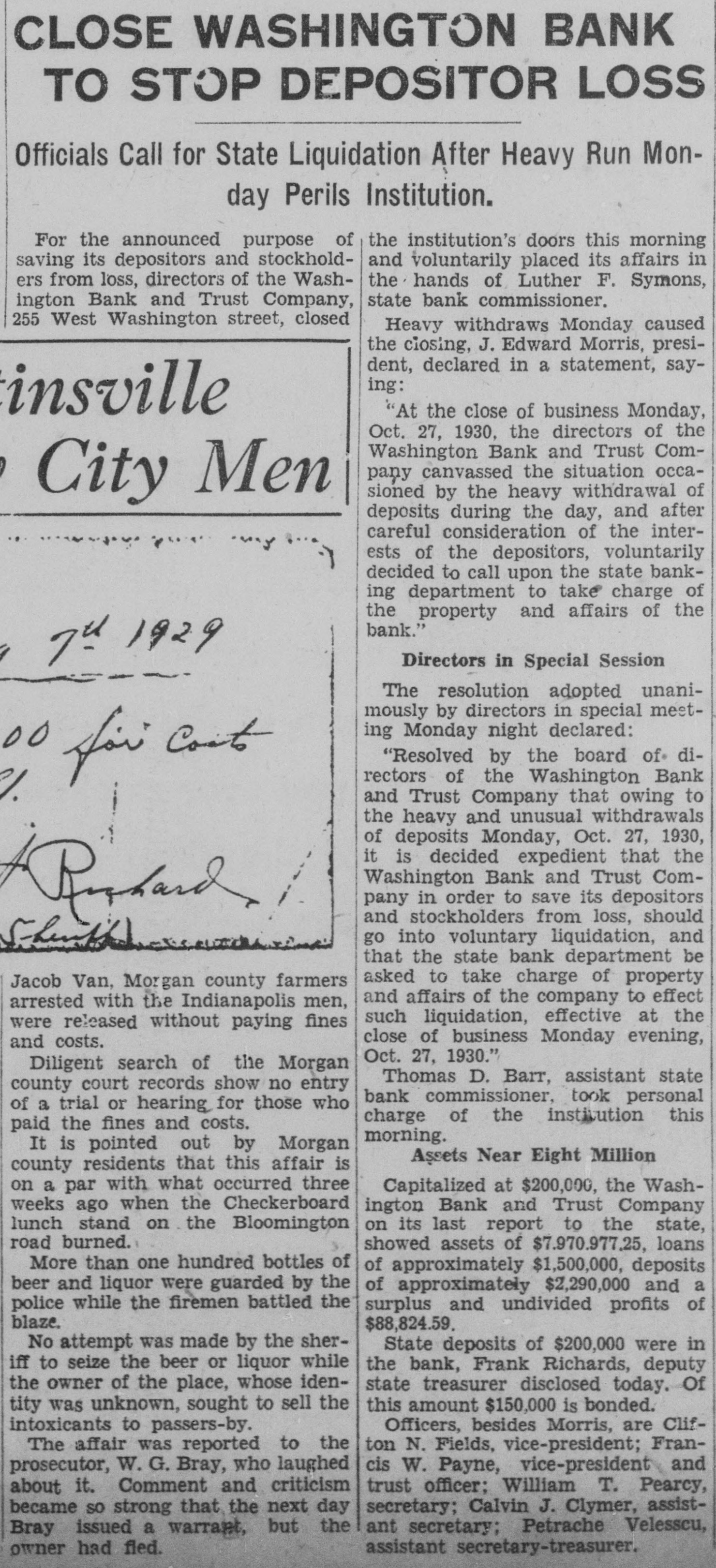
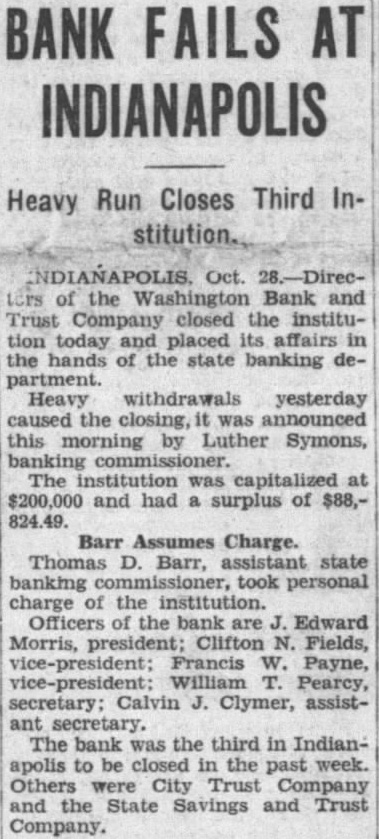
CLOSE WASHINGTON BANK TO STOP DEPOSITOR LOSS Officials Call for State Liquidation After Heavy Run Monday Perils Institution. For the announced purpose of the institution's doors this morning saving its depositors and stockholdand voluntarily placed its affairs in ers from loss, directors of the Washthe hands of Luther F. Symons, state bank commissioner. ington Bank and Trust Company, 255 West Washington street, closed Heavy withdraws Monday caused the closing, J. Edward Morris, president, declared in a statement, saying: insville "At the close of business Monday, Oct. 27, 1930, the directors of the Washington Bank and Trust Company canvassed the situation occasioned by the heavy withdrawal of City Men deposits during the day, and after careful consideration of the interests of the depositors, voluntarily decided to call upon the state banking department to take charge of the property and affairs of the bank." 7th 1929 Directors in Special Session The resolution adopted unanimously by directors in special meeting Monday night declared: "Resolved by the board of directors of the Washington Bank for Cost and Trust Company that owing to the heavy and unusual withdrawals of deposits Monday, Oct. 27, 1930, it is decided expedient that the Washington Bank and Trust Company in order to save its depositors and stockholders from loss, should Rishard go into voluntary liquidation, and that the state bank department be asked to take charge of property Jacob Van, Morgan county farmers and affairs of the company to effect arrested with the Indianapolis men, such liquidation, effective at the were released without paying fines close of business Monday evening, and costs. Oct. 27, 1930." Diligent search of the Morgan Thomas D. Barr, assistant state county court records show no entry bank commissioner, took personal of a trial or hearing for those who charge of the institution this paid the fines and costs. morning. It is pointed out by Morgan Assets Near Eight Million county residents that this affair is on a par with what occurred three Capitalized at $200,000, the Washweeks ago when the Checkerboard ington Bank and Trust Company lunch stand on the Bloomington on its last report to the state, road burned. showed assets of $7.970.977,25, loans More than one hundred bottles of of approximately $1,500,000, deposits beer and liquor were guarded by the of approximately $2,290,000 and a police while the firemen battled the surplus and undivided profits of blaze. $88,824.59. No attempt was made by the sherState deposits of $200,000 were in iff to seize the beer or liquor while the bank, Frank Richards, deputy the owner of the place, whose idenstate treasurer disclosed today. Of tity was unknown, sought to sell the this amount $150,000 is bonded. Officers, besides Morris, are Clifintoxicants to passers-by. ton N. Fields, vice-president; FranThe affair was reported to the prosecutor, W. G. Bray, who laughed cis W. Payne, vice-president and trust officer: William T. Pearcy, about it. Comment and criticism secretary; Calvin J. Clymer, assistbecame so strong that the next day ant secretary; Petrache Velesscu, Bray issued a warrant, but the assistant secretary-treasurer. owner had fled.
Article from Muncie Evening Press, October 28, 1930

Click image to open full size in new tab

Article Text

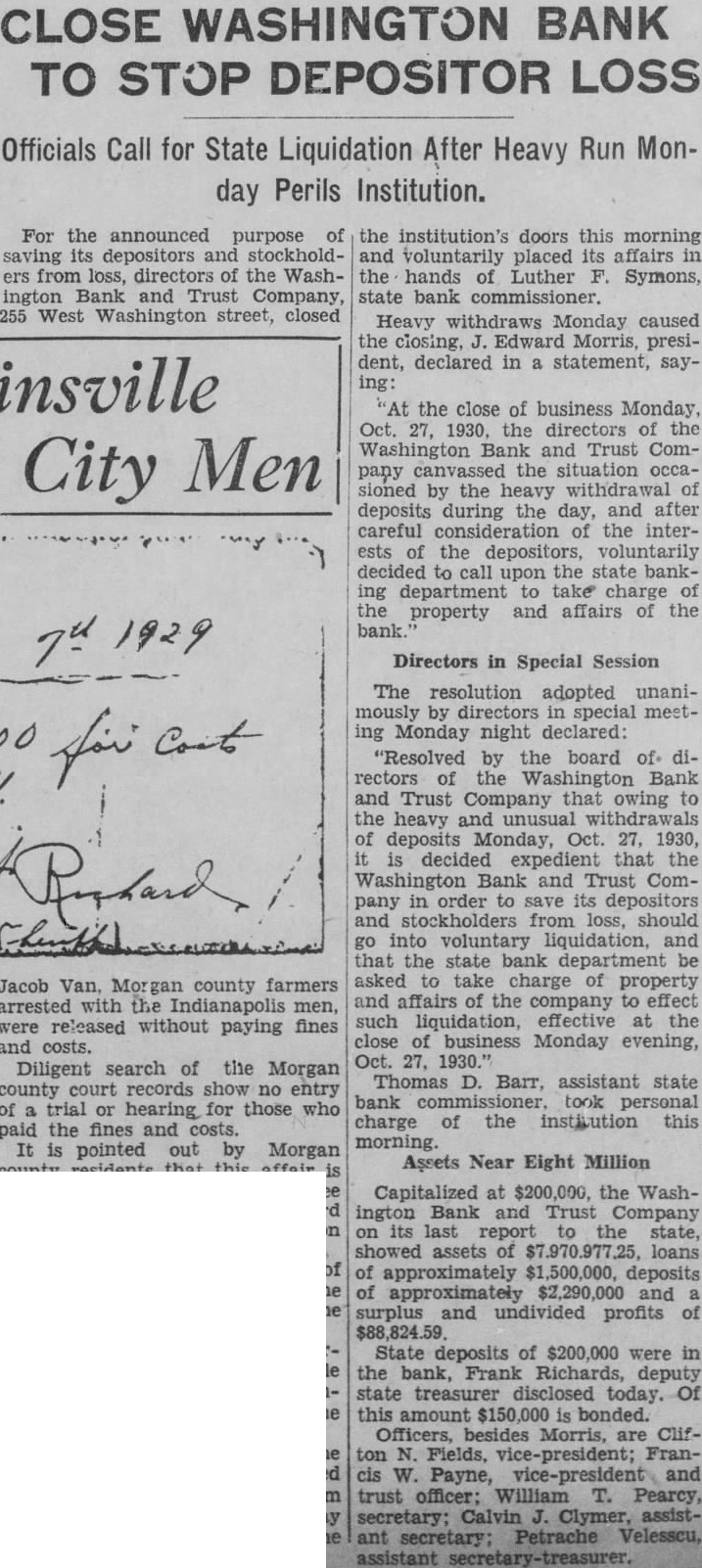
BANK FAILS INDIANAPOLIS Heavy Run Closes Third Oct. of the Washington Bank and Trust Company closed the institution today and placed its affairs the hands of the state banking partment. Heavy withdrawals yesterday caused the closing, was announced this morning by Luther Symons, banking The institution was capitalized and had surplus of Barr Assumes Charge. Thomas Barr, assistant state banking took personal charge of the institution. of the bank are Edward Morris, president; Clifton Fields, Francis Payne, Pearcy, secretary; Calvin Clymer, assistsecretary. The bank was the third in Indianapolis to be closed in the past week. Others City Trust Company and the State Savings and Trust Company.


Article from The Indianapolis Times, October 28, 1930

Click image to open full size in new tab

Article Text

CLOSE WASHINGTON BANK TO STOP DEPOSITOR LOSS Officials Call for State Liquidation After Heavy Run Monday Perils Institution. For the announced purpose of depositors and from the Washand Trust Company, West Washington street, closed the institution's doors this morning voluntarily placed its affairs the hands Luther Symons, state bank Heavy withdraws caused the Morris president, declared in statement, say- the close of business Monday, 1930, the the Washington Company the occasioned by the deposits during the day, and after careful the interthe depositors, decided call the state bankdepartment property and affairs of the Directors in Special Session The resolution adopted unanimously directors special meeting Monday night declared: "Resolved by the board rectors Washington Bank and Trust Company that owing to the heavy and unusual deposits Monday, 27, 1930, expedient that the Washington and Trust Company in order to its depositors from should voluntary and state department be asked charge of and affairs effect liquidation, effective the close of business Monday evening, Oct. 1930." Thomas D. Barr, assistant state bank personal charge of the institution this morning. Assets Near Eight Million Capitalized $200,000, the Washington Bank Trust Company report state, showed assets approximately $1,500,000, deposits approximately $2,290,000 and surplus and undivided profits State deposits of were the bank, Frank Richards, deputy state today. this amount $150,000 bonded. Morris, Clifton Fields, FranPayne, and trust officer: William Pearcy, Calvin assistPetrache Velesscu,


Article from The Spokesman-Review, October 29, 1930

Click image to open full size in new tab

Article Text

HEAVY RUNS CLOSE BANK $7,970,977 Institution Third to Fall Town Washington Bank and Trust pany of Indianapolis its doors Failure this tution other banks last week. They were the company and the Postal Station State Luther state bankin the last few responsible for the closing the Washington bank. Symons said the was According its report, it had assets of $7,970,977.


Article from Franklin Democrat, October 30, 1930

Click image to open full size in new tab

Article Text

Washington Fails To "Run" Heavy run Monday, which depleted cash was given as the reason for closing the Washington Bank and Trust Company at Indianapolis by Luther Symons, state banking commissioner. The bank failed to open its doors Tuesday, directors having voted to put the institution in the hands of the banking department, according to Symons. Thomas D. Barr, assistant state banking commissioner, took personal charge. The institution was capitalised at $200,000 and had surplus $88,824.59 at the last bank call. Report at that time showed the bank in fair condition, Symons said, but could not withstand the Monday run. City Trust Company closed by vote of directors last week. The Washington bank is the fourth downtown financial institution to close, others being the Wild bank and the State Savings and Trust Company. Officers the Washington bank Edward Morris, president: Clifton Fields, Francis W. Payne, and trust officer; William Pearcy, secretary; Calvin assistant secretary; Petrache assist- Mrs. W. H. Schlosser attended meeting and luncheon of the Gen. Lew Wallace chapter of the Daughters of the Union at Terre Haute, Thursday. In the evening she was the guest of honor at dinner the home of Mrs. George Shannon, regent of the Terre Haute D. of U. entertaining the board members of the chapter. Mrs. Schlosser is Indiana state regent of Daughters of the Union.


Article from The Indianapolis Times, November 6, 1930

Click image to open full size in new tab

Article Text

BANK RECEIVERS ASKED State Files Action Against City Trust, Washington Institution. Suits by the state banking department for apponitment of receivers for the Washington Bank and Trust Company and the City Trust Company, both closed recently, were filed Wednesday in Marion circuit court. Hearing on the City Trust Company petition will be held on next Wednesday and on the Washington Bank and Trust Company petition two days later.


Article from The Indianapolis Times, November 6, 1930

Click image to open full size in new tab

Article Text

State Files Action Against City Trust, Washington Institution. Suits by the state banking department for apponitment of receivers for the Washington Bank and Trust Company and the City Trust Company. both closed recently. were filed Wednesday in Marion circuit court. Hearing on the City Trust Company petition will be held on next Wednesday and on the Washington Bank and Trust Company petition two days later.


Article from The Indianapolis Times, November 10, 1930

Click image to open full size in new tab

Article Text

Some Light on City's Closed Bank Tangles Events which preceded today's court action in the receivership battle involving the City Trust Company, Washington Bank and Trust Company, the state banking commissioner, attorney-general and county courts were: Oct. 23-City Trust Company closes its doors, its directors blaming frozen assets, placing company's affairs in hands of state banking department. Oct. 28-Washington Bank and Trust Company closed by its directors after heavy run Oct. 27; state banking department takes charge. Nov. 5-Attorney-General James M. Ogden, through his chief deputy, Charles Werner, files suits in Marion circuit court (Harry O. Chamberlin, judge) asking appointment of receivers for both the City Trust Company and Washington Bank and Trust Company. Nov. 6.-Luthe F. Symons. state banking ocmmissioner, without Judge Chamberlin's approval, withdraws the suits from circuit court. paying costs by personal check, and refiles them, designating City Trust Company receivership suit for probate court (Mahlon E. Bash, judge) and Washington Bank and Trust Company suit for superior court five (Joseph M. Milner, judge). Nov. 7-Attorney-General Ogden and Circuit Judge Chamberlin declare attempted transfer was without their approval. Symons refuses explanation of action. Thomas D. Barr, deputy banking commissioner, denies he is interested in being appointed receiver for either institution. Nov. 8-Symons asserts that Jess Murden, Peru. state highway commisisoner, talked to him about transferring the suits from circuit court. Reported that Murden's interest was inspired by Arthur B. Ayres, Newcastle capitalist and heavy donor to Republican state campaign funds, who, with George Marott, Indianapolis merchants, owns City Trust building, where City Trust Company pays $25,000 annual rent. Murden denies Symons assertion and disclaims acquaintance with Ayres. Ayres denies having asked Murden or Governor Harry G. Leslie to act. Report persists that Governor advised Symons by telephone to make the transfer if it could be done without embarrassment. Symons issues statement upholding his right to choose the courts, defends his action as intended for best interests of depositors. Attorney-general admits Symons' charges that he (Ogden) filed the suits in circuit court despite the fact Symons intended them for superior and probate courts. Ogden explains he did this because Judges Milner and Bash leave office Jan. 1, 1931, and probate court lacks jurisdiction. Ralph Kane. attorney. announces his firm is entering appearance for City Trust Company in circuit court and in superior court five. Although suits. when refiled by Symons. bore penciled notation sending City Trust action to probate court and Washington Bank and Trust Company suit to superior court five, they now are found to be on file in just the opposite position, City Trust in superior court five and Washington Bank and Trust in probate court. Ogden's chief deputy filed motion in circuit court to dismiss Symons' motion for dismissal (filed when the transfer was sought).


Article from The Indianapolis Times, November 14, 1930

Click image to open full size in new tab

Article Text

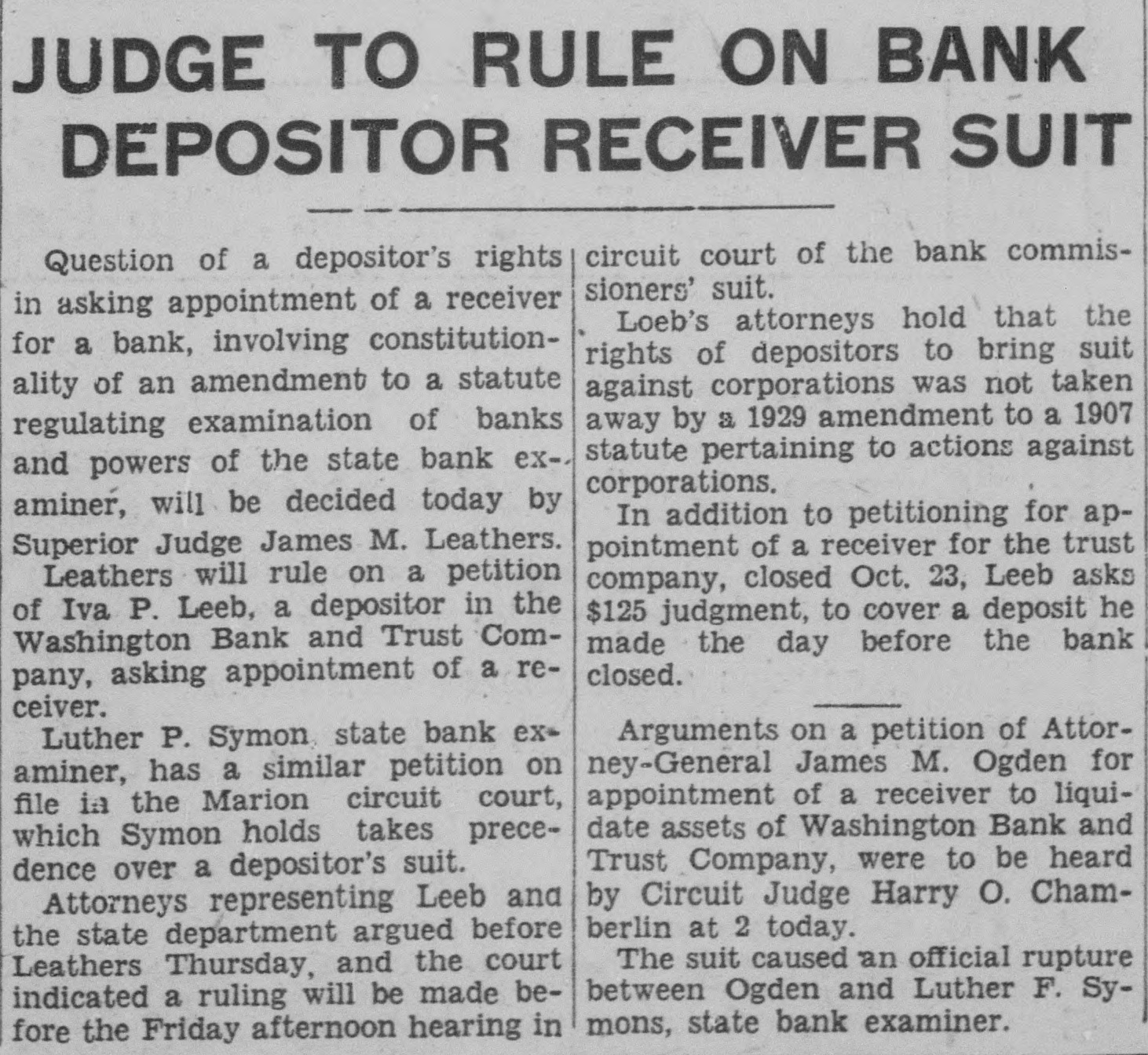
JUDGE TO RULE ON BANK DEPOSITOR RECEIVER SUIT circuit court of the bank commisQuestion of a depositor's rights sioners' suit. in asking appointment of a receiver Loeb's attorneys hold that the for a bank, involving constitutionrights of depositors to bring suit ality of an amendment to a statute against corporations was not taken away by a 1929 amendment to a 1907 regulating examination of banks statute pertaining to actions against and powers of the state bank ex-, corporations. aminer, will be decided today by In addition to petitioning for apSuperior Judge James M. Leathers. pointment of a receiver for the trust Leathers will rule on a petition company, closed Oct. 23, Leeb asks of Iva P. Leeb, a depositor in the $125 judgment, to cover a deposit he Washington Bank and Trust Commade the day before the bank closed. pany, asking appointment of a receiver. Arguments on a petition of AttorLuther P. Symon state bank exney-General James M. Ogden for aminer, has a similar petition on appointment of a receiver to liquifile in the Marion circuit court, date assets of Washington Bank and which Symon holds takes preceTrust Company, were to be heard dence over a depositor's suit. by Circuit Judge Harry O. ChamAttorneys representing Leeb and berlin at 2 today. the state department argued before The suit caused an official rupture Leathers Thursday, and the court between Ogden and Luther F. Syindicated a ruling will be made bemons, state bank examiner. fore the Friday afternoon hearing in


Article from The Indianapolis Times, March 2, 1933

Click image to open full size in new tab

Article Text

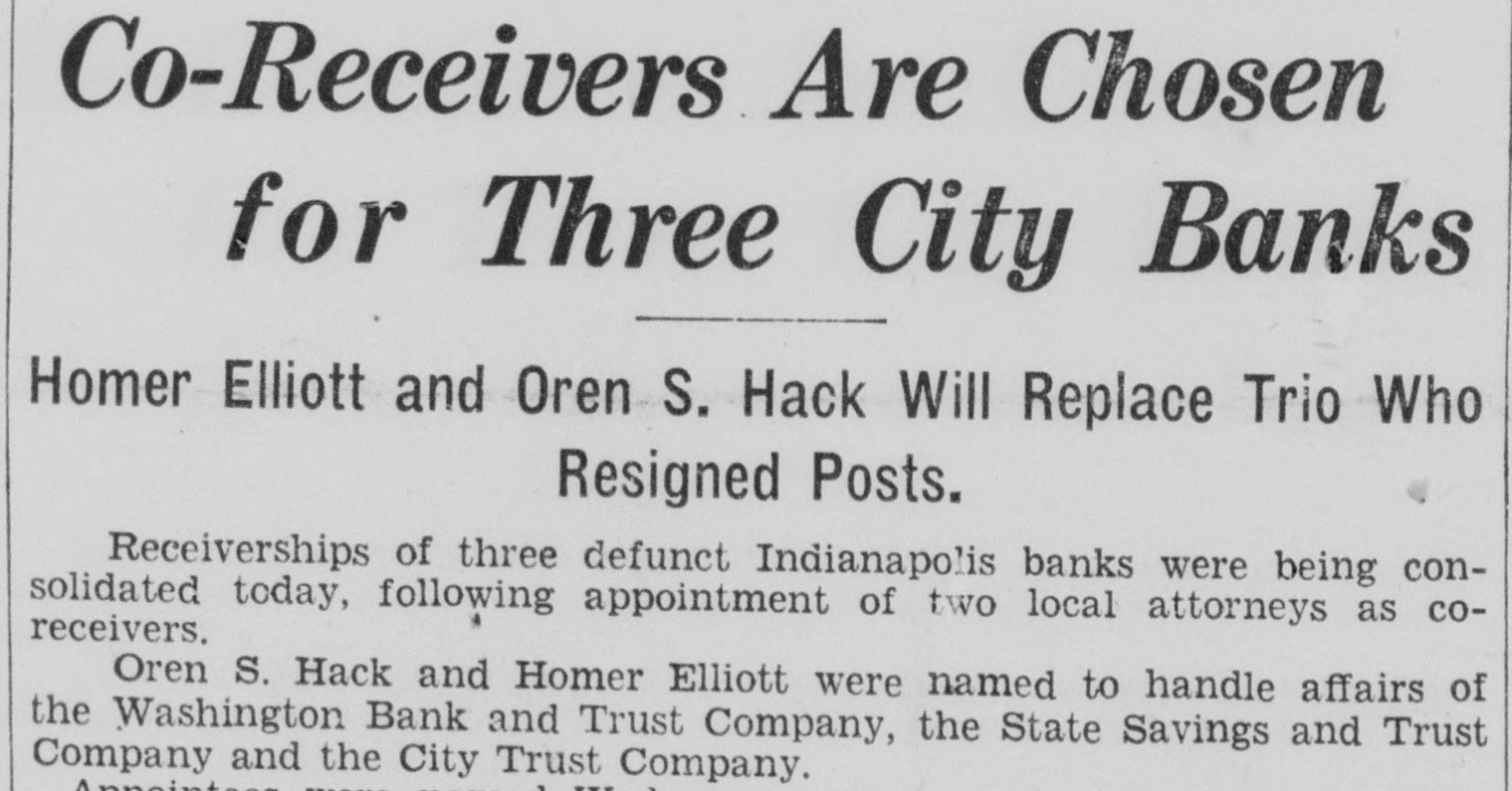
Co-Receivers Are Chosen for Three City Banks Homer Elliott and Oren S. Hack Will Replace Trio Who Resigned Posts. Receiverships of three defunct Indianapolis banks were being consolidated receivers. today, following appointment of two local attorneys as coOren S. Hack and Homer Elliott were named to handle affairs of the Washington Bank and Trust Company, the State Savings and Trust Company and the City Trust Company. A


Article from The Indianapolis Times, April 22, 1933

Click image to open full size in new tab

Article Text

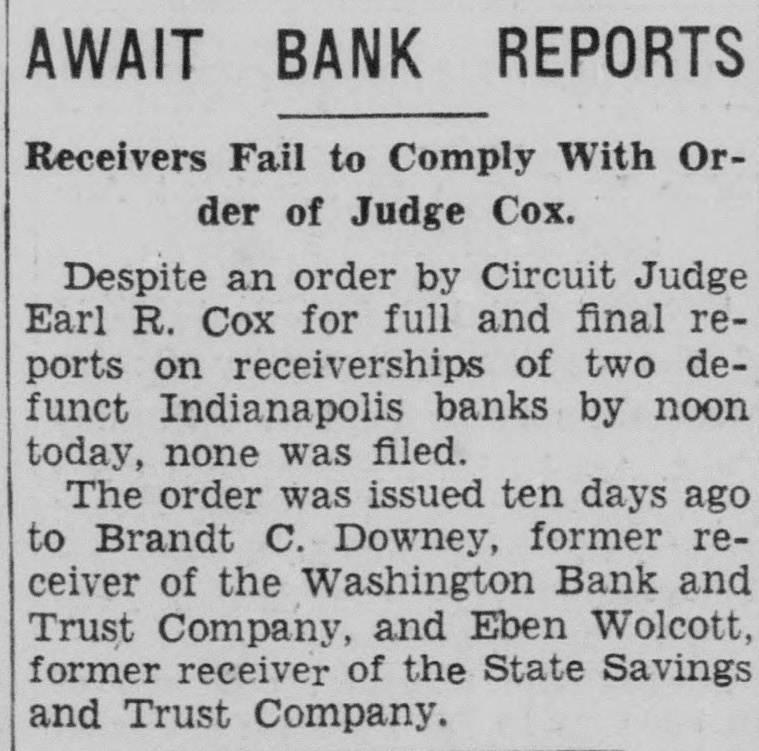
AWAIT BANK REPORTS Receivers Fail to Comply With Order of Judge Cox. Despite an order by Circuit Judge Earl R. Cox for full and final reports on receiverships of two defunct Indianapolis banks by noon today, none was filed. The order was issued ten days ago to Brandt C. Downey, former receiver of the Washington Bank and Trust Company, and Eben Wolcott, former receiver of the State Savings and Trust Company.


Article Text

Bank Receiver Files 18 Suits to Collect Notes Eighteen seeking recovery on notes amounts ranging from $100 were filed Marion county Superior and Municipal courts terday by Oren Hack receiver the Washington Bank and Trust Company The largest is from R. Brewer Others defendants in follow William Archer Morris Thomas Quinn Fred Charles Samuel Dorfman, George Cor poration, Nola Boyer Obed Ellis Gooding Irwin Guthrie, Alice Harry Frankovitz, Harry Baxter and William Green.


Article from The Indianapolis Times, June 6, 1933

Click image to open full size in new tab

Article Text

BANK SUITS ARE FILED Washington Trust Receiver Seeks to Collect $22,325 on Notes. Ten suits to collect $22,325 on notes due the defunct Washington Bank and Trust Company were filed Monday in Marion county courts by Oren S. Hack, receiver, on instructions of Circuit Judge Earl R. Cox. This is the first action taken by the receiver to create assets in an effort to meet the bank's obligations. Amounts sought range from $100 to $10,000.


Article Text

BANK OFFICERS SUED FOR BOND RECOVERY INDIANAPOLIS, June charging officers the closed Washington Bank and Trust Company with unlawful acts were on in Marion Circuit Court today. Four bonding companies, with whom the officers were bonded, are defendants. The suits were filed by Oran S. Hack, the bank's receiver, seeks recovery $625,000 in bonds the officers. If the amount is recovered it will be used depositors. The bank closed in 1930.


Article from The Indianapolis Times, July 1, 1933

Click image to open full size in new tab

Article Text

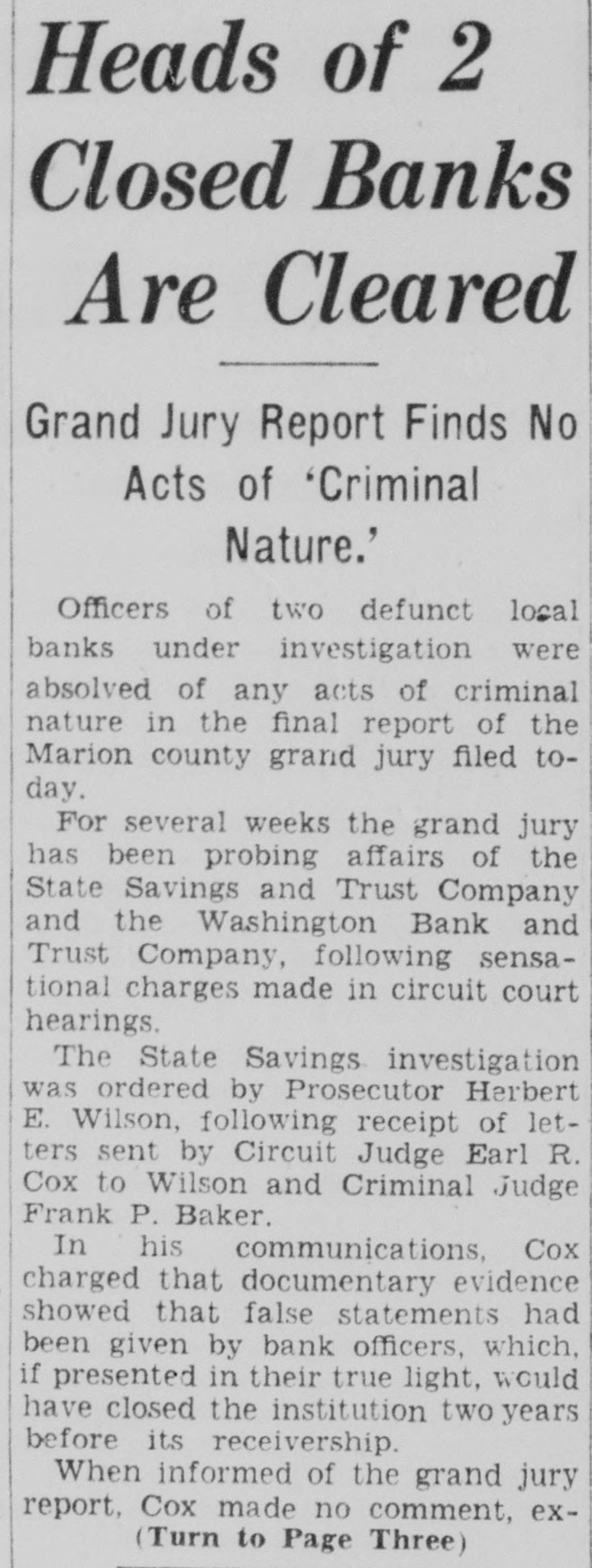
Heads of 2 Closed Banks Are Cleared Grand Jury Report Finds No Acts of 'Criminal Nature.' Officers of two defunct local banks under investigation were absolved of any acts of criminal nature in the final report of the Marion county grand jury filed today. For several weeks the grand jury has been probing affairs of the State Savings and Trust Company and the Washington Bank and Trust Company, following sensational charges made in circuit court hearings. The State Savings investigation was ordered by Prosecutor Herbert E. Wilson, following receipt of letters sent by Circuit Judge Earl R. Cox to Wilson and Criminal Judge Frank P. Baker. In his communications, Cox charged that documentary evidence showed that false statements had been given by bank officers, which, if presented in their true light, would have closed the institution two years before its receivership. When informed of the grand jury report, Cox made no comment, ex(Turn to Page Three)


Article from The Indianapolis Times, February 24, 1934

Click image to open full size in new tab

Article Text

MEYER-KISER BANK CASE IS BEFORE JURY Affidavits Turned Over to Talesmen by Prosecutor Herbert Wilson. SIGNED BY RECEIVER Accusations Loosely Drawn, Is Official's Charge to Probers. Talesmen of the Marion county grand jury today were considering the Meyer-Kiser bank case, referred to them yesterday by Herbert E. Wilson, Marion county prosecutor. In laying the bank case before the grand jury, Mr. Wilson stated that charges made against four officials of the defunct bank were of "such great importane" as to warrant such action. Affidavits were signed Tuesday by Thmoas E. Garvin, receiver for the bank, against Sol Meyer, Ferd S. Meyer, Julian J. Kiser and Melville S. Cohn, the four former officials of the bank, charging them with embezzlement of bank funds, conspiracy to accept deposits in an insolvent institution, and accepting deposits in an insolvent institution. Turned Over to Wilson Previous to the signing of the affidavits, Alvah J. Rucker, a special investigator named by Judge Earl R. Cox in circuit court. to investigate the circumstances surrounding defunct Indianapolis banks, read a forty-page typewritten report outlining the bank's alleged condition. Judge Cox instructed that the affidavits be delivered to Mr. Garvin and then sent to Judge Frank P. Baker of criminal court for approval. Judge Baker pointed out that all affidavits must be signed by the prosecutor and the documents were finally turned over to Mr. Wilson. Mr. Wilson charged that the affidavits as drawn by Mr. Rucker were subject to a motion to quash. He charged that they were not properly drawn. Mattice Is Named Floyd J. Mattice, chief deputy prosecutor was named yesterday by Mr. Wilson as special grand jury deputy prosecutor to conduct the investigation. Mr. Rucker and his aids have completed a five months' investigation of the closed bank. A former grand jury heard events incident to the closing of the Washington Bank and Trust Company and the State Savings and Trust Company, but refused to return true bills against any person or persons connected with either bank. The grand jury report also set out that the evidence obtained by Judge Cox and his court attaches was not sufficient to hold any particular individual criminally liable for affairs of the bank.


Article from The Indianapolis Times, February 24, 1934

Click image to open full size in new tab

Article Text

MEYER-KISER BANK CASE IS BEFORE JURY Affidavits Turned Over to Talesmen by Prosecutor Herbert Wilson. Talesmen of the Marion county grand jury today were considering the Meyer-Kiser bank case, referred to them yesterday by Herbert E. Wilson, Marion county prosecutor. In laying the bank case before the grand jury, Mr. Wilson stated that charges made against four officials of the defunct bank were of "such great importane" as to warrant such action. Affidavits were signed Tuesday by Thmoas E. Garvin, receiver for the bank, against Sol Meyer, Ferd S. Meyer, Julian J. Kiser and Melville S. Cohn, the four former officials of the bank, charging them with embezzlement of bank funds, conspiracy to accept deposits in an insolvent institution, and accepting deposits in an insolvent institution. Turned Over to Wilson Previous to the signing of the affidavits, Alvah J. Rucker, a special investigator named by Judge Earl R. Cox in circuit court. to investigate the circumstances surrounding defunct Indianapolis banks, read a forty-page typewritten report outlining the bank's alleged condition. Judge Cox instructed that the affidavits be delivered to Mr. Garvin and then sent to Judge Frank P. Baker of criminal court for approval. Judge Baker pointed out that all affidavits must be signed by the prosecutor and the documents were finally turned over to Mr. Wilson. Mr. Wilson charged that the affidavits as drawn by Mr. Rucker were subject to a motion to quash. He charged that they were not properly drawn. Mattice Is Named Floyd J. Mattice, chief deputy prosecutor was named yesterday by Mr. Wilson as special grand jury deputy prosecutor to conduct the investigation. Mr. Rucker and his aids have completed a five months' investigation of the closed bank. A former grand jury heard events incident to the closing of the Washington Bank and Trust Company and the State Savings and Trust Company, but refused to return true bills against any person or persons connected with either bank. The grand jury report also set out that the evidence obtained by Judge Cox and his court attaches was not sufficient to hold any particular individual criminally liable for affairs of the bank.


Article Text

NAME RINEHART, MILLER, MEYER IN AFFIDAVITS Officials of Defunct City Banks Charged With Accepting Deposits Knowing Institutions Were Insolvent. BONDS ARE FIXED BY JUDGE BAKER Capias Warrants Are Issued for Arrest of Trio After Filing of Counts in Criminal Court. Dick Miller, president of the defunct City Trust Co.; Mark V. Rinehart, vice president and director of the wrecked Washington Bank and Trust Co., and Sol S. Meyer, president of the closed Meyer-Kiser bank, were charged today, by affidavit, with the embezzlement of deposits. The affidavits, presented in the Marion County Criminal Court by Prosecutor Herbert M. Spencer and signed by John F. Dugan, investigator for the prosecutor's office, culminated months of effort in probing closed banks in Indianapolis by grand juries and special investigators. Criminal Judge Frank P. Baker fixed bonds on the charges at $15,000 for Mr. Miller and Mr. Rinehart and $5000 for Mr. Meyer who is now out on a $15,000 bond in connection with a similar charge. Capias warrants were issued for the arrest of the three bankers. Extradition proceedings to bring Mr. Meyer back to this city from his home in Miami, Fla., and Mr. Rinehart from his residence in Louisville, Ky., will be started next week, Prosecutor Spencer said. Mr. Miller has been reported ill at his home, 3130 N. Delaware-st. The three affidavits are identical in that they charge each former bank officer with accepting deposits with the knowledge that each of the banks was insolvent on or about the date of the closing of the three institutions.


Article Text

Depositors Are Named The affidavit against Mr. Miller charges that on Oct. 22, 1930, the day before the City Trust Co. closed, that a deposit of $25 in money was accepted by the bank from Wilfred Bradshaw. Mr. Bradshaw now is judge of Municipal Court One. Mr. Rinehart is charged, through bank employes, with accepting a deposit from the Roberts Restaurant, Inc., of $312.63 in money on Oct. 27, 1930, the day the Washington Bank and Trust Co. closed its doors. Checks totaling $320.95 and $129.98 in money deposited by Lee F. Remmetter, druggist, of 4225 E. Washington-st, on May 11, 1931, in the Meyer-Kiser bank are the basis of the charges of accepting deposits "fraudulently" against Mr. Meyer. Morris Death Recalled Mr. Spencer pointed out that in filing the charges that every effort was made to fix the responsibility for alleged violation of the state banking statutes on men holding the presidency or highest executive position in the banks. Although Mr. Rinehart resigned as vice president of the Washington Bank and Trust Co. in 1929 to head the Farmers Trust Co. he still retained his directorship in the W. Washington-st bank up to the time of its closing, Mr. Spencer says. J. Edward Morris, president of the W. Washington-st institution, was found dead in his garage, victim of carbon monoxide poisoning. He was believed to have committed suicide.


Article Text

THREE MORE CITY BANKERS ARE CHARGED WITH EMBEZZLEMENT Miller, Meyer and Rinehart Accepted Cash Deposits Knowing Institutions Were Solvent, Affidavits Allege. BONDS ARE FIXED BY JUDGE BAKER Capias Warrants Are Issued for Arrest of Trio After Filing of Counts in Criminal Court. Dick Miller, president of the defunct City Trust Co.; Mark V. Rinehart, vice president and director of the wrecked Washington Bank and Trust Co., and Sol S. Meyer, president of the closed Meyer-Kiser bank, were charged today, by affidavit, with the embezzlement of deposits. The affidavits, presented in the Marion County Criminal Court by Prosecutor Herbert M. Spencer and signed by John F. Dugan, investigator for the prosecutor's office, culminated months of effort in probing closed banks in Indianapolis by grand juries and special investigators.


Article Text

Depositors Are Named The affidavit against Mr. Miller charges that on Oct. 22, 1930, the day before the City Trust Co. closed, that a deposit of $25 in money was accepted by the bank from Wilfred Bradshaw. Mr. Bradshaw now is judge of Municipal Court One. Mr. Rinehart is charged, through bank employes, with accepting a deposit from the Roberts Restaurant, Inc., of $312.63 in money on Oct. 27, 1930, the day the Washington Bank and Trust Co. closed its doors. Checks totaling $320.95 and $129.98 in money deposited by Lee F. Remmetter, druggist, of 4225 E. Washington-st, on May 11, 1931, in the Meyer-Kiser bank are the basis of the charges of accepting deposits "fraudulently" against Mr. Meyer. Witnesses on the affidavits in the three cases are: Miller affidavit, Municipal Judge Wilfred Bradshaw, George S. Olive, Howard W. Painter, R. W. Spiegel, Gavin Payne, Oren S. Hack, J. Harry Miles and Joseph V. Hurley; Rinehart affidavit, Henry A. Roberts, Charlton Carlton, and Oren S. Hack; Meyer affidavit, Karl I. Hamilton, Howard Painter, Ida S. Broo, Harold Phipps, John Fox, Russell Lookabill, Albert Uhl, John Roberts, Thomas E. Garvin, Richard A. McKinley.


Article Text

Morris Death Recalled Mr. Spencer pointed out that in filing the charges every effort was made to fix the responsibility for alleged violation of the state banking statutes on men holding the presidency or highest executive position in the banks. Although Mr. Rinehart resigned as vice president of the Washington Bank and Trust Co. in 1929 to head the Farmers Trust Co. he still retained his directorship in the W. Washington-st bank up to the time of its closing, Mr. Spencer says. J. Edward Morris, president of the W. Washington-st institution, was found dead in his garage, victim of carbon monoxide poisoning. He was believed to have committed suicide. The prosecutor was emphatic in declaring that he did not expect to file additional charges against other officers or directors of the closed institutions.


Article from The Indianapolis Times, August 10, 1935

Click image to open full size in new tab

Article Text

August, 1900, DANIEL J. O'NEILL. City Clerk. SEAL] Oren S. Hack. as and in capacity of Receiver of Washington Bank and Trust Company, vs. Samuel V. Kirazian, Emma M. Kirazian. Charlotte H. Passwater. State of Indiana, Marion County, SS: In the Circuit Court of Marion County in the State of Indiana. No. 50991.