State Savings & Trust Company (Indianapolis, IN)

Episode Information

Episode UID
20007271564
Episode Type
Suspension β†’ Closure
Bank Type
trust
Bank ID
2000727 routing
Routing Number
20-0072
Start Date
April 26, 1930
Location
Indianapolis, Indiana (39.768, -86.158)

Metadata

Model
gpt-5-mini (chosen from majority vote of a three-model LLM ensemble)
Short Digest
08d28e4ed74509b7

Response Measures

None

Description

Directors voted voluntary liquidation; receiver appointed and bank remained in receivership with litigation following.

Events (4)

1. April 26, 1930 Suspension
Cause
Voluntary Liquidation
Cause Details
Directors adopted resolution citing inability to market real estate, depreciation of farm values and shrinkage of deposits and went into voluntary liquidation
Newspaper Excerpt
Doors of the State Savings and Trust Company ... were closed today on order of the board of directors
Source
newspapers
2. April 28, 1930 Receivership
Newspaper Excerpt
Petition for a receiver for the State Savings and Trust Company was filed today in Marion circuit court by Luther F. Symons, state banking commissioner ... The bank was closed Saturday on order of the board of directors
Source
newspapers
3. May 15, 1930 Other
Newspaper Excerpt
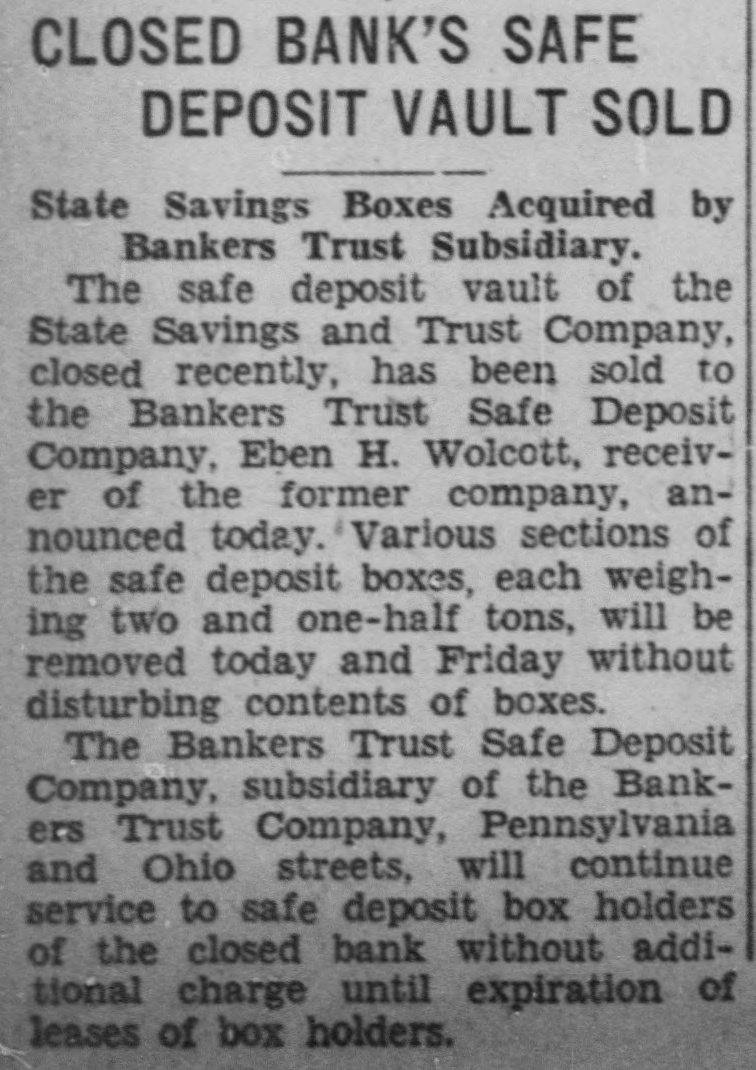
The safe deposit vault of the State Savings and Trust Company, closed recently, has been sold to the Bankers Trust Safe Deposit Company, Eben H. Wolcott, receiver of the former company, announced today.
Source
newspapers
4. June 3, 1930 Other
Newspaper Excerpt
First court action by the receiver of the defunct State Savings and Trust Company to foreclose on debtors was started today, with filing of a suit against Fred Cline ... for a $40,000 judgment.
Source
newspapers

Newspaper Articles (21)

Article from The Indianapolis Times, April 26, 1930

Click image to open full size in new tab

Article Text

STATE SAVINGS BANK CLOSES; TO LIQUIDATE 8,000 Depositors Affected as Doors Shut on City Institution. Doors of the State Savings and Trust Company, 123 East Market street, were closed today on order of the board of directors, as state banking department officials started liquidation of the company's assets. Decision to close the doors of the institution was reached Friday afternoon, affecting 8,000 depositors, according to Scott R. Brewer, president. Brewer, although making no definite comment on the possibility of full payment of claims, said with proper management payment might be made in full. Police Assigned to Bank "The reason for closing, in the mind of the board, was the matter of liquidity rather than solvency, especially as this was affected by shrinkage of deposits," Brewer stated. Police were asigned to the bank this morning as a protective measure. Thomas D. Barr, assistant state banking commissioner, said the inventory of assets and liabilities was started today. This will be followed by court action for the appointment of a receiver next week. Resolution Is Adopted Directors adopted a resolution stating that inability to market real estate holdings, depreciation of farm values and shrinkage of deposits made it expedient to go into voluntary liquidation in order "to save its depositors and stockholders from loss." When the closing order came, the financial situation was: Deposits, $1,410,000; capital stock, $375,000; surplus and reserves, $48,500, Brewer said. Samuel P. Good, state bank examiner, assisted by K. G. Inwood and J. W. Parrett, examiners, is working on the bank's books. The company moved into the Market street location several months ago, taking over the property formerly occupied by the J. F. Wild & Co. State bank, which crashed three years ago.


Article from The Indianapolis Times, April 28, 1930

Click image to open full size in new tab

Article Text

SEEK RECEIVER FOR STATE SAVINGS BANK Petition Is Filed in Circuit Court by Indiana Commissioner. Petition for a receiver for the State Savings and Trust Company was filed today in Marion circuit court by Luther F. Symons, state banking commissioner, through Attorney-General James M. Ogden. The bank was closed Saturday on order of the board of directors, and Scott R. Brewer, president, issued a statement saying closing was a matter of liquidity rather than solvency. Eight thousand depositors were affected by the move. Assets of the bank are listed at $1,400,000 in deposits and $400,000 in other properties. Hearing for appointment of the receiver will be held by Judge Harry O. Chamberlin Saturday.


Article from The Indianapolis Star, April 29, 1930

Click image to open full size in new tab

Article Text

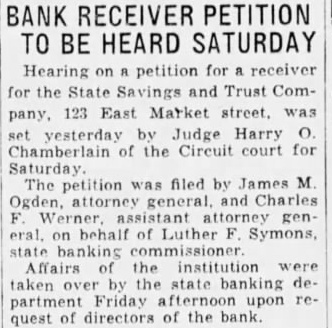
BANK RECEIVER PETITION TO BE HEARD SATURDAY Hearing on petition for receiver for the State Savings and Trust Company, 123 East Market street, was set yesterday by Judge Harry O Chamberlain of the Circuit court for Saturday The petition was filed by James M Ogden, attorney general, and Charles eral. on behalf of Luther F. Symons, state banking commissioner Affairs of the institution were taken by the state banking department Friday afternoon upon request of directors of the bank.


Article from The Indianapolis Times, May 15, 1930

Click image to open full size in new tab

Article Text

CLOSED BANK'S SAFE DEPOSIT VAULT SOLD State Savings Boxes Acquired by Bankers Trust Subsidiary. The safe deposit vault of the State Savings and Trust Company, closed recently, has been sold to the Bankers Trust Safe Deposit Company, Eben H. Wolcott, receiver of the former company, announced today. Various sections of the safe deposit boxes, each weighing two and one-half tons, will be removed today and Friday without disturbing contents of boxes. The Bankers Trust Safe Deposit Company, subsidiary of the Bankers Trust Company, Pennsylvania and Ohio streets, will continue service to safe deposit box holders of the closed bank without additional charge until expiration of leases of box holders.


Article from The Indianapolis Times, June 3, 1930

Click image to open full size in new tab

Article Text

NEW YORK COFFEE RANGE Close. Low. High 7.36 March 7.32 7.31 7.20 7.18 7.20 May 7.95 7.90 7.97 July 7.70 7.64 September 7.70 December 7.42 7.50 7.45 START RECOVERY IN STATE BANK CRASH Receiver Files Suit Against Realtor for $40,000 on Note. First court action by the receiver of the defunct State Savings and Trust Company to foreclose on debtors was started today, with filing of a suti against Fred Cline, Indianapolis realtor, for a $40,000 judgment. Filed before Superior Judge Linn D. Hay, the suit, brought by Eben H. Wolcott, receiver, seeks payment of a past due promissory note for $25,000 given to the bank by Cline in 1923. Interest amounting to $12,500, and $2,500 attorneys fees are sought. The note is past ddue since Dec. 1924, according to the complaint.


Article from The Indianapolis Times, June 3, 1930

Click image to open full size in new tab

Article Text

START RECOVERY IN STATE BANK CRASH Receiver Files Suit Against Realtor for $40,000 on Note. First court action by the receiver of the defunct State Savings and Trust Company to foreclose on debtors was started today, filing of suti against Fred Cline, Indianapolis realtor. for $40,000 judgment. Filed before Judge Linn Hay, suit, by Eben seeks payment of past due promissory for $25,000 given to the bank by Cline in 1923. Interest amounting to $12,500, and $2,500 attorneys fees are sought. The note is past ddue since Dec. 1924, according to the complaint.


Article from The Indianapolis Star, June 4, 1930

Click image to open full size in new tab

Article Text

RECEIVER FOR DEFUNCT BANK FILES FIRST SUIT Suit demanding judgment of $40,000 against Fred Cline, Indianapolis real estate dealer, was filed yesterday by Eben H. Wolcott, receiver for the State Savings and Trust Company, in Superior court, The action contends that Cline borrowed $25,000 from the bank on promissory note in December, 1923, payable one year later. The note has not been paid, according to the suit. The action was the first brought by the bank receiver against debtors.


Article from The Indianapolis Times, June 7, 1930

Click image to open full size in new tab

Article Text

WILD BUILDING PURCHASED BY FLETCHER FIRM Realty Changes Hands for Price of $450,000; to Be Remodeled. Plans for remodeling the J. F. Wild & Co. State Bank building, 129 East Market street, were under way today by the officials of the Fletcher American Company, purchasers. The structure was bought for $450,000 by George C. Forrey Jr., president of the Fletcher organization, from Edgar M. Blessing, J. F. Wild Realty Company receiver. The sale was made on direction of Judge Harry O. Chamberlin, circuit court, to wind up the receivership case of the realty company. To Pay $57,000 in Cash Receivership of the bank realty company went into circuit court simultaneously with the receivership of the bank, handled by Probate Judge Mahlon E. Bash. The Fletcher company will pay $57,000 in cash for the property and will organize the 129 East Market Building Corporation, which will issue $393,000 in preferred stock. This stock will be accepted by holders of preferred stock in the Wild Realty Company. The Fletcher American Company will hold the common stock. New securities probably will be issued shortly after July 1, almost three years after the Wild failure. Lease Is Scheduled The holding company will lease the building to a firm not yet announced. Officials of the Fletcher company said the company may extend its banking quarters into the Wild structure. Through the transaction, holders of stock in the Wild Realty Company will be given stock in the new company, obtaining $60 a share for their old holdings. In addition, there is a prospect of further liquidation of the holdings of the defunct realty company which may net preferred shareholders $15 a share additional. Plans for remodeling and improving the building are under way. Bowman Elder will be named building manager and will have charge of the improvement program, which, Fletcher company officials said, will bring the structure up to date. Much to Be Spent "Stockholders of the old realty company will find negotiations very profitable," one official said. "There has been no disagreement over the plan for them to accept the new stock in the new holding company. "Much money will be spent on the structure, and it is assured practically that a twenty-year lease will be made that will pay worthwhile dividends." This is the third transaction in as many years, that has involved the bank property. Following its failure, the receivership resulted in action in four courts, including criminal moves against officers of the bank, which later were dismissed. The State Savings and Trust Company took over the property last year, but its doors were closed several weeks ago. Eben H. Wolcott, former state bank examiner, is receiver for the company. The Wild building was valued at $881,000 on the Wild bank's books but appraisal of the property after receivership brought it down to $371,000.


Article from Muncie Evening Press, October 28, 1930

Click image to open full size in new tab

Article Text

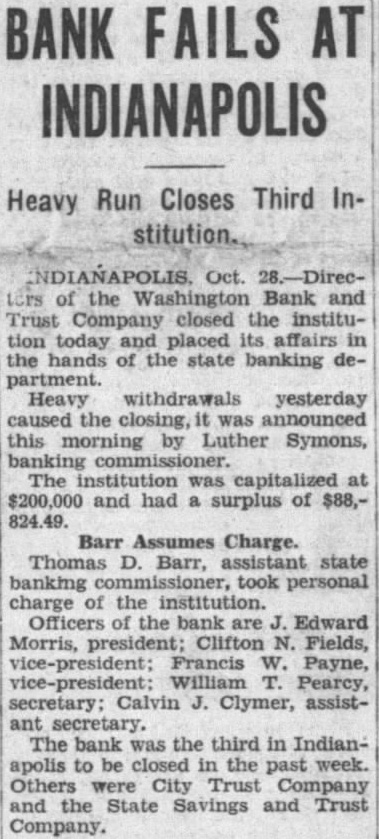
BANK FAILS INDIANAPOLIS Heavy Run Closes Third Oct. of the Washington Bank and Trust Company closed the institution today and placed its affairs the hands of the state banking partment. Heavy withdrawals yesterday caused the closing, was announced this morning by Luther Symons, banking The institution was capitalized and had surplus of Barr Assumes Charge. Thomas Barr, assistant state banking took personal charge of the institution. of the bank are Edward Morris, president; Clifton Fields, Francis Payne, Pearcy, secretary; Calvin Clymer, assistsecretary. The bank was the third in Indianapolis to be closed in the past week. Others City Trust Company and the State Savings and Trust Company.


Article from Franklin Democrat, October 30, 1930

Click image to open full size in new tab

Article Text

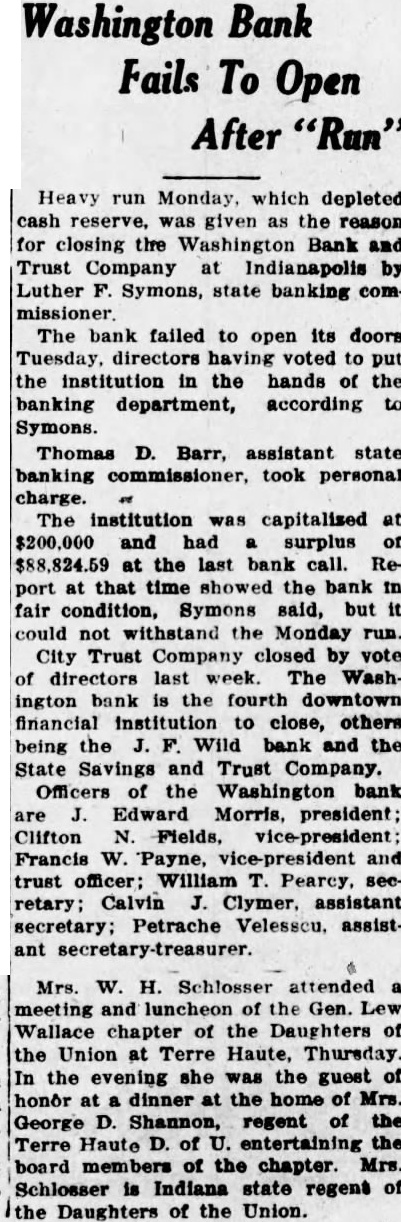
Washington Fails To "Run" Heavy run Monday, which depleted cash was given as the reason for closing the Washington Bank and Trust Company at Indianapolis by Luther Symons, state banking commissioner. The bank failed to open its doors Tuesday, directors having voted to put the institution in the hands of the banking department, according to Symons. Thomas D. Barr, assistant state banking commissioner, took personal charge. The institution was capitalised at $200,000 and had surplus $88,824.59 at the last bank call. Report at that time showed the bank in fair condition, Symons said, but could not withstand the Monday run. City Trust Company closed by vote of directors last week. The Washington bank is the fourth downtown financial institution to close, others being the Wild bank and the State Savings and Trust Company. Officers the Washington bank Edward Morris, president: Clifton Fields, Francis W. Payne, and trust officer; William Pearcy, secretary; Calvin assistant secretary; Petrache assist- Mrs. W. H. Schlosser attended meeting and luncheon of the Gen. Lew Wallace chapter of the Daughters of the Union at Terre Haute, Thursday. In the evening she was the guest of honor at dinner the home of Mrs. George Shannon, regent of the Terre Haute D. of U. entertaining the board members of the chapter. Mrs. Schlosser is Indiana state regent of Daughters of the Union.


Article from The Indianapolis Times, December 18, 1931

Click image to open full size in new tab

Article Text

TRUSTEE NAMED FOR LEVY ON BANK STOCK State Savings and Trust Depositors Slated for 5 Per cent Dividend. Samuel E. Garrison Thursday was named trustee to collect funds from stockholders of the defunct State Savings & Trust Company, in an attempt to pay a 5 per cent dividend to depositors, by Superior Judge Clarence R. Williams. Approximately $375,000, of which $20,000 has been collected, is to be obtained as receivership funds. Under the state law stockholders are liable to twice the amount of stock held in the defunct bank. Appointment of Garrison as trustee followed filing of a suit by depositors. Scott Brewer and Robert G. le Ayare included among the holders of large blocks of stock in the defunct institution.


Article from The Indianapolis Times, March 2, 1933

Click image to open full size in new tab

Article Text

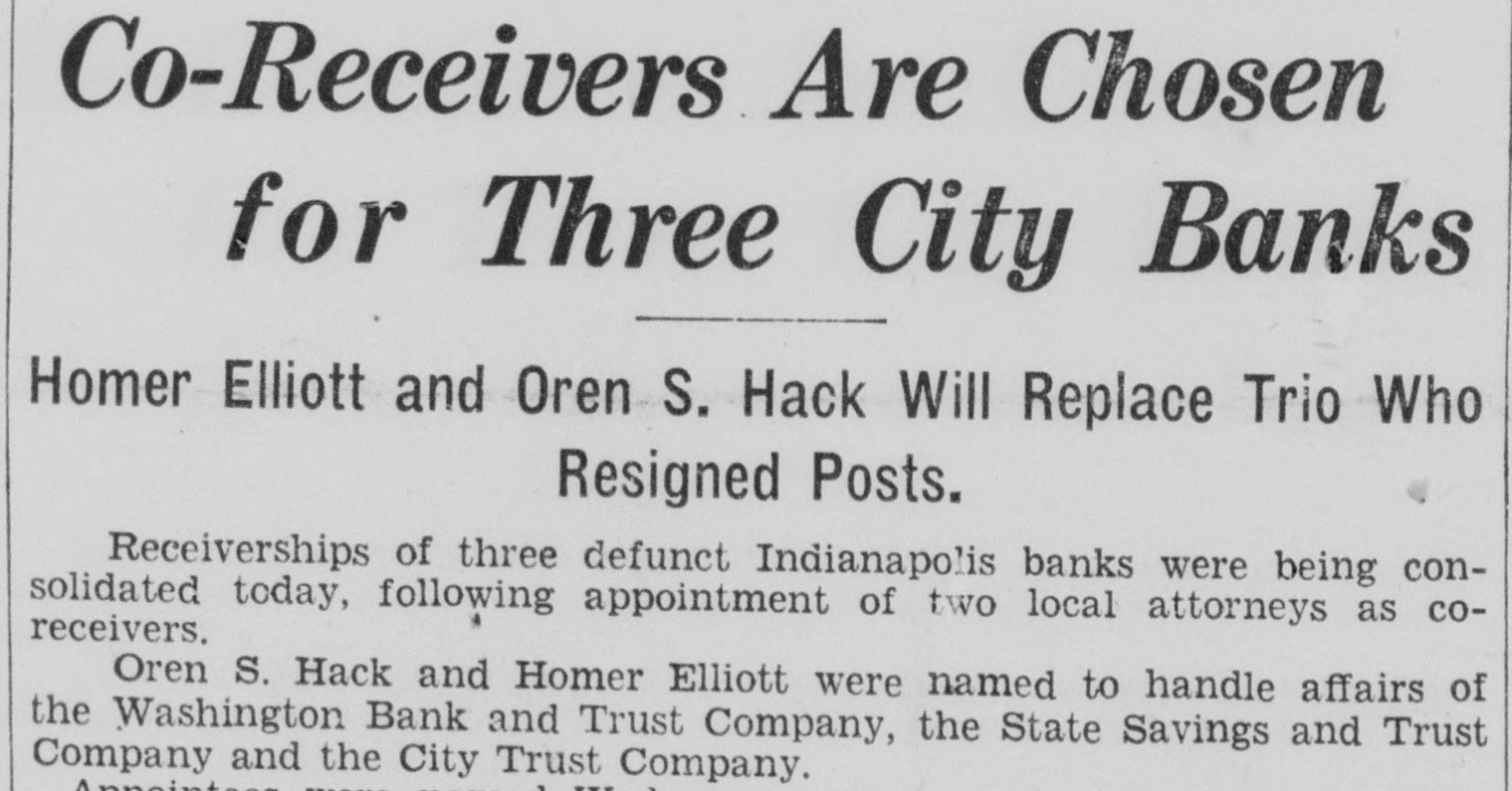
Co-Receivers Are Chosen for Three City Banks Homer Elliott and Oren S. Hack Will Replace Trio Who Resigned Posts. Receiverships of three defunct Indianapolis banks were being consolidated receivers. today, following appointment of two local attorneys as coOren S. Hack and Homer Elliott were named to handle affairs of the Washington Bank and Trust Company, the State Savings and Trust Company and the City Trust Company. A


Article from The Indianapolis Times, April 22, 1933

Click image to open full size in new tab

Article Text

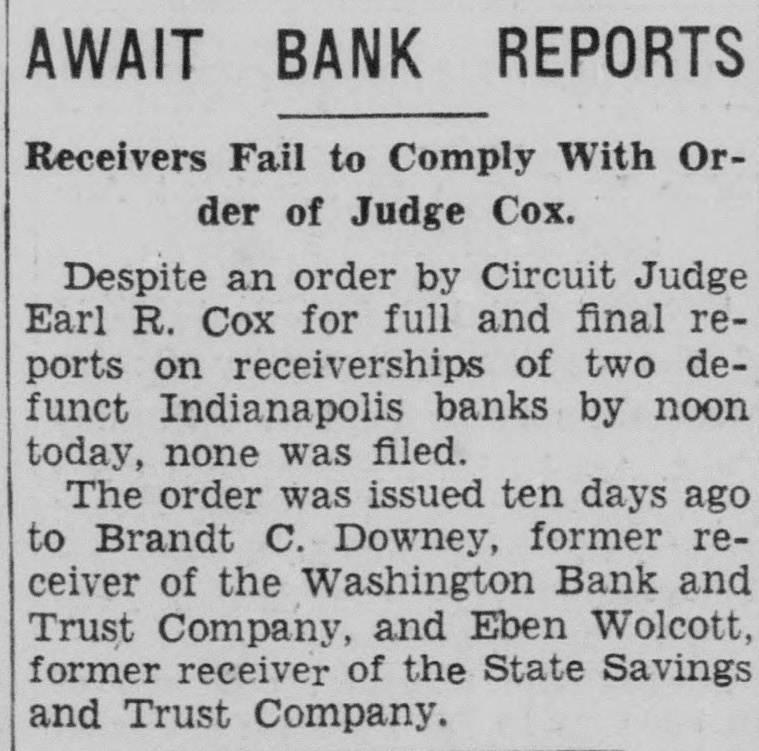
AWAIT BANK REPORTS Receivers Fail to Comply With Order of Judge Cox. Despite an order by Circuit Judge Earl R. Cox for full and final reports on receiverships of two defunct Indianapolis banks by noon today, none was filed. The order was issued ten days ago to Brandt C. Downey, former receiver of the Washington Bank and Trust Company, and Eben Wolcott, former receiver of the State Savings and Trust Company.


Article from The Indianapolis Times, May 22, 1933

Click image to open full size in new tab

Article Text

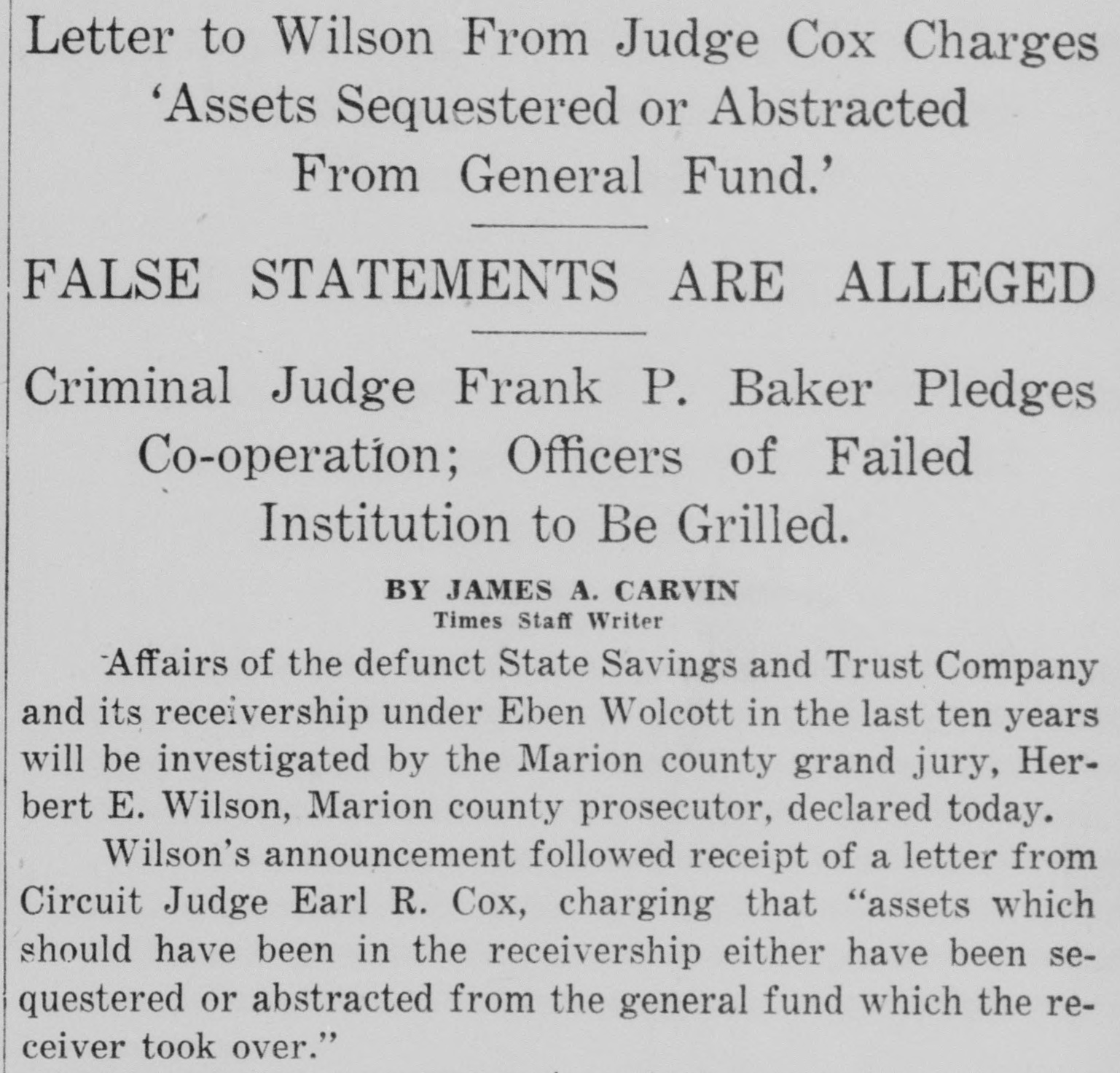
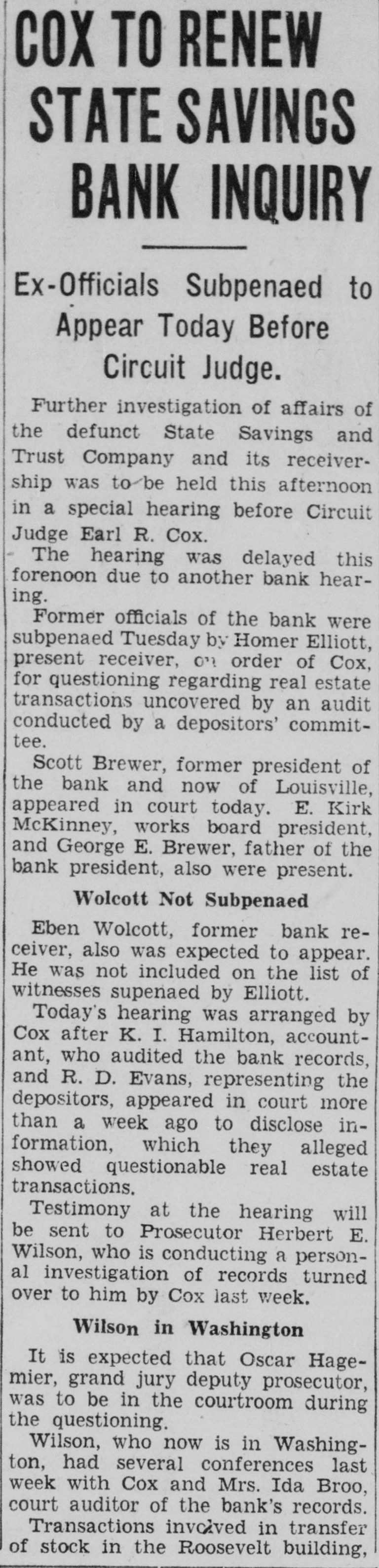
COURTS WILL ACT IN CLOSED BANK INQUIRY Officials of Two Defunct Institutions Will Be Called to Account. WILSON PROBES CASES Prosecutor Says Evidence Will Be Laid Before Grand Jury. After more than two years' delay, criminal as well as civil law will demand an accounting from officials of defunct local banks, it appeared today. At least two transactions of the State Savings and Trust Company will be given to the grand jury, Prosecutor Herbert E. Wilson announced. Charges of "criminal and dishonest acts" against former officials also will be investigated by the grand jury at the direction of Wilson, provided "newspaper accounts are true," Wilson said. "My only knowledge of the acts is through reading the newspapers," Wilson said. "As soon as I have had opportunity today to examine the records, I will take whatever action is warranted. If newspaper accounts are true, the grand jury will investigate." Cox Assures Action Circuit Judge Earl R. Cox, who precipitated the sensational disclosures of recent weeks, announced that civil action would be taken to recover from bonding companies At the time of the closing of the Washington bank. officials and employes were covered by a $100,000 bond, evidence in circuit court disclosed Friday. Suit will be started immediately by Samuel Miller, attorney for Oren S. Hack, present receiver. Charges that depositors in the bank lost more than $1,750,000 through acts of the officers were brought to light Friday, when Hack petitioned for instructions regarding suit on the bond. No Action Taken It was revealed that two years ago, an audit showed the loss, but that no action was taken by Brandt C. Downey, -former receiver. Downey testified that he left action to Earl R. Conder, his attorney, but that Conder preferred to obtain a deed to the home of J. Edward Morris, former bank president, in restitution. Temporarily crowded from the spotlight by developments in the other two banks, affairs of the remaining institutions in the group of four major closed banks also will be considered this week. Charges of depositors that Curtis Rottger, former receiver of the City Trust Company, "dissipated" more than $125,000 of trust funds will be aired in circuit court. Meyer-Kiser Case Up Hearing also will be conducted on a petition of former liquidating agents of the Meyer-Kiser bank to obtain records and other documents of bank departments. J. J. Kiser and Melville S. Cohn, two of the former bank officials who were in charge of the liquidation until recently, have petitioned for the records to act as registration and fiscal agents for securities handled by the bank. The attempted action is opposed by Thomas E. Garvin, receiver, and William J. Fahey, attorney. Garvin's oppostion to the move centers on the contention that handling of registration and other service by a private business will remove profitable business from the receivership. Belmont Depositors Active Fahey's petition in the interests of Mrs. Margaret Caito, 221 East Henry street, holder of approximately $36,000 of bonds issued by the bank, represents an attempt to secure information regarding the securities. Emphatically voicing a determination "not to sit by while we lose our money," 191 depositors, with $68,000 in the closed Belmont State bank, laid plans Saturday for an aggressive organization and protection of their claims. At a meeting held in the Belmont theater, a depositors' committee was elected and empowered to act by employing an attorney, and an accountant if necessary. Members of the committee are A. E. Moore, Harry Markun, Dr. William L. Jennings, C. A. Klingensmith and Walter Gingery, principal of Washington high school. Numerous speeches by depositors exhibted varying attitudes regarding closing of the bank and appointment of Frank B. Ross as reciver. Practically every speaker referred to his understanding that the Belmont bank was "affiliated" with the (Turn to Page Two)
Article from The Indianapolis Times, May 24, 1933

Click image to open full size in new tab

Article Text

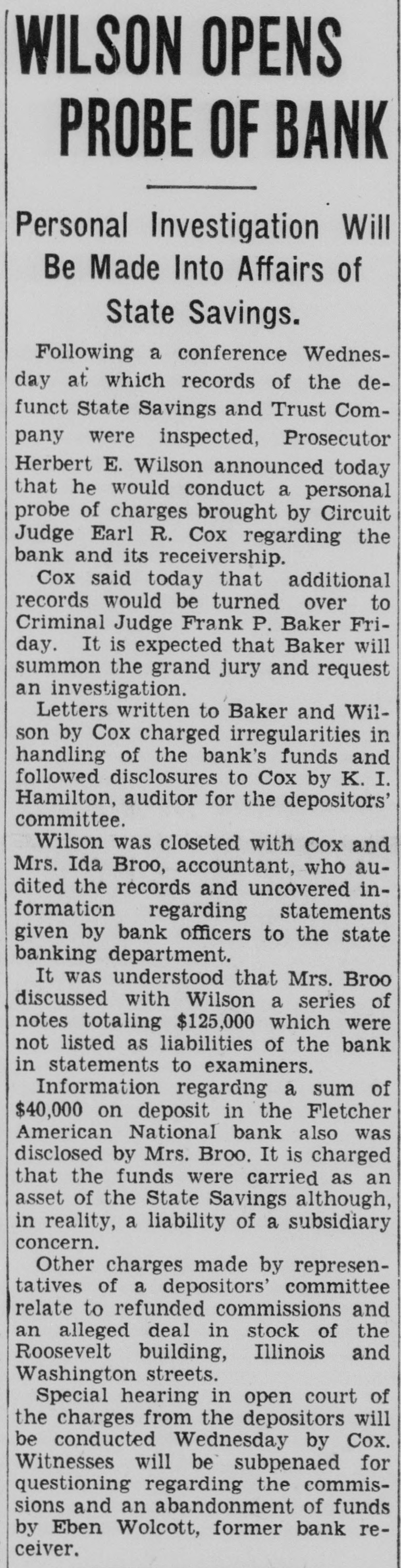
# JURY PROBE OF # STATE SAVINGS # BANK STARTED Acts of Closed Organization Chiefs Are Put Under Scrutiny. Grand jury investigation of affairs of the defunct State Savings and Trust Company began today with two acts by former officers under scrutiny. Two witnesses, Homer Elliott, receiver of the bank, and Miss Catherine Holland, his employe, were subpenaed for the grand jury hearing. A $40,000 deposit at the Fletcher American National bank carried as an asset of the State Savings and Trust, and called statements to the state banking department will be investigated by the grand jury, Prosecutor Herbert E Wilson said after a conference with Oscar Hagemier, grand jury deputy. Wilson said that, apparently, the $40,000 was carried as a bank as-


Article Text

The report explains charges included in the affidavits and outlines an appraisal of assets of the bank, just completed by Albert E. Uhl, John Roberts and Russell W. Lookabill, Indianapolis, and Harold Phipps and John Fox, Gary. Shrinkage of $2,357,521.97 in the assets of the bank is disclosed by the appraisal, it is alleged. It is pointed out that assets of the bank, carried at a book value of $3,004,003.82 by officers of the bank, have been appraised at only $646,511.85, leaving depositors small hope of salvaging a dividend. It is charged in the embezzlement affidavit prepared that bank officials took $18,000 of the bank's funds to pay dividends of a defunct subsidiary. Another of the affidavits sets out that the bank was insolvent since 1928, with knowledge of the defendants. The action in preparing affidavits is believed to have been based on the fact that the Marion county grand jury failed to return indictments when evidence in the Washington bank and the State Savings and Trust Company was submitted. Missouri Prisons Called "Barbaric" By United Press ST. LOUIS, Feb. 20. β€” Circuit Judge Max G. Baron, after a tour of inspection of the state's penal institutions, today criticized the prisons as "barbaric," with few exceptions.


Article Text

FOUR OFFICERS OF INDIANAPOLIS BANK INDICTED Affidavits Charging Criminal Actions Signed by Bank Receiver INDIANAPOLIS, Feb. 20. (P) Affidavits charging four officials of the defunct Meyer-Kiser bank with criminal actions were presented today to Prosecuting Attorney Herbert E. Wilson by Alvah J. Rucker, special investigator for the circuit court. The affidavits were signed by Thomas Garvin, receiver for the closed bank. The officials named were the president, Sol Meyer, and three vice presidents, Julian J. Kiser, Melvin Cohen and Fred S. Meyer. The affidavits were first placed before Judge P. Baker of the criminal court. Wilson, notified that the affivavits had been prepared, said: "It has not been the spirit of our lawmakers to have the prosecutor file affidavits when the grand jury is in session. The matter is of such grave importance I think it should go before the grand jury. Rucker reported to Circuit Judge Earl R. Cox earlier in the day that he had found ample evidence in the records the bank for prosecution of the officials on felony charges. Rucker at the direction of Judge Cox has been making an investigation of the affairs of several closed banks here including the City Trust, the Washington Bank and Trust and the State Savings and Trust. In his report to Judge Cox Rucker advanced the theory that the active officers of the Meyer-Kiser bank knew of its insolvency before the institution was closed and despite this knowledge continued to accept deposits.


Article from The Indianapolis Times, February 24, 1934

Click image to open full size in new tab

Article Text

MEYER-KISER BANK CASE IS BEFORE JURY Affidavits Turned Over to Talesmen by Prosecutor Herbert Wilson. SIGNED BY RECEIVER Accusations Loosely Drawn, Is Official's Charge to Probers. Talesmen of the Marion county grand jury today were considering the Meyer-Kiser bank case, referred to them yesterday by Herbert E. Wilson, Marion county prosecutor. In laying the bank case before the grand jury, Mr. Wilson stated that charges made against four officials of the defunct bank were of "such great importane" as to warrant such action. Affidavits were signed Tuesday by Thmoas E. Garvin, receiver for the bank, against Sol Meyer, Ferd S. Meyer, Julian J. Kiser and Melville S. Cohn, the four former officials of the bank, charging them with embezzlement of bank funds, conspiracy to accept deposits in an insolvent institution, and accepting deposits in an insolvent institution. Turned Over to Wilson Previous to the signing of the affidavits, Alvah J. Rucker, a special investigator named by Judge Earl R. Cox in circuit court. to investigate the circumstances surrounding defunct Indianapolis banks, read a forty-page typewritten report outlining the bank's alleged condition. Judge Cox instructed that the affidavits be delivered to Mr. Garvin and then sent to Judge Frank P. Baker of criminal court for approval. Judge Baker pointed out that all affidavits must be signed by the prosecutor and the documents were finally turned over to Mr. Wilson. Mr. Wilson charged that the affidavits as drawn by Mr. Rucker were subject to a motion to quash. He charged that they were not properly drawn. Mattice Is Named Floyd J. Mattice, chief deputy prosecutor was named yesterday by Mr. Wilson as special grand jury deputy prosecutor to conduct the investigation. Mr. Rucker and his aids have completed a five months' investigation of the closed bank. A former grand jury heard events incident to the closing of the Washington Bank and Trust Company and the State Savings and Trust Company, but refused to return true bills against any person or persons connected with either bank. The grand jury report also set out that the evidence obtained by Judge Cox and his court attaches was not sufficient to hold any particular individual criminally liable for affairs of the bank.


Article from The Indianapolis Times, February 24, 1934

Click image to open full size in new tab

Article Text

MEYER-KISER BANK CASE IS BEFORE JURY Affidavits Turned Over to Talesmen by Prosecutor Herbert Wilson. Talesmen of the Marion county grand jury today were considering the Meyer-Kiser bank case, referred to them yesterday by Herbert E. Wilson, Marion county prosecutor. In laying the bank case before the grand jury, Mr. Wilson stated that charges made against four officials of the defunct bank were of "such great importane" as to warrant such action. Affidavits were signed Tuesday by Thmoas E. Garvin, receiver for the bank, against Sol Meyer, Ferd S. Meyer, Julian J. Kiser and Melville S. Cohn, the four former officials of the bank, charging them with embezzlement of bank funds, conspiracy to accept deposits in an insolvent institution, and accepting deposits in an insolvent institution. Turned Over to Wilson Previous to the signing of the affidavits, Alvah J. Rucker, a special investigator named by Judge Earl R. Cox in circuit court. to investigate the circumstances surrounding defunct Indianapolis banks, read a forty-page typewritten report outlining the bank's alleged condition. Judge Cox instructed that the affidavits be delivered to Mr. Garvin and then sent to Judge Frank P. Baker of criminal court for approval. Judge Baker pointed out that all affidavits must be signed by the prosecutor and the documents were finally turned over to Mr. Wilson. Mr. Wilson charged that the affidavits as drawn by Mr. Rucker were subject to a motion to quash. He charged that they were not properly drawn. Mattice Is Named Floyd J. Mattice, chief deputy prosecutor was named yesterday by Mr. Wilson as special grand jury deputy prosecutor to conduct the investigation. Mr. Rucker and his aids have completed a five months' investigation of the closed bank. A former grand jury heard events incident to the closing of the Washington Bank and Trust Company and the State Savings and Trust Company, but refused to return true bills against any person or persons connected with either bank. The grand jury report also set out that the evidence obtained by Judge Cox and his court attaches was not sufficient to hold any particular individual criminally liable for affairs of the bank.


Article from The Indianapolis Times, June 15, 1934

Click image to open full size in new tab

Article Text

COX ASKS REPORTS ON DEFUNCT BANKS Probability of Dividends Is Sought. Letters asking receivers of four Indianapolis banks in receivership to inform the court as to the probability of early dividends for depositors were sent yesterday by Circuit Judge Earl R. Cox. Judge Cox asserted that bank depositors are entitled to know whether they are going to receive any dividends soon. Banks in receivership in circuit court are the Washington Bank and Trust Company, City Trust Company, State Savings and Trust Company and the Meyer-Kiser bank.


Article Text

JUDGE ATTACKED BY GRAND JURY Members of Jury Claim They Are Discharged as Smoke Screen to Protect Certain Persons. Indianapolis, Ind., March 27. (AP)β€”Members of a criminal court grand jury discharged by Judge Frank P. Baker today described their dismissal as a "smoke screen" laid down to protect certain persons facing indictment. From Judge Baker, however, came a statement in which he declared the jurors were discharged for ignoring his instructions to devote their time exclusively to an investigation of the affairs of several closed banks. Prosecuting Attorney Herbert M. Spencer stepped into the controversy by filing two affidavits against Scott R. Brewer, former president of the State Savings and Trust Co., one of the banks whose affairs were under investigation. Brewer is now a patient in the Walter Reid hospital at Washington. One affidavit charges Brewer with perjury in connection with a sworn statement made as to the bank's assets and liabilities on March 27, 1930. The other accused him of accepting a deposit while knowing the bank to be insolvent. No decision has yet been reached as to what steps shall be taken to arrest Brewer in view of his illness. His bond was fixed at $10,000. The prosecuting attorney said other affidavits may be filed within a few days in connection with the closing of some other banks. Sherman Roberts, foreman of the grand jury discharged by Judge Baker, charged the grand jury had been hampered in its inquiry.