City Trust Company (Indianapolis, IN)

Episode Information

Episode UID
20007571570
Episode Type
Suspension β†’ Closure
Bank Type
trust
Bank ID
2000757 routing
Routing Number
20-0075
Start Date
October 23, 1930
Location
Indianapolis, Indiana (39.768, -86.158)

Metadata

Model
gemini-3-flash-preview (chosen from majority vote of a three-model LLM ensemble)
Short Digest
2afff326fe07ca40

Response Measures

None

Description

The bank closed voluntarily on Oct 23, 1930, followed by receivership; while other local banks experienced runs that week, the City Trust closure is described as voluntary or by state order due to frozen assets and insolvency.

Events (3)

1. October 23, 1930 Suspension
Cause
Bank Specific Adverse Info
Cause Details
Frozen assets and insolvency; later investigations revealed embezzlement and unsecured loans to related enterprises.
Newspaper Excerpt
The City Trust company... closed by the state banking department here this afternoon.
Source
newspapers
2. November 17, 1930 Receivership
Newspaper Excerpt
appointment of Curtis H. Rottger, chairman of the board of the Indiana Bell Telephone Company, as receiver.
Source
newspapers
3. June 29, 1934 Other
Newspaper Excerpt
Depositors and creditors of the defunct City Trust Company will receive a 5 per cent dividend this fall
Source
newspapers

Newspaper Articles (24)

Article from The Times, October 23, 1930

Click image to open full size in new tab

Article Text

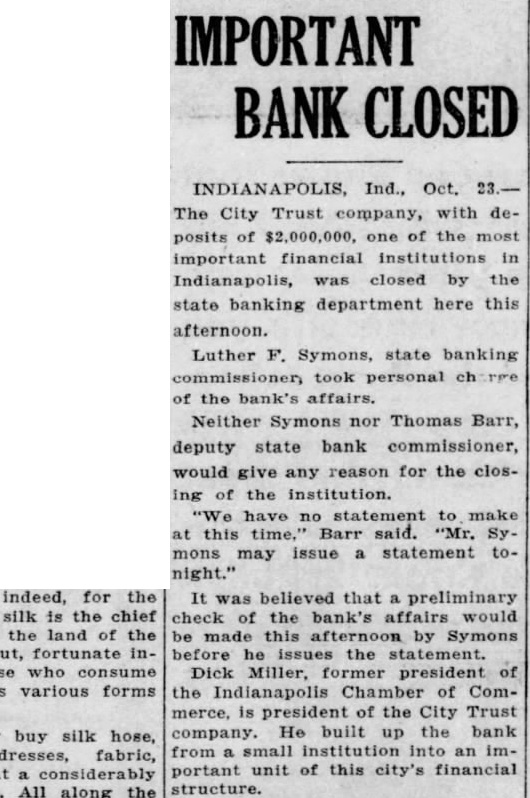
IMPORTANT BANK CLOSED INDIANAPOLIS, Ind., Oct. The City Trust company, with deposits of one of the most important financial institutions in Indianapolis, closed by the state banking department here this afternoon. Luther F. Symons, state banking took personal of the Neither Symons Thomas Barr, deputy state bank commissioner, would reason for the closof the institution. make Barr mons may issue statement night." was believed that preliminary check of the bank's would by before he the Dick Miller, former president of the Indianapolis Chamber Commerce, president of the City Trust company. He built the bank from small institution important unit of this city's financial structure.


Article from The Times, October 23, 1930

Click image to open full size in new tab

Article Text

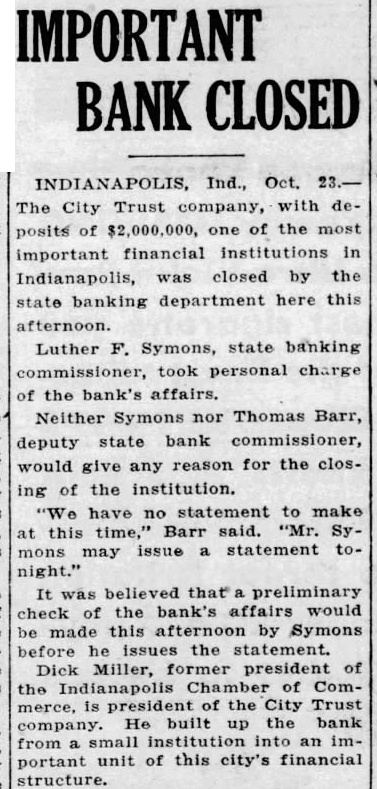
IMPORTANT BANK CLOSED INDIANAPOLIS, Ind., Oct. The City Trust company, with deposits of one of the important financial institutions in closed by the Indianapolis, banking department here this afternoon. Luther F. Symons, state banking commissioner, took charge of the bank's Neither Symons nor Thomas Barr, deputy state bank commissioner, would reason for the closing of the institution. "We no statement to make at this Barr said. Systatement night." It was believed preliminary check the bank's would afternoon by Symons before issues the statement. Dick Miller, president of the Comthe City Trust company. He built up the bank from institution an important unit of this city's financial structure.


Article from Muncie Evening Press, October 28, 1930

Click image to open full size in new tab

Article Text

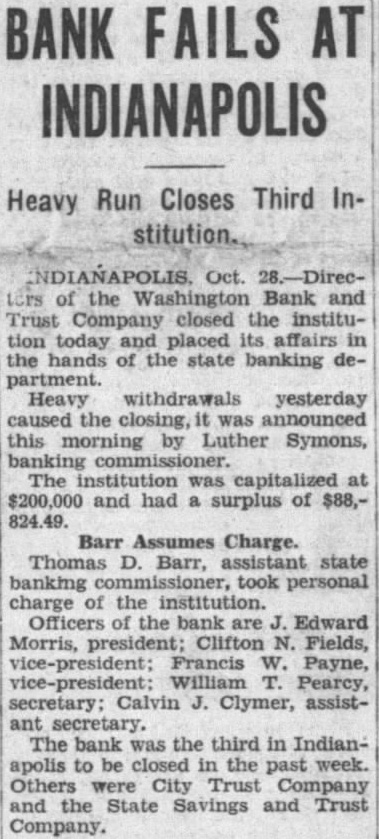
BANK FAILS INDIANAPOLIS Heavy Run Closes Third Oct. of the Washington Bank and Trust Company closed the institution today and placed its affairs the hands of the state banking partment. Heavy withdrawals yesterday caused the closing, was announced this morning by Luther Symons, banking The institution was capitalized and had surplus of Barr Assumes Charge. Thomas Barr, assistant state banking took personal charge of the institution. of the bank are Edward Morris, president; Clifton Fields, Francis Payne, Pearcy, secretary; Calvin Clymer, assistsecretary. The bank was the third in Indianapolis to be closed in the past week. Others City Trust Company and the State Savings and Trust Company.


Article from The Indianapolis Times, October 29, 1930

Click image to open full size in new tab

Article Text

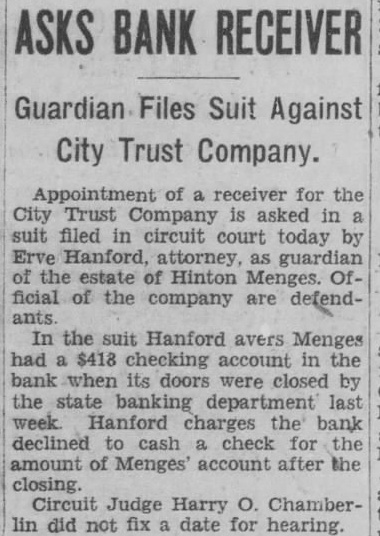
BANK RECEIVER Guardian Files Suit Against City Trust Company. Appointment receiver for the Trust Company filed circuit court today by Hanford, Hinton Menges. ficial of the company are defendthe Hanford avers Menges $418 checking account the bank when its were closed the state banking department week Hanford charges the declined cash check for amount of Menges' account after the closing. Judge Harry Chamberlin did not date hearing.


Article from Franklin Democrat, October 30, 1930

Click image to open full size in new tab

Article Text

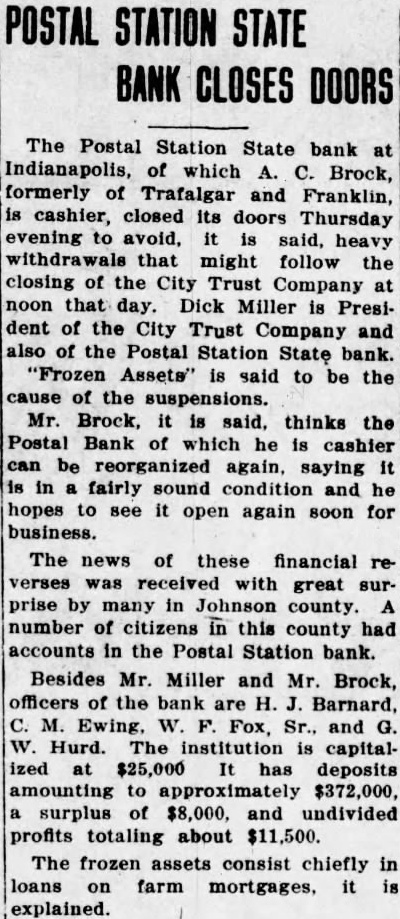
The Postal Station State bank Indianapolis, of which C. Brock, formerly of Trafalgar and Franklin, cashier, closed its doors Thursday evening to avoid, it said, heavy withdrawals that might follow the closing of the City Trust Company noon that day. Dick Miller is President of the City Trust Company and also of the Postal Station State bank. "Frozen Assets" is said to be the cause of the suspensions. Mr. Brock, it is said, thinks the Postal Bank of which he is cashier can be reorganized again, saying in fairly sound condition and he hopes to see it open again soon for business. The news of these financial verses was received with great prise by many in Johnson county. number of citizens in this county had accounts in the Postal Station bank. Besides Mr. Miller and Mr. Brock, officers of the bank are Barnard, M. Ewing, W. Fox, Sr., and Hurd. The institution capitalized at $25,000 has deposits amounting to approximately $372,000, surplus of $8,000. and undivided profits totaling about The frozen assets consist chiefly in loans on farm mortgages, it explained.


Article from The Indianapolis Times, November 6, 1930

Click image to open full size in new tab

Article Text

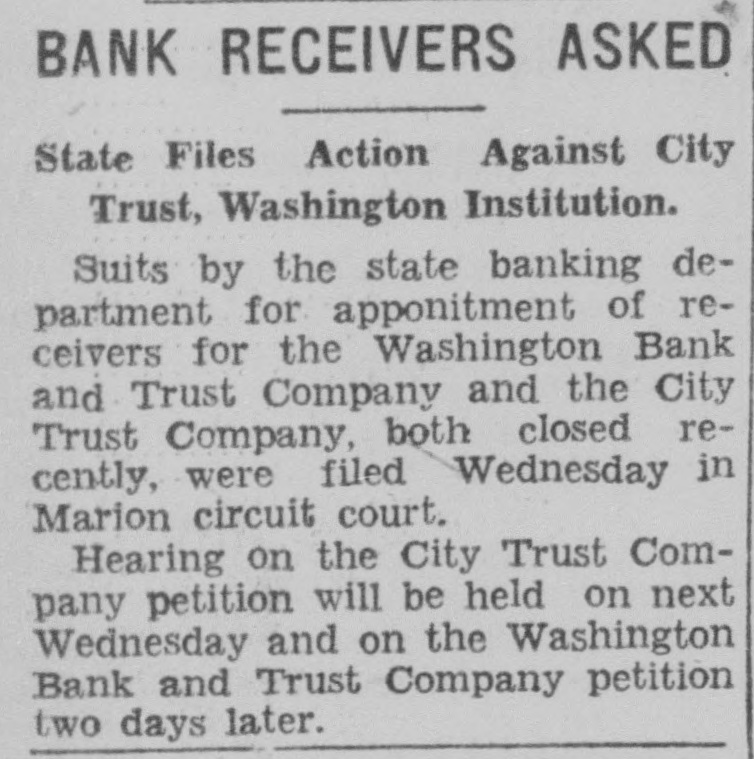
BANK RECEIVERS ASKED State Files Action Against City Trust, Washington Institution. Suits by the state banking department for apponitment of receivers for the Washington Bank and Trust Company and the City Trust Company, both closed recently, were filed Wednesday in Marion circuit court. Hearing on the City Trust Company petition will be held on next Wednesday and on the Washington Bank and Trust Company petition two days later.


Article from The Indianapolis Times, November 6, 1930

Click image to open full size in new tab

Article Text

State Files Action Against City Trust, Washington Institution. Suits by the state banking department for apponitment of receivers for the Washington Bank and Trust Company and the City Trust Company. both closed recently. were filed Wednesday in Marion circuit court. Hearing on the City Trust Company petition will be held on next Wednesday and on the Washington Bank and Trust Company petition two days later.


Article from The Richmond Item, November 8, 1930

Click image to open full size in new tab

Article Text

State Departments Disagree Upon Two Bank Receiverships INDIANAPOLIS, Nov. Receiverships for two Indianapolis banks which closed their doors withrecent weeks became the center disagreement between state departments today, when Attorney General James M. Ogden announced he preparing motions counterthose filed yesterday Luther Symons, state banking commissioner. Ogden already had filed receiverproceedings the Marion court Judge Harry Chamberlin. Ogden, virtue his office attorney for all state departments. yesterday, however, Symons filed circuit court asking Judge Chamberlin to dismiss Ogden's suits, Ogden today clared the action was without his Symons contended he did not such approval. mons followed by motions dismiss by filing in the probate court and superior court. Ogden, in announcing today that he would file motions strike out the dismiss in circuit court and to dismiss the to file in the probate court the City Trust company, he would carry the suits to the state supreme court necessary. He contended the probate court is the The other bank involved the Bank Trust which closed its doors last week.


Article from The Indianapolis Times, November 13, 1930

Click image to open full size in new tab

Article Text

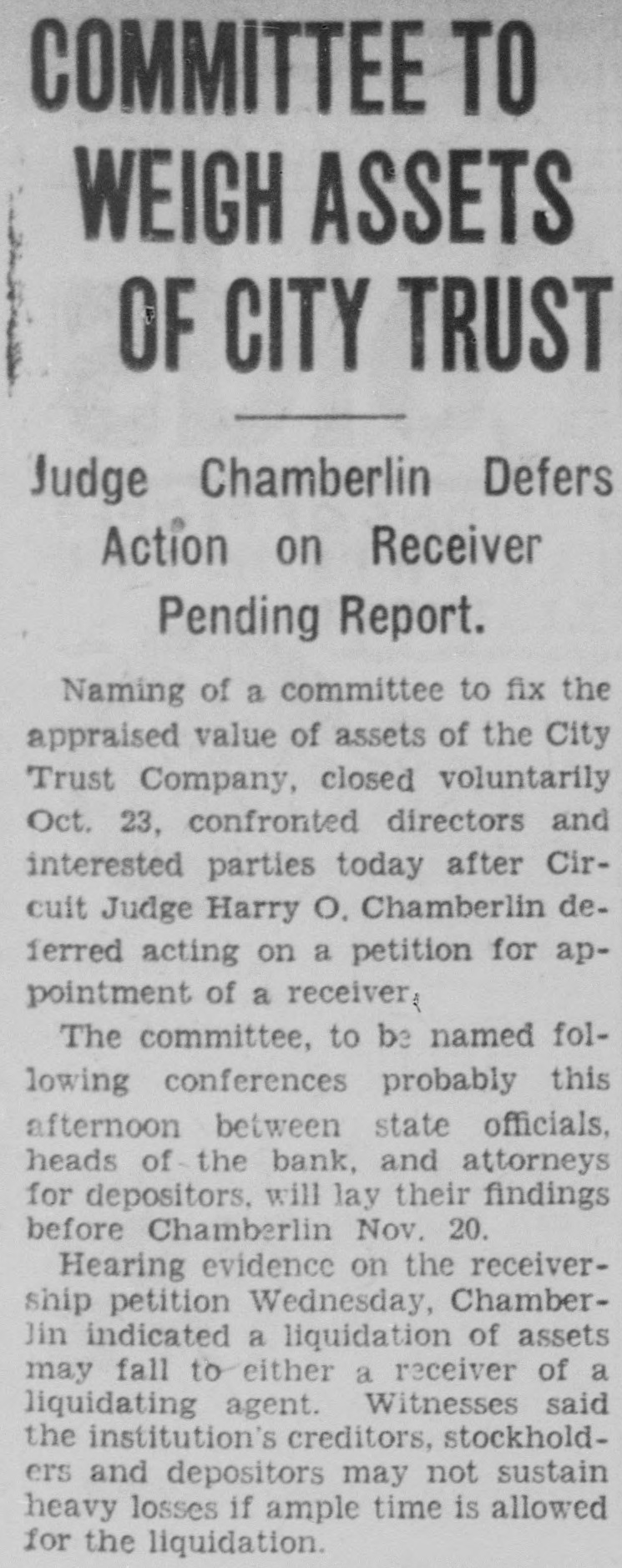
COMMITTEE TO WEIGH ASSETS OF CITY TRUST Judge Chamberlin Defers Action on Receiver Pending Report. Naming of a committee to fix the appraised value of assets of the City Trust Company, closed voluntarily Oct. 23, confronted directors and interested parties today after Circuit Judge Harry O. Chamberlin deferred acting on a petition for appointment of a receiver, The committee, to be named following conferences probably this afternoon between state officials, heads of the bank, and attorneys for depositors, will lay their findings before Chamberlin Nov. 20. Hearing evidence on the receivership petition Wednesday, ChamberJin indicated a liquidation of assets may fall to either a receiver of a liquidating agent. Witnesses said the institution's creditors, stockholders and depositors may not sustain heavy losses if ample time is allowed for the liquidation.


Article from The Indianapolis Times, November 18, 1930

Click image to open full size in new tab

Article Text

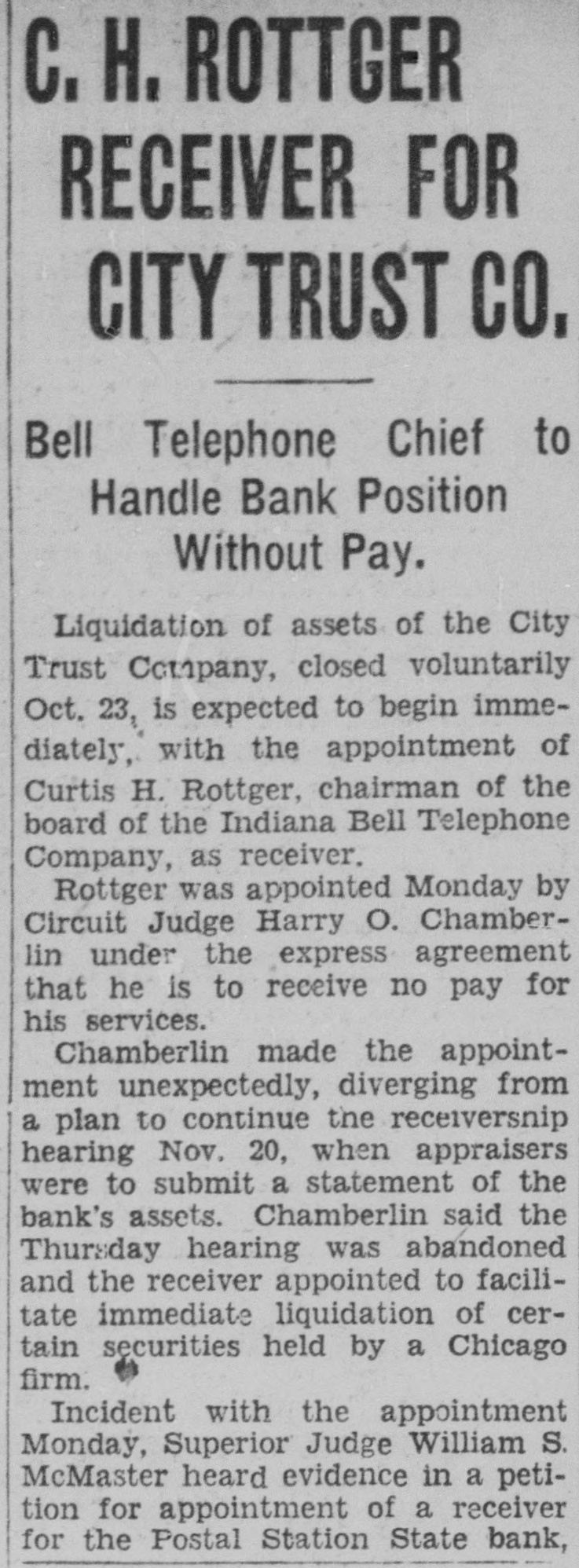
C. H. ROTTGER RECEIVER FOR CITY TRUST CO. Bell Telephone Chief to Handle Bank Position Without Pay. Liquidation of assets of the City Trust Cotipany, closed voluntarily Oct. 23, is expected to begin immediately, with the appointment of Curtis H. Rottger, chairman of the board of the Indiana Bell Telephone Company, as receiver. Rottger was appointed Monday by Circuit Judge Harry O. Chamberlin under the express agreement that he is to receive no pay for his services. Chamberlin made the appointment unexpectedly, diverging from a plan to continue the receiversnip hearing Nov. 20, when appraisers were to submit a statement of the bank's assets. Chamberlin said the Thursday hearing was abandoned and the receiver appointed to facilitate immediate liquidation of certain securities held by a Chicago firm. Incident with the appointment Monday, Superior Judge William S. McMaster heard evidence in a petition for appointment of a receiver for the Postal Station State bank,


Article from The Indianapolis Times, November 21, 1930

Click image to open full size in new tab

Article Text

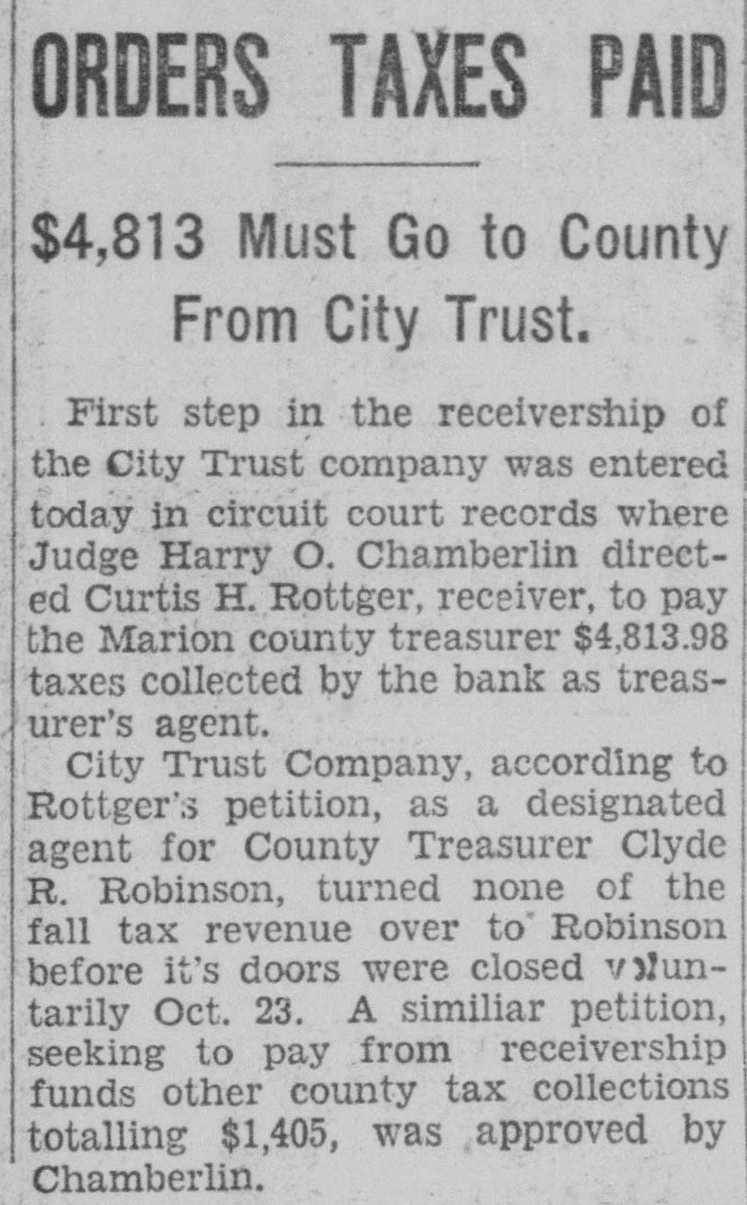
ORDERS TAXES PAID $4,813 Must Go to County From City Trust. First step in the receivership of the City Trust company was entered today in circuit court records where Judge Harry O. Chamberlin directed Curtis H. Rottger, receiver, to pay the Marion county treasurer $4,813.98 taxes collected by the bank as treasurer's agent. City Trust Company, according to Rottger's petition, as a designated agent for County Treasurer Clyde R. Robinson, turned none of the fall tax revenue over to Robinson before it's doors were closed v)Juntarily Oct. 23. A similiar petition, seeking to pay from receivership funds other county tax collections totalling $1,405, was approved by Chamberlin.


Article from The Indianapolis Times, November 22, 1930

Click image to open full size in new tab

Article Text

ORDERS TAXES PAID $4,813 Must Go to County From City Trust. First step in the receivership of the City Trust company was entered today in circuit court records where Judge Harry O. Chamberlin directed Curtis H. Rottger, receiver, to pay the Marion county treasurer $4,813.98 taxes collected by the bank as treasurer's agent. City Trust Company, according to Rottger's petition, as a designated agent for County Treasurer Clyde R. Robinson, turned none of the fall tax revenue over to Robinson before it's doors were closed voluntarily Oct. 23. A similiar petition, seeking to pay from receivership funds other county tax collections totalling $1,405, was approved by Chamberlin.


Article from The Indianapolis Times, March 6, 1931

Click image to open full size in new tab

Article Text

$300,000 IS SOUGHT IN CITY TRUST SUIT Injunction, Special Receiver Are Asked in Court Action. Collection of $300,000 from stockholders of the City Trust Company, now in receivership, is asked in a suit filed Thursday in superior court two. Appointment of a special receiver to administer this sum also is asked. Filed by Mrs. Ruby Lipscomb, and authorized by Superior Judge Joseph R. Williams on behalf of all depositors and creditors, the suit is based on a statute which provides that stockholders in a bank shall be individually responsible to an amount over and above the value of their respective shares of stock. The suit also asks an injunction to prevent individual creditors from bringing separate suits against individual stockholders.


Article Text

Closed Bank Head Admits Loaning Without Security Testimony that officials of the defunct City Trust Company, prior to its made huge loans to enterprise which they were interested, in hands of. Circuit Judge Earl R Cox today. Dick Miller. Trust president. chief witness Wednesday's probe of defunct banks. admitted the bank carried loan of $159,000 on its books The money was advanced to finance construction the Postal Station bank building in this city, according to testimony. Cox Miller concerning deals with D. Brown, postal station bank in promotion and sale of stock for erection the and in negopost in cities. The bank president's testimony ended a hearing in suit brought by Brown against Curtis H. ger, City Trust Company receiver Cox ordered attorneys to file briefs, he would fix date for final arguments in the case within few days. matter fact wasn't the holding the bag for 000 for which had no liability until settlement in April. 1927?" Cox asked Miller. 'Yes, that is right,' Miller replied.


Article from The Indianapolis Times, March 2, 1933

Click image to open full size in new tab

Article Text

Co-Receivers Are Chosen for Three City Banks Homer Elliott and Oren S. Hack Will Replace Trio Who Resigned Posts. Receiverships of three defunct Indianapolis banks were being consolidated receivers. today, following appointment of two local attorneys as coOren S. Hack and Homer Elliott were named to handle affairs of the Washington Bank and Trust Company, the State Savings and Trust Company and the City Trust Company. A


Article from The Indianapolis Times, June 15, 1934

Click image to open full size in new tab

Article Text

COX ASKS REPORTS ON DEFUNCT BANKS Probability of Dividends Is Sought. Letters asking receivers of four Indianapolis banks in receivership to inform the court as to the probability of early dividends for depositors were sent yesterday by Circuit Judge Earl R. Cox. Judge Cox asserted that bank depositors are entitled to know whether they are going to receive any dividends soon. Banks in receivership in circuit court are the Washington Bank and Trust Company, City Trust Company, State Savings and Trust Company and the Meyer-Kiser bank.


Article from The Indianapolis Times, June 29, 1934

Click image to open full size in new tab

Article Text

CITY TRUST TO ISSUE DIVIDEND OF 5 PER CENT Court Indicates Approval of Proposal Suggested by by Receiver. Depositors and creditors of the defunct City Trust Company will receive a 5 per cent dividend this fall, Oren S. Hack, receiver, announced today. Mr. Hack, in a report filed with Circuit Judge Earl R. Cox petitioned the court to allow the dividend. It will be the first paid by any of the major Indianapolis banks in receivership in circuit court. The receiver explained that because of court adjournment for the summer and becausce hearings must be held on preferred claims in circuit court in September, the dividend checks will not be issued until Nov. 15. General depositors and creditors will be paid the 5 per cent dividend,


Article Text

3 EX-BANKERS FACE ARREST Indianapolis Men Named as Embezzlers. By Associated Press. INDIANAPOLIS, April 13.β€”Affidavits were filed in criminal court here today against three former officials of closed banks in Indianapolis, nearly five years from the time the alleged offenses were committed. Those named in the affidavits are Sol S. Meyer, former president of the Meyer-Kiser Bank; Dick Miller, former president of the City Trust Company, and Mark V. Rinehart, former vice-president of the Washington Bank and Trust Company. Each is charged with embezzling deposits. The affidavits were signed by John Dugan, investigator for the office of Herbert M. Spencer, county prosecutor. The failure of these three banks brought losses to approximately 35,000 depositors whose deposits totaled approximately $12,000,000. Meyer, who is said to be in impaired health in Miami, Fla., is alleged to have knowingly and fraudulently received a deposit when he knew the bank to be insolvent. Similar charges are contained in the affidavits against Miller and Rinehart. One Under Sentence. Meyer already is under indictment for embezzlement in connection with the failure of his bank. He and Julian J. Kiser, Melville S. Cohn and Ferdinand S. Meyer, other officers, were charged in an indictment returned last summer with having illegally paid a $27.50 dividend to a stockholder in the Fralich Realty Company of Hammond, Ind., a subsidiary of the bank, when the company had not earned a dividend. Cohn was found guilty and the case is now pending on appeal to the Supreme Court. Trial of Kiser is set for May 6 in criminal court here. The other officers of the bank are at liberty under $15,000 bond each. Miller, who lives in Indianapolis, also is said to be in impaired health. Rinehart has been living in Louisville, Ky. He was vice-president of the Washington Bank and Trust Company until 1929, when he resigned to become president of another trust company. He retained his directorship in the former institution, however, until it suspended business October 27, 1930. The City Trust Company had failed four days previously and the Meyer-Kiser Bank failed five months later. Extradition papers for the return of Meyer and Rinehart will be prepared next week, the prosecutor said. Scott R. Brewer, former president of the State Savings and Trust Company here, was named in affidavits filed by the prosecutor's office last week on charges of embezzlement and perjury. Brewer is in ill health in a hospital at Washington, D. C.
Article Text

NAME RINEHART, MILLER, MEYER IN AFFIDAVITS Officials of Defunct City Banks Charged With Accepting Deposits Knowing Institutions Were Insolvent. BONDS ARE FIXED BY JUDGE BAKER Capias Warrants Are Issued for Arrest of Trio After Filing of Counts in Criminal Court. Dick Miller, president of the defunct City Trust Co.; Mark V. Rinehart, vice president and director of the wrecked Washington Bank and Trust Co., and Sol S. Meyer, president of the closed Meyer-Kiser bank, were charged today, by affidavit, with the embezzlement of deposits. The affidavits, presented in the Marion County Criminal Court by Prosecutor Herbert M. Spencer and signed by John F. Dugan, investigator for the prosecutor's office, culminated months of effort in probing closed banks in Indianapolis by grand juries and special investigators. Criminal Judge Frank P. Baker fixed bonds on the charges at $15,000 for Mr. Miller and Mr. Rinehart and $5000 for Mr. Meyer who is now out on a $15,000 bond in connection with a similar charge. Capias warrants were issued for the arrest of the three bankers. Extradition proceedings to bring Mr. Meyer back to this city from his home in Miami, Fla., and Mr. Rinehart from his residence in Louisville, Ky., will be started next week, Prosecutor Spencer said. Mr. Miller has been reported ill at his home, 3130 N. Delaware-st. The three affidavits are identical in that they charge each former bank officer with accepting deposits with the knowledge that each of the banks was insolvent on or about the date of the closing of the three institutions.


Article Text

THREE MORE CITY BANKERS ARE CHARGED WITH EMBEZZLEMENT Miller, Meyer and Rinehart Accepted Cash Deposits Knowing Institutions Were Solvent, Affidavits Allege. BONDS ARE FIXED BY JUDGE BAKER Capias Warrants Are Issued for Arrest of Trio After Filing of Counts in Criminal Court. Dick Miller, president of the defunct City Trust Co.; Mark V. Rinehart, vice president and director of the wrecked Washington Bank and Trust Co., and Sol S. Meyer, president of the closed Meyer-Kiser bank, were charged today, by affidavit, with the embezzlement of deposits. The affidavits, presented in the Marion County Criminal Court by Prosecutor Herbert M. Spencer and signed by John F. Dugan, investigator for the prosecutor's office, culminated months of effort in probing closed banks in Indianapolis by grand juries and special investigators.


Article Text

Affidavit, charging embezzlement of deposit, was filed today in Marion County Criminal Court against Dick Miller, president of the defunct City Trust Co. Mr. Miller was one of three former bankers against whom affidavits were sworn to today.


Article Text

Depositors Are Named The affidavit against Mr. Miller charges that on Oct. 22, 1930, the day before the City Trust Co. closed, that a deposit of $25 in money was accepted by the bank from Wilfred Bradshaw. Mr. Bradshaw now is judge of Municipal Court One. Mr. Rinehart is charged, through bank employes, with accepting a deposit from the Roberts Restaurant, Inc., of $312.63 in money on Oct. 27, 1930, the day the Washington Bank and Trust Co. closed its doors. Checks totaling $320.95 and $129.98 in money deposited by Lee F. Remmetter, druggist, of 4225 E. Washington-st, on May 11, 1931, in the Meyer-Kiser bank are the basis of the charges of accepting deposits "fraudulently" against Mr. Meyer. Witnesses on the affidavits in the three cases are: Miller affidavit, Municipal Judge Wilfred Bradshaw, George S. Olive, Howard W. Painter, R. W. Spiegel, Gavin Payne, Oren S. Hack, J. Harry Miles and Joseph V. Hurley; Rinehart affidavit, Henry A. Roberts, Charlton Carlton, and Oren S. Hack; Meyer affidavit, Karl I. Hamilton, Howard Painter, Ida S. Broo, Harold Phipps, John Fox, Russell Lookabill, Albert Uhl, John Roberts, Thomas E. Garvin, Richard A. McKinley.


Article from The Indianapolis Times, December 14, 1935

Click image to open full size in new tab

Article Text

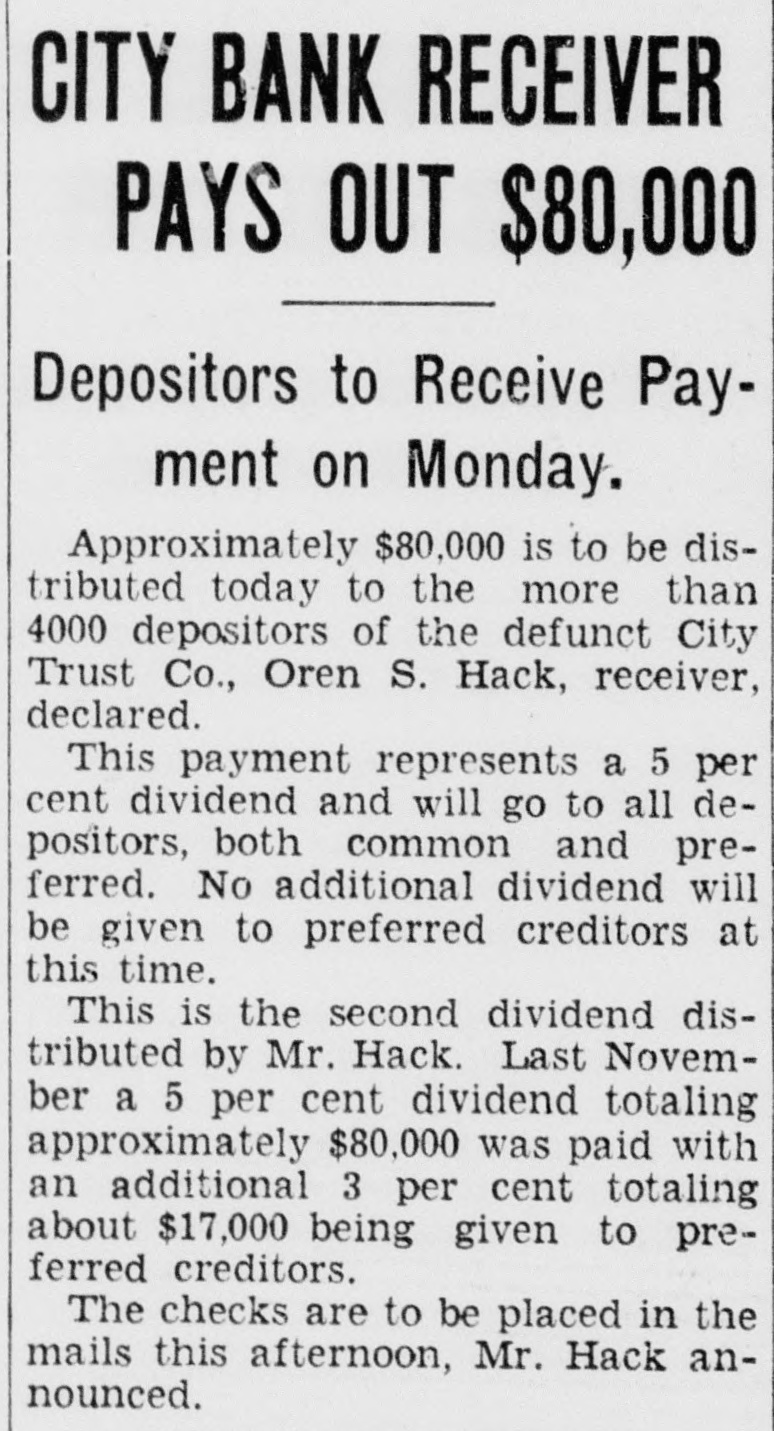
CITY BANK RECEIVER PAYS OUT $80,000 Depositors to Receive Payment on Monday. Approximately $80,000 is to be distributed today to the more than 4000 depositors of the defunct City Trust Co., Oren S. Hack, receiver, declared. This payment represents a 5 per cent dividend and will go to all depositors, both common and preferred. No additional dividend will be given to preferred creditors at this time. This is the second dividend distributed by Mr. Hack. Last November a 5 per cent dividend totaling approximately $80,000 was paid with an additional 3 per cent totaling about $17,000 being given to preferred creditors. The checks are to be placed in the mails this afternoon, Mr. Hack announced.


Article Text

All Seem To Have Turned Over Cash To Noteholders Before Closing. When J. W. Carpenter, receiver of the Citizens National, Howard National and Russiaville National banks, was shown a press dispatch from Indianapolis, stating that a superior court judge there had just held that where money had been left in banks to pay notes and the banks had closed before the noteholders had been paid, the note-makers and not the banks are liable for the payment, he said he knew of not a single case of the kind in any of the receiverships he is handling. This statement was made by Mr. Carpenter after he conferred with a member of his clerical staff who was in service during much of the receivership of Frank W. Bryant, who held the position nearly four years. This assistant said he had never heard of a case of the kind in connection with the administration of the affairs of any of the closed banks here, and felt reasonably confident there had been none. It would seem therefore that, despite the fact the press dispatch says the decision, should it be sustained on appeal, would affect millions of dollars in Indiana, no cases of the kind are likely to come to light here. In other words, it would seem that in instances in which money was left with local banks to be paid to noteholders, the latter, in all instances, received their money before the banks were closed. Text of Press Dispatch. The press dispatch received by the Tribune on the Indianapolis judge's decision is as follows: "Superior Judge Herbert E. Wilson in a decision today held that where banks closed their doors before paying noteholders money deposited for such notes, the original maker of the note and not the closed bank is liable for payment. "The decision, which affects millions of dollars in Indiana, is expected to be appealed to the state supreme court. "Judge Wilson said his ruling was contrary to decisions in Michigan, Florida and Kansas but supported by the Iowa supreme court. "The case concerns the Seymour National bank, administrator of the estate of James M. Shields, which brought suit against the Commercial Credit company. Shields had bought a note issued by the defendant company and backed by pledged paper held by the City Trust Company of Indianapolis as trustee. "When the note became due the finance company paid to the bank a sufficient sum to meet the payment, but before the note was presented for payment, the City Trust Company failed. "The ruling in the case was in behalf of the plaintiff."