Central Trust Company of Illinois (Chicago, IL)

Episode Information

Episode UID
2002871590
Episode Type
Run β†’ Suspension β†’ Closure
Bank Type
trust
Bank ID
200287 routing
Routing Number
2-0028
Start Date
June 25, 1932
Location
Chicago, Illinois (41.850, -87.650)

Metadata

Model
gemini-3-flash-preview (chosen from majority vote of a three-model LLM ensemble)
Short Digest
65c4aaeef4eb7f2b

Response Measures

None

Description

The bank is frequently referred to as the 'Dawes bank' or 'Central Republic Bank and Trust Co.' in the articles. It underwent a run in June 1932, was saved by an RFC loan, but eventually entered liquidation and was succeeded by the City National Bank.

Events (3)

1. June 25, 1932 Run
Cause
Local Banks
Cause Details
Runs and closings of several other Chicago banks during the week beginning June 19th created a local panic.
Measures
The bank secured a $90,000,000 loan from the Reconstruction Finance Corporation (RFC) and other Chicago/New York banks to meet depositor demands.
Newspaper Excerpt
There had been bad run on the bank that day. Without government assistance, the bank might open on Monday.
Source
newspapers
2. June 27, 1932 Other
Newspaper Excerpt
At 10 o'clock on Monday all these banks opened for business as usual. Public announcement was made that ample funds were on hand to pay every depositor. As had been anticipated immediately excitement and panic subsided and confidence was restored. The crowds melted away deposits began to return. The situation was saved, not only in this bank, but in the other banks which had been subject to heavy withdrawals. The loans offered by the co- operating banks and the Reconstruction Corporation were never fully called for and have since been largely repaid, and every danger in connection with that episode is now over. National Necessity. The central human figure of that bank was a man who had served his country for 40 years in many high capacities, who in recent years had been absent from the country in position of first importance to the American people That is the story of the Dawes Bank in Chicago You know the use our political opponents have made of this incident. They ignore the fact that Gen. Dawes resigned from the Reconstruction Corporation three weeks before on his first news that attacks were being made on the bank with which his name had long been associated. He resigned to try to save that bank without call on the Reconstruction Corporation of which he had been a director. He knew and appreciated the use that would be made in this campaign of such calumny. He sought
Source
newspapers
3. December 23, 1932 Receivership
Newspaper Excerpt
The bank process of liquidation: At time the RFC bailed out Dawes' bank, 32 other banks in Chicago were allowed collapse
Source
newspapers

Newspaper Articles (21)

Article Text

AIDS BANK Charles Chicago, Dawes Tuesday issued the following statement forth the cash position of the Central setting public Bank and Trust of which he is chairman: demands on the Central Republic Bank and Trust Co. during the past week made recourse to borrowing to meet them. These sary loans have been completed and placed the bank in an impregnable cash The loans tiated are for current requirements and depositors and are not for the purpose understood the bank received from the Reconstruction Finance Corporation, from which General recently resigned chairman; from Chicago banks. and from New York correspondent banks. That makes nice that Dawes can go to the people's cash fund, the R, and get the coin to protect his bank in serious or demands of depositors. reported that heavy run has been on the Dawes and Traylor banks in Chicago for several days which produced an This gives rise to the question could smaller banks of the country, and farmers get from the same quarter, the people's cash fund in such Echo answers, could they.


Article Text

Bank Credits Attack Called Just Politics (Continued From Page 1) ironic conception of the true conditions. During the week beginning June 19th there had been runs and closings of several Chicago banks. Runs on two of the biggest banks had taken out some sixty-five millions of deposit. The head of one of the banks, Melvin Traylor, stopped the run on his bank by a public address to the line of depositors. The advance to Dawes' bank was decided upon late Saturday night, June 26, upon the appeal of most of the great bankers and business men in Chicago, under conditions which make it safe to say this advance may have saved as many as five hundred banks, big and little, throughout the middle-west. Democratic business men joined in the midnight telephone appeal to Washington, and Democratic directors of the corporation united in the decision to make the advance. Attacks Merely 'Politics' The attacks on this loan and on the reconstruction finance corporation generally will be merely the politics of the campaign. The essential and solid fact is that three and a half billion dollars in all has been put to work of averting bankruptcies, preventing bank closings, and in general bringing about reconstruction. That suspicion of partisanship in the corporation's should be avoided is not unreasonable. President Hoover asked Congress to require that the directors be evenly distributed between the parties and has shown an intention to give the headship of it to a Democrat.


Article Text

RELIEF BILL APPEARS FODDER FOR POLITICS Sullivan Thinks Democrats Meant No Harm to It at Any Time. By Mark Sullivan. WASHINGTON. right) The politics in the closing actions of congress on the relief bill was chiefly aimed to achieve appearand placid judgment should be grateful there was not more. respects substance, the democrats had intention of making the bill other than reasonably fective under the conditions. The complete result is that the Reconstruction Finance corporation has three and half billion dollars. Three hundred million is to loaned to states for direct relief of billion and half for loans to provide employment on public, and private corporations for come yielding projects such as bridges, tunnels, waterworks and the like. Three hundred twenty-two million is for federal government public works familiar sort including road building. remainder for the genpurpose of the Finance corporation as originally defined, mainly to to banks, insurance companies and railroads upon whose solvency depends the investments savings banks and companies. The solid worth of all that cannot be and there was time when the democrats had any other intention than to promote it. The politics that was practiced had only the purpose of making public for the campaign. The aim is to make appear that the operations of the are conducted favor to republicans and with favor to what Speaker Garner calls the "classes" as against the "masses,' Everyone course, that the savings of banks, savings banks and insurance is really for the interest of depositors and policy holders. The corporation can only function practically by making loans carefully lected key points. It would be terly impossible to make perhaps ten million small loans to "any individual" who applies. Question Garner Stand. Probably Speaker Garner, in his insistence the final point in controversy, publicity for all advances the corporation, assumed that by President Hoover would resist and negative it. The president, ever, took the position that if the speaker insisted on this point, he and the democrats could take the responsibility. The president already taken firm stand against Garner on the points of making loans "any individual" and against Garner's project of building some 1,400 postoffices and other enterprises cost of some three billion There is reason to assume that Garner's stand for publicity taken by with one who apparently spoke for the democratic presidential candidate, Gov. ernor Roosevelt. There is some appearance also that different adviser of Roosevelt favored on publicity. The the Reconstruction Finance including the democrats, strongly appealed the publicity provision dropped. Their point was that many of the loans have been and will be made to banks in and that public of such relief is likely to increase rather than ease the troubles of bank. The democrats intend in the campaign to direct heavy fire already begun, against an advance of more than million dollars to Charles Dawes bank in Chicago. suppose that was merely favor Dawes or to any other individual would be tragic and ironic conception of the true conditions. During the week beginning June 19 there had been runs and closings of several Chicago banks. Runs on two of the biggest banks had taken out some 65 millions of deposits. The head of one of the banks, Melvin Traylor, stopped the on his bank by public address to the line of depositors. The Dawes Bank Loan. The advance to Dawes' bank was decided upon late Saturday night June 26, upon the appeal most of the great bankers and businessmen of Chicago, under conditions which make safe to say this advance may have saved as many as 500 banks, big and little, thruout the business joined in the midnight telephone appeal to Washington, and democrat directors of the corporation united in the decision to make the advance. The attacks on this loan and on the Reconstruction Finance ration generally will be merely the politics of the campaign. The essential and solid fact is that 31-2 billion in all has been put to work of averting bankruptcies, preventing bank closings, and in general bringing about reconstruction. That suspicion of partisanship the corporation's loans should be avoided is not unreasonable. President Hoover asked congress require that the directors be evenly distributed the parties and has shown an intention give the headship of it to democrat.


Article Text

Party Speakers May Cite Loan to Charles Dawes' Bank Exas ample of "Favoritism" By MARK SULLIVAN in the closing actions of Congress on the relief bill was chiefly aimed to achieve appearand placid judgment should be grateful there not respects substance, the Demohad intention the reasonably effective under the conditions. The complete result that the struction Finance Corporation has three and half billion dollars. hundred million to loaned states for direct relief billion and half for loans employment on public, and private corporations for incomeyielding projects such as tolltoll-tunnels, and the Three hundred and million for federal government public works the familiar including ing. remainder the general purpose the Reconstruction Finance Corporation originally defined mainly to loan banks, insurance companies and railroads upon whose solvency depends the investments of savings and insurance companies. The solid worth of all that be questioned, and there time the Democrats had intention than promote The politics that practiced had only the purpose of making public for the The make appear that the the conducted with favor to and with favor to Speaker Garner calls the "classes" as against the "masses. Every one knows, of course, the of banks, and insurance panies for the interest depositors and The corporation only function making loans fully selected key points. would utterly impossible to make perhaps million small loans Probably Speaker Garner. in his insistence final point publicity for all advances by the corporation, assumed President Hoover would resist negative The however, took the position that the speaker insisted this point. and could take the president had already taken successfully firm stand against Garner on points loans to "any individual" and against Garner's project of building some postoffices and other enterprises cost of some three billion dollars. There assume that Garner's stand for publicity was taken by agreement apparently spoke Democratic presidential candidate, Gov. Roosevelt There some appearalso subsequently ferent favored yielding on The directors the Finance Corporation, including the Democrats, strongly appealed have the publicity provision dropped. Their point that many the loans have been will be made banks in and that public such relief likely increase than the troubles of The Democrats intend the campaign direct heavy fire, ready begun, against advance more than eighty million dollars Charles bank Chicago. suppose that was merely to Dawes any other individual would tragic and the true conditions. During the week beginJune 19th there had been ning several Chiruns closings banks. two the banks had taken out biggest millions deposits. The head the banks, Melvin Tray. one the his bank stopped address the line public to Dawes' bank The advance decided Saturday night, upon June upon the appeal bankers business the great under conditions men in Chicago, safe this which make saved many hundred banks, big and five little, throughout the business men joined Democratic telephone appeal the and Democratic corporation united directors to make the the decision vance. The attacks this loan and Finance Corthe will be merely poration generally the politics of the campaign. solid that essential and half billion dollars three and work of been put preventing bank general bringing and about reconstruction That suspicion the corporation's loans should be avoided not unreasonable. President Hoover asked the directors eventually distributed between the parties has shown an intention the headship Democrat.


Article Text

is some appearance also that subseFOUGHT FOR quently a different adviser of Roosevelt favored yielding on publicity. The directors of the Reconstruction Fl. POLITICAL VIEWS nance corporation, Including the Democrats, strongly appealed to have Public Impression Sought By Enemies of Huge Relief Project By MARK SULLIVAN Copyright WASHIN GTON, July The polities in the closing actions of congress on the relief bill was chiefly aimed to achieve appearances, and a placid judgment should be grateful there was more. As respects substance, the Democrats had no intention of making the bill other than reasonably effective under the conditions. The complete result is that the Reconstruction Finance corporation has three and half billion dollars, Three hundred million is to be loaned to states for direct relief of A billion and half is for loans to provide employment on public, quasipublic, and private corporations for income-yielding projects such as toll bridges, toll tunnels, waterworks and the like. Three hundred and twenty. two million is for federal ernment public works of the familiar sort including road building. The remainder for the general purposes of the Reconstruction Finance as originally defined, mainly to loan to banks, insurance companies and railroads upon whose solvency depends the investments of savings banks and insurance companies. The solid worth of all that cannot be questioned. there never time when the Democrats had any other intention than to promote The politics that was practiced had only the purpose of making a public impression for the campaign. The aim is to make appear that the operations of the corporation are conducted with favor to Republicans and with favor to what Speaker Garner calls the "classes" as against the "masses." Everyone knows, of course, that the saving of banks, savings banks and Insurance companies really for the Interest of depositors and policy holders. The corporation can only function practicably by making loans at carefully selected key points. It would be utterly impossible make perhaps ten million small loans to "any individual' who applies. Garner's Publicity Stand Probably Speaker Garner, In his Insistence on the final point in controversy, publicity for all advances by the corporation, assumed that President Hoover would resist and negative it. The President, however, took the position that If the speaker insisted on this point, he and the Democrats could take the responsibility. The President had already taken firm stand against Garner on the points of making loans to "any individual' and against Garner's project of building some 1,400 post offices and other enterprises at a cost of some three bilThere is reason to assume that Garner's stand for publicity was taken by agreement with one who apparently spoke for the Democratic presidential candidate, Governor Roosevelt. There the publicity provision dropped. Their point was that many of the loans have been and will be made to banks in distress: and that public announcement of such relief is likely to increase rather than case the troubles of a bank. Traylor Halts Bank Run The Democrats Intend in the campaign to direct heavy fire already be. gun. against an advance of more than 80,000,000,000 dollars to Charles G. Dawes' bank In Chicago. To suppose that was merely a favor to Dawes or to any other would be tragic and ironic conception of the true conditions. During the week be. ginning June 19 there had been runs and closings of Chicago banks. Runs on two of the biggest banks had taken out some 65 millions of deposits. The head of one of the banks, Melvin Traylor, stopped the run on his bank by public address to the line of depositors. The advance to Dawes's bank was decided upon late Saturday night, June 25, upon the appeal of most of the great bankers and men in Chicago. under conditions which make it safe to say this advance may have saved as many as 500 banks, big and little, throughout the Middle West Democratic business men joined in midnight telephone appeal to Washington, and Democrati directors of the corporation united in the decision to make the advance. The attacks on this loan and on the Reconstruction Finance corporation generally will be merely the politics of the The and solid fact is that three and half billion dollars in all has been put to the work of averting bankruptcies, preventing bank closings, and in general bringing about That suspicion of partisanship in the corporation's loans should voided is not unreasonable. President Hoover asked congress to require that the directors be evenly distributed between the parties and has shown an Intention to give the headship of it to Democrat.


Article Text

HOOVER WILL BE BY MINNESOTANS HEARD (Continued from rage One) question can reach solution. Speaking of the Democrats, he said, they know that their own Democratic strongholds in the South no other will not accept the proposal for outright repeal of the eighteenth amendment with the consequent return of the saloon, and its resultant lack of protection to dry Tells of Loan to Dawes Bank As examples what he called 'the great constructive measures of the Mr. Hoover told for the first time his story of the loan by the Reconstruction Corporation to the Dawes bank of Chicago and his negotiation of the one year on war debts "The constant of this episode for political purposes by Democratic politicians is slander upon men of their own party well cruel injustice to General Dawes, the President said with reference to the Dawes bank loan Mr. Hoover told of the run on the Dawes bank and the quick investigation which he said showed its assound but not immediately saleable for cash The inquiry showed. he said that of the depositors were savings depositors and that their average savings were only cash Drawing picture of banking connections, the President said 755 country banks had commer-


Article Text

Home State Continued from Page One sign a beer bill should the short session of congress adopt one. As an interesting high light of the St. Louis speech, Mr. Hoover took the country "back stage" on two outstanding events of the depression which the Democrats have been attacking, but which the president described as "great dramas, great tragedies" β€” the $80,000,000 loan of the Reconstruction Finance Corporation to the Dawes bank of Chicago, and the arranging of the one-year German moratorium. The president told how three groups of financiers went into desperate conference over one week-end β€” one in Chicago, one in New York and one at the White House β€” to solve the problem of an impending run on the Dawes bank which would spread out and affect 775 country banks, whose ramification in all represented 20,000,000 depositors. He revealed how the R. F. C. examiners worked into the small hours of Monday morning, found the Dawes bank's securities sound, and rushed out the money that averted a major financial panic.


Article from Evening Star, November 5, 1932

Click image to open full size in new tab

Article Text

money to quiet unreasonable fear and give absolute assurance that funds were available to pay every depositor in full without question. Had Ample Security. In the course of inquiry into the condition of the bank it was found that they had ample securities. which in normal times could have paid out their depositors, leaving a large margin. But the securities could not be instantly sold at any price, or at least at a price which would produce sufficient to pay all depositors, and they could not collect instantly from the notes. In the inquiry into the condition of the bank it developed they had 122.900 depositors, of whom 105,000 were savings depositors; that the average of the savings deposits was only $140 each many of them working women and children that the safety of these depositors could not be separated from the other depositors of the bank. It was found that there were 17,000 commercial depositors, most of whom were men and women engaged in small businesses, whose deposits represented the money necessary to meet their pay rolls, the purchasing of their materials and the discharge of obligations to others incurred in the course of business. Jeopardy to them meant that many thousands of men and women in factories and stores would be discharged into untold hardships. But these were not all who were dependent upon the maintenance of this bank It was found that among the 17,000 commercial deposits 755 were country banks, the great majority of them in towns of less than 5.000 people. If this bank should fail, many of these country banks must fall In the complex system of our economic life things that on the surface seem unrelated are, in fact. under the A surface inextricably tied together farmer in a small town in an agricul tural State might feel no concern for the safety of this important bank in a great city The widow with a small deposit in a small bank of a town of another State might know of no relationship between her bank and the city bank But the farmer in one State and the widow in another. even though they did not know it. had a direct financial stake in the fate of this city bank. For the country banks must conduct business with the city banks in the ordinary conduct of trade. and must carry their reserves with the city banks in order that they may draw interest upon them. which they in turn pay to their depositors Now. it was found on examination that these 755 depositing banks had 6.500.000 depositors, scattered over 15 States. But that is not all There were 21.000 other banks scattered throughout the country which had deposits in the 755 banks depositing with this particular city bank and in these 21,000 banks were more than 20,000,000 depositors and they involved widows, orphans. workers, insurance companies, manufacturers and merchants. Men of High Esteem. And in addition to all this there was the position of the borrowers from all this mass of banks If the city bank should fail there must be immediate demand for the payment of the money due from its borrowers. If any of the banks dependent upon it should fail their borrowers in turn would be compelled to make immediate payment of money due and to realize upon their property at a time when property could not be turned into cash at anyt thing like its real value. In this city bank and in the 755 banks who carried their reserve deposits in this city bank there were 695,000 men and women and institutions owing money on their notes. They were scattered throughout the length and breadth of the land. They were on the farms. in the cities. the villages and hamlets Most of all these groups of people were unaware of their danger They were in their homes and in their churches, concerned with their own affairs-bu they were not being forgotten. The men who had conducted this bank over great numbers of years were men of high esteem in the whole community To their credit be it said that their chief concern was the preservation of these hundreds of thousands or millions of people from disaster. They were not asking aid for themselves The investigations and the conversations occupied many hours of continuous communication from these two cities to Washington and back again Remember, this was on Sunday when the normal processes of business were difficult to conduct Countless difficulties were encountered and solutions worked out. They were working against time. Finally at three hours after Sunday midnight the task was completed The assets had been valued by the examiners of the Reconstruction Corporation. The banks of the two cities joined in lending assistance and the Reconstruction Corporation agreed to furnish a sufficient sum to assure that this. bank could open without fear and meet every demand of its depositors. At 10 o'clock on Monday all these banks opened for business as usual Public announcement was made that ample funds were on hand to pay every depositor As had been anticipated immediately excitement and panic subsided and confidence was restored The crowds melted away deposits began to return. The situation was saved, not only in this bank, but in the other banks which had been subject to heavy withdrawals The loans offered by the co- operating banks and the Reconstruction Corporation were never fully called for and have since been largely repaid, and every danger in connection with that episode is now over. National Necessity. The central human figure of that bank was a man who had served his country for 40 years in many high capacities, who in recent years had been absent from the country in position of first importance to the American people That is the story of the Dawes Bank in Chicago You know the use our political opponents have made of this incident. They ignore the fact that Gen. Dawes resigned from the Reconstruction Corporation three weeks before on his first news that attacks were being made on the bank with which his name had long been associated. He resigned to try to save that bank without call on the Reconstruction Corporation of which he had been a director. He knew and appreciated the use that would be made in this campaign of such calumny. He sought


Article Text

Home State Continued from Page One sign a beer bill should the short session of congress adopt one. As an interesting high light of the St. Louis speech, Mr. Hoover took the country "back stage" on two outstanding events of the depression which the Democrats have been attacking, but which the president described as "great dramas, great tragedies" β€” the $80,000,000 loan of the Reconstruction Finance Corporation to the Dawes bank of Chicago, and the arranging of the one-year German moratorium. The president told how three groups of financiers went into desperate conference over one week-end β€” one in Chicago, one in New York and one at the White House β€” to solve the problem of an impending run on the Dawes bank which would spread out and affect 775 country banks, whose ramification in all represented 20,000,000 depositors. He revealed how the R. F. C. examiners worked into the small hours of Monday morning, found the Dawes bank's securities sound, and rushed out the money that averted a major financial panic.


Article Text

PRESIDENT HOOVER'S HOME IN CALIFORNIA cations the walls have not yet people have yet learn what proposes respect soldiers bonus. He seems think cash surplus of 000,000. that there surplus people promise start congress. the pork barrel and other people deserve to know why, Demohas passed than back Garner the Democratic house. Personal Banking Plan. he yet stated the governinto vided in the bill passed the congress under Garner's leaderto know his the rubber dollar vided legislation passed by people deserve to know what phrases and the Hawley Smoot protective mean. He 100 per cent support the competitive revenue. gives nebular implications Boston that he will protect certain of dif ferent schedules law debate merits, he be ciently which high once the mission as to the truth and can give quick remedy. that should do away with the tariff people deserve to know whether, reciprocal omit the agricultural commodities from deserve know mittee Oklahoma his thority their promise federal legislation which will pour liquidation Indian claims expense of federal taxpayer. Takes Fling At Hearst. The American whether draw the proposal vastly expand reclamaland thereby increase despite assurances surpluses people deserve whether support repudiWheeler, Long. Hearst and others long put government into large business deserve know details Shearon the be once given job by the the people to assume that he congress his supporter, people deserve know whether has accepted the posal his Hearst, for sue William his opposition the Does join Mr. Hearst his still the foreign debt permitting foreign nations country which owed our government. words, giving up our farmers, furnish our profits necessary make payments He emphatic the That the has the states of help to vide Position On Dry Law. The and charthe the cratic party evident their for the eighteenth than they know Demothe the posal for outright repeal the the sequent return and resultant lack of protection dry states, stated acceptance speech what only ground tection which whole question can reach solution. statement was the result intensive experience with delivered to probably the largest together United to you. matter public are false first place the United tSates secret; no place the interest identiwhich The Republican employer has the same publicly opinion employer and the Demosee tempts of the tonight to prewhole people of eration aster. These measures are now upon road and complicated. perhaps the only of them by Recites Dawes Bank Case. would like have picture sitting the room of the Federal one cities, room Federal some 200 from group seated of United States Both the groups included Federal Reserve banks, directors the the bankers embracing men political and all had on few meet gency by long distance During the preceding week there had upon banks cities. had pressure of On Saturday morning the situation become critical the extreme. financial districts thronged excited crowds frightened the lobbies the banks in the doors closed for the day crowds manding deposits. Throughout Saturday evening and Sunday increased and began spread like the district. banks heavy the positors the banks midst of crisis make quick sale of their securities without sacrifice to the positors, ment of and business Failure Threatened. found banks these had the others by depositors. Without bank would the following The failure this bank conthe threatened bring the other banks that spread involve many trust and insurcompanies. The was to before sufficient reasoning give absolute funds depositor in full without the of inquiry into the the found that had which, have leaving the could not instantly sold any price, would propay and could not collect instantly notes. In inquiry into the condition the depositors, of whom were savings depositors; that the the savings only them safety of be the other deposiof the was found there were 17.000 most whom were men gaged whose posits the their the chasing their the discharge obligations others curred the course business. Meant Great Hardships. Jeopardy meant that in factories stores would discharged into untold hardships. But these were all who this bank. the 17,000 depositors were country banks, the of them people. this should many of these country banks the complex system of life things the face der the surface inextricably tied farmer small town in for safety widow small deposit in bank another state might between her the city the farmer state and the though did not had direct financial this bank. banks must with the city banks the ordinary conduct trade and their city banks order upon which they pay to their deNow, found on examina755 banks 6,500,000 depositors scattered fifteen states. But There which had deposits banks this particular bank banks than depositors: involved widows, orphans, insurance manufacturers chants. "Not Forgotten." And addition all the banks. city bank must for the payment the money due from its borrow. any of dependent in would and to when could turned cash at anything like bank and in the who their posits bank, women instimoney on their They scattered throughout the length breadth the the farms, the cities, the Most these groups their danger. were their homes churches, their they were not beforgotten. had conducted this bank men said that their, concern the these dreds thousands millions people from They were for the conversations occupied many cities to Washington and again. Remember this was on Sunday, the difficult conduct. difficulties encounsolutions working against Secured Needed Cash. Finally, at three hours after Sunday pleted. assets been valued the examiners the Reconstruccorporation. The the two cities joined lending and the construction corporation agreed furnish sufficient assure that could open without and meet every demand of its At on Monday all these banks opened usual. Public that ample funds were on hand had been anticipated, immediately excitement panic The melted The saved, not bank but the which been subject to heavy withdrawals. loans offered by the co-operating the fully for been paid, connecepisode The central human figure that bank was served country forty many years been from the position the story of the Dawes bank Chicago. know use our political ophave this incident. ignore the fact that General from Reconstruction three weeks before, his first news attacks were the which name had long been asHe resigned try to that without of which he director. Says Democrats Insistent. He knew and appreciated the that made in of such calumny. He sought paign should know that, when Sunday GenDawes that could bring himself ask for assistance from the corporation which had so lately been director but upon insistence the the struction the meeting upon the insistence leading Democratic banker Chicago, was mentioned the United and upon the City Democratic banker mentioned for the presidency, insistence the other Democratic poration General effect upon my that was case of nationel and those there jointly offered the full responsibility for the These men acted not because Republicans, citizens United States. The situation demanded broad vision compreunderstanding of the probcouraction. Only by major disaster averted. may tell you only these adequately secured in ordinary business they are paid this episode political der upon men their party cruel injustice General Dawes. characteristic example the this campaign. insult this tion for the grave issues which lie before our country Six Similar Episodes. And tell that this great centers the United States, the direct result the shocks and fears which received foreign nations. But such by our governagencies has not limited of populations under the corintervene their banks under similar cirBeyond that they have made loans to 736 buildloan members, loans several hundred farm stock credit corall of for the purof preventing of dreds farms the their family The totals today aggregate millions men and women forgotten. remind you of thing these loans. The they should be loans been repaid. burden upon the But the jobs and women. into matter what the Reconstruction This example of the meanof my phrase about the government the full its credit great the of families. of both Reinterviewed the leaders publican them what display secured their oval sufficient assure complete the measure Other Nations Respond. then resolved upon course. within published proposal hours after communiother in cations that politicians might thwart through prodiplomacy. this for the time the history the world, made personal, hourly use. of the newly installed transatlantic and phone the presence of the leaders received wholehearted and immediate from Signor Mussolini, the same sympathetic response from the prime minthe government of Belgium which, might would from the than any other nation, instantly. The arrangements were not complicated nations and involved unsacrifices. Day after day. night after night, one another, methods difficulwhich arose, adjustfinally year of And was not merely postponement the ments debts which was seeking. seeking for year in which Europe situation into which she was driftseeking remove from the mind the world the fears bacle civilization which down credit bring their attention the healing power of international operation. New You yourselves are familiar* the history of the year which lowed. know that the proposal of the entire curof and changed tory of the ization brought new understanding the the burunder which Germany been Under the impulses of these agreethe peril out to the Gersecurthe world from the agreements at Lausanne. That agreement and the humane sympathies which the served greatly the healing of the wounds the great There lie events of the great dramas, great tragedies. have told of but two all these incidents, the the courage the willingness place their and their political future stake the No man can through these without there great the courage, for the guidance this back stability interthe development of human welfare. Challenge To Roosevelt. Democratic candidate for has, since the beginning the campaign, been going down criticising Reconstruction corporation maintaining its been the for the benefit of the ordinary citizen. Can he honestly believe that in the incident described in countless similar the action was taken for the benefit the and not for the deposhe then his spirit discontent political campaign the use erroneous information merits just of first to this citizen of his banks, who letter setting before the real facts and requesting Weeks and that request part the to episode protect the people, last fortress stability the world. the time assistance May year ago made journey from see me present me the desperthe German people. His under burden the war, that people Appeal From Germany. They had made courageous inexorably social desperation, those had fought comply upon them all heart for the coming the conclusion that taken place Russia, offered them the ambassador's ture of what was happening common and women that probnot from humanity that nation fall the the rest the and United States be irreparable. knowing character without lomatic history: appeal of great that should offices United States their order year which European nations, could come comprehension what doing to civilization proposed inone This easy to hates and still made its doubtful. make sure that would accepted in country,

Article Text

HoΓ³ver West On Final FROM turn the saloon, and its lack of protection to dry called constructive measof the Mr Hoover told for the first time his story of the loan by the tion corporation to the Dawes bank Chicago, and his of negotiation the moratorium on war constant misrepresentation this episode for political purposes democratic politicians slander upon men their party well oruel injustice to GenDawes," the president said with reference to the Dawes bank loan. Mr. Hoover told of the run on the Dayes bank and the quick investigation which, he said, showed its assets sound but not immediately saleable for cash.


Article Text

Discussing prohibition for the first time since his speech of acceptance, the President repeated that prohibition will be changed to eliminate "evils" and that states should be given control of the problem with protection from wet states and provisions against return of the saloon. Assails Democratic Stand. Speaking of the Democrats, he said: "They know that their own Democratic strongholds in the south, if no other, will not accept the proposal for outright repeal of the 18th amendment with the consequent return of the saloon, and its resultant lack of protection to dry states." As examples of what he called "the great constructive measures of the administration," Mr. Hoover told for the first time his story of the loan by the Reconstruction corporation to the Dawes bank of Chicago, and his negotiations of the one year moratorium on war debts. Mr. Hoover told of the run on the Dawes bank and the quick investigation which he said, showed its assets sound but not immediately saleable for cash.


Article Text

(Continued from Page 1.) with adequate protection on which this whole can reach solution." Tells of Dawes Loan. As examples what called "the great measures of the Mr. Hoover told for first his story of the by the corporation the Dawes bank of Chicago, and his negotiation one year moratorium on war debts. constant of this episode for political purposes democratic politicians slander upon men their own party as as cruel injustice General Dawes,' president said reference to the Dawes bank loan. Mr. Hoover told of the run on the Dawes bank the quick which, he said, showed assets not immediatesaleable for cash. Deposits The inquiry showed, he said, that


Article Text

They Were Not Forgotten has been no more dramatic feature of the or more impressive campaign than President Hoover's recital in his St. Louis speech of the ing, through the checking of the run on the Dawes bank in Chicago, of an untold number of people from disaster. It turned to his advantage the slogan of his gotten opponents by which they had sought to represent the President as concerned only for those "at the It was just one of many instances in which, even as his detractors were railing at him, he was devoting sleepless nights to preserving millions from ruin. Picture the situation one Sunday: In the preceding week panic had beaten against one of the great banks in the Middle West. In the city affected, in another city and in Washington, with President Hoover, groups of banking and business leaders were summoned to hurried conferences and the long distance telephone was kept busy. If they could not find a way to save the bank, which had been found sound in every way, embarrassed only by inability to realize on its assets immediately without sacrifice, it could not its doors on Monday. And if its open doors did not open, several hundreds of smaller banks that had deposits in would have been affected, their own positors put in jeopardy. Also picture many in that vast ritory, in their homes or churches, that Sunday, unaware of the that threatened the depositors alone, but countless others who would be thrown out of employment if a general crash were not averted. They were not forgotten. General Dawes revolted at the thought of asking a loan of the Reconstruction Finance Corporation, of which he had been director. He felt a that it not only would cause a cry against him, but that it would be used against the President in his campaign. Democratic business leaders joined with Republicans in telling him that all personal feelings must be subordinated to "National necessity. In the same spirit President Hoover ignored the possible effect upon his campaign. At 3 o'clock Monday morning the plans had been perfected and at 10 o'clock that same morning all the banks threatened opened as usual. The situation saved. In the main bank it was found that of 122,000 depositors 105,000 had savings accounts which averaged only $140 each. So also with many other banks. Those "little depositors" were not forgotten.


Article Text

LOAN TO DAWES CHICAGO BANK IS DEFAULT government holding of the which Finance Corporation Charley Dawes' Chicago bank back in June, 1932, two after resigned chairman the Tucked in RFC report figures showing that the loan the bank had matured Dec. 23, 1932, and had not renewed. The paid balance, considin "technical The bank process of liquidation: At time the RFC bailed out Dawes' bank, 32 other banks in Chicago were allowed collapse, though would have ed them. Rep. Sabath charged. Hoover said the loan to Dawes' bank averted bank panic, such later swept the country the closing month Hoover's administration.


Article Text

How former President Hoover saved the country from panic by helping the Dawes bank in Chicago and how the disobeyed his army quest that the bonus marchers in Washington be dispersed without force, among the revelations in the history of the Hoovregime written by his secretary, Theodore Joslin. The inside story of these crises told in Redbook magazine for October from Mr. Joslin's notes and unpublished documents: difficulties of the Chicago bank of which General was the head, and to which he had turned upon retiring from the RFC, became more serious in the summer of 1932. advices about the situation, which might start panic the generally weakened situation, reached white house on June Saturday when the president had sought respite at the There had been bad run camp. on the bank that day. Without ernment assistance, the bank might open on Monday. president, from the minute he notified, the telephone and stayed on the until Monday until the done. The Dawes bank had depositors. The savings deposit was only There were 17,000 commercial positors, most whom were gaged small business, whose deposits included the money meet purchase terials and discharge obligations curred in the course business. Jeopardy to these accounts meant that many thousands workers would be into the of unemployed. Among the deposits 755 banks. the Chicago banks should fall, then many these banks would close too. They had depositors scattered fifteen states. Several thousand other banks would close too. They had 6,500,000 depositors over fifteen states. Several thousand other banks scattered through the country had deposits in 755 banks depositing with the Chicago concerns. these banks were twenty million depositors who were unaware of their danger. investigations and conversations through which Hoover obtained the foregoing information necessitated continuous telephone communication from Chicago, to Washington, to the Rapidan and back again. all done after the close of business on Saturday. RFC appraised all the assets. Democratic as well as the republican directors unanimously recommended participation. The ation agreed furnish sufficient enable the bank to open without fear and meet every demand of its depositors. Other joined. 10 o'clock Monday the threatened banks opened. Public made that ample funds were on hand pay every depositor. panic subsided. Deposits


Article Text

Dawes' Loan Delayed Bank Holiday: Jones [Chicago Tribune Press Service.] Washington, D. C., March 28.β€”The 90 million dollars which the Reconstruction Finance corporation loaned the old Dawes bank in Chicago in 1932 staved off the national banking holiday for nine months, Jesse H. Jones, RFC chairman, said today in defense of the loan. Jones made his statement when the counter suit which three stockholders in the old Central Republic Bank and Trust company filed in Chicago yesterday was called to his attention. The suit charges officials of the bank and of the RFC with improperly transferring assets of the old bank to the new City National bank. The RFC is suing stockholders for $7,000,000 on double liability. "I assume some of the stockholders are fighting attempts to collect their double liability assessments," was the only comment Jones made directly on the suit, but he launched into a long defense of the loan. Afforded Chance to Prepare. "If the loan had not been made, we would have had the banking holiday in June, 1932, instead of March, 1933, and the country was then not ready for it," Jones declared, adding that the intervening nine months had given the country a chance to "prepare" for the banking holiday. The RFC may have to take a loss as a result of its action, Jones admitted, saying he "would not be surprised if there was some loss" on the 90 million dollar loan of which only about 24 1/2 million dollars in principal has been repaid to date. Jones' statement in defense of the loan recalled the charges that the RFC could have again staved off the banking collapse in March, 1933, by making a similar loan to the crucial Detroit banks had not Senator James Couzens [Rep., Mich.] blocked it by threatening to advertise it from the housetops. Says Utility Can Redeem Stock. Turning to the Public Utilities Securities corporation, a superholding company which the RFC now controls because its entire common stock was part of the collateral which the Dawes bank put up for the 90 million dollar loan, Jones said the RFC was in no hurry to complete foreclosure on this collateral.


Article Text

Naturally, Mr. Hoover stresses the same theme in different words. It would surprise nobody if he came out sometime with an "I-do-not-choose-to-run" declaration. That is part of the game, for in no other way can a smoky room nomination be presented as a call from the nation that no patriot can ignore. Incidentally, Mr. Hoover did some marvelous acrobatics with figures in his Oakland speech. It must be news to most people that the bank panic started with the nomination of Roosevelt, and that recovery was checked by the same incident. Those of us who attended the Democratic convention of 1932 in Chicago seem to remember that its opening was coincident with the run on the Dawes bank. That was when General Dawes held up President Hoover for a $90,000,000 loan from the RFC with the threat that if it was not forthcoming his bank would be shut next morning, and that the other Chicago banks would of necessity follow suit. The government is still trying to collect that loan. The statisticians tell me that something like 6,000 banks had already folded up as an element of the depression which was nearly three years old before Roosevelt was nominated.


Article Text

It must be news to most people that the bank panic started with the nomination of Roosevelt, and that recovery was checked by the same incident. Those of us who attended the Democratic convention of 1932 in Chicago seem to remember that its opening was coincident with the run on the Dawes bank. That was when General Dawes held up President Hoover for a $90,000,000 loan from the RFC with the threat that if it was not forthcoming his bank would be shut next morning, and that the other Chicago banks would of necessity follow suit. The government is still trying to collect that loan. The statisticians tell me that something like 6,000 banks had already folded up as an element of the depression which was nearly three years old before Roosevelt was nominated.


Article Text

It must be news to most people that the bank panic started with the nomination of Roosevelt, and that recovery was checked by the same incident. Those of us who attended the Democratic Convention of 1932 in Chicago seem to remember that its opening was coincident with the run on the Dawes bank. That was when General Dawes held up President Hoover for a $90,000,000 loan from the RFC with the threat that if it was not forthcoming his bank would be shut next morning, and that the other Chicago banks would of necessity follow suit. The Government is still trying to collect that loan.


Article from Morgan County Democrat, February 13, 1936

Click image to open full size in new tab

Article Text

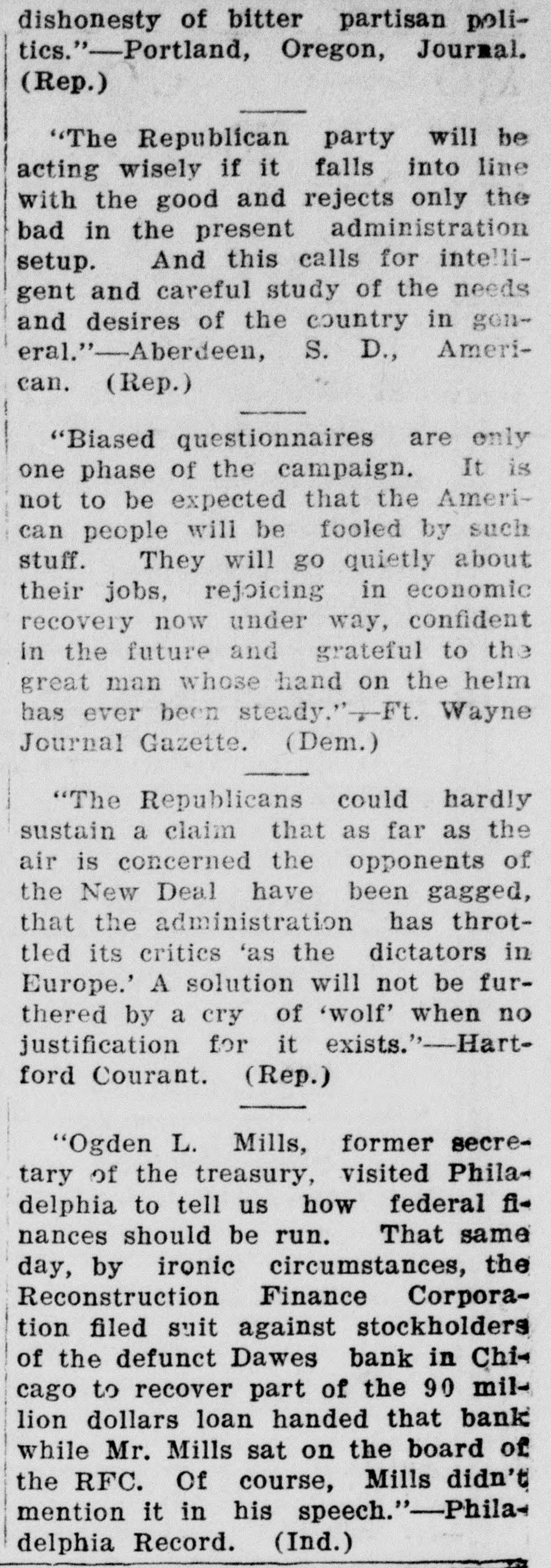
dishonesty of bitter partisan politics."-Portland, Oregon, Journal. (Rep.) "The Republican party will be acting wisely if it falls into line with the good and rejects only the bad in the present administration setup. And this calls for intelligent and careful study of the needs and desires of the country in general."-Aberdeen, S. D., American. (Rep.) "Biased questionnaires are only one phase of the campaign. It is not to be expected that the American people will be fooled by such stuff. They will go quietly about their jobs, rejoicing in economic recovery now under way, confident in the future and grateful to the great man whose hand on the helm has ever been steady."-Ft. Wayne Journal Gazette. (Dem.) / "The Republicans could hardly sustain a claim that as far as the air is concerned the opponents of the New Deal have been gagged, that the administration has throttled its critics 'as the dictators in Europe.' A solution will not be furthered by a cry of 'wolf' when no justification for it exists."-Hartford Courant. (Rep.) "Ogden L. Mills, former secretary of the treasury, visited Philadelphia to tell us how federal finances should be run. That same day, by ironic circumstances, the Reconstruction Finance Corporation filed suit against stockholders of the defunct Dawes bank in Chicago to recover part of the 90 million dollars loan handed that bank while Mr. Mills sat on the board of the RFC. Of course, Mills didn't mention it in his speech."-Phila+ delphia Record. (Ind.)