Bank of Commerce (Chicago, IL)

Episode Information

Episode UID
2008471122
Episode Type
Run Only
Bank Type
state
Bank ID
200847 routing
Routing Number
2-0084
Start Date
June 5, 1893
Location
Chicago, Illinois (41.850, -87.650)

Metadata

Model
gpt-5-mini (chosen from majority vote of a three-model LLM ensemble)
Short Digest
8b979d6d3c25c370

Response Measures

None

Events (1)

1. June 5, 1893 Run
Cause
Rumor Or Misinformation
Cause Details
A panic triggered by rumors following the failure/closure of a private banker (Meadoweroft/Schaffner) leading depositors to withdraw funds.
Measures
Paid depositors on demand; kept paying tellers at work; officials announced they would pay every claim and remained open (extended hours).
Newspaper Excerpt
A run was started which continued for hours ... Rumor, mere rumor, he answered.
Source
newspapers

Newspaper Articles (10)

Article from Rock Island Daily Argus, June 6, 1893

Click image to open full size in new tab

Article Text

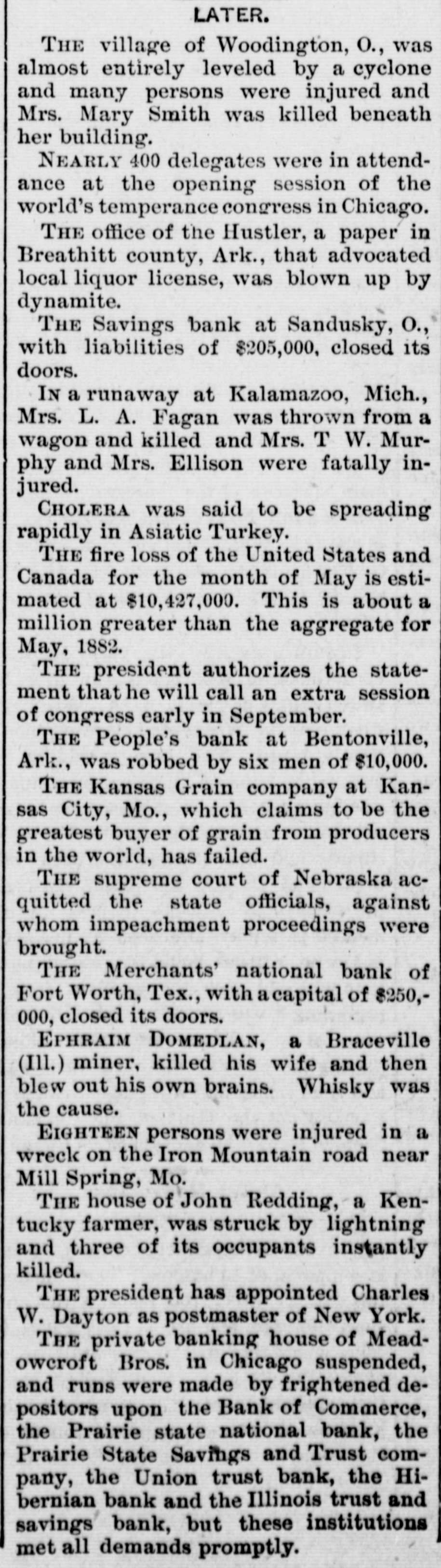
WILD PANIC ALL DAY, But Only One Failure, Private Bankers, Reported. Rumor had hardly started a story of one bank than the "dame" looked around for another victim. In this way there was a big run on the Bank of Commerce, but every comer was paid in full. President Felsenthal said the bank would pay every demand made upon it and that nobody would be asked to wait a moment for his money. The Prairie State National bank, corner Washington and Desplaines, was called on for a large amount of deposits in the savings department and paid on demand. The officers said they had been preparing for just this sort of thing. A run on the Illinois Trust and Savings bank was met by the announcement that it would keep open till 10 p. m. as long as the run lasted. There are $10,000,000 deposits in the savings department of this bank, and seven men were paying depositors. Working twelve hours a day it would take seven men 100 days to pay out the $10,000,000. There was no run on the deposit accounts. A run was begun on the Globe Savings bank at 2 p. m., and the bank immediately posted notice that its legal thirty and sixty-day limit would be the rule. At 9 p. m. there were 500 persons in line before the paying teller of the Illinois Trust and Savings bank, and the officials announced that they would continue paying until all had their money. At midnight there were 200 and the bank con-
Article from Rock Island Daily Argus, June 7, 1893

Click image to open full size in new tab

Article Text

THE RUN BEGINS TO ABATE. Everybody Paid Who Wanted Money and Millions in Sight. The day's developments showed an increased steadiness among the money institutions of Chicago. True the people continued to walk up to the wickets of the paying tellers to demand their deposits, but the numbers were reduced, and a more widespread feeling of confidence assumed the place of the panicky outburst of Monday. Those banks upon which the run was continued were the Illinois Trust and Savings, the Hibernian, the Union Trust and Savings, the Dime Savings, and the Bank of Commerce. Those that demanded the lawful notice of withdrawal of deposits were the Union Trust and Savings and the Globe Savings. In the afternoon it was easy to see that the excitement was dying ont. Philip D. Armour was responsible for the allaying of the fears of many of the depositors of the Illinois Trust and Savings by walking up to the line of people and announcing that he would guarantee the payment of their accounts or pay the same. About 100 of the frightened depositors took advantage of the millionaire packer's offer; some accepted a written guarantee, some were given checks, and in one case, that of an old woman with a deposit of $100, the amount was paid in cash. The banks closed their day's business at the usual hour and the directors make the statement that they are prepared to stand the run for an indefinite period and are satisfied with the condition of affairs as shown by the signs of returning confidence. Little more than the usual daily demand for currency in exchange for coin was made at the sub-treasury by the local banks. The Clearing House association discussed the general situation and gratifying reports were received indicating that the savings banks were in good shape to meet all requirements. Every bank attacked had ample backing besides the cash on hand. When business opened there were great piles of greenbacks. gold and silver. piled up behind


Article from St. Paul Daily Globe, June 7, 1893

Click image to open full size in new tab

Article Text

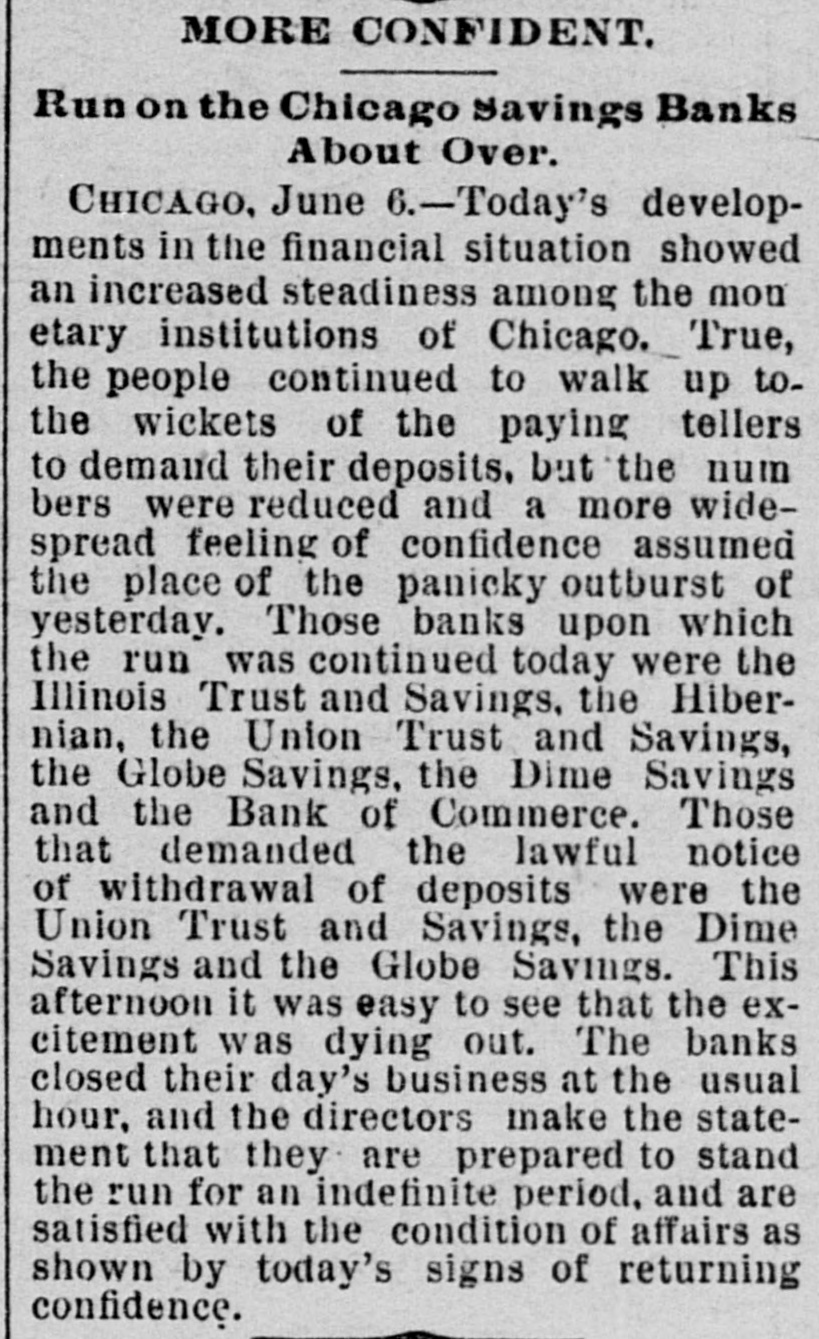
MORE CONFIDENT. Run on the Chicago Savings Banks About Over. CHICAGO, June 6.-Today's developments in the financial situation showed an increased steadiness among the mon etary institutions of Chicago. True, the people continued to walk up tothe wickets of the paying tellers to demand their deposits. but the num bers were reduced and a more widespread feeling of confidence assumed the place of the panicky outburst of yesterday. Those banks upon which the run was continued today were the Illinois Trust and Savings, the Hibernian, the Union Trust and Savings, the Globe Savings. the Dime Savings and the Bank of Commerce. Those that demanded the lawful notice of withdrawal of deposits were the Union Trust and Savings, the Dime Savings and the Globe Savings. This afternoon it was easy to see that the exeitement was dying out. The banks closed their day's business at the usual hour, and the directors make the statement that they are prepared to stand the run for an indefinite period, and are satisfied with the condition of affairs as shown by today's signs of returning confidence.


Article from The Sun, June 8, 1893

Click image to open full size in new tab

Article Text

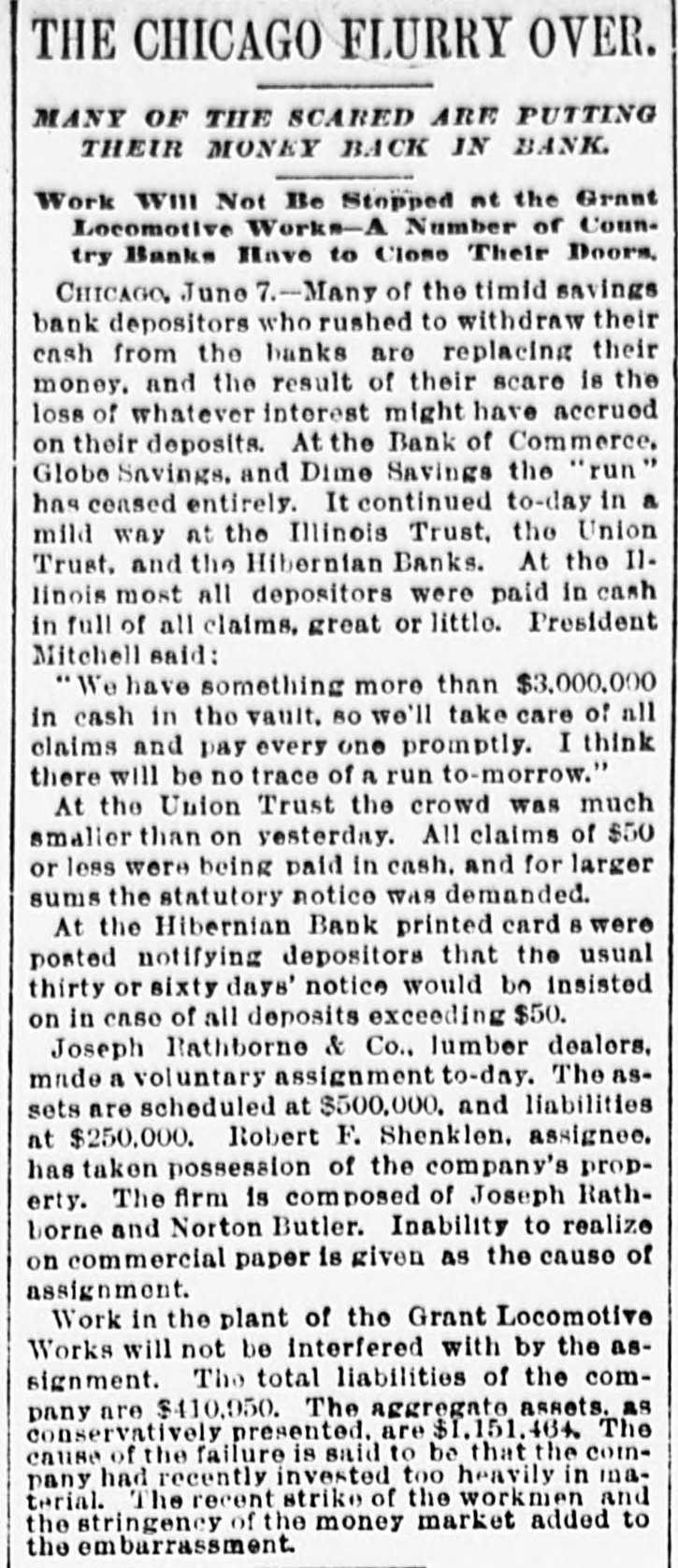
THE CHICAGO FLURRY OVER. MANY OF THE SCARED ARE PUTTING THEIR MONEY BACK IN BANK. Work WIII Not Be Stopped nt the Grant Locomotive Works-A Number or Country Banks Have to Close Their Doors. CHICAGO. June 7.-Many of the timid savings bank depositors who rushed to withdraw their cash from the banks are replacing their money. and the result of their scare is the loss of whatever interest might have accrued on their deposits. At the Bank of Commerce. Globe Savings. and Dime Savings the "run" has censed entirely. It continued to-day in a mild way nt the Illinois Trust, the Union Trust. and the Hibernian Banks. At the Illinois most all depositors were paid in cash in full of all claims. great or little. President Mitchell said: "We have something more than $3,000,000 in cash in the vault. 80 we'll take care of all claims and pay every one promptly. I think there will be no trace of a run to-morrow." At the Union Trust the crowd was much smaller than on yesterday. All claims of $50 or less were being paid in cash. and for larger sums the statutory notice was demanded. At the Hibernian Bank printed card 8 were posted notifying depositors that the usual thirty or sixty days' notice would be insisted on in case of all deposits exceeding $50. Joseph Rathborne & Co., lumber dealors. made a voluntary assignment to-day. The assets are scheduled at $500,000. and liabilities at $250,000. Robert F. Shenklen. assignee. has taken possession of the company's property. The firm is composed of Joseph Rathborne and Norton Butler. Inability to realize on commercial paper is given as the cause of assignment. Work in the plant of the Grant Locomotive Works will not be interfered with by the assignment. The total liabilities of the company are $410,950. The aggregate assets. as conservatively presented. are $1,151,464. The cause of the failure is said to be that the company had recently invested too heavily in material. The recent strike of the workmen and the stringency of the money market added to the embarrassment


Article from Iowa County Democrat, June 9, 1893

Click image to open full size in new tab

Article Text

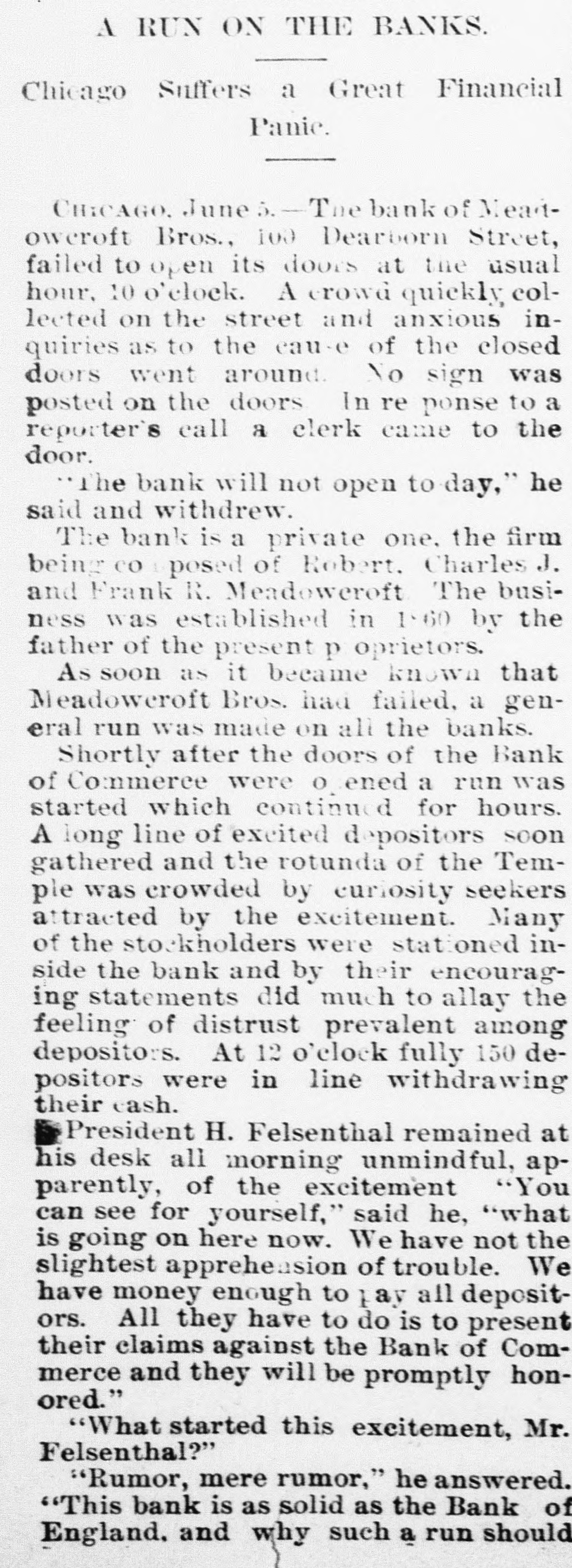
A RUN ON THE BANKS Chicago Suffers a Great Financial Panic. CHICAGO. June 5.-The bank of Mearoweroft Bros., 100 Dearborn Street, failed to open its doors at the usual hour. 10 o'clock. A crowa quickly colleeted on the street and anxious inquiries as to the cau-e of the closed doors went around No sign was posted on the doors In re ponse to a reporter's call a clerk came to the door. "The bank will not open to day," he said and withdrew. The bank is a private one, the firm being CO posed of Robert. Charles J. and Frank R. Meadoweroft The business was established in 1:60 by the father of the present p oprietors. As soon as it became known that Meadoweroft Bros. had failed. a general run was made on all the banks. Shortly after the doors of the Bank of Commerce were o ened a run was started which continued for hours. A long line of excited d epositors soon gathered and the rotunda of the Tempie was crowded by curiosity seekers attracted by the excitement. Many of the stockholders were stationed inside the bank and by their encouraging statements did much to allay the feeling of distrust prevalent among depositors. At 12 o'clock fully 150 depositors were in line withdrawing their cash. President H. Felsenthal remained at his desk all morning unmindful, apparently, of the excitement "You can see for yourself," said he, "what is going on here now. We have not the slightest appreheasion of trouble. We have money enough to pay all depositors. All they have to do is to present their claims against the Bank of Commerce and they will be promptly honored." "What started this excitement, Mr. Felsenthal?" "Rumor, mere rumor," he answered. "This bank is as solid as the Bank of England. and why such a run should


Article from Perrysburg Journal, June 10, 1893

Click image to open full size in new tab

Article Text

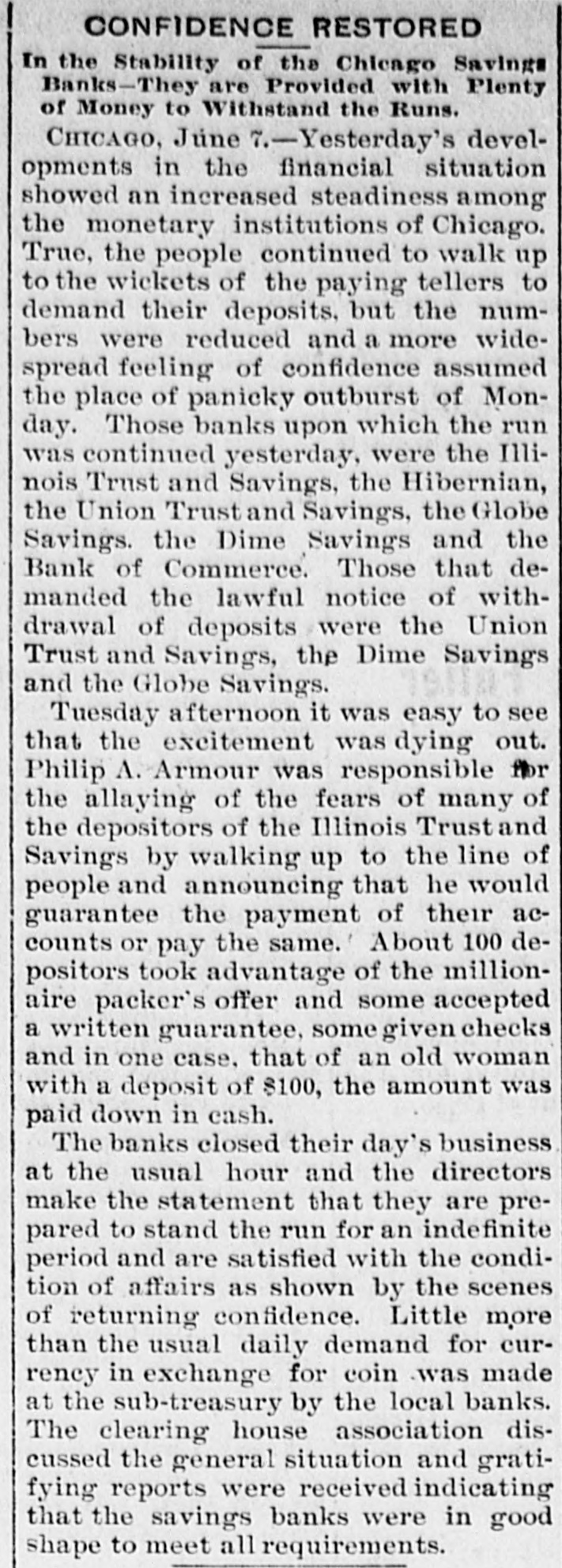
CONFIDENCE RESTORED In the Stability of the Chicago Savings Banks-They are Provided with Plenty of Money to Withstand the Runs. CHICAGO, June 7.-Yesterday's developments in the financial situation showed an increased steadiness among the monetary institutions of Chicago. True, the people continued to walk up to the wickets of the paying tellers to demand their deposits, but the numbers were reduced and a more widespread feeling of confidence assumed the place of panicky outburst of Monday. Those banks upon which the run was continued yesterday, were the Illinois Trust and Savings, the Hibernian, the Union Trust and Savings, the Globe Savings. the Dime Savings and the Bank of Commerce. Those that demanded the lawful notice of withdrawal of deposits were the Union Trust and Savings, the Dime Savings and the Globe Savings. Tuesday afternoon it was easy to see that the excitement was dying out. Philip A. Armour was responsible for the allaying of the fears of many of the depositors of the Illinois Trust and Savings by walking up to the line of people and announcing that he would guarantee the payment of their accounts or pay the same. About 100 depositors took advantage of the millionaire packer's offer and some accepted a written guarantee, some given checks and in one case, that of an old woman with a deposit of $100, the amount was paid down in cash. The banks closed their day's business at the usual hour and the directors make the statement that they are prepared to stand the run for an indefinite period and are satisfied with the condition of affairs as shown by the scenes of returning confidence. Little more than the usual daily demand for currency in exchange for coin was made at the sub-treasury by the local banks. The clearing house association discussed the general situation and gratifying reports were received indicating that the savings banks were in good shape to meet all requirements.


Article from The Enterprise, June 14, 1893

Click image to open full size in new tab

Article Text

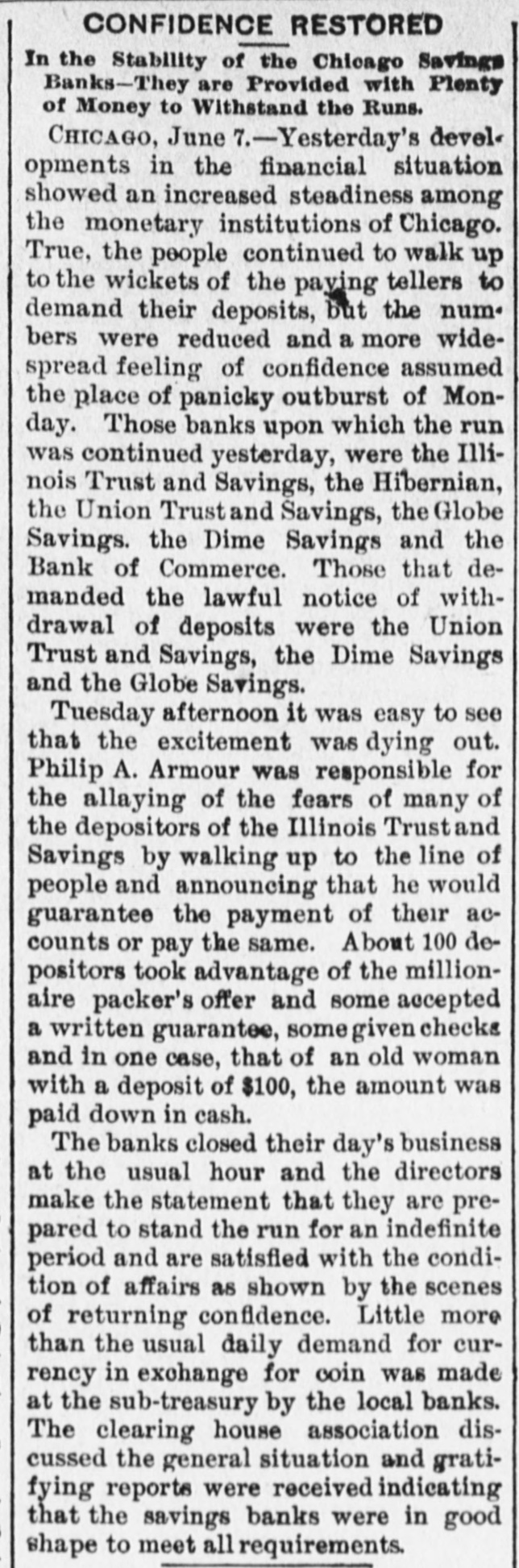
CONFIDENCE RESTORED In the Stability of the Chicago Savings Banks-They are Provided with Plenty of Money to Withstand the Runs. CHICAGO, June 7.-Yesterday's devel. opments in the financial situation showed an increased steadiness among the monetary institutions of Chicago. True, the people continued to walk up to the wickets of the paying tellers to demand their deposits, but the num. bers were reduced and a more widespread feeling of confidence assumed the place of panicky outburst of Monday. Those banks upon which the run was continued yesterday, were the Illinois Trust and Savings, the Hibernian, the Union Trust Savings, the Globe Savings. the Dime Savings and the Bank of Commerce. Those that demanded the lawful notice of withdrawal of deposits were the Union Trust and Savings, the Dime Savings and the Globe Savings. Tuesday afternoon it was easy to see that the excitement was dying out. Philip A. Armour was responsible for the allaying of the fears of many of the depositors of the Illinois Trust and Savings by walking up to the line of people and announcing that he would guarantee the payment of their accounts or pay the same. About 100 depositors took advantage of the millionaire packer's offer and some accepted a written guarantee, some given checks and in one case, that of an old woman with a deposit of $100, the amount was paid down in cash. The banks closed their day's business at the usual hour and the directors make the statement that they are prepared to stand the run for an indefinite period and are satisfied with the condition of affairs as shown by the scenes of returning confidence. Little more than the usual daily demand for currency in exchange for coin was made at the sub-treasury by the local banks. The clearing house association discussed the general situation and gratifying reports were received indicating that the savings banks were in good shape to meet all requirements.


Article from The Redwood Gazette, June 15, 1893

Click image to open full size in new tab

Article Text

RUNS ARE ENDED. The Chicago Banks Passed Through the Trying Ordeal Safely. CHICAGO, June S.--Quiet has been fully restored to the small arc of the monetary circle that was disturbed Monday, Tuesday and Wednesday. A great many of the timid savings depositors who rushed to withdraw their cash from the banks under a false impression that a sort of financial 'day 'of judgment had come are now replacing their money in the banks and the only result of their scare is the loss of whatever interest might have accrued on their deposits. At the Pink of Commerce, Globe savings and Dime savings the "run" has ceased entirely. At 10:30 o'clock a m., at the receiving teller's window in the Bank of Commerce, were some twenty persons waiting to deposit money and at the pay. ing teller's desk were two men having checks cashed. At the, Dime savings, depositors are revoking the notices they gave Monday of their intention to withdraw their cash. The "run" continued in a mild way at the Illinois trust, the Union trust and the Hibernian banks. At the Illinois trust all depositors were naid in cash in full of all claims.


Article from Western Kansas World, June 17, 1893

Click image to open full size in new tab

Article Text

Chicago Banks on the Run. CHICAGO, June 7.-The failure of Herman Schaffner, a private banker who deals in commercial paper, precipitated a run upon nearly all savings banks of this city. The Bank of Commerce, which held the savings of many Jews of the poorer classes, was the first. The Illinois Trust and Savings bank, with $12,000,000 on deposit from the best class of depositors; the Hibernian bank, the favorite depository of the Irish; and & long list of savings banks, were kept busy with a double force of paying tellers, in paying out money to crowds waiting their turns in long lines. Nearly all the banks paid on sight, while two or three took advantage of the percentage, or thirty day, conditions which all savings banks make. The leading banks gave notice at the regular clearing house that they would be kept open until 10 p. m. to pay depositors. and one, the Illinois Trust and Savings bank, was still paying checks at midnight. The bank officials said they cared nothing whatever. for the run, but were rather pleased than otherwise, to pay out the money, as it meant a big saving to the institution in interest.


Article from Chicago Eagle, September 9, 1899

Click image to open full size in new tab

Article Text

banker he passed through the financial panic of '73, and six years ago, being at the head of the Bank of Commerce, he brought that Institution safely through a "run" which lasted several days. He was elected President of the Bank of Commerce at the time it was organized in 1891, and remained at Its head until it passed into other hands last November. In German and Jewish circles Mr. Felsenthal was prominent as a charitable worker. The United Hebrew Relief Association was fostered by him in its infancy, and for years he was a member of the governing board of Michael Reese Hospital. He was a long time Secretary of Sinai Temple, was a past grand master of Lodge No. 6, I. O. B. B., and was treasurer of the order at the time of his death. Mr. Felsenthal was one of the organizers of the Covenant Culture Club and for twenty-three years had been chairman of the Board of Trustees of Ramah Lodge. He was also an active member of Landmark Lodge, F. and A. M. The funeral occurred on Wednesday. Services were conducted at Sinai Temple. Indiana avenue and 21st street, in the morning at 9:30 o'clock, by Dr. Hirsch. The honorary pall-bearers were Adolph Moses, Henry Greenebaum, Adolf Kraus, Adolph Loeb, D. B. Felsenthal, Judge Philip Stein, Israel Cowen, E. Rubovits, S. Norden, Jacob Birk, Adolph Shire, S. M. Fischer, and Samuel Woolner. The active pall-bearers were Joseph L. Gatzert, Joseph Belfeld, Conrad Witkowsky, Herman F. Hahn, Harry Hart, Joseph Spiegel, and Fred Miller. Interment was at Rose Hill.