Stuyvesant Bank (New York, NY)

Episode Information

Episode UID
2027940590862
Episode Type
Run β†’ Suspension β†’ Closure
Bank Type
state
Bank ID
202794059 hash
Start Date
October 12, 1871
Location
New York, New York (40.714, -74.006)

Metadata

Model
gpt-5-mini (chosen from majority vote of a three-model LLM ensemble)
Short Digest
d506979dc5d88cb0

Response Measures

None

Events (3)

1. October 12, 1871 Run
Cause
Macro News
Cause Details
Depositors withdrew heavily after the Chicago fire tightened money markets and induced correspondent banks to refuse redemption
Newspaper Excerpt
the Chicago fire caused a heavy run and induced the Manufacturers' Bank to refuse to redeem for them
Source
newspapers
2. October 13, 1871 Suspension
Cause
Macro News
Cause Details
Suspension attributed to losses and tightening of the money market following the Chicago fire and inability to obtain redeeming funds
Newspaper Excerpt
The Stuyvesant Bank ... suspended payment yesterday
Source
newspapers
3. October 14, 1871 Receivership
Newspaper Excerpt
A receiver was appointed; O. H. P. Archer was appointed receiver and took charge of the books and assets yesterday
Source
newspapers

Newspaper Articles (22)

Article from Evening Star, October 13, 1871

Click image to open full size in new tab

Article Text

Suspension of a New York Bank. NEW YORK, Oct. 13.-The Stuyvesant bank, 744 Broadway, suspended payment yesterday. The Stuyvesant is a State bank, with a capital of $200,000. Davis Callamore is president and John Van Orden cashier. It is claimed that the bank can pay every dollar due depositors, and that its capital is liable to be encroached upon only from $50,000 to $75,000. The failure is doubtless attributable to the Chicago fire and the consequent tightening of the money market and difficulty in procuring funds.


Article from Alexandria Gazette, October 13, 1871

Click image to open full size in new tab

Article Text

From New York. NEW YORK Oct. 13.-The Stuyvesant Bank, 744 Broadway, suspended payment yesterday. The Stuyvesant is a State bank, with a capital of $200,000. Davis Callanon is President and Jno. Van Orden Cashier. It is claimed that the bank can pay every dollar due depositors, and that its capital is liable to be encroached upon only from $50,000 to $75,000. The failure is doubtless attributable to the Chicago fire, and the consequent tightening of the money market and difficulty in procuring funds. The central President and spiritual director of the Catholic temperance societies of New Jersey have issued an appeal to the socities within their jurisdiction for appropriations and contributions for the Chicago relief fund. The ship Jessor from Liverpool, arrived to. day. She reports that in lat, 40; long 72, 50. passed the hull of an unknown vessel apparently about 140 feet long, very deep in water.


Article from The Daily State Journal, October 13, 1871

Click image to open full size in new tab

Article Text

Telegraphic Summary. The steamers Rising Sun Cuba, and James Adger have arrived at New York. The Russia and Assyria had arrived out. A dispatch from Hartford says the Hartford Insurance Company's capital is intact with a million and a half excess. A sovere rain storm has prevailed in Maine. Seven trains are detained between washed culverts. A saloon-keeper of Philadelpia killed one and fatally wounded another assailant this morning. The first frost of the season visited Montgomery, Alabama, yesterday morning. Daniel Torrence has been elected president, and A. M. Christy vice-president, of the Ohio and Mississippi railroad. Stuyvesant Bank, New York city, has suspended-suspension attributed to the Chicago conflagration. The Fenian General O'Neil, with a force, is said to have seized the Canadian customhouse at Hudson bay post. O'Neil was captured by United States troops. The larger portion of the city of Onanister, on the east coast of Lake Michigan, is burned. An express box was robbed in Sonora county, California, a few days ago, by masked men.


Article from The Charleston Daily News, October 14, 1871

Click image to open full size in new tab

Article Text

The Adams Express Company gives ten thousaud dollars to Chicago. LONDON, October 13. The donations to Chicago are large throughout the Empire and on the Continent. The Lord Mayor yesterday received Β£7000 sterling in contributions from private individuals. Baring Bros., Morgan & Co., Rothschilde, Browne, Shipley & Co., and the Great Western, of Canada, and Grand Trunk Railways give Β£1000 each. The government have ordered the military authorities in Canada to tender to Chicago all the tents and blankets in the Dominion. NEW ORLEANS, October 13. Mayor Flanders telegraphs the Mayor of Chicago to draw at once for $10,000, and subscriptions are still coming in. NEW YORK, October 13. The Stuyvesant Bank has suspended, on account, It is believed, of the Chicago fire. The latest statement from the Partford Insurance Company is that the capital is intact, with a million and a half excess.


Article from The New York Herald, October 14, 1871

Click image to open full size in new tab

Article Text

A STATEMENT OF THE AFFAIRS OF THE STUYVESANT BANK, as made by the cashier yesterday, is pnblished elsewhere. It shows that the assets are $854,000 and the liabilities only $590,000, so that, as it is now in the hands of a receiver, the depositors need not be entirely disconsolate.


Article from New-York Tribune, October 14, 1871

Click image to open full size in new tab

Article Text

This, it was explained, was merely a rough statement in round numbers. A summary winding-up of the affairs of the bank would not, in the opinion of the officers, impair the capital stock more than $50,000. By giving a little time it was thought that the loss to the stockholders would be very trifing. Mr. Dugan said that If the deficit was only $50,000, there was no sufficient reason for putting the bank in the hands of a receiver. The President, Mr. Collamore, said that the capital of the bank was unavailable for immediate use. The bank held $40,000 in an iron mine, and this bad been regarded as a good investment. Several gentlemen would have purchased this as an individual investment, and be felt sufficient confidence to purchase a fourth of it himself. This investment was held in common with the other banks and a private gentleman, the full amount of stock being $90,000. The cause of the failure was the refusal of the Manufacturers' and Merchants' Bank to redeem for the Stuyvesant. The indebtedness to the Manufacturers' and Merchants' Bank was about $100,000, for which they held $250,000 securities. Mr. Dugan asked what the available cash capital amounted to, if any existed; Mr. Collamore answered, doubt if there is any in positive cash." Much of the capital was involved In litigation, but the officers held the lease 88 worth $50,000. A discussion among the stockholders brought out the fact that the majority were in favor of carrying the bank on, and several gentlemen offered to give five times the value of the stock held by them to avoid a complete failure. It was stated that if on Wednesday the Stuyvesant Bank had been able to deposit $100,000 with any bank in the city connected with the Clearing-House, the business would have gone on without interruption. A committee of five was appointed to examine into the affairs of the bank. and to report at a meeting to be held this afternoon at 5 o'clock to determine the best course to pursue in the matter. The President of the Stuyvesant Bank told a TRIBUNE reporter yesterday afternoon that the liabilities of the bank were about $600,000 and that its affairs would probably be wound up. Mr. Collamore thought that paper had been discounted too freely; ,but this would not have injured the bank had not the Chicago fire caused a heavy run and induced the Manufacturers' Bank to refuse to redeem for them. One of the stockholders thought that the directors had been very careless in discounting, and that much of the paper in the bank would be found to be worthless. Another stockholder said that unless some bank could be found to redeem for them, the only basis on which a resumption could be effected was the placing of $600,000 in bills in the safe ready for the run that would occur as soon as the doors were opened.


Article from New-York Tribune, October 14, 1871

Click image to open full size in new tab

Article Text

FAILURE OF THE STUYVESANT BANK. A RECEIVER APPOINTED-LIABILITIES $600,000. A suit was begun yesterday by Wm. R. Barr, Justice O. White, Wm. H. Donington, and James H. Blaisdell, asking for an injunction restraining the Stuyvesant Bank from doing any further business and for the appointment of a receiver. The motion was granted by Judge Ingraham, and O. H. P. Archer was appointed receiver, and filed a bond of $100,000 as security. As soon as this action became known, a meeting of the stockholders of the bank was called, and at 8 o'clock last evening about 80 gentlemen owning stock assembled in the President's room. David Collamore, President of the institution, was called to the chair, and a statement of the condition of affairs was read, as follows:


Article from The New York Herald, October 14, 1871

Click image to open full size in new tab

Article Text

STUYVESANT BANK TROUBLE The Bank Ruined, But Will Pay Its Debts. A RECEIVER APPOINTED. MEETING OF THE STOCKHOLDERS, de , the trouble which has resulted in the suspension or the Stuyvesant Bank, reported yesterday, can now be pretty clearly explained. It is gratifying t note that none of the facts which have becor ae known can in any way impeach THE HONESTY OF ITS MANAGEMENT The President, Mr. Davis Collamore, d'scussed very freely yesterday with visitors the/dimoulty into which the Institution had fallen, and refused no desired information. A represents.tive of the HERALD had with him the following CO d'aversation:"Good morning, Mr. Collamore. Like a good many other people who, I suppose, have seen you no-day, I have come upon an inquisitive errand." "About the bank, of course'l/ (with a pleasant smalley. "I would like to ask one OF two questions which should, in all fairness, be asked or you arst." "I am very willing, sir, to/enlighten you as much - posstole." "What 18 the immediate cause of this trouble "DISCOUNTING TOO FREELY." "Is there no more remove cause 199 "No, sir." "Of what character has been the business of the bank "Strictly legitimate." "It has never indulged in any speculation p? "No, sir. It has never speculated in gold or stock to a dollar's worth since I was chosen President, which was three years ago. we have built up SOMETHING OF A REPUTATION, The bank owns a valuable sen years lease of this building (at the corner of Astor place and Broad. way), and in fitting it up has spent forty or nity thousand dollars." "Have the officers ever borrowed from the do 1 posited funds p" "The failure of the bank cannot be attributed to the officers. They have not used its money. The cashier may have borrowed sums at some past time, but he does not now owe the bank a cent. As to anyself, my account shows a balance in my favor." Will you pay your depositors 999 "There is no doubt of it. THE MERCHANTS AND MANUFACTURERS BANK holds about $250,000 of notes which are maturing in our lavor." "Will the bank be continued " "Idonot think It can DC. At any other time this difficulty would not have crushed us; but just now you know the money market Is very close." "How will its affairs be wound up?" "A receiver has been appointed, and he will colsect the assets, paying the creditors as last as possible." A generous confidence in the integrity of the omCORN has led to many expressions of SYMPATHY AND GOOD FEELING from those who have entrusted the bank with large sums of money. Some of the depositors came to the President yesterday and offered to place further deposts in the hands of the cashier, expressing them. selves in the following manner:" you can go on, we will stay with you." The bank, though not of such venerable standing as some others, has inspired confidence by its strict adherence to LEGITIMATE AND UNSPECULATIVE BUSINESS. The action of the Merchants and Manufacturers' Bank on Wednesday, in withdrawing its support, was very sudden and unexpected. It is even said that no notification was sent out in advance. If this is true, the event must certainly be viewed as " DIRTY TRICK. The Merchants and Manufacturers' Bank held the securities of the Stayvesant to the amount of over balf a million of dollars. This would seem to be sufficient to obviate all suspicion of insecurity especially when it is remembered that the half a million 18 double the amount risked in the redemp uon of exchanges But the Merchants and Manufacturera' Bank thought otherwise; and, by its basty action, has succeeded in placing the Stuy vesani IN QUANDARY, which will undoubtedly result in its permanent stoppage. The trouble might have been tidea over had the money market been in its normal condition But the demolition of Chicago by the Fire-Fiend and the conseq uent panic among business men rendered it impossible to raise any borrowed support, and under these circumstance the stoppage was compelled by the inability to continue exchanges. The bank for some time has been DISCOUNTING VERY HEAVILY. and holds a large amount of paper which bas not yes matured. It has drawn too near its margin of deposit, and its lack of funds became SERIOUS DIFFICULTY when the depositors, grown anxious through the excitement produced by the Chicago calamity, began withdrawing During Wednesday the bank was forced to refuse the large cnecks presented various other banking institutions, but continued to pay the demands of smaller and poorer depositors. MR. O. H.B. ARCHER, director of the Erie Railway Company, and form President of this bank. has been appointed receiver, and took charge of the books and assets vesterday. From what be already knows of the affairs of the bank be expresses confidence in the full payment of all its creditors, and after this payment 1 is thought there will be a large sum remaining in the bank. Among the poorer depositors yesterday there MAIN R was MORE EXCITEMENT than among those whose risk is greater. but who comprehend more fully the condition of affairs. Early in the morning a small crowd bad collected on the sidewalk in front of the entrance on Broadway, and besieged the door long before it was thrown open. There was some depression, Blight vestiges of anger and much anxiety. The throng, however, showed itself to be witha: quite TOLERANT AND CHARITABLE although very earnest in the discussion of facts and possibilities. Later in the day, when it became cog. mizant of the real suspension of payment, it dis solved itself away in a very quiet and orderly manner. ANXIOUS INDIVIDUALS, of course, continued to walk up to the ontlook of the paying teller, with bank books. but only to receive THE QUIRTUS OF THEIR HOPES. A few of the principal creditors loltered about exchanging ideas and absorbing all the information that by any means leaked out. The reporter or the HERALD con versed with one of them, who informed Dim that many of the depositors were "cattle men, and on this premise further remarked that " was the drovers WHO DROVE THE BANK. " they having drawn very heavily on their accounts. This gentleman evinced a little alarm and said that be had just been offered 2.000 for $3,000 which was in the hands of the bank. and he was damned ar hewasn't a notion take it." He asked the reporter for advice, and that individual did as much as bis conscience would permit to reassure him, which was not much MEETING OP THE STOCKHOLDERS.
Article from New-York Tribune, October 16, 1871

Click image to open full size in new tab

Article Text

THE BANK EXCITEMENT. VIEWS OF A PROMINENT BANKER. Regarding the stability of the banks of the city a prominent bank President said to a TRIBUNE reporter after the reported failure of the Stuyvesant Bank " It has been a common remark during the last six months that securities were 10 per cent higher than they should be. The Chicago fire has operated to produce a contraction, leading to a depression of values. All the moneyed interest of the country is admonished to make everything safe, and bankers and banks in the Western States who have balances in the Atlantic cities draw at least a portion of their balances in currency to be strong at home. Drafts which are made on any of the cities outside of New-York are made good by banks in those cities drawing on New-York, 80 that this city is forced to stand the entire load. To meet this demand for funds they have to call in loans on collateral securities and curtail their discount lines. The calling in of loans and curtailment of discounts is the cause of the present depreciation and excitement. The Chicago fire comet in as an aggravating element, and precipitates the climax by throwing at least $50,000,000 of securities upon the mar. ket, wiping ont for the time another $50,000,000 of bills receivable, ledger balances, &c., and still another $50,000,000 of property actually destroyed. The trouble in Wall-et. has the same origin. Values must suffer a depreciation of fully 25 per cent upon all the property of the entire country. This is the only adjusting element, and, to bring this to bear, it becomes necessary to go through a species of what may be called a revulsion. We have been suffering the vexations of a panic for the last three days, and we must soon meet the revulsion. Prices of property must be cut down. It is always a pleasant thing to mark up property, but it is not 80 agreeable to cut prices down. Those who have nothing but a margin to out down must go to the wall. There 18, in my opinion, but one power which can save the country from a general upheaval, and that is the power of the Secretary of the Treasury to take in $45,000,000 of Government bonds by issuing $50,000,000 of greenbacks. The power to issue this $50,000,000 is provided in the statutes passed under Secretary Chase's administration. It is doubtful, however, whether the present Secretary will feel at liberty to avail himself of a statute which has become measurably extinct. Regarding the savings banks, the excitement arises not from any absolute lack of money, but an absence of confidence." THE STUYVESANT BANK FAILURE. A second meeting of the stockholders of the Stuyvesant Bank was held in the bank building, Mr. Collamore presiding, at 4 p. m., Saturday. The Committee on the preparation of a statement of the condition of the bank reported that they had been unable to prepare a statement, but that Mr. Archer, the receiver appointed by Judge Ingrabam, would make. in a week, a full explanation, which would be published. Mr. Collamore, from the Committee on Conference with banks to procure a redeeming bank, reported that they had failed to induce any bank to cash the checks of the Stuyvesant. A Committee was appointed to consider proper disposition to be made of the leasehold of the bank building.


Article from The Daily State Register, October 18, 1871

Click image to open full size in new tab

Article Text

The Stuyvesant Bank of New York suspended on the 12th in consequence of its losses through the Chicago eonflagration.


Article from Public Ledger, October 24, 1871

Click image to open full size in new tab

Article Text

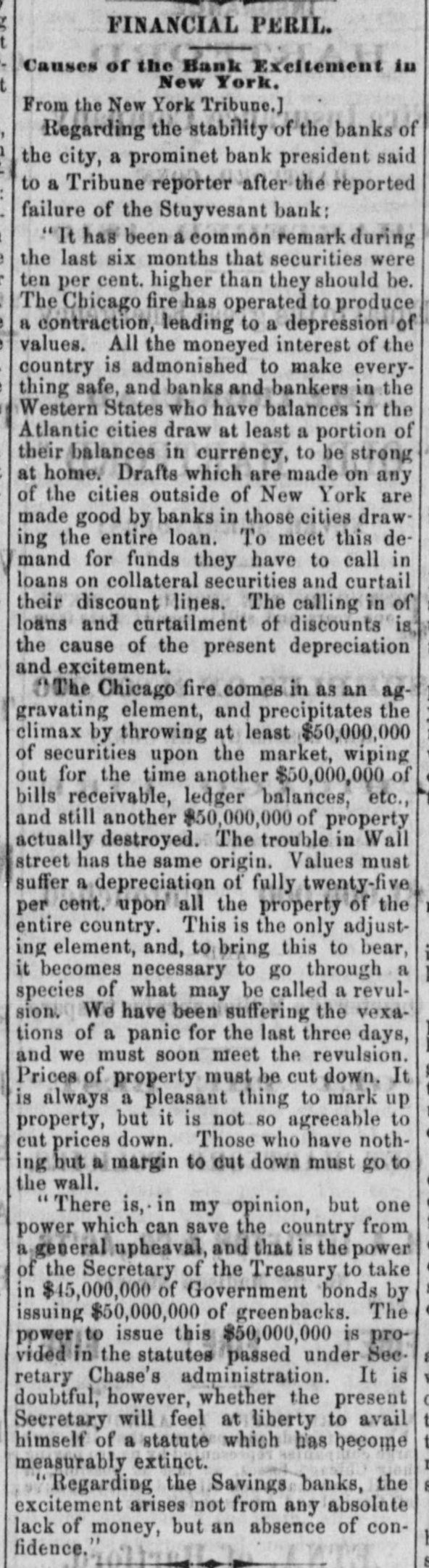
FINANCIAL PERIL. Causes of the Bank Excitement in New York. From the New York Tribune.] Regarding the stability of the banks of the city, a prominet bank president said to a Tribune reporter after the reported failure of the Stuyvesant bank: "It has been a common remark during the last six months that securities were ten per cent. higher than they should be. The Chicago fire has operated to produce a contraction, leading to a depression of values. All the moneyed interest of the country is admonished to make everything safe, and banks and bankers in the Western States who have balances in the Atlantic cities draw at least a portion of their balances in currency, to be strong at home. Drafts which are made on any of the cities outside of New York are made good by banks in those cities drawing the entire loan. To meet this demand for funds they have to call in loans on collateral securities and curtail their discount lines. The calling in of loans and curtailment of discounts is the cause of the present depreciation and excitement. OThe Chicago fire comes in as an aggravating element, and precipitates the climax by throwing at least $50,000,000 of securities upon the market, wiping out for the time another $50,000,000 of bills receivable, ledger balances, etc., and still another $50,000,000 of property actually destroyed. The trouble in Wall street has the same origin. Values must suffer a depreciation of fully twenty-five per cent. upon all the property of the entire country. This is the only adjusting element, and, to bring this to bear, it becomes necessary to go through a species of what may be called a revulsion. We have been suffering the vexations of a panic for the last three days, and we must soon meet the revulsion. Prices of property must be cut down. It is always a pleasant thing to mark up property, but it is not so agreeable to cut prices down. Those who have nothing but a margin to cut down must go to the wall. "There is, in my opinion, but one power which can save the country from a general upheaval, and that is the power of the Secretary of the Treasury to take in $45,000,000 of Government bonds by issuing $50,000,000 of greenbacks. The power to issue this $50,000,000 is provided in the statutes passed under Seeretary Chase's administration. It is doubtful, however, whether the present Secretary will feel at liberty to avail himself of a statute which has become measurably extinct. Regarding the Savings banks, the excitement arises not from any absolute lack of money, but an absence of confidence.


Article from Evening Star, December 6, 1871

Click image to open full size in new tab

Article Text

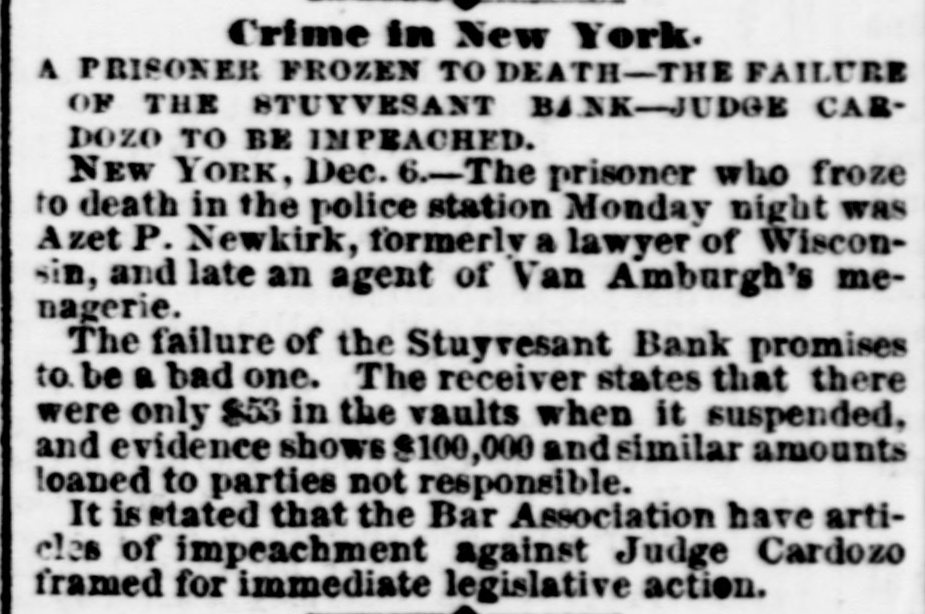
Crime in New York. A PRISONER FROZEN TO DEATH-THE FAILURE OF THE STUYVESANT BANK-JUDGE CARDOZO TO BE IMPEACHED. NEW YORK, Dec. 6.-The prisoner who froze to death in the police station Monday night was A zet P. Newkirk, formerly a lawyer of Wisconsin, and late an agent of Van Amburgh's menagerie. The failure of the Stuyvesant Bank promises to be a bad one. The receiver states that there were only $53 in the vaults when it suspended, and evidence shows $100,000 and similar amounts loaned to parties not responsible. It is stated that the Bar Association have artieles of impeachment against Judge Cardozo framed for immediate legislative action.


Article from The States and Union, December 13, 1871

Click image to open full size in new tab

Article Text

hiliarity generally drifted from its moorings, and for the nonce traveled around loose. The theatres are in full blast, and present unusual attractions; Nilsson, Capoul, Wachtel in opera; Edwin Booth in Hamlet; John E. Owens in Solon Shingle, Aime in Opera Bauffe; Sothern as Lord Dundreary, besides a dozen lesser lights are drawing fine audiences. The partial panic resulting from the suspension of the Bowling Green; the Guardian, and Stuyvesant Banks has abated. All of the institutions make a better showing than was anticipated, and the depositors are re-assured and hopeful. It is thought that pecuniary complications with some of the disgraced public officials may have had something to do with the "run" which compelled the banks to close their doors. The Mace-Coburn prize fighter is regarded here in the unchristian parlance of the natives, as a "put up job," and disgust at the results extends even to the virtuous swells of the Upper Tendom. Why Coburn, the party of the first port, did not, with his 'left duke' propound such a proposition on the knowledge-box of Mace, as to secure for that distinguished gladiator an obituary notice while in the zenith of his fame; and why Jem Mace, as the party of the second part, and true type of the muscular missionary, did not "plump" one one "bunch of fives" into the bread basket and with the other assault the "speculatar-probocis" of the aforesaid Coburn, in such a righteous manner, as to call for a first class funeral, are questions which disturb this religious community. They


Article from The New York Herald, December 14, 1871

Click image to open full size in new tab

Article Text

# SUPREME COURT-CHAMBERS Important as Touching Bank Failures and Special Deposits. Before Judge Cardozo. In the Matter of the Stuyvesant Bank.-Applica-tion was made on behalf of William S. Mann to compel the receiver of the Stuyvesant Bank to pay him $85, the amount of a special deposit. It is claimed that this money was left in the bank some two hours after it had suspended payment. Mr. Dudley Field, for the receiver, urged that the amount had been turned over as part of the assets of the bank. Decision reserved. Decisions. By Judge Cardozo. Hinman vs. Covert.-Motion granted, on defendant stipulating not to sue, &c. Garbull vs. Lenheim.-Same.


Article from New-York Tribune, December 14, 1871

Click image to open full size in new tab

Article Text

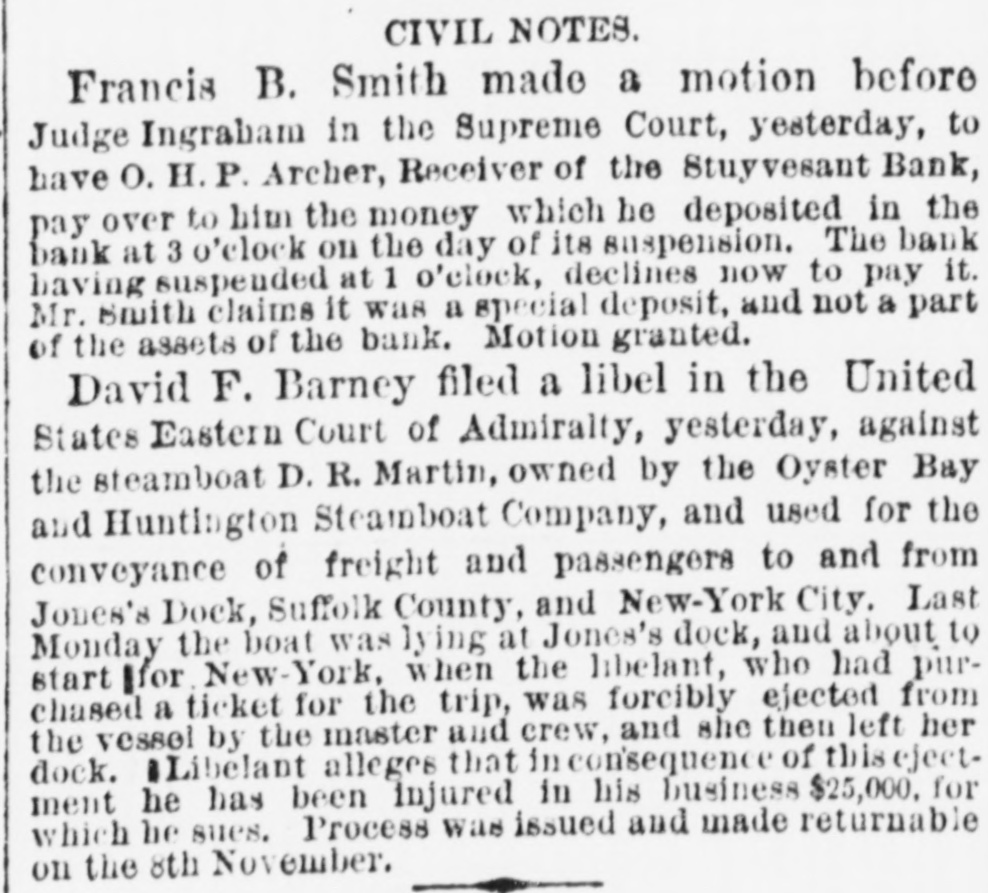
SPECIAL DEPOSITS IN THE STUYVESANT BANK. Wm. S. Mann, through counsel, applied, yesterday. to Judge Cardozo in the Supreme Court, Chambers, for an order to compel the Receiver of the stuyvesant Bank to pay over to him a deposit of 9885, which be made In that bunk at 245 D. m. on the day the bank failed, it having suspended at about It o'clock. He claimed that the money, having been deposited after the Bank had suspended payment, was . special deposit, and the not form n portion of the assets of the bank. Dudley Field, fur the bank, presented affidavits to prove that the money was thrown into the funds of the bank, and was properly a past of its adate. Allusion was also made to the censurable cardioveness OF ne on the part of the clerks 61 that day to receivious deposits, when they know the condition of the bank. in will throwing then into the Imade of the wassk and in other cases not. Decision reserved.


Article from The New York Herald, January 3, 1872

Click image to open full size in new tab

Article Text

The Stuyvesant Bank Failure. A meeting of the depositors of the Stuyvesant Bank was held last evening in the Sinclair House, ox-Judge Kelly in the chair. The committee on inquiry into the financial state of the bank reported that the receiver had collected $69,388 76 since his appointment. and had disbursed $50,696 62, leaving balance still in his hands of $8,692 54.


Article from The New York Herald, February 6, 1872

Click image to open full size in new tab

Article Text

THE BANK TROUBLES. THE STUYVESANT BANK. An Indignant Meeting of the Creditors-Protest Against Bankruptey The Present Receiver To Be Made Trustee of the Assets in Bankruptcy. At the bunding of the Stuyvesant Bank the credit. ors of that institution met again yesterday morning at ten o'clock for the purpose of protesting against the placing of its muddled affairs under the writ of involuntary bankruptcy, and of devising softe skilful coup d'Γ©tat whereby their interests under this unhappy misfortune could be as much prorected as possible. Mr. John A. Dougan was chairman, and the following resolutions were adopted:PROTEST AGAINST BANKRUPTCY. Resolved, That we are quite satisfied with the action of the Supreme Court of the State of New York in appointing a receiver to wind up the affairs of the bank, and believe that under the laws of the State, with an honest and faithful receiver, the creditors will realize far more than they would under bankruptcy proceedings, where the assignee 18 subject to rules and restrictions that render it didicult to administer the estate for the actual benefit of the creditors. SOMEBODY'S VIRTUES. Resolved, That we are entirely satisfied with the appointment of Mr. O. H. P. Archer as receiver of the assets of the bank. We believe him to be-first, an honest and trustworthy man; secondly, a capable and euergetic business man; thirdly, a man of large wealth and high reputation and entirely disinterested. Furthermore, since he has been receiver he has conducted the business of the bank most assiduously and with a sole view of realizing everything possible out of the assets, and we consider it would be a material injury to all of us if, after the knowledge of the affairs of the bank thus acquired by him, it were to fall into the hands of strangers. MACK'S MALICE. Resolved, That we are surprised and indignant at the action of one John Mack, who claims to hold a certificate of deposit for about $7,600 (which certificate actually belongs to the Security Bank, as we are creditably informed), such action having resulted in an adjudication of bankruptcy against the Stuyvesant Bank: that we believe this proceeding of John Mack and the Security Bank is a blackmailing operation, both of them well knowing that if the bank is put into the hands of an ordinary assignee in bankruptcy the assets will probably be sacrificed, and demanding as a condition of their withdrawing their bankruptcy proceedings that their debt be paid in full. MACK FLANKED. Resolved, That inasmuch as we are, by the action of John Mack and the Security Bank, driven into involuntary bankruptcy, we ask all interested to take advantage ot the fortythird section of the Bankrupt act, which authorizes us to elect our own trustee, instead of an assignee in bankruptcy, and that we recommend the creditors to attend the meeting of creditors appointed to be held on the 7th of February instant, and to elect Mr. O. H. P. Archer as our trustee, and a committee of creditors, consisting of Richard Kelly, President of the Fifth National Bank; the Rev. John Orcutt and others, without in any way waiving our rights to have the affairs of the bank closed under the statutes of this State. THE RECEIVER'S EXPLANATION. A committee was appointed to wait upon Mr. O. H. P. Arcner and to request him to make to them a statement of the cause of the unpleasantness of which the reprenensible. Mack was the apparent author. Mr. Archer, accompanied by David Dudley Field, made his appearance. He said. that as receiver he had pata to Howe and Macy $20,000 in settlement of their claims, in preference to naving the $26,000 worth of collaterals which they held forced upon the market. The Security Bank, represented by Mr. Mack, nad thought that they might secure just as favorable a settlement as Howe and Macy, and on finding that he (Mr. Archer) would not pay this claim. had forced the bank into bankruptcy. A vote of thanks was given Mr. Archer for his explanation and for his management of affairs. After a little more talk the meeting adjourned.


Article from New-York Tribune, February 8, 1872

Click image to open full size in new tab

Article Text

NEW-YORK CITY. The Sisters of the Stranger have adopted a minute in memory of the late Mrs. Hannah M. Cronly, the founder of the Society. Seven cases of small-pox were discovered yesterday by an Assistant Health Inspector, in a tenement in West Thirty-first-st., where ten families are living. The Stuyvesant Bank depositors have appointed O.H.P.Archer, the Rev. John Orcutt, Richard Kelly, and R. H. Bull a committee to wind up the business of the bank for them. The ex-Jesuit Passaglia arrived in Philadelphia, yesterday, in the bark Ollanda, from Genoa, and took the first train for this city, where he intends staying some time quietly with friends. Several depositors in the Central Savings Bank met last evening at No. 754 Sixth-ave., and resolved that they would wait upon the Receiver of that institution and demand a statement of its affairs. The following appointments were made yesterday: Charles H. Tucker, Assistant Sergeant-at-Arms and Doorkeeper to the Board of Aldermen; Samuel Bromberg, Third Assistant Clerk to the Board of Alternet. Boswell H. Jerome, age 30, a son of ex-Alderman Lawrence P.. Jerome, of No. 33 West Nineteenthst., was found dead in bed at the Summit House, at Bowery and Canal-st., on Tuesday evening. A post mortem examination showed that death was caused by Bright's disease of the kidneys. About 90 merchants and others of this city have signed a petition to the Legislature, praying that whatever charter may be adopted for the City of New. York, the Department of Docks, as at present constituted, with all its powers and duties, may be continued as a separate and independent department of the City Government." BROOKLYN. Ex-Mayor Kalbfleisch, and others of the Eastern District, went to Albany yesterday, for the purpose of advocating the passage of the Ferry Reform bill. The Coroner's Jury in the case of Prof. Panormo. rendered a verdict, yesterday, censuring Mr. Marvin, the apothecary, for not offering assistance, and recommending an increase of the police force. LONG ISLAND LONG ISLAND CITY.-While workmen were repairing a still at Warren's Oil Works, yesterday, an explosion took place, seriously burning Edward Moran David Leut The 6 p. m. train on the Flushing and and North Side Railroad ran over a horse last evening. and was thrown from the track, the passengers escaping without injury. NEW-JERSEY. JERSEY CITY.-In the Hudson County Courts, yesterday in the libel suit brought by George Watts, agent of the Lehigh and Wyoming Coal Company, against The Evening Journal, to recover $50,000 damages, a verdiet was rendered awarding $3,300 to the plaintiff.


Article from New-York Tribune, March 21, 1872

Click image to open full size in new tab

Article Text

THE STUYVESANT BANK. PLAIT MR. ARCHER'S INELIGIBILITY-JOHN APPOINTED ASSIGNEE. In the United States District Court, yes day. in the course of a decision in which he refuses to confirm the appointment of O. H. P. Archer as Trustee of the bankrupt Stuy vesant Bank, Judge Blatchford says: One of the grounds on which the bank was adjudged a bankrapt by this Court was. that. being insolvent. it procured and suffered its property to be taken on legal process with intent to defeat and delay the operation of the Bankraptey act, and suffered and procured a Receiver of all of its property and effects to be appointed by a State Court, and surrendered possession thereof to such Receiver. Mr. Archer was appointed such Receiver, and he is such still. All of the property of the bank passed into his hands. he thereafter claiming the legal right to it by transfer, and claiming to hold it as against all the world. Such as remains of it in his hands he claims to hold by the same title. The proceedings in bank ruptey were begun on Dec. 23, 1871. If Mr. Areber is ever to account to this Court for what was the property of the bank. he mast account for it as it stood on that dav. It must be administered as of that day, and from that day, according to such principles of administration as may be determined by this Court. It appears that Mr. Areber has since that day been dealing with the property which came into lus hands as Receiver, as having the legal title to it. For these acts he must. if be is to account to this Court at all for them account to a Trustee or Assignee, to be appointed by this Court. It is not proper that he should as Trustee be plaintiff, and as Receiver be defendant in respect to these matters. Moreover, nothing eaa pass from him as Receiver. of which he is now in possessioa, to any Trustee or Assignee to be appointed by this Court, unless he voluntarily surrenders it. or is compelled to do so by proper legal proceedings. It appears that he does not intend to 80 surrender it, nor does he intend, if confirmed as Trustee by this Court, to cease acting as Receiver. He announces that he intends to act both as Receiver and as Trustee. and have his sets authorized by the State Court which appoiated him Receiver, and by this Court. This is a position of incompatibility which this Court cannot permit one of its officers to occopy. If he 13 to be trustee under the Bankruptey act, appointed by this Court. he must look to this Court alone as the source of his anthority. If he is to hold and administer, as Receiver under the State laws, the property which he received as such. he must so administer it without looking to this Court for any authority or direction. If be is to administer such property as a trustee appointed by this Court, he must so admin it without looking to the State Court, or to any other Court but this Court, for authority and direction. The emphatic language of Judge ondriff in re. Bininger (7 Blatchford, C. C. R., 262, 215. 276). shows how utterly impossible it is for this Court to permit Mr. Areher to occupy at one and the same time the two inconsistent positions of Receiver under the State law, and of Trastee or Assignee appointed by this Coart. There is another objection to confirming the proceedings of the creditors in regard to a They have undertaken to select a committee consisting of three creditors. It is to be taken that they desire such committee to consist of three persons. Their action under the act is a unit, and their resolution must be confirmed as a whole, or not at all. One of the three persons they named to constitute the committee of creditors is Mr. Bull, President of the New-York Savings Bank, that bank claims, under a provision in the statutes of New-York to be entitied to a preference and to pavment in full in priority to others: and, by its proof of debt filed in these proceedings. it claims to have such tatutes of New-York applied in its favor, by so preferring its claim in distribof uting the assets of the bank under the Bankruptey act. This claim preference is contested by creditors of the bank who are unsecured. and who claim no preference. Under these circumstances it is manifestly improper that Mr. Bull should be one of the committee of creditors under whose direction. according to section 43 of the act. the estate of the bank is to be wound up and settled. The Register certifies to the Court that the first meeting of creditors hereia has been closed: that at such meeting there were some voter east for an assignee. but there was TO choice; and that the Register made no appointment of assignee. there being no opposing interest it is provideo by section 13 01 the act that, if no choice of assignee is made by the creditors at the first meeting. the Judge. or if there is no opposing interest. the Register shall appoint one or more assignees. The case, therefore, has arisen where the resolution nominating a trustee not being confirmed by the Court, it becomes the duty of the Court to appoint an signce. The objections to the confirmation of Mr. Archer, as apply equally to an appointment of him as assignee. aithough three-fourths in rate of the creditors whose claims were proven nome nated bim as Trustee. I appoint John H. Plata as Assignee of the bank rapt.


Article from New-York Tribune, February 28, 1873

Click image to open full size in new tab

Article Text

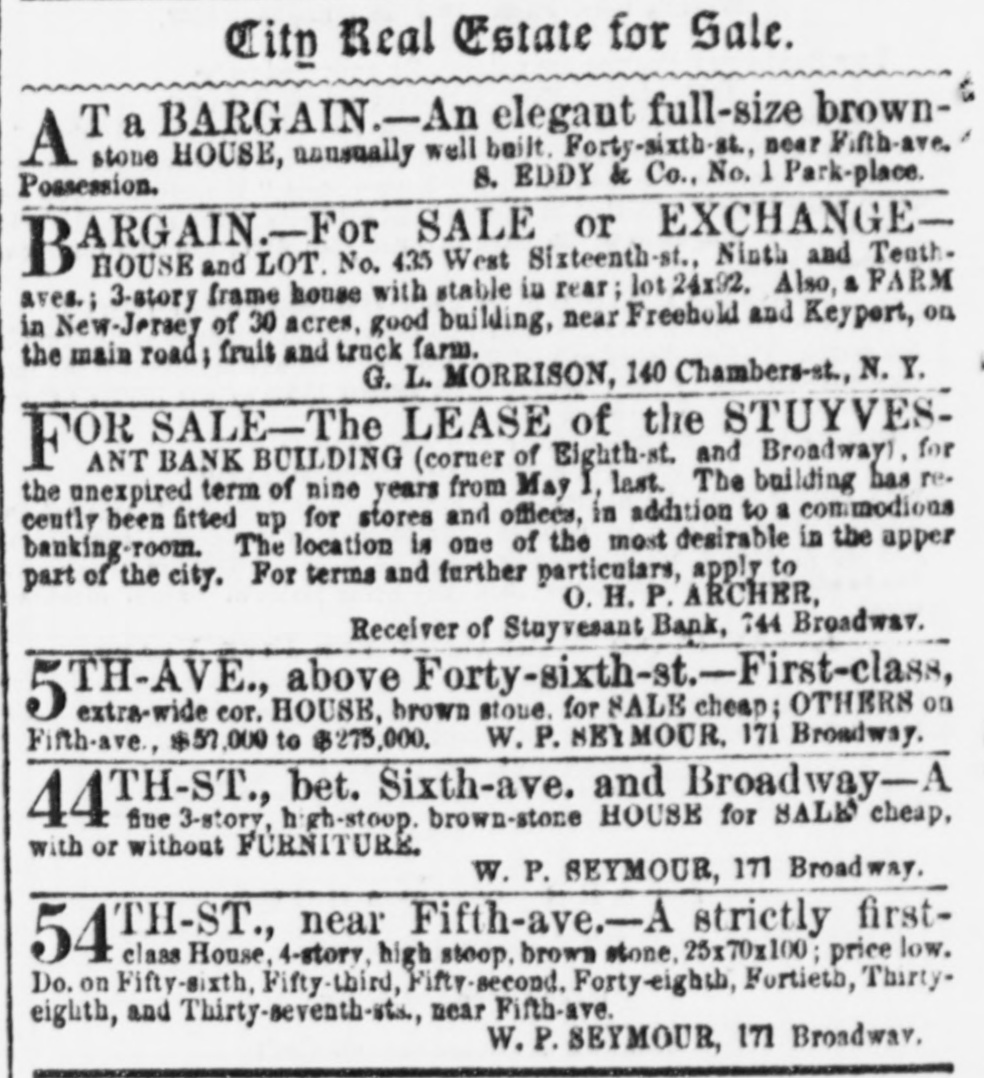
MORRIS WALKINS, Auctioneer. RECEIVER" SALE OF R LEASE OF No. 744 BROADWAY SOUTH-EAST CORNER OF ASTOR-PLACE by order of John H. Piatt, esq., Receiver of the Stayvesant Bank. E. H. LUDLOW & Co. will sell at ametion, on MONDAY. MARCH 3. 1873 at 12 o'clock, at the Exchange Salesroom: The Lease of the four story Brick Building No. 744 Broadway, known as the STUYVESANT BANK BUILDING Lease made by John David Wolfe to Stayvemant Bank expires May, 1880; annual rent. $17,500 per annum. Sold subject to sub-leases now existing. (4,312) Maps. &c., at No. 3 Pine-st.


Article from New-York Tribune, March 1, 1873

Click image to open full size in new tab

Article Text

MORRIS W.LKIN6, Auctioneer. OF RECEIVER SALE LEASE OF No. 744 BROADWAY, SOUTH-EAST CORNER OF ANTOR-PLACE by order of John H. Platt, esq. Receiver of the Stufvesant Bank K. H. LUDLOW & Co. will sell at auction. ou MONDAY, MARCH 3. 1873, at 12 o'clock, at the Exchange Salestoom: The Lease of the four-story Brick Building No. 744 Broadway, known as the STUYVESANT BANK BUILDING. Lease made by John David Wolfe to agreement Bank expires May, 1380: annual rent, $17,500 per assum. Sold subject to sub-leases now existing. (4,318) Maps. &c., at No. 3 Pine-st.


Article from The New York Herald, March 26, 1873

Click image to open full size in new tab

Article Text

THE STUYVESANT BANK. Meeting of the Depositors at Cooper Union Last Evening. The depositors of this long since defanct institution met at room 24, Cooper Union, last night, to take action to recover their money. The meeting was a very brief one. as business was transacted with great expedition. A committee, consisting of Messrs. Miller, Oliver and John T. Kelly, was appointed to call on Mr. Pratt, the receiver of the bank, and instruct him not to give up the lease of the building for ninety days. A proposition has been made to the receiver for the lease of the bank; but, as they (the depositors) do not think it a just one. they are to advise the receiver accordingly. When the committee has finished its labors and obtained some information for the depositors a meeting will be called by the Chairman, Mr. J. Kelly.