20502. Sioux Falls National Bank (Sioux Falls, SD)

Bank Information

Episode Type
Suspension → Closure
Bank Type
national
Bank ID
2823
Charter Number
2823
Start Date
January 11, 1924
Location
Sioux Falls, South Dakota (43.550, -96.700)

Metadata

Model
gpt-5-mini
Short Digest
3b3bf7ad

Response Measures

None

Description

The Sioux Falls National Bank closed its doors in early January 1924 (articles give Jan. 10–11, 1924). The closure appears tied to depleted reserves and agricultural/farm loan distress in the region rather than a discrete misinformation-driven run. The bank was closed/suspended and later placed in receivership (receiver appointed Jan. 24, 1924) and ultimately liquidated. Related heavy withdrawals hit the Sioux Falls Trust & Savings bank after this closing. Dates chosen based on contemporaneous reports (Jan. 10–11 closure; Jan. 24 receiver appointment).

Events (4)

1. January 11, 1924 Suspension
Cause
Local Shock
Cause Details
Depleted reserves and inability to collect from farmers / agricultural distress in the northwest led to bank closure; contemporaneous reports cite depleted reserves and farm loan defaults as general cause.
Newspaper Excerpt
The Sioux Falls National bank... failed to open its doors Friday.
Source
newspapers
2. January 15, 1924 Other
Newspaper Excerpt
Closing of this bank caused heavy withdrawals by depositors of the Sioux Falls Trust and Savings institution.
Source
newspapers
3. January 24, 1924 Receivership
Newspaper Excerpt
He was appointed receiver of the bank January 24. 1924. The bank closed its doors January 11. Dividends to the amount of 40 per cent have been paid to date on deposits in the bank.
Source
newspapers
4. December 8, 1931 Other
Newspaper Excerpt
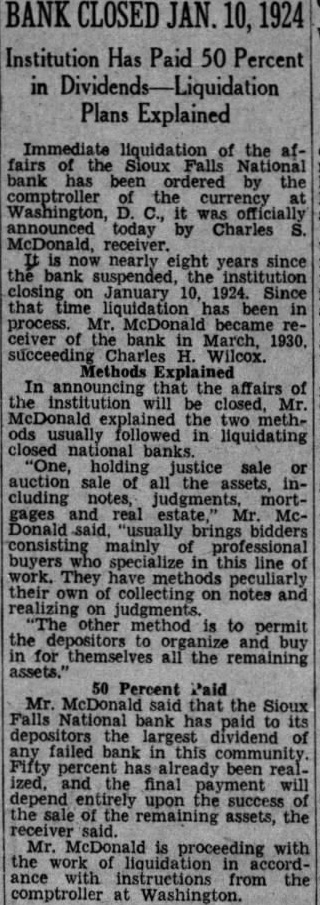
BANK CLOSED JAN. 10, 1924 ... Institution Has Paid 50 Percent in Liquidation Plans Explained
Source
newspapers

Newspaper Articles (17)

Article from Brownsville Herald, January 15, 1924

Click image to open full size in new tab

Article Text

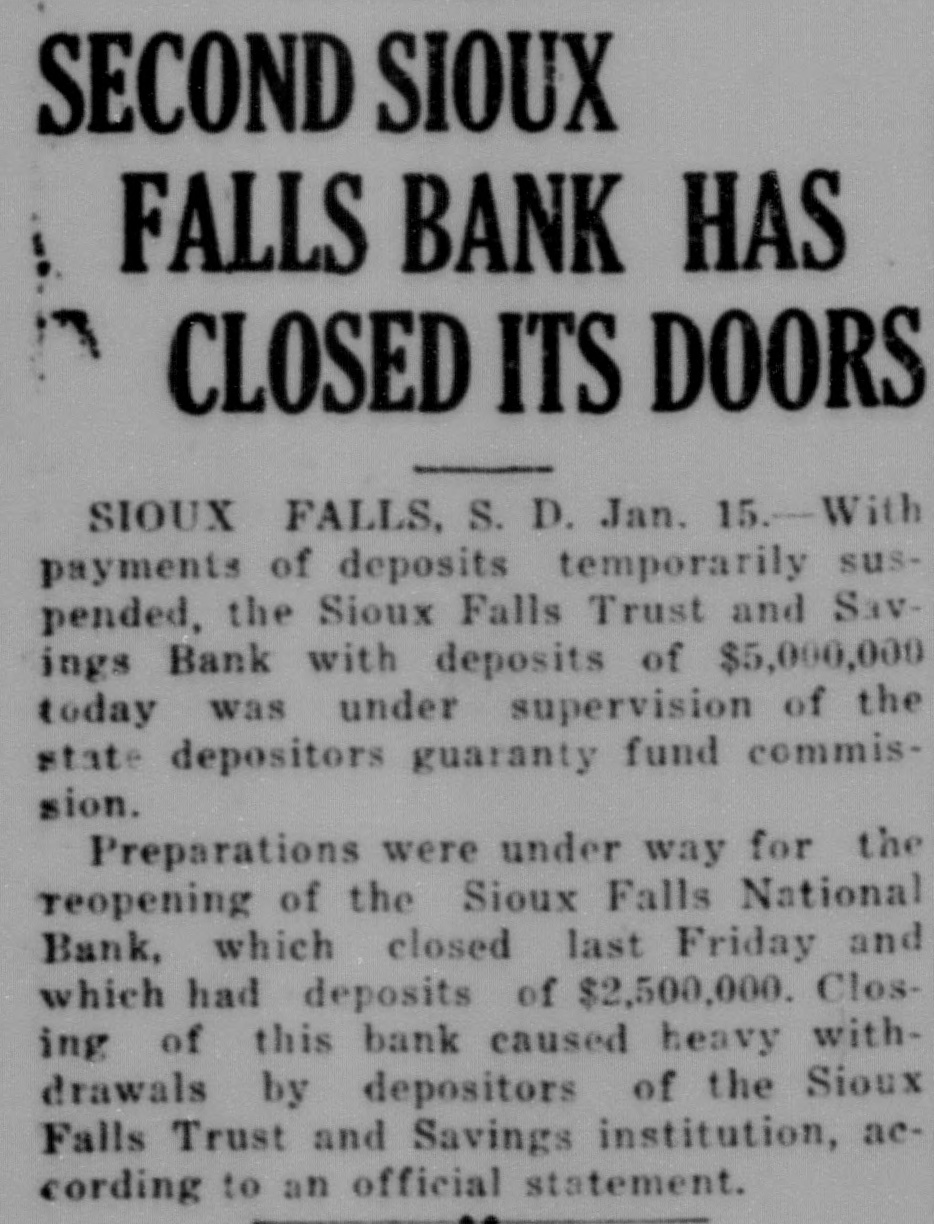
SECOND SIOUX FALLS BANK HAS CLOSED ITS DOORS SIOUX FALLS, S. D. Jan. 15.-With payments of deposits temporarily suspended, the Sioux Falls Trust and Savings Bank with deposits of $5,000,000 today was under supervision of the state depositors guaranty fund commission. Preparations were under way for the reopening of the Sioux Falls National Bank, which closed last Friday and which had deposits of $2,500,000. Closing of this bank caused heavy withdrawals by depositors of the Sioux Falls Trust and Savings institution, according to an official statement.


Article from Eagle River Review, January 17, 1924

Click image to open full size in new tab

Article Text

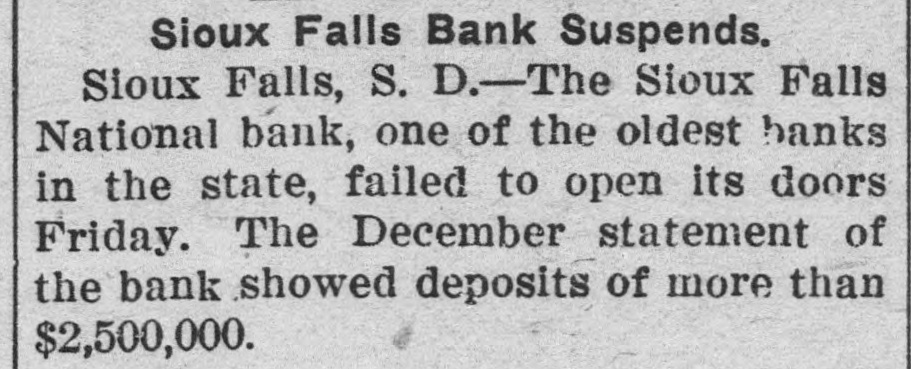
Sioux Falls Bank Suspends. Sioux Falls, S. D.-The Sioux Falls National bank, one of the oldest banks in the state, failed to open its doors Friday. The December statement of the bank showed deposits of more than $2,500,000.


Article from The Redwood Gazette, January 23, 1924

Click image to open full size in new tab

Article Text

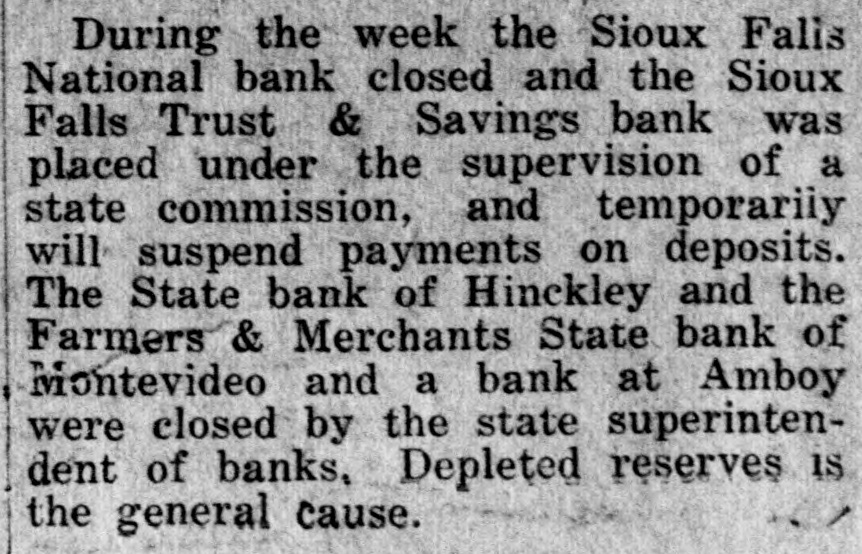
During the week the Sioux Falis National bank closed and the Sioux Falls Trust & Savings bank was placed under the supervision of a state commission, and temporariiy will suspend payments on deposits. The State bank of Hinckley and the Farmers & Merchants State bank of Montevideo and a bank at Amboy were closed by the state superintendent of banks, Depleted reserves IS the general cause.


Article from The Producers News, January 25, 1924

Click image to open full size in new tab

Article Text

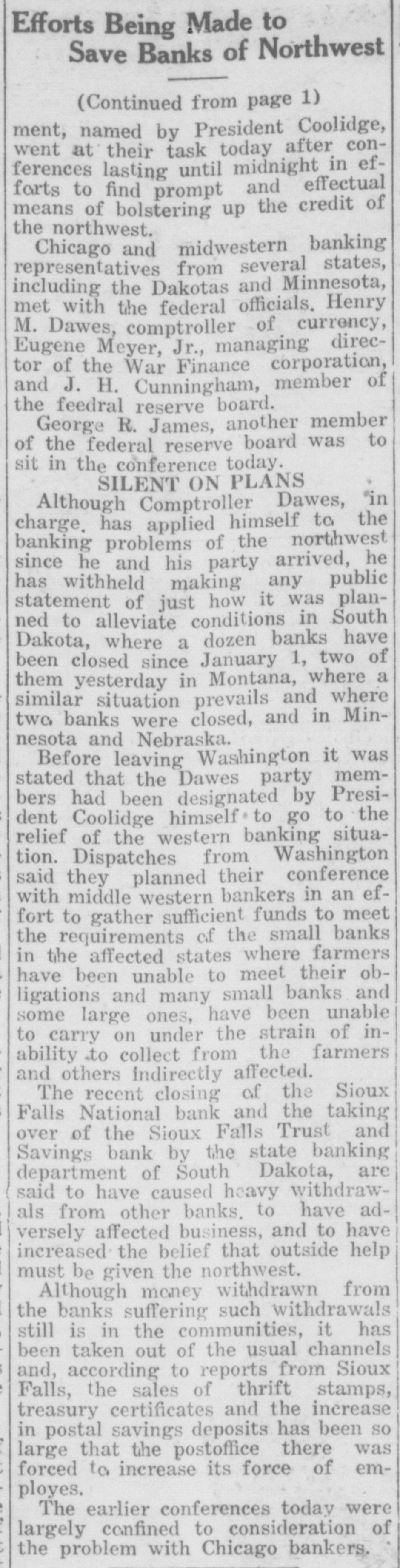
# Efforts Being Made to Save Banks of Northwest (Continued from page 1) ment, named by President Coolidge, went at their task today after conferences lasting until midnight in efforts to find prompt and effectual means of bolstering up the credit of the northwest. Chicago and midwestern banking representatives from several states, including the Dakotas and Minnesota, met with the federal officials. Henry M. Dawes, comptroller of currency, Eugene Meyer, Jr., managing director of the War Finance corporation, and J. H. Cunningham, member of the feedral reserve board. George R. James, another member of the federal reserve board was to sit in the conference today. # SILENT ON PLANS Although Comptroller Dawes, in charge, has applied himself to the banking problems of the northwest since he and his party arrived, he has withheld making any public statement of just how it was planned to alleviate conditions in South Dakota, where a dozen banks have been closed since January 1, two of them yesterday in Montana, where a similar situation prevails and where two banks were closed, and in Minnesota and Nebraska. Before leaving Washington it was stated that the Dawes party members had been designated by President Coolidge himself to go to the relief of the western banking situation. Dispatches from Washington said they planned their conference with middle western bankers in an effort to gather sufficient funds to meet the requirements of the small banks in the affected states where farmers have been unable to meet their obligations and many small banks and some large ones, have been unable to carry on under the strain of inability to collect from the farmers and others indirectly affected. The recent closing of the Sioux Falls National bank and the taking over of the Sioux Falls Trust and Savings bank by the state banking department of South Dakota, are said to have caused heavy withdrawals from other banks, to have adversely affected business, and to have increased the belief that outside help must be given the northwest. Although money withdrawn from the banks suffering such withdrawals still is in the communities, it has been taken out of the usual channels and, according to reports from Sioux Falls, the sales of thrift stamps, treasury certificates and the increase in postal savings deposits has been so large that the postoffice there was forced to increase its force of employes. The earlier conferences today were largely confined to consideration of the problem with Chicago bankers.


Article from The Daily Worker, February 4, 1924

Click image to open full size in new tab

Article Text

oldest institution in the town, closed its doors. Tied to this ak was the First Trust Company, organized under the state law, to take up the musty paper that had been accumulated thru years of bad loans by the First National. Fresh deposits were desired for the First National, and the only way these could be got was by the organization of the subsidiary company. One of the devices of the First Trust to coax new deposits, was to send out several hundred pass books to people of small means, inviting their deposits. A credit of one dollar was written in the pass book, providing the recipient of the book became depositor of the bank. This pass book a credit "come-on" system worked with a great many, with the result that a large number of people are now patiently awaiting the promised re-opening of the bank. The First National Bank was a favorite of the officers of the State Rural Credits Board. One of the members of the Rural Credits Board, Albert Zosky, was a director of the bank. How much Rural Credits funds, borrowed by the State on bonds sold to furnish loans on land to farmers, are tied up in the failure, nobody but the insiders know. The Rural Credits Board is a closed corporation, divulging nothing it can conveniently keep from the public. Panic Grips Sioux Falls. The acute stage of the panic which has been approaching for months, broke in Sioux Falls, with the failure of the Sioux Falls National Bank on the 10th of January. This bank had deposits of two and a half million dollars, and with it went a number of its satellite banks in the smaller towns. This failure was followed two days later by the failure of the Sioux Falls Trust & Savings Bank, with deposits of between four and five million dollars, and with this institution also went a number of its country correspondents. In the interim, other smaller banks in the State, having no relations with these banks, "went South." These huge failures startled the big boys at Washington, and last week we were informed that Coolidgequick to come to the aid of the banks but slow to recognize the farmer distress as the cause of the troublehad instructed the War Finance Corporation to come to the rescue of the banks of North and South Dakota and Minnesota, with a thirty million slice of War Finance Corporation funds. Eugene Meyer is now on the ground with the alleged purpose of plugging the financial storm sewer with public money, one third of which is to go to this State, and the balance to North Dakota and Minnesota. Coolidge Didn't Save Them. This promise of the administration to come to the rescue could not been taken seriously, however, for on Monday the Western National Bank of Mitchell, with deposits of nearly a million dollars and five branch banks, closed its doors. This bank is headed by W. S. Hill, who was formerly president of the South Dakota Farm Bureau Federation. He was a prospective "dirt" farmer choice for member of the Federal Reserve Board and later for an appointment to the Shipping Board. On the same day the International State Bank of Sioux Falls, with deposits of $1,300,000 turned the key in its doors. This makes the third big failure in Sioux Falls within ten days. The combined deposit obligations of the three failed Sioux Falls banks amounts to over eight million dollars, which makes the Coolidge donation of ten million dollars for South Dakota look like a drop in the bucket to the distressed bankers who are not yet closed, but are shivering on the brink. Banks Failed Mondav. The daily press of this section is running a "closed shop" on news of bank failures generally, but from current information available at this writing, eleven banks closed their doors in this State on Monday. It was Black Monday for South Dakota's financiers. Nobody can tell how many more banks will tumble within the next few days or weeks. ,Depositors are quietly withdrawing their funds from all the banks now open, so that a continuation of the bank explosions may be expected. Nobody, not even the bankers themselves, appear to believe that the dumping of thirty or even fifty million dollars into the banks of the northwest to take up the bad paper of the banks, would now do any


Article from The Producers News, February 8, 1924

Click image to open full size in new tab

Article Text

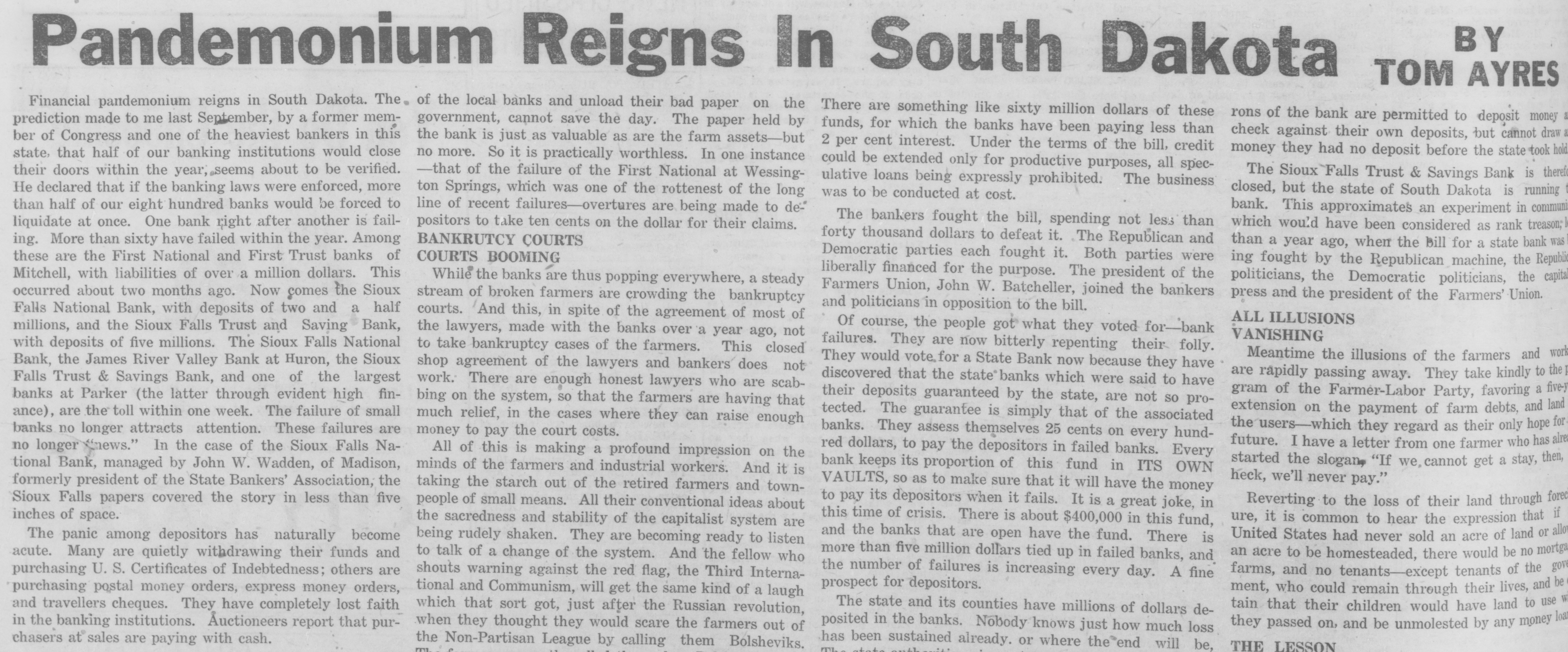
BY In South Dakota Pandemonium Reigns TOM AYRES the Financial pandemonium reigns in South Dakota. The. of the local banks and unload their bad paper on There are something like sixty million dollars of these rons of the bank are permitted to deposit money prediction made to me last September, by a former memgovernment, cannot save the day. The paper held by funds, for which the banks have been paying less than check against their own deposits, but cannot draw the bank is just as valuable as are the farm assets-but ber of Congress and one of the heaviest bankers in this 2 per cent interest. Under the terms of the bill, credit money they had no deposit before the state took hold state, that half of our banking institutions would close no more. So it is practically worthless. In one instance could be extended only for productive purposes, all spectheir doors within the year, seems about to be verified. -that of the failure of the First National at WessingThe Sioux Falls Trust & Savings Bank is theref ulative loans being expressly prohibited. The business He declared that if the banking laws were enforced, more closed, but the state of South Dakota is running ton Springs, which was one of the rottenest of the long was to be conducted at cost. than half of our eight hundred banks would be forced to line of recent failures—overtures are being made to debank. This approximates an experiment in communi The bankers fought the bill, spending not less than positors to take ten cents on the dollar for their claims. liquidate at once. One bank right after another is failwhich would have been considered as rank treason, forty thousand dollars to defeat it. The Republican and BANKRUTCY COURTS ing. More than sixty have failed within the year. Among than a year ago, when the Bill for a state bank was Democratic parties each fought it. Both parties were these are the First National and First Trust banks of COURTS BOOMING ing fought by the Republican machine, the Republic liberally financed for the purpose. The president of the Mitchell, with liabilities of over a million dollars. This politicians, the Democratic politicians, the capital While the banks are thus popping everywhere, a steady Farmers Union, John W. Batcheller, joined the bankers occurred about two months ago. Now comes the Sioux press and the president of the Farmers' Union. stream of broken farmers are crowding the bankruptcy and politicians in opposition to the bill. Falls National Bank, with deposits of two and a half courts. And this, in spite of the agreement of most of ALL ILLUSIONS Of course, the people got what they voted for-bank millions, and the Sioux Falls Trust and Saving Bank, the lawyers, made with the banks over a year ago, not VANISHING with deposits of five millions. The Sioux Falls National failures. They are now bitterly repenting their folly. to take bankruptcy cases of the farmers. This closed Meantime the illusions of the farmers and work Bank, the James River Valley Bank at Huron, the Sioux They would vote for a State Bank now because they have shop agreement of the lawyers and bankers does not are rapidly passing away. They take kindly to the Falls Trust & Savings Bank, and one of the largest discovered that the state® banks which were said to have work. There are enough honest lawyers who are scabgram of the Farmer-Labor Party, favoring a five-y banks at Parker (the latter through evident high fintheir deposits guaranteed by the state, are not SO probing on the system, SO that the farmers are having that extension on the payment of farm debts, and land ance), are the toll within one week. The failure of small tected. The guarantee is simply that of the associated much relief, in the cases where they can raise enough the users-which they regard as their only hope for banks no longer attracts attention. These failures are money to pay the court costs. banks. They assess themselves 25 cents on every hundfuture. I have a letter from one farmer who has alre no longer "news." In the case of the Sioux Falls NaAll of this is making a profound impression on the red dollars, to pay the depositors in failed banks. Every started the slogan, "If we, cannot get a stay, then, tional Bank, managed by John W. Wadden, of Madison, bank keeps its proportion of this fund in ITS OWN minds of the farmers and industrial workers. And it is heck, we'll never pay." formerly president of the State Bankers' Association, the taking the starch out of the retired farmers and townVAULTS, SO as to make sure that it will have the money Sioux Falls papers covered the story in less than five Reverting to the loss of their land through forec people of small means. All their conventional ideas about to pay its depositors when it fails. It is a great joke, in inches of space. ure, it is common to hear the expression that if the sacredness and stability of the capitalist system are this time of crisis. There is about $400,000 in this fund, United States had never sold an acre of land or allo The panic among depositors has naturally become and the banks that are open have the fund. There is being rudely shaken. They are becoming ready to listen acute. Many are quietly withdrawing their funds and an acre to be homesteaded, there would be no mortga more than five million dollars tied up in failed banks, and to talk of a change of the system. And the fellow who purchasing U.S. Certificates of Indebtedness; others are the number of failures is increasing every day. A fine shouts warning against the red flag, the Third Internafarms, and no tenants-except tenants of the gove prospect for depositors. purchasing postal money orders, express money orders, ment, who could remain through their lives, and be tional and Communism, will get the same kind of a laugh W and travellers cheques. They have completely lost faith tain that their children would have land to use The state and its counties have millions of dollars dewhich that sort got, just after the Russian revolution, in the banking institutions. Auctioneers report that purthey passed on, and be unmolested by any money loa when they thought they would scare the farmers out of posited in the banks. Nobody knows just how much loss chasers at sales are paying with cash. the Non-Partisan League by calling them Bolsheviks. THE LESSON has been sustained already. or where the end will be,


Article from Evening Star, February 17, 1924

Click image to open full size in new tab

Article Text

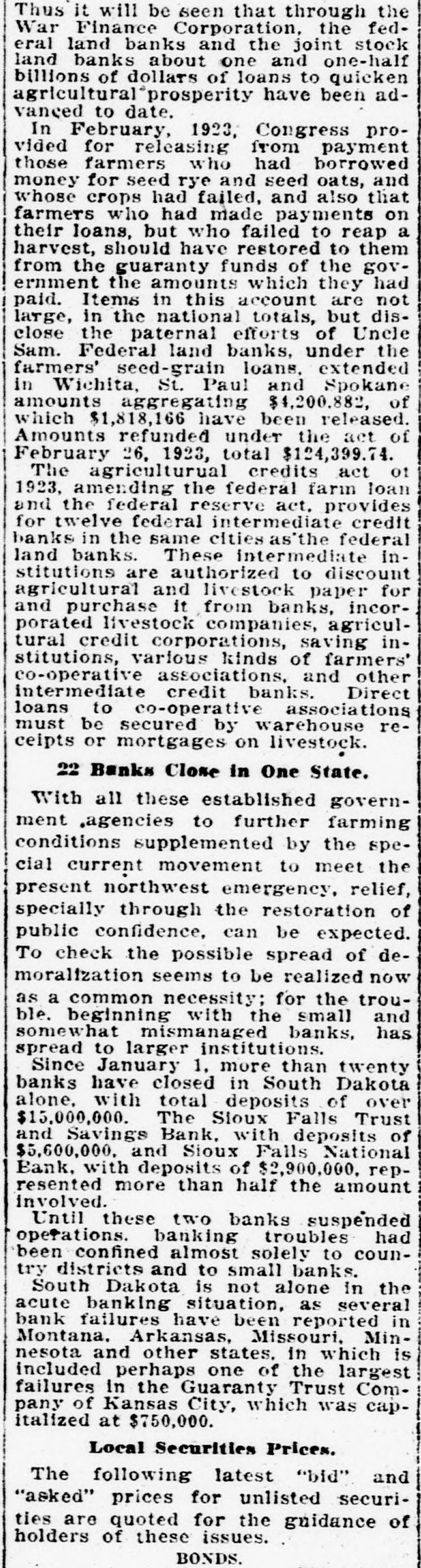
Thus it will be seen that through the War Finance Corporation, the federal land banks and the joint stock land banks about one and one-half billions of dollars of loans to quicken agricultural prosperity have been advanced to date. In February, 1923, Congress provided for releasing from payment those farmers who had borrowed money for seed rye and seed oats, and whose crops had failed, and also that farmers who had made payments on their loans, but who failed to reap a harvest, should have restored to them from the guaranty funds of the government the amounts which they had paid. Items in this account are not large, in the national totals, but disclose the paternal efforts of Uncle Sam. Federal land banks, under the farmers' seed-grain loans, extended in Wichita, St. Paul and Spokane amounts aggregating $4,200.882, of which $1,818,166 have been released. Amounts refunded under the act of February 26, 1923, total $124,399.74. The agriculturual credits act of 1923, amending the federal farm loan and the federal reserve act, provides for twelve federal intermediate credit banks in the same cities as the federal land banks. These intermediate institutions are authorized to discount agricultural and livestock paper for and purchase it from banks, incorporated livestock companies, agricultural credit corporations, saving institutions, various kinds of farmers' co-operative associations, and other intermediate credit banks. Direct loans to co-operative associations must be secured by warehouse receipts or mortgages on livestock. ### 22 BANKS CLOSE IN ONE STATE. With all these established government agencies to further farming conditions supplemented by the special current movement to meet the present northwest emergency, relief, specially through the restoration of public confidence, can be expected. To check the possible spread of demoralization seems to be realized now as a common necessity; for the trouble, beginning with the small and somewhat mismanaged banks, has spread to larger institutions. Since January 1, more than twenty banks have closed in South Dakota alone, with total deposits of over $15,000,000. The Sioux Falls Trust and Savings Bank, with deposits of $5,600,000, and Sioux Falls National Bank, with deposits of $2,900,000, represented more than half the amount involved. Until these two banks suspended operations, banking troubles had been confined almost solely to country districts and to small banks. South Dakota is not alone in the acute banking situation, as several bank failures have been reported in Montana, Arkansas, Missouri, Minnesota and other states, in which is included perhaps one of the largest failures in the Guaranty Trust Company of Kansas City, which was capitalized at $750,000. ### LOCAL SECURITIES PRICES. The following latest "bid" and "asked" prices for unlisted securities are quoted for the guidance of holders of these issues. BONDS.


Article from Argus-Leader, February 3, 1926

Click image to open full size in new tab

Article Text

Britain there are fewer murders in in any one of the larger cities of the United States. Force, or punishment is the surest deter to crime there is, not Gigantie Governmental Waste Quite comment has been rife in Sioux Falls during recent months relative to the cost of receiverships of closed banks. The Sioux Falls bank was the biggest in South and its affairs are wound at less than half the cost of the receivership in the Sioux Falls National The receiver in the latter institution gets thousand dollars month, has only about half he volume of of that by the recelver in the Falls Savings, though the latter gets a third of that salary. The federal pays the salary of national bank of course of the proceeds of the the job supposed to last for state of Dakota the rate of for the men in pay of the state its affairs of public trust, and the federal department in particular not waste time in trying to make savings The receiver of the Sloux Falls New Donal bank in Chicago, and part his time is spent on the road be tween his his here in Sioux Careful prime requisite in winding up closed national bank, in with desire to nurse a job. Another Dutchman's Gun Congress made bully good Dutchman's gun out of the world court. You remember that gun would hit when pointed deer, but would miss when at the owner's GOW. Same way with the membership of Uncle Sam in the world court. is all right while doesn't mean anything, and it is all wrong when it seeks to involve the United States, according to the tions, hence we are not in if means we are in good standing if it doesn't mean anything. Psychology and Things to Eat "Just let the sun shine for half day, and all that fine rhubarb will picked up in almost no time,' remarked Mr Foster of the Golden Rule grocery the other day. Mr. Foster said that on full drab day the rhubarb not look, spite of the fact it is one of the items for table use in the vegetable line. Industrious Hens Clarence Berry, on East Eighth street, flock of Industrious hens that is worth talking These hens, 135 of them, lay from 90 to 100 eggs each day. They belong to the Tom Baron strain of English Leghorns this particular flock of 135 hens laid 3,006 eggs during January. In of eggs was 2,643, they are on the job during holiday Victor Tharp, of the who thinks is something of hen shark himself, says the English Leghorns are not RB nice to look at as the American type, but he admits they are great on the egg production. Mr. Berry says the English Leghorns are good sized fowl, the roosters often reaching six pounds in size. More School Room Needed The Stoux Falls board of education is again confronted with a need of more school room. The high school. crowded, and the ward schools are uncomfortably filled. The need seems to be for ward school and completion of the high school. The architects advise that over $600,000 will be needed for the completion of school single additional school cost more. drew Dell like bond of or would be needed for require- MRS. WILLIAM ments in the future. Lack The funeral of of made boe, Mrs. in the future. Those pupils who are of this city, held for of ernoon facilities are for all at Hills, where will time. School days come but once in made. ber of Falls lifetime. to be the people will the funeral. attend for bad this is the fact that the Miss Martin and institutions daughter filled famous of are with of whom but received medal for reciting recently poetry. very small per cent have reached the eighth grade in public schools. Bad citizenship generally is due to ignor. ance, in self defense the public must provide those remedies which MUDDY. quickly improved OILY SKIN promise greatest returns, namely more school facilities. SOUTH DAKOTANS AT SIOUX FALLS HOTELS Teton: Mr. and Mrs. Paul Hansen, USE SULPHUR TO Viborg; Leo Traver, Mr. and Mrs. M. Van Hees, Stickney; B. H. Dell Rapids; Iver Tufty, Nunda; HEAL YOUR SKIN G. Hazel; G. Wilson, Madison; B. F. Magness, St. Gordon Magness, St. Lawrence: O. H. Tol Any breaking Albert: H. Comstock, Brookings: out the L. Penhallegon, Rapid City: G. even can be quickly come by Sinal: W. O. Glenapp, William applying Mentho Potas, Alvin R. Lidel, Went- clares noted worth: Carl Rude, Toronto: Gust skin specialist. Because Chester: A. Carlson, Trent; C. E. Lind- its germ destroying Aberdeen. properties, this Cataract: F. Halladay, Iroquois: E. phur preparation U. Berdahl, Brook stantly brings Fred from skin Hitcheock; G. H. Glendenning. Arling and heals the ton; Mr. and eczema right up and leaves the skin Mrs. J. Keller, Bereaford; Mrs. clear and Swartz, Watertown; Mrs. M. Smith, It seldom fails to relieve the Watertown: O. F. McKillip, Madison: Rowles without delay. You can obtain torment jar Robert Harding, Brookings; W. E. Ly from any good man, Spearfish: E. D. Parker; druggist. A. Gentle, Brookings; Ed W. Rebel, Let trial of show what this to Olivet: Elmer Spindler, Olivet: Eddie Send the pon for it. Clip It now. town; G. W. Gage, Gayville; George Whitehall Pharmacal Co. Ings; F. D. Peckham, Alexandria: A. Avenue Free New York, M. Gun, Watertown; A. R. Schlosser, Dept. Trial Plankinton: G. F. Adams, Yankton; Frank Ferguson, Artesian; H. M. Sulphur. Mall me Free Sample of Mentho. Fairchild, Madison: Mr. and Mrs. A. Feinman, Lennox: Ella VermilMon; A. T. Wilson, Vermillion; Ruth Cunningham, Canton. Carpenter: Mrs. Elinor H. Whiting. Pierre; A. O. Ringsrud, Elk Point: Aberdeen; F. L. Youngers, Parker; Ralph O. Howe, Mellette;
Article from Argus-Leader, July 26, 1926

Click image to open full size in new tab

Article Text

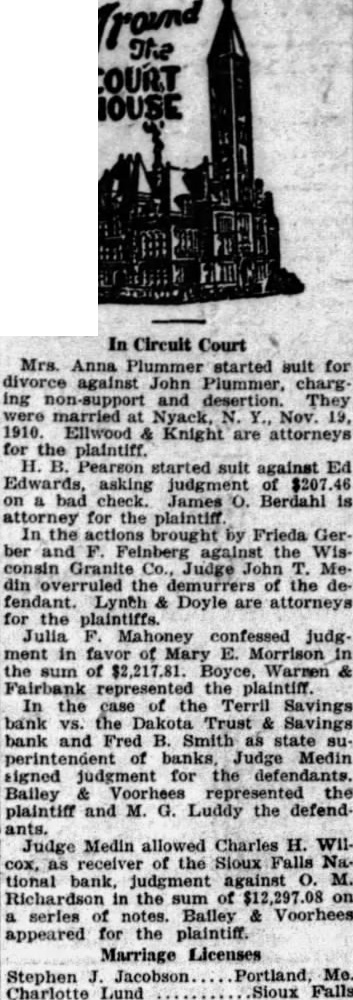
The In Circuit Court Mrs. Anna Plummer started suit for divorce against John Plummer, ing and desertion. They married Nyack, Nov. 19, 1910. Ellwood Knight are attorneys the plaintiff. Pearson started suit against Ed asking judgment bad check. James Berdahl attorney for the plaintiff In brought by Frieda Ger ber against the din the defendant. Lynth Doyle are for the plaintiffs. Julia Mahoney confessed judg. ment in favor of E. Morrison the sum $2,217.81. Boyce, Warren plaintiff. In the the Savings vs. Savings bank and Fred su of Judge Medin signed for the defendants. Bailey plaintiff and M. Luddy the defendJudge Medin allowed Charles H. WIIcox, as receiver of the Sloux tional bank, M. Balley Voorhees appeared for the plaintiff. Marriage Licenses Stephen Portland, Charlotte Lund .Sioux Falls


Article from Argus-Leader, December 14, 1929

Click image to open full size in new tab

Article Text

ried in Sioux Falls on February 17. 1916. Melquist are attorneys for the $120.50 has been entered in circuit court in Charles Wilcox, of the Sioux Falls National against John G. Muth, Davison county, defendant in action Mr. Wilcox against Downey, defendant, and John Muth, garnishee. was signed by Judge John T. MeBailey Voorhees and Keister are attorneys for the bank receiver. Marriage Licenses Will Witte Paul, Minn. Caroline Hoehne Paul, Minn.


Article from Argus-Leader, March 4, 1930

Click image to open full size in new tab

Article Text

McDONALD NAMED AS BANK RECEIVER Replaces C. H. Wilcox in S. F. National Bank Charles S. McDonald has been appointed receiver of the closed Sioux Falls National bank, replacing Charles H. Wilcox. who has resigned to take position in Chicago, according to word received late Monday night from W. Pole, comptroller of the currency. Mr. McDonald will take over the office at once. he announced. the appointment being effective today. Mr. Wilcox been elected director of the Pettibone Mulligan company of Chicago, steel corporation. He left Sioux Falls Saturday to begin his duties with the firm. He was appointed receiver of the bank January 24. 1924. The bank closed its doors January 11. Dividends to the amount of 40 per cent have been paid to date on deposits in the bank. and it is understood that further dividends will be declared in the near future.


Article from The Sioux City Journal, March 6, 1930

Click image to open full size in new tab

Article Text

will co-operate with retail merchants in all sections of the Black Hills and surrounding territory. Tuition Rates Vary Greatly Sturgis, S. -Special: Rates for county high school tuition in Meade county ranged from $98 in Sturgis $135 in the Hereford and Piedmont districts. Clough district charges $80, Faith $115 and Stoneville $100. These schools are maintained by Meade county. Named Bank Receiver Sioux Falls, S. D.-Special: Charles McDonald has been appointed receiver of the closed Sioux Falls National bank, to succeed Charles H. Wilcox, who resigned to accept position in Chicago. The bank was closed 11, 1924. and to date has paid dividends of 40 per cent.


Article from Argus-Leader, December 8, 1931

Click image to open full size in new tab

Article Text

Sioux Falls National Bank Affairs Will Be Liquidated Immediately SEEKS SENATE SEAT Receiver McDonald Announces Receipt of Instructions From Washington Official


Article from Argus-Leader, December 8, 1931

Click image to open full size in new tab

Article Text

BANK CLOSED JAN. 10, 1924 Institution Has Paid 50 Percent in Liquidation Plans Explained Immediate liquidation of the afof Sioux Falls National bank has been ordered by the the currency Washington, D. it was official announced today by Charles S. nearly eight years the bank institution closing on January 10, 1924 that liquidation has been in process. Mr. McDonald of the bank March, Charles Wilcox. Methods Explained In announcing that the affairs of McDonald explained the two ods usually followed in liquidating closed national "One, sale or auction sale of all the including notes, gages and real Mr. McDonald said, "usually brings bidders consisting mainly professional buyers who specialize in this line of work. They peculiarly their own of collecting on notes realizing on judgments. "The other method is to permit the depositors to organize and in for themselves all the remaining assets." 50 Percent Paid Mr. McDonald said that the Sioux Falls National bank has to depositors the largest dividend any failed this Fifty already been realized, and the final payment depend entirely upon success the sale of the remaining assets, the Mr. McDonald is proceeding with the work of liquidation in ance with instructions from the comptroller at Washington.


Article from Argus-Leader, August 8, 1932

Click image to open full size in new tab

Article Text

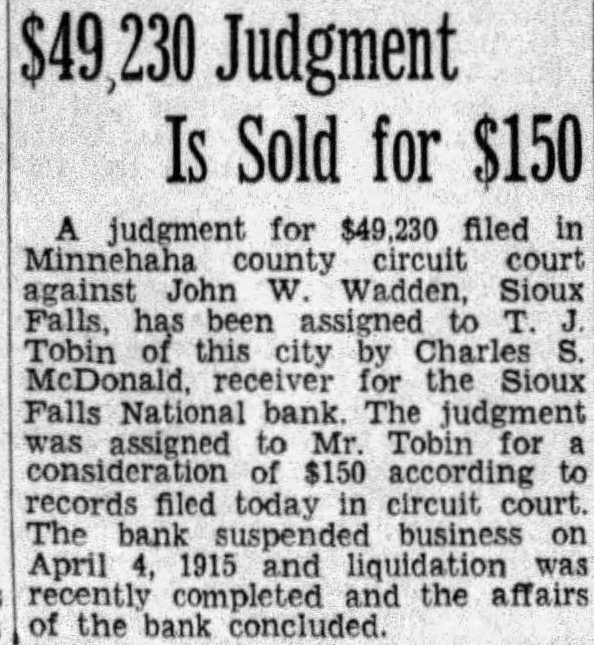
$49,230 Judgment Is Sold for $150 A judgment for $49,230 filed in Minnehaha circuit court against John W. Sioux Falls, has been assigned to T. Tobin of this Charles S. McDonald, receiver for the Sioux Falls National The judgment was assigned to Mr. Tobin consideration of $150 according to records filed today in circuit court. The bank suspended business on April 4, 1915 and liquidation was recently completed the affairs the bank concluded.


Article from The Sioux City Journal, August 10, 1932

Click image to open full size in new tab

Article Text

CALLED OFTEN TO SAME CHURCH Rev. George H. Croker To Rev. George Croker goes of having been called distinction to the Whiting Consix times serve church. He first was called in 1893 and then served five Rev. Mr. Croker was born in England, care to this country when old, and worked his way years through college. When he came here in 1893 the church had members when left had 189. During and in Whiting he that first pastorate to Kittie Whiting. born both sons were world war. Rev. Mr. serving the Croker retired in 1907. with an assistant superintendent charge of each. Approximately club members and leaders can be in the camp at the fair. Rooms is provided for 36 teams home economics, 20 county revue champions, 30 health champions, approximately agricultural teams the rest of the space used by caretakers for the live stock. face and head and few minor the his body. He was taken burns on the Wagner hospital. $49,230 Judgment Brings $150 Sioux Falls, judgment for $49,320 which was filed circuit court here against John Wadden, former Sioux Falls W. banker, has been sold T. bin, Sioux Falls, by Charles McDonald, receiver the Sioux Falls National bank. The judgment sold to Mr. Tobin for consideration of $150. according records circuit court. The bank suspendbusiness on April 1925, and liquidation recently was completed. School For Cattle Feeders Canton, school for Lincoln county live stock feeders wish to keep accurate records of their operation will be held here Friday evening, County Agent Sayre announced. Interest in development of simple system of keeping records officials to arrange for the school, Mr. Sayre said. Church Chairs, Rug Stolen Sioux Falls, D.-Special: Officers looking for thief entered the Free Methodist church here during the darkness of night and carried away two expensive leather covered chairs and rug measuring by feet. The thief left no clew. Many Given Farm Work Up more than 100 men assigned to places on farms of this district by the federal bureau There has been heavy demand for threshing hands, farmers now are starting threshing operations Corn 12 Feet High corn taken from field John Waltner's farm in the Turkey Ridge section. nearly feet height. and the tallest corn ever grown this Nearer town the corn not tall.


Article from Argus-Leader, August 19, 1932

Click image to open full size in new tab

Article Text

Around the Courthouse IN CIRCUIT COURT Sioux Fantle default judgment obtained court costs of of and action filed against today in an on Earl that he failed to the grounds goods purchased John MeJudge cember, din signed the judgment and Frank Vust appeared as attorney for the plaintiff Charges of extreme cruelty decree in her brought vorce and permission maiden to name, resume Hazel the of her Barkley. Hazel Bordeau today. She brought the suit against Edgar Both reside married in Sioux Falls. Las The couple was July 14, 1931 Judge Medin Vegas, signed the decree and Coon tiff and Coon appeared for the plainLela Heng Dell Rapids. cruelty bringing and charges nonsupport. asked for divorce permission to resume her maiden Lela Strauderman. filed today against Carl Heng, Rapids. The couple was Zim- at Sioux Falls January 1931. merman and Nisbet appear for the Charles McDonald. receiver of the Sioux Falls National suspended business January obtained permission court today to dispose of of the bank for a total of $1,071.03.